ANIMAL
TISSUE
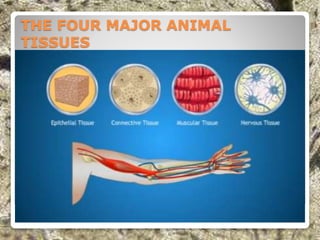
THE FOUR MAJOR ANIMAL
TISSUES
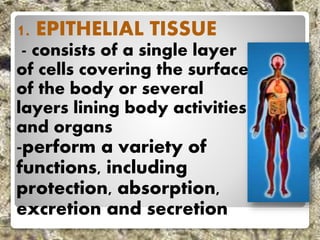
1. EPITHELIAL TISSUE
- consists of a single layer
of cells covering the surface
of the body or several
layers lining body activities
and organs
-perform a variety of
functions, including
protection, absorption,
excretion and secretion
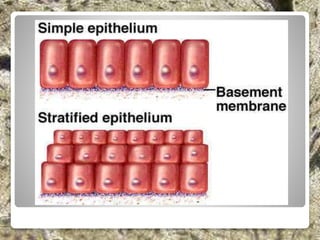
TWO LAYERS OF EPITHELIAL
TISSUE
oSimple – single layer
oStratified – 2 or more
layer
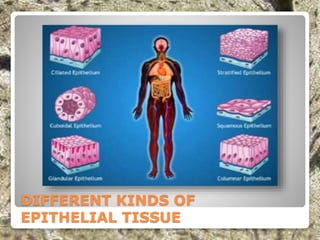
DIFFERENT KINDS OF
EPITHELIAL TISSUE
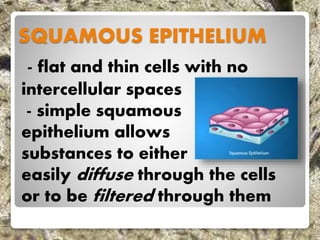
SQUAMOUS EPITHELIUM
- flat and thin cells with no
intercellular spaces
- simple squamous
epithelium allows
substances to either
easily diffuse through the cells
or to be filtered through them
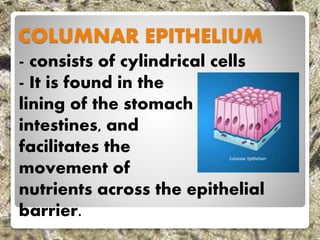
COLUMNAR EPITHELIUM
- consists of cylindrical cells
- It is found in the
lining of the stomach and
intestines, and
facilitates the
movement of
nutrients across the epithelial
barrier.
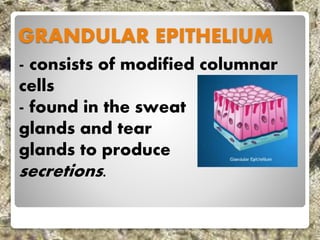
GRANDULAR EPITHELIUM
- consists of modified columnar
cells
- found in the sweat
glands and tear
glands to produce
secretions.
CILIATED EPITHELIUM
-They are most common in the
nasal and respiratory
passageways, and are one of
the main reasons mucus flows
and carries out dead cells.
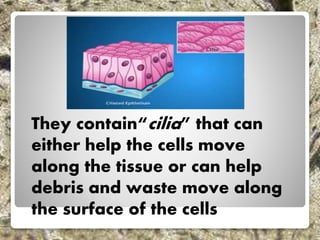
They contain“cilia” that can
either help the cells move
along the tissue or can help
debris and waste move along
the surface of the cells
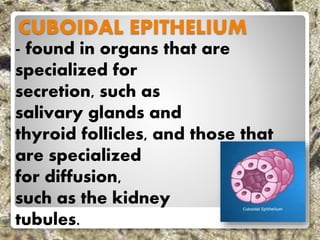
CUBOIDAL EPITHELIUM
- found in organs that are
specialized for
secretion, such as
salivary glands and
thyroid follicles, and those that
are specialized
for diffusion,
such as the kidney
tubules.
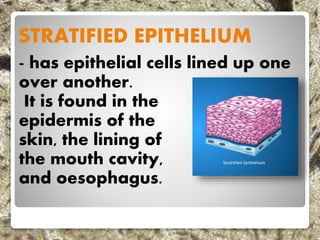
STRATIFIED EPITHELIUM
- has epithelial cells lined up one
over another.
It is found in the
epidermis of the
skin, the lining of
the mouth cavity,
and oesophagus.
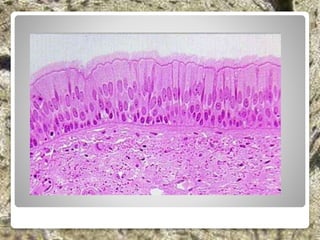
PSEUDOSTRATIFIED EPITHELIUM
- Cells are columnar but tall and
thin. All cells rest on the
basement membrane. The unique
appearance of pseudostratified
epithelia occurs because the tall,
thin cells intertwine.
2. CONNECTIVE TISSUE
- Its function is to bind other
tissues together; therefore, this
tissue must be strong.
COMMON TYPES OF
CONNECTIVE TISSUE
LOOSE CONNECTIVE TISSUE
It holds organs in place and
attaches epithelial tissue to other
underlying tissues. It also surrounds
the blood vessels and nerves. Cells
called fibroblasts are widely dispersed
in this tissue; they are irregular
branching cells that secrete strong
fibrous proteins and proteoglycans as
an extracellular matrix.
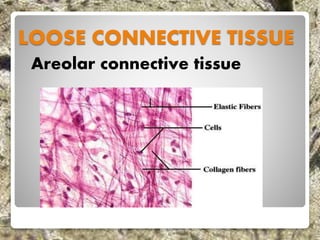
LOOSE CONNECTIVE TISSUE
Areolar connective tissue
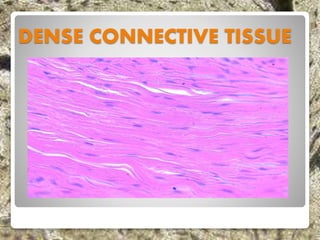
DENSE CONNECTIVE TISSUE
- provides connection between different
tissues in the human body
- it forms strong, rope-like structures such
as tendons and ligaments. Tendons
attach skeletal muscles to bones;
ligaments connect bones to bones at
joints. Ligaments are more stretchy and
contain more elastic fibres than
tendons.
DENSE CONNECTIVE TISSUE
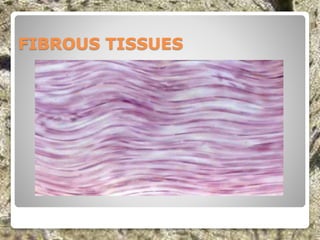
FIBROUS TISSUES
- Holds muscle cells and surrounds
groups of cells that make up the
nerves
- Composed of parallel bundles of
collagen fibers, is found in the
dermis, tendons, and ligaments
FIBROUS TISSUES
CARTILAGE TISSUE
- It is found at joints surface and
rib ends. They are also present
in the tracheal rings.
- Cartilage cells secrete fibrous
materials that are strong but
flexible.
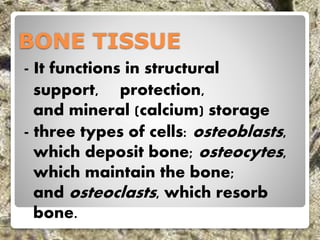
BONE TISSUE
- It functions in structural
support, protection,
and mineral (calcium) storage
- three types of cells: osteoblasts,
which deposit bone; osteocytes,
which maintain the bone;
and osteoclasts, which resorb
bone.
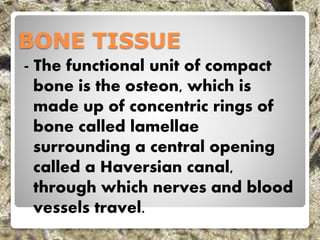
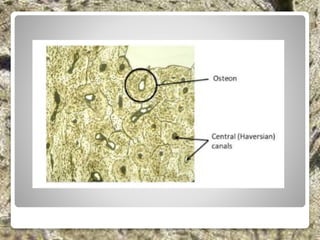
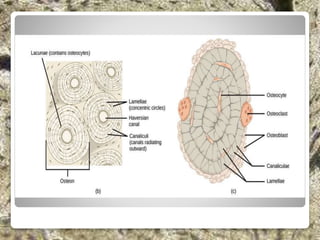
BONE TISSUE
- The functional unit of compact
bone is the osteon, which is
made up of concentric rings of
bone called lamellae
surrounding a central opening
called a Haversian canal,
through which nerves and blood
vessels travel.
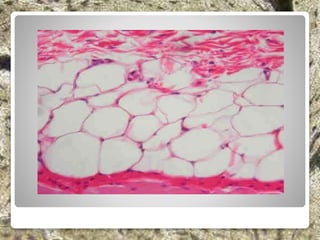
ADIPOSE TISSUE
- a loose connective tissue that fills
up space between organs and
tissues and provides structural
and metabolic support
- Serves as the fat storage and
as supporting pads for other
tissues
VASCULAR TISSUE(BLOOD)
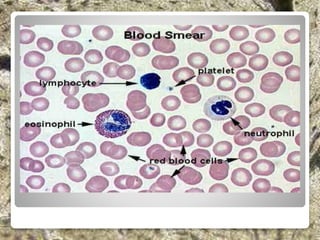
- Blood is composed of
erythrocytes (RBC), which
distribute oxygen throughout the
body; Leukocytes (WBC), which
mount immune responses; and
thrombocytes (platelets), which
are involved in blood clotting.
- Blood has a number of
functions, but primarily it
transports material through the
body to bring nutrients to cells
and remove waste material
from them.
3. MUSCULAR TISSUE
- They give shape and form to
the body. And also help the
bones move our body.
3 TYPES:
• SMOOTH MUSCLE
• STRIATED MUSCLE
• CARDIAC MUSCLE
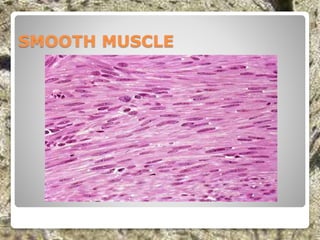
SMOOTH MUSCLE
- spindle shaped with only one
nucleus, contract involuntarily
to push food through the
digestive tract and blood
through blood vessels.
SMOOTH MUSCLE
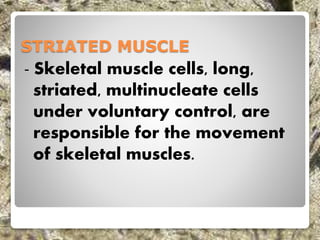
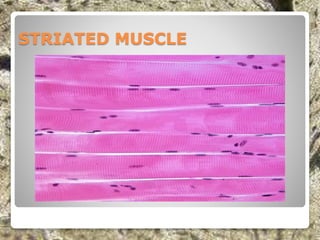
STRIATED MUSCLE
- Skeletal muscle cells, long,
striated, multinucleate cells
under voluntary control, are
responsible for the movement
of skeletal muscles.
STRIATED MUSCLE
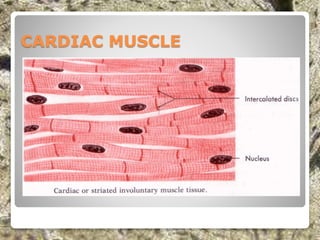
CARDIAC MUSCLE
- found only in the heart, are
striated and branching (with
one nucleus); they are joined
by intercalated discs which
allow the cells to synchronize
the beating of the heart.
CARDIAC MUSCLE
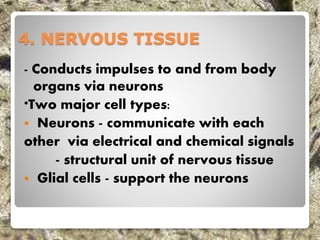
4. NERVOUS TISSUE
- Conducts impulses to and from body
organs via neurons
*Two major cell types:
 Neurons - communicate with each
other via electrical and chemical signals
- structural unit of nervous tissue
 Glial cells - support the neurons
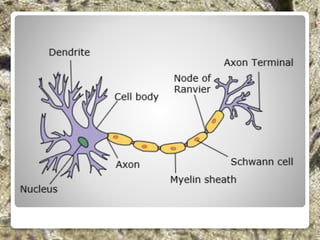
PARTS OF NEURONS
Cell Body
- contains the nucleus
Dendrites
- tree-like fashion and serve as
the main apparatus for receiving
signals from other nerve cells.
- pick up the electrical impulses
and pass them to the cell body.
Axon
- elongated fiber that extends
from the cell body to the terminal
endings and transmits the neural
signal
-carries the impulse away from
the cell body.
Animal Tissue - NAS102

Animal Tissue - NAS102

  • 1.
  • 2.
    THE FOUR MAJORANIMAL TISSUES
  • 3.
    1. EPITHELIAL TISSUE -consists of a single layer of cells covering the surface of the body or several layers lining body activities and organs -perform a variety of functions, including protection, absorption, excretion and secretion
  • 4.
    TWO LAYERS OFEPITHELIAL TISSUE oSimple – single layer oStratified – 2 or more layer
  • 6.
  • 7.
    SQUAMOUS EPITHELIUM - flatand thin cells with no intercellular spaces - simple squamous epithelium allows substances to either easily diffuse through the cells or to be filtered through them
  • 8.
    COLUMNAR EPITHELIUM - consistsof cylindrical cells - It is found in the lining of the stomach and intestines, and facilitates the movement of nutrients across the epithelial barrier.
  • 9.
    GRANDULAR EPITHELIUM - consistsof modified columnar cells - found in the sweat glands and tear glands to produce secretions.
  • 10.
    CILIATED EPITHELIUM -They aremost common in the nasal and respiratory passageways, and are one of the main reasons mucus flows and carries out dead cells.
  • 11.
    They contain“cilia” thatcan either help the cells move along the tissue or can help debris and waste move along the surface of the cells
  • 12.
    CUBOIDAL EPITHELIUM - foundin organs that are specialized for secretion, such as salivary glands and thyroid follicles, and those that are specialized for diffusion, such as the kidney tubules.
  • 13.
    STRATIFIED EPITHELIUM - hasepithelial cells lined up one over another. It is found in the epidermis of the skin, the lining of the mouth cavity, and oesophagus.
  • 14.
    PSEUDOSTRATIFIED EPITHELIUM - Cellsare columnar but tall and thin. All cells rest on the basement membrane. The unique appearance of pseudostratified epithelia occurs because the tall, thin cells intertwine.
  • 16.
    2. CONNECTIVE TISSUE -Its function is to bind other tissues together; therefore, this tissue must be strong.
  • 17.
  • 18.
    LOOSE CONNECTIVE TISSUE Itholds organs in place and attaches epithelial tissue to other underlying tissues. It also surrounds the blood vessels and nerves. Cells called fibroblasts are widely dispersed in this tissue; they are irregular branching cells that secrete strong fibrous proteins and proteoglycans as an extracellular matrix.
  • 19.
  • 20.
    DENSE CONNECTIVE TISSUE -provides connection between different tissues in the human body - it forms strong, rope-like structures such as tendons and ligaments. Tendons attach skeletal muscles to bones; ligaments connect bones to bones at joints. Ligaments are more stretchy and contain more elastic fibres than tendons.
  • 21.
  • 22.
    FIBROUS TISSUES - Holdsmuscle cells and surrounds groups of cells that make up the nerves - Composed of parallel bundles of collagen fibers, is found in the dermis, tendons, and ligaments
  • 23.
  • 24.
    CARTILAGE TISSUE - Itis found at joints surface and rib ends. They are also present in the tracheal rings. - Cartilage cells secrete fibrous materials that are strong but flexible.
  • 25.
    BONE TISSUE - Itfunctions in structural support, protection, and mineral (calcium) storage - three types of cells: osteoblasts, which deposit bone; osteocytes, which maintain the bone; and osteoclasts, which resorb bone.
  • 26.
    BONE TISSUE - Thefunctional unit of compact bone is the osteon, which is made up of concentric rings of bone called lamellae surrounding a central opening called a Haversian canal, through which nerves and blood vessels travel.
  • 29.
    ADIPOSE TISSUE - aloose connective tissue that fills up space between organs and tissues and provides structural and metabolic support - Serves as the fat storage and as supporting pads for other tissues
  • 31.
    VASCULAR TISSUE(BLOOD) - Bloodis composed of erythrocytes (RBC), which distribute oxygen throughout the body; Leukocytes (WBC), which mount immune responses; and thrombocytes (platelets), which are involved in blood clotting.
  • 32.
    - Blood hasa number of functions, but primarily it transports material through the body to bring nutrients to cells and remove waste material from them.
  • 34.
    3. MUSCULAR TISSUE -They give shape and form to the body. And also help the bones move our body. 3 TYPES: • SMOOTH MUSCLE • STRIATED MUSCLE • CARDIAC MUSCLE
  • 35.
    SMOOTH MUSCLE - spindleshaped with only one nucleus, contract involuntarily to push food through the digestive tract and blood through blood vessels.
  • 36.
  • 37.
    STRIATED MUSCLE - Skeletalmuscle cells, long, striated, multinucleate cells under voluntary control, are responsible for the movement of skeletal muscles.
  • 38.
  • 39.
    CARDIAC MUSCLE - foundonly in the heart, are striated and branching (with one nucleus); they are joined by intercalated discs which allow the cells to synchronize the beating of the heart.
  • 40.
  • 41.
    4. NERVOUS TISSUE -Conducts impulses to and from body organs via neurons *Two major cell types:  Neurons - communicate with each other via electrical and chemical signals - structural unit of nervous tissue  Glial cells - support the neurons
  • 42.
    PARTS OF NEURONS CellBody - contains the nucleus
  • 43.
    Dendrites - tree-like fashionand serve as the main apparatus for receiving signals from other nerve cells. - pick up the electrical impulses and pass them to the cell body.
  • 44.
    Axon - elongated fiberthat extends from the cell body to the terminal endings and transmits the neural signal -carries the impulse away from the cell body.