PRESENTATOR
 Ms. Sakun Rasaily
 PAEDIATRIC WARD
 BPKIHS
 sakunrasaily@gmail.com
SENSORY
SYSTEM
BLURRED VISION.
PRESENTATION OUTLINES
INTRODUCTION
CAUSES
CLINICALPICTURES
DIAGNOSIS
PREVENTATION
POTENTIALCOMPLICATION
MANAGEMENT
Medical
Surgical
Nursing
REFERENCES
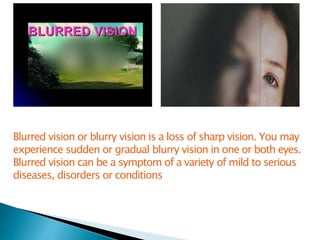
Blurred vision or blurry vision is a loss of sharp vision. You may
experience sudden or gradual blurry vision in one or both eyes.
Blurred vision can be a symptom of a variety of mild to serious
diseases, disorders or conditions
Eye-relatedcausesof blurredvision
1 Astigmatism (when light rays do not focus clearly at one point onthe retina due to the
unequal curvature of the surface of the eye)
2 Dry eyes
3 Eye irritation
4 Farsightedness
5
5 Nearsightedness
6 Presbyopia (a normal, gradual loss of your eyes’ ability to focus on near objects due to
aging)
7 Wrong prescription for eyeglasses or contact lenses
8 Retinopathy and diabetic lens osmosis (complications of diabetes).
9 Uveitis and iritis.
10 Autoimmunecausesof blurredvision.
12 Multiple sclerosis (disease that affects the brain and spinal cord causing weakness,
coordination, balance difficulties, and other problems).
13 Myasthenia gravis (autoimmune neuromuscular disorder that causes muscle
14 weakness).
14 Systemic lupus erythematosus (disorder in which the body attacks its own healthy cells
and tissues).
CONT…..
1 Cataracts
2 Conjunctivitis (inflammation of the eye surface
3 Corneal ulcer
4 Eye inflammation or infection
6 Macular degeneration (condition that causes blurring of the central vision)
7 Optic neuritis (inflammation of the optic nerve)
8 Retinal detachment (detachment of the light-sensing layer inside your eyefrom the
blood vessels that provide it oxygen and nutrients)
9 Retinal vessel occlusion (blockage of the blood vessels of the eye)
10 Retinoblastoma (cancer of the retina9
Diseases and conditions of the eye can lead to blurred vision
Life-threatening causes of blurred vision
1 Atherosclerotic emboli (plaque that travels to the brain and can cause a stroke)
2 Botulism
3 Brain hemorrhage (bleeding in the brain)
4 Carotid embolism
5 Encephalitis (inflammation and swelling of the brain due to a viral infection or other
causes)
6 Head injury
7 Stroke
Other causes of blurred vision
1 Concussion
2 Pregnancy
3 Temporal arteritis (inflammation of blood vessels in the head)
1 Photophobia or sensitivity to light
2 Pain in the eyes, or headaches
3 Floaters or spots/ mosquitos in front of the eye
4 Dryness of eyes
5 Eye strain andfatigue
6 Watering and or discharge from the eyes
7 Signs of trauma to the eyes
8 The whiteness of the pupil
CLINICAL PICTURES
1 Historttaking
2 Eyetests
Yourdoctormaynextwanttoperformaphysicalexaminationofyoureyes.Theymaytestyourvision
byaskingyoutoreadaneyechart.Theymightalsoperformothereyetests,suchas:
Ophthalmoscopy
Visiontest
slitlampexamination
tonometry,whichmeasuresintraocularpressure
3 Bloodtests
Yourdoctormightalsoperformbloodtesting.Bloodtestsmaybeusedtohelpthemdetermine
whetherbacteriaareintheblood.Theycanalsouseteststoobtainyourwhitebloodcellcount(WBC)if
theysuspecttherecouldbeaninfection.
1 Encourage your clients to – Get Tested, especially if:
there is a family history of eye disease
the client is over 40
the client has diabetes
the client has noticed a change in their vision
2 Recognise symptoms of common problem
3 Know when and where to refer
4 Talkto yourclientsabout theirvision;vision lossmaybean underlyingcausefor
anothercondition.
Potential
1 Brain damage
2 Loss of sight (blindness
4 Loss of the eye and orbit
Blurred vision complications depend on the underlying disease, disorder or
condition.
4 Migraine.
5 Hypertension
:
1 Falls
2 Depression
3 early special accommodation
4 increased risk of hip fracture
5 increased early mortality
6 social isolation
1 Eye Drops and Medication:
Certain eyedrops, especially those for checking
your retina, and power of glasses can cause a transient blurring of vision. It
resolves on its own, over two to six hours for most dilating drops (may be up
to two weeksin case of atropine). Also, some anti-allergy, anti-hypertensive,
and anti-depressant drugs can cause dry eyesand blurred vision, which
response to tear supplements.
2 Changein the power of glasses/ contact lens:
Incase, your prescription for
spectacles or contact lenses is not up to date, you will experience a visual
blur, despite wearing corrective lenses. Wearing your contact lenses for
longer than prescribed, or wearing eyeglasses that are dirty or with an oily
residue may also cause a decrease in vision.
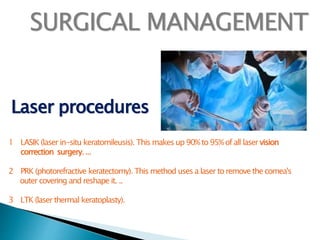
Laser procedures
1 LASIK (laser in-situ keratomileusis). This makesup 90% to 95% of all laser vision
correction surgery....
2 PRK (photorefractive keratectomy). This method usesa laser to remove the cornea's
outer covering and reshape it. ..
3 LTK (laser thermal keratoplasty).
SURGICAL MANAGEMENT
NURSING MANAGEMENT
Nursing Assessment..
 Take hostory.
 physical examination.
 Opthalmo evaluation.
 Lab value evaluation.
 Assess for general well being
and general condition of the
client.
Nursing Diagnosis and Intervention
1. Alter comfort to eye structure related to blurred vision.
 Take hostory properly regarding to blurred vision.
 Eg trauma,infection, foreign body etc
 Physical examination systemetically.
 Provede comfortable position to the client.
2 Alter tissue integraty of the eye related to trauma or
infection.
 Provide general comfort to the eye as per clients wish.
 Regular eye examination and take pothalmologist
suggestion.
 Protection from rediation.
3 Anxiety related to gradual vision liss.
 Provide alternative solution to the old.
 Proper councelling to the age related visual impairment or blurred vision.
 Balance diet with multi vitaminous component.
 Provide education regarding use and effect of medication.
4 Knowledge deficiet related to treatment procedure.
 Councell about potential complication.
 Councell about medical and surgical interventation.
 Tought about prognosis possibility.
5 Knowledge deficiet on possibility of secondary infection.
 Share knowledge about proper personal hygine.
 Never provide stress to the eye.
 Spent stress free life in society.
 Provide much protrnious diet for surgical healing.
 Focus onmaintaininag the therapeutic resimin for lifelong controll of a
chronic condition.
References
1 A hand book of geriatric nursing care .. 2nd edition.
2 A text boof of geriatric nursung ..2nd edition..
Gautam Ms. Saraswati.
3 Wallance M essential of Gerontological Nursing..
4 Mauk K.L. gerontological Nursing $th edition..
5 Essential text book of geriatric nursing..
6 samikshya publication..
 Blurred vision.pptx
 Blurred vision.pptx

Blurred vision.pptx

  • 1.
    PRESENTATOR  Ms. SakunRasaily  PAEDIATRIC WARD  BPKIHS  sakunrasaily@gmail.com SENSORY SYSTEM BLURRED VISION.
  • 2.
  • 3.
    Blurred vision orblurry vision is a loss of sharp vision. You may experience sudden or gradual blurry vision in one or both eyes. Blurred vision can be a symptom of a variety of mild to serious diseases, disorders or conditions
  • 4.
    Eye-relatedcausesof blurredvision 1 Astigmatism(when light rays do not focus clearly at one point onthe retina due to the unequal curvature of the surface of the eye) 2 Dry eyes 3 Eye irritation 4 Farsightedness 5 5 Nearsightedness 6 Presbyopia (a normal, gradual loss of your eyes’ ability to focus on near objects due to aging) 7 Wrong prescription for eyeglasses or contact lenses
  • 5.
    8 Retinopathy anddiabetic lens osmosis (complications of diabetes). 9 Uveitis and iritis. 10 Autoimmunecausesof blurredvision. 12 Multiple sclerosis (disease that affects the brain and spinal cord causing weakness, coordination, balance difficulties, and other problems). 13 Myasthenia gravis (autoimmune neuromuscular disorder that causes muscle 14 weakness). 14 Systemic lupus erythematosus (disorder in which the body attacks its own healthy cells and tissues). CONT…..
  • 6.
    1 Cataracts 2 Conjunctivitis(inflammation of the eye surface 3 Corneal ulcer 4 Eye inflammation or infection 6 Macular degeneration (condition that causes blurring of the central vision) 7 Optic neuritis (inflammation of the optic nerve) 8 Retinal detachment (detachment of the light-sensing layer inside your eyefrom the blood vessels that provide it oxygen and nutrients) 9 Retinal vessel occlusion (blockage of the blood vessels of the eye) 10 Retinoblastoma (cancer of the retina9 Diseases and conditions of the eye can lead to blurred vision
  • 7.
    Life-threatening causes ofblurred vision 1 Atherosclerotic emboli (plaque that travels to the brain and can cause a stroke) 2 Botulism 3 Brain hemorrhage (bleeding in the brain) 4 Carotid embolism 5 Encephalitis (inflammation and swelling of the brain due to a viral infection or other causes) 6 Head injury 7 Stroke
  • 8.
    Other causes ofblurred vision 1 Concussion 2 Pregnancy 3 Temporal arteritis (inflammation of blood vessels in the head)
  • 9.
    1 Photophobia orsensitivity to light 2 Pain in the eyes, or headaches 3 Floaters or spots/ mosquitos in front of the eye 4 Dryness of eyes 5 Eye strain andfatigue 6 Watering and or discharge from the eyes 7 Signs of trauma to the eyes 8 The whiteness of the pupil CLINICAL PICTURES
  • 10.
    1 Historttaking 2 Eyetests Yourdoctormaynextwanttoperformaphysicalexaminationofyoureyes.Theymaytestyourvision byaskingyoutoreadaneyechart.Theymightalsoperformothereyetests,suchas: Ophthalmoscopy Visiontest slitlampexamination tonometry,whichmeasuresintraocularpressure 3Bloodtests Yourdoctormightalsoperformbloodtesting.Bloodtestsmaybeusedtohelpthemdetermine whetherbacteriaareintheblood.Theycanalsouseteststoobtainyourwhitebloodcellcount(WBC)if theysuspecttherecouldbeaninfection.
  • 11.
    1 Encourage yourclients to – Get Tested, especially if: there is a family history of eye disease the client is over 40 the client has diabetes the client has noticed a change in their vision 2 Recognise symptoms of common problem 3 Know when and where to refer 4 Talkto yourclientsabout theirvision;vision lossmaybean underlyingcausefor anothercondition.
  • 12.
    Potential 1 Brain damage 2Loss of sight (blindness 4 Loss of the eye and orbit Blurred vision complications depend on the underlying disease, disorder or condition. 4 Migraine. 5 Hypertension : 1 Falls 2 Depression 3 early special accommodation 4 increased risk of hip fracture 5 increased early mortality 6 social isolation
  • 13.
    1 Eye Dropsand Medication: Certain eyedrops, especially those for checking your retina, and power of glasses can cause a transient blurring of vision. It resolves on its own, over two to six hours for most dilating drops (may be up to two weeksin case of atropine). Also, some anti-allergy, anti-hypertensive, and anti-depressant drugs can cause dry eyesand blurred vision, which response to tear supplements. 2 Changein the power of glasses/ contact lens: Incase, your prescription for spectacles or contact lenses is not up to date, you will experience a visual blur, despite wearing corrective lenses. Wearing your contact lenses for longer than prescribed, or wearing eyeglasses that are dirty or with an oily residue may also cause a decrease in vision.
  • 14.
    Laser procedures 1 LASIK(laser in-situ keratomileusis). This makesup 90% to 95% of all laser vision correction surgery.... 2 PRK (photorefractive keratectomy). This method usesa laser to remove the cornea's outer covering and reshape it. .. 3 LTK (laser thermal keratoplasty). SURGICAL MANAGEMENT
  • 15.
    NURSING MANAGEMENT Nursing Assessment.. Take hostory.  physical examination.  Opthalmo evaluation.  Lab value evaluation.  Assess for general well being and general condition of the client.
  • 16.
    Nursing Diagnosis andIntervention 1. Alter comfort to eye structure related to blurred vision.  Take hostory properly regarding to blurred vision.  Eg trauma,infection, foreign body etc  Physical examination systemetically.  Provede comfortable position to the client. 2 Alter tissue integraty of the eye related to trauma or infection.  Provide general comfort to the eye as per clients wish.  Regular eye examination and take pothalmologist suggestion.  Protection from rediation.
  • 17.
    3 Anxiety relatedto gradual vision liss.  Provide alternative solution to the old.  Proper councelling to the age related visual impairment or blurred vision.  Balance diet with multi vitaminous component.  Provide education regarding use and effect of medication. 4 Knowledge deficiet related to treatment procedure.  Councell about potential complication.  Councell about medical and surgical interventation.  Tought about prognosis possibility. 5 Knowledge deficiet on possibility of secondary infection.  Share knowledge about proper personal hygine.  Never provide stress to the eye.  Spent stress free life in society.  Provide much protrnious diet for surgical healing.  Focus onmaintaininag the therapeutic resimin for lifelong controll of a chronic condition.
  • 18.
    References 1 A handbook of geriatric nursing care .. 2nd edition. 2 A text boof of geriatric nursung ..2nd edition.. Gautam Ms. Saraswati. 3 Wallance M essential of Gerontological Nursing.. 4 Mauk K.L. gerontological Nursing $th edition.. 5 Essential text book of geriatric nursing.. 6 samikshya publication..