COLOSTOMY CARE
Presented By
Ms. SAKUN RASAILY
(PAEDIATRIC WARD
BPKIHS
PRESENTATION OUTLINES
1. ANATOMY OF GIT & LAGRE INTESTINE
2. INTRODUCTION OF COLOSTOMY
3. TYPES OF COLOSTOMY
4. INDICATIONS OF COLOSTOMY
5. COMPLICATIONS OF COLOSTOMY
6. PURPOSE OF COLOSTOMY CARE
7. GUIDELINES OF COLOSTOMY CARE
8. ARTICLES REQUIRED FOR COLOSTOMY CARE
9. PROCEDURE FOR COLOSTOMY CARE
10. MONITOR, ASSESS AND COUNSEL AFTER CARE
11. NURSING ASSESSMENT
12. FAMILY TEACHING ON
13. NURSING DOCUMENTATION/NOTE
14. POST TEST
15. REFRENCES
1 which is not a types of colostomy………
[a] ascending [b] descending
[c] transverse [d] jejunostomy
2 What is the Indication of colostomy……………..
[a] HSP [b] peptic ulcer
[c] SLE [C] All of the above
3 Adequate blood supply of stoma color is……
[a] white [b] red
[c] pink [d] B&C
4 Colostomy care documentation includes…….
[a] date/time [b] color
[c] both a&b [d] none
5 Complication of colostomy…….
[a] bleeding [b] obstruction
[c] prolapce [d] all
GOOD LUCK
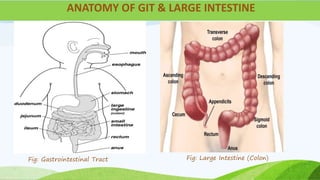
ANATOMY OF GIT & LARGE INTESTINE
Fig: Large Intestine (Colon)
Fig: Gastrointestinal Tract
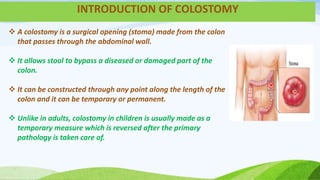
 A colostomy is a surgical opening (stoma) made from the colon
that passes through the abdominal wall.
 It allows stool to bypass a diseased or damaged part of the
colon.
 It can be constructed through any point along the length of the
colon and it can be temporary or permanent.
 Unlike in adults, colostomy in children is usually made as a
temporary measure which is reversed after the primary
pathology is taken care of.
INTRODUCTION OF COLOSTOMY
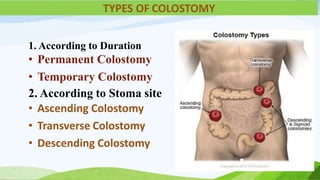
TYPES OF COLOSTOMY
1. According to Duration
• Permanent Colostomy
• Temporary Colostomy
2. According to Stoma site
• Ascending Colostomy
• Transverse Colostomy
• Descending Colostomy
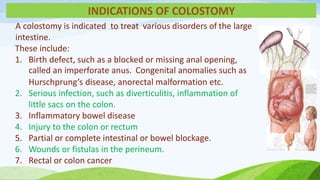
INDICATIONS OF COLOSTOMY
A colostomy is indicated to treat various disorders of the large
intestine.
These include:
1. Birth defect, such as a blocked or missing anal opening,
called an imperforate anus. Congenital anomalies such as
Hurschprung’s disease, anorectal malformation etc.
2. Serious infection, such as diverticulitis, inflammation of
little sacs on the colon.
3. Inflammatory bowel disease
4. Injury to the colon or rectum
5. Partial or complete intestinal or bowel blockage.
6. Wounds or fistulas in the perineum.
7. Rectal or colon cancer
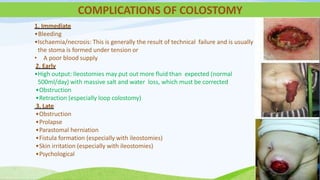
COMPLICATIONS OF COLOSTOMY
1. Immediate
•Bleeding
•Ischaemia/necrosis: This is generally the result of technical failure and is usually if
the stoma is formed under tension or
• A poor blood supply
2. Early
•High output: Ileostomies may put out more fluid than expected (normal
500ml/day) with massive salt and water loss, which must be corrected
•Obstruction
•Retraction (especially loop colostomy)
3. Late
•Obstruction
•Prolapse
•Parastomal herniation
•Fistula formation (especially with ileostomies)
•Skin irritation (especially with ileostomies)
•Psychological
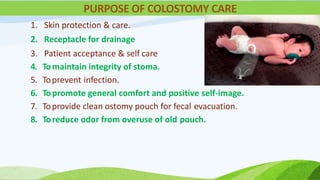
PURPOSE OF COLOSTOMY CARE
1. Skin protection & care.
2. Receptacle for drainage
3. Patient acceptance & self care
4. Tomaintain integrity of stoma.
5. Toprevent infection.
6. Topromote general comfort and positive self-image.
7. Toprovide clean ostomy pouch for fecal evacuation.
8. Toreduce odor from overuse of old pouch.
GUIDELINES OF COLOSTOMY
1. Keep odour as free of odors as possible.
2. Ostomy bag should be emptied frequently.
3. Check the stoma regularly, the colour should be dark pink to
red and moist.
4. Pale colour indicates anaemia,
5. Dark or purple blue indicates compromised circulation.
6. Size of the stoma stablizes 6-8 weeks.
7. If dressing, check frequently for drainage and bleeding.
8. Keep the skin around the stoma (peristomal area) site clean
and dry.
9. If not it causes skin irritation and infection.
10. Intake and out put chart must be recorded for every 4 hours.
11. Encourage the patient to participate in care and to look at the
ostomy.
12. Can help the patient by listening, explaining, being available
and supportive.
13. Encourage the patient to avoid fibre rich diets.
14. Encourage the patient to drink fluids.
15. Educate the patient about the various methods of odor
control measures.
16. Chlorophyll rich diet will deodorize the feces.
17. Direct contact sports and heavy lifting must be avoided.
GUIDELINES OF COLOSTOMY Contd..
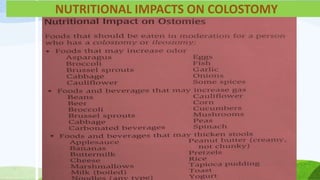
NUTRITIONAL IMPACTS ON COLOSTOMY
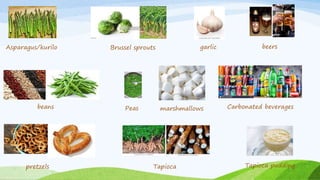
Asparagus/kurilo Brussel sprouts garlic
beans
beers
Peas Carbonated beverages
marshmallows
pretzels Tapioca Tapioca pudding
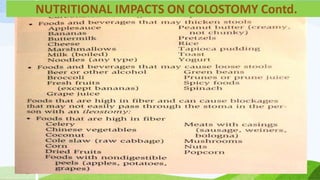
NUTRITIONAL IMPACTS ON COLOSTOMY Contd.
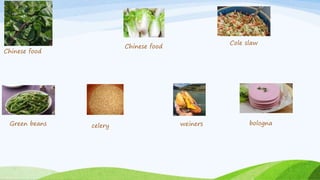
Chinese food
bologna
celery
Cole slaw
Chinese food
weiners
Green beans
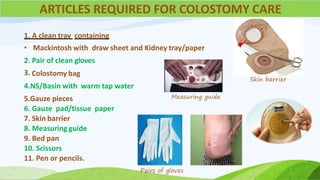
1. A clean tray containing
• Mackintosh with draw sheet and Kidney tray/paper
2. Pair of clean gloves.
3. Colostomy bag
4.NS/Basin with warm tap water
5.Gauze pieces
6. Gauze pad/tissue paper
7. Skin barrier
8. Measuring guide
9. Bed pan
10. Scissors
11. Pen or pencils.
ARTICLES REQUIRED FOR COLOSTOMY CARE
Skin barrier
Pairs of gloves
Measuring guide
1. Detailed history taken down: current complaint, history of
presenting illness, past medical history (co-morbidities),
surgical history, social and environmental history.
2. Medications and allergies documented.
3. Arrange the all necessary articles.
4. Explain the procedure to the patient.
5. Maintain privacy and assist patient to a comfortable position.
PROCEDURE FOR COLOSTOMY CARE
6. Follow aseptic techniques such as washing hands, wearing
gloves etc for infection prevention and control.
7. Spread Mackintosh & draw sheet to protect linen.
8. Remove used pouch & skin barrier gently by pushing the skin
away from the barrier.
9. Reduces trauma, jerking, irritates skin and can cause tear.
10 Remove clamp and empty the content.
PROCEDURE FOR COLOSTOMY CARE Contd.
11. Rinse the pouch with tepid water or normal saline to minimize the
odour & growth of microbes.
12. Discard the disposable pouch in paper bag.
13. Observe stoma for colour,swelling,trauma,& healing. Stoma
should be moist and pink.
14. Cover the stoma with a gauze piece to prevent the
fecal matters from contacting with skin.
PROCEDURE FOR COLOSTOMY CARE Contd.
15. Clean stomal region gently with warm tap water using gauze pad.
16. Do not scrub the skin, dry completely by patting the skin with
gauze.
17. Remove gauze and clean stoma with gauze and pat dry.
18. Measure the stoma using measuring guide.
19. Ensures accuracy in determining correct pouch
size needed.
20. Trace same circle behind the skin barrier, using scissors, cut
an opening 1/16th to 1/8th inch larger than stoma before
removing the wrapper over adhesive part.
PROCEDURE FOR COLOSTOMY CARE Contd.
21. Put skin barrier and pouch over the stoma, and gently
press on to the skin, for 1-2 minutes.
22. To prevent irritation to skin.
23. Remove gloves and wash hands.
24. Make the patient comfortable
25. Clean the area and replace all articles.
PROCEDURE FOR COLOSTOMY CARE Contd.
1. Monitor Vitals.
2. Instruct the parents to support the operative site during deep - .breathing and
coughing, and given pain medication as necessary.
3. Measure Fluid intake and output and the operative site is observed for color and
amount of wound drainage
4. The nasogastric tube will remain in place, attached to low intermittent - .suction until
bowel activity resumes For the first 24-48 hours after surgery, the colostomy will drain
bloody - . Mucus
5. Fluids and electrolytes are infused intravenously until the patient's diet is - . can
gradually be resumed, beginning with liquids.
6. Usually within 72 hours, passage of gas and stool through the stoma - begins. Initially
the stool is liquid, gradually thickening as the patient begins to take solid foods.
7. The patient is usually out of bed in 8-24 hours after surgery and discharged in 2-4
days.
MONITOR, ASSESS AND COUNSEL AFTER CARE
9. During the hospital stay, the patient and his or her caregivers will be - .
10. educated on how to care for the colostomy .
10. Regular assessment to the skin surrounding the stoma is important .
11. Assess Warning signs: Bleeding from stoma and from the skin around the
stoma, Change in the bowel pattern, Change in the stoma size.,icreased in
the temperature
12. Assess Complications: Leakage, Prolapse, Obstruction or stenosis.
and Stoma Inflammation.
MONITOR, ASSESS AND COUNSEL AFTER CARE Contd.
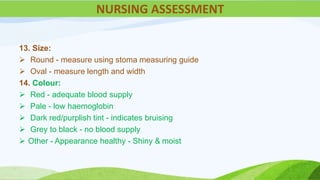
13. Size:
 Round - measure using stoma measuring guide
 Oval - measure length and width
14. Colour:
 Red - adequate blood supply
 Pale - low haemoglobin
 Dark red/purplish tint - indicates bruising
 Grey to black - no blood supply
 Other - Appearance healthy - Shiny & moist
NURSING ASSESSMENT
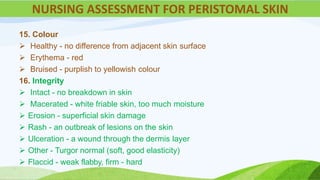
15. Colour
 Healthy - no difference from adjacent skin surface
 Erythema - red
 Bruised - purplish to yellowish colour
16. Integrity
 Intact - no breakdown in skin
 Macerated - white friable skin, too much moisture
 Erosion - superficial skin damage
 Rash - an outbreak of lesions on the skin
 Ulceration - a wound through the dermis layer
 Other - Turgor normal (soft, good elasticity)
 Flaccid - weak flabby, firm - hard
NURSING ASSESSMENT FOR PERISTOMAL SKIN
17. Stoma Colour:
 Normal - Pink/red/warm to touch
 Abnormal - black/dusky/pale/sloughy
18. Skin:
 Normal - In the post-operative period the stoma can be quite swollen. It
may reduce in size for about 6 weeks after surgery.
 Abnormal - Any sudden or unexplained swelling of the stoma
19. Bleeding Stoma:
 Normal - A slight smear of blood on the wipe when washing or drying
the stoma.
 Abnormal - Excessive bleeding when cleaning the stoma/blood in
the pouch/bleeding from inside the
NURSING ASSESSMENT FOR STOMA
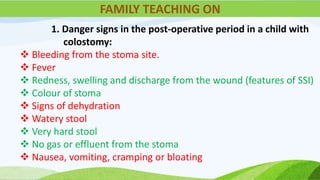
1. Danger signs in the post-operative period in a child with
colostomy:
 Bleeding from the stoma site.
 Fever
 Redness, swelling and discharge from the wound (features of SSI)
 Colour of stoma
 Signs of dehydration
 Watery stool
 Very hard stool
 No gas or effluent from the stoma
 Nausea, vomiting, cramping or bloating
FAMILY TEACHING ON
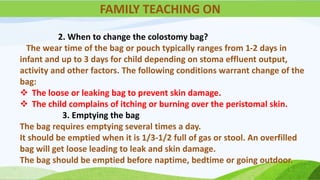
2. When to change the colostomy bag?
The wear time of the bag or pouch typically ranges from 1-2 days in
infant and up to 3 days for child depending on stoma effluent output,
activity and other factors. The following conditions warrant change of the
bag:
 The loose or leaking bag to prevent skin damage.
 The child complains of itching or burning over the peristomal skin.
3. Emptying the bag
The bag requires emptying several times a day.
It should be emptied when it is 1/3-1/2 full of gas or stool. An overfilled
bag will get loose leading to leak and skin damage.
The bag should be emptied before naptime, bedtime or going outdoor.
FAMILY TEACHING ON
4. Food and stoma effluent: Usually the colostomy output will be
semisolid or formed stool with characteristic odour.
 Cabbage, cauliflower, egg, fish, onions and some spices will increase the
odour of the stool.Colostomy bags have inbuilt odour-barrier film to
control the smell. Moreover, the bags are fitted with filters which let the
gas escape but not the odour preventing ballooning of the pouch.
 Certain foods such as beans, sprouts, garlic, onions etc. and drinking
through straw may increase gas.
 There may be diarrhoea in children with colostomy. Certain food such as
yoghurt, banana, white rice, cheese or noodles may be tried to thicken
the stool.
FAMILY TEACHING ON
5. Guidelines for activity
 Bathing: Water does not harm the stoma and can be done with the
pouch on or off. The skin around the stoma should be dried and
integrity of the skin barrier checked.
 Swimming: An ostomy belt or waterproof tape can help securing the
bag while swimming.
 Sleeping: The pouch should be emptied before nap and bedtime.
Sleeping on abdomen does not hurt stoma but infants should sleep on
their back.
 Clothing: Tight garments or the one with waistband might hurt the
stoma and should be avoided.
FAMILY TEACHING ON
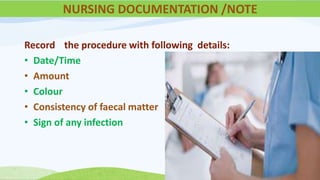
Record the procedure with following details:
• Date/Time
• Amount
• Colour
• Consistency of faecal matter
• Sign of any infection
NURSING DOCUMENTATION /NOTE
1. Principle and practice of surgery in the tropics- 4th edition
2. Farquharson’s textbook of operative general surgery-9th ed
3. www.surgeryencyclopedia.com
3. American College of Surgeons “kit”: www.facs. org/education/patient-education/skills-
programs/ostomy-program/pediatric-ostomy
4. McIltrot, K. (Ed.). (2016). Assessment and Management of the Pediatric Patient. In
Wound, Ostomy and Continence Nurses Society Core curriculum Wound Management (pp.
158-175). Philadelphia.
5. United Ostomy Associations of America (UOAA) colostomy guide
6. https://www.massgeneral.org/children/stoma/caring-for-your-childs-stoma-colostomy
7. https://www.ijsr.net/archive/v4i10/SUB159241.pdf
8. https://surgery.ucsf.edu/conditions--procedures/colostomy-(pediatric).aspx
9.https://www.rch.org.au/rchcpg/hospital_clinical_guideline_index/Neonatal_Fecal_Stoma_Car
e/
10. https://www.cancer.org/treatment/treatments-and-side-effects/treatment-
types/surgery/ostomies/colostomy/types-of-colostomies.html
11. https://www.hopkinsmedicine.org/health/treatment-tests-and-therapies/colostomy
12. https://www.ostomy.org/wp-content/uploads/2018/03/ColostomyGuide.pdf
13. www.slideshare.com
14. www.goggle.com
15.https://www.researchgate.net/publication/328430088_Colostomy_Care_in_Paediatric_Pa
tients
REFERENCES
POST TEST
1 which is not a types of colostomy………
[a] ascending [b] descending
[c] transverse [d] jejunostomy
2 What is the Indication of colostomy……………..
[a] HSP [b] peptic ulcer
[c] SLE [C] All of the above
3 Adequate blood supply of stoma color is……
[a] white [b] red
[c] pink [d] B&C
4 Colostomy care documentation includes…….
[a] date/time [b] color
[c] both a&b [d] none
5 Complication fo colostomy…….
[a] bleeding [b] obstruction
[c] prolapce [d] all
GOOD LUCK
Feed Back ?
Please
Comments
?
Questions
?

colostomy care ppt..pptx

  • 1.
    COLOSTOMY CARE Presented By Ms.SAKUN RASAILY (PAEDIATRIC WARD BPKIHS
  • 2.
    PRESENTATION OUTLINES 1. ANATOMYOF GIT & LAGRE INTESTINE 2. INTRODUCTION OF COLOSTOMY 3. TYPES OF COLOSTOMY 4. INDICATIONS OF COLOSTOMY 5. COMPLICATIONS OF COLOSTOMY 6. PURPOSE OF COLOSTOMY CARE 7. GUIDELINES OF COLOSTOMY CARE 8. ARTICLES REQUIRED FOR COLOSTOMY CARE 9. PROCEDURE FOR COLOSTOMY CARE 10. MONITOR, ASSESS AND COUNSEL AFTER CARE 11. NURSING ASSESSMENT 12. FAMILY TEACHING ON 13. NURSING DOCUMENTATION/NOTE 14. POST TEST 15. REFRENCES
  • 3.
    1 which isnot a types of colostomy……… [a] ascending [b] descending [c] transverse [d] jejunostomy 2 What is the Indication of colostomy…………….. [a] HSP [b] peptic ulcer [c] SLE [C] All of the above
  • 4.
    3 Adequate bloodsupply of stoma color is…… [a] white [b] red [c] pink [d] B&C 4 Colostomy care documentation includes……. [a] date/time [b] color [c] both a&b [d] none 5 Complication of colostomy……. [a] bleeding [b] obstruction [c] prolapce [d] all GOOD LUCK
  • 5.
    ANATOMY OF GIT& LARGE INTESTINE Fig: Large Intestine (Colon) Fig: Gastrointestinal Tract
  • 6.
     A colostomyis a surgical opening (stoma) made from the colon that passes through the abdominal wall.  It allows stool to bypass a diseased or damaged part of the colon.  It can be constructed through any point along the length of the colon and it can be temporary or permanent.  Unlike in adults, colostomy in children is usually made as a temporary measure which is reversed after the primary pathology is taken care of. INTRODUCTION OF COLOSTOMY
  • 7.
    TYPES OF COLOSTOMY 1.According to Duration • Permanent Colostomy • Temporary Colostomy 2. According to Stoma site • Ascending Colostomy • Transverse Colostomy • Descending Colostomy
  • 8.
    INDICATIONS OF COLOSTOMY Acolostomy is indicated to treat various disorders of the large intestine. These include: 1. Birth defect, such as a blocked or missing anal opening, called an imperforate anus. Congenital anomalies such as Hurschprung’s disease, anorectal malformation etc. 2. Serious infection, such as diverticulitis, inflammation of little sacs on the colon. 3. Inflammatory bowel disease 4. Injury to the colon or rectum 5. Partial or complete intestinal or bowel blockage. 6. Wounds or fistulas in the perineum. 7. Rectal or colon cancer
  • 9.
    COMPLICATIONS OF COLOSTOMY 1.Immediate •Bleeding •Ischaemia/necrosis: This is generally the result of technical failure and is usually if the stoma is formed under tension or • A poor blood supply 2. Early •High output: Ileostomies may put out more fluid than expected (normal 500ml/day) with massive salt and water loss, which must be corrected •Obstruction •Retraction (especially loop colostomy) 3. Late •Obstruction •Prolapse •Parastomal herniation •Fistula formation (especially with ileostomies) •Skin irritation (especially with ileostomies) •Psychological
  • 10.
    PURPOSE OF COLOSTOMYCARE 1. Skin protection & care. 2. Receptacle for drainage 3. Patient acceptance & self care 4. Tomaintain integrity of stoma. 5. Toprevent infection. 6. Topromote general comfort and positive self-image. 7. Toprovide clean ostomy pouch for fecal evacuation. 8. Toreduce odor from overuse of old pouch.
  • 11.
    GUIDELINES OF COLOSTOMY 1.Keep odour as free of odors as possible. 2. Ostomy bag should be emptied frequently. 3. Check the stoma regularly, the colour should be dark pink to red and moist. 4. Pale colour indicates anaemia, 5. Dark or purple blue indicates compromised circulation. 6. Size of the stoma stablizes 6-8 weeks. 7. If dressing, check frequently for drainage and bleeding. 8. Keep the skin around the stoma (peristomal area) site clean and dry.
  • 12.
    9. If notit causes skin irritation and infection. 10. Intake and out put chart must be recorded for every 4 hours. 11. Encourage the patient to participate in care and to look at the ostomy. 12. Can help the patient by listening, explaining, being available and supportive. 13. Encourage the patient to avoid fibre rich diets. 14. Encourage the patient to drink fluids. 15. Educate the patient about the various methods of odor control measures. 16. Chlorophyll rich diet will deodorize the feces. 17. Direct contact sports and heavy lifting must be avoided. GUIDELINES OF COLOSTOMY Contd..
  • 13.
  • 14.
    Asparagus/kurilo Brussel sproutsgarlic beans beers Peas Carbonated beverages marshmallows pretzels Tapioca Tapioca pudding
  • 15.
    NUTRITIONAL IMPACTS ONCOLOSTOMY Contd.
  • 16.
  • 17.
    1. A cleantray containing • Mackintosh with draw sheet and Kidney tray/paper 2. Pair of clean gloves. 3. Colostomy bag 4.NS/Basin with warm tap water 5.Gauze pieces 6. Gauze pad/tissue paper 7. Skin barrier 8. Measuring guide 9. Bed pan 10. Scissors 11. Pen or pencils. ARTICLES REQUIRED FOR COLOSTOMY CARE Skin barrier Pairs of gloves Measuring guide
  • 18.
    1. Detailed historytaken down: current complaint, history of presenting illness, past medical history (co-morbidities), surgical history, social and environmental history. 2. Medications and allergies documented. 3. Arrange the all necessary articles. 4. Explain the procedure to the patient. 5. Maintain privacy and assist patient to a comfortable position. PROCEDURE FOR COLOSTOMY CARE
  • 19.
    6. Follow aseptictechniques such as washing hands, wearing gloves etc for infection prevention and control. 7. Spread Mackintosh & draw sheet to protect linen. 8. Remove used pouch & skin barrier gently by pushing the skin away from the barrier. 9. Reduces trauma, jerking, irritates skin and can cause tear. 10 Remove clamp and empty the content. PROCEDURE FOR COLOSTOMY CARE Contd.
  • 20.
    11. Rinse thepouch with tepid water or normal saline to minimize the odour & growth of microbes. 12. Discard the disposable pouch in paper bag. 13. Observe stoma for colour,swelling,trauma,& healing. Stoma should be moist and pink. 14. Cover the stoma with a gauze piece to prevent the fecal matters from contacting with skin. PROCEDURE FOR COLOSTOMY CARE Contd.
  • 21.
    15. Clean stomalregion gently with warm tap water using gauze pad. 16. Do not scrub the skin, dry completely by patting the skin with gauze. 17. Remove gauze and clean stoma with gauze and pat dry. 18. Measure the stoma using measuring guide. 19. Ensures accuracy in determining correct pouch size needed. 20. Trace same circle behind the skin barrier, using scissors, cut an opening 1/16th to 1/8th inch larger than stoma before removing the wrapper over adhesive part. PROCEDURE FOR COLOSTOMY CARE Contd.
  • 22.
    21. Put skinbarrier and pouch over the stoma, and gently press on to the skin, for 1-2 minutes. 22. To prevent irritation to skin. 23. Remove gloves and wash hands. 24. Make the patient comfortable 25. Clean the area and replace all articles. PROCEDURE FOR COLOSTOMY CARE Contd.
  • 23.
    1. Monitor Vitals. 2.Instruct the parents to support the operative site during deep - .breathing and coughing, and given pain medication as necessary. 3. Measure Fluid intake and output and the operative site is observed for color and amount of wound drainage 4. The nasogastric tube will remain in place, attached to low intermittent - .suction until bowel activity resumes For the first 24-48 hours after surgery, the colostomy will drain bloody - . Mucus 5. Fluids and electrolytes are infused intravenously until the patient's diet is - . can gradually be resumed, beginning with liquids. 6. Usually within 72 hours, passage of gas and stool through the stoma - begins. Initially the stool is liquid, gradually thickening as the patient begins to take solid foods. 7. The patient is usually out of bed in 8-24 hours after surgery and discharged in 2-4 days. MONITOR, ASSESS AND COUNSEL AFTER CARE
  • 24.
    9. During thehospital stay, the patient and his or her caregivers will be - . 10. educated on how to care for the colostomy . 10. Regular assessment to the skin surrounding the stoma is important . 11. Assess Warning signs: Bleeding from stoma and from the skin around the stoma, Change in the bowel pattern, Change in the stoma size.,icreased in the temperature 12. Assess Complications: Leakage, Prolapse, Obstruction or stenosis. and Stoma Inflammation. MONITOR, ASSESS AND COUNSEL AFTER CARE Contd.
  • 25.
    13. Size:  Round- measure using stoma measuring guide  Oval - measure length and width 14. Colour:  Red - adequate blood supply  Pale - low haemoglobin  Dark red/purplish tint - indicates bruising  Grey to black - no blood supply  Other - Appearance healthy - Shiny & moist NURSING ASSESSMENT
  • 26.
    15. Colour  Healthy- no difference from adjacent skin surface  Erythema - red  Bruised - purplish to yellowish colour 16. Integrity  Intact - no breakdown in skin  Macerated - white friable skin, too much moisture  Erosion - superficial skin damage  Rash - an outbreak of lesions on the skin  Ulceration - a wound through the dermis layer  Other - Turgor normal (soft, good elasticity)  Flaccid - weak flabby, firm - hard NURSING ASSESSMENT FOR PERISTOMAL SKIN
  • 27.
    17. Stoma Colour: Normal - Pink/red/warm to touch  Abnormal - black/dusky/pale/sloughy 18. Skin:  Normal - In the post-operative period the stoma can be quite swollen. It may reduce in size for about 6 weeks after surgery.  Abnormal - Any sudden or unexplained swelling of the stoma 19. Bleeding Stoma:  Normal - A slight smear of blood on the wipe when washing or drying the stoma.  Abnormal - Excessive bleeding when cleaning the stoma/blood in the pouch/bleeding from inside the NURSING ASSESSMENT FOR STOMA
  • 28.
    1. Danger signsin the post-operative period in a child with colostomy:  Bleeding from the stoma site.  Fever  Redness, swelling and discharge from the wound (features of SSI)  Colour of stoma  Signs of dehydration  Watery stool  Very hard stool  No gas or effluent from the stoma  Nausea, vomiting, cramping or bloating FAMILY TEACHING ON
  • 29.
    2. When tochange the colostomy bag? The wear time of the bag or pouch typically ranges from 1-2 days in infant and up to 3 days for child depending on stoma effluent output, activity and other factors. The following conditions warrant change of the bag:  The loose or leaking bag to prevent skin damage.  The child complains of itching or burning over the peristomal skin. 3. Emptying the bag The bag requires emptying several times a day. It should be emptied when it is 1/3-1/2 full of gas or stool. An overfilled bag will get loose leading to leak and skin damage. The bag should be emptied before naptime, bedtime or going outdoor. FAMILY TEACHING ON
  • 30.
    4. Food andstoma effluent: Usually the colostomy output will be semisolid or formed stool with characteristic odour.  Cabbage, cauliflower, egg, fish, onions and some spices will increase the odour of the stool.Colostomy bags have inbuilt odour-barrier film to control the smell. Moreover, the bags are fitted with filters which let the gas escape but not the odour preventing ballooning of the pouch.  Certain foods such as beans, sprouts, garlic, onions etc. and drinking through straw may increase gas.  There may be diarrhoea in children with colostomy. Certain food such as yoghurt, banana, white rice, cheese or noodles may be tried to thicken the stool. FAMILY TEACHING ON
  • 31.
    5. Guidelines foractivity  Bathing: Water does not harm the stoma and can be done with the pouch on or off. The skin around the stoma should be dried and integrity of the skin barrier checked.  Swimming: An ostomy belt or waterproof tape can help securing the bag while swimming.  Sleeping: The pouch should be emptied before nap and bedtime. Sleeping on abdomen does not hurt stoma but infants should sleep on their back.  Clothing: Tight garments or the one with waistband might hurt the stoma and should be avoided. FAMILY TEACHING ON
  • 32.
    Record the procedurewith following details: • Date/Time • Amount • Colour • Consistency of faecal matter • Sign of any infection NURSING DOCUMENTATION /NOTE
  • 33.
    1. Principle andpractice of surgery in the tropics- 4th edition 2. Farquharson’s textbook of operative general surgery-9th ed 3. www.surgeryencyclopedia.com 3. American College of Surgeons “kit”: www.facs. org/education/patient-education/skills- programs/ostomy-program/pediatric-ostomy 4. McIltrot, K. (Ed.). (2016). Assessment and Management of the Pediatric Patient. In Wound, Ostomy and Continence Nurses Society Core curriculum Wound Management (pp. 158-175). Philadelphia. 5. United Ostomy Associations of America (UOAA) colostomy guide 6. https://www.massgeneral.org/children/stoma/caring-for-your-childs-stoma-colostomy 7. https://www.ijsr.net/archive/v4i10/SUB159241.pdf 8. https://surgery.ucsf.edu/conditions--procedures/colostomy-(pediatric).aspx 9.https://www.rch.org.au/rchcpg/hospital_clinical_guideline_index/Neonatal_Fecal_Stoma_Car e/ 10. https://www.cancer.org/treatment/treatments-and-side-effects/treatment- types/surgery/ostomies/colostomy/types-of-colostomies.html 11. https://www.hopkinsmedicine.org/health/treatment-tests-and-therapies/colostomy 12. https://www.ostomy.org/wp-content/uploads/2018/03/ColostomyGuide.pdf 13. www.slideshare.com 14. www.goggle.com 15.https://www.researchgate.net/publication/328430088_Colostomy_Care_in_Paediatric_Pa tients REFERENCES
  • 35.
    POST TEST 1 whichis not a types of colostomy……… [a] ascending [b] descending [c] transverse [d] jejunostomy 2 What is the Indication of colostomy…………….. [a] HSP [b] peptic ulcer [c] SLE [C] All of the above
  • 36.
    3 Adequate bloodsupply of stoma color is…… [a] white [b] red [c] pink [d] B&C 4 Colostomy care documentation includes……. [a] date/time [b] color [c] both a&b [d] none 5 Complication fo colostomy……. [a] bleeding [b] obstruction [c] prolapce [d] all GOOD LUCK
  • 37.