Eye Health Campaign Workshop
Mohamed Abdelmongy
local Officer Assistant on Public Health (LPO Assistant)
EYE Health Project Local Coordinator
Eyes is a Very Precious Gift from the GOD For
Everyone In the World.
Anatomy of the eye
Eyes: The Windows to Your Health
sixty year old man walked into his
ophthalmologist for a routine annual eye
exam, and walked out with something he
wasn’t expecting!
"I saw a microscopic clot in the blood vessels
of his retina, So I reffer him to an urgent
follow-up with his cardiologist. “
ophthalmologist said.
The follow-up by cardiologist revealed a much
bigger mass residing in his carotid artery,
putting him at high risk for a stroke.
An Eye Exam May Be Life-Saving
A potential stroke is just one of the health conditions that
might be visible in the eyes, which are not only the windows
to our soul, but also to our body's overall health.
diabetes, high blood pressure, autoimmune diseases,
sexually transmitted diseases and cancers are among the
illnesses that can be detected during an eye exam.
Why ?
That's because the eye is the only
place in the body where a doctor can
have an unobstructed view of our
blood vessels, nerves and connecting
tissue — without any need for surgery.
Because the eye has the same
microscopic tissue as our other major
organs, and is an important part of our
larger nervous system, abnormalities
spotted in the eye may signal the same
changes in other parts of the body.
For example,
• ophthalmologists often detect diabetes during the
dilated portion of the eye exam by observing changes
or damage in the blood vessels of the retina, known as
diabetic retinopathy. In these cases, the disease may
show up in the eye tissue even before it does in a
blood sugar test. Thanks to early detection during eye
exams, people diagnosed in this beginning stage of
diabetes potentially can avoid vision loss and other
serious complications.
• Loss of side vision, which can be a symptom of
glaucoma, also can indicate serious health issues that
go beyond vision. It can map back to a problem in
certain regions of the brain, indicating a stroke, head
trauma, tumor, or brain bleed.
Eye Exams: How Often and What to
Expect?
The American Academy of Ophthalmology recommends
all adults get a baseline eye exam from an
ophthalmologist by age 40, when early signs of disease
and vision changes may start to occur.
But, If you have an eye disease or a risk factor for
developing one, such as diabetes, high blood pressure or
a family history of eye disease, you should see an
ophthalmologist even if you are younger than 40.
Adults age 65 and over should have a comprehensive eye
exam every one years.
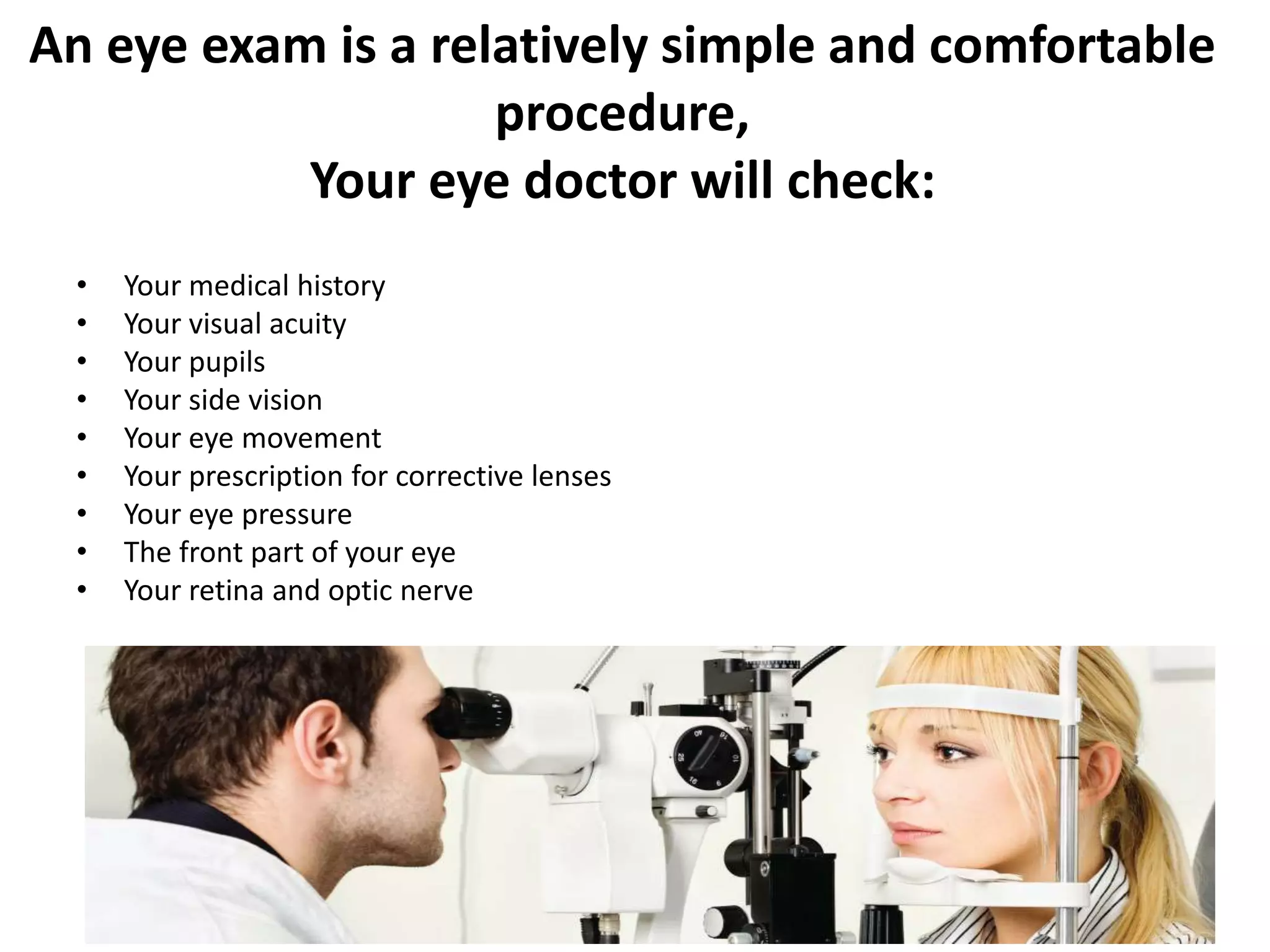
An eye exam is a relatively simple and comfortable
procedure,
Your eye doctor will check:
• Your medical history
• Your visual acuity
• Your pupils
• Your side vision
• Your eye movement
• Your prescription for corrective lenses
• Your eye pressure
• The front part of your eye
• Your retina and optic nerve
When to have an eye exam
Several factors may determine how frequently you need an eye exam, including your age, health and risk of
developing eye problems. General guidelines are as follows:
Children 5 years and younger :
For children under 3, your pediatrician will likely look for the most common eye problems — lazy eye, crossed
eyes or turned-out eyes.
But in pre-mature infants?
School-age children and adolescents.
before he or she enters first grade. If the child has no symptoms of vision problems and no family history of
vision problems, have his or her vision rechecked every one to two years. Otherwise, schedule eye exams
based on the advice of your eye doctor.
Adults :
In general, if you're healthy and have no symptoms of vision problems, have your eyes checked on this
schedule:
Every three years in your 20s and 30s
Every one years from 40 to 54
Every one years from 55 to 64
Every 6 month years after age 65
Have your eyes checked more often if you:
Wear glasses or contact lenses
Have a family history of eye disease
Have a chronic disease that puts you at greater risk of eye disease, such as diabetes
statistics
• 285 milion people around the world are blind or
visually impaired.
• About 80% of these cases are avoidable.
• Poorer population are more affected.
• 90% of these patients lives in developing
countries.
so, what’s the common causes of
visual impairment ?
• 42% Refractive errors.
• 33% Cataract.
• 25% Others.
cause prevalence
Cataract 47.8%
Glaucoma 12.3%
Trachoma 3.6% (but in Egypt ?)
Corneal Opacity 5.1%
Diabetic Retinopathy 4.8%
AMD 8.7%
Blindness in children 3.9%
NOW, we will talk in brief about
the common eye diseases :
Refractive Errors
When light is not focused properly, it causes blurry vision. Refractive errors can
usually be corrected with glasses, contacts, or surgery. They include:
• myopia (nearsightedness), which is when far-away objects look blurry
• hyperopia (farsightedness), which is when close-up objects look blurry
• astigmatism, which can result in blurry vision because the cornea is not
perfectly shaped to direct light into the eye
• presbyopia, which is farsightedness caused by the loss of elasticity of the
eye’s lens due to aging
• TTT: …………………………
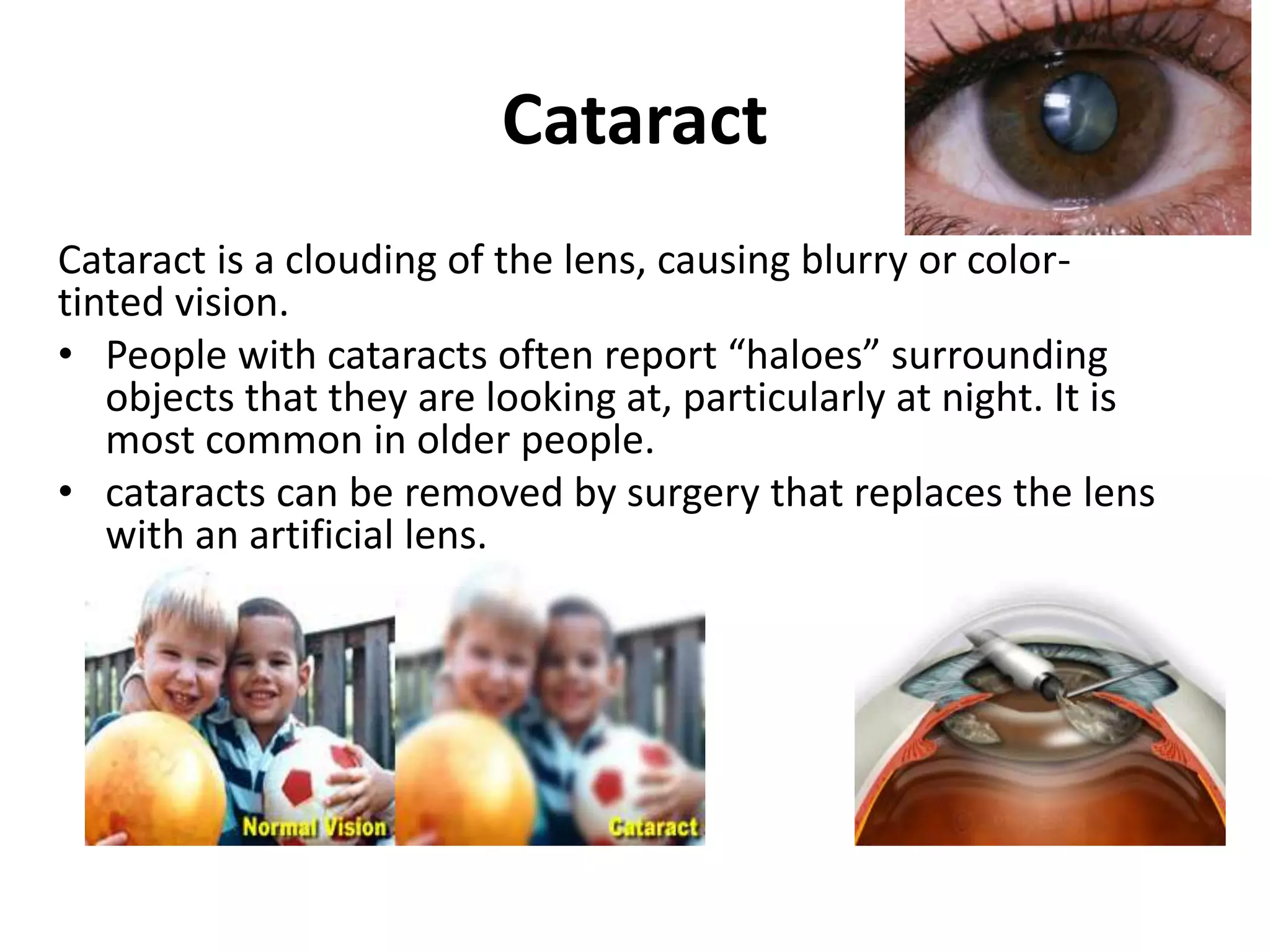
Cataract
Cataract is a clouding of the lens, causing blurry or color-
tinted vision.
• People with cataracts often report “haloes” surrounding
objects that they are looking at, particularly at night. It is
most common in older people.
• cataracts can be removed by surgery that replaces the lens
with an artificial lens.
Glaucoma
• Glaucoma is increased pressure of the fluid inside
the eye, which can cause optic nerve damage.
• Glaucoma is a common cause of blindness,
particularly in diabetic patients.
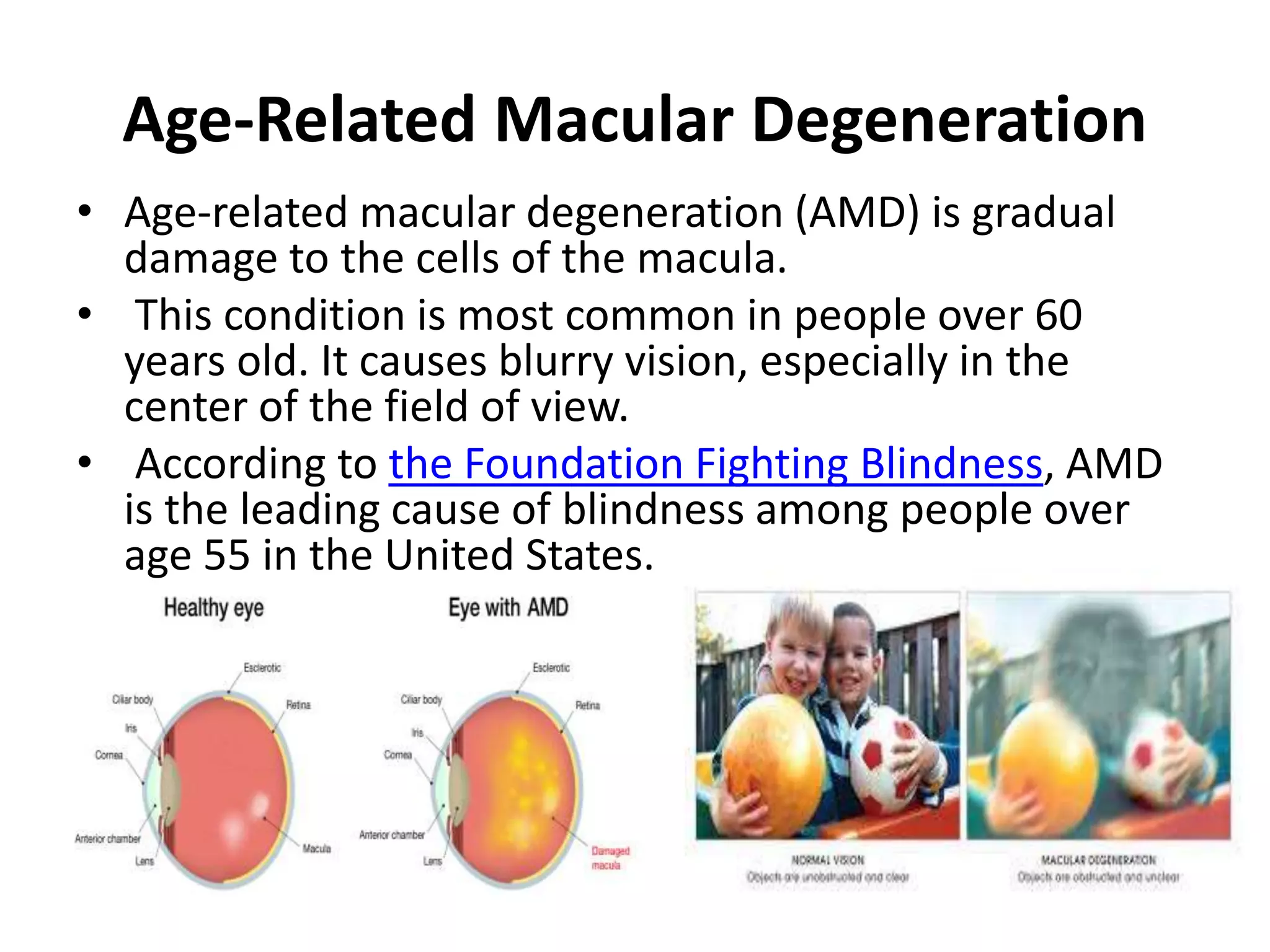
Age-Related Macular Degeneration
• Age-related macular degeneration (AMD) is gradual
damage to the cells of the macula.
• This condition is most common in people over 60
years old. It causes blurry vision, especially in the
center of the field of view.
• According to the Foundation Fighting Blindness, AMD
is the leading cause of blindness among people over
age 55 in the United States.
Amblyopia
• Commonly referred to a "lazy eye,“
• amblyopia occurs when one eye has worse vision than the other,
and the brain begins to favor the better eye.
• This will occur if one of the eyes is blocked from producing clear
images during the critical years from ages 0 to 6.
• One eye may be inhibited by problems such as a lid droop, tumor,
or crossed eyes (strabismus) that are not fixed when a child is
young.
• It is important to have young children evaluated by an eye doctor
in order to ensure that subtle signs of amblyopia are not present.
Diabetic Retinopathy
Diabetic retinopathy is damage to the blood vessels of the retina
caused by diabetes.
• It causes blurred or dark spots in the field of vision and will
eventually lead to blindness.
• The best way to avoid these vision problems is to keep your blood
sugars under control and see your eye doctor every year for a
dilated eye exam.
• TTT and Invest. : ……………..
Retinal Detachment or Tear
A tear in or detachment of the retina causes
blurry vision or partial loss of vision.
Dry Eye Syndrome
Dry eye is a lack of proper tears, usually due to a
problem with the tear ducts or eyelids, or a
problem with certain medications. This
condition can cause pain and blurry vision.
Trachoma
• also called granular conjunctivitis, Egyptian ophthalmia, and blinding
trachoma,
• is an infectious disease caused by bacterium Chlamydia trachomatis.
• The infection causes a roughening of the inner surface of the eyelids.
• This roughening can lead to pain in the eyes, breakdown of the outer
surface or cornea of the eyes, and possibly blindness.
• Untreated, repeated trachoma infections can result in a form of
permanent blindness
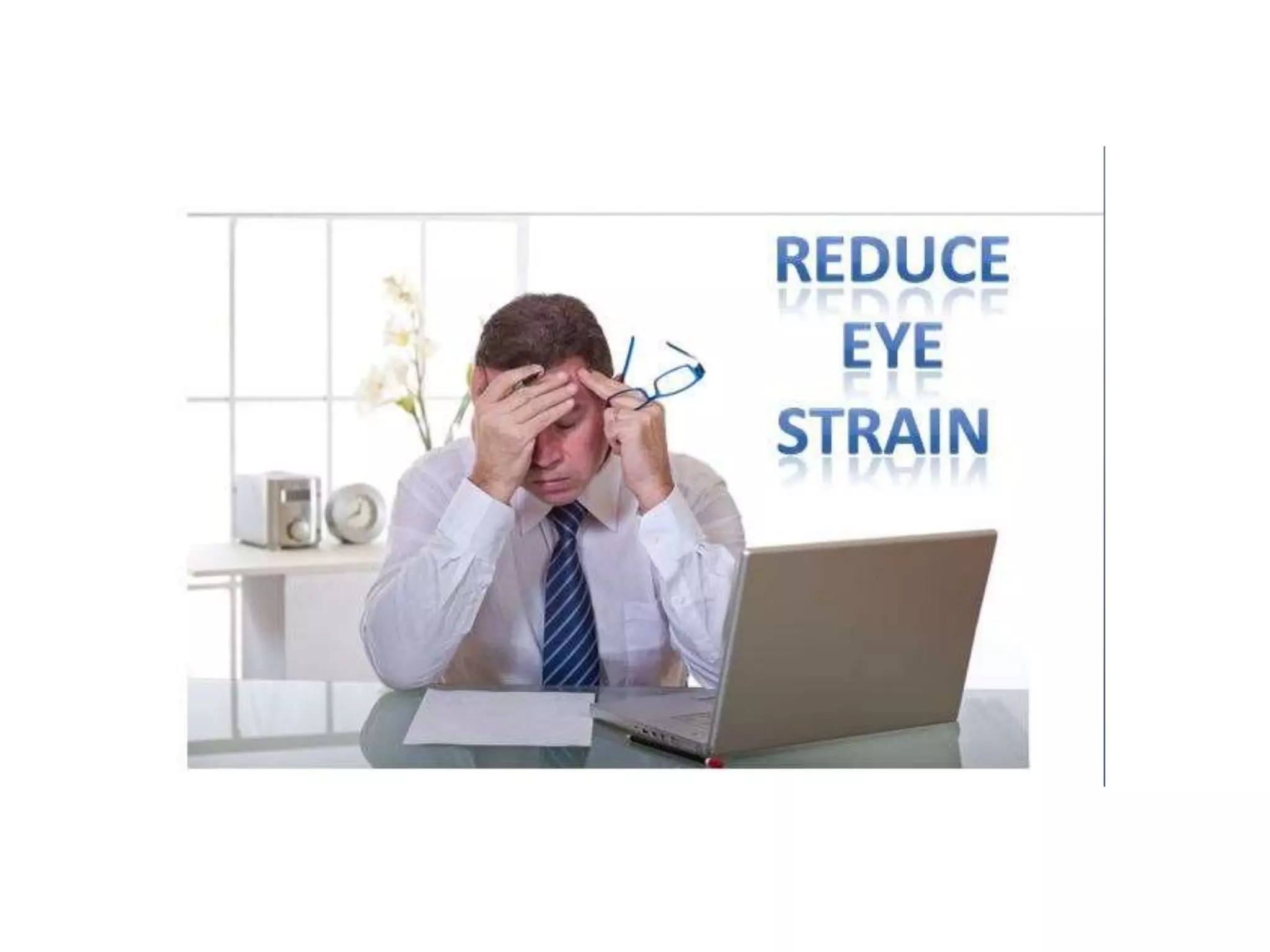
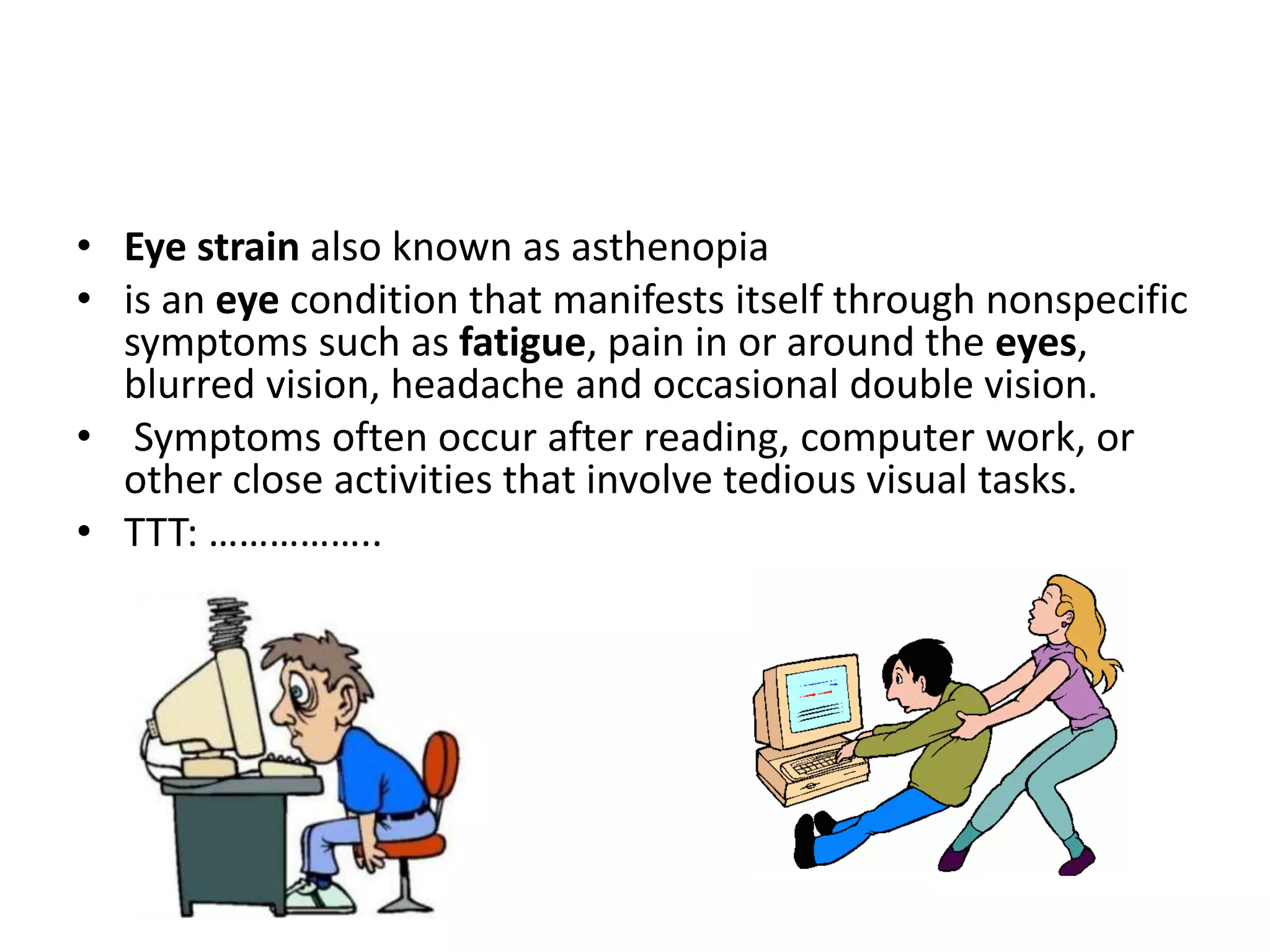
• Eye strain also known as asthenopia
• is an eye condition that manifests itself through nonspecific
symptoms such as fatigue, pain in or around the eyes,
blurred vision, headache and occasional double vision.
• Symptoms often occur after reading, computer work, or
other close activities that involve tedious visual tasks.
• TTT: ……………..
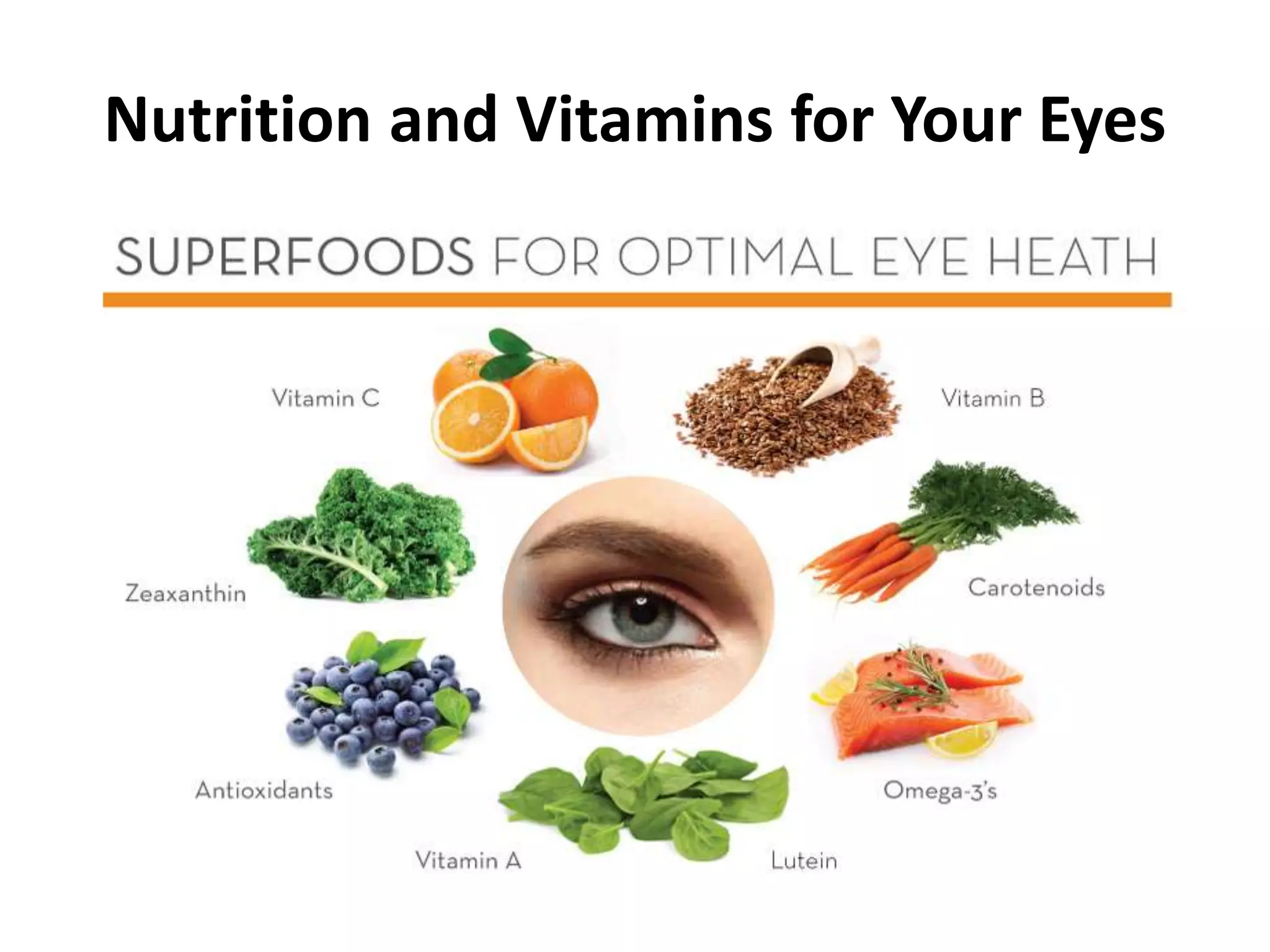
Nutrition and Vitamins for Your Eyes
‫الهامه‬ ‫النقاط‬ ‫على‬ ‫مراجعة‬
•‫الشئ‬‫النصائح‬ ‫في‬ ‫األهم‬‫هو‬‫للعينين‬ ‫الدوري‬ ‫الفحص‬ ‫إجراء‬ ‫ضرورة‬‫تكاسل‬ ‫بدون‬‫هذا‬ ‫و‬
‫قب‬ ‫وقت‬ ‫أسرع‬ ‫في‬ ‫العينين‬ ‫في‬ ‫مشكلة‬ ‫أي‬ ‫عالج‬ ‫المعالج‬ ‫الطبيب‬ ‫يستطيع‬ ‫لكي‬‫تتفاقم‬ ‫أن‬ ‫ل‬
‫أصعب‬ ‫العالج‬ ‫يصبح‬ ‫و‬ ‫المشكلة‬.
•‫الطبية‬ ‫النظارات‬‫إ‬ ‫بل‬ ‫بذلك‬ ‫الطبيب‬ ‫نصحك‬ ‫ذا‬ ‫إرتدائها‬ ‫من‬ ‫تخجل‬ ‫ال‬ ً‫ا‬‫عيب‬ ‫ليست‬‫تصبح‬ ‫نها‬
‫عينيك‬ ‫على‬ ‫تحافظ‬ ‫حتى‬ ‫ضرورة‬.
•‫في‬ ‫ذلك‬ ‫فعل‬ ‫إلى‬ ‫اضطررت‬ ‫إن‬ ‫و‬ ‫كان‬ ‫ظرف‬ ‫أي‬ ‫تحت‬ ‫عينيك‬ ‫في‬ ‫يديك‬ ‫تدخل‬ ‫أال‬ ‫حاول‬‫جب‬
ً‫ا‬‫جيد‬ ‫غسلها‬ ‫يجب‬ ‫و‬ ً‫ا‬‫تمام‬ ‫يديك‬ ‫نظافة‬ ‫من‬ ‫تتأكد‬ ‫أن‬ ‫عليك‬.
•‫الذبا‬ ‫طريق‬ ‫عن‬ ‫تنتقل‬ ‫قد‬ ‫األمراض‬ ‫ألن‬ ‫ذلك‬ ‫و‬ ً‫ا‬‫ضروري‬ ‫عامة‬ ‫بصفة‬ ‫المكان‬ ‫نظافة‬‫لذلك‬ ‫ب‬
‫األخرى‬ ‫الضارة‬ ‫الحشرات‬ ‫و‬ ‫الذباب‬ ‫من‬ ً‫ا‬‫خالي‬ ً‫ا‬‫نظيف‬ ‫المكان‬ ‫على‬ ‫الحفاظ‬ ‫وجب‬.
•‫الصحة‬‫العامة‬‫مرتبطة‬‫العين‬ ‫بصحة‬‫و‬‫يجب‬‫ب‬ ‫تتأثر‬ ‫العينين‬ ‫صحة‬ ‫أن‬ ‫تعلم‬ ‫أن‬‫صحة‬
‫بصحتك‬ ‫تهتم‬ ‫أن‬ ‫فيجب‬ ‫عينين‬ ‫صحة‬ ‫على‬ ‫تحافظ‬ ‫أن‬ ‫أردت‬ ‫إذا‬ ‫لذلك‬ ً‫ا‬‫عموم‬ ‫الجسم‬.
•‫بص‬ ‫الدم‬ ‫ضغط‬ ‫متابعة‬ ‫يجب‬ ‫لذلك‬ ‫العينين‬ ‫سالمة‬ ‫على‬ ‫يؤثر‬ ‫قد‬ ‫الدم‬ ‫ضغط‬ ‫ارتفاع‬‫ورة‬
‫دورية‬.
•‫خال‬ ‫كافية‬ ‫لمدد‬ ‫العينين‬ ‫إغالق‬ ‫و‬ ‫النوم‬ ‫و‬ ‫الراحة‬ ‫من‬ ‫الكافي‬ ‫القسط‬ ‫أخذ‬ ‫عليك‬ ‫يجب‬‫ل‬
‫اليوم‬.
•‫االعتب‬ ‫في‬ ‫األشياء‬ ‫بعض‬ ‫وضع‬ ً‫ا‬‫أيض‬ ‫يجب‬ ‫الكمبيوتر‬ ‫شاشات‬ ‫استخدام‬ ‫عند‬ ‫و‬‫أن‬ ‫منها‬ ‫ار‬
‫كافي‬ ‫بعد‬ ‫لهما‬ ‫العينين‬ ‫يكون‬ ‫و‬ ‫الشاشة‬ ‫مستوى‬ ‫من‬ ‫أعلى‬ ‫العيني‬ ‫مستوى‬ ‫يكون‬‫عن‬
‫يكون‬ ‫ألن‬ ‫يحتاج‬ ‫قد‬ ‫الذي‬ ‫و‬ ‫الشاشة‬60‫الشاشة‬ ‫بنظافة‬ ‫اإلهتمام‬ ً‫ا‬‫أيض‬ ‫المهم‬ ‫من‬ ‫و‬ ‫سم‬
‫التلفزيون‬ ‫شاشة‬ ‫أو‬ ‫الكمبيوتر‬ ‫شاشة‬ ‫كانت‬ ‫سواء‬ ‫نشاهدها‬ ‫التي‬.
•‫آ‬ ‫شئ‬ ‫إلى‬ ‫النظر‬ ‫عليه‬ ‫العمل‬ ‫و‬ ‫الكمبيوتر‬ ‫مشاهدة‬ ‫خالل‬ ً‫ا‬‫جد‬ ‫الضرورية‬ ‫األشياء‬ ‫من‬‫خر‬
‫كل‬10‫العمل‬ ‫إلى‬ ‫أخرى‬ ‫مرة‬ ‫العودة‬ ‫ثم‬ ‫دقائق‬.
•‫و‬‫الصح‬ ‫و‬ ‫الطب‬ ‫مجاالت‬ ‫كافة‬ ‫في‬ ‫ن‬ ‫المتخصصو‬ ‫أغلب‬ ‫ينصحها‬ ‫التي‬ ‫النصائح‬ ‫من‬‫ة‬
‫إ‬ ‫أما‬ ‫يوم‬ ‫كل‬ ‫الماء‬ ‫من‬ ‫لترين‬ ‫بشرب‬ ‫المتخصصون‬ ‫ينصح‬ ‫و‬ ‫المياه‬ ‫شرب‬ ‫هي‬ ً‫ا‬‫عموم‬‫ذا‬
‫ب‬ ‫الخاصة‬ ‫الرطوبة‬ ‫نسبة‬ ‫على‬ ‫الحفاظ‬ ‫في‬ ‫تساعد‬ ‫الماء‬ ‫فإن‬ ‫العين‬ ‫عن‬ ‫الحديث‬ ‫جاء‬‫االعين‬
‫الجفاف‬ ‫من‬ ‫تحميها‬ ‫و‬.
•‫غرفة‬ ‫أو‬ ‫العمل‬ ‫مكان‬ ‫أي‬ ‫طويل‬ ‫وقت‬ ‫فيها‬ ‫نجلس‬ ‫التي‬ ‫الغرفة‬ ‫إلضاءة‬ ‫بالنسبة‬ ‫أما‬
‫مناسبة‬ ‫فيها‬ ‫اإلضاءة‬ ‫تكون‬ ‫أن‬ ‫مراعاة‬ ‫فيجب‬ ‫المنزل‬ ‫في‬ ‫الجلوس‬.
•‫يج‬ ‫ال‬ ‫و‬ ً‫ا‬‫مستقيم‬ ‫الجلوس‬ ‫يكون‬ ‫أن‬ ‫فينصح‬ ‫الكمبيوتر‬ ‫على‬ ‫العمل‬ ‫حالة‬ ‫في‬ ‫و‬ً‫ا‬‫أبد‬ ‫ب‬
‫الكمبيوتر‬ ‫لشاشة‬ ‫أو‬ ‫للتلفزيون‬ ‫المشاهدة‬ ‫أوقات‬ ‫في‬ ‫اإلستلقاء‬.
Thanks

Eye health campaign workshop IFMSA

  • 1.
    Eye Health CampaignWorkshop Mohamed Abdelmongy local Officer Assistant on Public Health (LPO Assistant) EYE Health Project Local Coordinator
  • 3.
    Eyes is aVery Precious Gift from the GOD For Everyone In the World.
  • 4.
  • 5.
    Eyes: The Windowsto Your Health sixty year old man walked into his ophthalmologist for a routine annual eye exam, and walked out with something he wasn’t expecting! "I saw a microscopic clot in the blood vessels of his retina, So I reffer him to an urgent follow-up with his cardiologist. “ ophthalmologist said. The follow-up by cardiologist revealed a much bigger mass residing in his carotid artery, putting him at high risk for a stroke.
  • 6.
    An Eye ExamMay Be Life-Saving A potential stroke is just one of the health conditions that might be visible in the eyes, which are not only the windows to our soul, but also to our body's overall health. diabetes, high blood pressure, autoimmune diseases, sexually transmitted diseases and cancers are among the illnesses that can be detected during an eye exam.
  • 7.
    Why ? That's becausethe eye is the only place in the body where a doctor can have an unobstructed view of our blood vessels, nerves and connecting tissue — without any need for surgery. Because the eye has the same microscopic tissue as our other major organs, and is an important part of our larger nervous system, abnormalities spotted in the eye may signal the same changes in other parts of the body.
  • 8.
    For example, • ophthalmologistsoften detect diabetes during the dilated portion of the eye exam by observing changes or damage in the blood vessels of the retina, known as diabetic retinopathy. In these cases, the disease may show up in the eye tissue even before it does in a blood sugar test. Thanks to early detection during eye exams, people diagnosed in this beginning stage of diabetes potentially can avoid vision loss and other serious complications. • Loss of side vision, which can be a symptom of glaucoma, also can indicate serious health issues that go beyond vision. It can map back to a problem in certain regions of the brain, indicating a stroke, head trauma, tumor, or brain bleed.
  • 9.
    Eye Exams: HowOften and What to Expect? The American Academy of Ophthalmology recommends all adults get a baseline eye exam from an ophthalmologist by age 40, when early signs of disease and vision changes may start to occur. But, If you have an eye disease or a risk factor for developing one, such as diabetes, high blood pressure or a family history of eye disease, you should see an ophthalmologist even if you are younger than 40. Adults age 65 and over should have a comprehensive eye exam every one years.
  • 10.
    An eye examis a relatively simple and comfortable procedure, Your eye doctor will check: • Your medical history • Your visual acuity • Your pupils • Your side vision • Your eye movement • Your prescription for corrective lenses • Your eye pressure • The front part of your eye • Your retina and optic nerve
  • 11.
    When to havean eye exam Several factors may determine how frequently you need an eye exam, including your age, health and risk of developing eye problems. General guidelines are as follows: Children 5 years and younger : For children under 3, your pediatrician will likely look for the most common eye problems — lazy eye, crossed eyes or turned-out eyes. But in pre-mature infants? School-age children and adolescents. before he or she enters first grade. If the child has no symptoms of vision problems and no family history of vision problems, have his or her vision rechecked every one to two years. Otherwise, schedule eye exams based on the advice of your eye doctor. Adults : In general, if you're healthy and have no symptoms of vision problems, have your eyes checked on this schedule: Every three years in your 20s and 30s Every one years from 40 to 54 Every one years from 55 to 64 Every 6 month years after age 65 Have your eyes checked more often if you: Wear glasses or contact lenses Have a family history of eye disease Have a chronic disease that puts you at greater risk of eye disease, such as diabetes
  • 13.
    statistics • 285 milionpeople around the world are blind or visually impaired. • About 80% of these cases are avoidable. • Poorer population are more affected. • 90% of these patients lives in developing countries.
  • 14.
    so, what’s thecommon causes of visual impairment ? • 42% Refractive errors. • 33% Cataract. • 25% Others.
  • 15.
    cause prevalence Cataract 47.8% Glaucoma12.3% Trachoma 3.6% (but in Egypt ?) Corneal Opacity 5.1% Diabetic Retinopathy 4.8% AMD 8.7% Blindness in children 3.9%
  • 16.
    NOW, we willtalk in brief about the common eye diseases :
  • 17.
    Refractive Errors When lightis not focused properly, it causes blurry vision. Refractive errors can usually be corrected with glasses, contacts, or surgery. They include: • myopia (nearsightedness), which is when far-away objects look blurry • hyperopia (farsightedness), which is when close-up objects look blurry • astigmatism, which can result in blurry vision because the cornea is not perfectly shaped to direct light into the eye • presbyopia, which is farsightedness caused by the loss of elasticity of the eye’s lens due to aging • TTT: …………………………
  • 18.
    Cataract Cataract is aclouding of the lens, causing blurry or color- tinted vision. • People with cataracts often report “haloes” surrounding objects that they are looking at, particularly at night. It is most common in older people. • cataracts can be removed by surgery that replaces the lens with an artificial lens.
  • 19.
    Glaucoma • Glaucoma isincreased pressure of the fluid inside the eye, which can cause optic nerve damage. • Glaucoma is a common cause of blindness, particularly in diabetic patients.
  • 21.
    Age-Related Macular Degeneration •Age-related macular degeneration (AMD) is gradual damage to the cells of the macula. • This condition is most common in people over 60 years old. It causes blurry vision, especially in the center of the field of view. • According to the Foundation Fighting Blindness, AMD is the leading cause of blindness among people over age 55 in the United States.
  • 23.
    Amblyopia • Commonly referredto a "lazy eye,“ • amblyopia occurs when one eye has worse vision than the other, and the brain begins to favor the better eye. • This will occur if one of the eyes is blocked from producing clear images during the critical years from ages 0 to 6. • One eye may be inhibited by problems such as a lid droop, tumor, or crossed eyes (strabismus) that are not fixed when a child is young. • It is important to have young children evaluated by an eye doctor in order to ensure that subtle signs of amblyopia are not present.
  • 24.
    Diabetic Retinopathy Diabetic retinopathyis damage to the blood vessels of the retina caused by diabetes. • It causes blurred or dark spots in the field of vision and will eventually lead to blindness. • The best way to avoid these vision problems is to keep your blood sugars under control and see your eye doctor every year for a dilated eye exam. • TTT and Invest. : ……………..
  • 25.
    Retinal Detachment orTear A tear in or detachment of the retina causes blurry vision or partial loss of vision.
  • 26.
    Dry Eye Syndrome Dryeye is a lack of proper tears, usually due to a problem with the tear ducts or eyelids, or a problem with certain medications. This condition can cause pain and blurry vision.
  • 27.
    Trachoma • also calledgranular conjunctivitis, Egyptian ophthalmia, and blinding trachoma, • is an infectious disease caused by bacterium Chlamydia trachomatis. • The infection causes a roughening of the inner surface of the eyelids. • This roughening can lead to pain in the eyes, breakdown of the outer surface or cornea of the eyes, and possibly blindness. • Untreated, repeated trachoma infections can result in a form of permanent blindness
  • 30.
    • Eye strainalso known as asthenopia • is an eye condition that manifests itself through nonspecific symptoms such as fatigue, pain in or around the eyes, blurred vision, headache and occasional double vision. • Symptoms often occur after reading, computer work, or other close activities that involve tedious visual tasks. • TTT: ……………..
  • 31.
  • 32.
    ‫الهامه‬ ‫النقاط‬ ‫على‬‫مراجعة‬ •‫الشئ‬‫النصائح‬ ‫في‬ ‫األهم‬‫هو‬‫للعينين‬ ‫الدوري‬ ‫الفحص‬ ‫إجراء‬ ‫ضرورة‬‫تكاسل‬ ‫بدون‬‫هذا‬ ‫و‬ ‫قب‬ ‫وقت‬ ‫أسرع‬ ‫في‬ ‫العينين‬ ‫في‬ ‫مشكلة‬ ‫أي‬ ‫عالج‬ ‫المعالج‬ ‫الطبيب‬ ‫يستطيع‬ ‫لكي‬‫تتفاقم‬ ‫أن‬ ‫ل‬ ‫أصعب‬ ‫العالج‬ ‫يصبح‬ ‫و‬ ‫المشكلة‬. •‫الطبية‬ ‫النظارات‬‫إ‬ ‫بل‬ ‫بذلك‬ ‫الطبيب‬ ‫نصحك‬ ‫ذا‬ ‫إرتدائها‬ ‫من‬ ‫تخجل‬ ‫ال‬ ً‫ا‬‫عيب‬ ‫ليست‬‫تصبح‬ ‫نها‬ ‫عينيك‬ ‫على‬ ‫تحافظ‬ ‫حتى‬ ‫ضرورة‬. •‫في‬ ‫ذلك‬ ‫فعل‬ ‫إلى‬ ‫اضطررت‬ ‫إن‬ ‫و‬ ‫كان‬ ‫ظرف‬ ‫أي‬ ‫تحت‬ ‫عينيك‬ ‫في‬ ‫يديك‬ ‫تدخل‬ ‫أال‬ ‫حاول‬‫جب‬ ً‫ا‬‫جيد‬ ‫غسلها‬ ‫يجب‬ ‫و‬ ً‫ا‬‫تمام‬ ‫يديك‬ ‫نظافة‬ ‫من‬ ‫تتأكد‬ ‫أن‬ ‫عليك‬. •‫الذبا‬ ‫طريق‬ ‫عن‬ ‫تنتقل‬ ‫قد‬ ‫األمراض‬ ‫ألن‬ ‫ذلك‬ ‫و‬ ً‫ا‬‫ضروري‬ ‫عامة‬ ‫بصفة‬ ‫المكان‬ ‫نظافة‬‫لذلك‬ ‫ب‬ ‫األخرى‬ ‫الضارة‬ ‫الحشرات‬ ‫و‬ ‫الذباب‬ ‫من‬ ً‫ا‬‫خالي‬ ً‫ا‬‫نظيف‬ ‫المكان‬ ‫على‬ ‫الحفاظ‬ ‫وجب‬. •‫الصحة‬‫العامة‬‫مرتبطة‬‫العين‬ ‫بصحة‬‫و‬‫يجب‬‫ب‬ ‫تتأثر‬ ‫العينين‬ ‫صحة‬ ‫أن‬ ‫تعلم‬ ‫أن‬‫صحة‬ ‫بصحتك‬ ‫تهتم‬ ‫أن‬ ‫فيجب‬ ‫عينين‬ ‫صحة‬ ‫على‬ ‫تحافظ‬ ‫أن‬ ‫أردت‬ ‫إذا‬ ‫لذلك‬ ً‫ا‬‫عموم‬ ‫الجسم‬. •‫بص‬ ‫الدم‬ ‫ضغط‬ ‫متابعة‬ ‫يجب‬ ‫لذلك‬ ‫العينين‬ ‫سالمة‬ ‫على‬ ‫يؤثر‬ ‫قد‬ ‫الدم‬ ‫ضغط‬ ‫ارتفاع‬‫ورة‬ ‫دورية‬.
  • 33.
    •‫خال‬ ‫كافية‬ ‫لمدد‬‫العينين‬ ‫إغالق‬ ‫و‬ ‫النوم‬ ‫و‬ ‫الراحة‬ ‫من‬ ‫الكافي‬ ‫القسط‬ ‫أخذ‬ ‫عليك‬ ‫يجب‬‫ل‬ ‫اليوم‬. •‫االعتب‬ ‫في‬ ‫األشياء‬ ‫بعض‬ ‫وضع‬ ً‫ا‬‫أيض‬ ‫يجب‬ ‫الكمبيوتر‬ ‫شاشات‬ ‫استخدام‬ ‫عند‬ ‫و‬‫أن‬ ‫منها‬ ‫ار‬ ‫كافي‬ ‫بعد‬ ‫لهما‬ ‫العينين‬ ‫يكون‬ ‫و‬ ‫الشاشة‬ ‫مستوى‬ ‫من‬ ‫أعلى‬ ‫العيني‬ ‫مستوى‬ ‫يكون‬‫عن‬ ‫يكون‬ ‫ألن‬ ‫يحتاج‬ ‫قد‬ ‫الذي‬ ‫و‬ ‫الشاشة‬60‫الشاشة‬ ‫بنظافة‬ ‫اإلهتمام‬ ً‫ا‬‫أيض‬ ‫المهم‬ ‫من‬ ‫و‬ ‫سم‬ ‫التلفزيون‬ ‫شاشة‬ ‫أو‬ ‫الكمبيوتر‬ ‫شاشة‬ ‫كانت‬ ‫سواء‬ ‫نشاهدها‬ ‫التي‬. •‫آ‬ ‫شئ‬ ‫إلى‬ ‫النظر‬ ‫عليه‬ ‫العمل‬ ‫و‬ ‫الكمبيوتر‬ ‫مشاهدة‬ ‫خالل‬ ً‫ا‬‫جد‬ ‫الضرورية‬ ‫األشياء‬ ‫من‬‫خر‬ ‫كل‬10‫العمل‬ ‫إلى‬ ‫أخرى‬ ‫مرة‬ ‫العودة‬ ‫ثم‬ ‫دقائق‬. •‫و‬‫الصح‬ ‫و‬ ‫الطب‬ ‫مجاالت‬ ‫كافة‬ ‫في‬ ‫ن‬ ‫المتخصصو‬ ‫أغلب‬ ‫ينصحها‬ ‫التي‬ ‫النصائح‬ ‫من‬‫ة‬ ‫إ‬ ‫أما‬ ‫يوم‬ ‫كل‬ ‫الماء‬ ‫من‬ ‫لترين‬ ‫بشرب‬ ‫المتخصصون‬ ‫ينصح‬ ‫و‬ ‫المياه‬ ‫شرب‬ ‫هي‬ ً‫ا‬‫عموم‬‫ذا‬ ‫ب‬ ‫الخاصة‬ ‫الرطوبة‬ ‫نسبة‬ ‫على‬ ‫الحفاظ‬ ‫في‬ ‫تساعد‬ ‫الماء‬ ‫فإن‬ ‫العين‬ ‫عن‬ ‫الحديث‬ ‫جاء‬‫االعين‬ ‫الجفاف‬ ‫من‬ ‫تحميها‬ ‫و‬. •‫غرفة‬ ‫أو‬ ‫العمل‬ ‫مكان‬ ‫أي‬ ‫طويل‬ ‫وقت‬ ‫فيها‬ ‫نجلس‬ ‫التي‬ ‫الغرفة‬ ‫إلضاءة‬ ‫بالنسبة‬ ‫أما‬ ‫مناسبة‬ ‫فيها‬ ‫اإلضاءة‬ ‫تكون‬ ‫أن‬ ‫مراعاة‬ ‫فيجب‬ ‫المنزل‬ ‫في‬ ‫الجلوس‬. •‫يج‬ ‫ال‬ ‫و‬ ً‫ا‬‫مستقيم‬ ‫الجلوس‬ ‫يكون‬ ‫أن‬ ‫فينصح‬ ‫الكمبيوتر‬ ‫على‬ ‫العمل‬ ‫حالة‬ ‫في‬ ‫و‬ً‫ا‬‫أبد‬ ‫ب‬ ‫الكمبيوتر‬ ‫لشاشة‬ ‫أو‬ ‫للتلفزيون‬ ‫المشاهدة‬ ‫أوقات‬ ‫في‬ ‫اإلستلقاء‬.
  • 36.