ADULT BLS AND ACLS
OBJECTIVES:
At the end of this lecture you would be able to:
• identify the steps of adult basic life support.
• recognise the signs of someone needing CPR.
• perform high quality CPR for an adult.
• describe the steps of airway control and management.
• discuss the management of cardiac arrest.
• enumerate the drug used during cardiac arrest management.
INDIAN SCENARIO
• Heart attacks are the leading cause of death in India .
• one -fifth of the deaths in India are from coronary heart disease.
• By the year 2020 ,it will account for one-third of all the deaths in the
country. There is an estimate of 45 million coronary artery disease in
India .
• With the increasing number of young Indians hooked to roller coastal
lifestyle and falling pray to coronary artery disease,the future looks even
grimmer
• Despite recent gains, less than 40% of adults receive layperson-initiated
CPR, and fewer than 12% have an AED applied before EMS arrival.
LIFE IS WHY?
DEFINITION OF CPR
• Cardiopulmonary resuscitation (CPR) is an emergency
procedure that combines chest compressions often with
artificial ventilation in an effort to manually preserve intact
brain function until further measures are taken to restore
spontaneous blood circulation and breathing in a person who
is cardiac arrest.
CPR CONSISTS OF-
CHEST COMPRESSION
AIRWAY
BREATHING
HIGH-QUALITY CPR IS WHY?
EARLY RECOGNITION AND CPR ARE CRUCIAL FOR SURVIVAL
FROM CARDIAC ARREST. BY LEARNING HIGH-QUALITY CPR,
YOU WILL HAVE THE ABILITY TO IMPROVE PATIENT
OUTCOMES AND SAVE MORE LIVES
Building Blocks of CPR
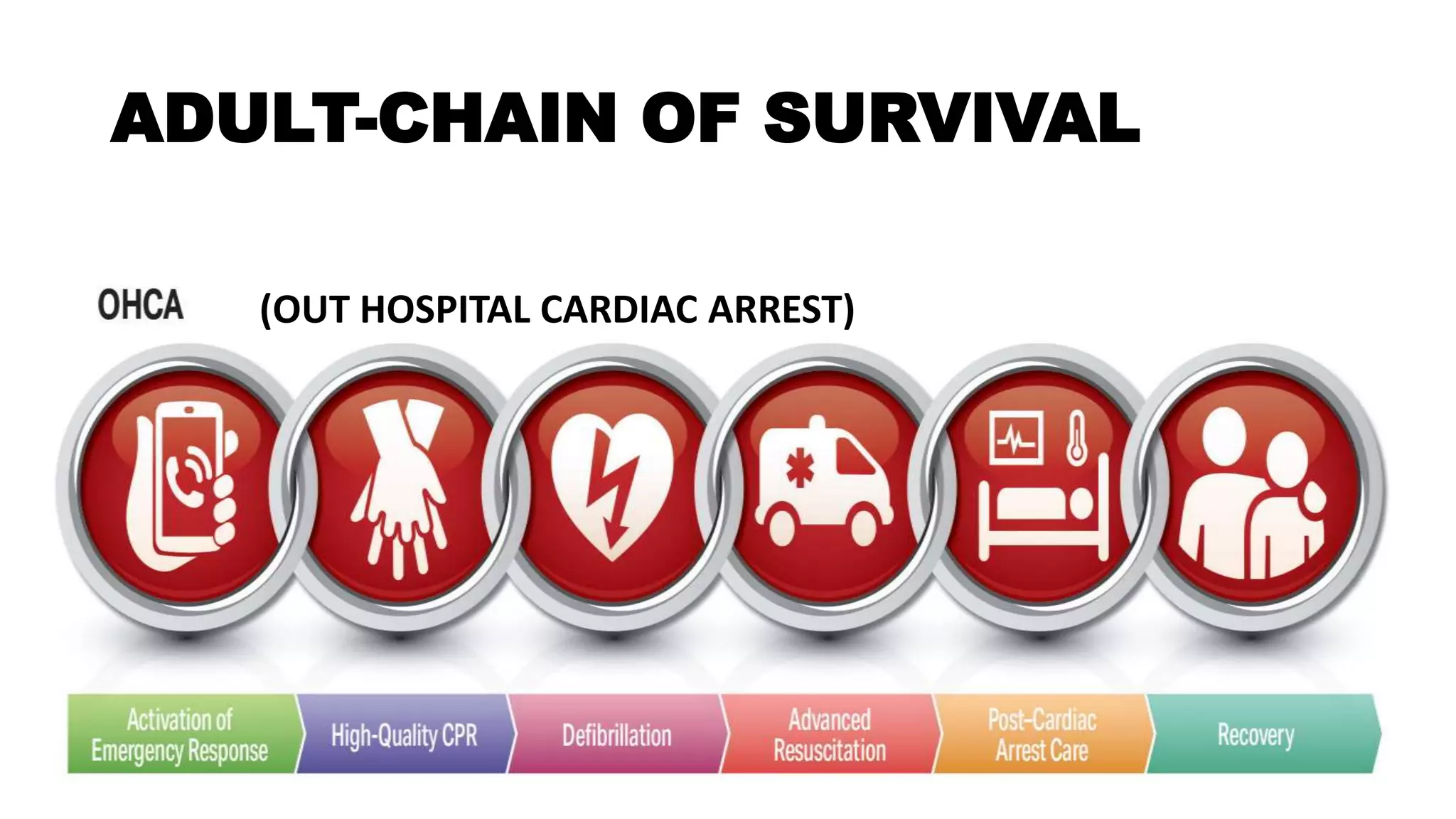
ADULT-CHAIN OF SURVIVAL
(OUT HOSPITAL CARDIAC ARREST)
IN HOSITAL CARDIAC ARREST
CHAIN OF SURVIVAL- INCLUDING 6TH STEP : RECOVERY
BLS ALGORITHM
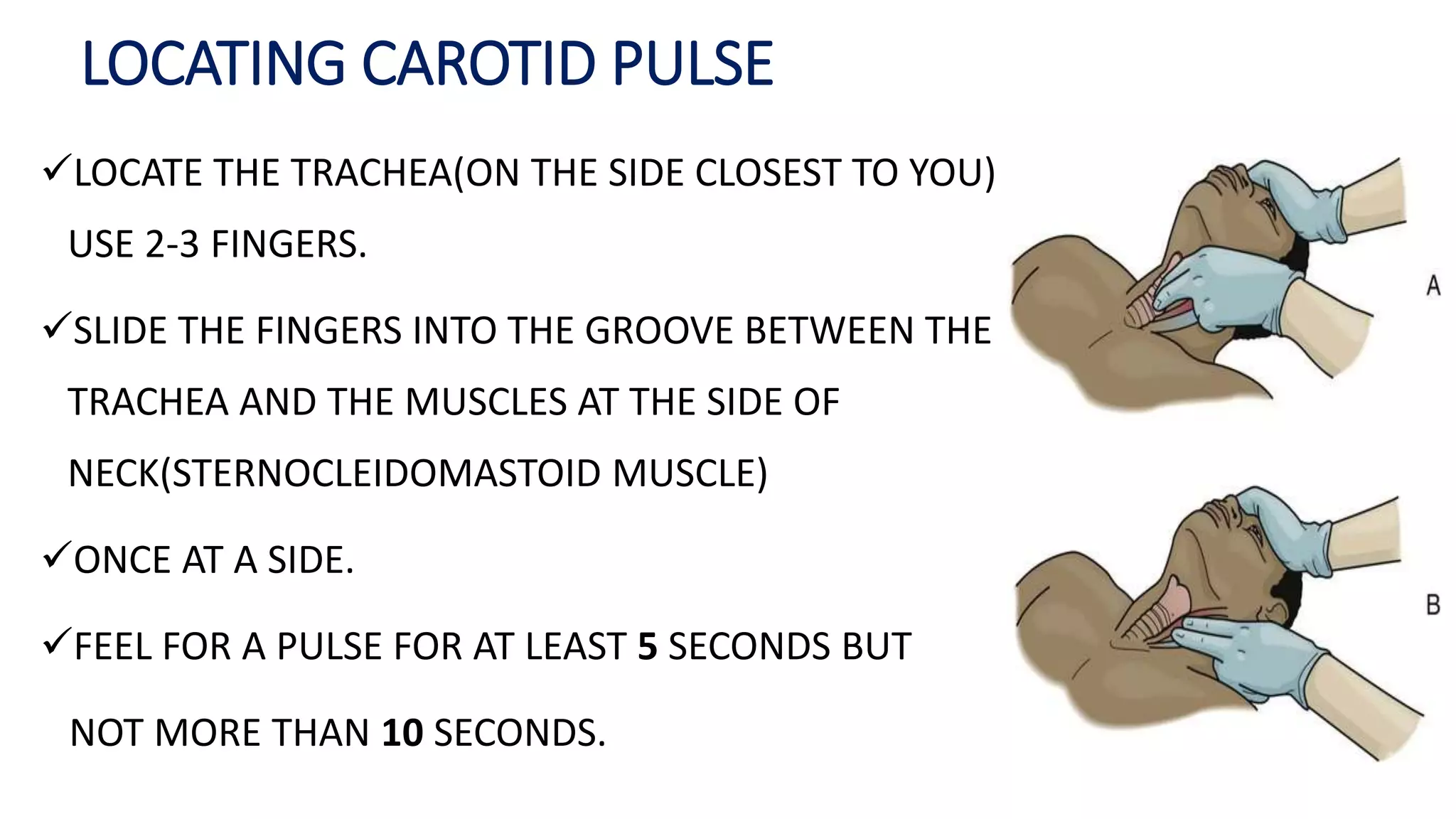
LOCATING CAROTID PULSE
LOCATE THE TRACHEA(ON THE SIDE CLOSEST TO YOU)
USE 2-3 FINGERS.
SLIDE THE FINGERS INTO THE GROOVE BETWEEN THE
TRACHEA AND THE MUSCLES AT THE SIDE OF
NECK(STERNOCLEIDOMASTOID MUSCLE)
ONCE AT A SIDE.
FEEL FOR A PULSE FOR AT LEAST 5 SECONDS BUT
NOT MORE THAN 10 SECONDS.
AIRWAY MANEUVERS
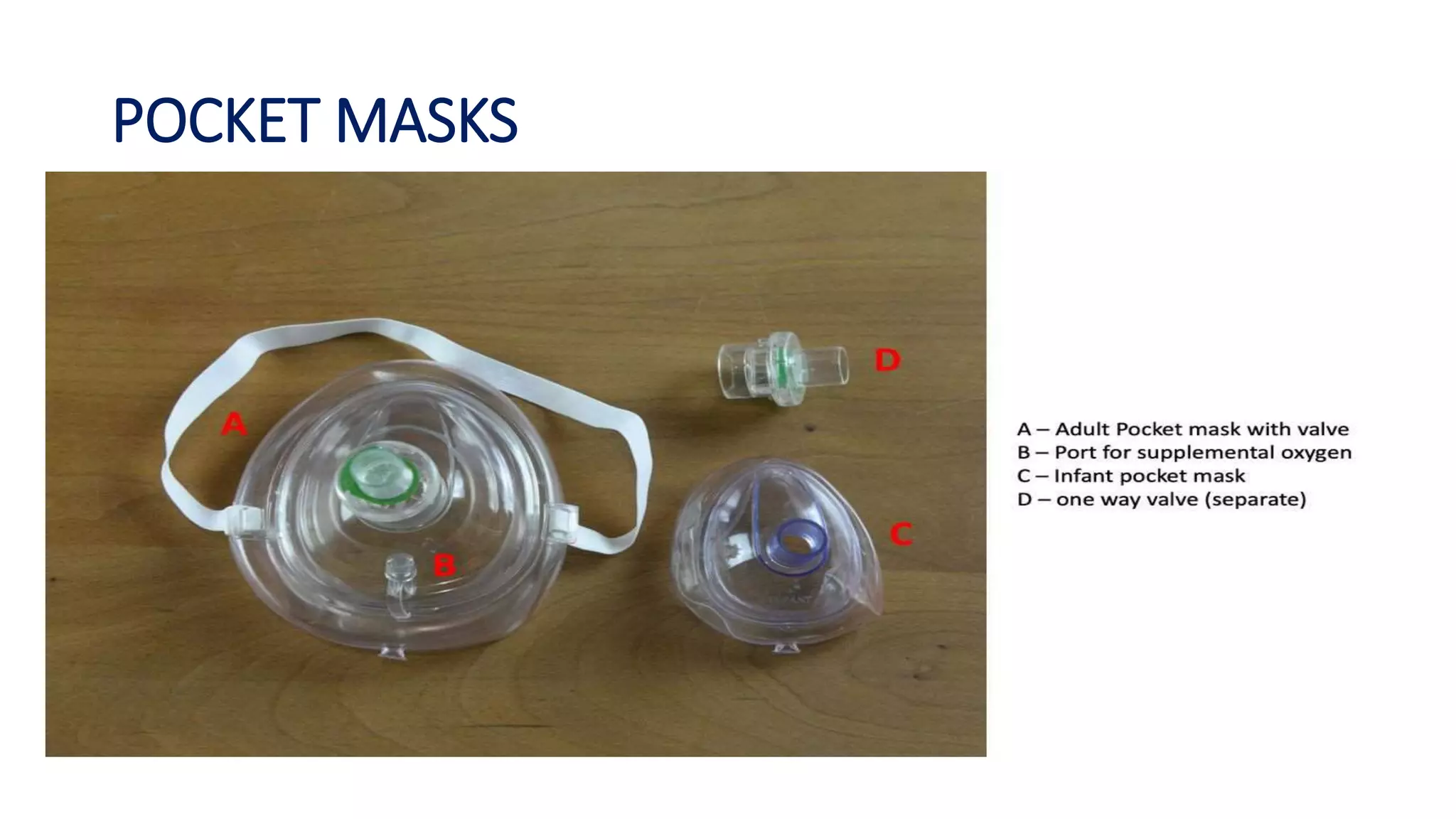
POCKET MASKS
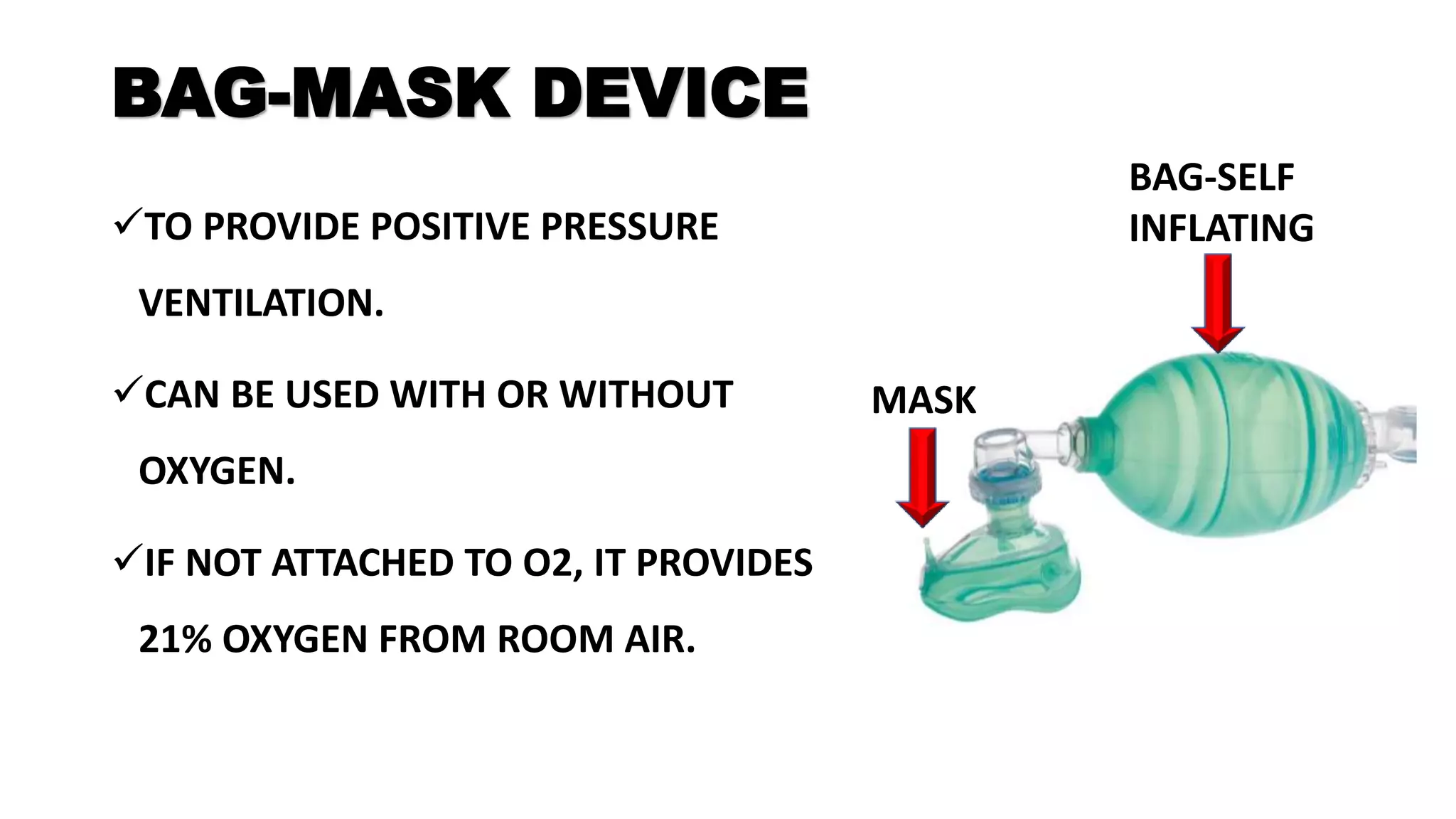
BAG-MASK DEVICE
TO PROVIDE POSITIVE PRESSURE
VENTILATION.
CAN BE USED WITH OR WITHOUT
OXYGEN.
IF NOT ATTACHED TO O2, IT PROVIDES
21% OXYGEN FROM ROOM AIR.
BAG-SELF
INFLATING
MASK
TECHNIQES TO HOLD
PERFORM A HEAD TILT
PLACE NARROW PORTION AT THE BRIDGE
OF NOSE.
USE THUMB AND INDEX FINGER TO MAKE A
“C”
USE REMAINING FINGERS TO LIFT THE
ANGLES OF THE JAW(3 FINGER FORMS A “E”
SHAPE.
EACH BREATH OVER 1 SECOND-CHECK FOR
CHEST RISE SIMULTANEOUSLY.
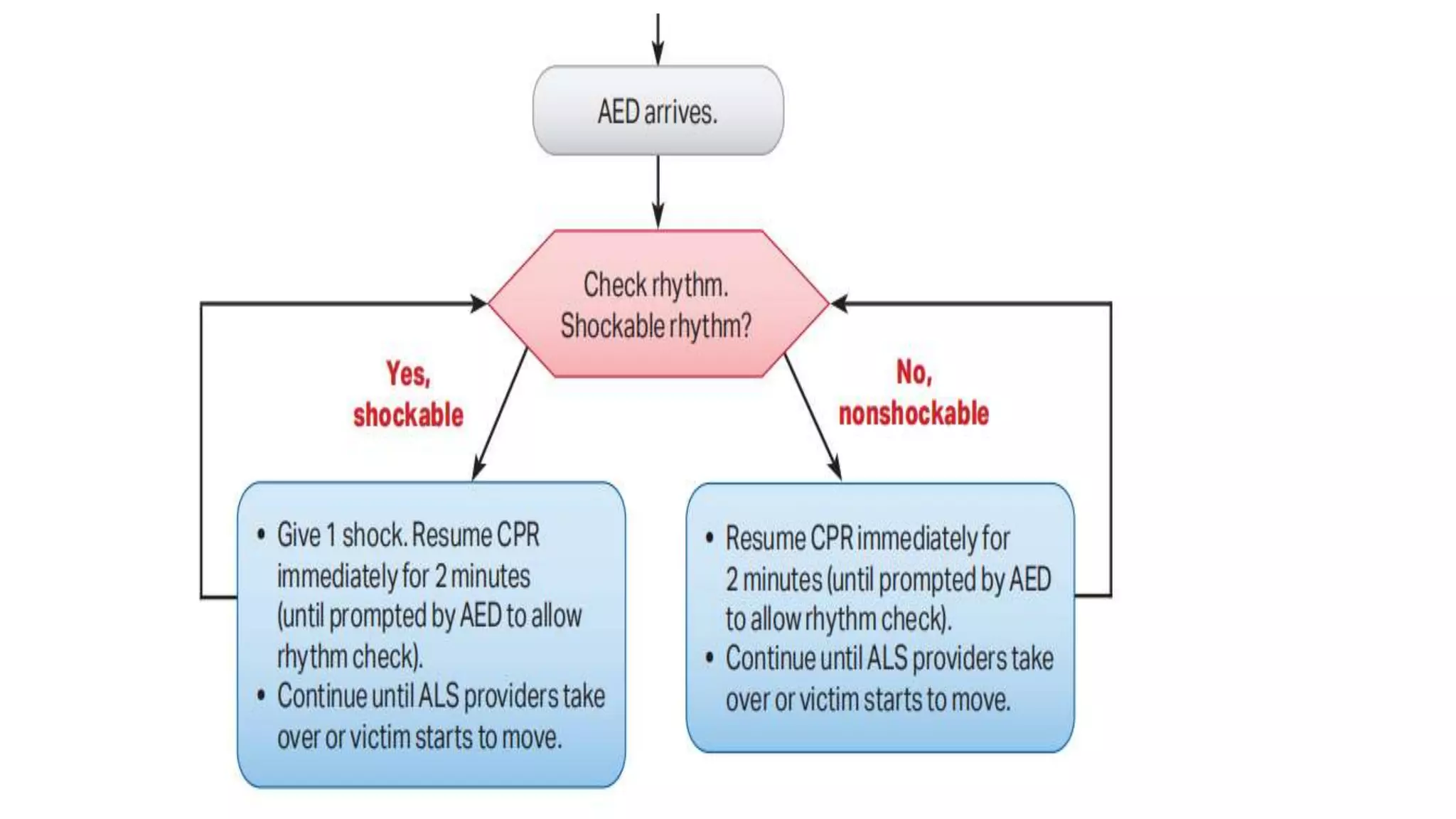
AUTOMATED EXTERNAL DEFIBRILLATOR(AED)
AED A LIGHTWEIGHT , PORTABLE,
COMPUTERIZED DEVICE.
CAN IDENTIFY AN ABNORMAL HEART
RHYTHM THAT NEEDS A SHOCK.
EASY TO USE.
PLACEMENT OF PADS
ANTEROLATERAL ANTEROPOSTERIOR
HOW TO USE AN AED
BLS-SEQUENCE
VERIFY SCENE SAFETY
CHECK FOR RESPONSIVENESS
CALL FOR HELP
ASSESS FOR BREATHING AND PULSE SIMULTANEOUSLY
START CPR
RESQUE BREATHING
GET AED
CONTINUE TILL ALS PROVIDER TAKES OVER
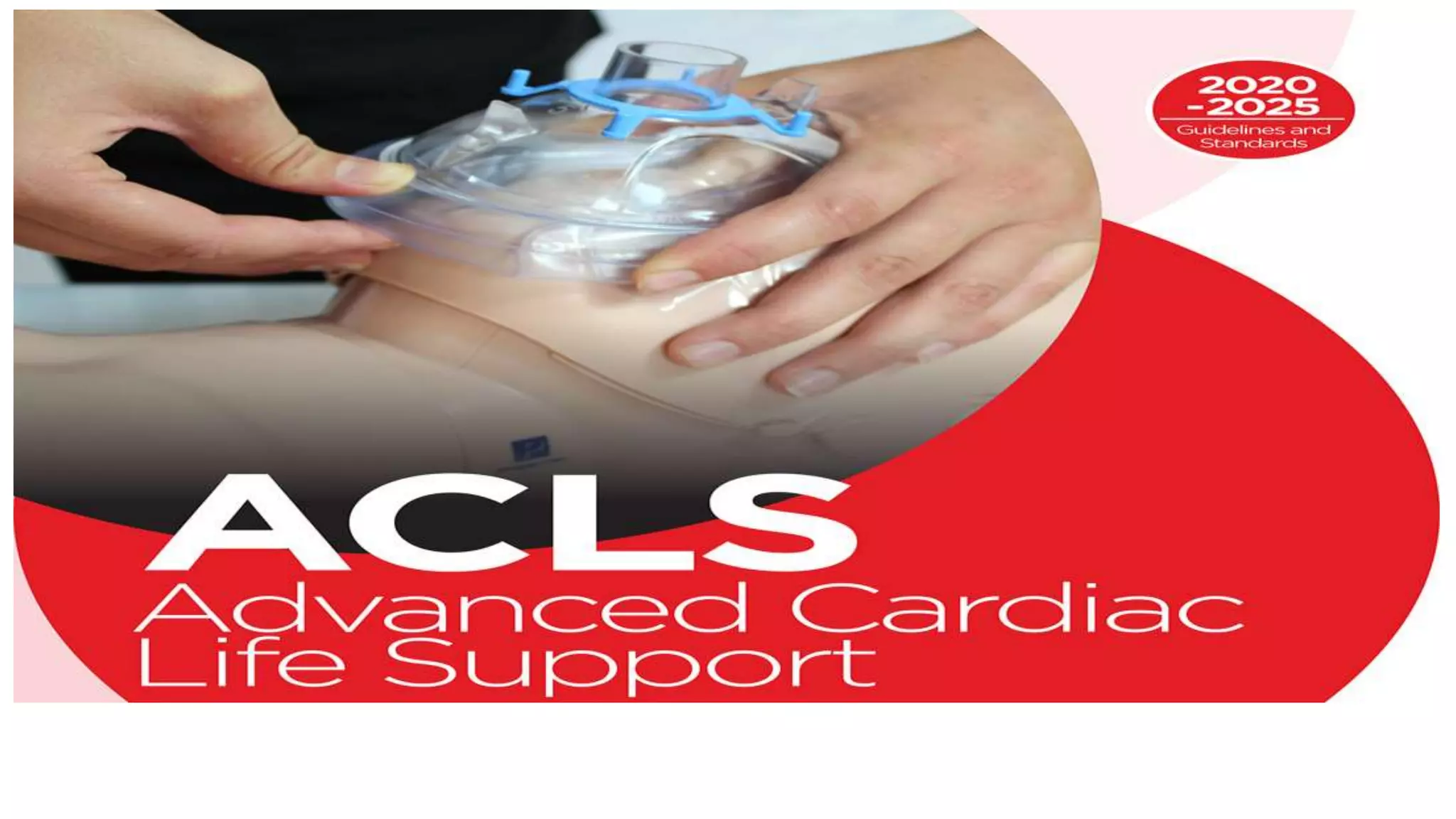
WHAT IS ACLS?
• Advanced cardiac life support (ACLS) refers to a set of
clinical interventions for the urgent treatment of cardiac arrest
,stroke and other life threatening cardiovascular emergency
,as well as the knowledge and skills to deploy those
interventions.
ACLS ALGORITHM
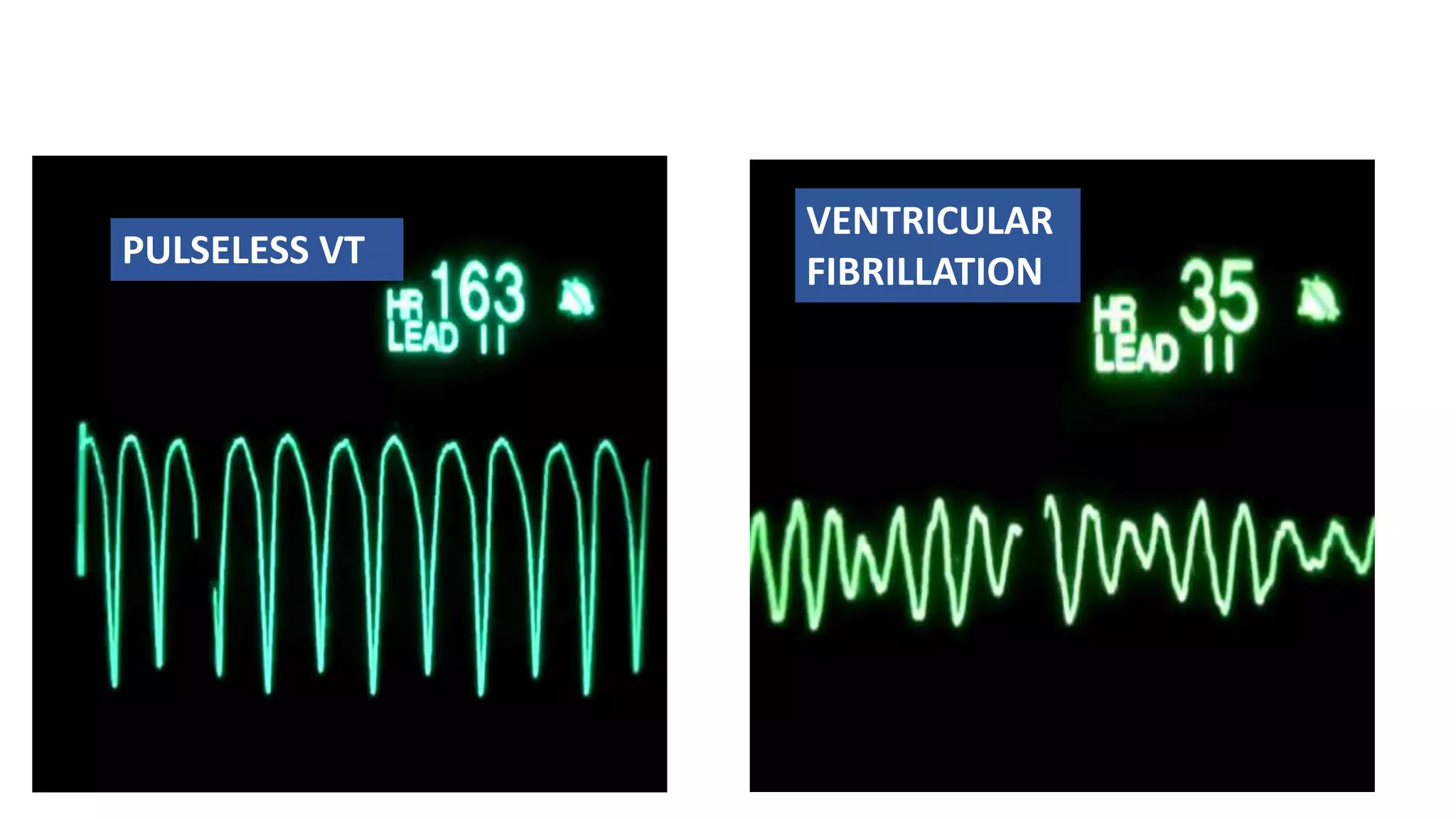
PULSELESS VT
VENTRICULAR
FIBRILLATION
ASYSTOLE PULSELESS ELECTRICAL
ACTIVITY
CPR QUALITY
• Push hard (at least 2inches o 5cm
and fast (100-120/min) and allow
complete chest recoil.
• Minimise interruptions in
compressions
• Avoid excessive ventilation .
• Change compression every 2 min
or sooner if fatigued.
• If no advanced airway ,30:2
compression -ventilation ratio
• Quantitative waveform
capnography
-if PETCO2 is low or
decreasing,reassess CPR quality
SHOCK ENERGY FOR DEFIBRILLATION
BIPHASIC:
• Manufacturer recommendation(eg.
initial dose of 120-200J ),if unknown
use maximum available
• second and subsequent doses should
be equivalent ,and higher doses may
be considered .
MONOPHASIC(360 J)
DRUG THERAPY
• Epinephrine IV/IO dose:1mg
every 3-5min
• Amiodarone IV/IO dose
-First dose: 300mg bolus
-second dose: 150mg
or
• lidocaine IV /IO dose :
-First dose:1-1.5mg /kg
-Second dose :0.5 -0.75mg/kg
ADVANCED AIRWAY
• Endotracheal intubation or
supraglotic advanced airway
• waveform capnography or
capnometry to cofirm and
monitor ET Tube placement
• Once advanced airway in place
give one breath every 6seconds
(10 breaths per minute) with
continuous chest compressions
REVERSIBLE CAUSES
• Hypovolemia
• Hypoxia
• Hydrogen ion(Acidosis)
• Hypo-/Hyperkalemia
• Hypothermia
• Tension pneumothorax
• Tamponade,Cardiac
• Toxins
• Thrombosis,Pulmonary
• Thrombosis,Coronary
5 H’S 5 T’S
RETURN OF SPONTANEOUS
CIRCULATION(ROSC)
• Pulse and blood pressure
• Abrupt sustained increase in
PETCO2(typically more than or equal to
40mm Hg)
• Spontaneous arterial pressure waves with
intraarterial monitoring
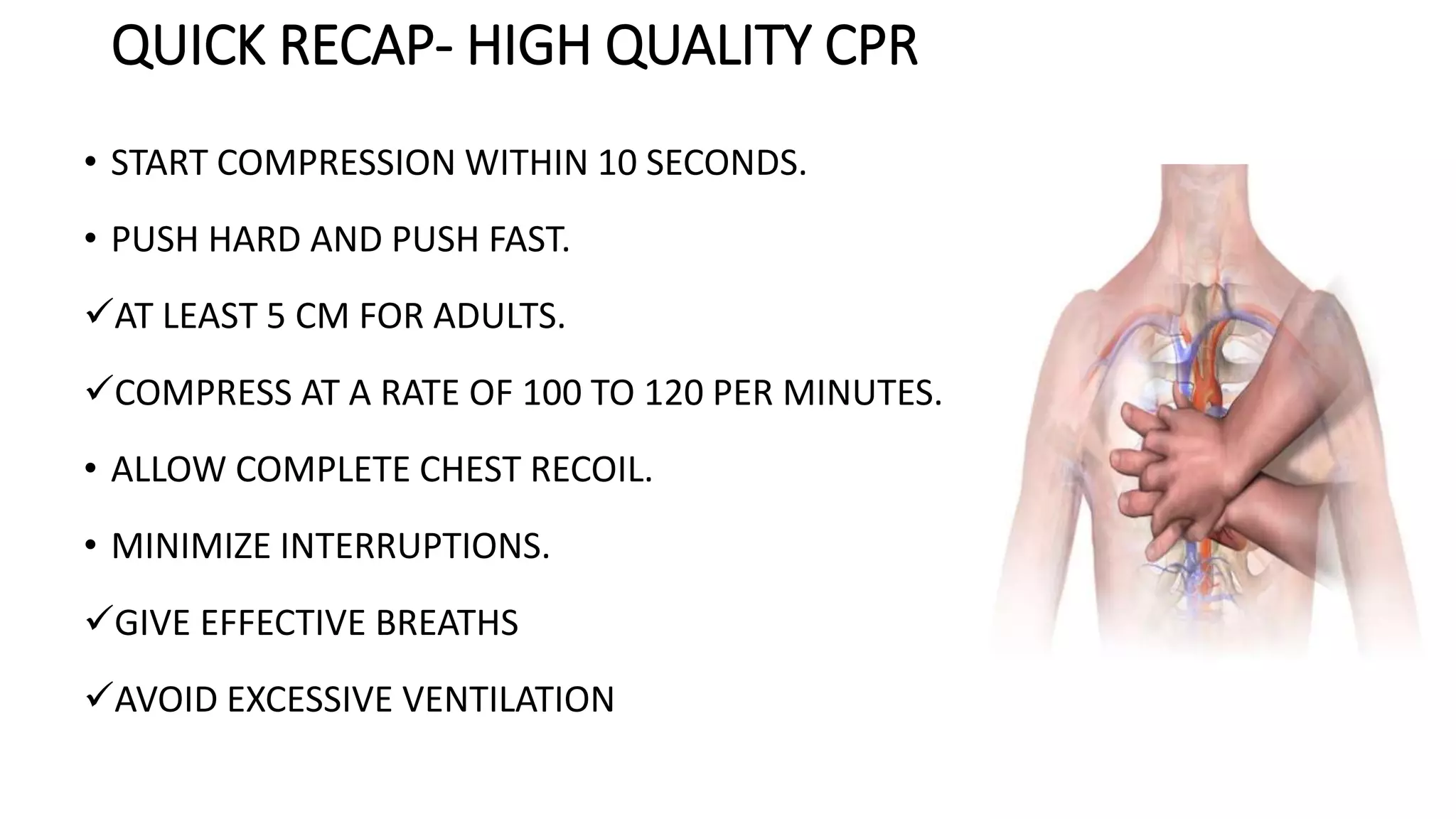
QUICK RECAP- HIGH QUALITY CPR
• START COMPRESSION WITHIN 10 SECONDS.
• PUSH HARD AND PUSH FAST.
AT LEAST 5 CM FOR ADULTS.
COMPRESS AT A RATE OF 100 TO 120 PER MINUTES.
• ALLOW COMPLETE CHEST RECOIL.
• MINIMIZE INTERRUPTIONS.
GIVE EFFECTIVE BREATHS
AVOID EXCESSIVE VENTILATION
ADULT BLS AND ACLS.pptx

ADULT BLS AND ACLS.pptx

  • 1.
  • 2.
    OBJECTIVES: At the endof this lecture you would be able to: • identify the steps of adult basic life support. • recognise the signs of someone needing CPR. • perform high quality CPR for an adult. • describe the steps of airway control and management. • discuss the management of cardiac arrest. • enumerate the drug used during cardiac arrest management.
  • 3.
    INDIAN SCENARIO • Heartattacks are the leading cause of death in India . • one -fifth of the deaths in India are from coronary heart disease. • By the year 2020 ,it will account for one-third of all the deaths in the country. There is an estimate of 45 million coronary artery disease in India . • With the increasing number of young Indians hooked to roller coastal lifestyle and falling pray to coronary artery disease,the future looks even grimmer • Despite recent gains, less than 40% of adults receive layperson-initiated CPR, and fewer than 12% have an AED applied before EMS arrival.
  • 4.
  • 6.
    DEFINITION OF CPR •Cardiopulmonary resuscitation (CPR) is an emergency procedure that combines chest compressions often with artificial ventilation in an effort to manually preserve intact brain function until further measures are taken to restore spontaneous blood circulation and breathing in a person who is cardiac arrest.
  • 7.
    CPR CONSISTS OF- CHESTCOMPRESSION AIRWAY BREATHING
  • 8.
    HIGH-QUALITY CPR ISWHY? EARLY RECOGNITION AND CPR ARE CRUCIAL FOR SURVIVAL FROM CARDIAC ARREST. BY LEARNING HIGH-QUALITY CPR, YOU WILL HAVE THE ABILITY TO IMPROVE PATIENT OUTCOMES AND SAVE MORE LIVES
  • 10.
  • 11.
    ADULT-CHAIN OF SURVIVAL (OUTHOSPITAL CARDIAC ARREST)
  • 12.
  • 13.
    CHAIN OF SURVIVAL-INCLUDING 6TH STEP : RECOVERY
  • 14.
  • 17.
    LOCATING CAROTID PULSE LOCATETHE TRACHEA(ON THE SIDE CLOSEST TO YOU) USE 2-3 FINGERS. SLIDE THE FINGERS INTO THE GROOVE BETWEEN THE TRACHEA AND THE MUSCLES AT THE SIDE OF NECK(STERNOCLEIDOMASTOID MUSCLE) ONCE AT A SIDE. FEEL FOR A PULSE FOR AT LEAST 5 SECONDS BUT NOT MORE THAN 10 SECONDS.
  • 18.
  • 19.
  • 20.
    BAG-MASK DEVICE TO PROVIDEPOSITIVE PRESSURE VENTILATION. CAN BE USED WITH OR WITHOUT OXYGEN. IF NOT ATTACHED TO O2, IT PROVIDES 21% OXYGEN FROM ROOM AIR. BAG-SELF INFLATING MASK
  • 21.
    TECHNIQES TO HOLD PERFORMA HEAD TILT PLACE NARROW PORTION AT THE BRIDGE OF NOSE. USE THUMB AND INDEX FINGER TO MAKE A “C” USE REMAINING FINGERS TO LIFT THE ANGLES OF THE JAW(3 FINGER FORMS A “E” SHAPE. EACH BREATH OVER 1 SECOND-CHECK FOR CHEST RISE SIMULTANEOUSLY.
  • 22.
    AUTOMATED EXTERNAL DEFIBRILLATOR(AED) AEDA LIGHTWEIGHT , PORTABLE, COMPUTERIZED DEVICE. CAN IDENTIFY AN ABNORMAL HEART RHYTHM THAT NEEDS A SHOCK. EASY TO USE.
  • 23.
  • 24.
    HOW TO USEAN AED
  • 26.
    BLS-SEQUENCE VERIFY SCENE SAFETY CHECKFOR RESPONSIVENESS CALL FOR HELP ASSESS FOR BREATHING AND PULSE SIMULTANEOUSLY START CPR RESQUE BREATHING GET AED CONTINUE TILL ALS PROVIDER TAKES OVER
  • 28.
    WHAT IS ACLS? •Advanced cardiac life support (ACLS) refers to a set of clinical interventions for the urgent treatment of cardiac arrest ,stroke and other life threatening cardiovascular emergency ,as well as the knowledge and skills to deploy those interventions.
  • 29.
  • 30.
  • 31.
  • 33.
    CPR QUALITY • Pushhard (at least 2inches o 5cm and fast (100-120/min) and allow complete chest recoil. • Minimise interruptions in compressions • Avoid excessive ventilation . • Change compression every 2 min or sooner if fatigued. • If no advanced airway ,30:2 compression -ventilation ratio • Quantitative waveform capnography -if PETCO2 is low or decreasing,reassess CPR quality SHOCK ENERGY FOR DEFIBRILLATION BIPHASIC: • Manufacturer recommendation(eg. initial dose of 120-200J ),if unknown use maximum available • second and subsequent doses should be equivalent ,and higher doses may be considered . MONOPHASIC(360 J)
  • 34.
    DRUG THERAPY • EpinephrineIV/IO dose:1mg every 3-5min • Amiodarone IV/IO dose -First dose: 300mg bolus -second dose: 150mg or • lidocaine IV /IO dose : -First dose:1-1.5mg /kg -Second dose :0.5 -0.75mg/kg ADVANCED AIRWAY • Endotracheal intubation or supraglotic advanced airway • waveform capnography or capnometry to cofirm and monitor ET Tube placement • Once advanced airway in place give one breath every 6seconds (10 breaths per minute) with continuous chest compressions
  • 35.
    REVERSIBLE CAUSES • Hypovolemia •Hypoxia • Hydrogen ion(Acidosis) • Hypo-/Hyperkalemia • Hypothermia • Tension pneumothorax • Tamponade,Cardiac • Toxins • Thrombosis,Pulmonary • Thrombosis,Coronary 5 H’S 5 T’S
  • 36.
    RETURN OF SPONTANEOUS CIRCULATION(ROSC) •Pulse and blood pressure • Abrupt sustained increase in PETCO2(typically more than or equal to 40mm Hg) • Spontaneous arterial pressure waves with intraarterial monitoring
  • 37.
    QUICK RECAP- HIGHQUALITY CPR • START COMPRESSION WITHIN 10 SECONDS. • PUSH HARD AND PUSH FAST. AT LEAST 5 CM FOR ADULTS. COMPRESS AT A RATE OF 100 TO 120 PER MINUTES. • ALLOW COMPLETE CHEST RECOIL. • MINIMIZE INTERRUPTIONS. GIVE EFFECTIVE BREATHS AVOID EXCESSIVE VENTILATION