The purpose of this presentation is to introduce and refresh
some basic life support principles for children.
Children are much more than ‘little adults’, and whilst the
majority of first aid principles are similar, it’s important to
bear to be aware of the differences.
This presentation is attended for lay-people and healthcare
students. If you are a healthcare professional or wish to
extend your knowledge, please read the Paediatric Advanced
Life Support Edition.
If you’re unfamiliar with Adult First Aid or First Aid principles
in general, please look at Basic Life Support & First Aid 2012
presentation first.
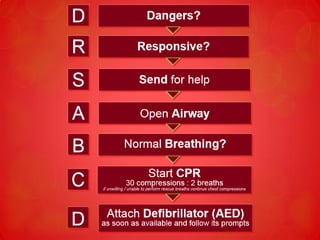
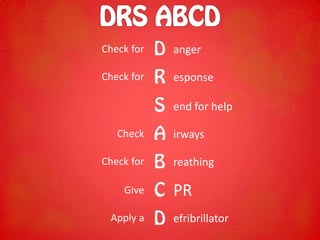
Check for
Check for
Check
Check for
Give
Apply a
anger
esponse
irways
reathing
PR
efribrillator
end for help
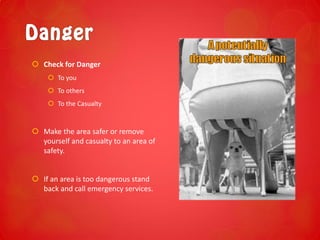
 Check for Danger
 To you
 To others
 To the Casualty
 Make the area safer or remove
yourself and casualty to an area of
safety.
 If an area is too dangerous stand
back and call emergency services.
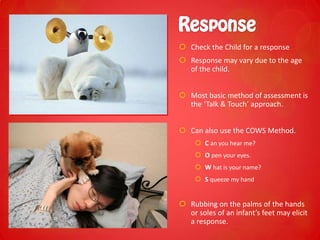
 Check the Child for a response
 Response may vary due to the age
of the child.
 Most basic method of assessment is
the ‘Talk & Touch’ approach.
 Can also use the COWS Method.
 C an you hear me?
 O pen your eyes.
 W hat is your name?
 S queeze my hand
 Rubbing on the palms of the hands
or soles of an infant’s feet may elicit
a response.
Help can be anyone nearby, but you should
aim to contact a healthcare professional or
service as quickly as possible.
Call to reach emergency
services virtually anywhere in
the world.
Someone should always stay with the child. Send others to get help.
Call for USA
or
for Australia
or
Notify your Cardiac Arrest Team
within the hospital
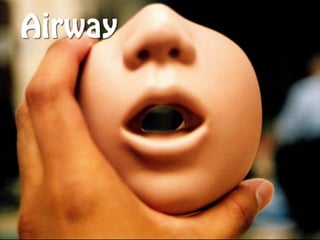
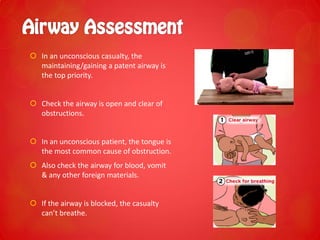
 In an unconscious casualty, the
maintaining/gaining a patent airway is
the top priority.
 Check the airway is open and clear of
obstructions.
 In an unconscious patient, the tongue is
the most common cause of obstruction.
 Also check the airway for blood, vomit
& any other foreign materials.
 If the airway is blocked, the casualty
can’t breathe.
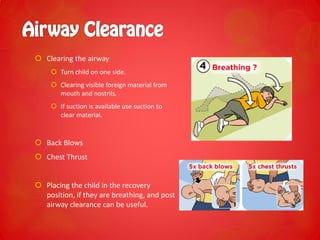
 Clearing the airway
 Turn child on one side.
 Clearing visible foreign material from
mouth and nostrils.
 If suction is available use suction to
clear material.
 Back Blows
 Chest Thrust
 Placing the child in the recovery
position, if they are breathing, and post
airway clearance can be useful.
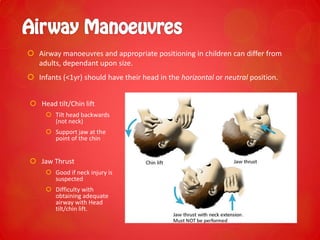
 Head tilt/Chin lift
 Tilt head backwards
(not neck)
 Support jaw at the
point of the chin
 Jaw Thrust
 Good if neck injury is
suspected
 Difficulty with
obtaining adequate
airway with Head
tilt/chin lift.
 Airway manoeuvres and appropriate positioning in children can differ from
adults, dependant upon size.
 Infants (<1yr) should have their head in the horizontal or neutral position.
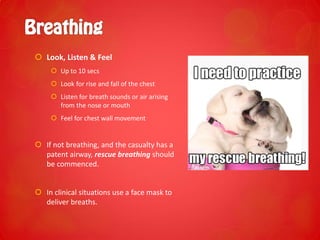
 Look, Listen & Feel
 Up to 10 secs
 Look for rise and fall of the chest
 Listen for breath sounds or air arising
from the nose or mouth
 Feel for chest wall movement
 If not breathing, and the casualty has a
patent airway, rescue breathing should
be commenced.
 In clinical situations use a face mask to
deliver breaths.
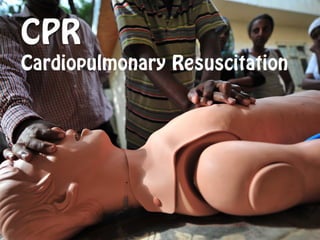
 CPR = Compression + Ventilation
 COMPRESSION RATE: 100 compressions/min
 Useful tunes to keep the rate are ‘Staying Alive’ – Bee Gees, Another one bites
the Dust and many more.
 RATIO: 30 Compressions to 2 ventilations (breaths)
 CYCLES: 5 cycles of [30:2] in approximately 2
minutes. Recheck for signs of life at the end of cycle.
 Pause compressions to allow for ventilation.
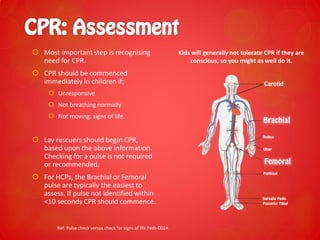
 Most important step is recognising
need for CPR.
 CPR should be commenced
immediately in children if;
 Unresponsive
 Not breathing normally
 Not moving, signs of life.
 Lay rescuers should begin CPR,
based upon the above information.
Checking for a pulse is not required
or recommended.
 For HCPs, the Brachial or Femoral
pulse are typically the easiest to
assess. If pulse not identified within
<10 seconds CPR should commence.
Ref: Pulse check versus check for signs of life Peds-002A
Kids will generally not tolerate CPR if they are
conscious, so you might as well do it.
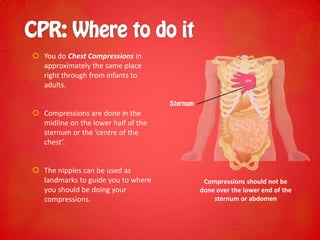
 You do Chest Compressions in
approximately the same place
right through from infants to
adults.
 Compressions are done in the
midline on the lower half of the
sternum or the ‘centre of the
chest’.
 The nipples can be used as
landmarks to guide you to where
you should be doing your
compressions.
Compressions should not be
done over the lower end of the
sternum or abdomen
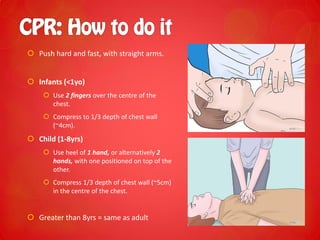
 Push hard and fast, with straight arms.
 Infants (<1yo)
 Use 2 fingers over the centre of the
chest.
 Compress to 1/3 depth of chest wall
(~4cm).
 Child (1-8yrs)
 Use heel of 1 hand, or alternatively 2
hands, with one positioned on top of the
other.
 Compress 1/3 depth of chest wall (~5cm)
in the centre of the chest.
 Greater than 8yrs = same as adult
 Don’t stop CPR to check for
a response or breathing –
except at the end of a cycle.
 Interruptions to CPR should
be minimised.
 If possible change the
person giving compressions
every 2 minutes.
 CPR should continue until
the casualty becomes
responsive, or a healthcare
professional arrives.
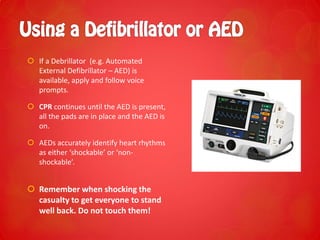
 If a Debrillator (e.g. Automated
External Defibrillator – AED) is
available, apply and follow voice
prompts.
 CPR continues until the AED is present,
all the pads are in place and the AED is
on.
 AEDs accurately identify heart rhythms
as either ‘shockable’ or ‘non-
shockable’.
 Remember when shocking the
casualty to get everyone to stand
well back. Do not touch them!
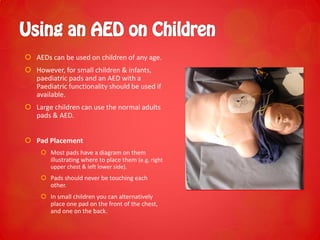
 AEDs can be used on children of any age.
 However, for small children & infants,
paediatric pads and an AED with a
Paediatric functionality should be used if
available.
 Large children can use the normal adults
pads & AED.
 Pad Placement
 Most pads have a diagram on them
illustrating where to place them (e.g. right
upper chest & left lower side).
 Pads should never be touching each
other.
 In small children you can alternatively
place one pad on the front of the chest,
and one on the back.
Information
 Australian Resuscitation Council
 Resus4Kids
Photos
 St John’s Ambulance
 Global Medical Education
Project
 Pixar Wikia
 Physio-Control, Inc.
 Shaun Wood
 Michael Kappel
 Vicki’s Pics
 US Army Africa
 Wikimedia
 Peter Daems
Whilst I am a medical professional the information provided here does not
constitute medical advice. The information provided here is primarily
based off the Australian Guidelines and my own experience in healthcare.
Practice may differ in your area.
This presentation is not a substitute for professional training or
appropriate medical advice. In fact if you have not done it, I hope this
presentation inspires you to take a first aid course.
Please contact your local medical practitioner if you have any concerns.
Cheers,
Aaron
 Paediatric Advanced Life Support
 Extend your knowledge.
 Learn advanced life support skills for the care of children.
 Basic Life Support & First Aid 2012
 Principles of Basic Life Support
 Revisit DRSABCD
 Airway Management
 Care of bleeding, shock, burns, fractures, burns, diabetic emergencies.

Paediatric Basic Life Support & First Aid

  • 2.
    The purpose ofthis presentation is to introduce and refresh some basic life support principles for children. Children are much more than ‘little adults’, and whilst the majority of first aid principles are similar, it’s important to bear to be aware of the differences. This presentation is attended for lay-people and healthcare students. If you are a healthcare professional or wish to extend your knowledge, please read the Paediatric Advanced Life Support Edition. If you’re unfamiliar with Adult First Aid or First Aid principles in general, please look at Basic Life Support & First Aid 2012 presentation first.
  • 3.
    Check for Check for Check Checkfor Give Apply a anger esponse irways reathing PR efribrillator end for help
  • 5.
     Check forDanger  To you  To others  To the Casualty  Make the area safer or remove yourself and casualty to an area of safety.  If an area is too dangerous stand back and call emergency services.
  • 7.
     Check theChild for a response  Response may vary due to the age of the child.  Most basic method of assessment is the ‘Talk & Touch’ approach.  Can also use the COWS Method.  C an you hear me?  O pen your eyes.  W hat is your name?  S queeze my hand  Rubbing on the palms of the hands or soles of an infant’s feet may elicit a response.
  • 8.
    Help can beanyone nearby, but you should aim to contact a healthcare professional or service as quickly as possible. Call to reach emergency services virtually anywhere in the world.
  • 9.
    Someone should alwaysstay with the child. Send others to get help. Call for USA or for Australia or Notify your Cardiac Arrest Team within the hospital
  • 11.
     In anunconscious casualty, the maintaining/gaining a patent airway is the top priority.  Check the airway is open and clear of obstructions.  In an unconscious patient, the tongue is the most common cause of obstruction.  Also check the airway for blood, vomit & any other foreign materials.  If the airway is blocked, the casualty can’t breathe.
  • 12.
     Clearing theairway  Turn child on one side.  Clearing visible foreign material from mouth and nostrils.  If suction is available use suction to clear material.  Back Blows  Chest Thrust  Placing the child in the recovery position, if they are breathing, and post airway clearance can be useful.
  • 13.
     Head tilt/Chinlift  Tilt head backwards (not neck)  Support jaw at the point of the chin  Jaw Thrust  Good if neck injury is suspected  Difficulty with obtaining adequate airway with Head tilt/chin lift.  Airway manoeuvres and appropriate positioning in children can differ from adults, dependant upon size.  Infants (<1yr) should have their head in the horizontal or neutral position.
  • 15.
     Look, Listen& Feel  Up to 10 secs  Look for rise and fall of the chest  Listen for breath sounds or air arising from the nose or mouth  Feel for chest wall movement  If not breathing, and the casualty has a patent airway, rescue breathing should be commenced.  In clinical situations use a face mask to deliver breaths.
  • 17.
     CPR =Compression + Ventilation  COMPRESSION RATE: 100 compressions/min  Useful tunes to keep the rate are ‘Staying Alive’ – Bee Gees, Another one bites the Dust and many more.  RATIO: 30 Compressions to 2 ventilations (breaths)  CYCLES: 5 cycles of [30:2] in approximately 2 minutes. Recheck for signs of life at the end of cycle.  Pause compressions to allow for ventilation.
  • 18.
     Most importantstep is recognising need for CPR.  CPR should be commenced immediately in children if;  Unresponsive  Not breathing normally  Not moving, signs of life.  Lay rescuers should begin CPR, based upon the above information. Checking for a pulse is not required or recommended.  For HCPs, the Brachial or Femoral pulse are typically the easiest to assess. If pulse not identified within <10 seconds CPR should commence. Ref: Pulse check versus check for signs of life Peds-002A Kids will generally not tolerate CPR if they are conscious, so you might as well do it.
  • 19.
     You doChest Compressions in approximately the same place right through from infants to adults.  Compressions are done in the midline on the lower half of the sternum or the ‘centre of the chest’.  The nipples can be used as landmarks to guide you to where you should be doing your compressions. Compressions should not be done over the lower end of the sternum or abdomen
  • 20.
     Push hardand fast, with straight arms.  Infants (<1yo)  Use 2 fingers over the centre of the chest.  Compress to 1/3 depth of chest wall (~4cm).  Child (1-8yrs)  Use heel of 1 hand, or alternatively 2 hands, with one positioned on top of the other.  Compress 1/3 depth of chest wall (~5cm) in the centre of the chest.  Greater than 8yrs = same as adult
  • 21.
     Don’t stopCPR to check for a response or breathing – except at the end of a cycle.  Interruptions to CPR should be minimised.  If possible change the person giving compressions every 2 minutes.  CPR should continue until the casualty becomes responsive, or a healthcare professional arrives.
  • 23.
     If aDebrillator (e.g. Automated External Defibrillator – AED) is available, apply and follow voice prompts.  CPR continues until the AED is present, all the pads are in place and the AED is on.  AEDs accurately identify heart rhythms as either ‘shockable’ or ‘non- shockable’.  Remember when shocking the casualty to get everyone to stand well back. Do not touch them!
  • 24.
     AEDs canbe used on children of any age.  However, for small children & infants, paediatric pads and an AED with a Paediatric functionality should be used if available.  Large children can use the normal adults pads & AED.  Pad Placement  Most pads have a diagram on them illustrating where to place them (e.g. right upper chest & left lower side).  Pads should never be touching each other.  In small children you can alternatively place one pad on the front of the chest, and one on the back.
  • 26.
    Information  Australian ResuscitationCouncil  Resus4Kids Photos  St John’s Ambulance  Global Medical Education Project  Pixar Wikia  Physio-Control, Inc.  Shaun Wood  Michael Kappel  Vicki’s Pics  US Army Africa  Wikimedia  Peter Daems
  • 27.
    Whilst I ama medical professional the information provided here does not constitute medical advice. The information provided here is primarily based off the Australian Guidelines and my own experience in healthcare. Practice may differ in your area. This presentation is not a substitute for professional training or appropriate medical advice. In fact if you have not done it, I hope this presentation inspires you to take a first aid course. Please contact your local medical practitioner if you have any concerns. Cheers, Aaron
  • 28.
     Paediatric AdvancedLife Support  Extend your knowledge.  Learn advanced life support skills for the care of children.  Basic Life Support & First Aid 2012  Principles of Basic Life Support  Revisit DRSABCD  Airway Management  Care of bleeding, shock, burns, fractures, burns, diabetic emergencies.