MULTIDISCIPLINARY CONFERENCE
BASIC LIFE SUPPORT
BY
DR. RAVIKIRAN H M
MBBS, DNB ANAESTHESIOLOGY
DEPARTMENT OF ANAESTHESIOLOGY AND CRITICAL CARE
ADMO, CENTRAL HOSPITAL, MALIGAON
INDEX
Definition
Physiology
Requirement
Chain of survival
Techniques
Adult BLS algorithm
Special situations: Opioid overdose, FBAO, Stroke, Heart attack
DEFINITION
BLS is a type of care that first-responders provide which involves
1. Early recognition of medical emergency,
2. Activation of an emergency response system (911,108) and
3. Interventions made in response to SCA, heart attack, stroke, and FBAO.
CARDIAC ARREST OR HEART
ATTACK
???
CARDIAC ARREST HEART ATTACK
WHAT IT IS? Occur when the heart malfunctions &
stops beating unexpectedly
Occur when blood flow to the heart is
blocked
It is an Electrical problem Circulation problem
WHAT
HAPPENS?
Within seconds Patient becomes
unresponsive, not breathing, only
gasping
Symptoms may be immediate & include
intense chest pain/discomfort, SOB,
cold sweats and/or nausea vomiting
Death occurs within minutes if victim
does not receive treatment
Longer the person goes without
treatment, the greater the damage
WHAT TO
DO?
Call EMS
Provide BLS
Call EMS
INTERLINK All cardiac arrest lead to heart attack All heart attack may not lead to cardiac
arrest
DIFFERENCE BETWEEN BLS &ACLS
BLS ACLS
Can be performed by anyone Trained medical/paramedical staff
Rhythm identification by AED Rhythm identification by Resuscitator
AED for Defibrillation Manual defibrillation
No IV line IV line & drug management
No advanced airway Advanced airway use
No oxygen support Oxygen support
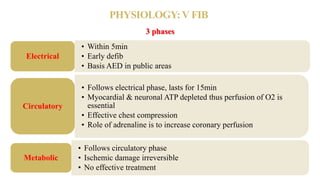
PHYSIOLOGY:V FIB
3 phases
• Within 5min
• Early defib
• Basis AED in public areas
Electrical
• Follows electrical phase, lasts for 15min
• Myocardial & neuronal ATP depleted thus perfusion of O2 is
essential
• Effective chest compression
• Role of adrenaline is to increase coronary perfusion
Circulatory
• Follows circulatory phase
• Ischemic damage irreversible
• No effective treatment
Metabolic
PHYSIOLOGY: CHEST COMPRESSION
Chest compression squeeze heart, thus promoting pumping
Chest wall recoil creates a relative negative intrathoracic pressure that promotes venous return
and cardiopulmonary blood flow.
Leaning on the chest wall between compressions precludes full chest wall recoil.
Incomplete recoil raises intrathoracic pressure and reduces venous return, coronary perfusion
pressure, and myocardial blood flow and can influence resuscitation outcomes.
Medication administration is ineffective without concomitant chest compressions for drug
delivery to the tissues, so naloxone/adrenaline administration may be considered after initiation
of CPR.
PHYSIOLOGY: ROLE OFVENTILATION ?HARMFUL
1. Spontaneous gasping is sufficient
2. Chest compression also provides some ventilation & gas exchange
3. Interrupt chest compression thereby reducing vital organ perfusion
4. Hyperventilation reduce CO2 thus cerebral perfusion
5. Positive-pressure ventilation may also be deleterious because it prohibits the development of
negative intrathoracic pressure during chest wall recoil, inhibiting venous blood return to the
right heart and thereby decreasing the hemodynamic effectiveness of CPR
6. Gastric insufflation, splinting of diaphragm, aspiration
COLS
PHYSIOLOGY: ROLE OFVENTILATION cont…
Studies in anesthetized adults (with normal perfusion) suggest that a tidal volume of 8 to 10
mL/kg maintains normal oxygenation and elimination of CO2.
During CPR, cardiac output is ?25% to 33% of normal, so oxygen uptake from the lungs and
CO2 delivery to the lungs are also reduced.
Low minute ventilation (lower than normal TV and RR) can maintain effective oxygenation and
ventilation.
For victims of prolonged cardiac arrest both ventilations and compressions are important because
over time oxygen in the blood is consumed and oxygen in the lungs is depleted.
REQUIREMENTS
RECOGNITION OFCARDIACARREST
Lay rescuer:
victim is unconscious/unresponsive
with absent or abnormal breathing (ie, only gasping).
Healthcare provider :
victim is unconscious/unresponsive,
with absent or abnormal breathing (ie, only gasping),
check for a pulse for no more than 10 s : no definite pulse is felt.
SITE OFPULSE CHECK
CATEGORY AGE SITE
Neonate 1st 30day of birth Precordial auscultation/
3lead ECG
Infant 30day to 1year after birth Brachial artery
Child 1 year to puberty Femoral/carotid
Adult/Adoloscent After puberty Carotid
Note: Puberty- Male: axillary air, Female: breast
SCENE SAFETY
Patient to be shifted to safe place
WHATTO SAYDURINGTHE CALL?
1. Identify yourself
2. Identify your location
3. Tell about victim’s condition
4. Number of victims
5. Age, sex, complaint
6. General condition
7. Number of rescuer
Assure ---------Hang only when asked to do so
108
TECHNIQUE: PLACEMENT OFAED
ADULT:
•Upper right sternal border, just below the clavicle
•Lateral to the left nipple.
CHILD OR INFANT :
•Anterior and Posterior.
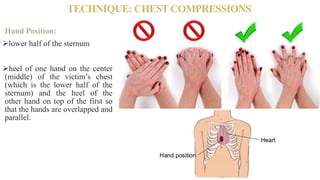
TECHNIQUE: CHEST COMPRESSIONS
Hand Position:
lower half of the sternum
heel of one hand on the center
(middle) of the victim’s chest
(which is the lower half of the
sternum) and the heel of the
other hand on top of the first so
that the hands are overlapped and
parallel.
TECHNIQUE: CHEST COMPRESSIONS cont…
1. Elbows straight
2. Shoulders above the victim’s
chest
3. Fingers interlocked
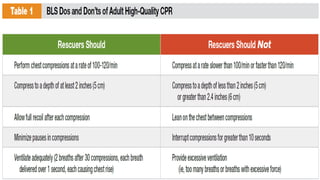
HIGH-QUALITYCPR
1. Adequate rate
2. Adequate depth
3. Allowing full chest recoil between
compressions
4. Minimizing interruptions in chest
compressions
5. Avoiding excessive ventilation
TECHNIQUE:AIRWAYOPENING
Bag-mask ventilation with a head tilt–chin lift or head
tilt–jaw thrust manoeuvre is recommended for initial
airway control in most circumstances.
Triple manoeuvre: head tilt-chin lift , mouth open,
jaw thrust
TECHNIQUE : MASK HOLDING
EC EO
EV
TWO HANDED
TECHNIQUE:VENTILATION
Mouth-to-mouth rescue breaths:
open the victim’s airway, pinch the
victim’s nose, and create an airtight
mouth-to mouth seal.
Take a “regular” (not a deep) breath
& give 1 breath over 1 second.
Visible chest raise, to confirm
adequacy.
MOUTH TO BARRIER DEVICE
TECHNIQUE:VENTILATION cont…
Bag volume:
 1600ml
 550ml
 300ml
Required Tidal volume:
8ml/kg
Visible chest rise
TECHNIQUE: RECOVERYPOSITION
WHEN NOTTO START CPR?
Scene is not safe
Patient Responsive
Victim become stiff body (Signs of irreversible death Like -Rigor mortis)
HARM FROM CPRTO VICTIMS NOT IN CARDIAC
ARREST
Desirable effects will far outweigh undesirable effects.
1. Rhabdomyolysis of 0.3%
2. Bone fracture (ribs and clavicle) of 1.7%
3. pain in the area of chest compression of 8.7%
HARM FROM CPRTOVICTIMS or COMPLICATIONS OFCPR
1. Vomiting
2. Aspiration
3. Rib fracture
4. Pulmonary contusion
5. Pneumothorax
6. Cardiac contusion
7. Cardiac rupture
HARM TO RESCUERS FROM CPR
Relatively safe
Defibrillator-related injuries
Psychological & Emotional
FAILURE OFCPR
Delay in starting
Improper procedure
No ACLS follow-up and delay in defibrillation
Terminal or unmanageable disease(eg. Massive heart attack)
LAZARUS SYNDROME
Also known as autoresuscitation after failed CPR.
Spontaneous return of circulation after failed attempts of resuscitation.
Implication: observation of patient vitals for atleast 10-15 min post CPR before
declaration death.
OTHER ELECTRIC OR PSEUDO-ELECTRIC
THERAPIES
Cough CPR, fist/percussion pacing, and precordial thump
Heart will respond to electric stimuli by producing myocardial contraction and
generating forward movement of blood, but clinical trials have not shown pacing to
improve patient outcomes.
Not recommended routinely.
Temporizing measures in select patients who are either periarrest or in the initial
seconds of witnessed cardiac arrest (before losing consciousness in the case of cough
CPR) when definitive therapy is not readily available.
OTHER ELECTRIC OR PSEUDO-ELECTRIC
THERAPIES cont…
Precordial thump is a single, sharp, high-velocity impact (or “punch”) to the middle
sternum by the ulnar aspect of a tightly clenched fist.
Fist (or percussion) pacing is the delivery of a serial, rhythmic, relatively low-
velocity impact to the sternum by a closed fist.
Cough CPR is described as repeated deep breaths followed immediately by a cough
every few seconds in an attempt to increase aortic and intracardiac pressures,
providing transient hemodynamic support before a loss of consciousness.
Naloxone dose:
2mg intranasal or
0.4mg IM
FOREIGN BODYAIRWAYOBSTRUCTION
More than 90% of childhood deaths from foreign-body aspiration occur in children
<5 years of age; 65% of the victims are infants.
Liquids are the most common cause of choking in infants.
Balloons, small objects, and foods (eg, round candies, nuts, and grapes) are the most
common causes of FBAO in children.
SIGNS OFFBAO
Sudden onset of
 Respiratory distress
 Coughing
 Gagging
 Stridor
 Wheezing
 Absence of fever or other respiratory symptoms (eg, antecedent cough, congestion)
HEMILICH
SIGN
MILD
Child can cough &
make some sound
Do not
interfere
Allow the
victim to clear
airway by
coughing
Observe for
severe FBAO
signs
SEVERE
Child can not cough or make
any sound
You must act to relieve
CHILD
Abdominal thrust ( Heimlich
maneuver) until the object
expelled or victim become
unresponsive
INFANTS
Repeated cycles of 5 back blows
followed by 5 chest compressions
until the object expelled or victim
become unresponsive
IF THE VICTIM BECOME UNRESPONSIVE
Start CPR with chest compressions(do not check pulse)
After 30 chest compressions open the airway-if you see a FB remove it but do not perform
blind finger sweeps because they may push objects farther
Attempt to give 2breaths & continue with cycles of compression and ventilations until the
object is expelled
After 2min if no one has already done so activate the EMS
HEIMLICH MANEUVR
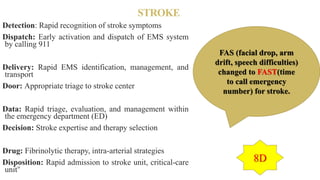
STROKE
Detection: Rapid recognition of stroke symptoms
Dispatch: Early activation and dispatch of EMS system
by calling 911
Delivery: Rapid EMS identification, management, and
transport
Door: Appropriate triage to stroke center
Data: Rapid triage, evaluation, and management within
the emergency department (ED)
Decision: Stroke expertise and therapy selection
Drug: Fibrinolytic therapy, intra-arterial strategies
Disposition: Rapid admission to stroke unit, critical-care
unit"
FAS (facial drop, arm
drift, speech difficulties)
changed to FAST(time
to call emergency
number) for stroke.
8D
HEARTATTACK
Aspirin 325mg intake advised for all non-traumatic chest pain before arrival of EMS
unless contraindicated.
Training or Computerized ECG interpretation
Inform and Shift early to cath lab facility
REFERENCES
Panchal AR et al. Part 3: Adult Basic and Advanced Life Support.2020 American
Heart Association Guidelines for Cardiopulmonary Resuscitation and Emergency
Cardiovascular Care. Circulation. 2020;142(suppl 2):S366–S468.
Olasveengen TM et al. Adult Basic Life Support 2020 International Consensus on
Cardiopulmonary Resuscitation and Emergency Cardiovascular Care Science With
Treatment Recommendations. Circulation. 2020;142(suppl 1):S41–S91.
THANK YOU
"ধন্যবাদ"
PRACTICE MAKES MAN PERFECT

BASIC LIFE SUPPORT AHA 2020-1.pptx

  • 1.
    MULTIDISCIPLINARY CONFERENCE BASIC LIFESUPPORT BY DR. RAVIKIRAN H M MBBS, DNB ANAESTHESIOLOGY DEPARTMENT OF ANAESTHESIOLOGY AND CRITICAL CARE ADMO, CENTRAL HOSPITAL, MALIGAON
  • 2.
    INDEX Definition Physiology Requirement Chain of survival Techniques AdultBLS algorithm Special situations: Opioid overdose, FBAO, Stroke, Heart attack
  • 3.
    DEFINITION BLS is atype of care that first-responders provide which involves 1. Early recognition of medical emergency, 2. Activation of an emergency response system (911,108) and 3. Interventions made in response to SCA, heart attack, stroke, and FBAO.
  • 4.
    CARDIAC ARREST ORHEART ATTACK ???
  • 5.
    CARDIAC ARREST HEARTATTACK WHAT IT IS? Occur when the heart malfunctions & stops beating unexpectedly Occur when blood flow to the heart is blocked It is an Electrical problem Circulation problem WHAT HAPPENS? Within seconds Patient becomes unresponsive, not breathing, only gasping Symptoms may be immediate & include intense chest pain/discomfort, SOB, cold sweats and/or nausea vomiting Death occurs within minutes if victim does not receive treatment Longer the person goes without treatment, the greater the damage WHAT TO DO? Call EMS Provide BLS Call EMS INTERLINK All cardiac arrest lead to heart attack All heart attack may not lead to cardiac arrest
  • 6.
    DIFFERENCE BETWEEN BLS&ACLS BLS ACLS Can be performed by anyone Trained medical/paramedical staff Rhythm identification by AED Rhythm identification by Resuscitator AED for Defibrillation Manual defibrillation No IV line IV line & drug management No advanced airway Advanced airway use No oxygen support Oxygen support
  • 7.
    PHYSIOLOGY:V FIB 3 phases •Within 5min • Early defib • Basis AED in public areas Electrical • Follows electrical phase, lasts for 15min • Myocardial & neuronal ATP depleted thus perfusion of O2 is essential • Effective chest compression • Role of adrenaline is to increase coronary perfusion Circulatory • Follows circulatory phase • Ischemic damage irreversible • No effective treatment Metabolic
  • 9.
    PHYSIOLOGY: CHEST COMPRESSION Chestcompression squeeze heart, thus promoting pumping Chest wall recoil creates a relative negative intrathoracic pressure that promotes venous return and cardiopulmonary blood flow. Leaning on the chest wall between compressions precludes full chest wall recoil. Incomplete recoil raises intrathoracic pressure and reduces venous return, coronary perfusion pressure, and myocardial blood flow and can influence resuscitation outcomes. Medication administration is ineffective without concomitant chest compressions for drug delivery to the tissues, so naloxone/adrenaline administration may be considered after initiation of CPR.
  • 10.
    PHYSIOLOGY: ROLE OFVENTILATION?HARMFUL 1. Spontaneous gasping is sufficient 2. Chest compression also provides some ventilation & gas exchange 3. Interrupt chest compression thereby reducing vital organ perfusion 4. Hyperventilation reduce CO2 thus cerebral perfusion 5. Positive-pressure ventilation may also be deleterious because it prohibits the development of negative intrathoracic pressure during chest wall recoil, inhibiting venous blood return to the right heart and thereby decreasing the hemodynamic effectiveness of CPR 6. Gastric insufflation, splinting of diaphragm, aspiration COLS
  • 11.
    PHYSIOLOGY: ROLE OFVENTILATIONcont… Studies in anesthetized adults (with normal perfusion) suggest that a tidal volume of 8 to 10 mL/kg maintains normal oxygenation and elimination of CO2. During CPR, cardiac output is ?25% to 33% of normal, so oxygen uptake from the lungs and CO2 delivery to the lungs are also reduced. Low minute ventilation (lower than normal TV and RR) can maintain effective oxygenation and ventilation. For victims of prolonged cardiac arrest both ventilations and compressions are important because over time oxygen in the blood is consumed and oxygen in the lungs is depleted.
  • 12.
  • 13.
    RECOGNITION OFCARDIACARREST Lay rescuer: victimis unconscious/unresponsive with absent or abnormal breathing (ie, only gasping). Healthcare provider : victim is unconscious/unresponsive, with absent or abnormal breathing (ie, only gasping), check for a pulse for no more than 10 s : no definite pulse is felt.
  • 14.
    SITE OFPULSE CHECK CATEGORYAGE SITE Neonate 1st 30day of birth Precordial auscultation/ 3lead ECG Infant 30day to 1year after birth Brachial artery Child 1 year to puberty Femoral/carotid Adult/Adoloscent After puberty Carotid Note: Puberty- Male: axillary air, Female: breast
  • 15.
    SCENE SAFETY Patient tobe shifted to safe place
  • 16.
    WHATTO SAYDURINGTHE CALL? 1.Identify yourself 2. Identify your location 3. Tell about victim’s condition 4. Number of victims 5. Age, sex, complaint 6. General condition 7. Number of rescuer Assure ---------Hang only when asked to do so 108
  • 17.
    TECHNIQUE: PLACEMENT OFAED ADULT: •Upperright sternal border, just below the clavicle •Lateral to the left nipple. CHILD OR INFANT : •Anterior and Posterior.
  • 18.
    TECHNIQUE: CHEST COMPRESSIONS HandPosition: lower half of the sternum heel of one hand on the center (middle) of the victim’s chest (which is the lower half of the sternum) and the heel of the other hand on top of the first so that the hands are overlapped and parallel.
  • 19.
    TECHNIQUE: CHEST COMPRESSIONScont… 1. Elbows straight 2. Shoulders above the victim’s chest 3. Fingers interlocked
  • 20.
    HIGH-QUALITYCPR 1. Adequate rate 2.Adequate depth 3. Allowing full chest recoil between compressions 4. Minimizing interruptions in chest compressions 5. Avoiding excessive ventilation
  • 22.
    TECHNIQUE:AIRWAYOPENING Bag-mask ventilation witha head tilt–chin lift or head tilt–jaw thrust manoeuvre is recommended for initial airway control in most circumstances. Triple manoeuvre: head tilt-chin lift , mouth open, jaw thrust
  • 23.
    TECHNIQUE : MASKHOLDING EC EO EV TWO HANDED
  • 24.
    TECHNIQUE:VENTILATION Mouth-to-mouth rescue breaths: openthe victim’s airway, pinch the victim’s nose, and create an airtight mouth-to mouth seal. Take a “regular” (not a deep) breath & give 1 breath over 1 second. Visible chest raise, to confirm adequacy. MOUTH TO BARRIER DEVICE
  • 25.
    TECHNIQUE:VENTILATION cont… Bag volume: 1600ml  550ml  300ml Required Tidal volume: 8ml/kg Visible chest rise
  • 26.
  • 34.
    WHEN NOTTO STARTCPR? Scene is not safe Patient Responsive Victim become stiff body (Signs of irreversible death Like -Rigor mortis)
  • 36.
    HARM FROM CPRTOVICTIMS NOT IN CARDIAC ARREST Desirable effects will far outweigh undesirable effects. 1. Rhabdomyolysis of 0.3% 2. Bone fracture (ribs and clavicle) of 1.7% 3. pain in the area of chest compression of 8.7%
  • 37.
    HARM FROM CPRTOVICTIMSor COMPLICATIONS OFCPR 1. Vomiting 2. Aspiration 3. Rib fracture 4. Pulmonary contusion 5. Pneumothorax 6. Cardiac contusion 7. Cardiac rupture
  • 38.
    HARM TO RESCUERSFROM CPR Relatively safe Defibrillator-related injuries Psychological & Emotional
  • 39.
    FAILURE OFCPR Delay instarting Improper procedure No ACLS follow-up and delay in defibrillation Terminal or unmanageable disease(eg. Massive heart attack)
  • 40.
    LAZARUS SYNDROME Also knownas autoresuscitation after failed CPR. Spontaneous return of circulation after failed attempts of resuscitation. Implication: observation of patient vitals for atleast 10-15 min post CPR before declaration death.
  • 41.
    OTHER ELECTRIC ORPSEUDO-ELECTRIC THERAPIES Cough CPR, fist/percussion pacing, and precordial thump Heart will respond to electric stimuli by producing myocardial contraction and generating forward movement of blood, but clinical trials have not shown pacing to improve patient outcomes. Not recommended routinely. Temporizing measures in select patients who are either periarrest or in the initial seconds of witnessed cardiac arrest (before losing consciousness in the case of cough CPR) when definitive therapy is not readily available.
  • 42.
    OTHER ELECTRIC ORPSEUDO-ELECTRIC THERAPIES cont… Precordial thump is a single, sharp, high-velocity impact (or “punch”) to the middle sternum by the ulnar aspect of a tightly clenched fist. Fist (or percussion) pacing is the delivery of a serial, rhythmic, relatively low- velocity impact to the sternum by a closed fist. Cough CPR is described as repeated deep breaths followed immediately by a cough every few seconds in an attempt to increase aortic and intracardiac pressures, providing transient hemodynamic support before a loss of consciousness.
  • 43.
  • 45.
    FOREIGN BODYAIRWAYOBSTRUCTION More than90% of childhood deaths from foreign-body aspiration occur in children <5 years of age; 65% of the victims are infants. Liquids are the most common cause of choking in infants. Balloons, small objects, and foods (eg, round candies, nuts, and grapes) are the most common causes of FBAO in children.
  • 46.
    SIGNS OFFBAO Sudden onsetof  Respiratory distress  Coughing  Gagging  Stridor  Wheezing  Absence of fever or other respiratory symptoms (eg, antecedent cough, congestion) HEMILICH SIGN
  • 47.
    MILD Child can cough& make some sound Do not interfere Allow the victim to clear airway by coughing Observe for severe FBAO signs SEVERE Child can not cough or make any sound You must act to relieve CHILD Abdominal thrust ( Heimlich maneuver) until the object expelled or victim become unresponsive INFANTS Repeated cycles of 5 back blows followed by 5 chest compressions until the object expelled or victim become unresponsive
  • 48.
    IF THE VICTIMBECOME UNRESPONSIVE Start CPR with chest compressions(do not check pulse) After 30 chest compressions open the airway-if you see a FB remove it but do not perform blind finger sweeps because they may push objects farther Attempt to give 2breaths & continue with cycles of compression and ventilations until the object is expelled After 2min if no one has already done so activate the EMS
  • 50.
  • 53.
    STROKE Detection: Rapid recognitionof stroke symptoms Dispatch: Early activation and dispatch of EMS system by calling 911 Delivery: Rapid EMS identification, management, and transport Door: Appropriate triage to stroke center Data: Rapid triage, evaluation, and management within the emergency department (ED) Decision: Stroke expertise and therapy selection Drug: Fibrinolytic therapy, intra-arterial strategies Disposition: Rapid admission to stroke unit, critical-care unit" FAS (facial drop, arm drift, speech difficulties) changed to FAST(time to call emergency number) for stroke. 8D
  • 54.
    HEARTATTACK Aspirin 325mg intakeadvised for all non-traumatic chest pain before arrival of EMS unless contraindicated. Training or Computerized ECG interpretation Inform and Shift early to cath lab facility
  • 55.
    REFERENCES Panchal AR etal. Part 3: Adult Basic and Advanced Life Support.2020 American Heart Association Guidelines for Cardiopulmonary Resuscitation and Emergency Cardiovascular Care. Circulation. 2020;142(suppl 2):S366–S468. Olasveengen TM et al. Adult Basic Life Support 2020 International Consensus on Cardiopulmonary Resuscitation and Emergency Cardiovascular Care Science With Treatment Recommendations. Circulation. 2020;142(suppl 1):S41–S91.
  • 56.