Dr. Imran Masood
drimranmasood@iub.edu.pk
EMERGENCY TREATMENT
Emergency Treatment or
Emergency Medicine
 Medical Emergency: A medical emergency is an injury or illness that is
acute and possess an immediate risk to a person’s life or long term
health.
 Emergency Medicine:
 The branch of medicine that deals with evaluation and initial treatment
of medical conditions caused by trauma or sudden illness.
 Emergency Treatment:
 First aid or other immediate intervention for accidents or medical
conditions requiring immediate care and treatment before definitive
medical and surgical management can be procured.
FIRST AID
 First Aid is the emergency care and treatment of a sick or injured person
before more advanced medical assistance, in the form of the
emergency medical services (EMS) arrives.
 Technically, it is not classed as medical treatment and should not be
compared to what a trained medical professional might do. First aid is a
combination of some simple procedures, plus the application of
common sense.
RESPONSIBILITIES OF A FIRST
AIDER:
 To preserve life: this is the main aim of first aid; to save lives. This
includes the life of the first aider, the casualty (the victim, the injured/sick
person), and bystanders
 To prevent further harm: the patient must be kept stable and his/her
condition must not worsen before medical services arrive. This may
include moving the patient out of harm's way, applying first aid
techniques, keeping him/her warm and dry, applying pressure to
wounds to stop bleeding, etc.
 Promote recovery: this may include applying a plaster (bandage) to a
small wound; anything that may help in the recovery process.
VITAL FIRST AID SKILLS
 ABC (and sometimes D) The most common term referred to in first aid
is ABC, which stands for
 Airway
 Breathing
 Circulation
 In fact, the term also is commonly used among emergency health
professionals. The D stands for
 Deadly bleeding or Defibrillation.
A,B,C,D
 Airway - the first aider needs to make sure the casualty's airway is
clear. Chocking, which results from the obstruction of airways, can
be fatal.
 Breathing - when the first aider has determined that the airways are
not obstructed, he/she must determine the casualty's adequacy of
breathing, and if necessary provide rescue breathing.
A,B,C,D
 Circulation - if the casualty is not breathing the first aider should go
straight for chest compressions and rescue breathing. The chest
compressions will provide circulation. The reason is time - checking
circulation to a non-breathing casualty consumes time that could be
used with chest compressions and rescue breathing. With less serious
casualties (those that are breathing), the first aider needs to check the
casualty's pulse.
 Defibrillation is a process in which an electronic device sends an
electric shock to the heart to stop an extremely rapid,irregular heartbeat,
and restore the normal heart rhythm.
AIRWAY
 If victim is facedown, gently roll victim onto their back. Place one hand
on the back of victim's neck and other on hip, and gently roll victim over
onto back. If back or neck injury suspected, enlist aid of others to keep
victim's head, neck, and back aligned as you roll victim over.
AIRWAY
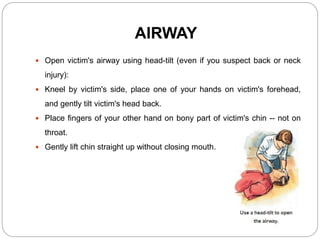
 Open victim's airway using head-tilt (even if you suspect back or neck
injury):
 Kneel by victim's side, place one of your hands on victim's forehead,
and gently tilt victim's head back.
 Place fingers of your other hand on bony part of victim's chin -- not on
throat.
 Gently lift chin straight up without closing mouth.
BREATHING AND CIRCULATION
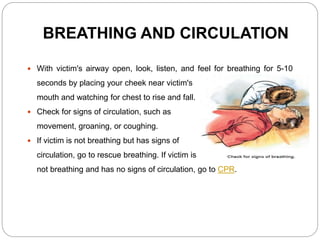
 With victim's airway open, look, listen, and feel for breathing for 5-10
seconds by placing your cheek near victim's
mouth and watching for chest to rise and fall.
 Check for signs of circulation, such as
movement, groaning, or coughing.
 If victim is not breathing but has signs of
circulation, go to rescue breathing. If victim is
not breathing and has no signs of circulation, go to CPR.
EMERGENCY TREATMENT,
INFANT:
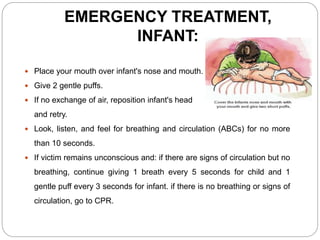
 Place your mouth over infant's nose and mouth.
 Give 2 gentle puffs.
 If no exchange of air, reposition infant's head
and retry.
 Look, listen, and feel for breathing and circulation (ABCs) for no more
than 10 seconds.
 If victim remains unconscious and: if there are signs of circulation but no
breathing, continue giving 1 breath every 5 seconds for child and 1
gentle puff every 3 seconds for infant. if there is no breathing or signs of
circulation, go to CPR.
EMERGENCY TREATMENT, CHILD
OR ADULT:
 Pinch victim's nose closed with your fingers, and place your mouth over
their mouth.
 Give 2 full, slow breaths, each lasting 1 to 1.5 seconds.
 After each breath, pull your mouth away and allow victim's lungs to deflate.
 If no exchange of air, reposition victim's head and retry.
 Look, listen, and feel for breathing and circulation (ABCs) for no more than
10 seconds.
 If victim remains unconscious and:
 -if there are signs of circulation but no breathing, continue giving 1 breath
every 5 seconds for adult
 -if there is no breathing or signs of circulation, go to CPR.
CARDIOPULMONARY
RESUSCITATION (CPR)
 Cardiopulmonary resuscitation (CPR) is an emergency treatment that try to
restart the heart and breathing during cardiac arrest by performing chest
compressions and artificial respiration. Cardiac arrest victims become
unconscious within 15 seconds after the heart stops and if no CPR is
performed, it only takes 3 to 4 minutes for the person to become brain
dead due to a lack of oxygen.
CARDIOPULMONARY
RESUSCITATION (CPR)
 By performing CPR as soon as the heart stops, you circulate the blood
so it can provide oxygen to the body in order to stay the brain and the
other organs alive. The person’s chances of survival drop as the time
passes by, however, it will slow down if CPR is performed.
HOW CPR WORKS
 The air we breathe in, travels to our lungs where oxygen is picked up by our
blood and then pumped by the heart to our tissue and organs. When a
person experiences cardiac arrest-whether due to heart failure in adults or
the elderly or an injury, or severe trauma in a child-the heart goes from a
normal arrhythmic pattern called ventricular fibrillation, and eventually
ceases to beat altogether. This prevents oxygen from circulating throughout
the body, rapidly killing cells and tissue. Inessence, cardio (heart)
pulmonary(lung) resuscitation (revive, revitalize) serves as an artificial heart
beat and an artificial respirator. CPR may not save the victim even when
performed properly, but if started within 4 minute of cardiac arrest and
defibrillation is provided within 10 minutes, a person has a 40% chance of
survival.
ADMINISTERING CPR
 Assess the Victim’s Consciousness:
 Gently tap his or her shoulder and ask “Are you OK?” in a loud, clear
voice. If he or she responds, CPR is not required but if doesn’t, continue
with the following steps.
 Send for Help:
 If he or she doesn’t respond, send for help around you.
 If more people are available around you, give directions to each person.
When giving directions, be specifically as much as possible. For
example, “Please call 1122.”
ADMINISTERING CPR
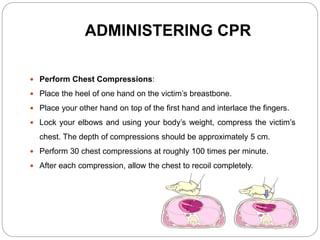
 Perform Chest Compressions:
 Place the heel of one hand on the victim’s breastbone.
 Place your other hand on top of the first hand and interlace the fingers.
 Lock your elbows and using your body’s weight, compress the victim’s
chest. The depth of compressions should be approximately 5 cm.
 Perform 30 chest compressions at roughly 100 times per minute.
 After each compression, allow the chest to recoil completely.
ADMINISTERING CPR
 After 30 chest compressions, give 2 rescue breaths.
 To an infant, use only one hand to perform heart compressions.
Compress about 1/3 the depth of the chest.
 To procedure for giving CPR to a child is essentially the same as that for
an adult. The difference is use only one hand to perform heart
compressions and gently compress about 1/3 the depth of the chest
COMPLICATIONS
 Common complications due to CPR are
 rib fractures
 sternal fractures
 bleeding in the anterior mediastinum
 lacerations of the liver and spleen
 The most common injuries sustained from CPR are rib fractures.
 The type and frequency of injury can be affected by factors such as
gender and age. For instance, women have a higher risk of sternal
fractures than men, and risk for rib fractures increases significantly with
age.
HOSPITAL EMERGENCY CODES
 Hospital emergency codes are used in hospitals worldwide to alert
staff to various emergencies. The use of codes is intended to convey
essential information quickly and with minimal misunderstanding to staff,
while preventing stress and panic among visitors to the hospital. These
codes may be posted on play cards throughout the hospital, or printed
on employee identification badges for ready reference.
CODE BLUE
 "Code Blue" is generally used to indicate a patient requiring
resuscitation or in need of immediate medical attention, most often as
the result of a respiratory arrest or cardiac arrest. Every hospital, as a
part of its disaster plans, sets a policy to determine which units provide
personnel for code coverage.
 In theory any medical professional may respond to a code, but in
practice the team makeup is limited to those with advanced cardiac life
support or other equivalent resuscitation training.
CODE BLUE
 Frequently these teams are staffed by physicians
(from anesthesia and internal medicine in larger medical centers or
the Emergency physician in smaller ones), respiratory therapists,
pharmacists, and nurses.
 A code team leader will be a physician in attendance on any code team;
this individual is responsible for directing the resuscitation effort and is
said to "run the code".

EMERGENCY TREATMENT.pptx

  • 1.
  • 2.
    Emergency Treatment or EmergencyMedicine  Medical Emergency: A medical emergency is an injury or illness that is acute and possess an immediate risk to a person’s life or long term health.  Emergency Medicine:  The branch of medicine that deals with evaluation and initial treatment of medical conditions caused by trauma or sudden illness.  Emergency Treatment:  First aid or other immediate intervention for accidents or medical conditions requiring immediate care and treatment before definitive medical and surgical management can be procured.
  • 3.
    FIRST AID  FirstAid is the emergency care and treatment of a sick or injured person before more advanced medical assistance, in the form of the emergency medical services (EMS) arrives.  Technically, it is not classed as medical treatment and should not be compared to what a trained medical professional might do. First aid is a combination of some simple procedures, plus the application of common sense.
  • 4.
    RESPONSIBILITIES OF AFIRST AIDER:  To preserve life: this is the main aim of first aid; to save lives. This includes the life of the first aider, the casualty (the victim, the injured/sick person), and bystanders  To prevent further harm: the patient must be kept stable and his/her condition must not worsen before medical services arrive. This may include moving the patient out of harm's way, applying first aid techniques, keeping him/her warm and dry, applying pressure to wounds to stop bleeding, etc.  Promote recovery: this may include applying a plaster (bandage) to a small wound; anything that may help in the recovery process.
  • 5.
    VITAL FIRST AIDSKILLS  ABC (and sometimes D) The most common term referred to in first aid is ABC, which stands for  Airway  Breathing  Circulation  In fact, the term also is commonly used among emergency health professionals. The D stands for  Deadly bleeding or Defibrillation.
  • 6.
    A,B,C,D  Airway -the first aider needs to make sure the casualty's airway is clear. Chocking, which results from the obstruction of airways, can be fatal.  Breathing - when the first aider has determined that the airways are not obstructed, he/she must determine the casualty's adequacy of breathing, and if necessary provide rescue breathing.
  • 7.
    A,B,C,D  Circulation -if the casualty is not breathing the first aider should go straight for chest compressions and rescue breathing. The chest compressions will provide circulation. The reason is time - checking circulation to a non-breathing casualty consumes time that could be used with chest compressions and rescue breathing. With less serious casualties (those that are breathing), the first aider needs to check the casualty's pulse.  Defibrillation is a process in which an electronic device sends an electric shock to the heart to stop an extremely rapid,irregular heartbeat, and restore the normal heart rhythm.
  • 8.
    AIRWAY  If victimis facedown, gently roll victim onto their back. Place one hand on the back of victim's neck and other on hip, and gently roll victim over onto back. If back or neck injury suspected, enlist aid of others to keep victim's head, neck, and back aligned as you roll victim over.
  • 9.
    AIRWAY  Open victim'sairway using head-tilt (even if you suspect back or neck injury):  Kneel by victim's side, place one of your hands on victim's forehead, and gently tilt victim's head back.  Place fingers of your other hand on bony part of victim's chin -- not on throat.  Gently lift chin straight up without closing mouth.
  • 10.
    BREATHING AND CIRCULATION With victim's airway open, look, listen, and feel for breathing for 5-10 seconds by placing your cheek near victim's mouth and watching for chest to rise and fall.  Check for signs of circulation, such as movement, groaning, or coughing.  If victim is not breathing but has signs of circulation, go to rescue breathing. If victim is not breathing and has no signs of circulation, go to CPR.
  • 11.
    EMERGENCY TREATMENT, INFANT:  Placeyour mouth over infant's nose and mouth.  Give 2 gentle puffs.  If no exchange of air, reposition infant's head and retry.  Look, listen, and feel for breathing and circulation (ABCs) for no more than 10 seconds.  If victim remains unconscious and: if there are signs of circulation but no breathing, continue giving 1 breath every 5 seconds for child and 1 gentle puff every 3 seconds for infant. if there is no breathing or signs of circulation, go to CPR.
  • 12.
    EMERGENCY TREATMENT, CHILD ORADULT:  Pinch victim's nose closed with your fingers, and place your mouth over their mouth.  Give 2 full, slow breaths, each lasting 1 to 1.5 seconds.  After each breath, pull your mouth away and allow victim's lungs to deflate.  If no exchange of air, reposition victim's head and retry.  Look, listen, and feel for breathing and circulation (ABCs) for no more than 10 seconds.  If victim remains unconscious and:  -if there are signs of circulation but no breathing, continue giving 1 breath every 5 seconds for adult  -if there is no breathing or signs of circulation, go to CPR.
  • 13.
    CARDIOPULMONARY RESUSCITATION (CPR)  Cardiopulmonaryresuscitation (CPR) is an emergency treatment that try to restart the heart and breathing during cardiac arrest by performing chest compressions and artificial respiration. Cardiac arrest victims become unconscious within 15 seconds after the heart stops and if no CPR is performed, it only takes 3 to 4 minutes for the person to become brain dead due to a lack of oxygen.
  • 14.
    CARDIOPULMONARY RESUSCITATION (CPR)  Byperforming CPR as soon as the heart stops, you circulate the blood so it can provide oxygen to the body in order to stay the brain and the other organs alive. The person’s chances of survival drop as the time passes by, however, it will slow down if CPR is performed.
  • 15.
    HOW CPR WORKS The air we breathe in, travels to our lungs where oxygen is picked up by our blood and then pumped by the heart to our tissue and organs. When a person experiences cardiac arrest-whether due to heart failure in adults or the elderly or an injury, or severe trauma in a child-the heart goes from a normal arrhythmic pattern called ventricular fibrillation, and eventually ceases to beat altogether. This prevents oxygen from circulating throughout the body, rapidly killing cells and tissue. Inessence, cardio (heart) pulmonary(lung) resuscitation (revive, revitalize) serves as an artificial heart beat and an artificial respirator. CPR may not save the victim even when performed properly, but if started within 4 minute of cardiac arrest and defibrillation is provided within 10 minutes, a person has a 40% chance of survival.
  • 16.
    ADMINISTERING CPR  Assessthe Victim’s Consciousness:  Gently tap his or her shoulder and ask “Are you OK?” in a loud, clear voice. If he or she responds, CPR is not required but if doesn’t, continue with the following steps.  Send for Help:  If he or she doesn’t respond, send for help around you.  If more people are available around you, give directions to each person. When giving directions, be specifically as much as possible. For example, “Please call 1122.”
  • 17.
    ADMINISTERING CPR  PerformChest Compressions:  Place the heel of one hand on the victim’s breastbone.  Place your other hand on top of the first hand and interlace the fingers.  Lock your elbows and using your body’s weight, compress the victim’s chest. The depth of compressions should be approximately 5 cm.  Perform 30 chest compressions at roughly 100 times per minute.  After each compression, allow the chest to recoil completely.
  • 18.
    ADMINISTERING CPR  After30 chest compressions, give 2 rescue breaths.  To an infant, use only one hand to perform heart compressions. Compress about 1/3 the depth of the chest.  To procedure for giving CPR to a child is essentially the same as that for an adult. The difference is use only one hand to perform heart compressions and gently compress about 1/3 the depth of the chest
  • 19.
    COMPLICATIONS  Common complicationsdue to CPR are  rib fractures  sternal fractures  bleeding in the anterior mediastinum  lacerations of the liver and spleen  The most common injuries sustained from CPR are rib fractures.  The type and frequency of injury can be affected by factors such as gender and age. For instance, women have a higher risk of sternal fractures than men, and risk for rib fractures increases significantly with age.
  • 20.
    HOSPITAL EMERGENCY CODES Hospital emergency codes are used in hospitals worldwide to alert staff to various emergencies. The use of codes is intended to convey essential information quickly and with minimal misunderstanding to staff, while preventing stress and panic among visitors to the hospital. These codes may be posted on play cards throughout the hospital, or printed on employee identification badges for ready reference.
  • 21.
    CODE BLUE  "CodeBlue" is generally used to indicate a patient requiring resuscitation or in need of immediate medical attention, most often as the result of a respiratory arrest or cardiac arrest. Every hospital, as a part of its disaster plans, sets a policy to determine which units provide personnel for code coverage.  In theory any medical professional may respond to a code, but in practice the team makeup is limited to those with advanced cardiac life support or other equivalent resuscitation training.
  • 22.
    CODE BLUE  Frequentlythese teams are staffed by physicians (from anesthesia and internal medicine in larger medical centers or the Emergency physician in smaller ones), respiratory therapists, pharmacists, and nurses.  A code team leader will be a physician in attendance on any code team; this individual is responsible for directing the resuscitation effort and is said to "run the code".