Child CPR
Learn child CPR step-
by-step.
Child CPR
• Anyone can be
affected by cardiac
arrest—even
children.
• There are several
differences
between adult and
child CPR—it’s
important to take
note of them.
Check the Scene
• Is it safe to provide
assistance?
• Things that may harm
you or the victim
include fires, falling
debris, risk of
electrocution, or
other hazards.
Check for a Response
• Check the victim for a response.
• Don’t check the pulse unless you are a trained
physician.
• Ask the victim, “Are you okay?”
Call Emergency Services
• Get help fast.
• Call 911 or get someone to do it for you.
Chest Compressions
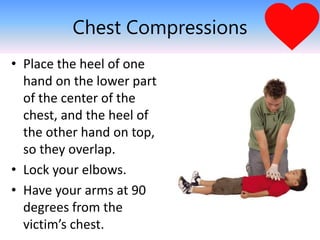
• Place the heel of one
hand on the lower part
of the center of the
chest, and the heel of
the other hand on top,
so they overlap.
• Lock your elbows.
• Have your arms at 90
degrees from the
victim’s chest.
Chest Compressions
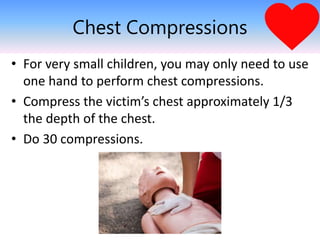
• For very small children, you may only need to use
one hand to perform chest compressions.
• Compress the victim’s chest approximately 1/3
the depth of the chest.
• Do 30 compressions.
Chest Compressions
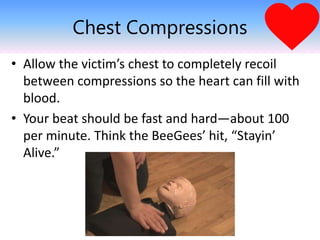
• Allow the victim’s chest to completely recoil
between compressions so the heart can fill with
blood.
• Your beat should be fast and hard—about 100
per minute. Think the BeeGees’ hit, “Stayin’
Alive.”
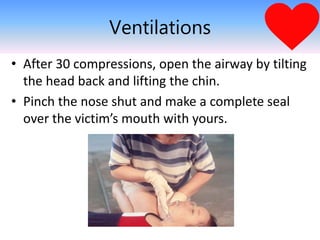
Ventilations
• After 30 compressions, open the airway by tilting
the head back and lifting the chin.
• Pinch the nose shut and make a complete seal
over the victim’s mouth with yours.
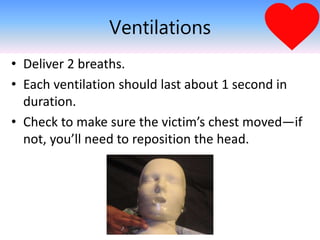
Ventilations
• Deliver 2 breaths.
• Each ventilation should last about 1 second in
duration.
• Check to make sure the victim’s chest moved—if
not, you’ll need to reposition the head.
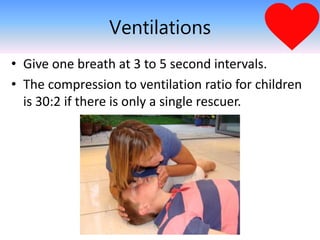
Ventilations
• Give one breath at 3 to 5 second intervals.
• The compression to ventilation ratio for children
is 30:2 if there is only a single rescuer.
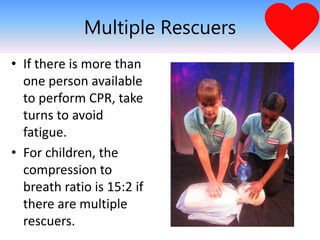
Multiple Rescuers
• If there is more than
one person available
to perform CPR, take
turns to avoid
fatigue.
• For children, the
compression to
breath ratio is 15:2 if
there are multiple
rescuers.
Child CPR Differences
• Compression to breath ratio for 2 rescuer CPR is
15:2.
• Depth of chest compression is at least one third
the depth of the chest (approximately 2 inches).
• 1 or 2 handed compression technique for small
children.
• “Hands-only” CPR (doing chest compressions
with no breaths) is not recommended for
children.
Free CPR Course
• Visit OnlineCPRCertification.net to take a free
CPR course, watch how-to videos, and brush up
on your life saving skills.
• Studies have shown that 15 minutes of training
can be just as effective as a 4 hour course when
it comes to saving a life.
• Download our free CPR ebook.

Child CPR

  • 1.
    Child CPR Learn childCPR step- by-step.
  • 2.
    Child CPR • Anyonecan be affected by cardiac arrest—even children. • There are several differences between adult and child CPR—it’s important to take note of them.
  • 3.
    Check the Scene •Is it safe to provide assistance? • Things that may harm you or the victim include fires, falling debris, risk of electrocution, or other hazards.
  • 4.
    Check for aResponse • Check the victim for a response. • Don’t check the pulse unless you are a trained physician. • Ask the victim, “Are you okay?”
  • 5.
    Call Emergency Services •Get help fast. • Call 911 or get someone to do it for you.
  • 6.
    Chest Compressions • Placethe heel of one hand on the lower part of the center of the chest, and the heel of the other hand on top, so they overlap. • Lock your elbows. • Have your arms at 90 degrees from the victim’s chest.
  • 7.
    Chest Compressions • Forvery small children, you may only need to use one hand to perform chest compressions. • Compress the victim’s chest approximately 1/3 the depth of the chest. • Do 30 compressions.
  • 8.
    Chest Compressions • Allowthe victim’s chest to completely recoil between compressions so the heart can fill with blood. • Your beat should be fast and hard—about 100 per minute. Think the BeeGees’ hit, “Stayin’ Alive.”
  • 9.
    Ventilations • After 30compressions, open the airway by tilting the head back and lifting the chin. • Pinch the nose shut and make a complete seal over the victim’s mouth with yours.
  • 10.
    Ventilations • Deliver 2breaths. • Each ventilation should last about 1 second in duration. • Check to make sure the victim’s chest moved—if not, you’ll need to reposition the head.
  • 11.
    Ventilations • Give onebreath at 3 to 5 second intervals. • The compression to ventilation ratio for children is 30:2 if there is only a single rescuer.
  • 12.
    Multiple Rescuers • Ifthere is more than one person available to perform CPR, take turns to avoid fatigue. • For children, the compression to breath ratio is 15:2 if there are multiple rescuers.
  • 13.
    Child CPR Differences •Compression to breath ratio for 2 rescuer CPR is 15:2. • Depth of chest compression is at least one third the depth of the chest (approximately 2 inches). • 1 or 2 handed compression technique for small children. • “Hands-only” CPR (doing chest compressions with no breaths) is not recommended for children.
  • 14.
    Free CPR Course •Visit OnlineCPRCertification.net to take a free CPR course, watch how-to videos, and brush up on your life saving skills. • Studies have shown that 15 minutes of training can be just as effective as a 4 hour course when it comes to saving a life. • Download our free CPR ebook.