Dr. Namrata Bavalekar
M.P.Th
 Bloom’s taxonomy is a set of
three hierarchical models used to classify
educational learning objectives into levels of
complexity and specificity.
1. The Cognitive domain (Knowledge-based)
2. The Affective domain (Emotion-based)
3. The Psychomotor domain (Action-based)
 Bloom’s taxonomy also known as taxonomy
of educational objectives, developed in the
1950s by the American educational
psychologist Benjamin Bloom.
 This taxonomy had permeated teaching and
instructional planning for almost 50 years
before it was revised in 2001 by Lorin
Anderson who was a student of Benjamin
Bloom.
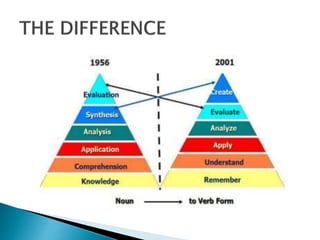
 The first volume of taxonomy, Handbook
I: Cognitive was published in 1956
 The second volume of taxonomy, Handbook
II: Affective was published in 1964.
 The framework was revised in 2001,
called revised Bloom’s taxonomy.
 Taxonomy means science of arrangements
(Taxis- arrangement and nomos- science)
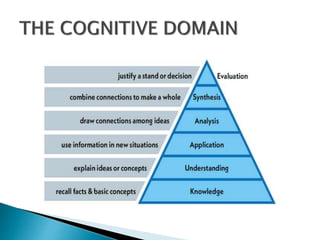
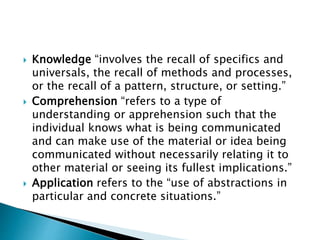
 Knowledge “involves the recall of specifics and
universals, the recall of methods and processes,
or the recall of a pattern, structure, or setting.”
 Comprehension “refers to a type of
understanding or apprehension such that the
individual knows what is being communicated
and can make use of the material or idea being
communicated without necessarily relating it to
other material or seeing its fullest implications.”
 Application refers to the “use of abstractions in
particular and concrete situations.”
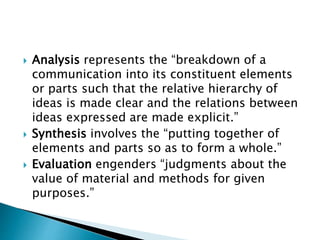
 Analysis represents the “breakdown of a
communication into its constituent elements
or parts such that the relative hierarchy of
ideas is made clear and the relations between
ideas expressed are made explicit.”
 Synthesis involves the “putting together of
elements and parts so as to form a whole.”
 Evaluation engenders “judgments about the
value of material and methods for given
purposes.”
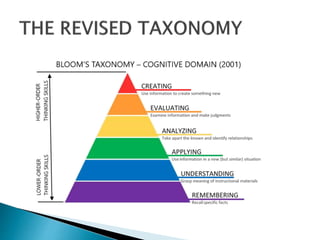
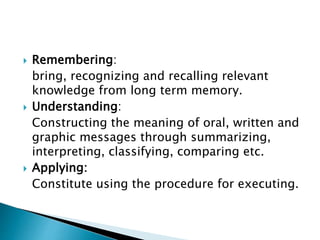
 Remembering:
bring, recognizing and recalling relevant
knowledge from long term memory.
 Understanding:
Constructing the meaning of oral, written and
graphic messages through summarizing,
interpreting, classifying, comparing etc.
 Applying:
Constitute using the procedure for executing.
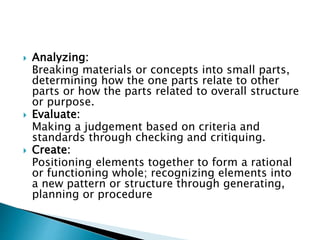
 Analyzing:
Breaking materials or concepts into small parts,
determining how the one parts relate to other
parts or how the parts related to overall structure
or purpose.
 Evaluate:
Making a judgement based on criteria and
standards through checking and critiquing.
 Create:
Positioning elements together to form a rational
or functioning whole; recognizing elements into
a new pattern or structure through generating,
planning or procedure
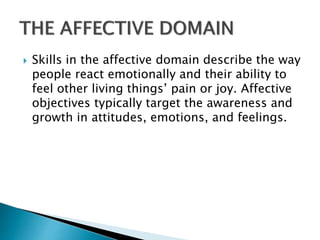
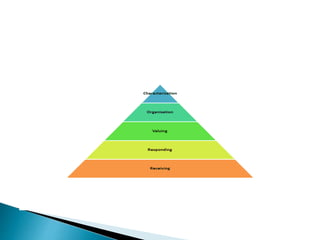
 Skills in the affective domain describe the way
people react emotionally and their ability to
feel other living things’ pain or joy. Affective
objectives typically target the awareness and
growth in attitudes, emotions, and feelings.
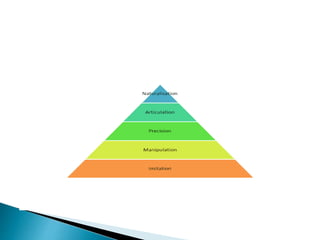
 The psychomotor objective is specific to
physical function, reflex actions and body
movements to interpret information and
learn. It implies that physical activity supports
or is a vehicle for cognitive growth and
furthering knowledge or skills. The learner
uses physical action to achieve a cognitive or
affective objective.
1.Objectives (learning goals) are important to
establish in a pedagogical interchange so that
teachers and students alike understand the
purpose of that interchange.
2. Organizing objectives helps to clarify objectives
for themselves and for students.
3. Having an organized set of objectives helps
teachers to:
“plan and deliver appropriate instruction”;
“design valid assessment tasks and strategies”;
and
“ensure that instruction and assessment are
aligned with the objectives.”
 BLOOM’S TAXONOMY
 BLOOM’S TAXONOMY 1
THANK YOU

Bloom’s taxonomy

  • 1.
  • 2.
     Bloom’s taxonomyis a set of three hierarchical models used to classify educational learning objectives into levels of complexity and specificity. 1. The Cognitive domain (Knowledge-based) 2. The Affective domain (Emotion-based) 3. The Psychomotor domain (Action-based)
  • 3.
     Bloom’s taxonomyalso known as taxonomy of educational objectives, developed in the 1950s by the American educational psychologist Benjamin Bloom.  This taxonomy had permeated teaching and instructional planning for almost 50 years before it was revised in 2001 by Lorin Anderson who was a student of Benjamin Bloom.
  • 4.
     The firstvolume of taxonomy, Handbook I: Cognitive was published in 1956  The second volume of taxonomy, Handbook II: Affective was published in 1964.  The framework was revised in 2001, called revised Bloom’s taxonomy.  Taxonomy means science of arrangements (Taxis- arrangement and nomos- science)
  • 6.
     Knowledge “involvesthe recall of specifics and universals, the recall of methods and processes, or the recall of a pattern, structure, or setting.”  Comprehension “refers to a type of understanding or apprehension such that the individual knows what is being communicated and can make use of the material or idea being communicated without necessarily relating it to other material or seeing its fullest implications.”  Application refers to the “use of abstractions in particular and concrete situations.”
  • 7.
     Analysis representsthe “breakdown of a communication into its constituent elements or parts such that the relative hierarchy of ideas is made clear and the relations between ideas expressed are made explicit.”  Synthesis involves the “putting together of elements and parts so as to form a whole.”  Evaluation engenders “judgments about the value of material and methods for given purposes.”
  • 9.
     Remembering: bring, recognizingand recalling relevant knowledge from long term memory.  Understanding: Constructing the meaning of oral, written and graphic messages through summarizing, interpreting, classifying, comparing etc.  Applying: Constitute using the procedure for executing.
  • 10.
     Analyzing: Breaking materialsor concepts into small parts, determining how the one parts relate to other parts or how the parts related to overall structure or purpose.  Evaluate: Making a judgement based on criteria and standards through checking and critiquing.  Create: Positioning elements together to form a rational or functioning whole; recognizing elements into a new pattern or structure through generating, planning or procedure
  • 12.
     Skills inthe affective domain describe the way people react emotionally and their ability to feel other living things’ pain or joy. Affective objectives typically target the awareness and growth in attitudes, emotions, and feelings.
  • 14.
     The psychomotorobjective is specific to physical function, reflex actions and body movements to interpret information and learn. It implies that physical activity supports or is a vehicle for cognitive growth and furthering knowledge or skills. The learner uses physical action to achieve a cognitive or affective objective.
  • 16.
    1.Objectives (learning goals)are important to establish in a pedagogical interchange so that teachers and students alike understand the purpose of that interchange. 2. Organizing objectives helps to clarify objectives for themselves and for students. 3. Having an organized set of objectives helps teachers to: “plan and deliver appropriate instruction”; “design valid assessment tasks and strategies”; and “ensure that instruction and assessment are aligned with the objectives.”
  • 17.
     BLOOM’S TAXONOMY BLOOM’S TAXONOMY 1
  • 18.