WELCOME
PRESENTERS
•Moazzam Ali (BS Tech. Edu)
•Numan Yaqub (BS Tech. Edu)
BlOOM’S
TAXONOMY
Who is Benjamin Bloom?
•A Jewish-American educational psychologist
•Contributions:
•1. Classification of educational objectives
•2. Theory of Mastery-Learning
What is TAXONOMY?
• Comes from two Greek words:
• (1) Taxis (2) Nomos
• Taxis : Arrangement
• Nomos : Science
• Science of arrangements
• A set of classification principles, or structure
and Domain simply means category.
DEFINITION
• Bloom’s taxonomy is a classification system used to define
and distinguish different level of human cognition_i.e.,
thinking, learning, and understanding.
PURPOSE
• The purpose of Bloom’s Taxonomy is to help
educators to inform or guide the development
of assessments (tests and other evaluations of student
learning), curriculum (units, lessons, projects, and other
learning activities), and instructional methods such as
questioning strategies.
Domains of BLOOM’S TAXONOMY
• The Three Domains Of Learning:
• Cognitive: mental skills (knowledge)
• Affective: growth in feelings or emotional areas
(attitude or self)
• Psychomotor: manual or physical skills
• Instructional designers, trainers, and educators
often refer
to these three categories as KSA
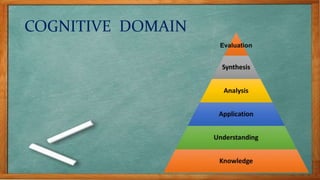
COGNITIVE DOMAIN
• The cognitive domain involves knowledge and the development of
intellectual skills.
• This is include the recall of recognition of specific facts, procedural
patterns, and concepts that serve in the development of intellectual
abilities and skills. There are six major categories of cognitive
processes, starting from the simplest to the complex.
COGNITIVE DOMAIN
KNOWLEDGE
• “involves the recall of specifics and universals, the recall of
methods and processes, or the recall of pattern, structure,
or setting.”
• Student can: write, list, define with his knowledge if he
have.
COMPREHENSION
• Refer to a type of understanding or apprehension such that the
individual knows what is being communicated.
• Students translates, comprehends or interprets information based
on prior learning like:
• Explain, summarize, paraphrase, describe
APPLICATION
• Refers to the “use of abstractions in particular and
concrete situations.”
• Students selects, transfers and uses data and principles
to complete a problem with a minimum of direction.
• How student can use, compute, solve and apply his
knowledge.
ANALYSIS
• Breakdown of a communication into its
• constituent elements or parts.
• Student distinguishes, classifies and relates the
• evidence or structure of a statement or question.
• Student can analyze, categorize, compare and
• separate.
• Example: old capital of Pakistan? New capital?
• Why? (Analysis)
SYNTHESIS
• Involves the "putting together of elements and parts
• so as to form a whole."
• Student originates, integrates, and combines ideas
• into a product, plan or proposal that is new to him.
• He can create, design, invent and develop
• He can combine different types of information to find
• alternative solutions.
• Example: he can combine this to make a sentence
• Mother- invention-is- necessary - the
EVALUATION
• Judgments about the value of material
• and methods for given purposes.
• Student can judge what he learned
• whether it is right or wrong. If wrong
• than he can start the process again.
• Student can judge, recommend,
• critique and justify.
THE AFFECTIVE DOMAIN
• Skills in the affective domain describe the way
• people react emotionally and their ability to feel
• other living things' pain or joy. Affective
• objectives typically target the awareness and
• growth in attitudes, emotion, and feelings.
• There are five levels in the affective domain moving
• through the lowest-order processes to the highest:
• Receiving Responding Valuing Organizing characterizing
RECEIVING
• The lowest level; the student passively pays attention. Without this
level, no learning can occur. Receiving is about the student's memory
and recognition as well.
Responding
• The student actively participates
• in the learning process, not only
• attends to a stimulus; the student
• also reacts in some way.
• EXAMPLE: He saw that people
• appreciating the person who helped
• poor...
VALUING
• The student attaches a value to an
• object, phenomenon, or piece of
• information. The student associates a
• value or some values to the
• knowledge they acquired.
ORGANIZING
• The student can put together different
• values, information, and ideas, and
• can accommodate them within his/her
• own schema; the student is
• comparing, relating and elaborating
• on what has been learned.
CHARACTERIZING
• The student at this level triees
• to build abstract knowledge.
• Example: At this stage the habit
• becomes the part of his character.
THE PSYCHOMOTOR DOMAIN (action
based)
• Skills in the psychomotor domain describe
• the ability to physically manipulate a tool
• or instrument like a hand or a hammer.
• Psychomotor objectives usually focus on
• change and/or development in behavior
• and/or skills.
• Bloom and his colleagues never created
• subcategories for skills in the psychomotor
• domain.
BLOOM'S TAXONOMY POWER POINT PRESENTATION.pptx

BLOOM'S TAXONOMY POWER POINT PRESENTATION.pptx

  • 1.
  • 2.
    PRESENTERS •Moazzam Ali (BSTech. Edu) •Numan Yaqub (BS Tech. Edu)
  • 3.
  • 4.
    Who is BenjaminBloom? •A Jewish-American educational psychologist •Contributions: •1. Classification of educational objectives •2. Theory of Mastery-Learning
  • 5.
    What is TAXONOMY? •Comes from two Greek words: • (1) Taxis (2) Nomos • Taxis : Arrangement • Nomos : Science • Science of arrangements • A set of classification principles, or structure and Domain simply means category.
  • 6.
    DEFINITION • Bloom’s taxonomyis a classification system used to define and distinguish different level of human cognition_i.e., thinking, learning, and understanding.
  • 7.
    PURPOSE • The purposeof Bloom’s Taxonomy is to help educators to inform or guide the development of assessments (tests and other evaluations of student learning), curriculum (units, lessons, projects, and other learning activities), and instructional methods such as questioning strategies.
  • 8.
    Domains of BLOOM’STAXONOMY • The Three Domains Of Learning: • Cognitive: mental skills (knowledge) • Affective: growth in feelings or emotional areas (attitude or self) • Psychomotor: manual or physical skills • Instructional designers, trainers, and educators often refer to these three categories as KSA
  • 9.
    COGNITIVE DOMAIN • Thecognitive domain involves knowledge and the development of intellectual skills. • This is include the recall of recognition of specific facts, procedural patterns, and concepts that serve in the development of intellectual abilities and skills. There are six major categories of cognitive processes, starting from the simplest to the complex.
  • 10.
  • 11.
    KNOWLEDGE • “involves therecall of specifics and universals, the recall of methods and processes, or the recall of pattern, structure, or setting.” • Student can: write, list, define with his knowledge if he have.
  • 12.
    COMPREHENSION • Refer toa type of understanding or apprehension such that the individual knows what is being communicated. • Students translates, comprehends or interprets information based on prior learning like: • Explain, summarize, paraphrase, describe
  • 13.
    APPLICATION • Refers tothe “use of abstractions in particular and concrete situations.” • Students selects, transfers and uses data and principles to complete a problem with a minimum of direction. • How student can use, compute, solve and apply his knowledge.
  • 14.
    ANALYSIS • Breakdown ofa communication into its • constituent elements or parts. • Student distinguishes, classifies and relates the • evidence or structure of a statement or question. • Student can analyze, categorize, compare and • separate. • Example: old capital of Pakistan? New capital? • Why? (Analysis)
  • 15.
    SYNTHESIS • Involves the"putting together of elements and parts • so as to form a whole." • Student originates, integrates, and combines ideas • into a product, plan or proposal that is new to him. • He can create, design, invent and develop • He can combine different types of information to find • alternative solutions. • Example: he can combine this to make a sentence • Mother- invention-is- necessary - the
  • 16.
    EVALUATION • Judgments aboutthe value of material • and methods for given purposes. • Student can judge what he learned • whether it is right or wrong. If wrong • than he can start the process again. • Student can judge, recommend, • critique and justify.
  • 17.
    THE AFFECTIVE DOMAIN •Skills in the affective domain describe the way • people react emotionally and their ability to feel • other living things' pain or joy. Affective • objectives typically target the awareness and • growth in attitudes, emotion, and feelings. • There are five levels in the affective domain moving • through the lowest-order processes to the highest: • Receiving Responding Valuing Organizing characterizing
  • 18.
    RECEIVING • The lowestlevel; the student passively pays attention. Without this level, no learning can occur. Receiving is about the student's memory and recognition as well.
  • 19.
    Responding • The studentactively participates • in the learning process, not only • attends to a stimulus; the student • also reacts in some way. • EXAMPLE: He saw that people • appreciating the person who helped • poor...
  • 20.
    VALUING • The studentattaches a value to an • object, phenomenon, or piece of • information. The student associates a • value or some values to the • knowledge they acquired.
  • 21.
    ORGANIZING • The studentcan put together different • values, information, and ideas, and • can accommodate them within his/her • own schema; the student is • comparing, relating and elaborating • on what has been learned.
  • 22.
    CHARACTERIZING • The studentat this level triees • to build abstract knowledge. • Example: At this stage the habit • becomes the part of his character.
  • 23.
    THE PSYCHOMOTOR DOMAIN(action based) • Skills in the psychomotor domain describe • the ability to physically manipulate a tool • or instrument like a hand or a hammer. • Psychomotor objectives usually focus on • change and/or development in behavior • and/or skills. • Bloom and his colleagues never created • subcategories for skills in the psychomotor • domain.