Prepared by:
Abid Nazir
What is a Test
Attributes of a good Test
Characteristics of a Good Test
Types of Test
Objective Type Test
Short answer type Test
Essay Type Test
Concept of Blue-Print
How to construct The Blue-Print
CONSTRUCTION OF TEST
What is a Test?
A test or examination (informally, exam
or evaluation) is an assessment intended
to measure a test-taker's knowledge,
skill, aptitude, physical fitness, or
classification in many other topics (e.g.,
beliefs). ... Formal testing often results in
a grade or a test score.
Attributes of a Good Test
 Validity
Validity of a test is the extent to which it measures what it
attempts to measure
Types of validity:-
a) Face validity b) Content validity c)Empirical validity
 Reliability
The higher the degree of reliability the results of a test have, the
greater is considered the reliability of the test itself
 Usability
There are a no. Of practical factors that are to be considered while
preparing or selecting a test to use.
a) Length of the test b) Test should be easy to administer c)
Taking care of scorability
 Discriminating Power
Power of discriminating between persons with greater or less ability
so that they score more or less points or marks.
Characteristics of a good test
 Continuous or Formative Evaluation
 Diagnosing the learning gaps and
weaknesses
 Diagnosing the remedial measures
 Formal arrangement for test
 Language must be clear
 Covering whole syllabus and easy to score
 Question should be neither too difficult
nor too easy
Types of Test
 Objective type test
An objective type test is one which is free
from any subjective bias either from the
tester or the marker. It refers to any
written test that requires the examinee
to select the correct answer from among
one or more of several alternatives or
supply a word or two and that demands
an objective judgement when it is
scored.
Short answer type test
 Short-answer questions are open-ended
questions that require students to create
an answer. They are commonly used in
examinations to assess the basic
knowledge and understanding (low
cognitive levels) of a topic before more
in-depth assessment questions are
asked on the topic. The answer is vary
from 1 word to 50 words or as specified
in the question paper
Essay type test
 Essay test is a test that requires the
student to compose responses, usually
lengthy up to several paragraphs. Its
word limit is from 200-400
Essay test measure Higher Level
Thinking Questions that test higher
level processes such as:-
 Analysis
 Synthesis
 Evaluation
 Creativity.
Concept of Blueprint
 Blueprint is a tool to increase the validity of
written examinations
 Blueprint is a map and a specification for an
assessment program which ensures that all
aspects of the curriculum and educational
domains are covered by assessment programs over
a specified period of time.
 The term “blueprint” is derived from the domain of
architecture which means “detailed plan of action”.
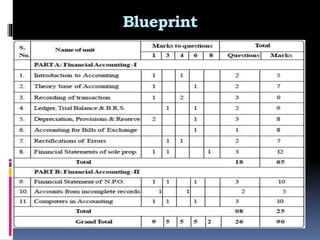
 In simple terms, blueprint links assessment to
learning objectives. It also indicates the marks
carried by each question.
 It is useful to prepare a blueprint so that the
faculty who sets question paper knows which
question will test which objective, which content
unit and how many marks it would carry
Blueprint
Thank You

Construction of test

  • 1.
  • 2.
    What is aTest Attributes of a good Test Characteristics of a Good Test Types of Test Objective Type Test Short answer type Test Essay Type Test Concept of Blue-Print How to construct The Blue-Print
  • 3.
    CONSTRUCTION OF TEST Whatis a Test? A test or examination (informally, exam or evaluation) is an assessment intended to measure a test-taker's knowledge, skill, aptitude, physical fitness, or classification in many other topics (e.g., beliefs). ... Formal testing often results in a grade or a test score.
  • 4.
    Attributes of aGood Test  Validity Validity of a test is the extent to which it measures what it attempts to measure Types of validity:- a) Face validity b) Content validity c)Empirical validity  Reliability The higher the degree of reliability the results of a test have, the greater is considered the reliability of the test itself  Usability There are a no. Of practical factors that are to be considered while preparing or selecting a test to use. a) Length of the test b) Test should be easy to administer c) Taking care of scorability  Discriminating Power Power of discriminating between persons with greater or less ability so that they score more or less points or marks.
  • 5.
    Characteristics of agood test  Continuous or Formative Evaluation  Diagnosing the learning gaps and weaknesses  Diagnosing the remedial measures  Formal arrangement for test  Language must be clear  Covering whole syllabus and easy to score  Question should be neither too difficult nor too easy
  • 6.
    Types of Test Objective type test An objective type test is one which is free from any subjective bias either from the tester or the marker. It refers to any written test that requires the examinee to select the correct answer from among one or more of several alternatives or supply a word or two and that demands an objective judgement when it is scored.
  • 7.
    Short answer typetest  Short-answer questions are open-ended questions that require students to create an answer. They are commonly used in examinations to assess the basic knowledge and understanding (low cognitive levels) of a topic before more in-depth assessment questions are asked on the topic. The answer is vary from 1 word to 50 words or as specified in the question paper
  • 8.
    Essay type test Essay test is a test that requires the student to compose responses, usually lengthy up to several paragraphs. Its word limit is from 200-400 Essay test measure Higher Level Thinking Questions that test higher level processes such as:-  Analysis  Synthesis  Evaluation  Creativity.
  • 9.
    Concept of Blueprint Blueprint is a tool to increase the validity of written examinations  Blueprint is a map and a specification for an assessment program which ensures that all aspects of the curriculum and educational domains are covered by assessment programs over a specified period of time.  The term “blueprint” is derived from the domain of architecture which means “detailed plan of action”.  In simple terms, blueprint links assessment to learning objectives. It also indicates the marks carried by each question.  It is useful to prepare a blueprint so that the faculty who sets question paper knows which question will test which objective, which content unit and how many marks it would carry
  • 10.
  • 11.