Test Administration
and
Scoring
Objectives
General objectives: After the end of the session, the
group will be able to -
Explain the guidelines of test administration,
identify the role of test administrator and follow the
steps for systematic administration of test in an
effective way.
Meaning of test administration:
• Test administration means the range of secure
activities from procurement of assessment
materials through the return of secure assessment
materials to the Department or its agents.
Purpose of test administration:
• To help reduce measurement error.
• To increase the likelihood of fair, valid and
reliable assessment.
• To improve measurement by increasing
consistency and test security.
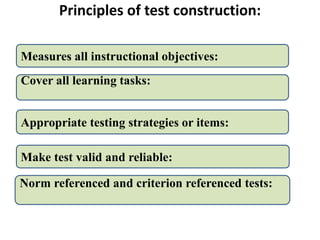
Principles of test construction:
Measures all instructional objectives:
Appropriate testing strategies or items:
Cover all learning tasks:
Make test valid and reliable:
Norm referenced and criterion referenced tests:
Test administration guidelines
 Test administration guidelines are a set of
policies and procedures that outline how
standardized assessments should be distributed
and administered.
 These guidelines exist in order to increase
consistency, ensure test security, and safeguard
the fair and reliable results of exam scores.
Role of test administrator:-
 Test Administrators must administer the forward exam in
a uniform manner to ensure the integrity of the testing
program.
 They establish, implement, and enforce test center policies
and procedures, ensuring compliance with all applicable
regulations and standards.
 Administering psychological tests is involves various
activities, including setting up the testing environment,
providing clear instructions to the test-taker, and ensuring
that the test is administered consistently and unbiasedly.
Steps Of test administration
• Conduct test in large lecture hall
spacious enough to accommodate
all students with comfortable
chairs.
Adequate
space
• Examination room must be well
lighted
Proper light
• Examination room must be well-
ventilated.
ventilation
• Comfortable temparature should
be maintained
Temparature
Seating Arrangement of hall:
Physical environment
Psychological environment:
Maintain a positive attitude for achievement
Maximise achievement motivation
Equalize advantages to all the students
Monitor student continuously
Seat arrangement
 Students should be randomly assigned seats for each
examination.
 In lecture rooms, where seats are numbered, place each
seat number on a 3 x 5 card, shuffle the cards, and hand
one to each .Ask students to sit in the seat indicated on
their card.
 Random seat assignments prevent prearranged plans for
sharing information and help breakup groups of friends.
 Before the day of the test seats are arranged according to
roll numbers .
Contd…
 In rooms where it is feasible, seat students in every other
seat directly behind the person in the row ahead of them.
If you have the luxury of a large room and a small class,
seat students every other seat, every other row.
 The simplest method is to control the flow of students in
the door and as they enter have support staff direct them
to a seat, varying the assignments from front to back and
side to side
 Students are not to enter the test room until the doors are
opened by Faculty on duty. Controlling entry to the room
for the test administration security.
Arrangement of question paper and answer sheet
Prepare Question paper for your college
Previous years question papers must be compiled
Test books should be numbered when they are distributed
Count the question papers prior to passing them out
Manage confidentiality of the test.
Answer sheets should be treated in the same manner as test book
Answer sheets should be signed by the teacher
Preparation before the test
Limit materials that can be brought into the classroom
Do not allow students to wear cap during the test.
Tell students the amount of time allowed for the test.
Tell the students how to signal you if they have a question,
Prepare attendance sheet for students.
Teach students deep breathing and relaxation exercises.
CCTV cameras may be installed to keep an eye on students
If a student is absent, write his/her name on a blank test paper
Test administration
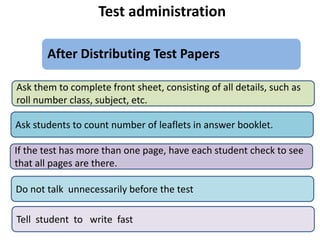
After Distributing Test Papers
If the test has more than one page, have each student check to see
that all pages are there.
Do not talk unnecessarily before the test
Ask students to count number of leaflets in answer booklet.
Ask them to complete front sheet, consisting of all details, such as
roll number class, subject, etc.
Tell student to write fast
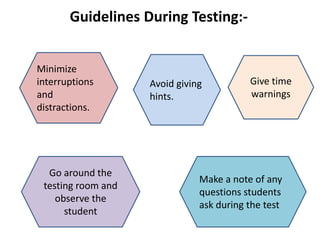
Guidelines During Testing:-
Avoid giving
hints.
Minimize
interruptions
and
distractions.
Give time
warnings
Go around the
testing room and
observe the
student
Make a note of any
questions students
ask during the test
Techniques of checking pilguage
Preventing cheating:
Collection of answer sheets
• After the Test Collecting test materials promptly
• At the end of the test, preferably before students have left
the room, count to see that all materials have been
returned.
• Answer sheets can also be numbered to match question
paper
• Secure Testing Material:
• Once testing is over testing materials must be brought
back to the secure and lockable place.
Return of test
 The process of returning exams can also promote student
learning.
 Return the exams promptly, preferably within 5 days, so
that the material is still fresh in the students' minds.
 Discuss the general results in class. In what areas did the
students do well? Where did they struggle?
 If students have questions, agree to look over their papers
again, as well as the papers of others who have the same
question.
 Have extra office hours after the exam to discuss
concerns, but consider asking students to wait 24 hours to
formulate their questions and calm down if necessary if
they are upset about the results.
Contd….
 Check the papers (and add comments if you can); do test
analysis after scoring and before returning papers to
students. It is important to both evaluation of your students
and improvement of your tests.
 If you are recording marks, record them in pencil in your
internal assessment register before returning papers. If
there are errors/adjustments in scoring, they (marks) are
easier to change when recorded in pencil.
 Provision of re-checking and re-evaluation should be made
for the purpose of transparency of results.
 Evaluation should be done carefully and honestly.
 Entire evaluation work should remain strictly confidential.
Summarization
Assignment
Conclusion
Test Administration.pptx

Test Administration.pptx

  • 2.
  • 3.
    Objectives General objectives: Afterthe end of the session, the group will be able to - Explain the guidelines of test administration, identify the role of test administrator and follow the steps for systematic administration of test in an effective way.
  • 4.
    Meaning of testadministration: • Test administration means the range of secure activities from procurement of assessment materials through the return of secure assessment materials to the Department or its agents.
  • 5.
    Purpose of testadministration: • To help reduce measurement error. • To increase the likelihood of fair, valid and reliable assessment. • To improve measurement by increasing consistency and test security.
  • 6.
    Principles of testconstruction: Measures all instructional objectives: Appropriate testing strategies or items: Cover all learning tasks: Make test valid and reliable: Norm referenced and criterion referenced tests:
  • 7.
    Test administration guidelines Test administration guidelines are a set of policies and procedures that outline how standardized assessments should be distributed and administered.  These guidelines exist in order to increase consistency, ensure test security, and safeguard the fair and reliable results of exam scores.
  • 8.
    Role of testadministrator:-  Test Administrators must administer the forward exam in a uniform manner to ensure the integrity of the testing program.  They establish, implement, and enforce test center policies and procedures, ensuring compliance with all applicable regulations and standards.  Administering psychological tests is involves various activities, including setting up the testing environment, providing clear instructions to the test-taker, and ensuring that the test is administered consistently and unbiasedly.
  • 9.
    Steps Of testadministration
  • 10.
    • Conduct testin large lecture hall spacious enough to accommodate all students with comfortable chairs. Adequate space • Examination room must be well lighted Proper light • Examination room must be well- ventilated. ventilation • Comfortable temparature should be maintained Temparature Seating Arrangement of hall: Physical environment
  • 11.
    Psychological environment: Maintain apositive attitude for achievement Maximise achievement motivation Equalize advantages to all the students Monitor student continuously
  • 12.
    Seat arrangement  Studentsshould be randomly assigned seats for each examination.  In lecture rooms, where seats are numbered, place each seat number on a 3 x 5 card, shuffle the cards, and hand one to each .Ask students to sit in the seat indicated on their card.  Random seat assignments prevent prearranged plans for sharing information and help breakup groups of friends.  Before the day of the test seats are arranged according to roll numbers .
  • 13.
    Contd…  In roomswhere it is feasible, seat students in every other seat directly behind the person in the row ahead of them. If you have the luxury of a large room and a small class, seat students every other seat, every other row.  The simplest method is to control the flow of students in the door and as they enter have support staff direct them to a seat, varying the assignments from front to back and side to side  Students are not to enter the test room until the doors are opened by Faculty on duty. Controlling entry to the room for the test administration security.
  • 14.
    Arrangement of questionpaper and answer sheet Prepare Question paper for your college Previous years question papers must be compiled Test books should be numbered when they are distributed Count the question papers prior to passing them out Manage confidentiality of the test. Answer sheets should be treated in the same manner as test book Answer sheets should be signed by the teacher
  • 15.
    Preparation before thetest Limit materials that can be brought into the classroom Do not allow students to wear cap during the test. Tell students the amount of time allowed for the test. Tell the students how to signal you if they have a question, Prepare attendance sheet for students. Teach students deep breathing and relaxation exercises. CCTV cameras may be installed to keep an eye on students If a student is absent, write his/her name on a blank test paper
  • 16.
    Test administration After DistributingTest Papers If the test has more than one page, have each student check to see that all pages are there. Do not talk unnecessarily before the test Ask students to count number of leaflets in answer booklet. Ask them to complete front sheet, consisting of all details, such as roll number class, subject, etc. Tell student to write fast
  • 17.
    Guidelines During Testing:- Avoidgiving hints. Minimize interruptions and distractions. Give time warnings Go around the testing room and observe the student Make a note of any questions students ask during the test
  • 18.
  • 19.
  • 20.
    Collection of answersheets • After the Test Collecting test materials promptly • At the end of the test, preferably before students have left the room, count to see that all materials have been returned. • Answer sheets can also be numbered to match question paper • Secure Testing Material: • Once testing is over testing materials must be brought back to the secure and lockable place.
  • 21.
    Return of test The process of returning exams can also promote student learning.  Return the exams promptly, preferably within 5 days, so that the material is still fresh in the students' minds.  Discuss the general results in class. In what areas did the students do well? Where did they struggle?  If students have questions, agree to look over their papers again, as well as the papers of others who have the same question.  Have extra office hours after the exam to discuss concerns, but consider asking students to wait 24 hours to formulate their questions and calm down if necessary if they are upset about the results.
  • 22.
    Contd….  Check thepapers (and add comments if you can); do test analysis after scoring and before returning papers to students. It is important to both evaluation of your students and improvement of your tests.  If you are recording marks, record them in pencil in your internal assessment register before returning papers. If there are errors/adjustments in scoring, they (marks) are easier to change when recorded in pencil.  Provision of re-checking and re-evaluation should be made for the purpose of transparency of results.  Evaluation should be done carefully and honestly.  Entire evaluation work should remain strictly confidential.
  • 23.
  • 24.
  • 25.