Dr. Namrata Bavalekar
M.P.Th
WRITING OBJECTIVES
& OUTCOMES
Objectives
 What Are Instructional Objectives?
 Why Have Objectives?
 Types Of Objectives
 How to Writing Objectives?
 What Are Learning Outcomes?
 Types Of Learning Outcomes
 How To Write Learning Outcomes?
What Are Instructional Objectives?
 Instructional objectives are specific, measurable,
short-term, observable student behaviors.
 An objective is a description of a performance you want
learners to be able to exhibit before you consider them
competent.
 An objective describes an intended result of instruction,
rather than the process of instruction itself.
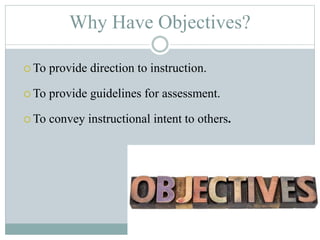
Why Have Objectives?
 To provide direction to instruction.
 To provide guidelines for assessment.
 To convey instructional intent to others.
Types Of Objectives
 Cognitive: understandings, awareness's, insights (e.g.,
"List and explain..."). This includes information recall,
conceptual understanding, and problem-solving.
 Psychomotor: special skills (e.g., "dissect a frog so that
the following organs are clearly displayed..."; "take a
replicable blood pressure reading by appropriately using
a sphygmomanometer").
 Affective: attitudes, appreciations, relationships.
Tips For Writing Objectives
How specific and detailed should objectives be?
 It depends on what they are used for! Objectives for
sequencing a unit plan will be more general than for
specifying a lesson plan.
 Don't make writing objectives tedious, trivial, time-
consuming, or mechanical. Keep them simple,
unambiguous, and clearly focused as a guide to
learning.
 The purpose of objectives is not to restrict spontaneity
or constrain the vision of education in the discipline; but
to ensure that learning is focused clearly enough that
both students and teacher know what is going on
 Express them in terms of student performance,
behavior, and achievement, not teacher activity.
 Three components of an instructional objective:
 Identify the type of activity in which competence is required
(e.g., "Dissect...").
 Specify the criteria or standards by which competence in the
activity will be assessed (e.g., "a frog so that the following
organs are clearly displayed...").
 List any conditions or circumstances required for students to
meet the objective (e.g., "...given two class periods working
with the materials at your lab station").
In writing objectives, answer the question:
"What should the participants be able to do?"
 Objectives must be clear and attainable.
 Focus on knowledge/skill acquisition or reinforcement.
 A recommended wording format is: "At the completion
of this activity, participants should be able to..." This
phrase is followed by a specific performance verb and
the desired learning outcome.
What Are Learning Outcomes?
 Learning outcomes are descriptions of the specific
knowledge, skills, or expertise that the learner will get
from a learning activity, such as a training session,
seminar, course, or program.
 Learning outcomes are measurable achievements that
the learner will be able to understand after the learning
is complete, which helps learners understand the
importance of the information and what they will gain
from their engagement with the learning activity.
 Creating clear, actionable learning outcomes is an
important part of the creation of training programs in
organizations. When developing these programs, both
management and instructors need to be clear about what
learners should understand after completing their
learning path.
 Learning outcomes also play a key role in assessment
and evaluation, making clear what knowledge learners
should have upon completion of the learning activity.
 A well-written learning outcome will focus on how the
learner will be able to apply their new knowledge in a
real-world context, rather than on a learner being able to
recite information.
 The most useful learning outcomes include a verb that
describes an observable action, a description of what
the learner will be able to do and under
which conditions they will be able to do it, and
the performance level they should be able to reach.
Types Of Learning Outcomes
1. Intellectual skills
 With this type of learning outcome, the learner will
understand concepts, rules or procedures. Put simply,
this is understanding how to do something.
2. Cognitive strategy
 In this type of learning outcome, the learner uses
personal strategies to think, organize, learn and behave.
3. Verbal information
 This type of learning outcome is when the learner is
able to definitively state what they have learned from an
organized body of knowledge
4. Motor skills
 This category is concerned with the physical ability to
perform actions, achieving fluidity, smoothness or
proper timing through practice.
5. Attitude
 This is the internal state that reflects in the learner’s
behaviour. It is complex to quantify but can be shown in
the learner’s response to people or situations.
How To Write Learning Outcomes?
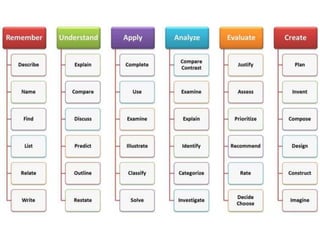
1. Learning outcomes always use an action verb.
What action verbs can be used when writing learning
outcomes? Depending on the type of outcome, different
verbs are appropriate.
2. Learning outcomes must be written clearly, and should
be easy to understand.
3. Learning outcomes should clearly indicate what
learners should learn from within the discipline they are
studying.
4. Learning outcomes must show what the expected level
of learning or understanding should be, and it should be
reasonable to the level of the learners.
5. Learning outcomes help with assessment, and thus
should clearly indicate what success looks like for the
learner.
6. There should not be too few or too many learning
outcomes. Four to six is the ideal number.
Summary
Why to
have
objectives
Types of
objectives
How to
write it
What are
outcomes
Types of
outcomes
How to
write it
Soures
 www. ulm.edu
 www.valamis.com
WRITING OBJECTIVES & OUTCOMES.pptx

WRITING OBJECTIVES & OUTCOMES.pptx

  • 1.
  • 2.
    Objectives  What AreInstructional Objectives?  Why Have Objectives?  Types Of Objectives  How to Writing Objectives?  What Are Learning Outcomes?  Types Of Learning Outcomes  How To Write Learning Outcomes?
  • 4.
    What Are InstructionalObjectives?  Instructional objectives are specific, measurable, short-term, observable student behaviors.  An objective is a description of a performance you want learners to be able to exhibit before you consider them competent.  An objective describes an intended result of instruction, rather than the process of instruction itself.
  • 5.
    Why Have Objectives? To provide direction to instruction.  To provide guidelines for assessment.  To convey instructional intent to others.
  • 6.
    Types Of Objectives Cognitive: understandings, awareness's, insights (e.g., "List and explain..."). This includes information recall, conceptual understanding, and problem-solving.  Psychomotor: special skills (e.g., "dissect a frog so that the following organs are clearly displayed..."; "take a replicable blood pressure reading by appropriately using a sphygmomanometer").  Affective: attitudes, appreciations, relationships.
  • 7.
    Tips For WritingObjectives How specific and detailed should objectives be?  It depends on what they are used for! Objectives for sequencing a unit plan will be more general than for specifying a lesson plan.  Don't make writing objectives tedious, trivial, time- consuming, or mechanical. Keep them simple, unambiguous, and clearly focused as a guide to learning.
  • 8.
     The purposeof objectives is not to restrict spontaneity or constrain the vision of education in the discipline; but to ensure that learning is focused clearly enough that both students and teacher know what is going on  Express them in terms of student performance, behavior, and achievement, not teacher activity.
  • 9.
     Three componentsof an instructional objective:  Identify the type of activity in which competence is required (e.g., "Dissect...").  Specify the criteria or standards by which competence in the activity will be assessed (e.g., "a frog so that the following organs are clearly displayed...").  List any conditions or circumstances required for students to meet the objective (e.g., "...given two class periods working with the materials at your lab station").
  • 10.
    In writing objectives,answer the question: "What should the participants be able to do?"  Objectives must be clear and attainable.  Focus on knowledge/skill acquisition or reinforcement.  A recommended wording format is: "At the completion of this activity, participants should be able to..." This phrase is followed by a specific performance verb and the desired learning outcome.
  • 13.
    What Are LearningOutcomes?  Learning outcomes are descriptions of the specific knowledge, skills, or expertise that the learner will get from a learning activity, such as a training session, seminar, course, or program.  Learning outcomes are measurable achievements that the learner will be able to understand after the learning is complete, which helps learners understand the importance of the information and what they will gain from their engagement with the learning activity.
  • 14.
     Creating clear,actionable learning outcomes is an important part of the creation of training programs in organizations. When developing these programs, both management and instructors need to be clear about what learners should understand after completing their learning path.  Learning outcomes also play a key role in assessment and evaluation, making clear what knowledge learners should have upon completion of the learning activity.
  • 15.
     A well-writtenlearning outcome will focus on how the learner will be able to apply their new knowledge in a real-world context, rather than on a learner being able to recite information.  The most useful learning outcomes include a verb that describes an observable action, a description of what the learner will be able to do and under which conditions they will be able to do it, and the performance level they should be able to reach.
  • 16.
    Types Of LearningOutcomes 1. Intellectual skills  With this type of learning outcome, the learner will understand concepts, rules or procedures. Put simply, this is understanding how to do something. 2. Cognitive strategy  In this type of learning outcome, the learner uses personal strategies to think, organize, learn and behave.
  • 17.
    3. Verbal information This type of learning outcome is when the learner is able to definitively state what they have learned from an organized body of knowledge 4. Motor skills  This category is concerned with the physical ability to perform actions, achieving fluidity, smoothness or proper timing through practice.
  • 18.
    5. Attitude  Thisis the internal state that reflects in the learner’s behaviour. It is complex to quantify but can be shown in the learner’s response to people or situations.
  • 19.
    How To WriteLearning Outcomes? 1. Learning outcomes always use an action verb. What action verbs can be used when writing learning outcomes? Depending on the type of outcome, different verbs are appropriate. 2. Learning outcomes must be written clearly, and should be easy to understand.
  • 20.
    3. Learning outcomesshould clearly indicate what learners should learn from within the discipline they are studying. 4. Learning outcomes must show what the expected level of learning or understanding should be, and it should be reasonable to the level of the learners.
  • 21.
    5. Learning outcomeshelp with assessment, and thus should clearly indicate what success looks like for the learner. 6. There should not be too few or too many learning outcomes. Four to six is the ideal number.
  • 22.
    Summary Why to have objectives Types of objectives Howto write it What are outcomes Types of outcomes How to write it
  • 23.