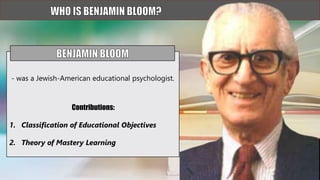
- was a Jewish-American educational psychologist.
Contributions:
1. Classification of Educational Objectives
2. Theory of Mastery Learning
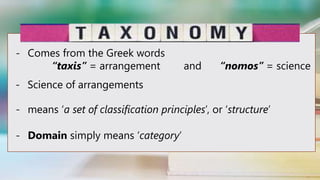
Taxonomy is a branch of Science concerned with
classification; It’s a scheme of classification
According to Sir JJ Guilbert, “Objective refers to the result
sought by the learner at the end of the educational program,
i.e. what the students should be able to do at the end of a
learning period, that they could not do before hand.”
- Comes from the Greek words
“taxis” = arrangement and “nomos” = science
- Science of arrangements
- means ‘a set of classification principles’, or ‘structure’
- Domain simply means ‘category’
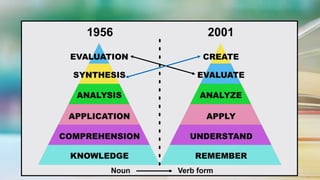
Bloom’s taxonomy was created in 1956 under the leadership
of educational psychologist Dr. Benjamin Samuel Bloom.
In order to promote higher forms of thinking in education
rather than just remembering facts (rote learning).
This taxonomy was created to categorize a continuum of
educational objectives. Which would also allow us to select
appropriate classroom assessment techniques for any
course.
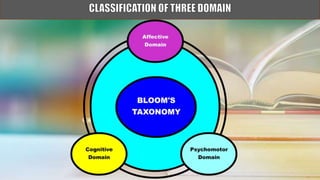
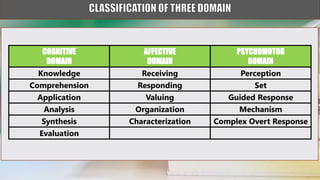
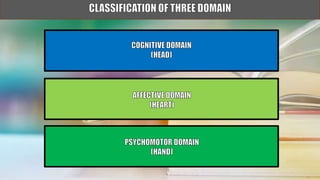
COGNITIVE
DOMAIN
AFFECTIVE
DOMAIN
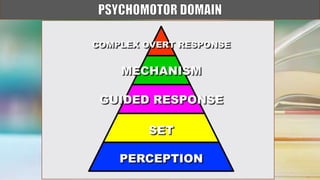
PSYCHOMOTOR
DOMAIN
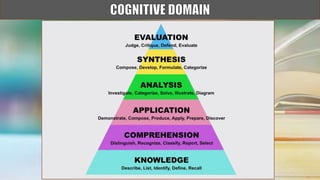
Knowledge Receiving Perception
Comprehension Responding Set
Application Valuing Guided Response
Analysis Organization Mechanism
Synthesis Characterization Complex Overt Response
Evaluation
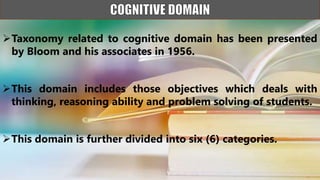
Taxonomy related to cognitive domain has been presented
by Bloom and his associates in 1956.
This domain includes those objectives which deals with
thinking, reasoning ability and problem solving of students.
This domain is further divided into six (6) categories.
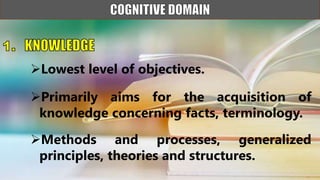
Lowest level of objectives.
Primarily aims for the acquisition of
knowledge concerning facts, terminology.
Methods and processes, generalized
principles, theories and structures.
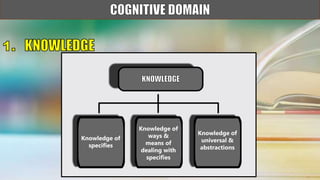
Knowledge of
specifies
Knowledge of
ways &
means of
dealing with
specifies
Knowledge of
universal &
abstractions
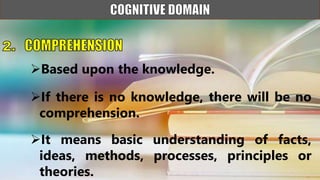
Based upon the knowledge.
If there is no knowledge, there will be no
comprehension.
It means basic understanding of facts,
ideas, methods, processes, principles or
theories.
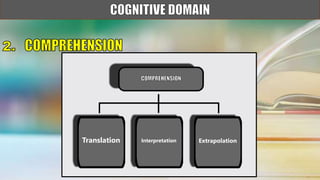
Translation Interpretation Extrapolation
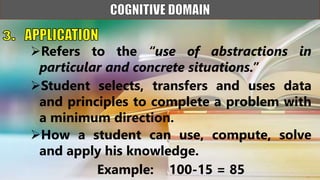
Refers to the “use of abstractions in
particular and concrete situations.”
Student selects, transfers and uses data
and principles to complete a problem with
a minimum direction.
How a student can use, compute, solve
and apply his knowledge.
Example: 100-15 = 85
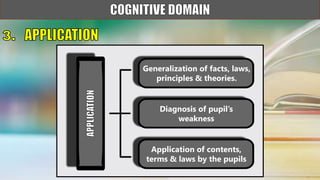
Generalization of facts, laws,
principles & theories.
Diagnosis of pupil’s
weakness
Application of contents,
terms & laws by the pupils
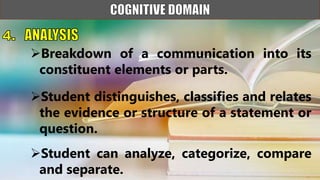
Breakdown of a communication into its
constituent elements or parts.
Student distinguishes, classifies and relates
the evidence or structure of a statement or
question.
Student can analyze, categorize, compare
and separate.
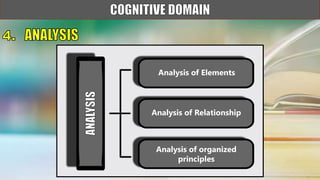
Analysis of Elements
Analysis of Relationship
Analysis of organized
principles
Involves the “putting together of elements
and parts so as to form a whole.”
Student originates, integrates, and
combines ideas into a product, plan or
proposal that is new to him
Student can create, design, invent and
develop
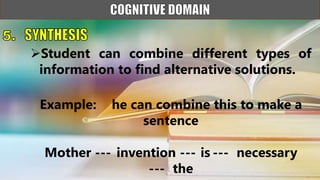
Student can combine different types of
information to find alternative solutions.
Example: he can combine this to make a
sentence
Mother --- invention --- is --- necessary
--- the
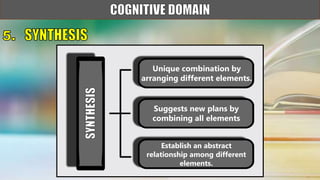
Unique combination by
arranging different elements.
Suggests new plans by
combining all elements
Establish an abstract
relationship among different
elements.
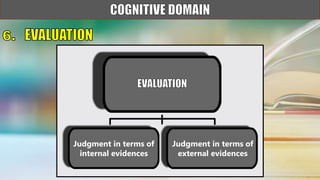
Judgments about the value of material and
methods for given purposes.
Student can judge what he learned
whether it is right or wrong. If wrong then
he can start the process again.
Student can judge, recommend, critique
and justify.
Judgment in terms of
internal evidences
Judgment in terms of
external evidences
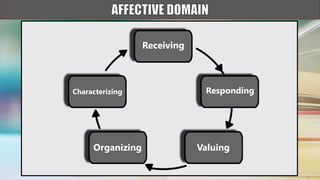
The affective domain includes those objectives
which deals with attitude, values, interests, and
appreciation.
These objectives of affected domain is divided
into five (5) major classes of objectives.
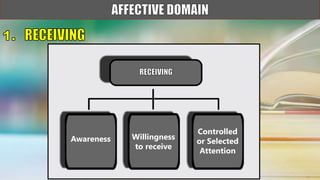
Receiving
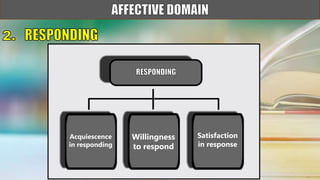
Responding
Valuing
Organizing
Characterizing
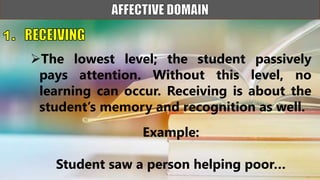
The lowest level; the student passively
pays attention. Without this level, no
learning can occur. Receiving is about the
student’s memory and recognition as well.
Example:
Student saw a person helping poor…
Awareness Willingness
to receive
Controlled
or Selected
Attention
The student actively participates in the
learning process, not only attends to a
stimulus; the student also reacts in some
ways.
Example:
He saw that people appreciating the person
who helped the poor…
Acquiescence
in responding
Willingness
to respond
Satisfaction
in response
The student attaches a value to an object,
phenomenon, or piece of information. The
student associates a value or some values
to the knowledge they acquired.
Example:
He gives value that helping poor is an
appreciable work…
The student can put together different
values, information and ideas, and can
accommodate them within his/her own
schema; the student is comparing, relating
and elaborating on what has been learned.
Example:
He organizes his learning on how he can
help poor…
The student at this level tries to build
abstract knowledge.
Example:
At this stage, the habit becomes a part of his
character.
This domain includes those objectives which
deals with manual and motor skills.
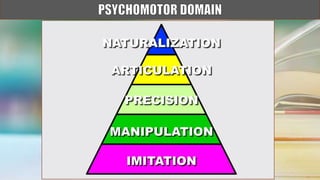
This domain is also divided into five (5)
categories.
directly copy action seen.
At this level, the learner will:
replicate what’s directly observed.
Example:
Align his/her own car seat exactly as advised
by the driving instructor
reproduce activity by instruction.
At this level, the learner will:
reproduce activity by memory.
Example:
Look into back and side mirror every time
you intend to take a turn.
Execute skill independent of help
At this level, the learner will:
Example:
Slow the car down in anticipation of a red
light without being instructed.
Adopt expertise to complete a non-
standard objective.
At this level, the learner will:
Example:
Stop behind a parked car to give way to an
incoming vehicle without instruction.
automate skills.
At this level, the learner will:
unconscious mastery of skills.
Example:
Pass a practical driving test by
independently driving satisfactorily.
In NIDHI KAKKAR’s Book of
Pedagogy of Physical Science,
Psychomotor Domain has five
(5) levels.
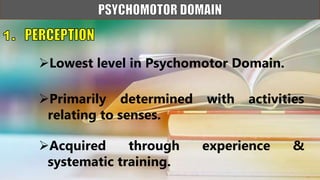
Lowest level in Psychomotor Domain.
Primarily determined with activities
relating to senses.
Acquired through experience &
systematic training.
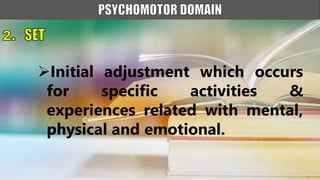
Initial adjustment which occurs
for specific activities &
experiences related with mental,
physical and emotional.
Initial stage of developing a
practical skill & external behavior
of a learner under the guidance
of another person.
At this level, there is a
development of self-confidence
and skills for doing some tasks.
Highest level of Psychomotor
Domain.
Learner acquires so much
efficiency & skills that can
accomplish the most complex task
with minimum energy and time
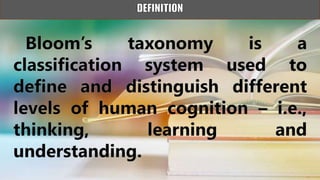
Bloom’s Taxonomy is simply a
classification system for educational
goals that tie in to the level of student
comprehension that is necessary for
achievement or mastery.
Bloom’s Taxonomy is helpful
for teachers in making their
teaching learning process
effective.

MED06-Blooms-Taxonomy-of-Instructional-Objectives.pptx

  • 3.
    - was aJewish-American educational psychologist. Contributions: 1. Classification of Educational Objectives 2. Theory of Mastery Learning
  • 4.
    Taxonomy is abranch of Science concerned with classification; It’s a scheme of classification According to Sir JJ Guilbert, “Objective refers to the result sought by the learner at the end of the educational program, i.e. what the students should be able to do at the end of a learning period, that they could not do before hand.”
  • 5.
    - Comes fromthe Greek words “taxis” = arrangement and “nomos” = science - Science of arrangements - means ‘a set of classification principles’, or ‘structure’ - Domain simply means ‘category’
  • 6.
    Bloom’s taxonomy wascreated in 1956 under the leadership of educational psychologist Dr. Benjamin Samuel Bloom. In order to promote higher forms of thinking in education rather than just remembering facts (rote learning). This taxonomy was created to categorize a continuum of educational objectives. Which would also allow us to select appropriate classroom assessment techniques for any course.
  • 9.
    COGNITIVE DOMAIN AFFECTIVE DOMAIN PSYCHOMOTOR DOMAIN Knowledge Receiving Perception ComprehensionResponding Set Application Valuing Guided Response Analysis Organization Mechanism Synthesis Characterization Complex Overt Response Evaluation
  • 11.
    Taxonomy related tocognitive domain has been presented by Bloom and his associates in 1956. This domain includes those objectives which deals with thinking, reasoning ability and problem solving of students. This domain is further divided into six (6) categories.
  • 13.
    Lowest level ofobjectives. Primarily aims for the acquisition of knowledge concerning facts, terminology. Methods and processes, generalized principles, theories and structures.
  • 14.
    Knowledge of specifies Knowledge of ways& means of dealing with specifies Knowledge of universal & abstractions
  • 15.
    Based upon theknowledge. If there is no knowledge, there will be no comprehension. It means basic understanding of facts, ideas, methods, processes, principles or theories.
  • 16.
  • 17.
    Refers to the“use of abstractions in particular and concrete situations.” Student selects, transfers and uses data and principles to complete a problem with a minimum direction. How a student can use, compute, solve and apply his knowledge. Example: 100-15 = 85
  • 18.
    Generalization of facts,laws, principles & theories. Diagnosis of pupil’s weakness Application of contents, terms & laws by the pupils
  • 19.
    Breakdown of acommunication into its constituent elements or parts. Student distinguishes, classifies and relates the evidence or structure of a statement or question. Student can analyze, categorize, compare and separate.
  • 20.
    Analysis of Elements Analysisof Relationship Analysis of organized principles
  • 21.
    Involves the “puttingtogether of elements and parts so as to form a whole.” Student originates, integrates, and combines ideas into a product, plan or proposal that is new to him Student can create, design, invent and develop
  • 22.
    Student can combinedifferent types of information to find alternative solutions. Example: he can combine this to make a sentence Mother --- invention --- is --- necessary --- the
  • 23.
    Unique combination by arrangingdifferent elements. Suggests new plans by combining all elements Establish an abstract relationship among different elements.
  • 24.
    Judgments about thevalue of material and methods for given purposes. Student can judge what he learned whether it is right or wrong. If wrong then he can start the process again. Student can judge, recommend, critique and justify.
  • 25.
    Judgment in termsof internal evidences Judgment in terms of external evidences
  • 27.
    The affective domainincludes those objectives which deals with attitude, values, interests, and appreciation. These objectives of affected domain is divided into five (5) major classes of objectives.
  • 28.
  • 29.
    The lowest level;the student passively pays attention. Without this level, no learning can occur. Receiving is about the student’s memory and recognition as well. Example: Student saw a person helping poor…
  • 30.
  • 31.
    The student activelyparticipates in the learning process, not only attends to a stimulus; the student also reacts in some ways. Example: He saw that people appreciating the person who helped the poor…
  • 32.
  • 33.
    The student attachesa value to an object, phenomenon, or piece of information. The student associates a value or some values to the knowledge they acquired. Example: He gives value that helping poor is an appreciable work…
  • 34.
    The student canput together different values, information and ideas, and can accommodate them within his/her own schema; the student is comparing, relating and elaborating on what has been learned.
  • 35.
    Example: He organizes hislearning on how he can help poor…
  • 36.
    The student atthis level tries to build abstract knowledge. Example: At this stage, the habit becomes a part of his character.
  • 37.
    This domain includesthose objectives which deals with manual and motor skills. This domain is also divided into five (5) categories.
  • 39.
    directly copy actionseen. At this level, the learner will: replicate what’s directly observed. Example: Align his/her own car seat exactly as advised by the driving instructor
  • 40.
    reproduce activity byinstruction. At this level, the learner will: reproduce activity by memory. Example: Look into back and side mirror every time you intend to take a turn.
  • 41.
    Execute skill independentof help At this level, the learner will: Example: Slow the car down in anticipation of a red light without being instructed.
  • 42.
    Adopt expertise tocomplete a non- standard objective. At this level, the learner will: Example: Stop behind a parked car to give way to an incoming vehicle without instruction.
  • 43.
    automate skills. At thislevel, the learner will: unconscious mastery of skills. Example: Pass a practical driving test by independently driving satisfactorily.
  • 44.
    In NIDHI KAKKAR’sBook of Pedagogy of Physical Science, Psychomotor Domain has five (5) levels.
  • 46.
    Lowest level inPsychomotor Domain. Primarily determined with activities relating to senses. Acquired through experience & systematic training.
  • 47.
    Initial adjustment whichoccurs for specific activities & experiences related with mental, physical and emotional.
  • 48.
    Initial stage ofdeveloping a practical skill & external behavior of a learner under the guidance of another person.
  • 49.
    At this level,there is a development of self-confidence and skills for doing some tasks.
  • 50.
    Highest level ofPsychomotor Domain. Learner acquires so much efficiency & skills that can accomplish the most complex task with minimum energy and time
  • 51.
    Bloom’s Taxonomy issimply a classification system for educational goals that tie in to the level of student comprehension that is necessary for achievement or mastery.
  • 52.
    Bloom’s Taxonomy ishelpful for teachers in making their teaching learning process effective.