By: Dr. Surekha Aditya
Bakle
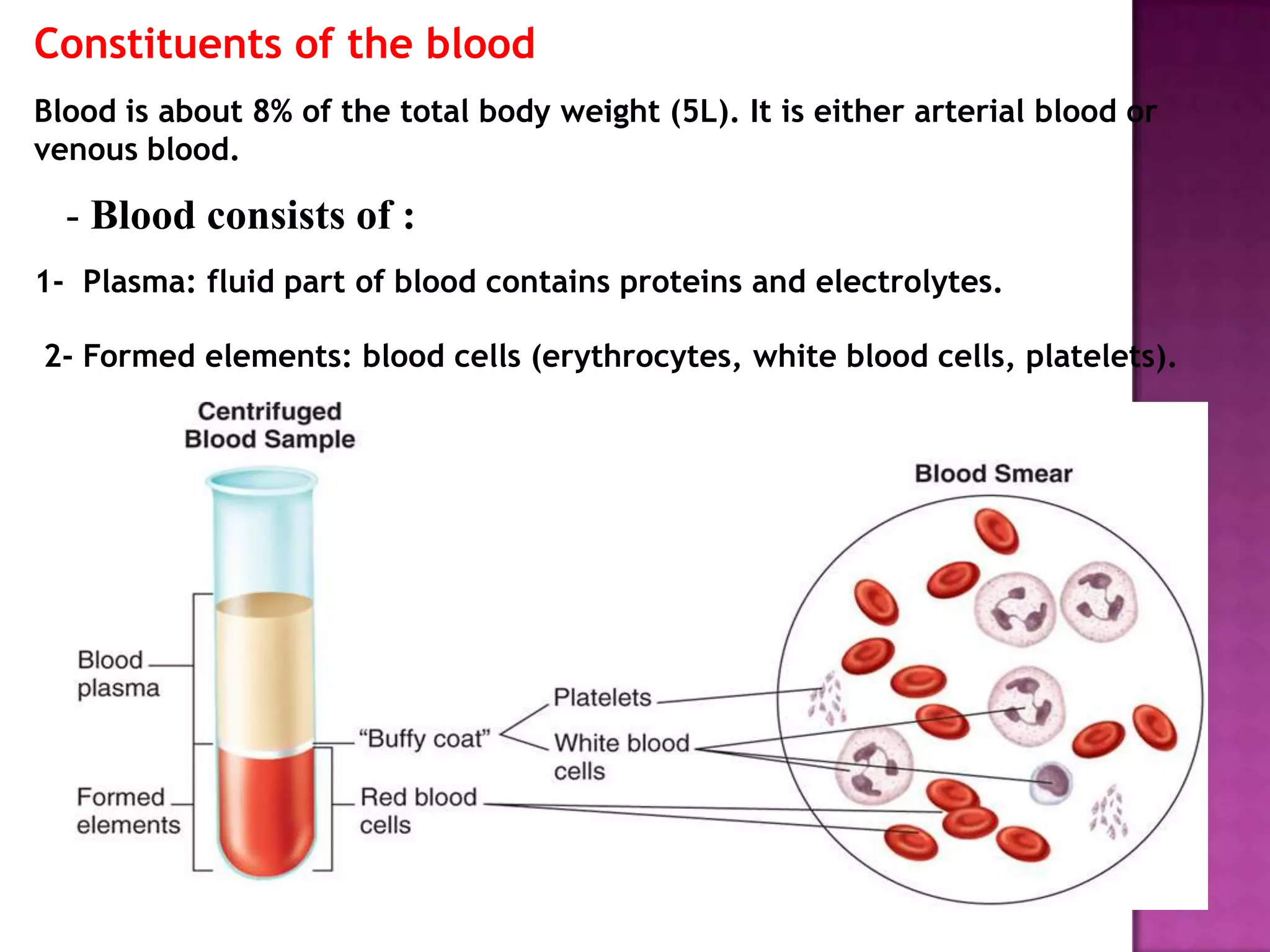
Constituents of the blood
Blood is about 8% of the total body weight (5L). It is either arterial blood or
venous blood.

- Blood consists of :
1- Plasma: fluid part of blood contains proteins and electrolytes.
2- Formed elements: blood cells (erythrocytes, white blood cells, platelets).
Plasma proteins
Plasma Proteins:

7%-9% of plasma volume.

i- Mainly albumins: account for 60% to 80% of the plasma
proteins (produced by the liver).
ii- Globulins:
iiA- Alpha globulin and Beta globulin: transport lipids- and fatsdissolved vitamins.

iiB- Gamma globulins: antibodies produced by lymphocytes
(immunity).
iii- Fibrinogen: essential for blood clotting (produced by the
liver).
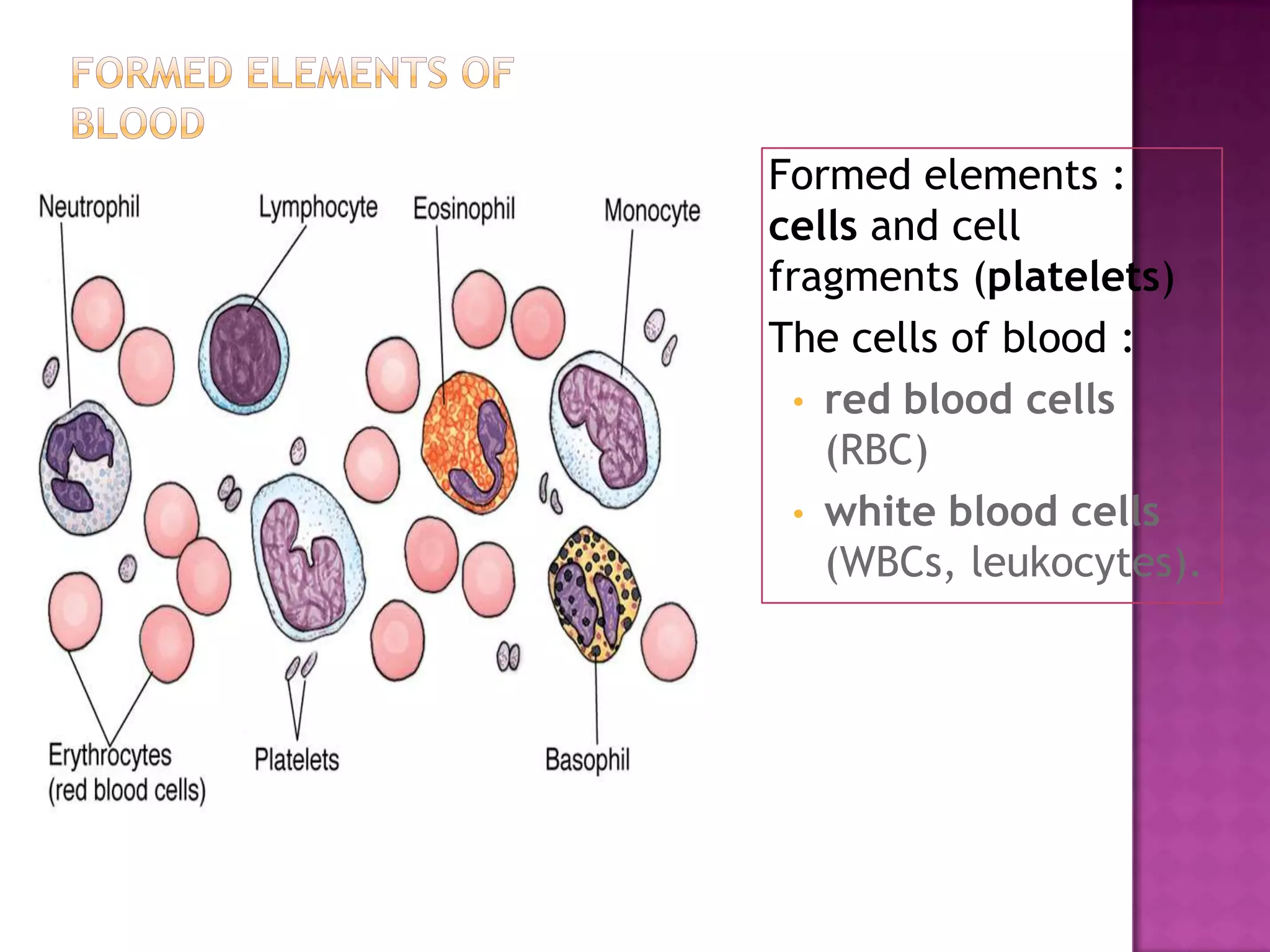
Formed elements :
cells and cell
fragments (platelets)
The cells of blood :
• red blood cells
(RBC)
• white blood cells
(WBCs, leukocytes).
Formed elements of the blood
1- Red blood cells (erythrocytes)

• Most abundant cells of the blood.
• Do not have a nucleus
• Biconcave discs, 7 m diameter and
2.2 m thick.
•
•

Haemoglobin carries oxygen
around the body.

•

Hemoglobin

Contain the protein haemoglobin.

At the centre of the haemoglobin
molecule is an iron atom (heme).
Note the 4 protein chains
that make up 1 molecule of
Hb.

Note that, in muscle, myoglob
(Mb) binds oxygen. Mb consist
of only 1 protein chain.
2- Platelets
• Called also Thrombocytes.
• The smallest of the formed elements.
• They play an important role in blood clotting.
3- White blood cells WBC (Leukocytes)
• Protective cells of the body. They contain nuclei, move in amoeboid fashion
and they can pass the capillary wall (diapedesis or extravasation).
• They are granular or agranular (non granular).
• Neutrophils are the most abundant type of the granular cells.

Granular

Agranular




Protect against infection: phagocytize bacteria; produce proteins that
destroy foreign particles
Diapedesis: leukocytes can squeeze between cells and leave the circulation

Fig. 14.14
Infectio
n
•60-70%

of total
leucocytes
•9-12 µm in diameter
•Multilobe nucleus
•Female : drum
stick/Barr Body
• Granules :
•Small

spesific granules
•Azurophilic granules (Lysosomes)
•Tertiary granules (gelatine and
cathepsins)

•Function

:
• Phagocytes
4% of total leucocyte
10 - 14 µm in diameter
Bilobed nucleus
Many large spesific
granules stained by eosin
Function :
• Eliminate antibodyantigen complexes
• Destroy parasitic
worms
<1% of total leucocyte
8-10 µm in diameter
S-shape nucleus (irregular
lobes)
Large spesific granules
obscured the nucleus
Granules (dark blue) contain
heparin & histamin
Surface receptor (Ig E
receptors)
Function :
As initiator of inflamatory
process
20%-25% of total
leucocyte
8-10 µm in diameter
Round nucleus with
slight indented, occupies
most of the cell
Contain few azurophilic
granules
Largest circulating
blood cells
3-8% ot total leucocyte
Large, acentric,
kidney- shape nucleus
numerous azurophlic
granules
Migrate to the
connective tissue 
MACROPHAGES
(phagocytose antigens
and as APC)
250.000-400.000
platelets/mm3
2 to 4 µm in diameter
Display peripheral clear
region (hyalomere ) and
central darker region
(granulomere)
receptor molecules
(glycocalyx) on
plasmalemma
Function : Blood clott
 Mature

blood cells have a relatively short life

span
 Must be continusly replaced by stem cells
 Stem cells produce in HEMATOPOIETIC ORGAN
Formation of blood cells
1- Hematopoiesis
Blood cells are formed by a process of hematopoiesis.
During embryogenesis the blood cells are formed from stem cells in the liver.
Soon after birth the stem cells migrate to the bone marrow.
Erythropoiesis is the formation of erythrocytes.
Leukopoiesis is the formation of leukocytes.

Bone marrow
 Subdivide


Mesoblastic :








Begins at 6 weeks until end of gestation
Nucleated erythrocyte
Appear of leucocyte (8th week)

Splenic




begin after 2 weeks after conception at yolk sac
Mesenchymal cells aggregate into blood islands

Hepatic




into four phases :

Begin at second trimester until end of gestation

Myeloid



Begin at the end of second trimester
Hemopoiesis at bone marrow
 Hemopoiesis

almost exclusively in BONE

MARROW
 Stem cells undergo




multiple cells divisions
and differentiation

 Replace

the cells that leave the blood
stream, die or destroy
A gelatinous, vascular
connective tissue located in
medulary cavity of long bones
Responsible for hemopoiesis
Structure :
Vascular compartment
Extensive network of
sinusoids , arteries and
veins form the
Hemopoietic compartment
Islands of hematopoietic
cells
Hemopoietic cells in various
stage of maturation
 Regulated

the hemopoiesis
 Produce by spesific cells
 Acts on specific stem cells, progenitor cells,
and precursor cells
 The route to deliver growth factor :




Via blood stream
Secrete near the hemopoietic cells
Direct cell-cell contact

 Induced

rapid mitosis or and differentiation
 Most ot them are glycoproteins
 Formation

of red blood cells
 Generates 2.5 x 10 11 erythrocytes /day
 By two types of unipotential progenitor cell




BFU-E
CFU-E

 Regulate

by : erythropoietin
A- Erythropoiesis
Erythropoieis = the process of
formation of erythrocytes (RBCs).
This process occurs in the bone
marrow (myeloid tissue).
Bone marrow/myeloid tissue is the
red tissue inside bones.
This process takes 3 days. 2 days in
bone marrow and circulate in the blood
in the 3rd day.

Life span of a blood cell is 120 days after
which it is removed by the phagocytic
cells of spleen, liver and bone marrow.
.
Biconcave-shape disk
Without nuclei and
organelles
Have soluble enzymes
Filled with Hemoglobin
(Hb)
Average life span of
erythrocyte : 120 days
B- Leukopoiesis

Leukopoieis = the process of formation
of leukocytes (WBCs).
This process occurs in lymphoid tissue
(lymph nodes, tonsils, spleen and
thymus.)
 Formation

of the granulocytes (neuthrophil,
eosinophil, and basophil




CFU-Eo : eosinophil lineage
CFU-Ba : Basophil lineage
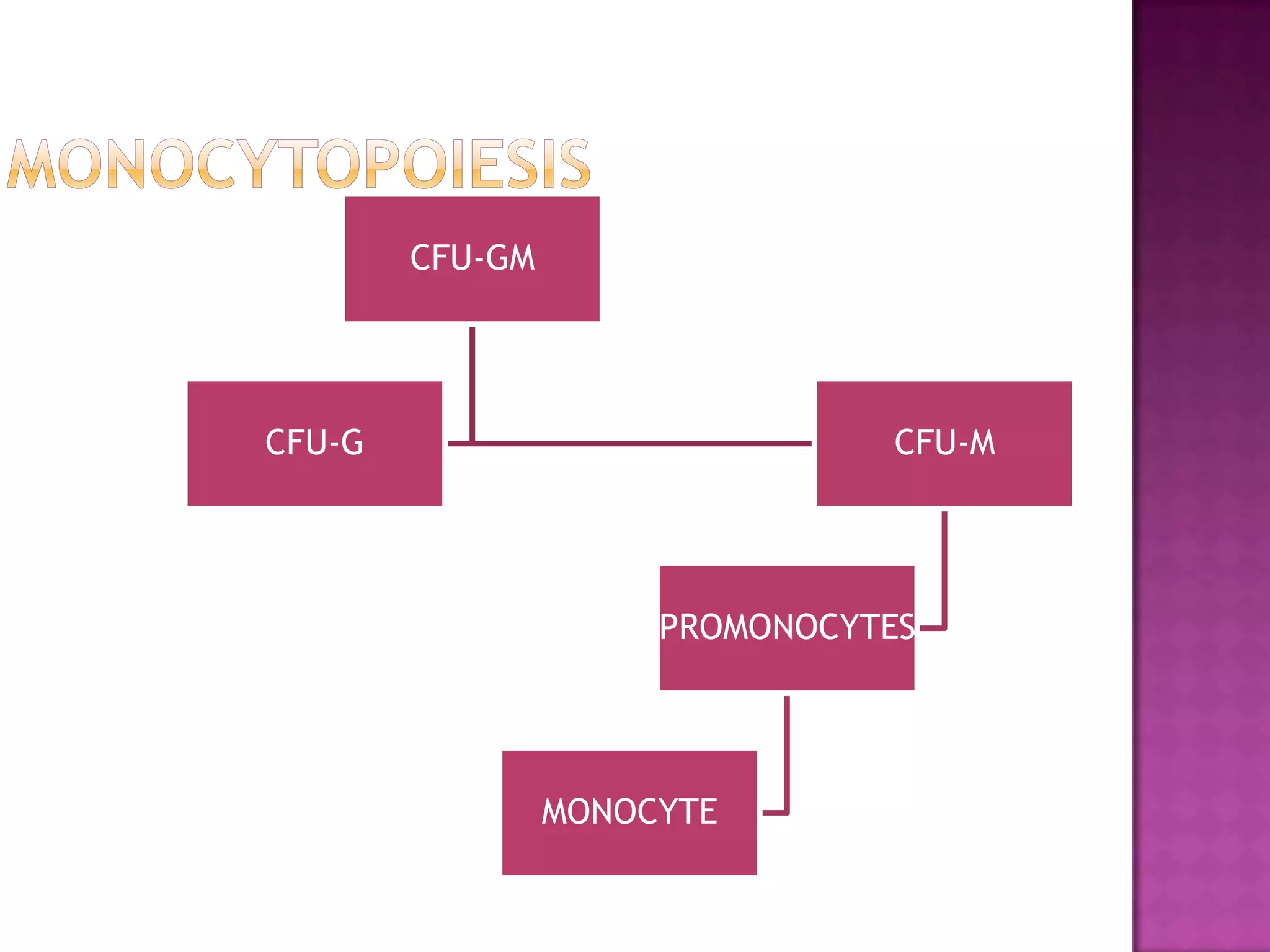
CFU-GM





CFH-G : Neutrophil line
CFU-M : monocyte line

Influence by G-CSF, GM-CSF
CFU-GM

CFU-G

CFU-M

PROMONOCYTES

MONOCYTE
 CFU-Meg,

gives rise the Megakaryoblast
 Megakaryoblast differentiate 
Megakaryocytes (single lobulated nucleus)
 Megakaryocytes protrude  clusters of
proplatelets  platelets
MEGAKARYOCYTE
 CFU-Ly

divides form the CFU-LyB and CFU-LyT
 CFU-LyB migrate to “bursa-equivalent
location”, divided  B lymphocytes
 CFU-LyT undergo mitosis migrate to the
Thymus  T lymphocytes
LYMPHOBLAST
Red blood cells antigens and blood types (ABO system)
There are certain molecules on the
surface of RBCs. These molecules
are called antigens (agglutinogens).
As a part of our body defense
system (immune system) some
WBCs (lymphocytes) secret proteins
called antibodies (agglutinins).

Every antigen type is coupled with
antibodies secreted by the
lymphocytes act against the other
antigens.

Antibodies can bind to antigens

Destroy RBCs
Gentotyping
Here the normal genetic roles of inheritance applies:
A blood group has A antigen which is
shown as IA and antibodies for B.
Blood group B has B antigen which is
shown as IB and antibodies for A.
O has no antigen and is shown as ii.
It has antibodies for A and B.
A person with A may hve got gene A from
each parent (IA IA ) or A from One parent
and O gene from the other (IA i).
A person with group B is (IBIB) or (IBi).
A person with O group has got O gene
from each parent (ii).
A person with AB blood group has got
A gene from one parent and B gene from
the other (IAIB).
Genotyping of the blood groups

B O

AO

Note that A and B are
dominants and O is always
recessive.
AO

AB

BO

OO
Transfusion reactions
Blood from a donor is usually checked by recipient serum.
If the donor is A and the recipient is B then agglutination will occur.

A accepts A and O, but makes clot with B.
B accepts B and O, but clots with A.
AB accepts A, B and O and called universal
recipient.
O can be given to A, B and AB and called
universal donor.
O accepts only from O and clots with A and
B because it has antibodies against them.

-

anti A

anti B

anti D
Blood typing Rhesus factor
Another group of antigens found on RBCs surface
is called Rh factor. People who have this antigen on
their RBCs are Rh positive (Rh+). People without Rh
antigen are Rh negative (Rh-).

The Rh factor is very important when Rh- mother gives birth to Rh+ babies.
Rh- Mother

RBC

RBC

Rh- Mother

Delivery
Rh+ Baby

1st pregnancy
No mixing of blood

Anti-Rh+

Next
pregnancy

RBC

Bloods mixes
RBC

Anti-Rh+
Rh+ Baby

2nd pregnancy
Mother has antibodies
Against baby RBCs










Expain the composition of the blood!
Explain the structure of formed elements of blood!
How to differentiate the blood cells from a bloodsmear?
Explain the classification and function of leucocyte !
Explain the maturation of lymphocyte!
What blood cell would be in abundance during an
active parasitic infection? Explain your answer!
Eplain the structure and function of platelets!
What blood cell in bone marrow is the earliest
recognizable stage of the red blood cell line?
Describe the structure of erythrocyte if lack of this
nutrient: vitamin B12 and iron during the
erythrocytopoiesis
Bloodcells and hematopoesis 2013

Bloodcells and hematopoesis 2013

  • 2.
    By: Dr. SurekhaAditya Bakle
  • 3.
    Constituents of theblood Blood is about 8% of the total body weight (5L). It is either arterial blood or venous blood. - Blood consists of : 1- Plasma: fluid part of blood contains proteins and electrolytes. 2- Formed elements: blood cells (erythrocytes, white blood cells, platelets).
  • 5.
    Plasma proteins Plasma Proteins: 7%-9%of plasma volume. i- Mainly albumins: account for 60% to 80% of the plasma proteins (produced by the liver). ii- Globulins: iiA- Alpha globulin and Beta globulin: transport lipids- and fatsdissolved vitamins. iiB- Gamma globulins: antibodies produced by lymphocytes (immunity). iii- Fibrinogen: essential for blood clotting (produced by the liver).
  • 6.
    Formed elements : cellsand cell fragments (platelets) The cells of blood : • red blood cells (RBC) • white blood cells (WBCs, leukocytes).
  • 7.
    Formed elements ofthe blood 1- Red blood cells (erythrocytes) • Most abundant cells of the blood. • Do not have a nucleus • Biconcave discs, 7 m diameter and 2.2 m thick. • • Haemoglobin carries oxygen around the body. • Hemoglobin Contain the protein haemoglobin. At the centre of the haemoglobin molecule is an iron atom (heme).
  • 8.
    Note the 4protein chains that make up 1 molecule of Hb. Note that, in muscle, myoglob (Mb) binds oxygen. Mb consist of only 1 protein chain.
  • 9.
    2- Platelets • Calledalso Thrombocytes. • The smallest of the formed elements. • They play an important role in blood clotting.
  • 10.
    3- White bloodcells WBC (Leukocytes) • Protective cells of the body. They contain nuclei, move in amoeboid fashion and they can pass the capillary wall (diapedesis or extravasation). • They are granular or agranular (non granular). • Neutrophils are the most abundant type of the granular cells. Granular Agranular
  • 11.
      Protect against infection:phagocytize bacteria; produce proteins that destroy foreign particles Diapedesis: leukocytes can squeeze between cells and leave the circulation Fig. 14.14
  • 12.
  • 14.
    •60-70% of total leucocytes •9-12 µmin diameter •Multilobe nucleus •Female : drum stick/Barr Body • Granules : •Small spesific granules •Azurophilic granules (Lysosomes) •Tertiary granules (gelatine and cathepsins) •Function : • Phagocytes
  • 15.
    4% of totalleucocyte 10 - 14 µm in diameter Bilobed nucleus Many large spesific granules stained by eosin Function : • Eliminate antibodyantigen complexes • Destroy parasitic worms
  • 16.
    <1% of totalleucocyte 8-10 µm in diameter S-shape nucleus (irregular lobes) Large spesific granules obscured the nucleus Granules (dark blue) contain heparin & histamin Surface receptor (Ig E receptors) Function : As initiator of inflamatory process
  • 17.
    20%-25% of total leucocyte 8-10µm in diameter Round nucleus with slight indented, occupies most of the cell Contain few azurophilic granules
  • 18.
    Largest circulating blood cells 3-8%ot total leucocyte Large, acentric, kidney- shape nucleus numerous azurophlic granules Migrate to the connective tissue  MACROPHAGES (phagocytose antigens and as APC)
  • 19.
    250.000-400.000 platelets/mm3 2 to 4µm in diameter Display peripheral clear region (hyalomere ) and central darker region (granulomere) receptor molecules (glycocalyx) on plasmalemma Function : Blood clott
  • 20.
     Mature blood cellshave a relatively short life span  Must be continusly replaced by stem cells  Stem cells produce in HEMATOPOIETIC ORGAN
  • 21.
    Formation of bloodcells 1- Hematopoiesis Blood cells are formed by a process of hematopoiesis. During embryogenesis the blood cells are formed from stem cells in the liver. Soon after birth the stem cells migrate to the bone marrow. Erythropoiesis is the formation of erythrocytes. Leukopoiesis is the formation of leukocytes. Bone marrow
  • 22.
     Subdivide  Mesoblastic :      Beginsat 6 weeks until end of gestation Nucleated erythrocyte Appear of leucocyte (8th week) Splenic   begin after 2 weeks after conception at yolk sac Mesenchymal cells aggregate into blood islands Hepatic   into four phases : Begin at second trimester until end of gestation Myeloid   Begin at the end of second trimester Hemopoiesis at bone marrow
  • 23.
     Hemopoiesis almost exclusivelyin BONE MARROW  Stem cells undergo   multiple cells divisions and differentiation  Replace the cells that leave the blood stream, die or destroy
  • 25.
    A gelatinous, vascular connectivetissue located in medulary cavity of long bones Responsible for hemopoiesis Structure : Vascular compartment Extensive network of sinusoids , arteries and veins form the Hemopoietic compartment Islands of hematopoietic cells Hemopoietic cells in various stage of maturation
  • 26.
     Regulated the hemopoiesis Produce by spesific cells  Acts on specific stem cells, progenitor cells, and precursor cells  The route to deliver growth factor :    Via blood stream Secrete near the hemopoietic cells Direct cell-cell contact  Induced rapid mitosis or and differentiation  Most ot them are glycoproteins
  • 29.
     Formation of redblood cells  Generates 2.5 x 10 11 erythrocytes /day  By two types of unipotential progenitor cell   BFU-E CFU-E  Regulate by : erythropoietin
  • 30.
    A- Erythropoiesis Erythropoieis =the process of formation of erythrocytes (RBCs). This process occurs in the bone marrow (myeloid tissue). Bone marrow/myeloid tissue is the red tissue inside bones. This process takes 3 days. 2 days in bone marrow and circulate in the blood in the 3rd day. Life span of a blood cell is 120 days after which it is removed by the phagocytic cells of spleen, liver and bone marrow.
  • 31.
  • 34.
    Biconcave-shape disk Without nucleiand organelles Have soluble enzymes Filled with Hemoglobin (Hb) Average life span of erythrocyte : 120 days
  • 35.
    B- Leukopoiesis Leukopoieis =the process of formation of leukocytes (WBCs). This process occurs in lymphoid tissue (lymph nodes, tonsils, spleen and thymus.)
  • 36.
     Formation of thegranulocytes (neuthrophil, eosinophil, and basophil    CFU-Eo : eosinophil lineage CFU-Ba : Basophil lineage CFU-GM    CFH-G : Neutrophil line CFU-M : monocyte line Influence by G-CSF, GM-CSF
  • 41.
  • 43.
     CFU-Meg, gives risethe Megakaryoblast  Megakaryoblast differentiate  Megakaryocytes (single lobulated nucleus)  Megakaryocytes protrude  clusters of proplatelets  platelets
  • 44.
  • 45.
     CFU-Ly divides formthe CFU-LyB and CFU-LyT  CFU-LyB migrate to “bursa-equivalent location”, divided  B lymphocytes  CFU-LyT undergo mitosis migrate to the Thymus  T lymphocytes
  • 46.
  • 47.
    Red blood cellsantigens and blood types (ABO system) There are certain molecules on the surface of RBCs. These molecules are called antigens (agglutinogens). As a part of our body defense system (immune system) some WBCs (lymphocytes) secret proteins called antibodies (agglutinins). Every antigen type is coupled with antibodies secreted by the lymphocytes act against the other antigens. Antibodies can bind to antigens Destroy RBCs
  • 48.
    Gentotyping Here the normalgenetic roles of inheritance applies: A blood group has A antigen which is shown as IA and antibodies for B. Blood group B has B antigen which is shown as IB and antibodies for A. O has no antigen and is shown as ii. It has antibodies for A and B. A person with A may hve got gene A from each parent (IA IA ) or A from One parent and O gene from the other (IA i). A person with group B is (IBIB) or (IBi). A person with O group has got O gene from each parent (ii). A person with AB blood group has got A gene from one parent and B gene from the other (IAIB).
  • 49.
    Genotyping of theblood groups B O AO Note that A and B are dominants and O is always recessive. AO AB BO OO
  • 50.
    Transfusion reactions Blood froma donor is usually checked by recipient serum. If the donor is A and the recipient is B then agglutination will occur. A accepts A and O, but makes clot with B. B accepts B and O, but clots with A. AB accepts A, B and O and called universal recipient. O can be given to A, B and AB and called universal donor. O accepts only from O and clots with A and B because it has antibodies against them. - anti A anti B anti D
  • 51.
    Blood typing Rhesusfactor Another group of antigens found on RBCs surface is called Rh factor. People who have this antigen on their RBCs are Rh positive (Rh+). People without Rh antigen are Rh negative (Rh-). The Rh factor is very important when Rh- mother gives birth to Rh+ babies. Rh- Mother RBC RBC Rh- Mother Delivery Rh+ Baby 1st pregnancy No mixing of blood Anti-Rh+ Next pregnancy RBC Bloods mixes RBC Anti-Rh+ Rh+ Baby 2nd pregnancy Mother has antibodies Against baby RBCs
  • 53.
             Expain the compositionof the blood! Explain the structure of formed elements of blood! How to differentiate the blood cells from a bloodsmear? Explain the classification and function of leucocyte ! Explain the maturation of lymphocyte! What blood cell would be in abundance during an active parasitic infection? Explain your answer! Eplain the structure and function of platelets! What blood cell in bone marrow is the earliest recognizable stage of the red blood cell line? Describe the structure of erythrocyte if lack of this nutrient: vitamin B12 and iron during the erythrocytopoiesis