THE BETHESDA SYSTEM
DR.ABHINAV GOLLA
MEDICURE DIAGNOSTICS AND RESEARCH CENTER
VIJAYANAGAR COLONY
HYDERABAD , TELANGANA
INTRODUCTION
• The Bethesda system (TBS) :
• It is a system of reporting cervical or vaginal cytologic diagnoses
,used for reporting Pap smear results
• Introduced in 1988 , revised in 1991 , 2001 , 2014.
THE BETHESDA SYSTEM (TBS)
• SPECIMEN TYPE
• SPECIMEN ADEQUACY
• GENERAL CATEGORIZATION (optional)
• INTERPRETATION / RESULT
• ANCILLARY TESTING
• AUTOMATED REVIEW
• EDUCATIONAL NOTES AND SUGGESTIONS (optional)
• The Bethesda system
• SPECIMEN TYPE
Indicate conventional smear (Pap smear)
vs. liquid-based preparation
vs. other.
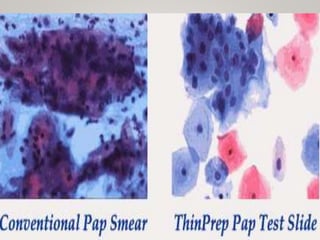
• Conventional Pap
In a conventional Pap smear , samples are smeared directly onto a
microscope slide after collection.
• Liquid based cytology
 The sample of (epithelial) cells is taken from the Transitional Zone
 Liquid-based cytology uses an arrow-shaped brush
 The cells taken are suspended in a bottle of preservative &
transported to the laboratory .
SPECIMEN ADEQUACY
• Satisfactory for evaluation
• Unsatisfactory for evaluation …(specify reason)
• Specimen rejected/not processed (specify reason)
• Specimen processed and examined, but unsatisfactory for evaluation of
epithelial abnormality because of (specify reason)
• Satisfactory :
 Presence / absence of Endocervical / transformation zone
component .
 Appropriate labeling & identifying information .
 Relevant clinical information .
• Unsatisfactory :
Rejected specimen
Fully evaluated , unsatisfactory
• Minimum squamous cellularity criteria :
5000 well visualized / well preserved squamous cells in liquid based
preparation .
8000 – 12000 cells in conventional preparation .
• Endocervical / Transformation Zone component :
10 well preserved endocervical / squamous metaplastic cells singly / in
clusters .
GENERAL CATEGORIZATION (optional)
• Negative for Intraepithelial Lesion or Malignancy
• Other: See Interpretation/result (e.g., endometrial cells in a woman >= 40
years of age)
• Epithelial Cell Abnormality: See Interpretation/result (specify ‘squamous’ or
‘glandular’ as appropriate)
INTERPRETATION / RESULT
Negative For Intraepithelial Lesion Or Malignancy,
( when there is no cellular evidence of neoplasia , state this in
the General Categorization above and / or in the
Interpretation / Result section of the report , whether or not
there are organisms or other non-neoplastic findings ).
INTERPRETATION / RESULT
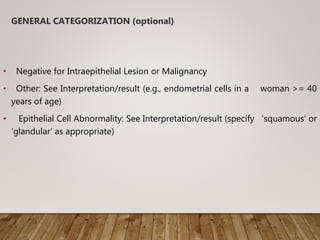
NEGATIVE FOR INTRAEPITHELIAL LESION OR MALIGNANCY
Normal Study :
Non neoplastic findings
Non Neoplastic cellular variations :
Reactive cellular changes :
Glandular cell changes post hysterectomy
Organisms :
Trichomonas , Candida , Bacterial vaginosis ,
Actinomyces ,HSV ,CMV
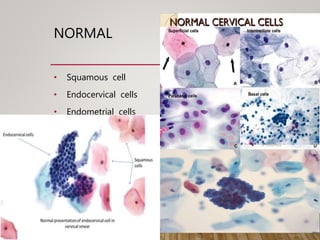
NORMAL
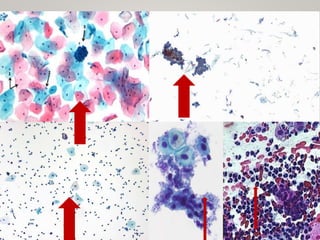
• Squamous cell
• Endocervical cells
• Endometrial cells
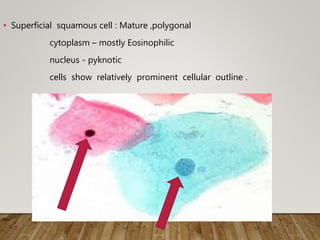
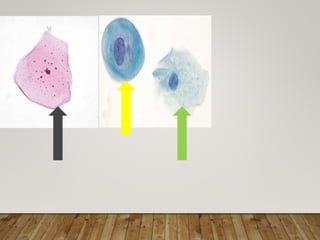
• Superficial squamous cell : Mature ,polygonal
cytoplasm – mostly Eosinophilic
nucleus - pyknotic
cells show relatively prominent cellular outline .
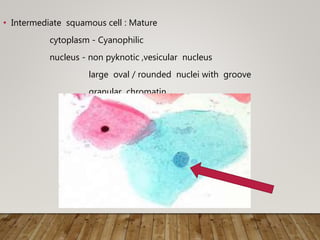
• Intermediate squamous cell : Mature
cytoplasm - Cyanophilic
nucleus - non pyknotic ,vesicular nucleus
large oval / rounded nuclei with groove
granular chromatin
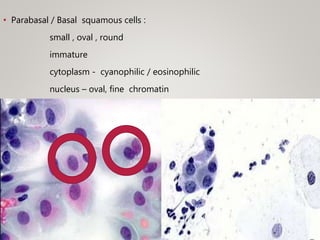
• Parabasal / Basal squamous cells :
small , oval , round
immature
cytoplasm - cyanophilic / eosinophilic
nucleus – oval, fine chromatin
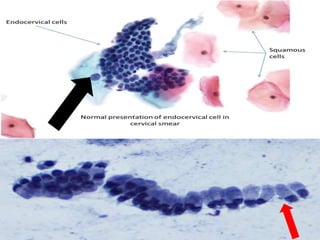
• Endocervical cells :
 Columnar in shape & contain mucin
 In cervical smears endocervical cells arranged singly in
layers & in sheets forming a palisade .
 Honey comb / picket fence appearance .
 nucleus is large ,rounded, placed at basal portion
nucleus is granular evenly distributed chromatin
 cytoplasm - eosinophilic / basophilic
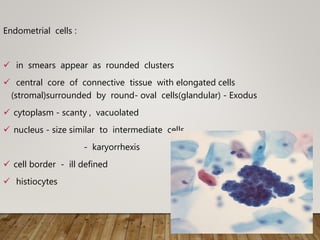
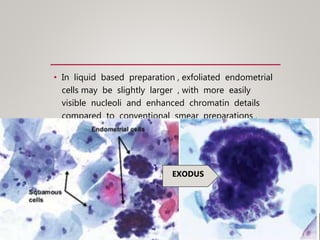
Endometrial cells :
 in smears appear as rounded clusters
 central core of connective tissue with elongated cells
(stromal)surrounded by round- oval cells(glandular) - Exodus
 cytoplasm - scanty , vacuolated
 nucleus - size similar to intermediate cells
- karyorrhexis
 cell border - ill defined
 histiocytes
• In liquid based preparation , exfoliated endometrial
cells may be slightly larger , with more easily
visible nucleoli and enhanced chromatin details
compared to conventional smear preparations .
EXODUS
NILM- NON NEOPLASTIC
FINDINGS
• Non neoplastic cellular variations
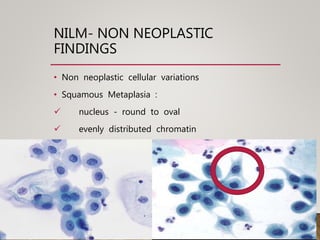
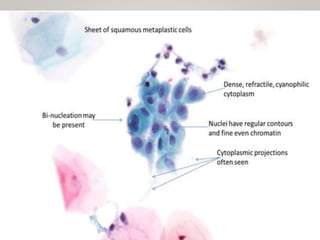
• Squamous Metaplasia :
 nucleus - round to oval
 evenly distributed chromatin
 in conventional smears – spider cells
NILM- NON NEOPLASTIC
FINDINGS
• Non neoplastic cellular variations
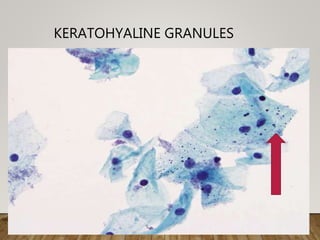
Keratotic cellular changes
 Keratosis
 Hyperkeratosis
 Parakeratosis
 Dyskeratosis
KERATOHYALINE GRANULES
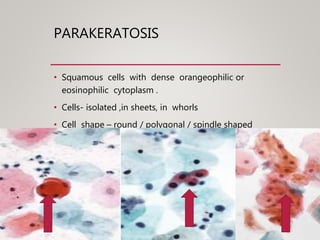
PARAKERATOSIS
• Squamous cells with dense orangeophilic or
eosinophilic cytoplasm .
• Cells- isolated ,in sheets, in whorls
• Cell shape – round / polygonal / spindle shaped
• Nucleus - pyknotic
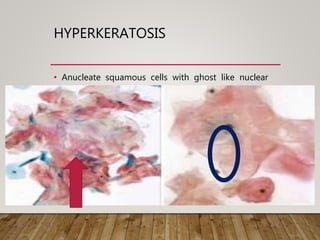
HYPERKERATOSIS
• Anucleate squamous cells with ghost like nuclear
holes .
NILM- NON NEOPLASTIC
FINDINGS
• Non neoplastic cellular changes :
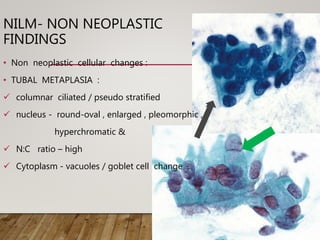
• TUBAL METAPLASIA :
 columnar ciliated / pseudo stratified
 nucleus - round-oval , enlarged , pleomorphic ,
hyperchromatic &
 N:C ratio – high
 Cytoplasm - vacuoles / goblet cell change
NILM- NON NEOPLASTIC
FINDINGS
• Non neoplastic cellular changes :
ATROPHY
 flat monolayer sheets of parabasal like cells
 nucleus enlargement , N:C ratio, regular contour
 abundant inflammatory exudate,
 basophilic granular backgroud
 blue blobs – conventional preparations
NILM- NON NEOPLASTIC
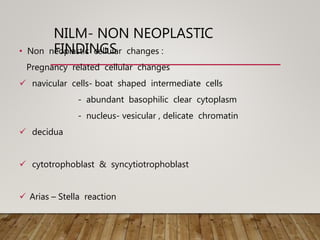
FINDINGS• Non neoplastic cellular changes :
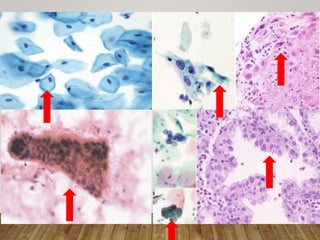
Pregnancy related cellular changes
 navicular cells- boat shaped intermediate cells
- abundant basophilic clear cytoplasm
- nucleus- vesicular , delicate chromatin
 decidua
 cytotrophoblast & syncytiotrophoblast
 Arias – Stella reaction
NILM- NON NEOPLASTIC
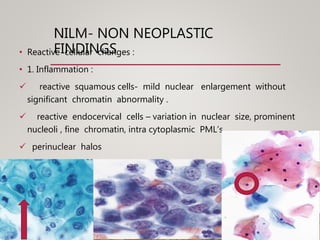
FINDINGS• Reactive cellular changes :
• 1. Inflammation :
 reactive squamous cells- mild nuclear enlargement without
significant chromatin abnormality .
 reactive endocervical cells – variation in nuclear size, prominent
nucleoli , fine chromatin, intra cytoplasmic PML’s
 perinuclear halos
NILM- NON NEOPLASTIC
FINDINGS• Reactive cellular changes :
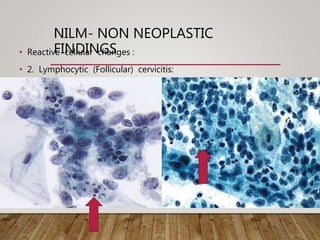
• 2. Lymphocytic (Follicular) cervicitis:
NILM- NON NEOPLASTIC
FINDINGS• Reactive cellular changes :
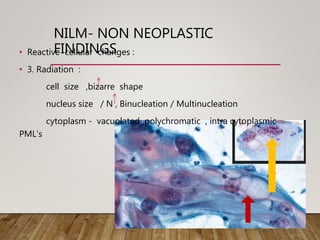
• 3. Radiation :
cell size ,bizarre shape
nucleus size / N , Binucleation / Multinucleation
cytoplasm - vacuolated polychromatic , intra cytoplasmic
PML’s
NILM- NON NEOPLASTIC
FINDINGS• Reactive cellular changes :
• 4. IUCD :
Glandular cells - singly / clusters in clean background
signet ring appearance
NILM- NON NEOPLASTIC
FINDINGS
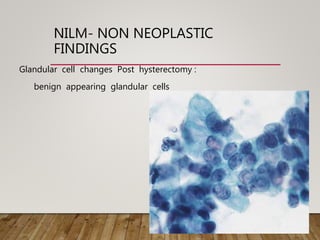
Glandular cell changes Post hysterectomy :
benign appearing glandular cells
NILM- ORGANISMS
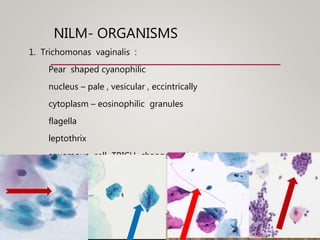
1. Trichomonas vaginalis :
Pear shaped cyanophilic
nucleus – pale , vesicular , eccintrically
cytoplasm – eosinophilic granules
flagella
leptothrix
squamous cell TRICH change , polyballs
NILM- ORGANISMS
2. Candida :
budding yeast &/ pseudo hyphae
in liquid based preparation : spearing of epithelial cells/ shish
kebab effect
NILM- ORGANISMS
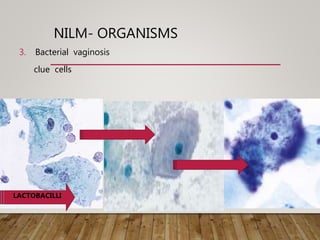
3. Bacterial vaginosis
clue cells
LACTOBACILLI
NILM- ORGANISMS
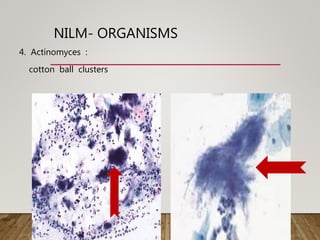
4. Actinomyces :
cotton ball clusters
NILM- ORGANISMS
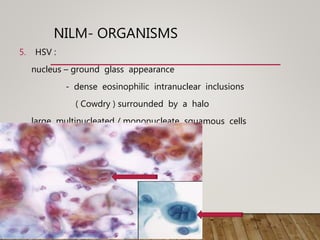
5. HSV :
nucleus – ground glass appearance
- dense eosinophilic intranuclear inclusions
( Cowdry ) surrounded by a halo
large multinucleated / mononucleate squamous cells
NILM- ORGANISMS
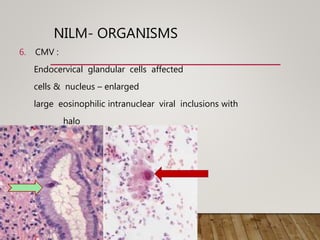
6. CMV :
Endocervical glandular cells affected
cells & nucleus – enlarged
large eosinophilic intranuclear viral inclusions with
halo
INTERPRETATION / RESULT
OTHERS :
Endometrial cells (in a woman >= 40 years of
age)
(Specify if ‘negative for squamous intraepithelial
lesion’)
INTERPRETATION / RESULT
EPITHELIAL CELL ABNORMALITIES
SQUAMOUS CELL
 Atypical squamous cells
- of undetermined significance (ASC-US)
- cannot exclude HSIL (ASC-H)
 Low grade squamous intraepithelial lesion (LSIL)
(encompassing: HPV/mild dysplasia/CIN 1)
 High grade squamous intraepithelial lesion (HSIL)
(encompassing: moderate and severe dysplasia, CIS,
CIN 2 and CIN 3)
- with features suspicious for invasion (if invasion is
INTERPRETATION / RESULT
EPITHELIAL CELL ABNORMALITIES
GLANDULAR CELL
ATYPICAL
 endocervical cells (not otherwise specified (NOS) or specify in comments),
 endometrial cells (NOS or specify in comments),
 glandular cells (NOS or specify in comments)
ATYPICAL
 endocervical cells, favor neoplastic
glandular cells, favor neoplastic
ENDOCERVICAL ADENOCARCINOMA IN SITU
ADENOCARCINOMA:
 Endocervical
 Endometrial
 extrauterine
 not otherwise specified (NOS)
INTERPRETATION / RESULT
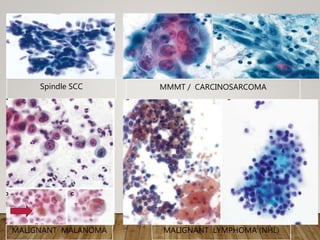
• OTHER MALIGNANT NEOPLASMS: (specify)
1. Uncommon primary tumors of cervix & uterine corpus:
 Carcinomas ( spindle SCC, Poorly diff SCC ,)
 Neuroendocrine ( small cell ,large cell, carcinoid ,glassy
,mucinous , MMMT ,Clear cell, Sarcoma, )
2. secondary / metastatic tumors :
 Extra uterine carcinomas (Breast , Stomach, Ovary ,Colon
, Kidney ,Bladder)
INTERPRETATION / RESULT
• ASC
• ASC-US:
changes that are suggestive of LSIL but are
insufficient for a definitive interpretation
ASC – 1. Squamous differentiation
2. N:C ratio
3. nucleus – size enlarged hyperchromasia ,
clumped chromatin ,irregular , multinucleated
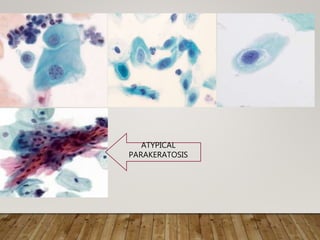
Seen in atypical parakeratosis , atypical repair , atypia
in postmenopausal woman
ATYPICAL
PARAKERATOSIS
INTERPRETATION / RESULT
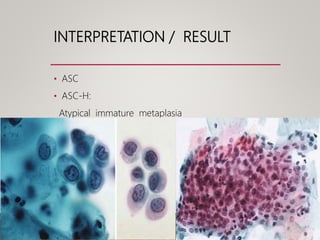
• ASC
• ASC-H:
Atypical immature metaplasia
Crowded sheet pattern
INTERPRETATION / RESULT
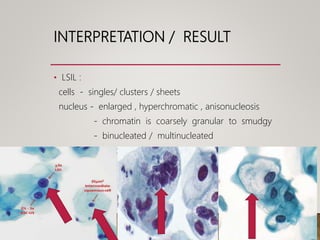
• LSIL :
cells - singles/ clusters / sheets
nucleus - enlarged , hyperchromatic , anisonucleosis
- chromatin is coarsely granular to smudgy
- binucleated / multinucleated
koilocytes & increased keratinization
INTERPRETATION / RESULT
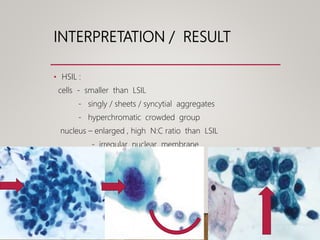
• HSIL :
cells - smaller than LSIL
- singly / sheets / syncytial aggregates
- hyperchromatic crowded group
nucleus – enlarged , high N:C ratio than LSIL
- irregular nuclear membrane
INTERPRETATION / RESULT
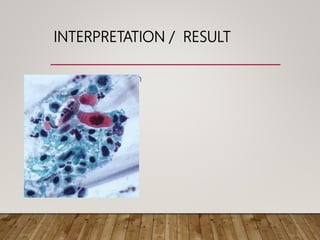
• HSIL with invasion
INTERPRETATION / RESULT
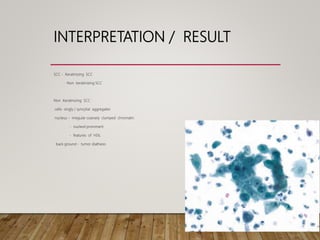
SCC - Keratinizing SCC
- Non keratinizing SCC
Keratinizing SCC :
cells- variable sizes & shapes ,
- keratinized tadpole cells
nucleus – vesicular to pyknotic
cytoplasm – deeply eosinophilic /cyanophilic
back ground - tumor diathesis
INTERPRETATION / RESULT
SCC - Keratinizing SCC
- Non keratinizing SCC
Non Keratinizing SCC :
cells- singly / syncytial aggregates
nucleus – irregular coarsely clumped chromatin
- nucleoli prominent
- features of HSIL
back ground - tumor diathesis
INTERPRETATION / RESULT
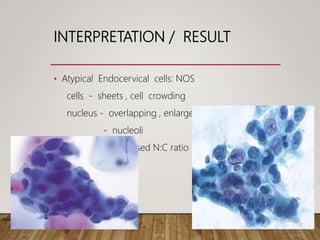
• Atypical Endocervical cells: NOS
cells - sheets , cell crowding
nucleus - overlapping , enlarged ,pleomorphism
- nucleoli
- increased N:C ratio
INTERPRETATION / RESULT
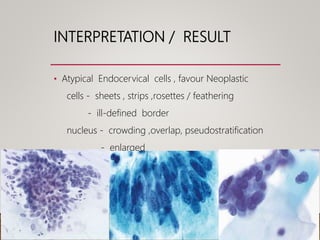
• Atypical Endocervical cells , favour Neoplastic
cells - sheets , strips ,rosettes / feathering
- ill-defined border
nucleus - crowding ,overlap, pseudostratification
- enlarged
- coarse chromatin , increased N:C ratio
INTERPRETATION / RESULT
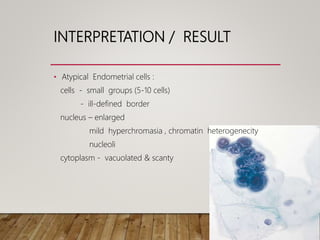
• Atypical Endometrial cells :
cells - small groups (5-10 cells)
- ill-defined border
nucleus – enlarged
mild hyperchromasia , chromatin heterogenecity
nucleoli
cytoplasm - vacuolated & scanty
INTERPRETATION / RESULT
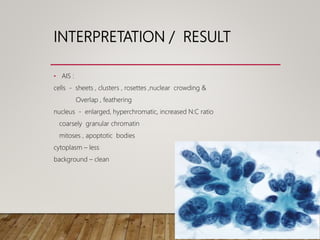
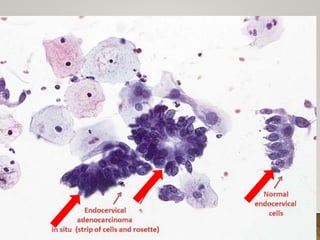
• AIS :
cells - sheets , clusters , rosettes ,nuclear crowding &
Overlap , feathering
nucleus - enlarged, hyperchromatic, increased N:C ratio
coarsely granular chromatin
mitoses , apoptotic bodies
cytoplasm – less
background – clean
INTERPRETATION / RESULT
• Adenocarcinoma :
Endocervical Adenocarcinoma
Endometrial Adenocarcinoma
Extrauterine Adenocarcinoma
INTERPRETATION / RESULT
• Adenocarcinoma :
Endocervical Adenocarcinoma :
cells – singles, sheets , clusters ,syncytial aggregates
- oval / columnar
nucleus - enlarged , pleomorphic, irregular
chromatin
macronucleoli
cytoplasm – vacuolated , mucin
background – necrotic tumor diathesis
INTERPRETATION / RESULT
• Adenocarcinoma :
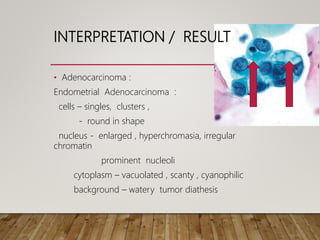
Endometrial Adenocarcinoma :
cells – singles, clusters ,
- round in shape
nucleus - enlarged , hyperchromasia, irregular
chromatin
prominent nucleoli
cytoplasm – vacuolated , scanty , cyanophilic
background – watery tumor diathesis
INTERPRETATION / RESULT
• Adenocarcinoma :
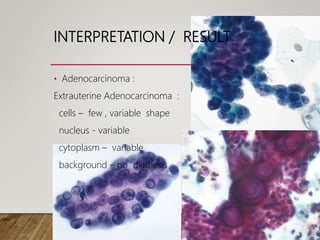
Extrauterine Adenocarcinoma :
cells – few , variable shape
nucleus - variable
cytoplasm – variable
background – no diathesis
Spindle SCC MMMT / CARCINOSARCOMA
MALIGNANT MALANOMA MALIGNANT LYMPHOMA (NHL)
ANCILLARY TESTING
• Provide a brief description of the test method(s) and report the result so
that it is easily understood by the clinician.
AUTOMATED REVIEW
If case examined by automated device, specify device and result.
EDUCATIONAL NOTES AND SUGGESTIONS
(optional)
Suggestions should be concise and consistent with clinical follow-up guidelines
published by professional organizations (references to relevant publications may
be included).
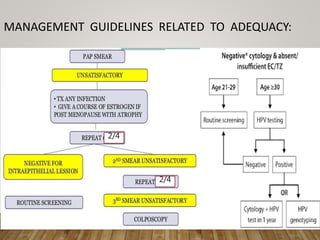
MANAGEMENT GUIDELINES RELATED TO ADEQUACY:
2/4
2/4
• Colposcopy is recommended (if LSIL)
• Loop electrosurgical excision or colposcopy for HSIL.
• ASCUS….. (HPV testing/ Repeat cytology in 1 year
If HPV negative - cotesting - cotesting at 3 years.
If HPV positive - colposcopy.
If 1 year cytology is negative - routine screening
• NILM – Repeat cotesting in 3 years is preferred.
• NILM – after 65 years – No further screening is required if
prior negative screening.
TAKE HOME MESSAGE
The 2014 BETHESDA SYSTEM FOR REPORTING CERVICAL
CYTOLOGY
SPECIMEN TYPE:
Indicate conventional smear (Pap smear) vs. liquid-based preparation vs. other
SPECIMEN ADEQUACY :
• Satisfactory for evaluation ( describe presence or absence of endocervical/transformation
zone component and any other quality indicators, e.g., partially
obscuring blood, infl ammation, etc. )
• Unsatisfactory for evaluation . . . ( specify reason )
– Specimen rejected/not processed (s pecify reason )
– Specimen processed and examined, but unsatisfactory for evaluation of epithelial
- abnormality because of ( specify reason )
GENERAL CATEGORIZATION ( optional )
• Negative for Intraepithelial Lesion or Malignancy
• Other: See Interpretation/Result ( e.g., endometrial cells in a woman ≥45 years of
age )
• Epithelial Cell Abnormality: See Interpretation/Result ( specify ‘squamous’ or
‘glandular’ as appropriate )
INTERPRETATION/RESULT
NEGATIVE FOR INTRAEPITHELIAL LESION OR MALIGNANCY
(When there is no cellular evidence of neoplasia, state this in the General
Categorization above and/or in the Interpretation/Result section of the report --
whether or not there are organisms or other non-neoplastic findings )
NON-NEOPLASTIC FINDINGS ( optional to report optional to report; list not
inclusive )
• Non-neoplastic cellular variations
– Squamous metaplasia
– Keratotic changes
– Tubal metaplasia
– Atrophy
– Pregnancy-associated changes
Reactive cellular changes associated with:
– Infl ammation (includes typical repair)
• Lymphocytic (follicular) cervicitis
– Radiation
– Intrauterine contraceptive device (IUD)
• Glandular cells status post hysterectomy
ORGANISMS
• Trichomonas vaginalis
• Fungal organisms morphologically consistent with Candida spp.
• Shift in flora suggestive of bacterial vaginosis
• Bacteria morphologically consistent with Actinomyces spp.
• Cellular changes consistent with herpes simplex virus
• Cellular changes consistent with cytomegalovirus
OTHER
• Endometrial cells ( in a woman ≥45 years of age )
( Specify if “negative for squamous intraepithelial lesion” )
EPITHELIAL CELL ABNORMALITIES
SQUAMOUS CELL
• Atypical squamous cells
– of undetermined signifi cance (ASC-US)
– cannot exclude HSIL (ASC-H)
• Low-grade squamous intraepithelial lesion (LSIL)
( encompassing: HPV/mild dysplasia/CIN 1 )
• High-grade squamous intraepithelial lesion (HSIL)
( encompassing: moderate and severe dysplasia, CIS; CIN 2 and CIN 3 )
– with features suspicious for invasion (i f invasion is suspected )
• Squamous cell carcinoma
GLANDULAR CELL
• Atypical
– endocervical cells (NOS o r specify in comments )
– endometrial cells (NOS o r specify in comments )
– glandular cells (NOS o r specify in comments )
• Atypical– endocervical cells, favor neoplastic
– glandular cells, favor neoplastic
• Endocervical adenocarcinoma in situ
• Adenocarcinoma– endocervical– endometrial– extrauterine– not otherwise specifi
ed (NOS)
OTHER MALIGNANT NEOPLASMS: (specify)
ADJUNCTIVE TESTING
Provide a brief description of the test method(s) and report the result so that it is
easily understood by the clinician.
COMPUTER-ASSISTED INTERPRETATION OF CERVICAL CYTOLOGY
If case examined by an automated device, specify device and result.
EDUCATIONAL NOTES AND COMMENTS APPENDED TO CYTOLOGY
REPORTS ( optional )
Suggestions should be concise and consistent with clinical follow-up guidelines
published by professional organizations (references to relevant publications may be
included).
REFERRENCES
• The Bethesda System for Reporting Cervical Cytology
– 3 rd edition – Ritu Nayar , David C.Wilbur
• Gynecological Cytopathology Cervix- 2 nd edition –
Suresh Bhambhani
• Comprehensive Cytopathology – 2 nd edition –
Marluce Bibbo
THANK YOU

Bethesda system for reporting . Dr. Abhinav Golla , Associate Professor , Lab Director & Consultant Pathologist . Aadhya Medicure Pathlabs .

  • 1.
    THE BETHESDA SYSTEM DR.ABHINAVGOLLA MEDICURE DIAGNOSTICS AND RESEARCH CENTER VIJAYANAGAR COLONY HYDERABAD , TELANGANA
  • 2.
    INTRODUCTION • The Bethesdasystem (TBS) : • It is a system of reporting cervical or vaginal cytologic diagnoses ,used for reporting Pap smear results • Introduced in 1988 , revised in 1991 , 2001 , 2014.
  • 3.
    THE BETHESDA SYSTEM(TBS) • SPECIMEN TYPE • SPECIMEN ADEQUACY • GENERAL CATEGORIZATION (optional) • INTERPRETATION / RESULT • ANCILLARY TESTING • AUTOMATED REVIEW • EDUCATIONAL NOTES AND SUGGESTIONS (optional)
  • 4.
    • The Bethesdasystem • SPECIMEN TYPE Indicate conventional smear (Pap smear) vs. liquid-based preparation vs. other.
  • 5.
    • Conventional Pap Ina conventional Pap smear , samples are smeared directly onto a microscope slide after collection. • Liquid based cytology  The sample of (epithelial) cells is taken from the Transitional Zone  Liquid-based cytology uses an arrow-shaped brush  The cells taken are suspended in a bottle of preservative & transported to the laboratory .
  • 7.
    SPECIMEN ADEQUACY • Satisfactoryfor evaluation • Unsatisfactory for evaluation …(specify reason) • Specimen rejected/not processed (specify reason) • Specimen processed and examined, but unsatisfactory for evaluation of epithelial abnormality because of (specify reason)
  • 8.
    • Satisfactory : Presence / absence of Endocervical / transformation zone component .  Appropriate labeling & identifying information .  Relevant clinical information . • Unsatisfactory : Rejected specimen Fully evaluated , unsatisfactory
  • 9.
    • Minimum squamouscellularity criteria : 5000 well visualized / well preserved squamous cells in liquid based preparation . 8000 – 12000 cells in conventional preparation . • Endocervical / Transformation Zone component : 10 well preserved endocervical / squamous metaplastic cells singly / in clusters .
  • 11.
    GENERAL CATEGORIZATION (optional) •Negative for Intraepithelial Lesion or Malignancy • Other: See Interpretation/result (e.g., endometrial cells in a woman >= 40 years of age) • Epithelial Cell Abnormality: See Interpretation/result (specify ‘squamous’ or ‘glandular’ as appropriate)
  • 12.
    INTERPRETATION / RESULT NegativeFor Intraepithelial Lesion Or Malignancy, ( when there is no cellular evidence of neoplasia , state this in the General Categorization above and / or in the Interpretation / Result section of the report , whether or not there are organisms or other non-neoplastic findings ).
  • 13.
    INTERPRETATION / RESULT NEGATIVEFOR INTRAEPITHELIAL LESION OR MALIGNANCY Normal Study : Non neoplastic findings Non Neoplastic cellular variations : Reactive cellular changes : Glandular cell changes post hysterectomy Organisms : Trichomonas , Candida , Bacterial vaginosis , Actinomyces ,HSV ,CMV
  • 14.
    NORMAL • Squamous cell •Endocervical cells • Endometrial cells
  • 15.
    • Superficial squamouscell : Mature ,polygonal cytoplasm – mostly Eosinophilic nucleus - pyknotic cells show relatively prominent cellular outline .
  • 16.
    • Intermediate squamouscell : Mature cytoplasm - Cyanophilic nucleus - non pyknotic ,vesicular nucleus large oval / rounded nuclei with groove granular chromatin
  • 17.
    • Parabasal /Basal squamous cells : small , oval , round immature cytoplasm - cyanophilic / eosinophilic nucleus – oval, fine chromatin
  • 19.
    • Endocervical cells:  Columnar in shape & contain mucin  In cervical smears endocervical cells arranged singly in layers & in sheets forming a palisade .  Honey comb / picket fence appearance .  nucleus is large ,rounded, placed at basal portion nucleus is granular evenly distributed chromatin  cytoplasm - eosinophilic / basophilic
  • 21.
    Endometrial cells : in smears appear as rounded clusters  central core of connective tissue with elongated cells (stromal)surrounded by round- oval cells(glandular) - Exodus  cytoplasm - scanty , vacuolated  nucleus - size similar to intermediate cells - karyorrhexis  cell border - ill defined  histiocytes
  • 22.
    • In liquidbased preparation , exfoliated endometrial cells may be slightly larger , with more easily visible nucleoli and enhanced chromatin details compared to conventional smear preparations . EXODUS
  • 23.
    NILM- NON NEOPLASTIC FINDINGS •Non neoplastic cellular variations • Squamous Metaplasia :  nucleus - round to oval  evenly distributed chromatin  in conventional smears – spider cells
  • 25.
    NILM- NON NEOPLASTIC FINDINGS •Non neoplastic cellular variations Keratotic cellular changes  Keratosis  Hyperkeratosis  Parakeratosis  Dyskeratosis
  • 26.
  • 27.
    PARAKERATOSIS • Squamous cellswith dense orangeophilic or eosinophilic cytoplasm . • Cells- isolated ,in sheets, in whorls • Cell shape – round / polygonal / spindle shaped • Nucleus - pyknotic
  • 28.
    HYPERKERATOSIS • Anucleate squamouscells with ghost like nuclear holes .
  • 29.
    NILM- NON NEOPLASTIC FINDINGS •Non neoplastic cellular changes : • TUBAL METAPLASIA :  columnar ciliated / pseudo stratified  nucleus - round-oval , enlarged , pleomorphic , hyperchromatic &  N:C ratio – high  Cytoplasm - vacuoles / goblet cell change
  • 30.
    NILM- NON NEOPLASTIC FINDINGS •Non neoplastic cellular changes : ATROPHY  flat monolayer sheets of parabasal like cells  nucleus enlargement , N:C ratio, regular contour  abundant inflammatory exudate,  basophilic granular backgroud  blue blobs – conventional preparations
  • 31.
    NILM- NON NEOPLASTIC FINDINGS•Non neoplastic cellular changes : Pregnancy related cellular changes  navicular cells- boat shaped intermediate cells - abundant basophilic clear cytoplasm - nucleus- vesicular , delicate chromatin  decidua  cytotrophoblast & syncytiotrophoblast  Arias – Stella reaction
  • 33.
    NILM- NON NEOPLASTIC FINDINGS•Reactive cellular changes : • 1. Inflammation :  reactive squamous cells- mild nuclear enlargement without significant chromatin abnormality .  reactive endocervical cells – variation in nuclear size, prominent nucleoli , fine chromatin, intra cytoplasmic PML’s  perinuclear halos
  • 34.
    NILM- NON NEOPLASTIC FINDINGS•Reactive cellular changes : • 2. Lymphocytic (Follicular) cervicitis:
  • 35.
    NILM- NON NEOPLASTIC FINDINGS•Reactive cellular changes : • 3. Radiation : cell size ,bizarre shape nucleus size / N , Binucleation / Multinucleation cytoplasm - vacuolated polychromatic , intra cytoplasmic PML’s
  • 36.
    NILM- NON NEOPLASTIC FINDINGS•Reactive cellular changes : • 4. IUCD : Glandular cells - singly / clusters in clean background signet ring appearance
  • 37.
    NILM- NON NEOPLASTIC FINDINGS Glandularcell changes Post hysterectomy : benign appearing glandular cells
  • 38.
    NILM- ORGANISMS 1. Trichomonasvaginalis : Pear shaped cyanophilic nucleus – pale , vesicular , eccintrically cytoplasm – eosinophilic granules flagella leptothrix squamous cell TRICH change , polyballs
  • 39.
    NILM- ORGANISMS 2. Candida: budding yeast &/ pseudo hyphae in liquid based preparation : spearing of epithelial cells/ shish kebab effect
  • 40.
    NILM- ORGANISMS 3. Bacterialvaginosis clue cells LACTOBACILLI
  • 41.
    NILM- ORGANISMS 4. Actinomyces: cotton ball clusters
  • 42.
    NILM- ORGANISMS 5. HSV: nucleus – ground glass appearance - dense eosinophilic intranuclear inclusions ( Cowdry ) surrounded by a halo large multinucleated / mononucleate squamous cells
  • 43.
    NILM- ORGANISMS 6. CMV: Endocervical glandular cells affected cells & nucleus – enlarged large eosinophilic intranuclear viral inclusions with halo
  • 44.
    INTERPRETATION / RESULT OTHERS: Endometrial cells (in a woman >= 40 years of age) (Specify if ‘negative for squamous intraepithelial lesion’)
  • 45.
    INTERPRETATION / RESULT EPITHELIALCELL ABNORMALITIES SQUAMOUS CELL  Atypical squamous cells - of undetermined significance (ASC-US) - cannot exclude HSIL (ASC-H)  Low grade squamous intraepithelial lesion (LSIL) (encompassing: HPV/mild dysplasia/CIN 1)  High grade squamous intraepithelial lesion (HSIL) (encompassing: moderate and severe dysplasia, CIS, CIN 2 and CIN 3) - with features suspicious for invasion (if invasion is
  • 46.
    INTERPRETATION / RESULT EPITHELIALCELL ABNORMALITIES GLANDULAR CELL ATYPICAL  endocervical cells (not otherwise specified (NOS) or specify in comments),  endometrial cells (NOS or specify in comments),  glandular cells (NOS or specify in comments) ATYPICAL  endocervical cells, favor neoplastic glandular cells, favor neoplastic ENDOCERVICAL ADENOCARCINOMA IN SITU ADENOCARCINOMA:  Endocervical  Endometrial  extrauterine  not otherwise specified (NOS)
  • 47.
    INTERPRETATION / RESULT •OTHER MALIGNANT NEOPLASMS: (specify) 1. Uncommon primary tumors of cervix & uterine corpus:  Carcinomas ( spindle SCC, Poorly diff SCC ,)  Neuroendocrine ( small cell ,large cell, carcinoid ,glassy ,mucinous , MMMT ,Clear cell, Sarcoma, ) 2. secondary / metastatic tumors :  Extra uterine carcinomas (Breast , Stomach, Ovary ,Colon , Kidney ,Bladder)
  • 48.
    INTERPRETATION / RESULT •ASC • ASC-US: changes that are suggestive of LSIL but are insufficient for a definitive interpretation ASC – 1. Squamous differentiation 2. N:C ratio 3. nucleus – size enlarged hyperchromasia , clumped chromatin ,irregular , multinucleated Seen in atypical parakeratosis , atypical repair , atypia in postmenopausal woman
  • 49.
  • 50.
    INTERPRETATION / RESULT •ASC • ASC-H: Atypical immature metaplasia Crowded sheet pattern
  • 51.
    INTERPRETATION / RESULT •LSIL : cells - singles/ clusters / sheets nucleus - enlarged , hyperchromatic , anisonucleosis - chromatin is coarsely granular to smudgy - binucleated / multinucleated koilocytes & increased keratinization
  • 52.
    INTERPRETATION / RESULT •HSIL : cells - smaller than LSIL - singly / sheets / syncytial aggregates - hyperchromatic crowded group nucleus – enlarged , high N:C ratio than LSIL - irregular nuclear membrane
  • 53.
    INTERPRETATION / RESULT •HSIL with invasion
  • 54.
    INTERPRETATION / RESULT SCC- Keratinizing SCC - Non keratinizing SCC Keratinizing SCC : cells- variable sizes & shapes , - keratinized tadpole cells nucleus – vesicular to pyknotic cytoplasm – deeply eosinophilic /cyanophilic back ground - tumor diathesis
  • 55.
    INTERPRETATION / RESULT SCC- Keratinizing SCC - Non keratinizing SCC Non Keratinizing SCC : cells- singly / syncytial aggregates nucleus – irregular coarsely clumped chromatin - nucleoli prominent - features of HSIL back ground - tumor diathesis
  • 56.
    INTERPRETATION / RESULT •Atypical Endocervical cells: NOS cells - sheets , cell crowding nucleus - overlapping , enlarged ,pleomorphism - nucleoli - increased N:C ratio
  • 57.
    INTERPRETATION / RESULT •Atypical Endocervical cells , favour Neoplastic cells - sheets , strips ,rosettes / feathering - ill-defined border nucleus - crowding ,overlap, pseudostratification - enlarged - coarse chromatin , increased N:C ratio
  • 58.
    INTERPRETATION / RESULT •Atypical Endometrial cells : cells - small groups (5-10 cells) - ill-defined border nucleus – enlarged mild hyperchromasia , chromatin heterogenecity nucleoli cytoplasm - vacuolated & scanty
  • 59.
    INTERPRETATION / RESULT •AIS : cells - sheets , clusters , rosettes ,nuclear crowding & Overlap , feathering nucleus - enlarged, hyperchromatic, increased N:C ratio coarsely granular chromatin mitoses , apoptotic bodies cytoplasm – less background – clean
  • 61.
    INTERPRETATION / RESULT •Adenocarcinoma : Endocervical Adenocarcinoma Endometrial Adenocarcinoma Extrauterine Adenocarcinoma
  • 62.
    INTERPRETATION / RESULT •Adenocarcinoma : Endocervical Adenocarcinoma : cells – singles, sheets , clusters ,syncytial aggregates - oval / columnar nucleus - enlarged , pleomorphic, irregular chromatin macronucleoli cytoplasm – vacuolated , mucin background – necrotic tumor diathesis
  • 63.
    INTERPRETATION / RESULT •Adenocarcinoma : Endometrial Adenocarcinoma : cells – singles, clusters , - round in shape nucleus - enlarged , hyperchromasia, irregular chromatin prominent nucleoli cytoplasm – vacuolated , scanty , cyanophilic background – watery tumor diathesis
  • 64.
    INTERPRETATION / RESULT •Adenocarcinoma : Extrauterine Adenocarcinoma : cells – few , variable shape nucleus - variable cytoplasm – variable background – no diathesis
  • 65.
    Spindle SCC MMMT/ CARCINOSARCOMA MALIGNANT MALANOMA MALIGNANT LYMPHOMA (NHL)
  • 66.
    ANCILLARY TESTING • Providea brief description of the test method(s) and report the result so that it is easily understood by the clinician. AUTOMATED REVIEW If case examined by automated device, specify device and result. EDUCATIONAL NOTES AND SUGGESTIONS (optional) Suggestions should be concise and consistent with clinical follow-up guidelines published by professional organizations (references to relevant publications may be included).
  • 67.
    MANAGEMENT GUIDELINES RELATEDTO ADEQUACY: 2/4 2/4
  • 68.
    • Colposcopy isrecommended (if LSIL) • Loop electrosurgical excision or colposcopy for HSIL. • ASCUS….. (HPV testing/ Repeat cytology in 1 year If HPV negative - cotesting - cotesting at 3 years. If HPV positive - colposcopy. If 1 year cytology is negative - routine screening • NILM – Repeat cotesting in 3 years is preferred. • NILM – after 65 years – No further screening is required if prior negative screening.
  • 69.
    TAKE HOME MESSAGE The2014 BETHESDA SYSTEM FOR REPORTING CERVICAL CYTOLOGY SPECIMEN TYPE: Indicate conventional smear (Pap smear) vs. liquid-based preparation vs. other SPECIMEN ADEQUACY : • Satisfactory for evaluation ( describe presence or absence of endocervical/transformation zone component and any other quality indicators, e.g., partially obscuring blood, infl ammation, etc. ) • Unsatisfactory for evaluation . . . ( specify reason ) – Specimen rejected/not processed (s pecify reason ) – Specimen processed and examined, but unsatisfactory for evaluation of epithelial - abnormality because of ( specify reason )
  • 70.
    GENERAL CATEGORIZATION (optional ) • Negative for Intraepithelial Lesion or Malignancy • Other: See Interpretation/Result ( e.g., endometrial cells in a woman ≥45 years of age ) • Epithelial Cell Abnormality: See Interpretation/Result ( specify ‘squamous’ or ‘glandular’ as appropriate ) INTERPRETATION/RESULT NEGATIVE FOR INTRAEPITHELIAL LESION OR MALIGNANCY (When there is no cellular evidence of neoplasia, state this in the General Categorization above and/or in the Interpretation/Result section of the report -- whether or not there are organisms or other non-neoplastic findings ) NON-NEOPLASTIC FINDINGS ( optional to report optional to report; list not inclusive ) • Non-neoplastic cellular variations – Squamous metaplasia – Keratotic changes – Tubal metaplasia – Atrophy – Pregnancy-associated changes
  • 71.
    Reactive cellular changesassociated with: – Infl ammation (includes typical repair) • Lymphocytic (follicular) cervicitis – Radiation – Intrauterine contraceptive device (IUD) • Glandular cells status post hysterectomy ORGANISMS • Trichomonas vaginalis • Fungal organisms morphologically consistent with Candida spp. • Shift in flora suggestive of bacterial vaginosis • Bacteria morphologically consistent with Actinomyces spp. • Cellular changes consistent with herpes simplex virus • Cellular changes consistent with cytomegalovirus OTHER • Endometrial cells ( in a woman ≥45 years of age ) ( Specify if “negative for squamous intraepithelial lesion” )
  • 72.
    EPITHELIAL CELL ABNORMALITIES SQUAMOUSCELL • Atypical squamous cells – of undetermined signifi cance (ASC-US) – cannot exclude HSIL (ASC-H) • Low-grade squamous intraepithelial lesion (LSIL) ( encompassing: HPV/mild dysplasia/CIN 1 ) • High-grade squamous intraepithelial lesion (HSIL) ( encompassing: moderate and severe dysplasia, CIS; CIN 2 and CIN 3 ) – with features suspicious for invasion (i f invasion is suspected ) • Squamous cell carcinoma GLANDULAR CELL • Atypical – endocervical cells (NOS o r specify in comments ) – endometrial cells (NOS o r specify in comments ) – glandular cells (NOS o r specify in comments ) • Atypical– endocervical cells, favor neoplastic – glandular cells, favor neoplastic • Endocervical adenocarcinoma in situ • Adenocarcinoma– endocervical– endometrial– extrauterine– not otherwise specifi ed (NOS)
  • 73.
    OTHER MALIGNANT NEOPLASMS:(specify) ADJUNCTIVE TESTING Provide a brief description of the test method(s) and report the result so that it is easily understood by the clinician. COMPUTER-ASSISTED INTERPRETATION OF CERVICAL CYTOLOGY If case examined by an automated device, specify device and result. EDUCATIONAL NOTES AND COMMENTS APPENDED TO CYTOLOGY REPORTS ( optional ) Suggestions should be concise and consistent with clinical follow-up guidelines published by professional organizations (references to relevant publications may be included).
  • 74.
    REFERRENCES • The BethesdaSystem for Reporting Cervical Cytology – 3 rd edition – Ritu Nayar , David C.Wilbur • Gynecological Cytopathology Cervix- 2 nd edition – Suresh Bhambhani • Comprehensive Cytopathology – 2 nd edition – Marluce Bibbo THANK YOU

Editor's Notes

  • #3 The Bethesda system (TBS) is a system for reporting cervicalor vaginal cytologic diagnoses,used for reporting Pap smearresults. It was introduced in 1988, and revised in 1991 and 2001. The name comes from the location (Bethesda, Maryland) of the conference that established the system. Cervical cytology is the most successful cancer prevention programme
  • #5 Liquid-based cervical cytology was developed to improve the diagnostic reliability of Papanicolaou (Pap) smears. Conventional Pap smears can have false-negative and false-positive results because of inadequate sampling and slide preparation, and errors in laboratory detection and interpretation. However, liquid-based cytology rinses cervical cells in preservatives so that blood and other potentially obscuring material can be separated. It also allows for additional testing of the sample, such as for human papillomavirus (HPV). The comparative accuracy of each technique has been studied extensively and has yielded conflicting results; recent systematic reviews reported that there is no convincing evidence to recommend one technique over the other. Siebers and colleagues designed this prospective study to compare the histologic detection rates and positive predictive values of conventional Pap smears and liquid-based cervical cytology. Routine cytopathologic evaluation Performed:  Monday - Friday Reported:  Within 5 days Use:  A Pap smear examines the cells of the cervix and detects cell abnormalities. Both, cancerous and precancerous cells can be detected. Pap tests are recommended in women ages 21 - 64, every two years with normal Pap results. Vaginal Pap smears can also be performed but must be noted on the requisition. Result:  Interpretive report Specimen Requirements:  Collection and Transportation: In general, the ideal time to perform a Pap test is more than 12 days after the last  menstrual period and 24 hours or more after douching or sexual intercourse. Perform the test before a bimanual exam. The proper technique for a conventional Pap smear, using the scrape and cytobrush and/or swab, is as follows: Place the patient in the lithotomy position. Using an unlubricated vaginal speculum (saline may be used as a lubricant) visualize the cervix as fully aspossible. Be sure the slide being used is already labeled in pencil with the proper patient information and site of sample. Label the slide(s) with the patient’s first and last name, date of birth, and specimen source directly on the frosted end of the glass, in pencil, before beginning the procedure. The laboratory will not accept unlabeled slides. A rare patient may have 2 cervices and then designate as right or left. If on visual inspection, the cervix is coated with excessive mucus, inflammatory debris, blood or other contaminants, lightly dab the surface with a salinemoistened 4x4 or swab to remove obscuring substances that will make the smear unsatisfactory for interpretation without disturbing the surface epithelium. After visualization of the cervix is accomplished, insert the cytobrush into the endocervical canal and rotate it half a turn. Withdraw the cytobrush and spread the collected material quickly and evenly onto the half of the slide opposite the frosted end. The endocervical mucus will prevent air-drying during collection of the subsequent cervical component.Using the extended-tip spatula, scrape material with the spatula from the whole circumference of the cervix (in a 360° turning motion). Withdraw the spatula and spread the collected material quickly and evenly onto the half of the slide adjacent to the frosted end. Fix the specimen immediately by dropping the slide into fixative or spraying it with fixative, holding the spray bottle approximately 8 to 12 inches from the slide. Complete the cytology test request form, including relevant clinical information. The importance of immediate and generous fixation with Pap fixative cannot be overstated. The smear should be left on a level surface (not at an angle) and allowed to dry if spray-fixed. If an accurate hormonal assessment is necessary (MI), a lateral vaginal wall scraping should be submitted separately. Do not submit for hormonal assessment if there is clinical evidence of active inflammation. Avoid using KY Jelly lubricant on the speculum (Use warmed water instead.). Be mindful that powder from gloves doesn’t contaminate the specimen or glass slides. If using powdered gloves rinse them after placing on your hands under running water. Send the smear to the laboratory in a protective slide holder, along with the matched requisition properly inserted in biohazard bag. The laboratory will proceed with the staining, screening and review of the specimen by a cytotechnologist and/or pathologist, according to established guidelines. Do not place thick mucus plugs on the Pap slide, as this interferes with staining and obscures important cellular detail.
  • #6 Liquid based cytology— The sample of (epithelial) cells is taken from the Transitional Zone; the squamo-columnar junction of the cervix, between the ecto and endocervix. Liquid-based cytology uses an arrow-shaped brush, rather than the conventional spatula. The cells taken are suspended in a bottle of preservative for transport to the laboratory, where using Pap stains it is analysed. III.F.1.  Collection of cervical/vaginal specimens for conventional smear preparation using the spatula and endocervical brush III.F.2.  Collection of cervical/vaginal specimens for liquid-based preparations using the spatula and endocervical brush III.F.3.  Collection of cervical/vaginal specimens for conventional smear preparation using the “broom-like” device III.F.4.  Collection of cervical/vaginal specimens for liquid-based preparations using the “broom-like” device II.G.  Cell Fixation for Conventional Cervical CytologyTypes of screening[edit] There are a number of different types of screening method available. In the USA, cervical screening is usually performed using the Pap test (or 'smear test'),[16] though the UK screening programmes changed the screening method to liquid-based cytology in 2008.[17] Conventional cytology[edit] Main article: Pap test In the conventional Pap smear, the physician collecting the cells smears them on a microscope slide and applies a fixative. In general, the slide is sent to a laboratory for evaluation. Studies of the accuracy of conventional cytology report:[18] sensitivity 72% specificity 94% Liquid-based monolayer cytology[edit] Since the mid-1990s, techniques based on placing the sample into a vial containing a liquid medium that preserves the cells have been increasingly used. Two of the types are Sure-Path (TriPath Imaging) and Thin-Prep (Cytyc Corp). The media are primarily ethanol-based for Sure-Path and methanol for ThinPrep. Once placed into the vial, the sample is processed at the laboratory into a cell thin-layer, stained, and examined by light microscopy. The liquid sample has the advantage of being suitable for high-risk HPV testing and may reduce unsatisfactory specimens from 4.1% to 2.6%.[19] Proper sample acquisition is crucial to the accuracy of the test, as a cell that is not in the sample cannot be evaluated. Studies of the accuracy of liquid based monolayer cytology report: sensitivity 61%[20] to 66%,[18] (although some studies report increased sensitivity from liquid-based smears[19]) specificity 82%[20] to 91%[18] Human papillomavirus testing[edit] Human papillomavirus (HPV) infection is a cause of nearly all cases of cervical cancer.[21] Most women will successfully clear HPV infections within 18 months. Those that have a prolonged infection with a high-risk type[22] (e.g. types 16, 18, 31, 45) are more likely to develop Cervical Intraepithelial Neoplasia, due to the effects that HPV has on DNA. The English National Health Service now includes "HPV triage" in its screening programme. This means that if initial screening test shows borderline results or low-grade abnormal cells, a further test for HPV is made on the sample. If this shows HPV is present, the patient is called for a further examination, but if no HPV is present the patient resumes the usual screening schedule as if no abnormalities had been found.[23] Studies of the accuracy of HPV testing report: sensitivity 88% to 91% (for detecting CIN 3 or higher)[20] to 97% (for detecting CIN2+)[24] specificity 73% to 79% (for detecting CIN 3 or higher)[20] to 93% (for detecting CIN2+)[24] By adding the more sensitive HPV test, the specificity may decline.[25] If the specificity does decline, the result is increased numbers of false positive tests and, for many women that did not have disease, an increased risk for colposcopy, an invasive procedure[26] and unnecessary treatment. A worthwhile screening test requires a balance between the sensitivity and specificity to ensure that those having a disease are correctly identified as having it and those without the disease are not identified as having it. Regarding the role of HPV testing, randomized controlled trials have compared HPV to colposcopy. HPV testing appears as sensitive as immediate colposcopy while reducing the number of colposcopies needed.[27] randomized controlled trial have suggested that HPV testing could follow abnormal cytology[20] or could precede cervical cytology examination.[24] A study published in 2007 suggested that the act of performing a Pap smear produces an inflammatory cytokine response, which may initiate immunologic clearance of HPV, therefore reducing the risk of cervical cancer. Women that had even a single Pap smear in their history had a lower incidence of cancer. "A statistically significant decline in the HPV positivity rate correlated with the lifetime number of Pap smears received."[28] HPV testing can reduce the incidence of grade 2 or 3 Cervical Intraepithelial Neoplasia or cervical cancer detected by subsequent screening tests among women 32–38 years old according to a randomized controlled trial.[29] The relative risk reduction was 41.3%. For patients at similar risk to those in this study (63.0% had CIN 2-3 or cancer), this leads to an absolute risk reduction of 26%. 3.8 patients must be treated for one to benefit (number needed to treat = 3.8). Click here to adjust these results for patients at higher or lower risk of CIN 2-3.
  • #8 Satisfactory for evaluation (describe presence or absence of endocervical/transformation zone component and any other quality indicators, e.g., partially obscuring blood, inflammation, etc.) Unsatisfactory for evaluation …(specify reason) Specimen rejected/not processed (specify reason) Specimen processed and examined, but unsatisfactory for evaluation of epithelial abnormality because of (specify reason)
  • #17 Seen usually in proliferative phase of menstrual cycle & in presence of irritation .nucleus cross sectional area is 10-15 Mm2.abundant cytoplasm,kh granules.superficial or outer most layer of the cervical epithelium
  • #18 Middle / intermidiate layer of cervical epithelium,in secretory phase of menstrual cycle - both superficial & intermediate. Intermediate layer is prominent in pregnancy ,with use of progestational agents. Nucleus cross sectional area is 35Mm2.
  • #19 Nucleus of para basal cell – cross sectional area 50Mm2.cells predominate in post menopausal and post partum status.cytoplasmic area is smaller & the N:C ratio is higher ,cytoplasmic texture is more granular & dense.
  • #21 Honey comb pattern-viewed enface , picket fence –side view
  • #23 Exfoliated endometrial cells are a normal finding in cervical cytology preparations from a woman of reproductive age group and are commonly seen during menses and proliferative phase of menstrual cycle.in post menopausal women presence of endometrial cells are considered abnormal and raise the suspicion of endometrial neoplasia . In 2014 bethesda system exfoliated endometrial cells should be reported in a women 45 age or older. Endometrial cells are seen from D1 – D12 of menstrual cycle . Exodus pattern noted from D6-D10. In liquid based preparation , exfoliated endometrial cells may be slightly larger , with more easily visible nucleoli and enhanced chromatin details compared to conventional smear preparations . Histiocytes are often seen in association with exfoliated endometrial cells.their presence has no significance in predicting the presence of endometrial carcinoma .histiocytes have folded,grooved ,kidney shaped nucleus & moderate amount of vacuolated cytoplasm. Some times endometrial cells seen as naked nuclei . These naked nuclei arranged in clusters must be differentiated from mature small lymphocyte clusters.lymphoid clusters are looser & more irregularly shaped ,& small mature lymphocytes have coarser chromatin than endometrial cells .
  • #25 Spider cells - cells having spindle shaped cytoplasmic projections ,due to disruption of the cohesion of cellular attachments by the force of smearing procedure , The process of metaplasia represents replacement of one type of epithelium with other as a protective response . N:C ratio 50%, smooth nuclear contours, evenly distributed chromatin .the stimuli for this change - infection , inflammation , trauma
  • #27 Normally cervix lined by nksse , keratotic changes occur as a protective reactive phenomenon or in association with HPV, HYPERMATURATION of the native squamous epithelium .
  • #31 TUBAL METAPLASIA is a metaplastic phenomenon in which the normal endocervical epithelium is replaced by an epithelium that recapitulates that of the normal fallopian tube. This metaplastic epithelium includes several cell types - ciliated cells ,peg cells ,globlet cells. Tubal metaplasia is a frequent finding in the upper endocervical canal /lower uterine segment, PRESENCE OF CILIA IS CHARACTERISTIC
  • #32 ATROPHY is a normal aging phenomenon associated with lack of hormonal stimulation leading to thinned epithelium consisting of immature parabasal / basal cells . Globular collections of basophilic amorphous material – blue blobs- reflect degenerated parabasal cells / inspissated mucus
  • #33 Altered hormone stimulation – intermediate cell predominates, prominent glycogen with flattened boat like appearance , navicular cells navicular cells have thickened borders & form dense clusters , Decidual cells - hormonally stimulated endocervical / endometrial stroma Criteria cells occur singly & rarely in small clusters cytoplasm abundant granular / finely vacuolated ,cytoplasmic processes nuclei - 35 -50 Mm2.,lobulated /multi nucleated chromatin fine – normo/ hyperchromatic nuclear membrane - smooth nucleoli - prominent , basophilic Cytotrophoblast - placenta derived criteria - cells occur singly / in clusters ,cytoplasm – scanty with prominent vacuoles ,nucleus - enlarged ,high N:C ratio, hyperchromasia background – highly inflammed & bloody SYNCYTIOTROPHOBLAST - late pregnancy & post partum rare months after delivery criteria – large multinucleated cells - >=50 nuclei tapering of granular cytoplasm at one end of the cell nuclei - normochromatic ÁRIAS stella reaction Glandular epithelial cells are involved Criteria – cells in singles / clusters cytoplasm vacuolated N:C ratio- high nucleus- lare ,hyperchromatic ,irregular,prominent nucleoli, background - inflammatory -leukophagocytosis
  • #35 Reparative changes more pronounced in conventional smear as the cells flatten out against the slide,inflammatory background is more pronounced.
  • #36 It is a form of chronic cervicitis - formation of mature lymphoid follicles in subepithelium In cytosmear – polymorphous population of lymphocytes In liquid based preparation – lymphocytes as loosely aggregated clusters / scattered in singles In conventional preparations - lymphocytes seen in clusters in strands of mucus
  • #37  radiation associated changes resolve with in 6 months following therapy
  • #38 signet ring appearance- large vacuoles in cytoplasm displace the nucleus
  • #40  in liquid based preparation : organisms smaller, nuclear & cytoplasmic eosinophilic granules ,flagella are preserved in conventional smears : increased neutrophilic infiltrate , flagella are less often identifiable
  • #42 Clue cells - individual squamous cells covered by a layer of coccobacilli, absence of lactobacilli Lactobacilli are GP ,rod shaped bacteria BV associated with PID , PRETERM BIRTH , post op gynecologic infections
  • #43 Tangled filamentous organisms with acute angle branching , background – PML’s Liquid based preparation : strands of actinomycotic organisms tend to be finer & more delicate –as proteineceous material is washed away, neutrophils in the back ground decreased In conventional preparations : aggregation of proteineceous material tend to form a coating / club at the periphery of actinomyces filaments
  • #44 HERPES cytopathic effect - multinucleation , molding , margination of chromatin nucleus – ground glass appearance- due to intra nuclear viral particles & enhancement of nuclear envelope caused by peripheral margination of chromatin
  • #45 In immunocompromised individuals
  • #53 ASCUS NUCLEUS SISE 2.5-3x =100Mm2 Lsil nucleus size >3x=150-175Mm2 X = intermediate nucleus csa 35Mm2
  • #54 ASCUS NUCLEUS SISE 2.5-3x =100Mm2 Lsil nucleus size >3x=150-175Mm2 X = intermediate nucleus csa 35Mm2
  • #61 Feathering – cell clusters have a palisading nuclear enlargement with nuclei & cytoplasmic tags protruding from the periphery
  • #68 ANCILLARY TESTING Provide a brief description of the test method(s) and report the result so that it is easily understood by the clinician. AUTOMATED REVIEW If case examined by automated device, specify device and result. EDUCATIONAL NOTES AND SUGGESTIONS (optional) Suggestions should be concise and consistent with clinical follow-up guidelines published by professional organizations (references to relevant publications may be included).
  • #69 Management guidelines related to adequacy: women with unsatisfactory – repeat 2-4 months , colposcopy if 2 unsatisfactory smears women as negative without EC/TZ : >/= 30 - hrHPV 21 – 29 - routine screening