BLOOD TRANSFUSION
By- Dr. Armaan Singh
At the end of 30 minutes, the
group should be able to:
Define Blood Transfusion
Identify purposes of the procedure
Cite situations in which blood
transfusion is needed
Enumerate the different transfusion
reactions with its clinical signs and
appropriate nursing interventions
Classify and describe the different
blood products and how it is being
used
BLOOD TRANSFUSION
It is a procedure in which a patient
receives a blood product through an
intravenous line.
It is the introduction of blood
components into the venous
circulation.
Process of transferring blood-based
products from one person into the
circulatory system of another.
Purposes
To replace blood lost during surgery or
a serious injury.
To restore oxygen-carrying capacity of
the blood.
To provide plasma factors to prevent or
treat bleeding.
Done if patient’s body is not capable of
making blood properly because of an
illness.
Typical Situations in which
blood products are given
Major injuries after an
accident or disaster
Surgery on an organ such as
the liver and the heart
Severe Anemia
Bleeding such as Haemophilia
and Thrombocytopenia
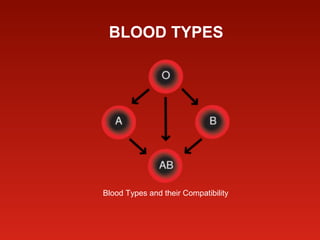
BLOOD TYPES
Blood Types and their Compatibility
BLOOD TYPES
•Each person has one of the following blood
types: A, B, AB, or O.
•O can be given to anyone but can only
receive O.
• AB can receive any type but can only be
given to AB.
• Also, every person's blood is either
Rh-positive or Rh-negative.
BLOOD TYPES
 The blood used in a transfusion must be
compatible with the patient's blood type.
 Type O blood is called the universal
donor
 People with type AB blood are called
universal recipients
 People with Rh-positive blood can get
Rh-positive or Rh-negative blood. But
people with Rh-negative blood should
get only Rh-negative blood.
BLOOD BANKS
Blood banks collect, test, and
store blood.
Autologous transfusion - If
surgery is scheduled months in
advance, patients may be able
to donate their own blood and
have it stored.
PREPARATION
Before a blood transfusion, a
technician tests the patient's
blood to find out what blood type
they have (that is, A, B, AB, or O
and Rh positive or Rh negative).
Some patients may have allergic
reactions even when the blood
given does work with their own
blood type.
ADMINISTERING BLOOD
Blood transfusions take
place in either a doctor's
office or a hospital. They
can be done at the
patient's home, but this
is less common.
ADMINISTERING BLOOD
A needle is used to insert an
intravenous (IV) line into a
blood vessel. Through this line,
the blood is transfused. The
procedure usually takes one to
four hours. The time depends
on how much blood is needed,
which blood product is given,
and whether the patient's body
can safely receive blood quickly
or not.
ADMINISTERING BLOOD
During the blood
transfusion, a nurse
carefully watches the
patient, especially for
the first 15 minutes.
This is when bad
reactions are most
likely to occur.
ADMINISTERING BLOOD
After a blood
transfusion, vital
signs are checked
(such as
temperature, blood
pressure, respiration
rate, and heart rate).
ADMINISTERING BLOOD
Follow-up blood
tests may be 
necessary to show 
how the body is 
reacting to the 
transfusion.
 
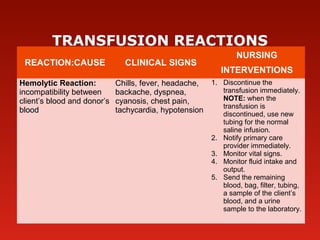
TRANSFUSION REACTIONS
REACTION:CAUSE CLINICAL SIGNS
NURSING
INTERVENTIONS
Hemolytic Reaction:
incompatibility between
client’s blood and donor’s
blood
Chills, fever, headache,
backache, dyspnea,
cyanosis, chest pain,
tachycardia, hypotension
1. Discontinue the
transfusion immediately.
NOTE: when the
transfusion is
discontinued, use new
tubing for the normal
saline infusion.
2. Notify primary care
provider immediately.
3. Monitor vital signs.
4. Monitor fluid intake and
output.
5. Send the remaining
blood, bag, filter, tubing,
a sample of the client’s
blood, and a urine
sample to the laboratory.
 
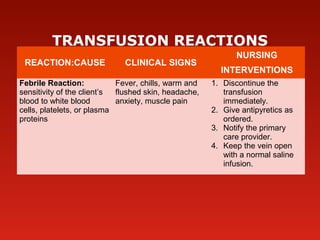
TRANSFUSION REACTIONS
REACTION:CAUSE CLINICAL SIGNS
NURSING
INTERVENTIONS
Febrile Reaction:
sensitivity of the client’s
blood to white blood
cells, platelets, or plasma
proteins
Fever, chills, warm and
flushed skin, headache,
anxiety, muscle pain
1. Discontinue the
transfusion
immediately.
2. Give antipyretics as
ordered.
3. Notify the primary
care provider.
4. Keep the vein open
with a normal saline
infusion.
 
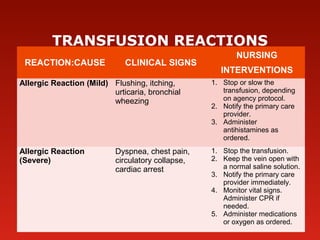
TRANSFUSION REACTIONS
REACTION:CAUSE CLINICAL SIGNS
NURSING
INTERVENTIONS
Allergic Reaction (Mild) Flushing, itching,
urticaria, bronchial
wheezing
1. Stop or slow the
transfusion, depending
on agency protocol.
2. Notify the primary care
provider.
3. Administer
antihistamines as
ordered.
Allergic Reaction
(Severe)
Dyspnea, chest pain,
circulatory collapse,
cardiac arrest
1. Stop the transfusion.
2. Keep the vein open with
a normal saline solution.
3. Notify the primary care
provider immediately.
4. Monitor vital signs.
Administer CPR if
needed.
5. Administer medications
or oxygen as ordered.
 
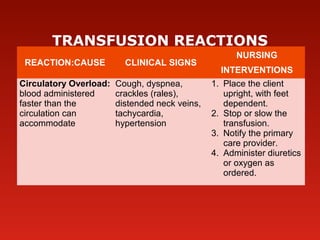
TRANSFUSION REACTIONS
REACTION:CAUSE CLINICAL SIGNS
NURSING
INTERVENTIONS
Circulatory Overload:
blood administered
faster than the
circulation can
accommodate
Cough, dyspnea,
crackles (rales),
distended neck veins,
tachycardia,
hypertension
1. Place the client
upright, with feet
dependent.
2. Stop or slow the
transfusion.
3. Notify the primary
care provider.
4. Administer diuretics
or oxygen as
ordered.
 
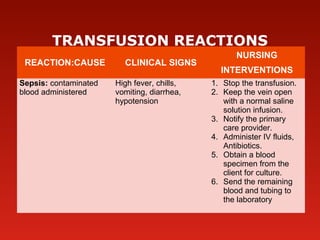
TRANSFUSION REACTIONS
REACTION:CAUSE CLINICAL SIGNS
NURSING
INTERVENTIONS
Sepsis: contaminated
blood administered
High fever, chills,
vomiting, diarrhea,
hypotension
1. Stop the transfusion.
2. Keep the vein open
with a normal saline
solution infusion.
3. Notify the primary
care provider.
4. Administer IV fluids,
Antibiotics.
5. Obtain a blood
specimen from the
client for culture.
6. Send the remaining
blood and tubing to
the laboratory
BLOOD PRODUCTS
Components of the blood 
which are collected from 
a donor for use in blood 
transfusion.
BLOOD PRODUCTS
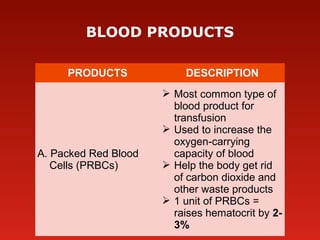
PRODUCTS DESCRIPTION
A. Packed Red Blood
Cells (PRBCs)
 Most common type of
blood product for
transfusion
 Used to increase the
oxygen-carrying
capacity of blood
 Help the body get rid
of carbon dioxide and
other waste products
 1 unit of PRBCs =
raises hematocrit by 2-
3%
BLOOD PRODUCTS
PRODUCTS DESCRIPTION
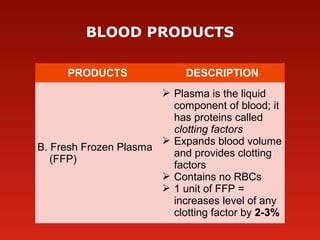
B. Fresh Frozen Plasma
(FFP)
 Plasma is the liquid
component of blood; it
has proteins called
clotting factors
 Expands blood volume
and provides clotting
factors
 Contains no RBCs
 1 unit of FFP =
increases level of any
clotting factor by 2-3%
BLOOD PRODUCTS
PRODUCTS DESCRIPTION
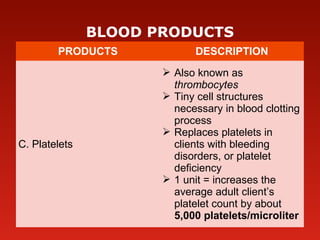
C. Platelets
 Also known as
thrombocytes
 Tiny cell structures
necessary in blood clotting
process
 Replaces platelets in
clients with bleeding
disorders, or platelet
deficiency
 1 unit = increases the
average adult client’s
platelet count by about
5,000 platelets/microliter
BLOOD PRODUCTS
PRODUCTS DESCRIPTION
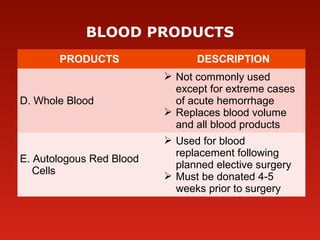
D. Whole Blood
 Not commonly used
except for extreme cases
of acute hemorrhage
 Replaces blood volume
and all blood products
E. Autologous Red Blood
Cells
 Used for blood
replacement following
planned elective surgery
 Must be donated 4-5
weeks prior to surgery
BLOOD PRODUCTS
PRODUCTS DESCRIPTION
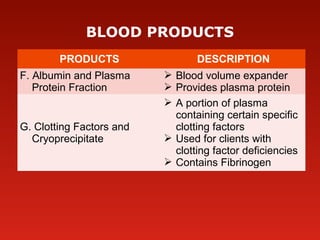
F. Albumin and Plasma
Protein Fraction
 Blood volume expander
 Provides plasma protein
G. Clotting Factors and
Cryoprecipitate
 A portion of plasma
containing certain specific
clotting factors
 Used for clients with
clotting factor deficiencies
 Contains Fibrinogen
THANK YOU^^

Blood transfusion

  • 1.
  • 2.
    At the endof 30 minutes, the group should be able to: Define Blood Transfusion Identify purposes of the procedure Cite situations in which blood transfusion is needed Enumerate the different transfusion reactions with its clinical signs and appropriate nursing interventions Classify and describe the different blood products and how it is being used
  • 3.
    BLOOD TRANSFUSION It isa procedure in which a patient receives a blood product through an intravenous line. It is the introduction of blood components into the venous circulation. Process of transferring blood-based products from one person into the circulatory system of another.
  • 4.
    Purposes To replace bloodlost during surgery or a serious injury. To restore oxygen-carrying capacity of the blood. To provide plasma factors to prevent or treat bleeding. Done if patient’s body is not capable of making blood properly because of an illness.
  • 5.
    Typical Situations inwhich blood products are given Major injuries after an accident or disaster Surgery on an organ such as the liver and the heart Severe Anemia Bleeding such as Haemophilia and Thrombocytopenia
  • 6.
    BLOOD TYPES Blood Typesand their Compatibility
  • 7.
    BLOOD TYPES •Each personhas one of the following blood types: A, B, AB, or O. •O can be given to anyone but can only receive O. • AB can receive any type but can only be given to AB. • Also, every person's blood is either Rh-positive or Rh-negative.
  • 8.
    BLOOD TYPES  Theblood used in a transfusion must be compatible with the patient's blood type.  Type O blood is called the universal donor  People with type AB blood are called universal recipients  People with Rh-positive blood can get Rh-positive or Rh-negative blood. But people with Rh-negative blood should get only Rh-negative blood.
  • 9.
    BLOOD BANKS Blood bankscollect, test, and store blood. Autologous transfusion - If surgery is scheduled months in advance, patients may be able to donate their own blood and have it stored.
  • 10.
    PREPARATION Before a bloodtransfusion, a technician tests the patient's blood to find out what blood type they have (that is, A, B, AB, or O and Rh positive or Rh negative). Some patients may have allergic reactions even when the blood given does work with their own blood type.
  • 11.
    ADMINISTERING BLOOD Blood transfusionstake place in either a doctor's office or a hospital. They can be done at the patient's home, but this is less common.
  • 12.
    ADMINISTERING BLOOD A needleis used to insert an intravenous (IV) line into a blood vessel. Through this line, the blood is transfused. The procedure usually takes one to four hours. The time depends on how much blood is needed, which blood product is given, and whether the patient's body can safely receive blood quickly or not.
  • 13.
    ADMINISTERING BLOOD During theblood transfusion, a nurse carefully watches the patient, especially for the first 15 minutes. This is when bad reactions are most likely to occur.
  • 14.
    ADMINISTERING BLOOD After ablood transfusion, vital signs are checked (such as temperature, blood pressure, respiration rate, and heart rate).
  • 15.
  • 16.
      TRANSFUSION REACTIONS REACTION:CAUSE CLINICALSIGNS NURSING INTERVENTIONS Hemolytic Reaction: incompatibility between client’s blood and donor’s blood Chills, fever, headache, backache, dyspnea, cyanosis, chest pain, tachycardia, hypotension 1. Discontinue the transfusion immediately. NOTE: when the transfusion is discontinued, use new tubing for the normal saline infusion. 2. Notify primary care provider immediately. 3. Monitor vital signs. 4. Monitor fluid intake and output. 5. Send the remaining blood, bag, filter, tubing, a sample of the client’s blood, and a urine sample to the laboratory.
  • 17.
      TRANSFUSION REACTIONS REACTION:CAUSE CLINICALSIGNS NURSING INTERVENTIONS Febrile Reaction: sensitivity of the client’s blood to white blood cells, platelets, or plasma proteins Fever, chills, warm and flushed skin, headache, anxiety, muscle pain 1. Discontinue the transfusion immediately. 2. Give antipyretics as ordered. 3. Notify the primary care provider. 4. Keep the vein open with a normal saline infusion.
  • 18.
      TRANSFUSION REACTIONS REACTION:CAUSE CLINICALSIGNS NURSING INTERVENTIONS Allergic Reaction (Mild) Flushing, itching, urticaria, bronchial wheezing 1. Stop or slow the transfusion, depending on agency protocol. 2. Notify the primary care provider. 3. Administer antihistamines as ordered. Allergic Reaction (Severe) Dyspnea, chest pain, circulatory collapse, cardiac arrest 1. Stop the transfusion. 2. Keep the vein open with a normal saline solution. 3. Notify the primary care provider immediately. 4. Monitor vital signs. Administer CPR if needed. 5. Administer medications or oxygen as ordered.
  • 19.
      TRANSFUSION REACTIONS REACTION:CAUSE CLINICALSIGNS NURSING INTERVENTIONS Circulatory Overload: blood administered faster than the circulation can accommodate Cough, dyspnea, crackles (rales), distended neck veins, tachycardia, hypertension 1. Place the client upright, with feet dependent. 2. Stop or slow the transfusion. 3. Notify the primary care provider. 4. Administer diuretics or oxygen as ordered.
  • 20.
      TRANSFUSION REACTIONS REACTION:CAUSE CLINICALSIGNS NURSING INTERVENTIONS Sepsis: contaminated blood administered High fever, chills, vomiting, diarrhea, hypotension 1. Stop the transfusion. 2. Keep the vein open with a normal saline solution infusion. 3. Notify the primary care provider. 4. Administer IV fluids, Antibiotics. 5. Obtain a blood specimen from the client for culture. 6. Send the remaining blood and tubing to the laboratory
  • 21.
  • 22.
    BLOOD PRODUCTS PRODUCTS DESCRIPTION A.Packed Red Blood Cells (PRBCs)  Most common type of blood product for transfusion  Used to increase the oxygen-carrying capacity of blood  Help the body get rid of carbon dioxide and other waste products  1 unit of PRBCs = raises hematocrit by 2- 3%
  • 23.
    BLOOD PRODUCTS PRODUCTS DESCRIPTION B.Fresh Frozen Plasma (FFP)  Plasma is the liquid component of blood; it has proteins called clotting factors  Expands blood volume and provides clotting factors  Contains no RBCs  1 unit of FFP = increases level of any clotting factor by 2-3%
  • 24.
    BLOOD PRODUCTS PRODUCTS DESCRIPTION C.Platelets  Also known as thrombocytes  Tiny cell structures necessary in blood clotting process  Replaces platelets in clients with bleeding disorders, or platelet deficiency  1 unit = increases the average adult client’s platelet count by about 5,000 platelets/microliter
  • 25.
    BLOOD PRODUCTS PRODUCTS DESCRIPTION D.Whole Blood  Not commonly used except for extreme cases of acute hemorrhage  Replaces blood volume and all blood products E. Autologous Red Blood Cells  Used for blood replacement following planned elective surgery  Must be donated 4-5 weeks prior to surgery
  • 26.
    BLOOD PRODUCTS PRODUCTS DESCRIPTION F.Albumin and Plasma Protein Fraction  Blood volume expander  Provides plasma protein G. Clotting Factors and Cryoprecipitate  A portion of plasma containing certain specific clotting factors  Used for clients with clotting factor deficiencies  Contains Fibrinogen
  • 27.