




Blood and
Blood Products
Safety
Ahmad Thanin
be able to identify
 Types of blood products
 Safe transfusion process
 Proper storage, collection &
transportation of blood products
 Right administration practice
 Types of transfusion reaction
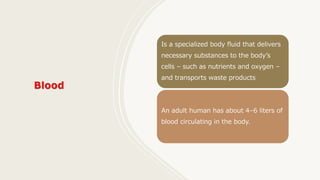
Is a specialized body fluid that delivers
necessary substances to the body’s
cells – such as nutrients and oxygen –
and transports waste products
An adult human has about 4–6 liters of
blood circulating in the body.
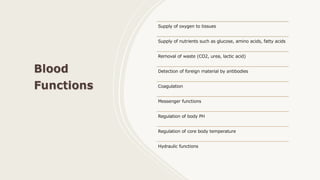
Supply of oxygen to tissues
Supply of nutrients such as glucose, amino acids, fatty acids
Removal of waste (CO2, urea, lactic acid)
Detection of foreign material by antibodies
Coagulation
Messenger functions
Regulation of body PH
Regulation of core body temperature
Hydraulic functions
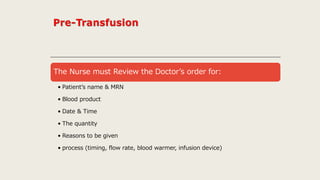
The Nurse must Review the Doctor’s order for:
• Patient’s name & MRN
• Blood product
• Date & Time
• The quantity
• Reasons to be given
• process (timing, flow rate, blood warmer, infusion device)
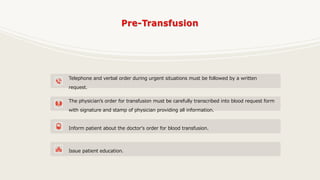
Telephone and verbal order during urgent situations must be followed by a written
request.
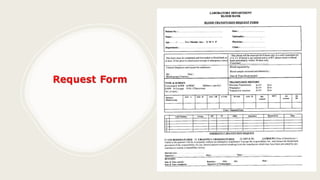
The physician’s order for transfusion must be carefully transcribed into blood request form
with signature and stamp of physician providing all information.
Inform patient about the doctor's order for blood transfusion.
Issue patient education.
must have a valid consent of each episode
of blood transfusion
The consent is valid for two weeks if
transfusion is not performed.
The Physician must obtain the signature
of the patient/family for the consent after
explaining the benefits and risks.
Use one plain tube and one lavender tube for
sample collection (2 tubes).
Confirm patient identity by patient name, and
patients medical record number.
The tube should be labeled with:
• patient name
• file number
• date & time of collection
• Initials & ID # of collector
All samples submitted to the blood bank must be
accompanied with the request form.
After 72 hours, another form is required & additional blood
sample.
Infants < 4 months of age need only one type & one cross-
match for all subsequent transfusions, providing he/she has not
been discharged since previous transfusion.
• Ensure patient has a patent IV
access prior to obtaining blood from
the Blood Bank, thus preventing
delay after blood has been
dispensed
• The nurse must not collect blood
from blood bank until ready to start
transfusion
Only Registered Nurse can collect
Blood & blood products from the Blood
Bank and not the porter.
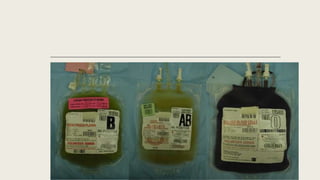
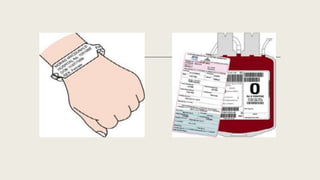
Label should all correspond with:
•Patient Name
•Patient MRN
•ABO / RH
•Unit Number
•Expiration date of Unit
 Blood/blood product must be transported in the transport container, available in
your department.
 The empty blood bag should be returned placing in the red plastic waste bag &
transport with the container to the blood bank within 6 hours.
 Nurse should also perform a visual check for:
– Condition of the bag
– Discoloration
– Cloudiness
– Clots & excess air
– Leaks at the port and seams
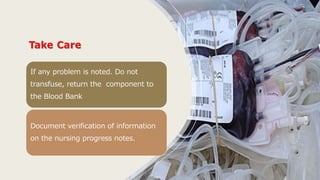
If any problem is noted. Do not
transfuse, return the component to
the Blood Bank
Document verification of information
on the nursing progress notes.
Two nurses must perform independent
double check.
Check the data on the donor unit and
transfusion requisition form with the same
details:
•Patient’s name
•Patient’s MRN
•ABO and Rh type
•Expiration date
•Unit identification number
Use of Administration Sets: Blood products should only be transfused through
the standard blood transfusion set (170–200-micron filter).
Use of Filters: All blood and blood components must be filtered. Blood
administration sets at this facility contain an integral filter. However, additional
approved filtration devices will be provided by blood bank staff as indicated.
Use of Pressure Bags: Pressure bags are to be used only in emergency
situations when blood must be transfused rapidly. Do not use a blood pressure
cuff as this may cause the seams to
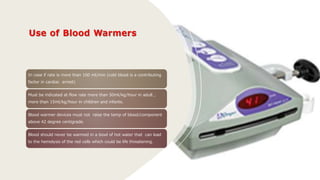
In case if rate is more than 100 ml/min (cold blood is a contributing
factor in cardiac arrest)
Must be indicated at flow rate more than 50ml/kg/hour in adult ,
more than 15ml/kg/hour in children and infants.
Blood warmer devices must not raise the temp of blood/component
above 42 degree centigrade.
Blood should never be warmed in a bowl of hot water that can lead
to the hemolysis of the red cells which could be life threatening.
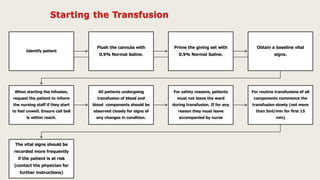
Identify patient
Flush the cannula with
0.9% Normal Saline.
Prime the giving set with
0.9% Normal Saline.
Obtain a baseline vital
signs.
When starting the infusion,
request the patient to inform
the nursing staff if they start
to feel unwell. Ensure call bell
is within reach.
All patients undergoing
transfusion of blood and
blood components should be
observed closely for signs of
any changes in condition.
For safety reasons, patients
must not leave the ward
during transfusion. If for any
reason they must leave
accompanied by nurse
For routine transfusions of all
components commence the
transfusion slowly (not more
than 5ml/min for first 15
min)
The vital signs should be
recorded more frequently
if the patient is at risk
(contact the physician for
further instructions)
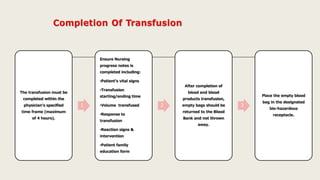
The transfusion must be
completed within the
physician’s specified
time frame (maximum
of 4 hours).
1
Ensure Nursing
progress notes is
completed including:
•Patient’s vital signs
•Transfusion
starting/ending time
•Volume transfused
•Response to
transfusion
•Reaction signs &
intervention
•Patient family
education form
2
After completion of
blood and blood
products transfusion,
empty bags should be
returned to the Blood
Bank and not thrown
away.
3
Place the empty blood
bag in the designated
bio-hazardous
receptacle.
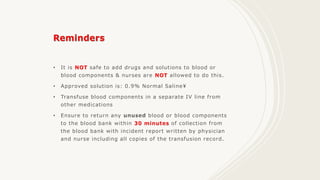
• It is NOT safe to add drugs and solutions to blood or
blood components & nurses are NOT allowed to do this.
• Approved solution is: 0.9% Normal Saline
• Transfuse blood components in a separate IV line from
other medications
• Ensure to return any unused blood or blood components
to the blood bank within 30 minutes of collection from
the blood bank with incident report written by physician
and nurse including all copies of the transfusion record.
Stop transfusion if any signs of reactions occur and notify physician.
Sign & Symptoms of transfusion reaction include:
• Increased patient temperature
• Hypotension
• Tachycardia
• Respiratory difficulties
• Nausea
• Oliguria or Anuria (normal urine range= 0.5-1 ml /kg/hr)
• Chills
• Headache
• Rashes, hives & Itching
• Swelling & pain at infusion site
• Pain in abdomen or chest
• Patient feeling agitated or unduly apprehensive
Keep line open with 0.9% Normal Saline (change giving set)
Recheck the following information with a second nurse utilizing patient ID band / bag label / Blood Bank
transfusion report
•Patient’s name
•Patient’s MRN
•ABO / RH
•Unit number
•Expiration date of unit
Perform observations at regular intervals.
Collect required specimens for transfusion reaction from opposite arm to site of transfusion:
Fill the transfusion reaction form and send copy to blood bank.
Document event on the clinical records & IR must be completed.
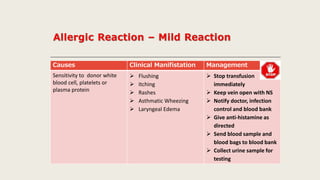
Allergic.
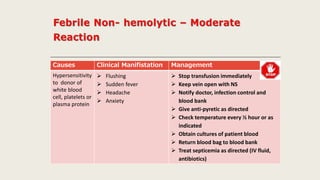
Febrile Non- hemolytic.
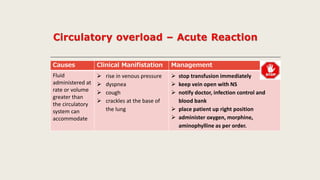
Circulatory overload
Causes Clinical Manifistation Management
Sensitivity to donor white
blood cell, platelets or
plasma protein
 Flushing
 Itching
 Rashes
 Asthmatic Wheezing
 Laryngeal Edema
 Stop transfusion
immediately
 Keep vein open with NS
 Notify doctor, infection
control and blood bank
 Give anti-histamine as
directed
 Send blood sample and
blood bags to blood bank
 Collect urine sample for
testing
Causes Clinical Manifistation Management
Hypersensitivity
to donor of
white blood
cell, platelets or
plasma protein
 Flushing
 Sudden fever
 Headache
 Anxiety
 Stop transfusion immediately
 Keep vein open with NS
 Notify doctor, infection control and
blood bank
 Give anti-pyretic as directed
 Check temperature every ½ hour or as
indicated
 Obtain cultures of patient blood
 Return blood bag to blood bank
 Treat septicemia as directed (IV fluid,
antibiotics)
Causes Clinical Manifistation Management
Fluid
administered at
rate or volume
greater than
the circulatory
system can
accommodate
 rise in venous pressure
 dyspnea
 cough
 crackles at the base of
the lung
 stop transfusion immediately
 keep vein open with NS
 notify doctor, infection control and
blood bank
 place patient up right position
 administer oxygen, morphine,
aminophylline as per order.
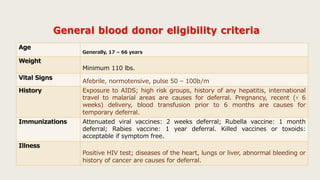
Age
Generally, 17 – 66 years
Weight
Minimum 110 lbs.
Vital Signs
Afebrile, normotensive, pulse 50 – 100b/m
History Exposure to AIDS; high risk groups, history of any hepatitis, international
travel to malarial areas are causes for deferral. Pregnancy, recent (‹ 6
weeks) delivery, blood transfusion prior to 6 months are causes for
temporary deferral.
Immunizations Attenuated viral vaccines: 2 weeks deferral; Rubella vaccine: 1 month
deferral; Rabies vaccine: 1 year deferral. Killed vaccines or toxoids:
acceptable if symptom free.
Illness
Positive HIV test; diseases of the heart, lungs or liver, abnormal bleeding or
history of cancer are causes for deferral.
Blood and blood products safety

Blood and blood products safety

  • 1.
  • 2.
    be able toidentify  Types of blood products  Safe transfusion process  Proper storage, collection & transportation of blood products  Right administration practice  Types of transfusion reaction
  • 3.
    Is a specializedbody fluid that delivers necessary substances to the body’s cells – such as nutrients and oxygen – and transports waste products An adult human has about 4–6 liters of blood circulating in the body.
  • 4.
    Supply of oxygento tissues Supply of nutrients such as glucose, amino acids, fatty acids Removal of waste (CO2, urea, lactic acid) Detection of foreign material by antibodies Coagulation Messenger functions Regulation of body PH Regulation of core body temperature Hydraulic functions
  • 6.
    The Nurse mustReview the Doctor’s order for: • Patient’s name & MRN • Blood product • Date & Time • The quantity • Reasons to be given • process (timing, flow rate, blood warmer, infusion device)
  • 7.
    Telephone and verbalorder during urgent situations must be followed by a written request. The physician’s order for transfusion must be carefully transcribed into blood request form with signature and stamp of physician providing all information. Inform patient about the doctor's order for blood transfusion. Issue patient education.
  • 8.
    must have avalid consent of each episode of blood transfusion The consent is valid for two weeks if transfusion is not performed. The Physician must obtain the signature of the patient/family for the consent after explaining the benefits and risks.
  • 9.
    Use one plaintube and one lavender tube for sample collection (2 tubes). Confirm patient identity by patient name, and patients medical record number. The tube should be labeled with: • patient name • file number • date & time of collection • Initials & ID # of collector All samples submitted to the blood bank must be accompanied with the request form.
  • 11.
    After 72 hours,another form is required & additional blood sample. Infants < 4 months of age need only one type & one cross- match for all subsequent transfusions, providing he/she has not been discharged since previous transfusion.
  • 12.
    • Ensure patienthas a patent IV access prior to obtaining blood from the Blood Bank, thus preventing delay after blood has been dispensed • The nurse must not collect blood from blood bank until ready to start transfusion
  • 13.
    Only Registered Nursecan collect Blood & blood products from the Blood Bank and not the porter. Label should all correspond with: •Patient Name •Patient MRN •ABO / RH •Unit Number •Expiration date of Unit
  • 14.
     Blood/blood productmust be transported in the transport container, available in your department.  The empty blood bag should be returned placing in the red plastic waste bag & transport with the container to the blood bank within 6 hours.  Nurse should also perform a visual check for: – Condition of the bag – Discoloration – Cloudiness – Clots & excess air – Leaks at the port and seams
  • 15.
    If any problemis noted. Do not transfuse, return the component to the Blood Bank Document verification of information on the nursing progress notes.
  • 16.
    Two nurses mustperform independent double check. Check the data on the donor unit and transfusion requisition form with the same details: •Patient’s name •Patient’s MRN •ABO and Rh type •Expiration date •Unit identification number
  • 18.
    Use of AdministrationSets: Blood products should only be transfused through the standard blood transfusion set (170–200-micron filter). Use of Filters: All blood and blood components must be filtered. Blood administration sets at this facility contain an integral filter. However, additional approved filtration devices will be provided by blood bank staff as indicated. Use of Pressure Bags: Pressure bags are to be used only in emergency situations when blood must be transfused rapidly. Do not use a blood pressure cuff as this may cause the seams to
  • 19.
    In case ifrate is more than 100 ml/min (cold blood is a contributing factor in cardiac arrest) Must be indicated at flow rate more than 50ml/kg/hour in adult , more than 15ml/kg/hour in children and infants. Blood warmer devices must not raise the temp of blood/component above 42 degree centigrade. Blood should never be warmed in a bowl of hot water that can lead to the hemolysis of the red cells which could be life threatening.
  • 20.
    Identify patient Flush thecannula with 0.9% Normal Saline. Prime the giving set with 0.9% Normal Saline. Obtain a baseline vital signs. When starting the infusion, request the patient to inform the nursing staff if they start to feel unwell. Ensure call bell is within reach. All patients undergoing transfusion of blood and blood components should be observed closely for signs of any changes in condition. For safety reasons, patients must not leave the ward during transfusion. If for any reason they must leave accompanied by nurse For routine transfusions of all components commence the transfusion slowly (not more than 5ml/min for first 15 min) The vital signs should be recorded more frequently if the patient is at risk (contact the physician for further instructions)
  • 21.
    The transfusion mustbe completed within the physician’s specified time frame (maximum of 4 hours). 1 Ensure Nursing progress notes is completed including: •Patient’s vital signs •Transfusion starting/ending time •Volume transfused •Response to transfusion •Reaction signs & intervention •Patient family education form 2 After completion of blood and blood products transfusion, empty bags should be returned to the Blood Bank and not thrown away. 3 Place the empty blood bag in the designated bio-hazardous receptacle.
  • 23.
    • It isNOT safe to add drugs and solutions to blood or blood components & nurses are NOT allowed to do this. • Approved solution is: 0.9% Normal Saline • Transfuse blood components in a separate IV line from other medications • Ensure to return any unused blood or blood components to the blood bank within 30 minutes of collection from the blood bank with incident report written by physician and nurse including all copies of the transfusion record.
  • 24.
    Stop transfusion ifany signs of reactions occur and notify physician. Sign & Symptoms of transfusion reaction include: • Increased patient temperature • Hypotension • Tachycardia • Respiratory difficulties • Nausea • Oliguria or Anuria (normal urine range= 0.5-1 ml /kg/hr) • Chills • Headache • Rashes, hives & Itching • Swelling & pain at infusion site • Pain in abdomen or chest • Patient feeling agitated or unduly apprehensive
  • 25.
    Keep line openwith 0.9% Normal Saline (change giving set) Recheck the following information with a second nurse utilizing patient ID band / bag label / Blood Bank transfusion report •Patient’s name •Patient’s MRN •ABO / RH •Unit number •Expiration date of unit Perform observations at regular intervals. Collect required specimens for transfusion reaction from opposite arm to site of transfusion: Fill the transfusion reaction form and send copy to blood bank. Document event on the clinical records & IR must be completed.
  • 27.
  • 28.
    Causes Clinical ManifistationManagement Sensitivity to donor white blood cell, platelets or plasma protein  Flushing  Itching  Rashes  Asthmatic Wheezing  Laryngeal Edema  Stop transfusion immediately  Keep vein open with NS  Notify doctor, infection control and blood bank  Give anti-histamine as directed  Send blood sample and blood bags to blood bank  Collect urine sample for testing
  • 29.
    Causes Clinical ManifistationManagement Hypersensitivity to donor of white blood cell, platelets or plasma protein  Flushing  Sudden fever  Headache  Anxiety  Stop transfusion immediately  Keep vein open with NS  Notify doctor, infection control and blood bank  Give anti-pyretic as directed  Check temperature every ½ hour or as indicated  Obtain cultures of patient blood  Return blood bag to blood bank  Treat septicemia as directed (IV fluid, antibiotics)
  • 30.
    Causes Clinical ManifistationManagement Fluid administered at rate or volume greater than the circulatory system can accommodate  rise in venous pressure  dyspnea  cough  crackles at the base of the lung  stop transfusion immediately  keep vein open with NS  notify doctor, infection control and blood bank  place patient up right position  administer oxygen, morphine, aminophylline as per order.
  • 32.
    Age Generally, 17 –66 years Weight Minimum 110 lbs. Vital Signs Afebrile, normotensive, pulse 50 – 100b/m History Exposure to AIDS; high risk groups, history of any hepatitis, international travel to malarial areas are causes for deferral. Pregnancy, recent (‹ 6 weeks) delivery, blood transfusion prior to 6 months are causes for temporary deferral. Immunizations Attenuated viral vaccines: 2 weeks deferral; Rubella vaccine: 1 month deferral; Rabies vaccine: 1 year deferral. Killed vaccines or toxoids: acceptable if symptom free. Illness Positive HIV test; diseases of the heart, lungs or liver, abnormal bleeding or history of cancer are causes for deferral.