Dr. U.Murali.M.S;M.B.A.
Professor of Surgery
Introduction
 Intravenous fluids are chemically prepared
solutions that are administered to the patient.
 They are tailored to the body’s needs and used
to replace lost fluid and/or aid in the delivery of
IV medications.
Indications
 For rapid restoration of fluid and electrolytes in
dehydration due to vomiting, diarrhoea, shock due
to haemorrhage or sepsis or burns.
 Total parenteral nutrition.
 Anaphylaxis, cardiac arrest, hypoxia.
 Post gastrointestinal surgeries.
 For maintenance, replacement of loss or as a special
fluid.
Advantages
 Provides the patient with life-sustaining fluids,
electrolytes, and drugs.
 Immediate and predictable therapeutic effects.
 Preferred for administering fluids, electrolytes, and
drugs in emergency situations.
 Allows fluid intake when a patient has GI
malabsorption.
 Permits accurate dosage titration for analgesics and
other drugs.
Disadvantages
 Needs hospitalisation, costly.
 Infection.
 Pyrogenic reaction.
 Discomfort, poor patient compliance.
 Fluid overload – chances.
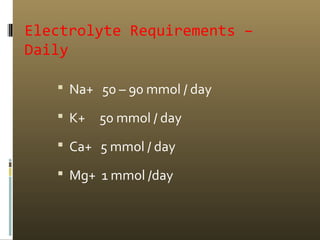
Electrolyte Requirements –
Daily
 Na+ 50 – 90 mmol / day
 K+ 50 mmol / day
 Ca+ 5 mmol / day
 Mg+ 1 mmol /day
IV Fluid ?
 The majority of an IV solution is sterile water.
 Chemically, water is referred to as a “solvent.” A
solvent is a substance that dissolves other
materials called “solutes.”
 Within IV solutions, the solutes can be molecules
called electrolytes or other larger compounds such
as proteins or molecules.
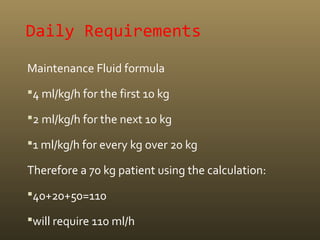
Daily Requirements
Maintenance Fluid formula
4 ml/kg/h for the first 10 kg
2 ml/kg/h for the next 10 kg
1 ml/kg/h for every kg over 20 kg
Therefore a 70 kg patient using the calculation:
40+20+50=110
will require 110 ml/h
Intra venous Fluids
IV fluids come in four different forms:
Colloids
Crystalloids
Blood and blood products
Colloid Solutions
 Colloid solutions are IV fluids containing large proteins and
molecules that tend to stay within the vascular space (blood
vessels).
 They shift the fluids from interstitial to intravascular compt.
 Colloids are useful in maintaining blood volume. Colloids are
expensive, have specific storage requirements, and have a short
shelf life.
 Commonly used colloid solutions include plasma protein
fraction, salt poor albumin, dextran.
Crystalloid Solutions
 Crystalloid solutions are the primary fluid used for IV therapy.
Crystalloids contain electrolytes but lack the large proteins and
molecules found in colloids.
 Crystalloids come in many preparations and are classified
according to their “tonicity.”
 A crystalloid’s tonicity describes the concentration of
electrolytes (solutes) dissolved in the water, as compared with
that of body plasma.
Isotonic
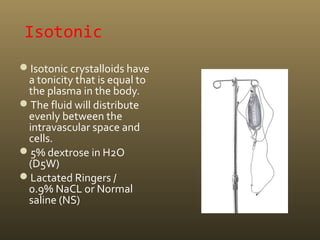
Isotonic crystalloids have
a tonicity that is equal to
the plasma in the body.
The fluid will distribute
evenly between the
intravascular space and
cells.
5% dextrose in H2O
(D5W)
Lactated Ringers /
0.9% NaCL or Normal
saline (NS)
Hypotonic
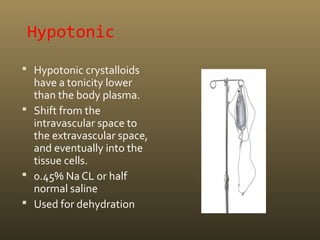
 Hypotonic crystalloids
have a tonicity lower
than the body plasma.
 Shift from the
intravascular space to
the extravascular space,
and eventually into the
tissue cells.
 0.45% Na CL or half
normal saline
 Used for dehydration
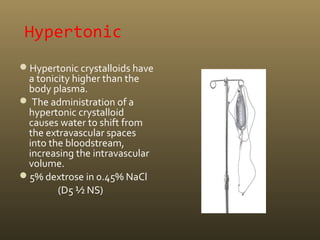
Hypertonic
Hypertonic crystalloids have
a tonicity higher than the
body plasma.
 The administration of a
hypertonic crystalloid
causes water to shift from
the extravascular spaces
into the bloodstream,
increasing the intravascular
volume.
5% dextrose in 0.45% NaCl
(D5 ½ NS)
Commonly used fluid
 Lactated Ringer’s (LR) is an isotonic crystalloid
that contains sodium chloride, potassium
chloride, calcium chloride, and sodium lactate in
sterile water.
 Normal saline solution (NSS) is an isotonic
crystalloid that contains 0.9% sodium chloride
(salt) in sterile water.
 5% Dextrose in water (D5W) is packaged as an
isotonic carbohydrate (sugar solution) that
contains glucose (sugar) as the solute which is
used by the cells to create energy.
Calculation – Drop rate
 1ml = 16 drops For microdrip set 1ml = 60 drops.
 A. QOF required in liters / day x 10 = Drop rate / mt
( 2.5 l is quantity of fluid / day. So 2.5 x 10 = 25 drops / mt )
 B. Fluid to be infused in 1 hour divided by 4 = Drops / mt.
 C. No. of microdrop / mt = volume in ml / hr
Summary
 There are several different types of fluids used for IV
therapy.
 Depending on their specific type and makeup, IV
fluids can cause the shift between the intracellular
and extracellular compartments.
 Therefore, it is important to choose the fluid most
appropriate to the patient’s needs.
 It is important to carefully examine the label on the
bag to ensure the right fluid has been selected.

Fluid therapy

  • 1.
  • 2.
    Introduction  Intravenous fluidsare chemically prepared solutions that are administered to the patient.  They are tailored to the body’s needs and used to replace lost fluid and/or aid in the delivery of IV medications.
  • 3.
    Indications  For rapidrestoration of fluid and electrolytes in dehydration due to vomiting, diarrhoea, shock due to haemorrhage or sepsis or burns.  Total parenteral nutrition.  Anaphylaxis, cardiac arrest, hypoxia.  Post gastrointestinal surgeries.  For maintenance, replacement of loss or as a special fluid.
  • 4.
    Advantages  Provides thepatient with life-sustaining fluids, electrolytes, and drugs.  Immediate and predictable therapeutic effects.  Preferred for administering fluids, electrolytes, and drugs in emergency situations.  Allows fluid intake when a patient has GI malabsorption.  Permits accurate dosage titration for analgesics and other drugs.
  • 5.
    Disadvantages  Needs hospitalisation,costly.  Infection.  Pyrogenic reaction.  Discomfort, poor patient compliance.  Fluid overload – chances.
  • 6.
    Electrolyte Requirements – Daily Na+ 50 – 90 mmol / day  K+ 50 mmol / day  Ca+ 5 mmol / day  Mg+ 1 mmol /day
  • 7.
    IV Fluid ? The majority of an IV solution is sterile water.  Chemically, water is referred to as a “solvent.” A solvent is a substance that dissolves other materials called “solutes.”  Within IV solutions, the solutes can be molecules called electrolytes or other larger compounds such as proteins or molecules.
  • 8.
    Daily Requirements Maintenance Fluidformula 4 ml/kg/h for the first 10 kg 2 ml/kg/h for the next 10 kg 1 ml/kg/h for every kg over 20 kg Therefore a 70 kg patient using the calculation: 40+20+50=110 will require 110 ml/h
  • 9.
    Intra venous Fluids IVfluids come in four different forms: Colloids Crystalloids Blood and blood products
  • 10.
    Colloid Solutions  Colloidsolutions are IV fluids containing large proteins and molecules that tend to stay within the vascular space (blood vessels).  They shift the fluids from interstitial to intravascular compt.  Colloids are useful in maintaining blood volume. Colloids are expensive, have specific storage requirements, and have a short shelf life.  Commonly used colloid solutions include plasma protein fraction, salt poor albumin, dextran.
  • 11.
    Crystalloid Solutions  Crystalloidsolutions are the primary fluid used for IV therapy. Crystalloids contain electrolytes but lack the large proteins and molecules found in colloids.  Crystalloids come in many preparations and are classified according to their “tonicity.”  A crystalloid’s tonicity describes the concentration of electrolytes (solutes) dissolved in the water, as compared with that of body plasma.
  • 12.
    Isotonic Isotonic crystalloids have atonicity that is equal to the plasma in the body. The fluid will distribute evenly between the intravascular space and cells. 5% dextrose in H2O (D5W) Lactated Ringers / 0.9% NaCL or Normal saline (NS)
  • 13.
    Hypotonic  Hypotonic crystalloids havea tonicity lower than the body plasma.  Shift from the intravascular space to the extravascular space, and eventually into the tissue cells.  0.45% Na CL or half normal saline  Used for dehydration
  • 14.
    Hypertonic Hypertonic crystalloids have atonicity higher than the body plasma.  The administration of a hypertonic crystalloid causes water to shift from the extravascular spaces into the bloodstream, increasing the intravascular volume. 5% dextrose in 0.45% NaCl (D5 ½ NS)
  • 15.
    Commonly used fluid Lactated Ringer’s (LR) is an isotonic crystalloid that contains sodium chloride, potassium chloride, calcium chloride, and sodium lactate in sterile water.  Normal saline solution (NSS) is an isotonic crystalloid that contains 0.9% sodium chloride (salt) in sterile water.  5% Dextrose in water (D5W) is packaged as an isotonic carbohydrate (sugar solution) that contains glucose (sugar) as the solute which is used by the cells to create energy.
  • 16.
    Calculation – Droprate  1ml = 16 drops For microdrip set 1ml = 60 drops.  A. QOF required in liters / day x 10 = Drop rate / mt ( 2.5 l is quantity of fluid / day. So 2.5 x 10 = 25 drops / mt )  B. Fluid to be infused in 1 hour divided by 4 = Drops / mt.  C. No. of microdrop / mt = volume in ml / hr
  • 17.
    Summary  There areseveral different types of fluids used for IV therapy.  Depending on their specific type and makeup, IV fluids can cause the shift between the intracellular and extracellular compartments.  Therefore, it is important to choose the fluid most appropriate to the patient’s needs.  It is important to carefully examine the label on the bag to ensure the right fluid has been selected.