Pre-operative Care
Prof. Utham Murali. M.S ; M.B.A.
Dept. of Surgery
Learning Outcomes
Describe the principles involved in pre-
operative assessment of a patient
Enumerate the Specific pre-operative
problems in preparing a patient for surgery
Identify the stages in the consent process
Definition
The preoperative period runs from the time
the patient is admitted to the hospital or
surgicenter to the time that the surgery begins.
3
Pre-operative plan
Gather and record all relevant information
Optimize patient condition
Choose surgery that offers minimal risk and
maximum benefit
Anticipate and plan for adverse events
Inform everyone concerned.
Steps of P.O.P’s
History
Examinations
Investigations
Preoperative treatments
Documentation
Communications – Valid consent
Types of patients
Out-Patient
Department
Usually seen 1-2
weeks before surgery
at preadmission clinic
Emergency
department
Need initial
assessment &
immediate
resuscitation
Principles of History taking
Listen: What is the problem? (Open questions)
Clarify: What does the patient expect?
(Closed questions)
Narrow: Differential diagnosis
(Focused questions)
Fitness: Comorbidities (Fixed questions)
Examination
General: + findings even if not related to
the proposed procedure should be explored
Surgery related: Type and site of surgery,
complications which have occurred due to
underlying pathology
Systemic: Comorbidities and their severity
Specific: For example, suitability for
positioning during surgery.
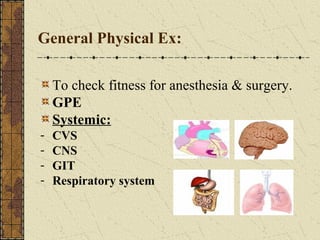
General Physical Ex:
To check fitness for anesthesia & surgery.
GPE
Systemic:
- CVS
- CNS
- GIT
- Respiratory system
Specific Surgical Ex:
Its aim: to confirm previous findings &
diagnosis, to determine severity & to gauge
extent.
E.g. in inguinal hernia confirm it’s inguinal
not femoral, reducible or not & whether
there are any signs of bowel obstruction.
Specific Medical Ex:
Its aim: to evaluates the presence & severity
of other problems.
E.g. Diabetic patient undergoing surgery
need careful examination for sepsis ,
neuropathy or microvascular disease
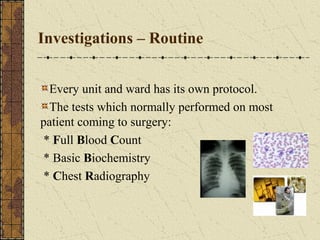
Investigations – Routine
Every unit and ward has its own protocol.
The tests which normally performed on most
patient coming to surgery:
* Full Blood Count
* Basic Biochemistry
* Chest Radiography
Investigations – Targeted tests
• Hematology : to exclude anemia, for platelets
count & to assess the amount of blood may be
needed during or after operation.
• Urea, Creatinine & Electrolytes: state of
dehydration & renal insufficiency.
• Liver Function Tests: Alb & Protein guide to
nutritional status & shows any clotting problems.
Investigations – Others
ECG : It’s recommended in all patient >65years,
pt. with blood loss & cardiovascular/pulmonary
problems.
Urinalysis: used for determination of renal
function, inflammation, infection & metabolic
disorders.
Pregnancy Test: ( B- HCG )
HBsAg & HIV testing.
RBS & HbA1c : Diabetes
Blood gas analysis: Occ. required
Management plan – Key points
Provide all information necessary for the
patient to make an informed decision
Use common language
Discuss the options rather than telling the
patient what will be done
Give the patient time to think things over
Encourage to discuss things – trusted person
Suggest to write down a list of points that to
be discussed
Specific Pre-op problems
Specific P.O.P – C.V.S
Hypertension
IHD / Recent MI
Arrhythmias
Cardiac failure
Anaemia & Blood
transfusion
Prosthetic valves
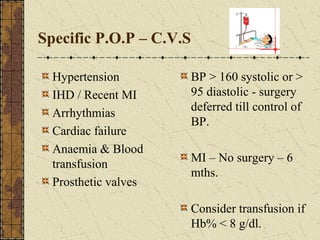
BP > 160 systolic or >
95 diastolic - surgery
deferred till control of
BP.
MI – No surgery – 6
mths.
Consider transfusion if
Hb% < 8 g/dl.
Specific P.O.P – R.S
Infection
Asthma
COPD
Pulmonary fibrosis
Stop smoking - 4 wks
& continue inhalers
LRI – to be treated
Avoid respiratory
suppressants
(narcotics)
Specific P.O.P – G.I.T
Malnutrition
Obesity
Regurgitation risk
Jaundice
Nutritional support is
required - a minimum
of 2 weeks prior to
surgery
Extra measures –
obese patients
No solids – 6hrs / No
fluids – 2hrs
Sec complications –
jaundice pts
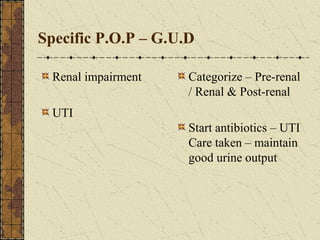
Specific P.O.P – G.U.D
Renal impairment
UTI
Categorize – Pre-renal
/ Renal & Post-renal
Start antibiotics – UTI
Care taken – maintain
good urine output
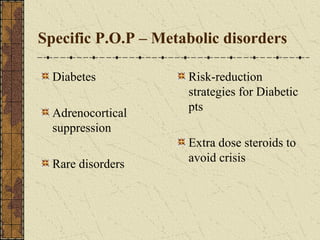
Specific P.O.P – Metabolic disorders
Diabetes
Adrenocortical
suppression
Rare disorders
Risk-reduction
strategies for Diabetic
pts
Extra dose steroids to
avoid crisis
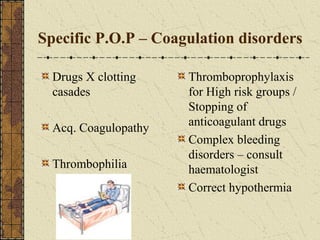
Specific P.O.P – Coagulation disorders
Drugs X clotting
casades
Acq. Coagulopathy
Thrombophilia
Thromboprophylaxis
for High risk groups /
Stopping of
anticoagulant drugs
Complex bleeding
disorders – consult
haematologist
Correct hypothermia
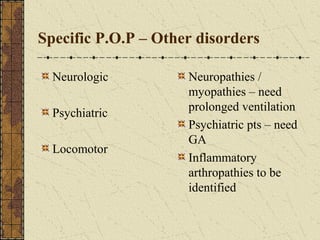
Specific P.O.P – Other disorders
Neurologic
Psychiatric
Locomotor
Neuropathies /
myopathies – need
prolonged ventilation
Psychiatric pts – need
GA
Inflammatory
arthropathies to be
identified
Specific P.O.P – Remote infection
> Sources of bacteraemia –
Artificial material – Jt replacement surgery /
arterial grafting
Infected toes / teeth
> Prophylactic antibiotic best administered just prior
to induction.
Documentation
History – presented logical manner
Investigations & Mgt plan – listed for
action
Drug chart – routine / prophylactic
Taking Consent - Stages
Lead in
Explore
Diagnosis
Treatment
Options
Introduce yourself and
identify the patient
How much does the
patient know
Why the operation is
being proposed
Explain whether the
treatment proposed is
in accordance with
protocols
Discuss all the options
Taking Consent - Stages
Results
Eventualities
Adverse events
Sound mind
Open question
Notes
Explain likely outcome
For example, the possibility
of needing to remove the
testicle in a hernia operation
Myocardial infarction, stroke
and embolus & bleeding
Ask if they have understood
Check if further clarification
Document everything
discussed and agreed
“ LED TO REASON ”
References
Bailey & Love’s - Short Practice of
Surgery
26th
edition.
Internet websites .
THE END
Thank you

Pre operative care

  • 1.
    Pre-operative Care Prof. UthamMurali. M.S ; M.B.A. Dept. of Surgery
  • 2.
    Learning Outcomes Describe theprinciples involved in pre- operative assessment of a patient Enumerate the Specific pre-operative problems in preparing a patient for surgery Identify the stages in the consent process
  • 3.
    Definition The preoperative periodruns from the time the patient is admitted to the hospital or surgicenter to the time that the surgery begins. 3
  • 4.
    Pre-operative plan Gather andrecord all relevant information Optimize patient condition Choose surgery that offers minimal risk and maximum benefit Anticipate and plan for adverse events Inform everyone concerned.
  • 5.
    Steps of P.O.P’s History Examinations Investigations Preoperativetreatments Documentation Communications – Valid consent
  • 6.
    Types of patients Out-Patient Department Usuallyseen 1-2 weeks before surgery at preadmission clinic Emergency department Need initial assessment & immediate resuscitation
  • 7.
    Principles of Historytaking Listen: What is the problem? (Open questions) Clarify: What does the patient expect? (Closed questions) Narrow: Differential diagnosis (Focused questions) Fitness: Comorbidities (Fixed questions)
  • 8.
    Examination General: + findingseven if not related to the proposed procedure should be explored Surgery related: Type and site of surgery, complications which have occurred due to underlying pathology Systemic: Comorbidities and their severity Specific: For example, suitability for positioning during surgery.
  • 9.
    General Physical Ex: Tocheck fitness for anesthesia & surgery. GPE Systemic: - CVS - CNS - GIT - Respiratory system
  • 10.
    Specific Surgical Ex: Itsaim: to confirm previous findings & diagnosis, to determine severity & to gauge extent. E.g. in inguinal hernia confirm it’s inguinal not femoral, reducible or not & whether there are any signs of bowel obstruction.
  • 11.
    Specific Medical Ex: Itsaim: to evaluates the presence & severity of other problems. E.g. Diabetic patient undergoing surgery need careful examination for sepsis , neuropathy or microvascular disease
  • 12.
    Investigations – Routine Everyunit and ward has its own protocol. The tests which normally performed on most patient coming to surgery: * Full Blood Count * Basic Biochemistry * Chest Radiography
  • 13.
    Investigations – Targetedtests • Hematology : to exclude anemia, for platelets count & to assess the amount of blood may be needed during or after operation. • Urea, Creatinine & Electrolytes: state of dehydration & renal insufficiency. • Liver Function Tests: Alb & Protein guide to nutritional status & shows any clotting problems.
  • 14.
    Investigations – Others ECG: It’s recommended in all patient >65years, pt. with blood loss & cardiovascular/pulmonary problems. Urinalysis: used for determination of renal function, inflammation, infection & metabolic disorders. Pregnancy Test: ( B- HCG ) HBsAg & HIV testing. RBS & HbA1c : Diabetes Blood gas analysis: Occ. required
  • 15.
    Management plan –Key points Provide all information necessary for the patient to make an informed decision Use common language Discuss the options rather than telling the patient what will be done Give the patient time to think things over Encourage to discuss things – trusted person Suggest to write down a list of points that to be discussed
  • 16.
  • 17.
    Specific P.O.P –C.V.S Hypertension IHD / Recent MI Arrhythmias Cardiac failure Anaemia & Blood transfusion Prosthetic valves BP > 160 systolic or > 95 diastolic - surgery deferred till control of BP. MI – No surgery – 6 mths. Consider transfusion if Hb% < 8 g/dl.
  • 18.
    Specific P.O.P –R.S Infection Asthma COPD Pulmonary fibrosis Stop smoking - 4 wks & continue inhalers LRI – to be treated Avoid respiratory suppressants (narcotics)
  • 19.
    Specific P.O.P –G.I.T Malnutrition Obesity Regurgitation risk Jaundice Nutritional support is required - a minimum of 2 weeks prior to surgery Extra measures – obese patients No solids – 6hrs / No fluids – 2hrs Sec complications – jaundice pts
  • 20.
    Specific P.O.P –G.U.D Renal impairment UTI Categorize – Pre-renal / Renal & Post-renal Start antibiotics – UTI Care taken – maintain good urine output
  • 21.
    Specific P.O.P –Metabolic disorders Diabetes Adrenocortical suppression Rare disorders Risk-reduction strategies for Diabetic pts Extra dose steroids to avoid crisis
  • 22.
    Specific P.O.P –Coagulation disorders Drugs X clotting casades Acq. Coagulopathy Thrombophilia Thromboprophylaxis for High risk groups / Stopping of anticoagulant drugs Complex bleeding disorders – consult haematologist Correct hypothermia
  • 23.
    Specific P.O.P –Other disorders Neurologic Psychiatric Locomotor Neuropathies / myopathies – need prolonged ventilation Psychiatric pts – need GA Inflammatory arthropathies to be identified
  • 24.
    Specific P.O.P –Remote infection > Sources of bacteraemia – Artificial material – Jt replacement surgery / arterial grafting Infected toes / teeth > Prophylactic antibiotic best administered just prior to induction.
  • 25.
    Documentation History – presentedlogical manner Investigations & Mgt plan – listed for action Drug chart – routine / prophylactic
  • 26.
    Taking Consent -Stages Lead in Explore Diagnosis Treatment Options Introduce yourself and identify the patient How much does the patient know Why the operation is being proposed Explain whether the treatment proposed is in accordance with protocols Discuss all the options
  • 27.
    Taking Consent -Stages Results Eventualities Adverse events Sound mind Open question Notes Explain likely outcome For example, the possibility of needing to remove the testicle in a hernia operation Myocardial infarction, stroke and embolus & bleeding Ask if they have understood Check if further clarification Document everything discussed and agreed
  • 28.
    “ LED TOREASON ”
  • 30.
    References Bailey & Love’s- Short Practice of Surgery 26th edition. Internet websites .
  • 31.

Editor's Notes

  • #4 Talking Points Shock is simply defined as inadequate tissue perfusion. It is also often referred to as hypoperfusion. During a shock state, inadequate amounts of oxygen and glucose are delivered to cells. In other words, the amount of oxygen delivered to the cells is less than the amount required for normal metabolism. In addition, an impaired elimination of carbon dioxide and other waste products occurs. Organs of vital importance, brain, heart, and kidneys can suffer irreversible damage, eventually leading to death. Tissue ischaemic sensitivity: - heart, brain, lung: 4-6 min.- GI tract, liver, kidney: 45-60 min.- muscle, skin: 2-3 hours