• DEFINITION:
Blood transfusion is the transfusion of
whole blood or its components such as blood cells or
plasma from one person to another person.
• Blood transfusion involves two procedures that is –
1. Collection of blood from donor.
2. Administration of blood to the recipient.
BLOOD TRANSFUSION PURPOSES:
To restore the blood volume when there is a sudden
loss of blood due to hemorrhage.
To raise the Hb level in case of severe anemia.
To treat deficiencies of plasma protein, clotting factors
or hemophilic globulin etc.
To provide antibodies to those person who are sick and
having lowered immunity .
To replace the blood with hemolytic agents with fresh
blood.
COMPONENTS OF BLOOD :
Whole blood
Packed red blood cells
Fresh frozen plasma
Platelets
cryoprecipitate
BLOOD GROUPING :
Each person has one of the following blood types:
Blood group A
Blood group B
Blood group AB
Blood group O
CROSS MATCHING
A can be given to A
B can be given to B
AB is called the universal recipients, AB can receive
any type but can only be given to AB.
O is called the universal donor, O can be given to
anyone but can only be receive from O.
Also every person’s blood is either Rh-positive or Rh –
negative.
MECHANISM
Selection of donor
Collection , storage and transportation of the blood
Administration of the blood to the recipient
Selection of donor
Donor should be free from disease such as
TB,HIV,AIDS,cancer.
HB levels must be above 12gm%.
Weight should be <50 for full donation of 450ml.
Age should be in between of 18 to 65 years.
Pulse rate must be regular and between 60 to 100/
min.
COLLECTION,STORAGE AND TRANSPORTATION OF
BLOOD
Collection of blood from the donor is done in
laboratory by laboratory technician.
Blood is collected in a sterile container containing
anticoagulant solution.
Donor’s blood should immediately after it is
withdrawn should be placed in refrigerator.
If the blood is kept at room temperature ,the
temperature of blood will rise 1o degree C in 30
minutes.
The transportation of blood in the hospital should be
done within 30 minutes after it is taken from the place
of storage.
When blood is transported to distant place use
precooled insulated bags to keep the temperature of
blood below 10 degreeC .
ADMINISTRTION OF BLOOD TO RECIPIENT
When sending the recipient blood sample for
grouping and cross matching ,it must be clearly
labeled with IP number, bed number, ward number.
Keep the patient warm and comfortable if necessary.
Record the amount of blood, type and group ,rate of
flow and any reaction and any medication
administered.
Adjust the rate of flow to 5 to 10 ml per minute during
the first 30 minutes of transfusion to detect any
complications.
BLOOD COMPONENTS TRANSFUSION
It is the transfusion of blood components such as:
PRBC
FFP
PLATELET
RED CELL TRANSFUSION
Transfuse through blood transfusion set only ,
containing 170 mm filter.
Start transfusion within first 30 min of release from
blood bank.
Best veins for blood transfusion are on dorsum of hand
and forearm.
Ensure that blood is warmed up to at least room
temperature before transfusion.
Do not add any medicines or fluid in blood.
Record blood pressure , pulse rate and temperature
before transfusion, 10 min after transfusion is started
and every 30 min during transfusion.
For adults transfusion set with 16-18 gauge needle and
for children 18-20 gauge needle.
Normally the transfusion should be completed in 2-3
hours.
In old age and chronic anemic it should take atleast 4
hours
Record the time of starting and finishing the
transfusion.
FINAL CHECKUP AFTER COMPLETION OF
TRANSFUSION
Remove the needle.
Apply pressure to stop bleeding.
Cover site with dressing.
FRESH FROZEN PLASMA TRANSFUSION
One bag of FFP contain 200ml of FFP.
It is transfused group to group.
Thaw FFP by placing it in water bath at 37 degree with
frequent agitation with hand.
Never thawed under hot water tap.
Transfused within half hour of thawing at the rate of
1oml/min.
Once thawed cannot be refrozen.
PLATELET TRANSFUSION
One bag of platelets contain 5oml of platelet
concentrate.
Transfused group to group.
Platelet once removed from incubator must be
transfused as early as possible.
One bag of 50ml should take 5-10 min in transfusion.
Platelets must be demanded when patient is ready for
platelet transfusion.
BLOOD TRANSFUSION REACTIONS
• Definition
Blood transfusion reaction is a systematic
response by the blood to incompatible with that of
recipient.
It mainly cause due to :
ABO incompatibility
Allergic reactions to the WBCs,platelets or plasma
components.
ACUTE HEMOLYTIC TRANSFUSION REACTION
Develops during the first 5-15 minutes.
The circulating RBCs are ruptured with the release of
hemoglobin.
Causes of acute hemolytic reactions:
• ABO incompatibility
• Improper storage of blood
• Storage beyond 21 days limit
• Exposure of blood to dextrose solution.
Clinical features acute hemolytic reaction;
Onset of fever
Chills, headache, chest pain,
Nausea ,vomiting
Increased heart rate and respiratory rate.
DELAYED HEMOLYTIC TRANSFUSION REACTION
 Occurs due to incompatibility of RBC antigens other than
ABO group.
 It develops days to week after transfusion.
 It is featured by persistent decrease in HB level and lo
grade fever.
ALLERGIC REACTIONS
 It develops any time or within one hour of transfusion.
 It is as a result of sensitivity of the individual of plasma
protein in the transfused blood.
 It is characterized by itching, rashes, bronchial spasm.
CIRCULATORY OVERLOAD
Giving whole blood to patient with severe anemia is
very dangerous as patient require the RBCs not the
other components of blood and may develop
circulatory over load
Condition of heart failure may also cause the
circulatory overload with blood transfusion.
HEMOSIDEROSIS
It is also known as iron overload.
It may develops in client receiving frequent blood
transfusion.
It is the abnormal deposition of Iron in various tissues
in the form of hemosiderin which is an iron rich
pigment that is the product of hemolysis.

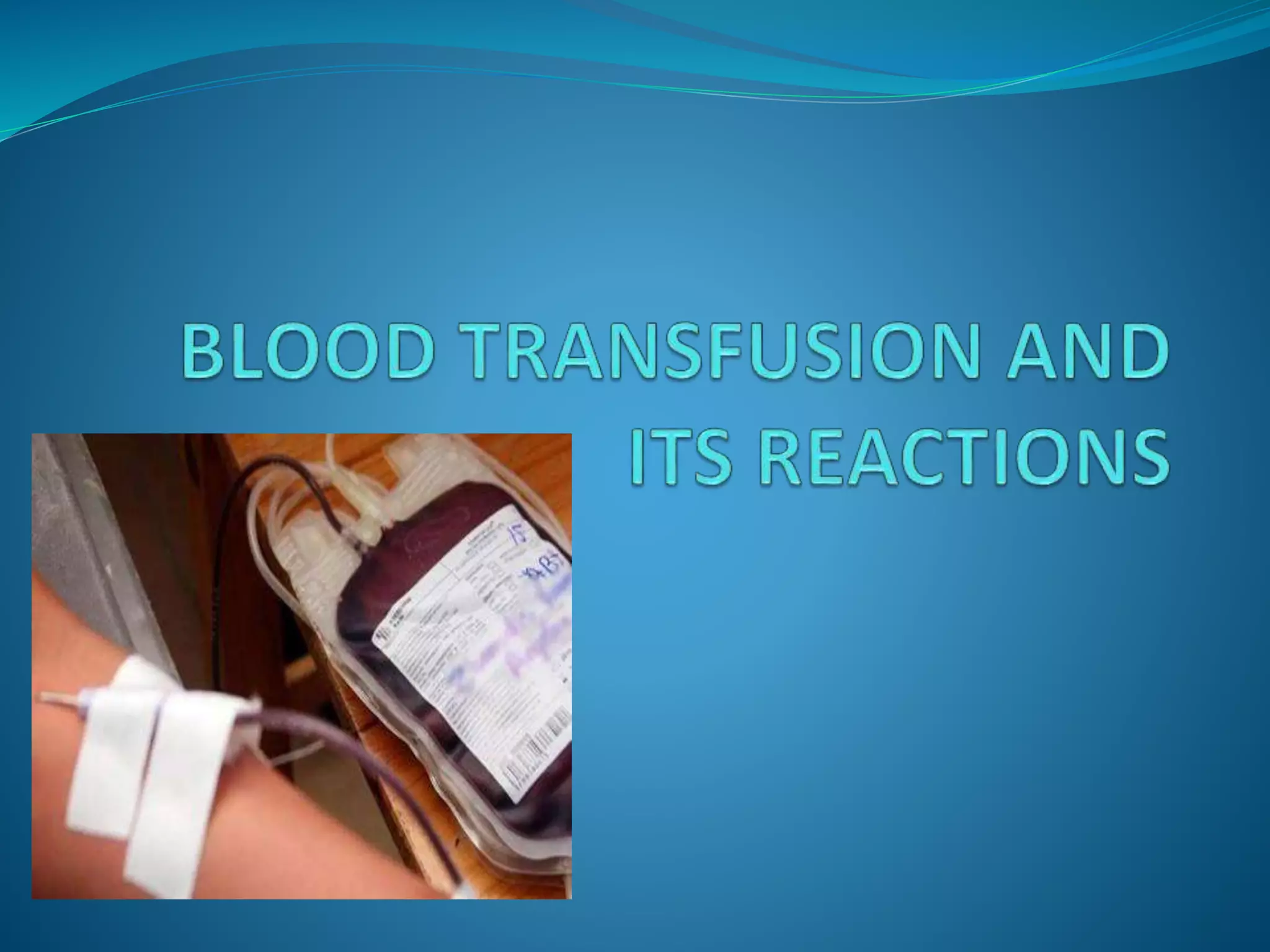
Blood transfusion and its reactions ppt

  • 2.
    • DEFINITION: Blood transfusionis the transfusion of whole blood or its components such as blood cells or plasma from one person to another person. • Blood transfusion involves two procedures that is – 1. Collection of blood from donor. 2. Administration of blood to the recipient.
  • 3.
    BLOOD TRANSFUSION PURPOSES: Torestore the blood volume when there is a sudden loss of blood due to hemorrhage. To raise the Hb level in case of severe anemia. To treat deficiencies of plasma protein, clotting factors or hemophilic globulin etc. To provide antibodies to those person who are sick and having lowered immunity . To replace the blood with hemolytic agents with fresh blood.
  • 4.
    COMPONENTS OF BLOOD: Whole blood Packed red blood cells Fresh frozen plasma Platelets cryoprecipitate
  • 5.
    BLOOD GROUPING : Eachperson has one of the following blood types: Blood group A Blood group B Blood group AB Blood group O
  • 6.
    CROSS MATCHING A canbe given to A B can be given to B AB is called the universal recipients, AB can receive any type but can only be given to AB. O is called the universal donor, O can be given to anyone but can only be receive from O. Also every person’s blood is either Rh-positive or Rh – negative.
  • 7.
    MECHANISM Selection of donor Collection, storage and transportation of the blood Administration of the blood to the recipient
  • 8.
    Selection of donor Donorshould be free from disease such as TB,HIV,AIDS,cancer. HB levels must be above 12gm%. Weight should be <50 for full donation of 450ml. Age should be in between of 18 to 65 years. Pulse rate must be regular and between 60 to 100/ min.
  • 9.
    COLLECTION,STORAGE AND TRANSPORTATIONOF BLOOD Collection of blood from the donor is done in laboratory by laboratory technician. Blood is collected in a sterile container containing anticoagulant solution. Donor’s blood should immediately after it is withdrawn should be placed in refrigerator. If the blood is kept at room temperature ,the temperature of blood will rise 1o degree C in 30 minutes.
  • 10.
    The transportation ofblood in the hospital should be done within 30 minutes after it is taken from the place of storage. When blood is transported to distant place use precooled insulated bags to keep the temperature of blood below 10 degreeC .
  • 11.
    ADMINISTRTION OF BLOODTO RECIPIENT When sending the recipient blood sample for grouping and cross matching ,it must be clearly labeled with IP number, bed number, ward number. Keep the patient warm and comfortable if necessary. Record the amount of blood, type and group ,rate of flow and any reaction and any medication administered. Adjust the rate of flow to 5 to 10 ml per minute during the first 30 minutes of transfusion to detect any complications.
  • 12.
    BLOOD COMPONENTS TRANSFUSION Itis the transfusion of blood components such as: PRBC FFP PLATELET
  • 13.
    RED CELL TRANSFUSION Transfusethrough blood transfusion set only , containing 170 mm filter. Start transfusion within first 30 min of release from blood bank. Best veins for blood transfusion are on dorsum of hand and forearm. Ensure that blood is warmed up to at least room temperature before transfusion. Do not add any medicines or fluid in blood.
  • 14.
    Record blood pressure, pulse rate and temperature before transfusion, 10 min after transfusion is started and every 30 min during transfusion. For adults transfusion set with 16-18 gauge needle and for children 18-20 gauge needle. Normally the transfusion should be completed in 2-3 hours. In old age and chronic anemic it should take atleast 4 hours Record the time of starting and finishing the transfusion.
  • 15.
    FINAL CHECKUP AFTERCOMPLETION OF TRANSFUSION Remove the needle. Apply pressure to stop bleeding. Cover site with dressing.
  • 16.
    FRESH FROZEN PLASMATRANSFUSION One bag of FFP contain 200ml of FFP. It is transfused group to group. Thaw FFP by placing it in water bath at 37 degree with frequent agitation with hand. Never thawed under hot water tap. Transfused within half hour of thawing at the rate of 1oml/min. Once thawed cannot be refrozen.
  • 17.
    PLATELET TRANSFUSION One bagof platelets contain 5oml of platelet concentrate. Transfused group to group. Platelet once removed from incubator must be transfused as early as possible. One bag of 50ml should take 5-10 min in transfusion. Platelets must be demanded when patient is ready for platelet transfusion.
  • 18.
    BLOOD TRANSFUSION REACTIONS •Definition Blood transfusion reaction is a systematic response by the blood to incompatible with that of recipient. It mainly cause due to : ABO incompatibility Allergic reactions to the WBCs,platelets or plasma components.
  • 19.
    ACUTE HEMOLYTIC TRANSFUSIONREACTION Develops during the first 5-15 minutes. The circulating RBCs are ruptured with the release of hemoglobin. Causes of acute hemolytic reactions: • ABO incompatibility • Improper storage of blood • Storage beyond 21 days limit • Exposure of blood to dextrose solution.
  • 20.
    Clinical features acutehemolytic reaction; Onset of fever Chills, headache, chest pain, Nausea ,vomiting Increased heart rate and respiratory rate.
  • 21.
    DELAYED HEMOLYTIC TRANSFUSIONREACTION  Occurs due to incompatibility of RBC antigens other than ABO group.  It develops days to week after transfusion.  It is featured by persistent decrease in HB level and lo grade fever. ALLERGIC REACTIONS  It develops any time or within one hour of transfusion.  It is as a result of sensitivity of the individual of plasma protein in the transfused blood.  It is characterized by itching, rashes, bronchial spasm.
  • 22.
    CIRCULATORY OVERLOAD Giving wholeblood to patient with severe anemia is very dangerous as patient require the RBCs not the other components of blood and may develop circulatory over load Condition of heart failure may also cause the circulatory overload with blood transfusion.
  • 23.
    HEMOSIDEROSIS It is alsoknown as iron overload. It may develops in client receiving frequent blood transfusion. It is the abnormal deposition of Iron in various tissues in the form of hemosiderin which is an iron rich pigment that is the product of hemolysis.