BLOOD AND BLOOD 
COMPONENT 
THERAPY Dr Rakesh Verma 
Guided by 
Dr Santosh Singh 1 
Nelson 
Cloherty handbook 
Ghai Essential Paediatrics 
Meherban Singh Care of Newborn 
AIIMS Newborn protocol 
Nathan and Oski children and infant Haematology
- 
• The routine separation of donor blood into 
components and plasma fraction has made it 
possible for blood banks to provide the 
specialized blood products required for the 
support of patients in multiple treatment 
modalities. 
• The infusion of blood component is called 
component transfusion or blood component 
therapy. 
2
However, in most cases blood components are 
preferred because each component has specific 
optimal storage conditions and component therapy 
maximizes the use of blood donations. 
Removal of 10 ml from 1500gm neonate equals 
400ml of adult (= 8% blood volume) 
As many as 70% - 80% LBW require atleast 1 
transfusion 
3
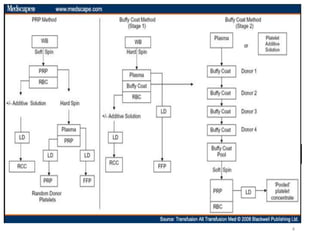
Fresh Whole Blood 
Packed Red Cells 
Light spin, 22oC(within 8 hrs) 
Platelet Rich Plasma 
Heavy spin,22oC 
Platelet Concentrate Fresh Plasma 
Store at 22oC Freeze(FFP) 
4
TYPES 
Blood- 
• Fresh Whole Blood 
• Reconstituted whole blood 
• From one unit of whole blood 
one can make = Blood components 
• PRBC 
• Platelet pack(random donor) 
• Fresh plasma 
• Granulocyte pack 
• Fresh plasma →frozen at -30°C→FFP 
• Pooled plasma→ components 
 
Cryoprecipitate 
 
Albumin 
 
Immunoglobulins 
5 
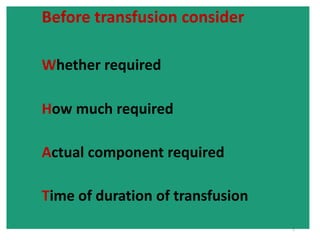
Before transfusion consider 
Whether required 
How much required 
Actual component required 
Time of duration of transfusion
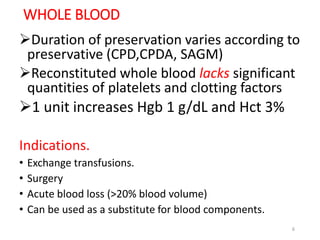
WHOLE BLOOD 
Duration of preservation varies according to 
preservative (CPD,CPDA, SAGM) 
Reconstituted whole blood lacks significant 
quantities of platelets and clotting factors 
1 unit increases Hgb 1 g/dL and Hct 3% 
Indications. 
• Exchange transfusions. 
• Surgery 
• Acute blood loss (>20% blood volume) 
• Can be used as a substitute for blood components. 
6
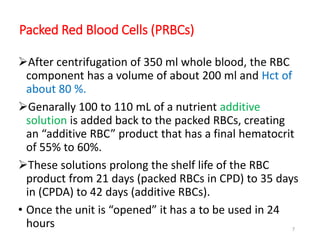
Packed Red Blood Cells (PRBCs) 
After centrifugation of 350 ml whole blood, the RBC 
component has a volume of about 200 ml and Hct of 
about 80 %. 
Genarally 100 to 110 mL of a nutrient additive 
solution is added back to the packed RBCs, creating 
an “additive RBC” product that has a final hematocrit 
of 55% to 60%. 
These solutions prolong the shelf life of the RBC 
product from 21 days (packed RBCs in CPD) to 35 days 
in (CPDA) to 42 days (additive RBCs). 
• Once the unit is “opened” it has a to be used in 24 
hours 7
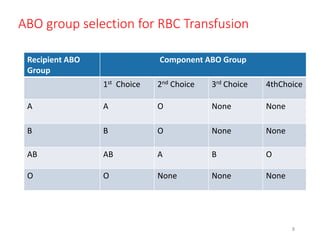
ABO group selection for RBC Transfusion 
Recipient ABO 
Group 
Component ABO Group 
1st Choice 2nd Choice 3rd Choice 4thChoice 
A A O None None 
B B O None None 
AB AB A B O 
O O None None None 
8
Available forms of RCCs 
• RBC concentrates. 
• RBC concentrates deprived of the buffy coat. 
• RBC concentrates with additive solutions. 
•Washed RBC. 
• Leucodepleted RBC. 
• Frozen RBC. 
• Apheretic RBC. 
• Irradiated RBC. 
9
1. Leucodepleted/ Leucoreduced RCCs 
Most plasma & 70-80% WBC(buffy coat) 
removed & 100 ml of Additive Solution added. 
Indications 
• Prevention of febrile non-haemolytic 
transfusion reactions (FNHTRs) 
• - patients with recurrent FNHTR; 
• - patients who need prolonged 
transfusion support. 
• Reduction of the incidence of CMV 
infections and other leukotrophic viruses 
• Intrauterine transfusions and transfusions 
to premature babies, neonates, and infants 
up to 1 year. 
• Candidates for renal transplantation. 10
2. Washed RCC 
RBC washed with Normal Saline 
Washing eliminates antibodies & other plasma 
constituents reduce potassium 
• recommended for intrauterine transfusions, 
• exchange transfusion and 
• large volume transfusions 
Indication 
• Patients with IgA deficiency (presence of 
anti-IgA). 
• Paroxysmal nocturnal hemoglobinuria 
• Allogeneic bone marrow transplant 
11
3. Irradiated RCCs 
• Irradiation, at the dose of 25–50 Gy Gamma radiation, is for 
preventing transfusion-related GvHD. Radiation damages T cells 
• Shelf life of RBC decrease to 28 days, hyperkalaemia is risk 
Donor units from a blood relative (Directed Donations) 
Intrauterine transfusion 
Immunodeficiency 
Premature newborns, recommended <1200gm baby 
Preferable for any transfusions till 4 months of age. 
Chemo or Radiotherapy 
Solid organ transplant, Bone marrow transplant 
12 
4. Frozen RCCs 
Glycerol is used as preservative 
Stored for 10 years, Once thawed should be used in 24 hours 
 Autologous transfusion 
 Preservation of rare blood group
Choice of blood in Emergency 
need 
• Patient should receive type specific blood 
• Time not permissible, then O –ve RBC and AB plasma can be 
given 
• In males when there is shortage of blood then O +ve RBC 
can be given 
Choice of blood in Massive transfusion 
• Greater than 1 blood volume within 24 hours 
• For alloimmunised tested patients, blood not tested for 
antigen may be used during an acute bleeding period and 
antigen negative blood reserved for late transfusion 
13
Autologous blood transfusion 
• For autologous blood transfusion children should have Hb >11gm%, and 
Hct >33%. 
• Collection before 4-5 weeks before surgery. 
• Oral iron supplement 
• Erythropoietin may be used 
Choice of blood for fetus 
• For intrauterine transfusion group O Rh(D-) should be used 
• To prevent GVHD blood is irradiated and to prevent CMV; CMV 
antibody negative blood or leukocyte reduced blood should be 
used 
14
Choice of blood for neonate 
• CMV antibody negative blood or leukocyte reduced blood should be used especially 
in less than 1200gm 
• Leukocyte reduced blood also prevent GVHD which is more common in low birth 
weight babies 
• For exchange transfusion for HDN, RBC must be negative for implicated antibody 
• In term of ABO group selection, group O RBC and plasma of infant’s ABO are used 
15 
Directed Donations 
A directed donation occurs when a patient's family or friends donate blood for 
their children 
Transfusion-associated GVHD can occur in these recievers 
It can also occur in situations in which the blood donor is homozygous and the 
recipient 
is heterozygous for an HLA haplotype. 
It is associated with higher mortality (80-90%). 
It is almost entirely preventable by controlled irradiation of blood products
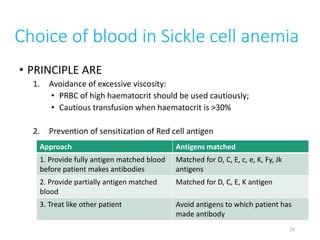
Choice of blood in Sickle cell anemia 
• PRINCIPLE ARE 
1. Avoidance of excessive viscosity: 
• PRBC of high haematocrit should be used cautiously; 
• Cautious transfusion when haematocrit is >30% 
2. Prevention of sensitization of Red cell antigen 
Approach Antigens matched 
1. Provide fully antigen matched blood 
before patient makes antibodies 
Matched for D, C, E, c, e, K, Fy, Jk 
antigens 
2. Provide partially antigen matched 
blood 
Matched for D, C, E, K antigen 
3. Treat like other patient Avoid antigens to which patient has 
made antibody 
16
In sickle cell anemia Hb should be maintained at 10-12 gm/dl 
with <30% Hb S 
Transfusion therapy is not normally indicated in patients with 
Hb values > 7 g/dL 
• Type of blood transfusion 
1. erythrocytapheresis, 
2. manual exchange transfusions 
3. simple transfusion. 
17
Choice of blood in Thalassemia 
• Goal of therapy are 
• Prevention of anemia 
• Maintenance of Hb level sufficient to supress endogenous 
erythropoiesis 
• Maintenance of pretransfusion level of 9-10g% is 
sufficient 
• Red cell alloantibodies are not a significant problem 
in most cases, probably because transfusion is 
usually initiated at early age when tolerance may 
develop 
18
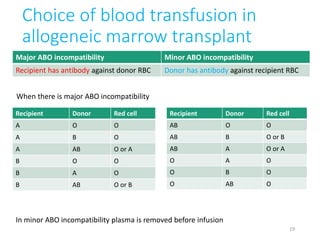
Choice of blood transfusion in 
allogeneic marrow transplant 
Major ABO incompatibility Minor ABO incompatibility 
Recipient has antibody against donor RBC Donor has antibody against recipient RBC 
When there is major ABO incompatibility 
Recipient Donor Red cell 
A O O 
A B O 
A AB O or A 
B O O 
B A O 
B AB O or B 
Recipient Donor Red cell 
AB O O 
AB B O or B 
AB A O or A 
O A O 
O B O 
O AB O 
In minor ABO incompatibility plasma is removed before infusion 
19
Factors other than hemoglobin concentration to be 
considered in the decision to transfuse RBCs include: 
• Patient's symptoms, signs, and functional capacities, 
• The presence of cardiorespiratory, vascular, and 
central nervous system disease 
• The cause and anticipated course of the anemia 
• Alternative therapies, such as recombinant human 
erythropoietin (EPO) therapy, which is known to 
reduce the need for RBC transfusions and to improve 
the overall condition of children with chronic renal 
insufficiency and preterm infants. 
20
Disease requiring intermittent or chronic blood 
transfusion in childhood 
• Thalassemia 
• Sickle cell disease 
• Aplastic anaemia 
• Chronic renal dysfunction 
21
Guideline for chronic transfusion 
• Aggressive management of the underlying disease 
dialysis or erythropoietin therapy for renal 
impairment 
• Leukocyte reduced RBC (to prevent FNHTR) 
• PRBC in such amount to prevent symptomatic 
anaemia and allow normal growth 
• Monitor iron, ferritin, TIBC, liver iron store 
22
Chronic Anaemia 
• Transfusion should be considered in a asymptomatic child with 
a Hb level of less than 4 g/dL. 
• Transfusion should be considered in a child with a Hb level of 
less than 5 g/dL with clinical signs of cardiac or respiratory 
distress. 
• Children with a Hb level of 5 g/dL or greater should NOT be 
transfused indiscriminately, but the cause of their anaemia 
should be investigated. 
• Transfusions must be given slowly (over a 4 hour period. At the 
rate of 2-3 ml/kg/hr). 
23
 Patients with iron-deficiency anemia are often treated 
successfully with oral iron alone, even at hemoglobin levels of 
<5 g/dL. 
 Treat the cause as infection, nutritional and mild blood loss 
anaemia with specific therapeutic agents as indicated (iron, 
folic acid, B12). 
• Premature babies are comfortable at Hb 6.5 - 7 
gm%. 
• Healthy asymptomatic neonate will self correct 
anemia, provided iron should be adequate 
• BT in neonate when asymptomatic Hct <21% or 
reticulocyte count < 2% 
24
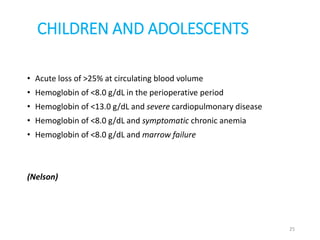
CHILDREN AND ADOLESCENTS 
• Acute loss of >25% at circulating blood volume 
• Hemoglobin of <8.0 g/dL in the perioperative period 
• Hemoglobin of <13.0 g/dL and severe cardiopulmonary disease 
• Hemoglobin of <8.0 g/dL and symptomatic chronic anemia 
• Hemoglobin of <8.0 g/dL and marrow failure 
(Nelson) 
25
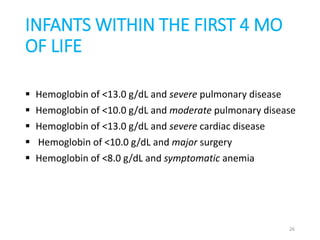
INFANTS WITHIN THE FIRST 4 MO 
OF LIFE 
 Hemoglobin of <13.0 g/dL and severe pulmonary disease 
 Hemoglobin of <10.0 g/dL and moderate pulmonary disease 
 Hemoglobin of <13.0 g/dL and severe cardiac disease 
 Hemoglobin of <10.0 g/dL and major surgery 
 Hemoglobin of <8.0 g/dL and symptomatic anemia 
26
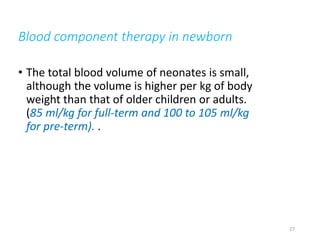
Blood component therapy in newborn 
• The total blood volume of neonates is small, 
although the volume is higher per kg of body 
weight than that of older children or adults. 
(85 ml/kg for full-term and 100 to 105 ml/kg 
for pre-term). . 
27
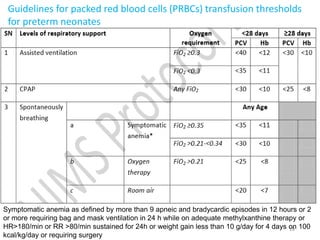
Guidelines for packed red blood cells (PRBCs) transfusion thresholds 
for preterm neonates 
Symptomatic anemia as defined by more than 9 apneic and bradycardic episodes in 12 hours or 2 
or more requiring bag and mask ventilation in 24 h while on adequate methylxanthine therapy or 
HR>180/min or RR >80/min sustained for 24h or weight gain less than 10 g/day for 4 days on 28 
100 
kcal/kg/day or requiring surgery
• Blood transfusion in pre-term infants, is often given for the 
anaemia of prematurity, associated with delayed renal 
production of erythropoietin due to decreased sensitivity 
to lower haematocrit levels. 
• These neonates may require multiple transfusions, 
increasing the risk of infectious disease transmission, 
through multiple donor exposures alloimmunization 
• Studies have shown that multiple transfusion from multiple 
donor in preterms is associated with increased risk of ROP 
and BPD. 
• Multiple donor exposures in small and sick neonates can be 
prevented by reserving a bag of fresh PRBC for up to 7 days 
for a newborn and withdrawing small aliquots required as 
and when needed 
29
Choosing the blood group for neonatal transfusions 
• Mother’s sample should be tested for blood group 
and for any atypical red cell antibodies. 
• ABO compatibility. 
Though ABO antigens may be expressed only 
weakly on neonatal erythrocytes, neonate’s serum may 
contain transplacentally acquired maternal IgG anti-A 
and/or anti-B. 
30
Choosing the blood group for neonatal transfusions. 
c. Blood should be of newborn’s ABO and Rh group. 
It should be compatible with any ABO or atypical red cell 
antibody present in the maternal serum. 
d. In exchange transfusions for hemolytic disease of newborn-, 
blood transfused should be compatible with mother’s serum. 
If the mother’s and the baby’s blood groups are the same, use 
Rh negative blood of baby’s ABO group. 
In case mother’s and baby’s blood group is not compatible, 
use group O and Rh negative blood for exchange transfusion. 
31
Volume and rate of transfusion: 
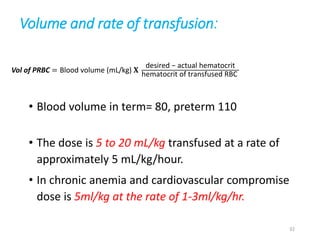
Vol of PRBC = Blood volume (mL/kg) 퐗 
desired − actual hematocrit 
hematocrit of transfused RBC 
• Blood volume in term= 80, preterm 110 
• The dose is 5 to 20 mL/kg transfused at a rate of 
approximately 5 mL/kg/hour. 
• In chronic anemia and cardiovascular compromise 
dose is 5ml/kg at the rate of 1-3ml/kg/hr. 
32
• It has been seen that transfusion with PRBC at a dose 
of 20 mL/kg is well tolerated and results in an overall 
decrease in number of transfusions compared to 
transfusions done at 10 mL/kg in preterm and VLBW 
infants. 
• In Infants and newborn, one unit of RCC( 10 ml/kg) 
increases Hb by 3g/dl. 
• In children, the transfusion of RCC 10 mL/kg 
increases the Hb concentration by about 2 g/dL. 
33
PLATELET TRANSFUSION 
• Platelets are stored at 20°C to 24°C using continuous gentle 
horizontal agitation in storage bags specifically designed to 
permit O2 and CO2 exchange to optimize platelet quality. 
• It should be transported quickly and infused rapidly over 20-30 
minutes to prevent loss of platelets due to aggregation. 
• Should use only ABO/Rh identical compatible donor. 
• In emergency one can use incompatible donors though the 
efficacy may be less than expected 
34
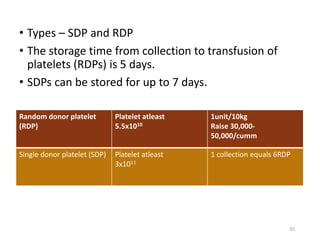
• Types – SDP and RDP 
• The storage time from collection to transfusion of 
platelets (RDPs) is 5 days. 
• SDPs can be stored for up to 7 days. 
Random donor platelet 
(RDP) 
Platelet atleast 
5.5x10¹⁰ 
1unit/10kg 
Raise 30,000- 
50,000/cumm 
Single donor platelet (SDP) Platelet atleast 
3x10¹¹ 
1 collection equals 6RDP 
35
Types of platelets 
• RANDOM DONOR 
• SINGLE DONOR 
• PLASMA DEPLETED PLATELETS 
• WASHED PLATELETS 
• WBC FILTERED 
• UV OR GAMMA IRRADIATED 
• PLATELETS FROM SPECIFIC DONOR: 
CMV NEGATIVE OR HLA-MATCHED DONOR. 
36
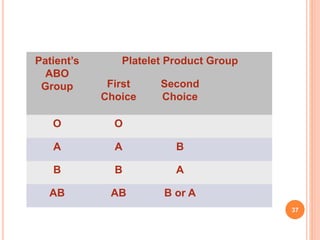
Patient’s 
ABO 
Group 
Platelet Product Group 
First 
Choice 
Second 
Choice 
O O 
A A B 
B B A 
AB AB B or A 
37
Recommandation for platelets use 
• Platelets should never be filtered through a 
micropore blood filter before transfusion. 
• Should be ABO compatible. 
• The usual recommended dose of platelets for 
neonates is 1 unit of platelets per 10 kg body weight, 
which amounts to 5 mL/kg. 
• The predicted rise in platelet count from a 5-mL/kg 
dose would be 20 to 60,000/cubic mm. 
38
CHILDREN AND ADOLESCENTS 
• PLTs < 50 × 109/L and bleeding 
• PLTs < 50 × 109/L and an invasive procedure 
• PLTs < 20 × 109/L and marrow failure with 
hemorrhagic risk factors 
• PLTs < 10 × 109/L and marrow failure without 
hemorrhagic risk factors 
• PLTs at any count, but with PLT dysfunction plus 
bleeding or an invasive procedure 
39
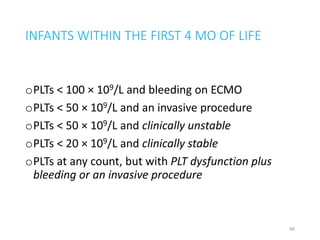
INFANTS WITHIN THE FIRST 4 MO OF LIFE 
oPLTs < 100 × 109/L and bleeding on ECMO 
oPLTs < 50 × 109/L and an invasive procedure 
oPLTs < 50 × 109/L and clinically unstable 
oPLTs < 20 × 109/L and clinically stable 
oPLTs at any count, but with PLT dysfunction plus 
bleeding or an invasive procedure 
40
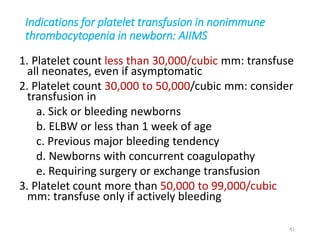
Indications for platelet transfusion in nonimmune 
thrombocytopenia in newborn: AIIMS 
1. Platelet count less than 30,000/cubic mm: transfuse 
all neonates, even if asymptomatic 
2. Platelet count 30,000 to 50,000/cubic mm: consider 
transfusion in 
a. Sick or bleeding newborns 
b. ELBW or less than 1 week of age 
c. Previous major bleeding tendency 
d. Newborns with concurrent coagulopathy 
e. Requiring surgery or exchange transfusion 
3. Platelet count more than 50,000 to 99,000/cubic 
mm: transfuse only if actively bleeding 
41
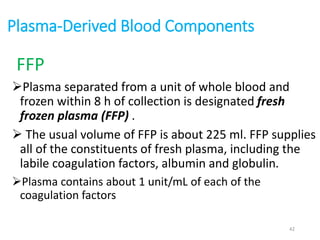
Plasma-Derived Blood Components 
FFP 
Plasma separated from a unit of whole blood and 
frozen within 8 h of collection is designated fresh 
frozen plasma (FFP) . 
 The usual volume of FFP is about 225 ml. FFP supplies 
all of the constituents of fresh plasma, including the 
labile coagulation factors, albumin and globulin. 
Plasma contains about 1 unit/mL of each of the 
coagulation factors 
42
Indications 
• Severe clotting factor deficiency (including DIC) with 
bleeding 
• Severe clotting factor deficiency patient undergoing 
an invasive procedure 
• Vitamin K deficiency with bleeding 
• Dilutional coagulopathy with bleeding 
• Severe anticoagulant protein deficiency 
• Reconstitution of packed RBC for exchange 
transfusion 
44
FFP use in newborn 
• Plasma should be transfused only after reference to normal 
values adjusted for the birthweight and age of the infant 
• 1. Sick neonate with unspecified coagulation disorder due to 
sepsis, DIC, NEC etc. 
• 2. Vitamin K deficiency bleeding 
• 3. Inherited deficiencies of coagulation factors 
It should not be used for prevention of intraventricular 
hemorrhage, and in supportive treatment of sepsis 
45
Cryoprecipitate: 
It is prepared from FFP by thawing at 2 – 4C. 
Contains approximately 100 u of factor VIII and von 
Willebrand factor, 
75 u of factor XIII, and 
250mg of fibrinogen 
in a volume of 20 ml. 
It is transfused usually at 5ml/kg over 30 min. 
46
Indications for use of cryoprecipitate: 
• Afibrinogenemia, 
• Von Willebrand factor deficiency, 
• Congenital antithrombin III deficiency, hemophilia. 
• It is also used for reconstitution of blood for 
exchange transfusion. 
47
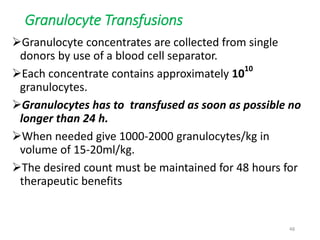
Granulocyte Transfusions 
Granulocyte concentrates are collected from single 
donors by use of a blood cell separator. 
Each concentrate contains approximately 1010 
granulocytes. 
Granulocytes has to transfused as soon as possible no 
longer than 24 h. 
When needed give 1000-2000 granulocytes/kg in 
volume of 15-20ml/kg. 
The desired count must be maintained for 48 hours for 
therapeutic benefits 
48
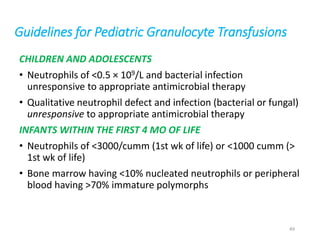
Guidelines for Pediatric Granulocyte Transfusions 
CHILDREN AND ADOLESCENTS 
• Neutrophils of <0.5 × 10⁹/L and bacterial infection 
unresponsive to appropriate antimicrobial therapy 
• Qualitative neutrophil defect and infection (bacterial or fungal) 
unresponsive to appropriate antimicrobial therapy 
INFANTS WITHIN THE FIRST 4 MO OF LIFE 
• Neutrophils of <3000/cumm (1st wk of life) or <1000 cumm (> 
1st wk of life) 
• Bone marrow having <10% nucleated neutrophils or peripheral 
blood having >70% immature polymorphs 
49
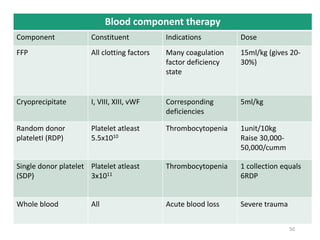
Blood component therapy 
Component Constituent Indications Dose 
FFP All clotting factors Many coagulation 
factor deficiency 
state 
15ml/kg (gives 20- 
30%) 
Cryoprecipitate I, VIII, XIII, vWF Corresponding 
deficiencies 
5ml/kg 
Random donor 
plateletI (RDP) 
Platelet atleast 
5.5x10¹⁰ 
Thrombocytopenia 1unit/10kg 
Raise 30,000- 
50,000/cumm 
Single donor platelet 
(SDP) 
Platelet atleast 
3x10¹¹ 
Thrombocytopenia 1 collection equals 
6RDP 
Whole blood All Acute blood loss Severe trauma 
50
51

Blood component therapy

  • 1.
    BLOOD AND BLOOD COMPONENT THERAPY Dr Rakesh Verma Guided by Dr Santosh Singh 1 Nelson Cloherty handbook Ghai Essential Paediatrics Meherban Singh Care of Newborn AIIMS Newborn protocol Nathan and Oski children and infant Haematology
  • 2.
    - • Theroutine separation of donor blood into components and plasma fraction has made it possible for blood banks to provide the specialized blood products required for the support of patients in multiple treatment modalities. • The infusion of blood component is called component transfusion or blood component therapy. 2
  • 3.
    However, in mostcases blood components are preferred because each component has specific optimal storage conditions and component therapy maximizes the use of blood donations. Removal of 10 ml from 1500gm neonate equals 400ml of adult (= 8% blood volume) As many as 70% - 80% LBW require atleast 1 transfusion 3
  • 4.
    Fresh Whole Blood Packed Red Cells Light spin, 22oC(within 8 hrs) Platelet Rich Plasma Heavy spin,22oC Platelet Concentrate Fresh Plasma Store at 22oC Freeze(FFP) 4
  • 5.
    TYPES Blood- •Fresh Whole Blood • Reconstituted whole blood • From one unit of whole blood one can make = Blood components • PRBC • Platelet pack(random donor) • Fresh plasma • Granulocyte pack • Fresh plasma →frozen at -30°C→FFP • Pooled plasma→ components  Cryoprecipitate  Albumin  Immunoglobulins 5 Before transfusion consider Whether required How much required Actual component required Time of duration of transfusion
  • 6.
    WHOLE BLOOD Durationof preservation varies according to preservative (CPD,CPDA, SAGM) Reconstituted whole blood lacks significant quantities of platelets and clotting factors 1 unit increases Hgb 1 g/dL and Hct 3% Indications. • Exchange transfusions. • Surgery • Acute blood loss (>20% blood volume) • Can be used as a substitute for blood components. 6
  • 7.
    Packed Red BloodCells (PRBCs) After centrifugation of 350 ml whole blood, the RBC component has a volume of about 200 ml and Hct of about 80 %. Genarally 100 to 110 mL of a nutrient additive solution is added back to the packed RBCs, creating an “additive RBC” product that has a final hematocrit of 55% to 60%. These solutions prolong the shelf life of the RBC product from 21 days (packed RBCs in CPD) to 35 days in (CPDA) to 42 days (additive RBCs). • Once the unit is “opened” it has a to be used in 24 hours 7
  • 8.
    ABO group selectionfor RBC Transfusion Recipient ABO Group Component ABO Group 1st Choice 2nd Choice 3rd Choice 4thChoice A A O None None B B O None None AB AB A B O O O None None None 8
  • 9.
    Available forms ofRCCs • RBC concentrates. • RBC concentrates deprived of the buffy coat. • RBC concentrates with additive solutions. •Washed RBC. • Leucodepleted RBC. • Frozen RBC. • Apheretic RBC. • Irradiated RBC. 9
  • 10.
    1. Leucodepleted/ LeucoreducedRCCs Most plasma & 70-80% WBC(buffy coat) removed & 100 ml of Additive Solution added. Indications • Prevention of febrile non-haemolytic transfusion reactions (FNHTRs) • - patients with recurrent FNHTR; • - patients who need prolonged transfusion support. • Reduction of the incidence of CMV infections and other leukotrophic viruses • Intrauterine transfusions and transfusions to premature babies, neonates, and infants up to 1 year. • Candidates for renal transplantation. 10
  • 11.
    2. Washed RCC RBC washed with Normal Saline Washing eliminates antibodies & other plasma constituents reduce potassium • recommended for intrauterine transfusions, • exchange transfusion and • large volume transfusions Indication • Patients with IgA deficiency (presence of anti-IgA). • Paroxysmal nocturnal hemoglobinuria • Allogeneic bone marrow transplant 11
  • 12.
    3. Irradiated RCCs • Irradiation, at the dose of 25–50 Gy Gamma radiation, is for preventing transfusion-related GvHD. Radiation damages T cells • Shelf life of RBC decrease to 28 days, hyperkalaemia is risk Donor units from a blood relative (Directed Donations) Intrauterine transfusion Immunodeficiency Premature newborns, recommended <1200gm baby Preferable for any transfusions till 4 months of age. Chemo or Radiotherapy Solid organ transplant, Bone marrow transplant 12 4. Frozen RCCs Glycerol is used as preservative Stored for 10 years, Once thawed should be used in 24 hours  Autologous transfusion  Preservation of rare blood group
  • 13.
    Choice of bloodin Emergency need • Patient should receive type specific blood • Time not permissible, then O –ve RBC and AB plasma can be given • In males when there is shortage of blood then O +ve RBC can be given Choice of blood in Massive transfusion • Greater than 1 blood volume within 24 hours • For alloimmunised tested patients, blood not tested for antigen may be used during an acute bleeding period and antigen negative blood reserved for late transfusion 13
  • 14.
    Autologous blood transfusion • For autologous blood transfusion children should have Hb >11gm%, and Hct >33%. • Collection before 4-5 weeks before surgery. • Oral iron supplement • Erythropoietin may be used Choice of blood for fetus • For intrauterine transfusion group O Rh(D-) should be used • To prevent GVHD blood is irradiated and to prevent CMV; CMV antibody negative blood or leukocyte reduced blood should be used 14
  • 15.
    Choice of bloodfor neonate • CMV antibody negative blood or leukocyte reduced blood should be used especially in less than 1200gm • Leukocyte reduced blood also prevent GVHD which is more common in low birth weight babies • For exchange transfusion for HDN, RBC must be negative for implicated antibody • In term of ABO group selection, group O RBC and plasma of infant’s ABO are used 15 Directed Donations A directed donation occurs when a patient's family or friends donate blood for their children Transfusion-associated GVHD can occur in these recievers It can also occur in situations in which the blood donor is homozygous and the recipient is heterozygous for an HLA haplotype. It is associated with higher mortality (80-90%). It is almost entirely preventable by controlled irradiation of blood products
  • 16.
    Choice of bloodin Sickle cell anemia • PRINCIPLE ARE 1. Avoidance of excessive viscosity: • PRBC of high haematocrit should be used cautiously; • Cautious transfusion when haematocrit is >30% 2. Prevention of sensitization of Red cell antigen Approach Antigens matched 1. Provide fully antigen matched blood before patient makes antibodies Matched for D, C, E, c, e, K, Fy, Jk antigens 2. Provide partially antigen matched blood Matched for D, C, E, K antigen 3. Treat like other patient Avoid antigens to which patient has made antibody 16
  • 17.
    In sickle cellanemia Hb should be maintained at 10-12 gm/dl with <30% Hb S Transfusion therapy is not normally indicated in patients with Hb values > 7 g/dL • Type of blood transfusion 1. erythrocytapheresis, 2. manual exchange transfusions 3. simple transfusion. 17
  • 18.
    Choice of bloodin Thalassemia • Goal of therapy are • Prevention of anemia • Maintenance of Hb level sufficient to supress endogenous erythropoiesis • Maintenance of pretransfusion level of 9-10g% is sufficient • Red cell alloantibodies are not a significant problem in most cases, probably because transfusion is usually initiated at early age when tolerance may develop 18
  • 19.
    Choice of bloodtransfusion in allogeneic marrow transplant Major ABO incompatibility Minor ABO incompatibility Recipient has antibody against donor RBC Donor has antibody against recipient RBC When there is major ABO incompatibility Recipient Donor Red cell A O O A B O A AB O or A B O O B A O B AB O or B Recipient Donor Red cell AB O O AB B O or B AB A O or A O A O O B O O AB O In minor ABO incompatibility plasma is removed before infusion 19
  • 20.
    Factors other thanhemoglobin concentration to be considered in the decision to transfuse RBCs include: • Patient's symptoms, signs, and functional capacities, • The presence of cardiorespiratory, vascular, and central nervous system disease • The cause and anticipated course of the anemia • Alternative therapies, such as recombinant human erythropoietin (EPO) therapy, which is known to reduce the need for RBC transfusions and to improve the overall condition of children with chronic renal insufficiency and preterm infants. 20
  • 21.
    Disease requiring intermittentor chronic blood transfusion in childhood • Thalassemia • Sickle cell disease • Aplastic anaemia • Chronic renal dysfunction 21
  • 22.
    Guideline for chronictransfusion • Aggressive management of the underlying disease dialysis or erythropoietin therapy for renal impairment • Leukocyte reduced RBC (to prevent FNHTR) • PRBC in such amount to prevent symptomatic anaemia and allow normal growth • Monitor iron, ferritin, TIBC, liver iron store 22
  • 23.
    Chronic Anaemia •Transfusion should be considered in a asymptomatic child with a Hb level of less than 4 g/dL. • Transfusion should be considered in a child with a Hb level of less than 5 g/dL with clinical signs of cardiac or respiratory distress. • Children with a Hb level of 5 g/dL or greater should NOT be transfused indiscriminately, but the cause of their anaemia should be investigated. • Transfusions must be given slowly (over a 4 hour period. At the rate of 2-3 ml/kg/hr). 23
  • 24.
     Patients withiron-deficiency anemia are often treated successfully with oral iron alone, even at hemoglobin levels of <5 g/dL.  Treat the cause as infection, nutritional and mild blood loss anaemia with specific therapeutic agents as indicated (iron, folic acid, B12). • Premature babies are comfortable at Hb 6.5 - 7 gm%. • Healthy asymptomatic neonate will self correct anemia, provided iron should be adequate • BT in neonate when asymptomatic Hct <21% or reticulocyte count < 2% 24
  • 25.
    CHILDREN AND ADOLESCENTS • Acute loss of >25% at circulating blood volume • Hemoglobin of <8.0 g/dL in the perioperative period • Hemoglobin of <13.0 g/dL and severe cardiopulmonary disease • Hemoglobin of <8.0 g/dL and symptomatic chronic anemia • Hemoglobin of <8.0 g/dL and marrow failure (Nelson) 25
  • 26.
    INFANTS WITHIN THEFIRST 4 MO OF LIFE  Hemoglobin of <13.0 g/dL and severe pulmonary disease  Hemoglobin of <10.0 g/dL and moderate pulmonary disease  Hemoglobin of <13.0 g/dL and severe cardiac disease  Hemoglobin of <10.0 g/dL and major surgery  Hemoglobin of <8.0 g/dL and symptomatic anemia 26
  • 27.
    Blood component therapyin newborn • The total blood volume of neonates is small, although the volume is higher per kg of body weight than that of older children or adults. (85 ml/kg for full-term and 100 to 105 ml/kg for pre-term). . 27
  • 28.
    Guidelines for packedred blood cells (PRBCs) transfusion thresholds for preterm neonates Symptomatic anemia as defined by more than 9 apneic and bradycardic episodes in 12 hours or 2 or more requiring bag and mask ventilation in 24 h while on adequate methylxanthine therapy or HR>180/min or RR >80/min sustained for 24h or weight gain less than 10 g/day for 4 days on 28 100 kcal/kg/day or requiring surgery
  • 29.
    • Blood transfusionin pre-term infants, is often given for the anaemia of prematurity, associated with delayed renal production of erythropoietin due to decreased sensitivity to lower haematocrit levels. • These neonates may require multiple transfusions, increasing the risk of infectious disease transmission, through multiple donor exposures alloimmunization • Studies have shown that multiple transfusion from multiple donor in preterms is associated with increased risk of ROP and BPD. • Multiple donor exposures in small and sick neonates can be prevented by reserving a bag of fresh PRBC for up to 7 days for a newborn and withdrawing small aliquots required as and when needed 29
  • 30.
    Choosing the bloodgroup for neonatal transfusions • Mother’s sample should be tested for blood group and for any atypical red cell antibodies. • ABO compatibility. Though ABO antigens may be expressed only weakly on neonatal erythrocytes, neonate’s serum may contain transplacentally acquired maternal IgG anti-A and/or anti-B. 30
  • 31.
    Choosing the bloodgroup for neonatal transfusions. c. Blood should be of newborn’s ABO and Rh group. It should be compatible with any ABO or atypical red cell antibody present in the maternal serum. d. In exchange transfusions for hemolytic disease of newborn-, blood transfused should be compatible with mother’s serum. If the mother’s and the baby’s blood groups are the same, use Rh negative blood of baby’s ABO group. In case mother’s and baby’s blood group is not compatible, use group O and Rh negative blood for exchange transfusion. 31
  • 32.
    Volume and rateof transfusion: Vol of PRBC = Blood volume (mL/kg) 퐗 desired − actual hematocrit hematocrit of transfused RBC • Blood volume in term= 80, preterm 110 • The dose is 5 to 20 mL/kg transfused at a rate of approximately 5 mL/kg/hour. • In chronic anemia and cardiovascular compromise dose is 5ml/kg at the rate of 1-3ml/kg/hr. 32
  • 33.
    • It hasbeen seen that transfusion with PRBC at a dose of 20 mL/kg is well tolerated and results in an overall decrease in number of transfusions compared to transfusions done at 10 mL/kg in preterm and VLBW infants. • In Infants and newborn, one unit of RCC( 10 ml/kg) increases Hb by 3g/dl. • In children, the transfusion of RCC 10 mL/kg increases the Hb concentration by about 2 g/dL. 33
  • 34.
    PLATELET TRANSFUSION •Platelets are stored at 20°C to 24°C using continuous gentle horizontal agitation in storage bags specifically designed to permit O2 and CO2 exchange to optimize platelet quality. • It should be transported quickly and infused rapidly over 20-30 minutes to prevent loss of platelets due to aggregation. • Should use only ABO/Rh identical compatible donor. • In emergency one can use incompatible donors though the efficacy may be less than expected 34
  • 35.
    • Types –SDP and RDP • The storage time from collection to transfusion of platelets (RDPs) is 5 days. • SDPs can be stored for up to 7 days. Random donor platelet (RDP) Platelet atleast 5.5x10¹⁰ 1unit/10kg Raise 30,000- 50,000/cumm Single donor platelet (SDP) Platelet atleast 3x10¹¹ 1 collection equals 6RDP 35
  • 36.
    Types of platelets • RANDOM DONOR • SINGLE DONOR • PLASMA DEPLETED PLATELETS • WASHED PLATELETS • WBC FILTERED • UV OR GAMMA IRRADIATED • PLATELETS FROM SPECIFIC DONOR: CMV NEGATIVE OR HLA-MATCHED DONOR. 36
  • 37.
    Patient’s ABO Group Platelet Product Group First Choice Second Choice O O A A B B B A AB AB B or A 37
  • 38.
    Recommandation for plateletsuse • Platelets should never be filtered through a micropore blood filter before transfusion. • Should be ABO compatible. • The usual recommended dose of platelets for neonates is 1 unit of platelets per 10 kg body weight, which amounts to 5 mL/kg. • The predicted rise in platelet count from a 5-mL/kg dose would be 20 to 60,000/cubic mm. 38
  • 39.
    CHILDREN AND ADOLESCENTS • PLTs < 50 × 109/L and bleeding • PLTs < 50 × 109/L and an invasive procedure • PLTs < 20 × 109/L and marrow failure with hemorrhagic risk factors • PLTs < 10 × 109/L and marrow failure without hemorrhagic risk factors • PLTs at any count, but with PLT dysfunction plus bleeding or an invasive procedure 39
  • 40.
    INFANTS WITHIN THEFIRST 4 MO OF LIFE oPLTs < 100 × 109/L and bleeding on ECMO oPLTs < 50 × 109/L and an invasive procedure oPLTs < 50 × 109/L and clinically unstable oPLTs < 20 × 109/L and clinically stable oPLTs at any count, but with PLT dysfunction plus bleeding or an invasive procedure 40
  • 41.
    Indications for platelettransfusion in nonimmune thrombocytopenia in newborn: AIIMS 1. Platelet count less than 30,000/cubic mm: transfuse all neonates, even if asymptomatic 2. Platelet count 30,000 to 50,000/cubic mm: consider transfusion in a. Sick or bleeding newborns b. ELBW or less than 1 week of age c. Previous major bleeding tendency d. Newborns with concurrent coagulopathy e. Requiring surgery or exchange transfusion 3. Platelet count more than 50,000 to 99,000/cubic mm: transfuse only if actively bleeding 41
  • 42.
    Plasma-Derived Blood Components FFP Plasma separated from a unit of whole blood and frozen within 8 h of collection is designated fresh frozen plasma (FFP) .  The usual volume of FFP is about 225 ml. FFP supplies all of the constituents of fresh plasma, including the labile coagulation factors, albumin and globulin. Plasma contains about 1 unit/mL of each of the coagulation factors 42
  • 43.
    Indications • Severeclotting factor deficiency (including DIC) with bleeding • Severe clotting factor deficiency patient undergoing an invasive procedure • Vitamin K deficiency with bleeding • Dilutional coagulopathy with bleeding • Severe anticoagulant protein deficiency • Reconstitution of packed RBC for exchange transfusion 44
  • 44.
    FFP use innewborn • Plasma should be transfused only after reference to normal values adjusted for the birthweight and age of the infant • 1. Sick neonate with unspecified coagulation disorder due to sepsis, DIC, NEC etc. • 2. Vitamin K deficiency bleeding • 3. Inherited deficiencies of coagulation factors It should not be used for prevention of intraventricular hemorrhage, and in supportive treatment of sepsis 45
  • 45.
    Cryoprecipitate: It isprepared from FFP by thawing at 2 – 4C. Contains approximately 100 u of factor VIII and von Willebrand factor, 75 u of factor XIII, and 250mg of fibrinogen in a volume of 20 ml. It is transfused usually at 5ml/kg over 30 min. 46
  • 46.
    Indications for useof cryoprecipitate: • Afibrinogenemia, • Von Willebrand factor deficiency, • Congenital antithrombin III deficiency, hemophilia. • It is also used for reconstitution of blood for exchange transfusion. 47
  • 47.
    Granulocyte Transfusions Granulocyteconcentrates are collected from single donors by use of a blood cell separator. Each concentrate contains approximately 1010 granulocytes. Granulocytes has to transfused as soon as possible no longer than 24 h. When needed give 1000-2000 granulocytes/kg in volume of 15-20ml/kg. The desired count must be maintained for 48 hours for therapeutic benefits 48
  • 48.
    Guidelines for PediatricGranulocyte Transfusions CHILDREN AND ADOLESCENTS • Neutrophils of <0.5 × 10⁹/L and bacterial infection unresponsive to appropriate antimicrobial therapy • Qualitative neutrophil defect and infection (bacterial or fungal) unresponsive to appropriate antimicrobial therapy INFANTS WITHIN THE FIRST 4 MO OF LIFE • Neutrophils of <3000/cumm (1st wk of life) or <1000 cumm (> 1st wk of life) • Bone marrow having <10% nucleated neutrophils or peripheral blood having >70% immature polymorphs 49
  • 49.
    Blood component therapy Component Constituent Indications Dose FFP All clotting factors Many coagulation factor deficiency state 15ml/kg (gives 20- 30%) Cryoprecipitate I, VIII, XIII, vWF Corresponding deficiencies 5ml/kg Random donor plateletI (RDP) Platelet atleast 5.5x10¹⁰ Thrombocytopenia 1unit/10kg Raise 30,000- 50,000/cumm Single donor platelet (SDP) Platelet atleast 3x10¹¹ Thrombocytopenia 1 collection equals 6RDP Whole blood All Acute blood loss Severe trauma 50
  • 50.