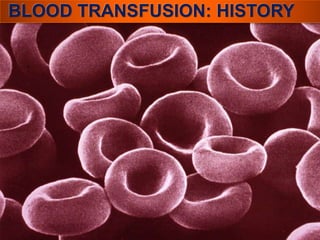
BLOOD TRANSFUSION: HISTORY
Pope Innocent VIII
FIRST HISTORICAL ATTEMPT 
 Of blood transfusion was in 1492. 
 Pope Innocent VIII sank into a coma. 
 The blood of three boys was infused into the dying pontiff 
(through the mouth). 
 The boys were ten years old, and had been promised a 
ducat(kind of gold coin) each. 
 However, not only did the pope die, but so did the three 
children.
HISTORY 
 China, 1000 BC 
 The soul was contained in the blood. 
 Egyptians bathed in blood for their health. 
 Pliny and Celsus describe Romans drinking the blood of 
fallen gladiators to gain strength and vitality and to cure 
epilepsy. 
 Taurobolium, the practice of bathing in blood as it cascaded 
from a sacrificial bull, was practiced by the Romans.
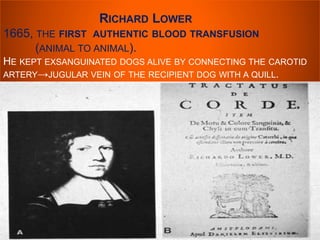
RICHARD LOWER 
1665, THE FIRST AUTHENTIC BLOOD TRANSFUSION 
(ANIMAL TO ANIMAL). 
HE KEPT EXSANGUINATED DOGS ALIVE BY CONNECTING THE CAROTID 
ARTERY→JUGULAR VEIN OF THE RECIPIENT DOG WITH A QUILL.
FIRST BLOOD TRANSFUSION 
•1665 conducted by Richard Lower, an Oxford physician 
started as dog-to-dog experiments and proceeded to animal-to-human 
over the next two years. 
•Lower (1665)
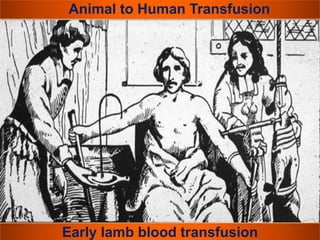
Animal to Human Transfusion 
Early lamb blood transfusion
WHAT IS NEW SCENARIO 
Transfusion practice has come a long way from 
animal to human transfusion to today’s practice 
where we have artificial blood coming out of shelf 
. 
 Though it is expensive but at present we can 
select the component desired by patient 
according to his illness.
FOR BETTER MANAGEMENT WE SHOULD STRICTLY 
MAINTAIN 
 Proper selection of donor. 
 Screening of donor. 
Compatibility testing. 
 Rational use of blood component therapy. 
Transfusion and monitoring
DONOR SELECTION 
 Criteria for donation: a healthy person with 
Age:>18 yrs <60 yrs. 
weight:>48kg but for 
whole blood for component preparation 
>60kg 
Hb>12.5 gm/dl
WHO CAN NOT DONATE 
o The person is unhealthy and thus cannot tolerate the 
hemodynamic stress. 
 Hematocrit value < 34 
 A blood bank or a camp organized by a blood bank is not 
available 
 Suffering from any of the following: 
HepatitisB,C, HIV/AIDS, syphilis, Malaria. 
(MALARIA- the blood is not to be taken for six months.)
WHO CAN NOT DONATE 
H/O of Jaundice during the past one year. 
H/O major surgery in past 6 months. 
Patient is currently suffering from a malignant 
disease, active TB. or epilepsy. 
Women when pregnant or lactating. 
Professional donors.
WHY VOLUNTARY DONATION? 
 Only half of the requirements of blood in India is 
generated by voluntary donation (30 Lac units are 
donated against the 60 Lac unit requirement). 
 As per the Supreme Court ruling, since January 01, 
1998 blood shall be accepted only from voluntary 
donors. 
 No blood bank can utilize professional (paid) donors for 
collection of blood. 
Indian Journal for the Practising Doctor
• Banning the professional donors in 
blood donation has good impact 
though resulting in 
"scarcity of blood" and encouraging 
grey areas in marketing in 
private Blood Banks
NO REPLACEMENT REQUIRED FOR 
Thalessemic Pts. 
 HIV positive pts. 
 Destitute pts. like shishugrah. 
Hemophilic pts.
HEALTH EDUCATION ASPECTS OF BLOOD DONATION: 
Human blood has no natural or synthetic 
substitute, so it has to be donated by other 
human beings. 
A healthy adult can donate blood 
every 3-4 months. 
 Every male has a surplus of 27ml /Kg and 
every female 16ml /Kg in excess of the normal 
requirements. 
 Thus every person can donate @ 8ml/kg body 
weight. (8x45=360ml) at one sitting 
every 3 months.
HEALTH EDUCATION ASPECTS OF BLOOD DONATION: 
 Blood donation- no discomfort or weakness 
during or after donation. 
 Replacement starts immediately after donation, 
and is complete within 12 weeks. 
 No chances of acquiring infection 
from donating blood as the entire procedure is 
sterile. 
Voluntarily donated blood is healthy for 
recipients. 
 Professional donors are themselves 
unhealthy.
PRACTICE POINT: 
 If weight of the person is 60 kg, his total blood 
volume (80x60) will equal 4800 ml. 
A 20% volume loss (960 ml), can be tolerated 
and needs only plasma expanders. 
 However, pts with 30% volume loss (1440 ml): 
require blood transfusion. 
Indian Journal for the Practising Doctor
SENDING THE REQUISITION FORM AND BLOOD 
SAMPLE OF PATIENT 
 Correct identification of the pt. 
 Sample into the type of sample tube required by the blood 
bank. 
 Label the sample tube clearly and accurately 
at the pt’s bedside the moment sample is being taken. 
 Labeling includes: 
patient’s name. 
Hospital registration no. 
Patient’s ward. 
Date. 
Signature of person taking sample. 
These should match with medical records.
PRE-TRANSFUSION TESTS 
 Serological tests:- Blood grouping-ABO 
- Irregular antibody screening 
- type and cross-match. 
o Transfusion transmitted disease tests: 
HIV 
HBV 
HCV 
VDRL 
MP 
NAT
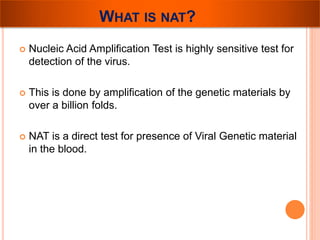
WHAT IS NAT? 
 Nucleic Acid Amplification Test is highly sensitive test for 
detection of the virus. 
 This is done by amplification of the genetic materials by 
over a billion folds. 
 NAT is a direct test for presence of Viral Genetic material 
in the blood.
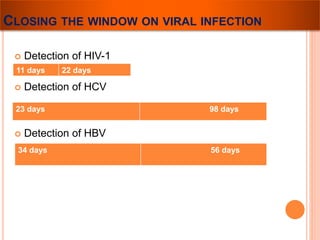
CLOSING THE WINDOW ON VIRAL INFECTION 
 Detection of HIV-1 
11 days 22 days 
 Detection of HCV 
23 days 98 days 
 Detection of HBV 
34 days 56 days
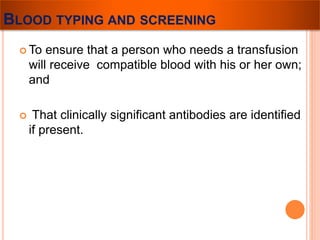
BLOOD TYPING AND SCREENING 
To ensure that a person who needs a transfusion 
will receive compatible blood with his or her own; 
and 
 That clinically significant antibodies are identified 
if present.
OBJECTIVES OF B.T & COMPONENT THERAPY 
Restoration of blood volume 
Enhance the O2 carrying capacity of blood 
Maintain Homeostasis 
– Platelet 
– Coagulation Factors 
– Fresh blood 
– FFP or Appropriate component
BLOOD 
Blood is a vital and life saving fluid. 
Can neither be manufactured in factories, 
nor substituted with blood of any other 
creature. 
But 
 Direct transfusion of infected blood can lead 
to transmission of various diseases like 
hepatitis, syphilis, malaria and HIV.
SAFE BLOOD 
Blood that is 
free of transmissible diseases, 
Compatible with the recipient. 
Stored optimally.
BEFORE TRANSFUSION WE MUST DETERMINE 
WHAT FOR ANY PROCEDURE 
Whether required 
How much required 
Actual component required 
Time of duration of transfusion
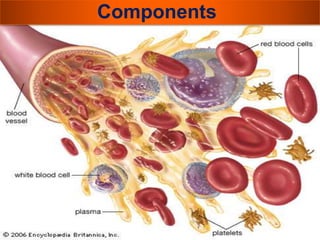
Components
BLOOD PRODUCTS(1) 
Blood-cells products 
-whole blood 
-packed red blood cells 
-leukocyte-poor (reduced) red 
cells 
-washed red blood cells 
-random-donor platelets 
concentrates
BLOOD PRODUCTS(1) 
•Single-donor platelets 
concentrates. 
•Irradiated blood products 
(red blood cells and platelets 
concentrates) 
•Leukocyte (granulocyte) 
concentrates
BLOOD PRODUCTS(2) 
Plasma products 
• fresh-frozen plasma (FFP) 
• cryoprecipitate 
• factor concentrates (VIII, 
IX) 
• albumin 
• immune globulins
UNMODIFIED COMPONENTS 
CELLULAR -PRBC 
-PLATELETS 
-GRANULOCYTES 
PLASMA -FFP 
-CRYOPRECIPITATE 
-FRACTIONETED COMP 
(FACTOR VIII AND IX)
MODIFIED PRODUCTS 
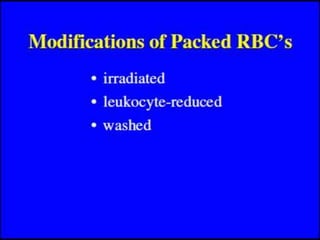
•IRRADIATED 
-PRBC 
-PLATELETS 
-GRANULOCYTES 
•LEUCOCYTE DEPLETED 
-PRBC 
-PLATELETS 
•SALINE WASHED 
-PRBC 
-PLATELETS
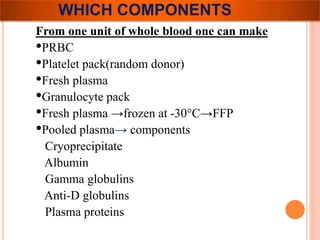
WHICH COMPONENTS 
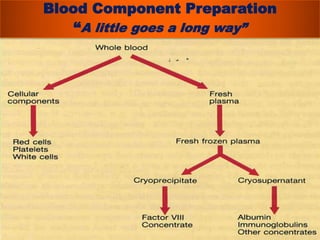
From one unit of whole blood one can make 
•PRBC 
•Platelet pack(random donor) 
•Fresh plasma 
•Granulocyte pack 
•Fresh plasma →frozen at -30°C→FFP 
•Pooled plasma→ components 
Cryoprecipitate 
Albumin 
Gamma globulins 
Anti-D globulins 
Plasma proteins
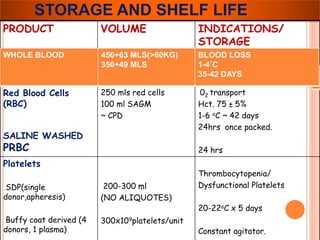
STORAGE AND SHELF LIFE 
PRODUCT VOLUME INDICATIONS/ 
STORAGE 
Red Blood Cells 
(RBC) 
SALINE WASHED 
PRBC 
250 mls red cells 
100 ml SAGM 
~ CPD 
02 transport 
Hct. 75 ± 5% 
1-6 oC ~ 42 days 
24hrs once packed. 
24 hrs 
Platelets 
SDP(single 
donor,apheresis) 
Buffy coat derived (4 
donors, 1 plasma) 
200-300 ml 
(NO ALIQUOTES) 
300x109platelets/unit 
Thrombocytopenia/ 
Dysfunctional Platelets 
20-22oC x 5 days 
Constant agitator. 
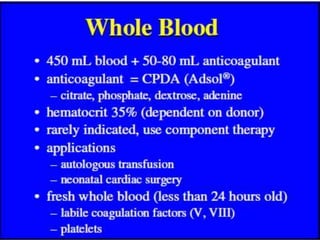
WHOLE BLOOD 450+63 MLS(>60KG) 
350+49 MLS 
BLOOD LOSS 
1-4˚C 
35-42 DAYS
PRODUCT VOLUME INDICATION 
STORAGE 
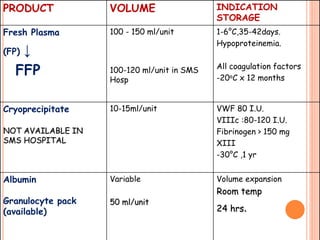
Fresh Plasma 
(FP) ↓ 
FFP 
100 - 150 ml/unit 
100-120 ml/unit in SMS 
Hosp 
1-6°C,35-42days. 
Hypoproteinemia. 
All coagulation factors 
-20oC x 12 months 
Cryoprecipitate 
NOT AVAILABLE IN 
SMS HOSPITAL 
10-15ml/unit VWF 80 I.U. 
VIIIc :80-120 I.U. 
Fibrinogen > 150 mg 
XIII 
-30°C ,1 yr 
Albumin 
Granulocyte pack 
(available) 
Variable 
50 ml/unit 
Volume expansion 
Room temp 
24 hrs.
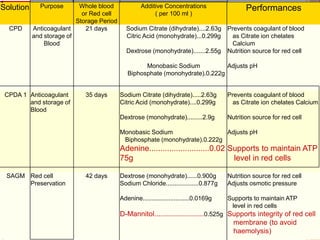
Solution Purpose Whole blood 
or Red cell 
Storage Period 
Additive Concentrations 
( per 100 ml ) 
Performances 
CPD Anticoagulant 
and storage of 
Blood 
21 days Sodium Citrate (dihydrate)....2.63g 
Citric Acid (monohydrate)...0.299g 
Dextrose (monohydrate).......2.55g 
Monobasic Sodium 
Biphosphate (monohydrate).0.222g 
Prevents coagulant of blood 
as Citrate ion chelates 
Calcium 
Nutrition source for red cell 
Adjusts pH 
CPDA 1 Anticoagulant 
and storage of 
Blood 
35 days Sodium Citrate (dihydrate).....2.63g 
Citric Acid (monohydrate)....0.299g 
Dextrose (monohydrate).........2.9g 
Monobasic Sodium 
Biphosphate (monohydrate).0.222g 
Adenine...........................0.02 
75g 
Prevents coagulant of blood 
as Citrate ion chelates Calcium 
Nutrition source for red cell 
Adjusts pH 
Supports to maintain ATP 
level in red cells 
SAGM Red cell 
Preservation 
42 days Dextrose (monohydrate)......0.900g 
Sodium Chloride...................0.877g 
Adenine...........................0.0169g 
D-Mannitol.........................0.525g 
Nutrition source for red cell 
Adjusts osmotic pressure 
Supports to maintain ATP 
level in red cells 
Supports integrity of red cell 
membrane (to avoid 
haemolysis)
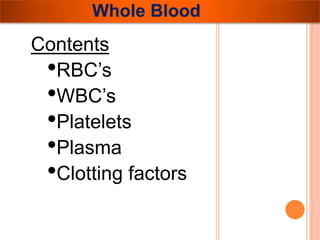
Whole Blood 
Contents 
•RBC’s 
•WBC’s 
•Platelets 
•Plasma 
•Clotting factors
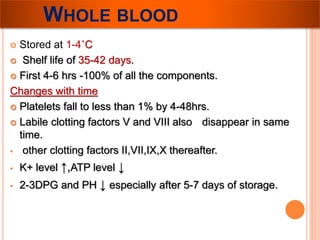
WHOLE BLOOD 
 Stored at 1-4˚C 
 Shelf life of 35-42 days. 
 First 4-6 hrs -100% of all the components. 
Changes with time 
 Platelets fall to less than 1% by 4-48hrs. 
 Labile clotting factors V and VIII also disappear in same 
time. 
• other clotting factors II,VII,IX,X thereafter. 
• K+ level ↑,ATP level ↓ 
• 2-3DPG and PH ↓ especially after 5-7 days of storage.
RECONSTITUTED WHOLE BLOOD 
PRBC suspended in AB Rh-VE plasma used with 
platelets if required. 
 10cc/kg body weight of whole blood will raise 
Hct by 3-5% and Hb by 1 to 1.5 gm%.
STORAGE OF FRESH BLOOD PRODUCTS 
 Fresh blood products should never be stored in 
clinical areas. 
 All products should begin administration 
within 30 minutes of collection from blood 
bank or returned to blood bank for correct 
monitored storage. 
 All Fresh blood products need to be 
administered within four hours of the 
product bag being spiked.
WHY NOT WHOLE BLOOD AND 
WHY COMPONENTS? 
 More than 6 important components 
in each Unit of whole blood. 
 Each component has a specialized function. 
 All functions are not deranged in all the patients 
and so 
 All the components are not required all the time.
WHY NOT WHOLE BLOOD AND 
WHY COMPONENTS? 
Blood is always in short supply. 
Making components from one unit of whole 
blood will satisfy the needs of more than 
one patient from the same unit of blood.
WHY NOT WHOLE BLOOD AND WHY 
COMPONENTS? 
 Whole blood will lead to harmful effects: 
plasma overload 
Lymphocyte mediated toxicities 
Allosensitization etc. 
 Some components-effective as component only 
eg: platelets which are otherwise destroyed in stored 
whole blood. 
 Some components-better given as components 
eg: clotting factors. 
 Level can be achieved at much higher level or even 100% 
by giving concentrates of such factors, than by giving 
whole blood or even FFP.
Indications 
Acute loss of whole blood. 
Exchange transfusion in infants for 
hemolytic anemia of the newborn.
ADVANTAGE 
 All components. 
DISADVANTAGE 
 Side effects due to plasma and lymphocytes as 
their level remains almost 100% till last date of 
storage. 
 Simply wastage of components not required.
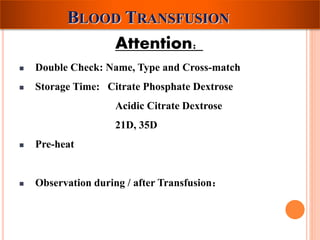
BLOOD TRANSFUSION 
Attention: 
 Double Check: Name, Type and Cross-match 
 Storage Time: Citrate Phosphate Dextrose 
Acidic Citrate Dextrose 
21D, 35D 
 Pre-heat 
 Observation during / after Transfusion:
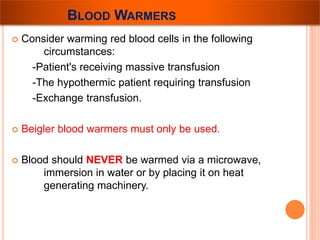
BLOOD WARMERS 
 Consider warming red blood cells in the following 
circumstances: 
-Patient's receiving massive transfusion 
-The hypothermic patient requiring transfusion 
-Exchange transfusion. 
 Beigler blood warmers must only be used. 
 Blood should NEVER be warmed via a microwave, 
immersion in water or by placing it on heat 
generating machinery.
Blood Component Preparation 
“ A little goes a long way”
RED CELL TRANSFUSIONS: INDICATIONS AND 
TRIGGERS
RED BLOOD CELLS - 
DESCRIPTION: 
Whole blood is collected into an anticoagulant then 
centrifuged to separate the red cells from the 
plasma. 
 The plasma is then expressed from the whole 
blood bag and the remaining red blood cells 
(RBC) are filtered. 
 85% of the original RBC volume will remain after 
filtration. 
A typical unit has a volume of 240-340 mL and a 
hematocrit of 80%.
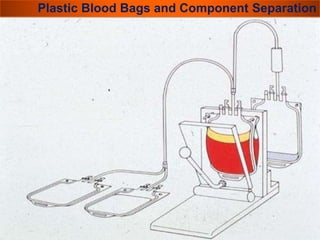
Plastic Blood Bags and Component Separation
PACKED RED BLOOD CELLS (PRBC) 
 PRBC contains packed red cells in 22-50% of original 
plasma. 
 Has nearly 100%of polymorphonuclear cells and 
lymphocytes but has less than 10% platelets and clotting 
factors. 
 Ideal Hct for PRBC is 70-75%. It should not be too tightly 
packed. 
 For newborns while doing exchange transfusion,Hct can be 
adjusted to 50-55% using additional FFP or albumin. 
Indian journal of practical pediatrics
ADVANTAGE 
 Low volume-no circulatory overload. 
Less plasma –so less citrate related toxicity. 
DISADVANTAGE 
 More viscous-flow with difficulty through pediatric IV lines. 
 Shelf life is 24 hrs, once packed. 
 Significant amount of plasma and leukocytes so Toxicity 
related to them: 
Allergic reactions 
NHFTR 
Allosensitization 
GVHD
A SINGLE UNIT of blood is rarely, if at all, 
is of any benefit to the recipient and carries 
all the risks associated with blood 
transfusion.
INDICATIONS:PRBC 
 Commonest indication:- 
chronic transfusion dependent anemia: 
Thalessemias, 
Sickle cell disease, 
Congenital dyserythropoietic anemia, 
Diamond Blackfan syndrome, 
Fanconi’s anemia, 
Aplastic anemia, 
Chronic renal failure, 
Cancer pts, 
Sideroblastic anemia etc.
INDICATIONS 
 Episodic transfusions for acute hemolysis 
G6PD deficiency, 
Malaria, 
Autoimmune hemolytic anemia, 
 Rarely, if at all, used in nutritional anemia 
-severe anemia with impending cardiac 
failure. 
 Has associated cardio-respiratory disease. 
 Before surgery. 
Indian journal of practical pediatrics
 Most oftenly misused 
as Top-ups in pts with nutritional anemia or 
before surgery to keep Hb>10gm% 
 It is counterproductive as it can lead to 
immunosupression of recipient and 
delay in healing.
INDICATIONS IN NEWBORNS 
 Any cause of bleeding. 
 Iatrogenic blood loss especially-sick pre-terms 
 Anemia of prematurity: 
when baby has poor sucking, apneic spells, poor 
weight gain, and Hb<7gm%. 
 Very sick neonates usually have associated 
sepsis, acidosis, DIC, bleeding, and anemia 
and will need support with PRBC, platelets and 
FFP.
•INDICATION FOR TRANSFUSION IN ANEMIC 
PATIENTS 
• Decision to transfuse based on clinical condition 
rather than a given level of hemoglobin. 
• chronic stable anemia - probably unjustifiable if the 
hemoglobin level is above 7g per 100ml 
•Symptomatic anemia 
(dizziness,weakness, shortness of breath), 
underlying cardiac, pulmonary, or vascular 
disease.
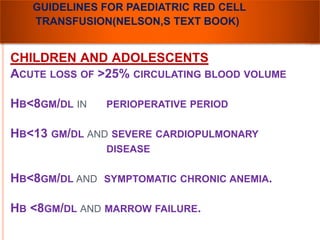
GUIDELINES FOR PAEDIATRIC RED CELL 
TRANSFUSION(NELSON,S TEXT BOOK) 
CHILDREN AND ADOLESCENTS 
ACUTE LOSS OF >25% CIRCULATING BLOOD VOLUME 
HB<8GM/DL IN PERIOPERATIVE PERIOD 
HB<13 GM/DL AND SEVERE CARDIOPULMONARY 
DISEASE 
HB<8GM/DL AND SYMPTOMATIC CHRONIC ANEMIA. 
HB <8GM/DL AND MARROW FAILURE.
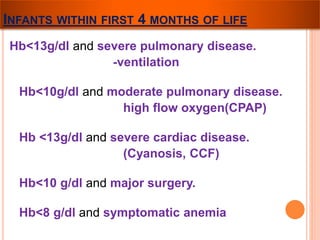
INFANTS WITHIN FIRST 4 MONTHS OF LIFE 
Hb<13g/dl and severe pulmonary disease. 
-ventilation 
Hb<10g/dl and moderate pulmonary disease. 
high flow oxygen(CPAP) 
Hb <13g/dl and severe cardiac disease. 
(Cyanosis, CCF) 
Hb<10 g/dl and major surgery. 
Hb<8 g/dl and symptomatic anemia
IRON DEFICIENCY ANEMIA 
 Rapid hematologic response with iron therapy. 
Transfusion indicated only when 
anemia is very severe Hb<4gm (nelson)
WITH CHRONIC ANEMIA, 
 Children compensate well and may be asymptomatic 
despite low haemoglobin levels. 
 Treated successfully with oral iron alone, even at 
haemoglobin levels of <5 g/dl. 
 Factors other than haemoglobin concentration 
to be considered in the decision to transfuse RBCs 
(1)Patient's symptoms, signs, and functional capacities; 
(2) Presence of cardio-respiratory, vascular, and central 
nervous system disease; 
(3)Cause and anticipated course of the anemia; and 
(4) alternative therapies, such as recombinant human 
erythropoietin (EPO) therapy, which is known to 
reduce the need for RBC transfusions and to improve 
the overall condition of children.
HEALTHY PREMATURE INFANTS 
Physiologic anaemia- no therapy. 
 Ensure diet of the infant- essential nutrients for 
normal haematopoiesis, especially folic acid and 
iron. 
 Premature infants feeding well and growing 
normally rarely need transfusion unless 
iatrogenic blood loss has been significant. 
• Healthy premature infants-Hb< 6.5 g/dl.(nelson)
FRESH V/S STORED RBCS 
The traditional use of relatively fresh RBCs 
(<7days of storage)has been halted in many 
centers in favour of diminishing donor 
exposure by using a single unit of RBCs to 
obtain aliquots for transfusing each infant 
throughout its permitted duration of storage 
(currently 42 days). 
 Neonatologists who insist on transfusing only 
fresh RBCs generally are fearful of the rise in 
the plasma potassium (K') level that occurs in 
RBC units during extended storage.
 After 42 days of storage, 
plasma K* levels are approximately 50 mEq/L (0.05 
mEq/ml) a value that at lst glance, seems 
alarmingly high. 
However, the actual dose of K* transfused in the 
extracellular fluid is tiny.
THALLASSEMIA PTS 
A transfusion program generally requires monthly 
transfusions, with the pre-transfusion haemoglobin 
level >9.5 and<10.5 g/dl. 
 In patients with cardiac disease, higher pre-transfusion 
haemoglobin levels may be beneficial.
PRECAUTIONS 
 Pts with chronic transfusion dependent anemia 
need SPECIAL PRECAUTIONS: 
 Detailed blood grouping should be done before first 
blood transfusion-minor blood group 
incompatibility. 
 Always use coomb’s negative cross-matched blood 
 Best is to use washed PRBC and if affordable,WBC 
filtered PRBC to decrease leuko-contamination.
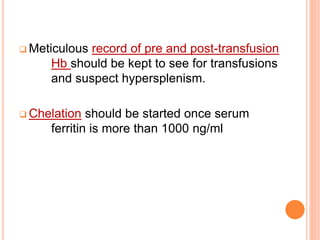
 Meticulous record of pre and post-transfusion 
Hb should be kept to see for transfusions 
and suspect hypersplenism. 
 Chelation should be started once serum 
ferritin is more than 1000 ng/ml
PRECAUTIONS 
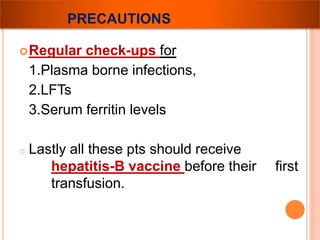
Regular check-ups for 
1.Plasma borne infections, 
2.LFTs 
3.Serum ferritin levels 
o Lastly all these pts should receive 
hepatitis-B vaccine before their first 
transfusion.
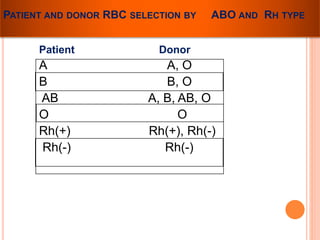
PATIENT AND DONOR RBC SELECTION BY ABO AND RH TYPE 
Patient Donor 
A A, O 
B B, O 
AB A, B, AB, O 
O O 
Rh(+) Rh(+), Rh(-) 
Rh(-) Rh(-)
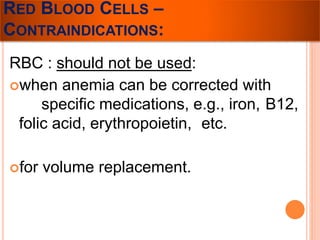
RED BLOOD CELLS – 
CONTRAINDICATIONS: 
RBC : should not be used: 
when anemia can be corrected with 
specific medications, e.g., iron, B12, 
folic acid, erythropoietin, etc. 
for volume replacement.
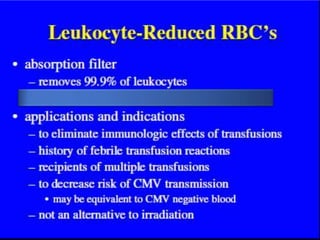
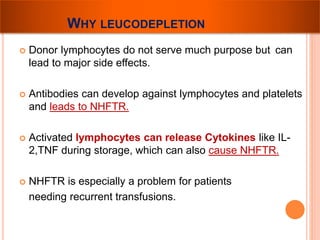
WHY LEUCODEPLETION 
 Donor lymphocytes do not serve much purpose but can 
lead to major side effects. 
 Antibodies can develop against lymphocytes and platelets 
and leads to NHFTR. 
 Activated lymphocytes can release Cytokines like IL- 
2,TNF during storage, which can also cause NHFTR. 
 NHFTR is especially a problem for patients 
needing recurrent transfusions.
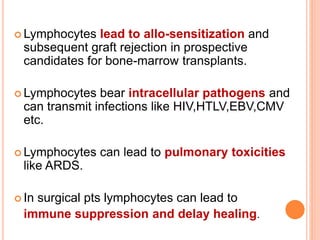
 Lymphocytes lead to allo-sensitization and 
subsequent graft rejection in prospective 
candidates for bone-marrow transplants. 
 Lymphocytes bear intracellular pathogens and 
can transmit infections like HIV,HTLV,EBV,CMV 
etc. 
 Lymphocytes can lead to pulmonary toxicities 
like ARDS. 
 In surgical pts lymphocytes can lead to 
immune suppression and delay healing.
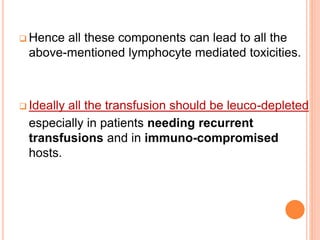
 Hence all these components can lead to all the 
above-mentioned lymphocyte mediated toxicities. 
 Ideally all the transfusion should be leuco-depleted 
especially in patients needing recurrent 
transfusions and in immuno-compromised 
hosts.
METHODS OF LEUCODEPLETION 
1.WBC filters: 
• 3rd generation WBC filters are highly efficient. 
 Efficacy is 99.5% 
 They contain fiber mesh to which the WBC stick and get 
filtered. when used during collection itself they will 
remove lymphocytes at source and hence prevent release 
of cytokines on storage. 
 They can also be used at the bedside while transfusing 
the blood. 
ADVANTAGE: 
 high efficacy 
 Simplicity to use.
DISADVANTAGE: 
 High cost 
 Inability to prevent TAGVHD. 
 Each filter costs Rs.600-700/- and is not reusable. 
 Ideally all transfusion should be given 
using filters especially if patient needs recurrent 
transfusions or develops NHFTR.
2.WASHED CELLS 
 Washing with saline or blood processor not only 
removes WBC but also plasma. 
• Efficacy of WBC removal is 90% and that of plasma is 
99%. 
• Hence it not only will reduce NHFTR, allosensitization 
toxicities related to WBC but will also 
reduce allergic reactions to plasma proteins. 
• Preparation is simple. 
DISADVANTAGE: 
• Not very effective in leucodepletion and cannot prevent 
TAGVHD. 
• It needs cold centrifuge to prepare washed cells.
 All red cell transfusions should be given using 
at least washed cells and preferably with WBC 
filters in pts needing recurrent transfusions and 
those with NHFTR or allergic reactions. 
 Washed platelets from mother are given to a baby 
suffering from allo-immune thrombocytopenia. 
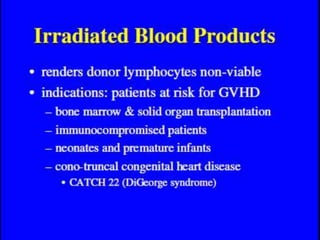
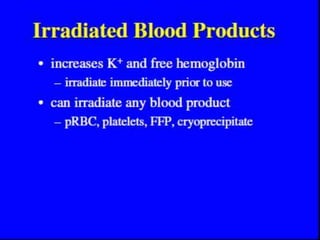
3.gamma-irradiation: 
• TAGVHD can be prevented only with gamma-irradiation 
of blood.
DISADVANTAGE: 
 Need for sophisticated irradiator and chances of 
membrane leak of the cells irradiated and 
increased K+ levels. 
• Hence blood should be irradiated just before infusion 
Or else supernatant plasma should be removed 
before transfusion
 Ideally all blood should be irradiated where there is 
risk of TAGVHD. 
This includes: 
 Transfusion in newborns especially pre term <1200gms 
 Intrauterine transfusion. 
 Pt with primary or secondary immunodeficiency. 
 Organ transplant recipients 
 Transfusion given to a normal person from a 
first degree relative donor
4.FROZEN CELLS 
 RBC can be frozen at -70°C and be kept for 5-7yrs. 
 Once thawed should be used within 24 hrs. 
 Efficacy for leucodepletion is 90% and plasma depletion is 
99%. 
 Hence it reduces toxicities related to both lymphocytes 
and plasma.
ADVANTAGE 
 Availability in emergency where one can use o-ve 
frozen cells in AB–ve plasma. 
• One can collect blood from CMV negative donors. 
• HLA matched donor or rare blood group donor and 
freeze it for future use. 
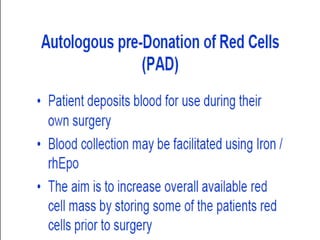
• Lastly autologous blood collected for surgery can be 
frozen and used in future, if surgery gets postponed for 
some reasons. 
DISADVANTAGE: 
• Needs sophisticated instruments to prepare and store. 
• Extremely costly. 
• It cannot prevent TAGVHD.
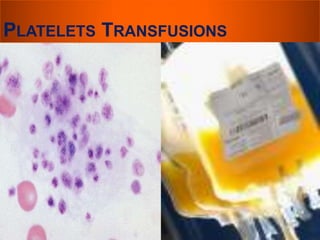
PLATELETS TRANSFUSIONS
PLATELETS 
-DESCRIPTIONS: 
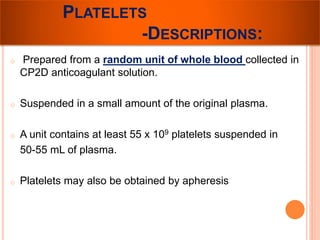
o Prepared from a random unit of whole blood collected in 
CP2D anticoagulant solution. 
o Suspended in a small amount of the original plasma. 
o A unit contains at least 55 x 109 platelets suspended in 
50-55 mL of plasma. 
o Platelets may also be obtained by apheresis
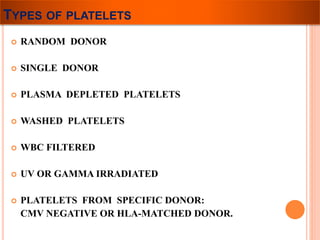
TYPES OF PLATELETS 
 RANDOM DONOR 
 SINGLE DONOR 
 PLASMA DEPLETED PLATELETS 
 WASHED PLATELETS 
 WBC FILTERED 
 UV OR GAMMA IRRADIATED 
 PLATELETS FROM SPECIFIC DONOR: 
CMV NEGATIVE OR HLA-MATCHED DONOR.
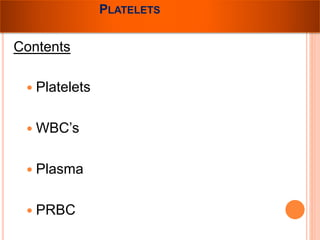
PLATELETS 
Contents 
 Platelets 
 WBC’s 
 Plasma 
 PRBC
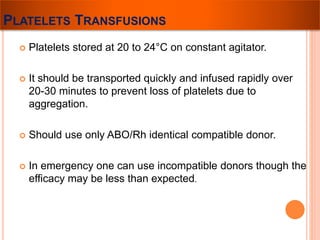
PLATELETS TRANSFUSIONS 
 Platelets stored at 20 to 24°C on constant agitator. 
 It should be transported quickly and infused rapidly over 
20-30 minutes to prevent loss of platelets due to 
aggregation. 
 Should use only ABO/Rh identical compatible donor. 
 In emergency one can use incompatible donors though the 
efficacy may be less than expected.
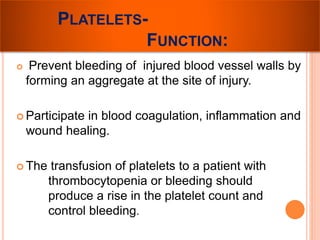
PLATELETS-FUNCTION: 
 Prevent bleeding of injured blood vessel walls by 
forming an aggregate at the site of injury. 
 Participate in blood coagulation, inflammation and 
wound healing. 
 The transfusion of platelets to a patient with 
thrombocytopenia or bleeding should 
produce a rise in the platelet count and 
control bleeding.
PLATELETS - 
INDICATIONS: 
o Bleeding due to severely decreased production or 
abnormal function of platelets. 
 Prophylacticaly to patients with rapidly falling or low 
platelet counts, less than 10 x 109/L (10,000/uL), 
secondary to bone marrow failure, cancer or 
chemotherapy. 
 Postoperative bleeding with platelet count less than 50 
x 109/L (50,000/uL).
RANDOM DONOR PLATELETS 
 Also called PLATELET PACK 
 Derived from SINGLE UNIT of whole blood. 
 Contains 5-6×10¹º in 50-60ml of plasma per pack. 
 One unit per 10 kg will raise platelet count 
by 20,000 to 30,000/cmm. 
 ADVANTAGE 
Less costly and easily available. 
DISADVANTAGE 
 Expose recipient to more no of donors. 
 One cannot use specific donor like CMV negative or HLA 
matched
PLATELETS APHAERESIS 
SDP: collected from a single donor via aphaeresis using cell 
separator and are suspended in plasma. 
Also called platelet concentrate. 
Volume: 150-300mL (actual volume is specified on the 
label) 
Platelet Count: >150-500 x 109/unit. 
(Equivalent to 3-10 single donations.)
ADVANTAGE: 
o More concentrated hence more effective. 
 Exposing recipient to only a single donor. 
 One can use same donor again after 2-3 weeks. 
 One can select specific donor. 
DISADVANTAGE: 
 Extremely costly. 
Needs sophisticated equipments. 
Donor has to wait for longer periods in blood bank.
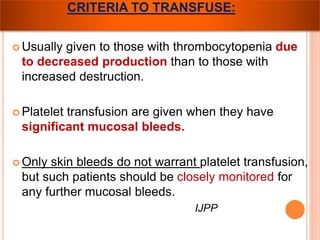
CRITERIA TO TRANSFUSE: 
 Usually given to those with thrombocytopenia due 
to decreased production than to those with 
increased destruction. 
 Platelet transfusion are given when they have 
significant mucosal bleeds. 
 Only skin bleeds do not warrant platelet transfusion, 
but such patients should be closely monitored for 
any further mucosal bleeds. 
IJPP
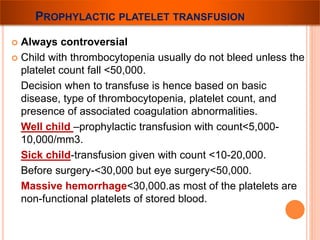
PROPHYLACTIC PLATELET TRANSFUSION 
 Always controversial 
 Child with thrombocytopenia usually do not bleed unless the 
platelet count fall <50,000. 
Decision when to transfuse is hence based on basic 
disease, type of thrombocytopenia, platelet count, and 
presence of associated coagulation abnormalities. 
Well child –prophylactic transfusion with count<5,000- 
10,000/mm3. 
Sick child-transfusion given with count <10-20,000. 
Before surgery-<30,000 but eye surgery<50,000. 
Massive hemorrhage<30,000.as most of the platelets are 
non-functional platelets of stored blood.
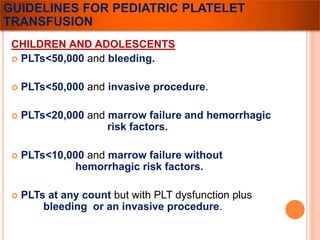
GUIDELINES FOR PEDIATRIC PLATELET 
TRANSFUSION 
CHILDREN AND ADOLESCENTS 
 PLTs<50,000 and bleeding. 
 PLTs<50,000 and invasive procedure. 
 PLTs<20,000 and marrow failure and hemorrhagic 
risk factors. 
 PLTs<10,000 and marrow failure without 
hemorrhagic risk factors. 
 PLTs at any count but with PLT dysfunction plus 
bleeding or an invasive procedure.
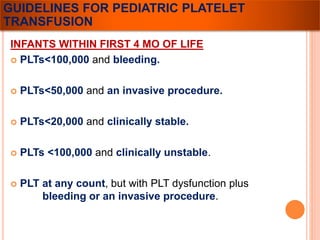
GUIDELINES FOR PEDIATRIC PLATELET 
TRANSFUSION 
INFANTS WITHIN FIRST 4 MO OF LIFE 
 PLTs<100,000 and bleeding. 
 PLTs<50,000 and an invasive procedure. 
 PLTs<20,000 and clinically stable. 
 PLTs <100,000 and clinically unstable. 
 PLT at any count, but with PLT dysfunction plus 
bleeding or an invasive procedure.
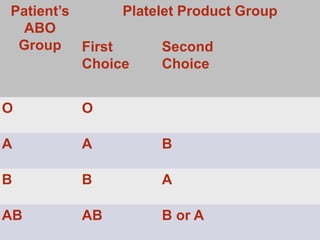
Patient’s 
ABO 
Group 
Platelet Product Group 
First 
Choice 
Second 
Choice 
O O 
A A B 
B B A 
AB AB B or A
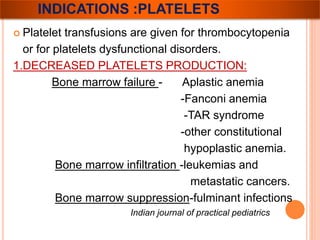
INDICATIONS :PLATELETS 
 Platelet transfusions are given for thrombocytopenia 
or for platelets dysfunctional disorders. 
1.DECREASED PLATELETS PRODUCTION: 
Bone marrow failure - Aplastic anemia 
-Fanconi anemia 
-TAR syndrome 
-other constitutional 
hypoplastic anemia. 
Bone marrow infiltration -leukemias and 
metastatic cancers. 
Bone marrow suppression-fulminant infections 
Indian journal of practical pediatrics
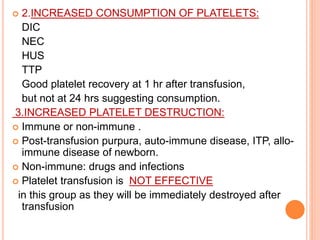
 2.INCREASED CONSUMPTION OF PLATELETS: 
DIC 
NEC 
HUS 
TTP 
Good platelet recovery at 1 hr after transfusion, 
but not at 24 hrs suggesting consumption. 
3.INCREASED PLATELET DESTRUCTION: 
 Immune or non-immune . 
 Post-transfusion purpura, auto-immune disease, ITP, allo-immune 
disease of newborn. 
 Non-immune: drugs and infections 
 Platelet transfusion is NOT EFFECTIVE 
in this group as they will be immediately destroyed after 
transfusion
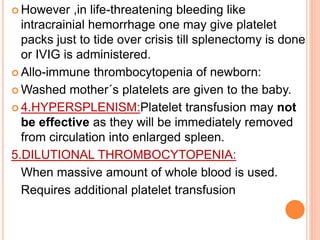
 However ,in life-threatening bleeding like 
intracrainial hemorrhage one may give platelet 
packs just to tide over crisis till splenectomy is done 
or IVIG is administered. 
 Allo-immune thrombocytopenia of newborn: 
Washed mother´s platelets are given to the baby. 
 4.HYPERSPLENISM:Platelet transfusion may not 
be effective as they will be immediately removed 
from circulation into enlarged spleen. 
5.DILUTIONAL THROMBOCYTOPENIA: 
When massive amount of whole blood is used. 
Requires additional platelet transfusion
6.Platelet –dysfunction: various congenital and 
acquired platelet functional disorders 
may present with significant bleeding . 
o If local measures fail to control bleeding transfusion 
will be required. 
o One should use platelets sparingly as allo-sensitization 
may prevent good recovery in future 
after a number of transfusions are given. 
o One can use HLA matched platelets in such cases.
Platelet transfusion efficacy: 
 One unit of RDP per 10 kg body wt increase platelet count 
by 20,000 to 30,000/cmm. 
 SDP is 5-7 times more efficacious than RDP. 
 Efficacy of platelet transfusion depend upon: 
Source, type, storage, collection and administration will 
affect the efficacy. 
Pre-transfusion count, fever, sepsis, size of liver and spleen, 
presence of antibodies or consumption coagulopathy and 
drugs taken by recipient. 
CLINICALLY one can judge efficacy by looking at the 
cessation of bleeding.
PLATELETS – 
CONTRAINDICATIONS: 
 Bleeding is unrelated to decreased numbers or 
abnormal platelet function. 
 Consumption of platelets, in 
Thrombotic Thrombocytopenia Purpura (TTP) 
Idiopathic Thrombocytopenia Purpura (ITP), 
Unless the patient has a life threatening 
hemorrhage. 
o Untreated DIC. 
o Thrombocytopenia associated with septicemia,untill 
treatment has commenced or in cases hypersplenism.
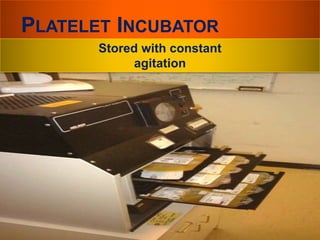
PLATELET INCUBATOR 
Stored with constant 
agitation
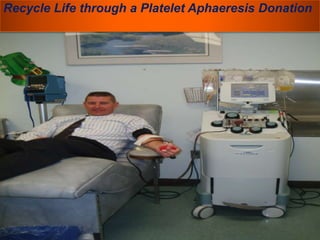
Recycle Life through a Platelet Aphaeresis Donation 
Recycle Life through a Plateletpheresis Donation 
This is John A. Zendt, a Moody Gardens Employee donating platelets 
and plasma. 
Do you want to become an Apheresis Donor?
GRANULOCYTES 
 Patients with severe uncontrollable infection. 
Congenital or acquired neutropenia. 
 Usually reserved for neutropenic pts with fulminent 
sepsis not controlled by antibiotics and antifungal 
ANC<300 in newborn, 
<100 in infants and 
<500 in immunocompromised host. 
 It should always be used along with antibiotics and 
antifungal.
GRANULOCYTES 
 Granulocytes in newborns -partial exchange with 
fresh whole blood to replace granulocytes. 
DOSE:10-15ml/kg body wt. 
 Can be repeated 12-24 hrly for 4-6 days. 
 It is to be stored at room temperature and to be 
used within 24 hrs. 
 It has all side-effects related to plasma and 
lymphocytes. 
 Should be used ABO/Rh compatible donor.
FRESH FROZEN PLASMA - FFP 
DESCRIPTION: 
 Platelet poor plasma obtained at the end of centrifugation 
while making components is frozen within 4-6 hrs 
at -30ºC to make FFP. 
 It can be obtained from a whole blood donation 
(approx. 250 mL) or by apheresis (approx. 500 mL). 
 Shelf life is one year. 
 FFP contains all plasma proteins including albumin, 
gamma-globulins and a normal concentration of fibrinogen and 
the labile coagulation factors VIII and V.
FRESH FROZEN PLASMA - 
DESCRIPTION: 
 One unit of FFP has 150cc-200cc of plasma and 
1ml of plasma contains approx 1 unit of each 
clotting factor. 
 One can use 10-15 cc/kg body weight of FFP every 
12 hrly. 
 Hence one cannot raise factor levels beyond a 
certain limit without leading to volume overload.
FRESH FROZEN PLASMA – 
INDICATIONS: 
 The majority of clinical situations for which FFP is 
currently used do not require FFP. 
 Pt presenting with bleeding for the first time 
where the diagnosis is uncertain as to which 
factor is deficient. 
Massive transfusion with a demonstrated 
deficiency of Factor VIII and V, otherwise 
frozen plasma is adequate. 
 Exchange transfusion in neonates.
FRESH FROZEN PLASMA – 
INDICATIONS: 
 Mainly used to replace clotting factors. 
 Where multiple factors need to be replaced 
liver disease, DIC,TTP 
Warfarin anticoagulant overdose. 
Pts receiving large volume of whole blood. 
Antithrombin III deficiency 
 In reconstitution of whole blood along with PRBC or to 
adjust hematocrit of PRBC for exchange transfusion in 
newborn. 
 Lastly FFP is useful to prevent and treat coagulopathy due 
to L-asperagenase in cancer pts. 
 Hemophilia ,it is better to use factor concentrate.
FRESH FROZEN PLASMA 
 As FFP contains plasma, it can lead to 
allergic reactions, anaphylaxis in IgA deficient 
patient and can transmit all the plasma borne 
infections. 
 Hence albumin should be used as a volume expander as it 
is much safer. 
 Similarly albumin and not FFP should be used to replace 
proteins or albumin. 
 If pt need both volume expansion as well as clotting 
factors like in DIC, sepsis, NEC etc. one can use 
FFP. 
 In small babies, it can lead to hemolysis if it contains 
high levels of antibodies against recipient’s blood 
group antigen
FRESH FROZEN PLASMA - 
CONTRAINDICATIONS: 
 Should not be used when 
coagulopathy can be corrected more effectively with 
specific therapy, such as 
vitamin K, cryoprecipitate, or 
Factor VIII concentrates. 
Same infectious disease risk as whole blood. 
 Should not be used when the blood volume can be 
replaced with other volume expanders such as 0.9% 
sodium chloride, lactated ringer’s, albumin.
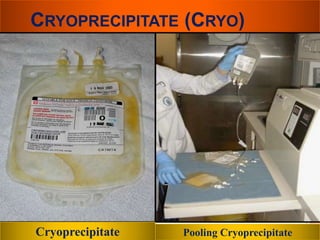
CRYOPRECIPITATE (CRYO) 
DESCRIPTION: 
 Cryoprecipitate is prepared by thawing fresh frozen 
plasma at a temperature between 1°C and 6°C. 
 After centrifugation, the supernatant plasma is 
removed and the insoluble cryoprecipitate is refrozen. 
 On average, each unit of cryoprecipitate contains 80 
IU or more Factor VIII (FVIII:C) and at least 150 mg of 
fibrinogen in 5-15 mL of plasma.
CRYOPRECIPITATE (CRYO) 
INDICATIONS: 
 Source of fibrinogen or Factor XIII. 
 It may be used as a source of Factor VIII only when 
inactivated fractionation products or recombinant Factor VIII 
are not available. 
 Fibrinogen and fibronectin are present.
CRYOPRECIPITATE (CRYO) 
CONTRAINDICATIONS: 
 Should not be used unless results of laboratory studies 
indicate a specific haemostatic defect. 
 Specific factor concentrates are preferred.
CRYOPRECIPITATE (CRYO) 
Cryoprecipitate Pooling Cryoprecipitate
PRE-TRANSFUSION CHECKS 
Patent IV access and is ready to receive the transfusion. 
 Check medical orders: product type, 
special requirements and administration 
requirements. 
Checks prior to administration of the blood product: 
 Patient identification- Name, DOB and UR on the 
blood transfusion record, blood product and tag 
and on the patient's wrist band.
PRE-TRANSFUSION CHECKS 
• If parent or guardian or child of appropriate 
developmental age, 
include them in the patient identification 
checking product. 
 Blood product for any signs of leakage, 
clots or abnormal colour. 
 Complete documentation: 
sign, date, start and finish time. 
• Blood Transfusion Record and file in the 
patient's medical record.
PRINCIPLES OF BLOOD COMPONENT THERAPY 
• Beware of the indications, risks and benefits. 
 The cause of the deficiency should be identified. 
 Alternatives to transfusion considered. 
 Only the deficient component should be replaced. 
 The product should be as safe as possible. 
 Informed consent and documentation should be part 
of the process
SAFE ADMINISTRATION OF BLOOD 
 Involve following: 
1.accurate identification of patient. 
2.correct labeling of blood sample for pre-transfusion 
testing. 
3.After receipt from blood bank proper storage in 
the clinical area upto time transfusion is given. 
4.A final patient identity check to ensure the 
administration of the right blood to the right 
pt.
RISK TO THE PATIENT FROM BLOOD 
TRANSFUSION 
 With the highest levels of standards, working 
sophistication, best of equipments and trained 
personnel there are inherent risks in blood 
transfusion. 
 Some are preventable and on some there is no 
control. 
 With the present day methods there are almost 
negligible technical errors. 
Most of the errors are clerical and result from 
disregard to the standard procedures.
COMMON RISKS TO PATIENT 
 Blood meant for one pt transfused to another pt. 
 Blood pack which has been infected. 
 Heating or freezing of the blood. 
Transfusion transmitted diseases. 
 Adverse reaction to the blood transfusion.
DOCUMENTATION AND MONITORING 
Document vital signs 1 hr prior to 
administration. 
Immediately after commencement. 
Minimum of 15 minutes after starting. 
Hourly until transfusion is completed. 
20-60 minutes following completion of 
transfusion.
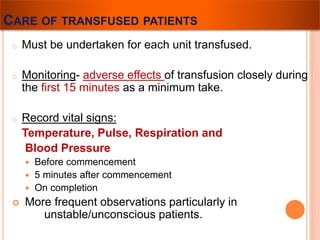
CARE OF TRANSFUSED PATIENTS 
o Must be undertaken for each unit transfused. 
o Monitoring- adverse effects of transfusion closely during 
the first 15 minutes as a minimum take. 
o Record vital signs: 
Temperature, Pulse, Respiration and 
Blood Pressure 
 Before commencement 
 5 minutes after commencement 
 On completion 
 More frequent observations particularly in 
unstable/unconscious patients.
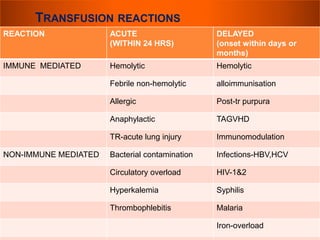
TRANSFUSION REACTIONS 
REACTION ACUTE 
(WITHIN 24 HRS) 
DELAYED 
(onset within days or 
months) 
IMMUNE MEDIATED Hemolytic Hemolytic 
Febrile non-hemolytic alloimmunisation 
Allergic Post-tr purpura 
Anaphylactic TAGVHD 
TR-acute lung injury Immunomodulation 
NON-IMMUNE MEDIATED Bacterial contamination Infections-HBV,HCV 
Circulatory overload HIV-1&2 
Hyperkalemia Syphilis 
Thrombophlebitis Malaria 
Iron-overload
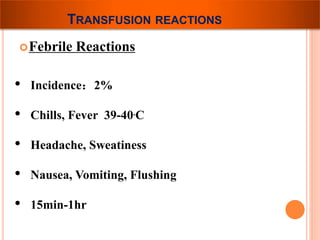
TRANSFUSION REACTIONS 
Febrile Reactions 
• Incidence:2% 
• Chills, Fever 39-40.C 
• Headache, Sweatiness 
• Nausea, Vomiting, Flushing 
• 15min-1hr
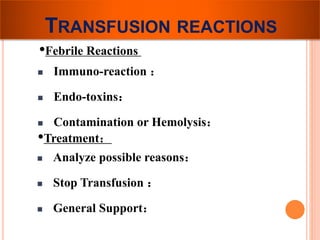
TRANSFUSION REACTIONS 
•Febrile Reactions : 
 Immuno-reaction : 
 Endo-toxins: 
 Contamination or Hemolysis: 
•Treatment: 
 Analyze possible reasons: 
 Stop Transfusion : 
 General Support:
TRANSFUSION REACTIONS 
•Anaphylactic reactions: 
• Urticaria 
• Abdominal cramps 
• Dyspnoea 
• Vomiting 
• Diarrhea
ANAPHYLACTIC REACTIONS: 
•Reason: 
 Immuno-reaction: IgE 
 Hereditary Immunoglobulin: IgA 
•Treatment: 
 Administer antihistamines 
 Administer epinephrine, diphenhydramine, and 
corticosteroids: 
 Support airway and circulation as necessary:
TRANSFUSION REACTIONS 
Hemolytic transfusion reactions 
• Burning at the intravenous (IV) line site 
• Fever, Chills, Dyspnoea 
• Shock 
• Cardiovascular Collapse 
• Hemoglobinuria, Hemoglobinemia 
• Renal Failure 
• DIC
HEMOLYTIC TRANSFUSION REACTIONS 
•Reasons: 
 ABO incompatibility 
 Rh Incompatibility 
 Non-immune Hemolysis 
 Immune Hemolysis
•Treatment: 
 Stop Transfusion as soon as reaction is suspected 
 Check the name, type and cross-match 
 Urine Exam 
 Renal Protection 
(Aggressive Fluid Resuscitation, Furosemide) 
 DIC Monitor
COMPONENT TRANSFUSION: 
• Saving blood source 
• Less likely carrier of transmitted diseases 
• Shortage of quality blood 
• Greater shelf life than whole blood 
• Helping to make blood safer by filtration 
• Infusing regardless of ABO type in some blood 
products 
give only essential/desired blood component
HAEMOVIGILANCE 
 Set of surveillance procedures from the collection 
of blood to the follow-up of recipients for any 
untoward effect in order to prevent them in future. 
 Notification of transfusion-incidents by the French 
health authorities became a legal obligation. 
 The concept was introduced in 1993 when the 
Blood Transfusion Safety Act in France was 
adopted.
HAEMOVIGILANCE 
The parties (or institutions) include all 
blood establishments, treating 
physicians, transfusion committees, 
and consumers (recipients). 
The process of 'haemovigilance' is already 
operational.
Blood Safety 
•Blood Safety Programme in India was initiated in 
1989-90. 
• Which subsequently became an integral part of the 
National AIDS Control Program (NACP) 
•The WHO recommends that all donated blood should 
be tested for HIV/AIDS with either ELISA or 
RAPID /SIMPLE test. 
•Besides, it is mandatory to test blood for hepatitis, 
syphilis, and malaria.
INDIA MARCHES TOWARDS SAFER BLOOD 
TRANSFUSION! 
 Now in INDIA the blood donation by professional donors is 
banned. 
• Voluntary blood donation is encouraged. 
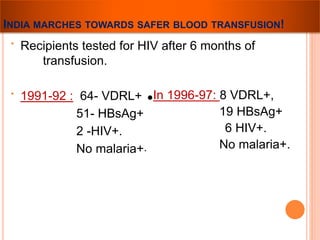
• Screening of blood is compared as on 1991-92 (Mar-Apr) 
and 1996-97. 
• Donors are screened for syphilis (VDRL), HBV 
(HBsAg), HIV (ELISA & W Blot) and malaria (MP). 
.
INDIA MARCHES TOWARDS SAFER BLOOD TRANSFUSION! 
• Recipients tested for HIV after 6 months of 
•In 1996-97: 8 VDRL+, 
19 HBsAg+ 
6 HIV+. 
No malaria+. 
transfusion. 
• 1991-92 : 64- VDRL+ 
51- HBsAg+ 
2 -HIV+. 
No malaria+.
India marches towards safer blood 
transfusion! 
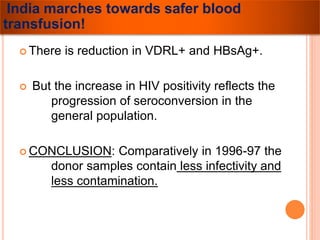
 There is reduction in VDRL+ and HBsAg+. 
 But the increase in HIV positivity reflects the 
progression of seroconversion in the 
general population. 
CONCLUSION: Comparatively in 1996-97 the 
donor samples contain less infectivity and 
less contamination.
THANKS

Blood Component Therapy

  • 2.
  • 3.
  • 4.
    FIRST HISTORICAL ATTEMPT  Of blood transfusion was in 1492.  Pope Innocent VIII sank into a coma.  The blood of three boys was infused into the dying pontiff (through the mouth).  The boys were ten years old, and had been promised a ducat(kind of gold coin) each.  However, not only did the pope die, but so did the three children.
  • 5.
    HISTORY  China,1000 BC  The soul was contained in the blood.  Egyptians bathed in blood for their health.  Pliny and Celsus describe Romans drinking the blood of fallen gladiators to gain strength and vitality and to cure epilepsy.  Taurobolium, the practice of bathing in blood as it cascaded from a sacrificial bull, was practiced by the Romans.
  • 6.
    RICHARD LOWER 1665,THE FIRST AUTHENTIC BLOOD TRANSFUSION (ANIMAL TO ANIMAL). HE KEPT EXSANGUINATED DOGS ALIVE BY CONNECTING THE CAROTID ARTERY→JUGULAR VEIN OF THE RECIPIENT DOG WITH A QUILL.
  • 7.
    FIRST BLOOD TRANSFUSION •1665 conducted by Richard Lower, an Oxford physician started as dog-to-dog experiments and proceeded to animal-to-human over the next two years. •Lower (1665)
  • 8.
    Animal to HumanTransfusion Early lamb blood transfusion
  • 9.
    WHAT IS NEWSCENARIO Transfusion practice has come a long way from animal to human transfusion to today’s practice where we have artificial blood coming out of shelf .  Though it is expensive but at present we can select the component desired by patient according to his illness.
  • 10.
    FOR BETTER MANAGEMENTWE SHOULD STRICTLY MAINTAIN  Proper selection of donor.  Screening of donor. Compatibility testing.  Rational use of blood component therapy. Transfusion and monitoring
  • 11.
    DONOR SELECTION Criteria for donation: a healthy person with Age:>18 yrs <60 yrs. weight:>48kg but for whole blood for component preparation >60kg Hb>12.5 gm/dl
  • 12.
    WHO CAN NOTDONATE o The person is unhealthy and thus cannot tolerate the hemodynamic stress.  Hematocrit value < 34  A blood bank or a camp organized by a blood bank is not available  Suffering from any of the following: HepatitisB,C, HIV/AIDS, syphilis, Malaria. (MALARIA- the blood is not to be taken for six months.)
  • 13.
    WHO CAN NOTDONATE H/O of Jaundice during the past one year. H/O major surgery in past 6 months. Patient is currently suffering from a malignant disease, active TB. or epilepsy. Women when pregnant or lactating. Professional donors.
  • 14.
    WHY VOLUNTARY DONATION?  Only half of the requirements of blood in India is generated by voluntary donation (30 Lac units are donated against the 60 Lac unit requirement).  As per the Supreme Court ruling, since January 01, 1998 blood shall be accepted only from voluntary donors.  No blood bank can utilize professional (paid) donors for collection of blood. Indian Journal for the Practising Doctor
  • 15.
    • Banning theprofessional donors in blood donation has good impact though resulting in "scarcity of blood" and encouraging grey areas in marketing in private Blood Banks
  • 16.
    NO REPLACEMENT REQUIREDFOR Thalessemic Pts.  HIV positive pts.  Destitute pts. like shishugrah. Hemophilic pts.
  • 17.
    HEALTH EDUCATION ASPECTSOF BLOOD DONATION: Human blood has no natural or synthetic substitute, so it has to be donated by other human beings. A healthy adult can donate blood every 3-4 months.  Every male has a surplus of 27ml /Kg and every female 16ml /Kg in excess of the normal requirements.  Thus every person can donate @ 8ml/kg body weight. (8x45=360ml) at one sitting every 3 months.
  • 18.
    HEALTH EDUCATION ASPECTSOF BLOOD DONATION:  Blood donation- no discomfort or weakness during or after donation.  Replacement starts immediately after donation, and is complete within 12 weeks.  No chances of acquiring infection from donating blood as the entire procedure is sterile. Voluntarily donated blood is healthy for recipients.  Professional donors are themselves unhealthy.
  • 19.
    PRACTICE POINT: If weight of the person is 60 kg, his total blood volume (80x60) will equal 4800 ml. A 20% volume loss (960 ml), can be tolerated and needs only plasma expanders.  However, pts with 30% volume loss (1440 ml): require blood transfusion. Indian Journal for the Practising Doctor
  • 20.
    SENDING THE REQUISITIONFORM AND BLOOD SAMPLE OF PATIENT  Correct identification of the pt.  Sample into the type of sample tube required by the blood bank.  Label the sample tube clearly and accurately at the pt’s bedside the moment sample is being taken.  Labeling includes: patient’s name. Hospital registration no. Patient’s ward. Date. Signature of person taking sample. These should match with medical records.
  • 21.
    PRE-TRANSFUSION TESTS Serological tests:- Blood grouping-ABO - Irregular antibody screening - type and cross-match. o Transfusion transmitted disease tests: HIV HBV HCV VDRL MP NAT
  • 22.
    WHAT IS NAT?  Nucleic Acid Amplification Test is highly sensitive test for detection of the virus.  This is done by amplification of the genetic materials by over a billion folds.  NAT is a direct test for presence of Viral Genetic material in the blood.
  • 23.
    CLOSING THE WINDOWON VIRAL INFECTION  Detection of HIV-1 11 days 22 days  Detection of HCV 23 days 98 days  Detection of HBV 34 days 56 days
  • 24.
    BLOOD TYPING ANDSCREENING To ensure that a person who needs a transfusion will receive compatible blood with his or her own; and  That clinically significant antibodies are identified if present.
  • 26.
    OBJECTIVES OF B.T& COMPONENT THERAPY Restoration of blood volume Enhance the O2 carrying capacity of blood Maintain Homeostasis – Platelet – Coagulation Factors – Fresh blood – FFP or Appropriate component
  • 27.
    BLOOD Blood isa vital and life saving fluid. Can neither be manufactured in factories, nor substituted with blood of any other creature. But  Direct transfusion of infected blood can lead to transmission of various diseases like hepatitis, syphilis, malaria and HIV.
  • 28.
    SAFE BLOOD Bloodthat is free of transmissible diseases, Compatible with the recipient. Stored optimally.
  • 29.
    BEFORE TRANSFUSION WEMUST DETERMINE WHAT FOR ANY PROCEDURE Whether required How much required Actual component required Time of duration of transfusion
  • 30.
  • 31.
    BLOOD PRODUCTS(1) Blood-cellsproducts -whole blood -packed red blood cells -leukocyte-poor (reduced) red cells -washed red blood cells -random-donor platelets concentrates
  • 32.
    BLOOD PRODUCTS(1) •Single-donorplatelets concentrates. •Irradiated blood products (red blood cells and platelets concentrates) •Leukocyte (granulocyte) concentrates
  • 33.
    BLOOD PRODUCTS(2) Plasmaproducts • fresh-frozen plasma (FFP) • cryoprecipitate • factor concentrates (VIII, IX) • albumin • immune globulins
  • 34.
    UNMODIFIED COMPONENTS CELLULAR-PRBC -PLATELETS -GRANULOCYTES PLASMA -FFP -CRYOPRECIPITATE -FRACTIONETED COMP (FACTOR VIII AND IX)
  • 35.
    MODIFIED PRODUCTS •IRRADIATED -PRBC -PLATELETS -GRANULOCYTES •LEUCOCYTE DEPLETED -PRBC -PLATELETS •SALINE WASHED -PRBC -PLATELETS
  • 36.
    WHICH COMPONENTS Fromone unit of whole blood one can make •PRBC •Platelet pack(random donor) •Fresh plasma •Granulocyte pack •Fresh plasma →frozen at -30°C→FFP •Pooled plasma→ components Cryoprecipitate Albumin Gamma globulins Anti-D globulins Plasma proteins
  • 37.
    STORAGE AND SHELFLIFE PRODUCT VOLUME INDICATIONS/ STORAGE Red Blood Cells (RBC) SALINE WASHED PRBC 250 mls red cells 100 ml SAGM ~ CPD 02 transport Hct. 75 ± 5% 1-6 oC ~ 42 days 24hrs once packed. 24 hrs Platelets SDP(single donor,apheresis) Buffy coat derived (4 donors, 1 plasma) 200-300 ml (NO ALIQUOTES) 300x109platelets/unit Thrombocytopenia/ Dysfunctional Platelets 20-22oC x 5 days Constant agitator. WHOLE BLOOD 450+63 MLS(>60KG) 350+49 MLS BLOOD LOSS 1-4˚C 35-42 DAYS
  • 38.
    PRODUCT VOLUME INDICATION STORAGE Fresh Plasma (FP) ↓ FFP 100 - 150 ml/unit 100-120 ml/unit in SMS Hosp 1-6°C,35-42days. Hypoproteinemia. All coagulation factors -20oC x 12 months Cryoprecipitate NOT AVAILABLE IN SMS HOSPITAL 10-15ml/unit VWF 80 I.U. VIIIc :80-120 I.U. Fibrinogen > 150 mg XIII -30°C ,1 yr Albumin Granulocyte pack (available) Variable 50 ml/unit Volume expansion Room temp 24 hrs.
  • 39.
    Solution Purpose Wholeblood or Red cell Storage Period Additive Concentrations ( per 100 ml ) Performances CPD Anticoagulant and storage of Blood 21 days Sodium Citrate (dihydrate)....2.63g Citric Acid (monohydrate)...0.299g Dextrose (monohydrate).......2.55g Monobasic Sodium Biphosphate (monohydrate).0.222g Prevents coagulant of blood as Citrate ion chelates Calcium Nutrition source for red cell Adjusts pH CPDA 1 Anticoagulant and storage of Blood 35 days Sodium Citrate (dihydrate).....2.63g Citric Acid (monohydrate)....0.299g Dextrose (monohydrate).........2.9g Monobasic Sodium Biphosphate (monohydrate).0.222g Adenine...........................0.02 75g Prevents coagulant of blood as Citrate ion chelates Calcium Nutrition source for red cell Adjusts pH Supports to maintain ATP level in red cells SAGM Red cell Preservation 42 days Dextrose (monohydrate)......0.900g Sodium Chloride...................0.877g Adenine...........................0.0169g D-Mannitol.........................0.525g Nutrition source for red cell Adjusts osmotic pressure Supports to maintain ATP level in red cells Supports integrity of red cell membrane (to avoid haemolysis)
  • 40.
    Whole Blood Contents •RBC’s •WBC’s •Platelets •Plasma •Clotting factors
  • 41.
    WHOLE BLOOD Stored at 1-4˚C  Shelf life of 35-42 days.  First 4-6 hrs -100% of all the components. Changes with time  Platelets fall to less than 1% by 4-48hrs.  Labile clotting factors V and VIII also disappear in same time. • other clotting factors II,VII,IX,X thereafter. • K+ level ↑,ATP level ↓ • 2-3DPG and PH ↓ especially after 5-7 days of storage.
  • 42.
    RECONSTITUTED WHOLE BLOOD PRBC suspended in AB Rh-VE plasma used with platelets if required.  10cc/kg body weight of whole blood will raise Hct by 3-5% and Hb by 1 to 1.5 gm%.
  • 43.
    STORAGE OF FRESHBLOOD PRODUCTS  Fresh blood products should never be stored in clinical areas.  All products should begin administration within 30 minutes of collection from blood bank or returned to blood bank for correct monitored storage.  All Fresh blood products need to be administered within four hours of the product bag being spiked.
  • 44.
    WHY NOT WHOLEBLOOD AND WHY COMPONENTS?  More than 6 important components in each Unit of whole blood.  Each component has a specialized function.  All functions are not deranged in all the patients and so  All the components are not required all the time.
  • 45.
    WHY NOT WHOLEBLOOD AND WHY COMPONENTS? Blood is always in short supply. Making components from one unit of whole blood will satisfy the needs of more than one patient from the same unit of blood.
  • 46.
    WHY NOT WHOLEBLOOD AND WHY COMPONENTS?  Whole blood will lead to harmful effects: plasma overload Lymphocyte mediated toxicities Allosensitization etc.  Some components-effective as component only eg: platelets which are otherwise destroyed in stored whole blood.  Some components-better given as components eg: clotting factors.  Level can be achieved at much higher level or even 100% by giving concentrates of such factors, than by giving whole blood or even FFP.
  • 47.
    Indications Acute lossof whole blood. Exchange transfusion in infants for hemolytic anemia of the newborn.
  • 48.
    ADVANTAGE  Allcomponents. DISADVANTAGE  Side effects due to plasma and lymphocytes as their level remains almost 100% till last date of storage.  Simply wastage of components not required.
  • 50.
    BLOOD TRANSFUSION Attention:  Double Check: Name, Type and Cross-match  Storage Time: Citrate Phosphate Dextrose Acidic Citrate Dextrose 21D, 35D  Pre-heat  Observation during / after Transfusion:
  • 51.
    BLOOD WARMERS Consider warming red blood cells in the following circumstances: -Patient's receiving massive transfusion -The hypothermic patient requiring transfusion -Exchange transfusion.  Beigler blood warmers must only be used.  Blood should NEVER be warmed via a microwave, immersion in water or by placing it on heat generating machinery.
  • 53.
    Blood Component Preparation “ A little goes a long way”
  • 54.
    RED CELL TRANSFUSIONS:INDICATIONS AND TRIGGERS
  • 55.
    RED BLOOD CELLS- DESCRIPTION: Whole blood is collected into an anticoagulant then centrifuged to separate the red cells from the plasma.  The plasma is then expressed from the whole blood bag and the remaining red blood cells (RBC) are filtered.  85% of the original RBC volume will remain after filtration. A typical unit has a volume of 240-340 mL and a hematocrit of 80%.
  • 56.
    Plastic Blood Bagsand Component Separation
  • 57.
    PACKED RED BLOODCELLS (PRBC)  PRBC contains packed red cells in 22-50% of original plasma.  Has nearly 100%of polymorphonuclear cells and lymphocytes but has less than 10% platelets and clotting factors.  Ideal Hct for PRBC is 70-75%. It should not be too tightly packed.  For newborns while doing exchange transfusion,Hct can be adjusted to 50-55% using additional FFP or albumin. Indian journal of practical pediatrics
  • 58.
    ADVANTAGE  Lowvolume-no circulatory overload. Less plasma –so less citrate related toxicity. DISADVANTAGE  More viscous-flow with difficulty through pediatric IV lines.  Shelf life is 24 hrs, once packed.  Significant amount of plasma and leukocytes so Toxicity related to them: Allergic reactions NHFTR Allosensitization GVHD
  • 60.
    A SINGLE UNITof blood is rarely, if at all, is of any benefit to the recipient and carries all the risks associated with blood transfusion.
  • 61.
    INDICATIONS:PRBC  Commonestindication:- chronic transfusion dependent anemia: Thalessemias, Sickle cell disease, Congenital dyserythropoietic anemia, Diamond Blackfan syndrome, Fanconi’s anemia, Aplastic anemia, Chronic renal failure, Cancer pts, Sideroblastic anemia etc.
  • 62.
    INDICATIONS  Episodictransfusions for acute hemolysis G6PD deficiency, Malaria, Autoimmune hemolytic anemia,  Rarely, if at all, used in nutritional anemia -severe anemia with impending cardiac failure.  Has associated cardio-respiratory disease.  Before surgery. Indian journal of practical pediatrics
  • 63.
     Most oftenlymisused as Top-ups in pts with nutritional anemia or before surgery to keep Hb>10gm%  It is counterproductive as it can lead to immunosupression of recipient and delay in healing.
  • 64.
    INDICATIONS IN NEWBORNS  Any cause of bleeding.  Iatrogenic blood loss especially-sick pre-terms  Anemia of prematurity: when baby has poor sucking, apneic spells, poor weight gain, and Hb<7gm%.  Very sick neonates usually have associated sepsis, acidosis, DIC, bleeding, and anemia and will need support with PRBC, platelets and FFP.
  • 65.
    •INDICATION FOR TRANSFUSIONIN ANEMIC PATIENTS • Decision to transfuse based on clinical condition rather than a given level of hemoglobin. • chronic stable anemia - probably unjustifiable if the hemoglobin level is above 7g per 100ml •Symptomatic anemia (dizziness,weakness, shortness of breath), underlying cardiac, pulmonary, or vascular disease.
  • 66.
    GUIDELINES FOR PAEDIATRICRED CELL TRANSFUSION(NELSON,S TEXT BOOK) CHILDREN AND ADOLESCENTS ACUTE LOSS OF >25% CIRCULATING BLOOD VOLUME HB<8GM/DL IN PERIOPERATIVE PERIOD HB<13 GM/DL AND SEVERE CARDIOPULMONARY DISEASE HB<8GM/DL AND SYMPTOMATIC CHRONIC ANEMIA. HB <8GM/DL AND MARROW FAILURE.
  • 67.
    INFANTS WITHIN FIRST4 MONTHS OF LIFE Hb<13g/dl and severe pulmonary disease. -ventilation Hb<10g/dl and moderate pulmonary disease. high flow oxygen(CPAP) Hb <13g/dl and severe cardiac disease. (Cyanosis, CCF) Hb<10 g/dl and major surgery. Hb<8 g/dl and symptomatic anemia
  • 70.
    IRON DEFICIENCY ANEMIA  Rapid hematologic response with iron therapy. Transfusion indicated only when anemia is very severe Hb<4gm (nelson)
  • 71.
    WITH CHRONIC ANEMIA,  Children compensate well and may be asymptomatic despite low haemoglobin levels.  Treated successfully with oral iron alone, even at haemoglobin levels of <5 g/dl.  Factors other than haemoglobin concentration to be considered in the decision to transfuse RBCs (1)Patient's symptoms, signs, and functional capacities; (2) Presence of cardio-respiratory, vascular, and central nervous system disease; (3)Cause and anticipated course of the anemia; and (4) alternative therapies, such as recombinant human erythropoietin (EPO) therapy, which is known to reduce the need for RBC transfusions and to improve the overall condition of children.
  • 72.
    HEALTHY PREMATURE INFANTS Physiologic anaemia- no therapy.  Ensure diet of the infant- essential nutrients for normal haematopoiesis, especially folic acid and iron.  Premature infants feeding well and growing normally rarely need transfusion unless iatrogenic blood loss has been significant. • Healthy premature infants-Hb< 6.5 g/dl.(nelson)
  • 74.
    FRESH V/S STOREDRBCS The traditional use of relatively fresh RBCs (<7days of storage)has been halted in many centers in favour of diminishing donor exposure by using a single unit of RBCs to obtain aliquots for transfusing each infant throughout its permitted duration of storage (currently 42 days).  Neonatologists who insist on transfusing only fresh RBCs generally are fearful of the rise in the plasma potassium (K') level that occurs in RBC units during extended storage.
  • 75.
     After 42days of storage, plasma K* levels are approximately 50 mEq/L (0.05 mEq/ml) a value that at lst glance, seems alarmingly high. However, the actual dose of K* transfused in the extracellular fluid is tiny.
  • 76.
    THALLASSEMIA PTS Atransfusion program generally requires monthly transfusions, with the pre-transfusion haemoglobin level >9.5 and<10.5 g/dl.  In patients with cardiac disease, higher pre-transfusion haemoglobin levels may be beneficial.
  • 77.
    PRECAUTIONS  Ptswith chronic transfusion dependent anemia need SPECIAL PRECAUTIONS:  Detailed blood grouping should be done before first blood transfusion-minor blood group incompatibility.  Always use coomb’s negative cross-matched blood  Best is to use washed PRBC and if affordable,WBC filtered PRBC to decrease leuko-contamination.
  • 78.
     Meticulous recordof pre and post-transfusion Hb should be kept to see for transfusions and suspect hypersplenism.  Chelation should be started once serum ferritin is more than 1000 ng/ml
  • 79.
    PRECAUTIONS Regular check-upsfor 1.Plasma borne infections, 2.LFTs 3.Serum ferritin levels o Lastly all these pts should receive hepatitis-B vaccine before their first transfusion.
  • 81.
    PATIENT AND DONORRBC SELECTION BY ABO AND RH TYPE Patient Donor A A, O B B, O AB A, B, AB, O O O Rh(+) Rh(+), Rh(-) Rh(-) Rh(-)
  • 82.
    RED BLOOD CELLS– CONTRAINDICATIONS: RBC : should not be used: when anemia can be corrected with specific medications, e.g., iron, B12, folic acid, erythropoietin, etc. for volume replacement.
  • 87.
    WHY LEUCODEPLETION Donor lymphocytes do not serve much purpose but can lead to major side effects.  Antibodies can develop against lymphocytes and platelets and leads to NHFTR.  Activated lymphocytes can release Cytokines like IL- 2,TNF during storage, which can also cause NHFTR.  NHFTR is especially a problem for patients needing recurrent transfusions.
  • 88.
     Lymphocytes leadto allo-sensitization and subsequent graft rejection in prospective candidates for bone-marrow transplants.  Lymphocytes bear intracellular pathogens and can transmit infections like HIV,HTLV,EBV,CMV etc.  Lymphocytes can lead to pulmonary toxicities like ARDS.  In surgical pts lymphocytes can lead to immune suppression and delay healing.
  • 89.
     Hence allthese components can lead to all the above-mentioned lymphocyte mediated toxicities.  Ideally all the transfusion should be leuco-depleted especially in patients needing recurrent transfusions and in immuno-compromised hosts.
  • 90.
    METHODS OF LEUCODEPLETION 1.WBC filters: • 3rd generation WBC filters are highly efficient.  Efficacy is 99.5%  They contain fiber mesh to which the WBC stick and get filtered. when used during collection itself they will remove lymphocytes at source and hence prevent release of cytokines on storage.  They can also be used at the bedside while transfusing the blood. ADVANTAGE:  high efficacy  Simplicity to use.
  • 91.
    DISADVANTAGE:  Highcost  Inability to prevent TAGVHD.  Each filter costs Rs.600-700/- and is not reusable.  Ideally all transfusion should be given using filters especially if patient needs recurrent transfusions or develops NHFTR.
  • 92.
    2.WASHED CELLS Washing with saline or blood processor not only removes WBC but also plasma. • Efficacy of WBC removal is 90% and that of plasma is 99%. • Hence it not only will reduce NHFTR, allosensitization toxicities related to WBC but will also reduce allergic reactions to plasma proteins. • Preparation is simple. DISADVANTAGE: • Not very effective in leucodepletion and cannot prevent TAGVHD. • It needs cold centrifuge to prepare washed cells.
  • 93.
     All redcell transfusions should be given using at least washed cells and preferably with WBC filters in pts needing recurrent transfusions and those with NHFTR or allergic reactions.  Washed platelets from mother are given to a baby suffering from allo-immune thrombocytopenia. 3.gamma-irradiation: • TAGVHD can be prevented only with gamma-irradiation of blood.
  • 94.
    DISADVANTAGE:  Needfor sophisticated irradiator and chances of membrane leak of the cells irradiated and increased K+ levels. • Hence blood should be irradiated just before infusion Or else supernatant plasma should be removed before transfusion
  • 95.
     Ideally allblood should be irradiated where there is risk of TAGVHD. This includes:  Transfusion in newborns especially pre term <1200gms  Intrauterine transfusion.  Pt with primary or secondary immunodeficiency.  Organ transplant recipients  Transfusion given to a normal person from a first degree relative donor
  • 96.
    4.FROZEN CELLS RBC can be frozen at -70°C and be kept for 5-7yrs.  Once thawed should be used within 24 hrs.  Efficacy for leucodepletion is 90% and plasma depletion is 99%.  Hence it reduces toxicities related to both lymphocytes and plasma.
  • 97.
    ADVANTAGE  Availabilityin emergency where one can use o-ve frozen cells in AB–ve plasma. • One can collect blood from CMV negative donors. • HLA matched donor or rare blood group donor and freeze it for future use. • Lastly autologous blood collected for surgery can be frozen and used in future, if surgery gets postponed for some reasons. DISADVANTAGE: • Needs sophisticated instruments to prepare and store. • Extremely costly. • It cannot prevent TAGVHD.
  • 98.
  • 99.
    PLATELETS -DESCRIPTIONS: oPrepared from a random unit of whole blood collected in CP2D anticoagulant solution. o Suspended in a small amount of the original plasma. o A unit contains at least 55 x 109 platelets suspended in 50-55 mL of plasma. o Platelets may also be obtained by apheresis
  • 100.
    TYPES OF PLATELETS  RANDOM DONOR  SINGLE DONOR  PLASMA DEPLETED PLATELETS  WASHED PLATELETS  WBC FILTERED  UV OR GAMMA IRRADIATED  PLATELETS FROM SPECIFIC DONOR: CMV NEGATIVE OR HLA-MATCHED DONOR.
  • 101.
    PLATELETS Contents Platelets  WBC’s  Plasma  PRBC
  • 102.
    PLATELETS TRANSFUSIONS Platelets stored at 20 to 24°C on constant agitator.  It should be transported quickly and infused rapidly over 20-30 minutes to prevent loss of platelets due to aggregation.  Should use only ABO/Rh identical compatible donor.  In emergency one can use incompatible donors though the efficacy may be less than expected.
  • 103.
    PLATELETS-FUNCTION:  Preventbleeding of injured blood vessel walls by forming an aggregate at the site of injury.  Participate in blood coagulation, inflammation and wound healing.  The transfusion of platelets to a patient with thrombocytopenia or bleeding should produce a rise in the platelet count and control bleeding.
  • 104.
    PLATELETS - INDICATIONS: o Bleeding due to severely decreased production or abnormal function of platelets.  Prophylacticaly to patients with rapidly falling or low platelet counts, less than 10 x 109/L (10,000/uL), secondary to bone marrow failure, cancer or chemotherapy.  Postoperative bleeding with platelet count less than 50 x 109/L (50,000/uL).
  • 105.
    RANDOM DONOR PLATELETS  Also called PLATELET PACK  Derived from SINGLE UNIT of whole blood.  Contains 5-6×10¹º in 50-60ml of plasma per pack.  One unit per 10 kg will raise platelet count by 20,000 to 30,000/cmm.  ADVANTAGE Less costly and easily available. DISADVANTAGE  Expose recipient to more no of donors.  One cannot use specific donor like CMV negative or HLA matched
  • 106.
    PLATELETS APHAERESIS SDP:collected from a single donor via aphaeresis using cell separator and are suspended in plasma. Also called platelet concentrate. Volume: 150-300mL (actual volume is specified on the label) Platelet Count: >150-500 x 109/unit. (Equivalent to 3-10 single donations.)
  • 107.
    ADVANTAGE: o Moreconcentrated hence more effective.  Exposing recipient to only a single donor.  One can use same donor again after 2-3 weeks.  One can select specific donor. DISADVANTAGE:  Extremely costly. Needs sophisticated equipments. Donor has to wait for longer periods in blood bank.
  • 108.
    CRITERIA TO TRANSFUSE:  Usually given to those with thrombocytopenia due to decreased production than to those with increased destruction.  Platelet transfusion are given when they have significant mucosal bleeds.  Only skin bleeds do not warrant platelet transfusion, but such patients should be closely monitored for any further mucosal bleeds. IJPP
  • 109.
    PROPHYLACTIC PLATELET TRANSFUSION  Always controversial  Child with thrombocytopenia usually do not bleed unless the platelet count fall <50,000. Decision when to transfuse is hence based on basic disease, type of thrombocytopenia, platelet count, and presence of associated coagulation abnormalities. Well child –prophylactic transfusion with count<5,000- 10,000/mm3. Sick child-transfusion given with count <10-20,000. Before surgery-<30,000 but eye surgery<50,000. Massive hemorrhage<30,000.as most of the platelets are non-functional platelets of stored blood.
  • 110.
    GUIDELINES FOR PEDIATRICPLATELET TRANSFUSION CHILDREN AND ADOLESCENTS  PLTs<50,000 and bleeding.  PLTs<50,000 and invasive procedure.  PLTs<20,000 and marrow failure and hemorrhagic risk factors.  PLTs<10,000 and marrow failure without hemorrhagic risk factors.  PLTs at any count but with PLT dysfunction plus bleeding or an invasive procedure.
  • 111.
    GUIDELINES FOR PEDIATRICPLATELET TRANSFUSION INFANTS WITHIN FIRST 4 MO OF LIFE  PLTs<100,000 and bleeding.  PLTs<50,000 and an invasive procedure.  PLTs<20,000 and clinically stable.  PLTs <100,000 and clinically unstable.  PLT at any count, but with PLT dysfunction plus bleeding or an invasive procedure.
  • 112.
    Patient’s ABO Group Platelet Product Group First Choice Second Choice O O A A B B B A AB AB B or A
  • 113.
    INDICATIONS :PLATELETS Platelet transfusions are given for thrombocytopenia or for platelets dysfunctional disorders. 1.DECREASED PLATELETS PRODUCTION: Bone marrow failure - Aplastic anemia -Fanconi anemia -TAR syndrome -other constitutional hypoplastic anemia. Bone marrow infiltration -leukemias and metastatic cancers. Bone marrow suppression-fulminant infections Indian journal of practical pediatrics
  • 114.
     2.INCREASED CONSUMPTIONOF PLATELETS: DIC NEC HUS TTP Good platelet recovery at 1 hr after transfusion, but not at 24 hrs suggesting consumption. 3.INCREASED PLATELET DESTRUCTION:  Immune or non-immune .  Post-transfusion purpura, auto-immune disease, ITP, allo-immune disease of newborn.  Non-immune: drugs and infections  Platelet transfusion is NOT EFFECTIVE in this group as they will be immediately destroyed after transfusion
  • 115.
     However ,inlife-threatening bleeding like intracrainial hemorrhage one may give platelet packs just to tide over crisis till splenectomy is done or IVIG is administered.  Allo-immune thrombocytopenia of newborn: Washed mother´s platelets are given to the baby.  4.HYPERSPLENISM:Platelet transfusion may not be effective as they will be immediately removed from circulation into enlarged spleen. 5.DILUTIONAL THROMBOCYTOPENIA: When massive amount of whole blood is used. Requires additional platelet transfusion
  • 116.
    6.Platelet –dysfunction: variouscongenital and acquired platelet functional disorders may present with significant bleeding . o If local measures fail to control bleeding transfusion will be required. o One should use platelets sparingly as allo-sensitization may prevent good recovery in future after a number of transfusions are given. o One can use HLA matched platelets in such cases.
  • 117.
    Platelet transfusion efficacy:  One unit of RDP per 10 kg body wt increase platelet count by 20,000 to 30,000/cmm.  SDP is 5-7 times more efficacious than RDP.  Efficacy of platelet transfusion depend upon: Source, type, storage, collection and administration will affect the efficacy. Pre-transfusion count, fever, sepsis, size of liver and spleen, presence of antibodies or consumption coagulopathy and drugs taken by recipient. CLINICALLY one can judge efficacy by looking at the cessation of bleeding.
  • 118.
    PLATELETS – CONTRAINDICATIONS:  Bleeding is unrelated to decreased numbers or abnormal platelet function.  Consumption of platelets, in Thrombotic Thrombocytopenia Purpura (TTP) Idiopathic Thrombocytopenia Purpura (ITP), Unless the patient has a life threatening hemorrhage. o Untreated DIC. o Thrombocytopenia associated with septicemia,untill treatment has commenced or in cases hypersplenism.
  • 119.
    PLATELET INCUBATOR Storedwith constant agitation
  • 120.
    Recycle Life througha Platelet Aphaeresis Donation Recycle Life through a Plateletpheresis Donation This is John A. Zendt, a Moody Gardens Employee donating platelets and plasma. Do you want to become an Apheresis Donor?
  • 121.
    GRANULOCYTES  Patientswith severe uncontrollable infection. Congenital or acquired neutropenia.  Usually reserved for neutropenic pts with fulminent sepsis not controlled by antibiotics and antifungal ANC<300 in newborn, <100 in infants and <500 in immunocompromised host.  It should always be used along with antibiotics and antifungal.
  • 122.
    GRANULOCYTES  Granulocytesin newborns -partial exchange with fresh whole blood to replace granulocytes. DOSE:10-15ml/kg body wt.  Can be repeated 12-24 hrly for 4-6 days.  It is to be stored at room temperature and to be used within 24 hrs.  It has all side-effects related to plasma and lymphocytes.  Should be used ABO/Rh compatible donor.
  • 123.
    FRESH FROZEN PLASMA- FFP DESCRIPTION:  Platelet poor plasma obtained at the end of centrifugation while making components is frozen within 4-6 hrs at -30ºC to make FFP.  It can be obtained from a whole blood donation (approx. 250 mL) or by apheresis (approx. 500 mL).  Shelf life is one year.  FFP contains all plasma proteins including albumin, gamma-globulins and a normal concentration of fibrinogen and the labile coagulation factors VIII and V.
  • 124.
    FRESH FROZEN PLASMA- DESCRIPTION:  One unit of FFP has 150cc-200cc of plasma and 1ml of plasma contains approx 1 unit of each clotting factor.  One can use 10-15 cc/kg body weight of FFP every 12 hrly.  Hence one cannot raise factor levels beyond a certain limit without leading to volume overload.
  • 125.
    FRESH FROZEN PLASMA– INDICATIONS:  The majority of clinical situations for which FFP is currently used do not require FFP.  Pt presenting with bleeding for the first time where the diagnosis is uncertain as to which factor is deficient. Massive transfusion with a demonstrated deficiency of Factor VIII and V, otherwise frozen plasma is adequate.  Exchange transfusion in neonates.
  • 126.
    FRESH FROZEN PLASMA– INDICATIONS:  Mainly used to replace clotting factors.  Where multiple factors need to be replaced liver disease, DIC,TTP Warfarin anticoagulant overdose. Pts receiving large volume of whole blood. Antithrombin III deficiency  In reconstitution of whole blood along with PRBC or to adjust hematocrit of PRBC for exchange transfusion in newborn.  Lastly FFP is useful to prevent and treat coagulopathy due to L-asperagenase in cancer pts.  Hemophilia ,it is better to use factor concentrate.
  • 127.
    FRESH FROZEN PLASMA  As FFP contains plasma, it can lead to allergic reactions, anaphylaxis in IgA deficient patient and can transmit all the plasma borne infections.  Hence albumin should be used as a volume expander as it is much safer.  Similarly albumin and not FFP should be used to replace proteins or albumin.  If pt need both volume expansion as well as clotting factors like in DIC, sepsis, NEC etc. one can use FFP.  In small babies, it can lead to hemolysis if it contains high levels of antibodies against recipient’s blood group antigen
  • 128.
    FRESH FROZEN PLASMA- CONTRAINDICATIONS:  Should not be used when coagulopathy can be corrected more effectively with specific therapy, such as vitamin K, cryoprecipitate, or Factor VIII concentrates. Same infectious disease risk as whole blood.  Should not be used when the blood volume can be replaced with other volume expanders such as 0.9% sodium chloride, lactated ringer’s, albumin.
  • 129.
    CRYOPRECIPITATE (CRYO) DESCRIPTION:  Cryoprecipitate is prepared by thawing fresh frozen plasma at a temperature between 1°C and 6°C.  After centrifugation, the supernatant plasma is removed and the insoluble cryoprecipitate is refrozen.  On average, each unit of cryoprecipitate contains 80 IU or more Factor VIII (FVIII:C) and at least 150 mg of fibrinogen in 5-15 mL of plasma.
  • 130.
    CRYOPRECIPITATE (CRYO) INDICATIONS:  Source of fibrinogen or Factor XIII.  It may be used as a source of Factor VIII only when inactivated fractionation products or recombinant Factor VIII are not available.  Fibrinogen and fibronectin are present.
  • 131.
    CRYOPRECIPITATE (CRYO) CONTRAINDICATIONS:  Should not be used unless results of laboratory studies indicate a specific haemostatic defect.  Specific factor concentrates are preferred.
  • 132.
  • 133.
    PRE-TRANSFUSION CHECKS PatentIV access and is ready to receive the transfusion.  Check medical orders: product type, special requirements and administration requirements. Checks prior to administration of the blood product:  Patient identification- Name, DOB and UR on the blood transfusion record, blood product and tag and on the patient's wrist band.
  • 134.
    PRE-TRANSFUSION CHECKS •If parent or guardian or child of appropriate developmental age, include them in the patient identification checking product.  Blood product for any signs of leakage, clots or abnormal colour.  Complete documentation: sign, date, start and finish time. • Blood Transfusion Record and file in the patient's medical record.
  • 135.
    PRINCIPLES OF BLOODCOMPONENT THERAPY • Beware of the indications, risks and benefits.  The cause of the deficiency should be identified.  Alternatives to transfusion considered.  Only the deficient component should be replaced.  The product should be as safe as possible.  Informed consent and documentation should be part of the process
  • 136.
    SAFE ADMINISTRATION OFBLOOD  Involve following: 1.accurate identification of patient. 2.correct labeling of blood sample for pre-transfusion testing. 3.After receipt from blood bank proper storage in the clinical area upto time transfusion is given. 4.A final patient identity check to ensure the administration of the right blood to the right pt.
  • 137.
    RISK TO THEPATIENT FROM BLOOD TRANSFUSION  With the highest levels of standards, working sophistication, best of equipments and trained personnel there are inherent risks in blood transfusion.  Some are preventable and on some there is no control.  With the present day methods there are almost negligible technical errors. Most of the errors are clerical and result from disregard to the standard procedures.
  • 138.
    COMMON RISKS TOPATIENT  Blood meant for one pt transfused to another pt.  Blood pack which has been infected.  Heating or freezing of the blood. Transfusion transmitted diseases.  Adverse reaction to the blood transfusion.
  • 139.
    DOCUMENTATION AND MONITORING Document vital signs 1 hr prior to administration. Immediately after commencement. Minimum of 15 minutes after starting. Hourly until transfusion is completed. 20-60 minutes following completion of transfusion.
  • 140.
    CARE OF TRANSFUSEDPATIENTS o Must be undertaken for each unit transfused. o Monitoring- adverse effects of transfusion closely during the first 15 minutes as a minimum take. o Record vital signs: Temperature, Pulse, Respiration and Blood Pressure  Before commencement  5 minutes after commencement  On completion  More frequent observations particularly in unstable/unconscious patients.
  • 141.
    TRANSFUSION REACTIONS REACTIONACUTE (WITHIN 24 HRS) DELAYED (onset within days or months) IMMUNE MEDIATED Hemolytic Hemolytic Febrile non-hemolytic alloimmunisation Allergic Post-tr purpura Anaphylactic TAGVHD TR-acute lung injury Immunomodulation NON-IMMUNE MEDIATED Bacterial contamination Infections-HBV,HCV Circulatory overload HIV-1&2 Hyperkalemia Syphilis Thrombophlebitis Malaria Iron-overload
  • 142.
    TRANSFUSION REACTIONS FebrileReactions • Incidence:2% • Chills, Fever 39-40.C • Headache, Sweatiness • Nausea, Vomiting, Flushing • 15min-1hr
  • 143.
    TRANSFUSION REACTIONS •FebrileReactions :  Immuno-reaction :  Endo-toxins:  Contamination or Hemolysis: •Treatment:  Analyze possible reasons:  Stop Transfusion :  General Support:
  • 144.
    TRANSFUSION REACTIONS •Anaphylacticreactions: • Urticaria • Abdominal cramps • Dyspnoea • Vomiting • Diarrhea
  • 145.
    ANAPHYLACTIC REACTIONS: •Reason:  Immuno-reaction: IgE  Hereditary Immunoglobulin: IgA •Treatment:  Administer antihistamines  Administer epinephrine, diphenhydramine, and corticosteroids:  Support airway and circulation as necessary:
  • 146.
    TRANSFUSION REACTIONS Hemolytictransfusion reactions • Burning at the intravenous (IV) line site • Fever, Chills, Dyspnoea • Shock • Cardiovascular Collapse • Hemoglobinuria, Hemoglobinemia • Renal Failure • DIC
  • 147.
    HEMOLYTIC TRANSFUSION REACTIONS •Reasons:  ABO incompatibility  Rh Incompatibility  Non-immune Hemolysis  Immune Hemolysis
  • 148.
    •Treatment:  StopTransfusion as soon as reaction is suspected  Check the name, type and cross-match  Urine Exam  Renal Protection (Aggressive Fluid Resuscitation, Furosemide)  DIC Monitor
  • 149.
    COMPONENT TRANSFUSION: •Saving blood source • Less likely carrier of transmitted diseases • Shortage of quality blood • Greater shelf life than whole blood • Helping to make blood safer by filtration • Infusing regardless of ABO type in some blood products give only essential/desired blood component
  • 152.
    HAEMOVIGILANCE  Setof surveillance procedures from the collection of blood to the follow-up of recipients for any untoward effect in order to prevent them in future.  Notification of transfusion-incidents by the French health authorities became a legal obligation.  The concept was introduced in 1993 when the Blood Transfusion Safety Act in France was adopted.
  • 153.
    HAEMOVIGILANCE The parties(or institutions) include all blood establishments, treating physicians, transfusion committees, and consumers (recipients). The process of 'haemovigilance' is already operational.
  • 154.
    Blood Safety •BloodSafety Programme in India was initiated in 1989-90. • Which subsequently became an integral part of the National AIDS Control Program (NACP) •The WHO recommends that all donated blood should be tested for HIV/AIDS with either ELISA or RAPID /SIMPLE test. •Besides, it is mandatory to test blood for hepatitis, syphilis, and malaria.
  • 155.
    INDIA MARCHES TOWARDSSAFER BLOOD TRANSFUSION!  Now in INDIA the blood donation by professional donors is banned. • Voluntary blood donation is encouraged. • Screening of blood is compared as on 1991-92 (Mar-Apr) and 1996-97. • Donors are screened for syphilis (VDRL), HBV (HBsAg), HIV (ELISA & W Blot) and malaria (MP). .
  • 156.
    INDIA MARCHES TOWARDSSAFER BLOOD TRANSFUSION! • Recipients tested for HIV after 6 months of •In 1996-97: 8 VDRL+, 19 HBsAg+ 6 HIV+. No malaria+. transfusion. • 1991-92 : 64- VDRL+ 51- HBsAg+ 2 -HIV+. No malaria+.
  • 157.
    India marches towardssafer blood transfusion!  There is reduction in VDRL+ and HBsAg+.  But the increase in HIV positivity reflects the progression of seroconversion in the general population. CONCLUSION: Comparatively in 1996-97 the donor samples contain less infectivity and less contamination.
  • 158.