AUTOLOGOUS BLOOD TRANSFUSION Dr.Shailendra.V.L. Specialist in Anesthesia Al Bukariya general hospital
Introduction Autologous Blood Transfusion (ABT) means reinfusion of blood or blood products taken from the same patient Transfusion of blood taken from a donor to a recipient is called Allogenic/Homologous blood transfusion
Introduction ABT is not a new concept, fear of transfusion- transmitted diseases stimulated the growth of autologous  programmes Reinfusion of blood was employed as early as 1818 & pre-operative donation was advocated in 1930s Blood salvaging was reported during neuro-surgical & obstetric procedures from 1936  During the last 20 years there is a increase in the use of ABT Technologic advances made possible the development of safe, easy to use devices for recovery & reinfusion of shed blood
Advantages of ABT Can avoid many complication associated with allogenic transfusion  Acute hemolytic reactions Allergic & febrile reactions Transmission of diseases Hepatitis – B AIDS Syphilis Malaria Conservation of blood resources Avoidance of immunosuppressive effects of allogenic transfusion Patient’s with rare blood group are particularly benefited by these techniques It allows the availability of fresh whole blood for transfusion
Techniques of ABT 3 different techniques available Pre-operative blood donation Acute normo-volaemic heamo-dilution Intra & post-operative blood salvage Advantages, applications & complications vary with each technique
Pre-operative Autologous blood donation (PABD) Can be considered before any elective surgical procedures where a significant blood loss is expected In 1992 – 8% of whole blood collections in the US was Autologous blood
Patient selection  Any patient with an adequate haemoglobin level(11g) A patient weighing 50 Kg, Hb >11gm & Hct> 33% can donate 450 ml of blood safely. Those with lesser body weight can donate proportionately lesser volume Adolescents & children below 10 years also can be a candidate if he is cooperative Elderly patients can safely donate Obstretric patients – no adverse effects for mother & baby are reported A history of Hepatitis-B or AIDS is not a contraindication Unstable angina, severe CAD, severe aortic stenosis are considered  as contraindications
Collection of blood Pre donation usually begins 4-5 weeks before the proposed surgery, depending on the number of units required Usually one donations per week is done. In 5 weeks we can have 5 units of blood To prevent anaemia due to donations Iron tablets are usually prescribed No special complications to pre-donations  Vasovagal reactions for which no Rx is needed This is higher is women and first time donors Time interval between the last donation and the surgery should be more than 72 hours
Storage of Pre-donated blood Separately labeled as Autologous with the patient’s name and ID number ABO & Rh typing is also done and labeled which will help in patient’s identification Screening for Hepatitis B and AIDS are not mandatory No cross matching is required If CPDA-1 is used as preservative the blood can be stored as whole blood for 35days Separation into plasma and Rbc increases the shelf life to 42 days If more storing is required the RBC can be frozen and stored
Transfusion of Pre-donated blood Mere availability of pre-donated blood is not an indication for transfusion But a more liberal policy is usually followed, because of the lower risks Unused blood as a policy is discarded, but after proper screening & cross matching can be used for other patients
Complications of transfusion  Complications include Volume overload Sepsis Transfusion of wrong blood (clerical error)
Acute Normovolaemic Haemodilution Acute normovolaemic haemodilution refers to the removal of blood from the surgical patient immediately before or just after the induction of anaesthesia, and its replacement with asanguinous fluid. No predonation, donation is done at the time of surgery, and the lost volume is replaced by crystalloids or colloids
ANH-Advantages Provides fresh whole blood for transfusion. No biochemical alterations associated with storage. Removed blood is kept in the OR in room temperature, so no chance of hypothermia Platelet function is preserved  No reduction in oxygen carrying capacity RBC loss during surgery is less as it is diluted with asanguinous fluid Haemodilution decreases blood viscosity , which improves tissue perfusion
ANH-Advantages Possible during emergency surgeries also Patients with systemic diseases also can undergo ANH, as they are not ideal for pre donation Can decrease the use of allogenic transfusions to 50 – 90 % , as we need only 1 or 2 units of blood for most of the surgeries, which is possible by ANH ANH is simple and less expensive than pre-donation & cell savage
Physiology of ANH Withdrawal of whole blood from the patient & its replacement with fluid are ↓   in haematocrit & arterial oxygen content oxygen delivery to the tissue is unaffected due to increase in cardiac output ↑  in cardiac output is through the ↑ in stroke volume  As there is no hypovolemia, usually no ↑ in the heart rate & the ↑sed cardiac output is usually due to ↓ viscocity
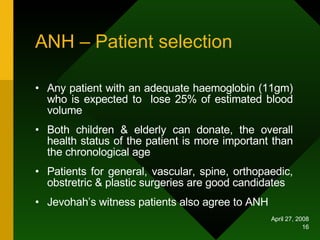
ANH – Patient selection Any patient with an adequate haemoglobin (11gm) who is expected to  lose 25% of estimated blood volume Both children & elderly can donate, the overall health status of the patient is more important than the chronological age Patients for general, vascular, spine, orthopaedic, obstretric & plastic surgeries are good candidates Jevohah’s witness patients also agree to ANH
ANH - technique Done after the induction of anaesthesia under monitiring. The amount of blood collected depends on the patients estimated blood volume, pre operative HCT and lowest HCT desired Volume ( V )  = EBV  × Hct(i) – Hct(f)/Hct(av) Eg. A pt with EBV of 5L,and a Hct 45% and a desired Hct 30%, the Volume is calculated as V= 5L  ×[45-30]/37.5 =2L. Serial HCT determinations are performed during during blood removal and the surgery.
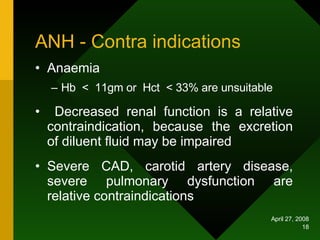
ANH - Contra indications Anaemia Hb  <  11gm or  Hct  < 33% are unsuitable Decreased renal function is a relative contraindication, because the excretion of diluent fluid may be impaired Severe CAD, carotid artery disease, severe pulmonary dysfunction are relative contraindications
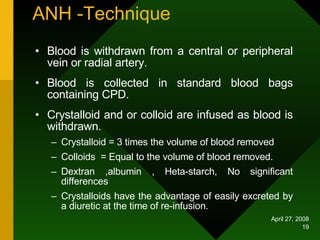
ANH -Technique Blood is withdrawn from a central or peripheral vein or radial artery. Blood is collected in standard blood bags containing CPD. Crystalloid and or colloid are infused as blood is withdrawn. Crystalloid = 3 times the volume of blood removed  Colloids  = Equal to the volume of blood removed. Dextran ,albumin , Heta-starch, No significant differences Crystalloids have the advantage of easily excreted by a diuretic at the time of re-infusion.
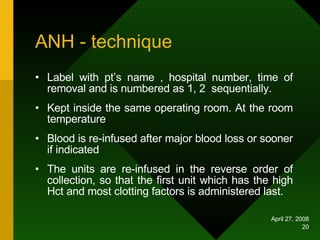
ANH - technique Label with pt’s name , hospital number, time of removal and is numbered as 1, 2  sequentially. Kept inside the same operating room. At the room temperature  Blood is re-infused after major blood loss or sooner if indicated The units are re-infused in the reverse order of collection, so that the first unit which has the high Hct and most clotting factors is administered last.
ANH- Complications. Myocardial ischemia and Cerebral hypoxia are the major potential complications, but are very rare in usual circumstances.
INTRA & POST OP BLOOD SALVAGING With the use of special equipments the blood is collected from the operative field and draining sites. Recovered blood is mixed with anticoagulant is collected in a reservoir with a filter. The filtered blood is then washed with saline. The RBCs suspended in the saline are then pumped into a re-infusion bag.  Most of the WBCs, platelets, clotting factors, cell fragments and other debris are eliminated. Several automated devices are available for use,.
Characteristics of processed blood HCT of processed blood is 50 – 60% and can be varied by altering the processing parameters. Oxygen transport properties and survival of RBCs are equal or superior to stored allogenic blood. Processed blood has a high 2,3-DPG level. pH of salvaged blood is alkaline, and potassium and sodium levels are normal.
Complications Air embolism and fat embolism are important complications. Renal dysfunction is possibility due to the presence of free Hb and Fragmented RBCs. Sepsis is another serious problem. Presence of tumor cells in the operative field is considered as a relative contraindication, but experience with many genitourinary tumors indicate that it is acceptable. The major applications are . Cardio-vascular surgery. Liver transplantation. Neuro-surgery. Ortho & gynecology operations.
SUMMARY Autologous transfusion can significantly decrease transfusion. Appropriate to employ several blood conservation techniques. In appropriative cases pre-donation is beneficial. ANH is beneficial for providing fresh blood Routine use of intra & post op blood salvage is not justified. Newer processing devices may improve cost-effectiveness
Thank you

Autologous Blood Transfusion

  • 1.
    AUTOLOGOUS BLOOD TRANSFUSIONDr.Shailendra.V.L. Specialist in Anesthesia Al Bukariya general hospital
  • 2.
    Introduction Autologous BloodTransfusion (ABT) means reinfusion of blood or blood products taken from the same patient Transfusion of blood taken from a donor to a recipient is called Allogenic/Homologous blood transfusion
  • 3.
    Introduction ABT isnot a new concept, fear of transfusion- transmitted diseases stimulated the growth of autologous programmes Reinfusion of blood was employed as early as 1818 & pre-operative donation was advocated in 1930s Blood salvaging was reported during neuro-surgical & obstetric procedures from 1936 During the last 20 years there is a increase in the use of ABT Technologic advances made possible the development of safe, easy to use devices for recovery & reinfusion of shed blood
  • 4.
    Advantages of ABTCan avoid many complication associated with allogenic transfusion Acute hemolytic reactions Allergic & febrile reactions Transmission of diseases Hepatitis – B AIDS Syphilis Malaria Conservation of blood resources Avoidance of immunosuppressive effects of allogenic transfusion Patient’s with rare blood group are particularly benefited by these techniques It allows the availability of fresh whole blood for transfusion
  • 5.
    Techniques of ABT3 different techniques available Pre-operative blood donation Acute normo-volaemic heamo-dilution Intra & post-operative blood salvage Advantages, applications & complications vary with each technique
  • 6.
    Pre-operative Autologous blooddonation (PABD) Can be considered before any elective surgical procedures where a significant blood loss is expected In 1992 – 8% of whole blood collections in the US was Autologous blood
  • 7.
    Patient selection Any patient with an adequate haemoglobin level(11g) A patient weighing 50 Kg, Hb >11gm & Hct> 33% can donate 450 ml of blood safely. Those with lesser body weight can donate proportionately lesser volume Adolescents & children below 10 years also can be a candidate if he is cooperative Elderly patients can safely donate Obstretric patients – no adverse effects for mother & baby are reported A history of Hepatitis-B or AIDS is not a contraindication Unstable angina, severe CAD, severe aortic stenosis are considered as contraindications
  • 8.
    Collection of bloodPre donation usually begins 4-5 weeks before the proposed surgery, depending on the number of units required Usually one donations per week is done. In 5 weeks we can have 5 units of blood To prevent anaemia due to donations Iron tablets are usually prescribed No special complications to pre-donations Vasovagal reactions for which no Rx is needed This is higher is women and first time donors Time interval between the last donation and the surgery should be more than 72 hours
  • 9.
    Storage of Pre-donatedblood Separately labeled as Autologous with the patient’s name and ID number ABO & Rh typing is also done and labeled which will help in patient’s identification Screening for Hepatitis B and AIDS are not mandatory No cross matching is required If CPDA-1 is used as preservative the blood can be stored as whole blood for 35days Separation into plasma and Rbc increases the shelf life to 42 days If more storing is required the RBC can be frozen and stored
  • 10.
    Transfusion of Pre-donatedblood Mere availability of pre-donated blood is not an indication for transfusion But a more liberal policy is usually followed, because of the lower risks Unused blood as a policy is discarded, but after proper screening & cross matching can be used for other patients
  • 11.
    Complications of transfusion Complications include Volume overload Sepsis Transfusion of wrong blood (clerical error)
  • 12.
    Acute Normovolaemic HaemodilutionAcute normovolaemic haemodilution refers to the removal of blood from the surgical patient immediately before or just after the induction of anaesthesia, and its replacement with asanguinous fluid. No predonation, donation is done at the time of surgery, and the lost volume is replaced by crystalloids or colloids
  • 13.
    ANH-Advantages Provides freshwhole blood for transfusion. No biochemical alterations associated with storage. Removed blood is kept in the OR in room temperature, so no chance of hypothermia Platelet function is preserved No reduction in oxygen carrying capacity RBC loss during surgery is less as it is diluted with asanguinous fluid Haemodilution decreases blood viscosity , which improves tissue perfusion
  • 14.
    ANH-Advantages Possible duringemergency surgeries also Patients with systemic diseases also can undergo ANH, as they are not ideal for pre donation Can decrease the use of allogenic transfusions to 50 – 90 % , as we need only 1 or 2 units of blood for most of the surgeries, which is possible by ANH ANH is simple and less expensive than pre-donation & cell savage
  • 15.
    Physiology of ANHWithdrawal of whole blood from the patient & its replacement with fluid are ↓ in haematocrit & arterial oxygen content oxygen delivery to the tissue is unaffected due to increase in cardiac output ↑ in cardiac output is through the ↑ in stroke volume As there is no hypovolemia, usually no ↑ in the heart rate & the ↑sed cardiac output is usually due to ↓ viscocity
  • 16.
    ANH – Patientselection Any patient with an adequate haemoglobin (11gm) who is expected to lose 25% of estimated blood volume Both children & elderly can donate, the overall health status of the patient is more important than the chronological age Patients for general, vascular, spine, orthopaedic, obstretric & plastic surgeries are good candidates Jevohah’s witness patients also agree to ANH
  • 17.
    ANH - techniqueDone after the induction of anaesthesia under monitiring. The amount of blood collected depends on the patients estimated blood volume, pre operative HCT and lowest HCT desired Volume ( V ) = EBV × Hct(i) – Hct(f)/Hct(av) Eg. A pt with EBV of 5L,and a Hct 45% and a desired Hct 30%, the Volume is calculated as V= 5L ×[45-30]/37.5 =2L. Serial HCT determinations are performed during during blood removal and the surgery.
  • 18.
    ANH - Contraindications Anaemia Hb < 11gm or Hct < 33% are unsuitable Decreased renal function is a relative contraindication, because the excretion of diluent fluid may be impaired Severe CAD, carotid artery disease, severe pulmonary dysfunction are relative contraindications
  • 19.
    ANH -Technique Bloodis withdrawn from a central or peripheral vein or radial artery. Blood is collected in standard blood bags containing CPD. Crystalloid and or colloid are infused as blood is withdrawn. Crystalloid = 3 times the volume of blood removed Colloids = Equal to the volume of blood removed. Dextran ,albumin , Heta-starch, No significant differences Crystalloids have the advantage of easily excreted by a diuretic at the time of re-infusion.
  • 20.
    ANH - techniqueLabel with pt’s name , hospital number, time of removal and is numbered as 1, 2 sequentially. Kept inside the same operating room. At the room temperature Blood is re-infused after major blood loss or sooner if indicated The units are re-infused in the reverse order of collection, so that the first unit which has the high Hct and most clotting factors is administered last.
  • 21.
    ANH- Complications. Myocardialischemia and Cerebral hypoxia are the major potential complications, but are very rare in usual circumstances.
  • 22.
    INTRA & POSTOP BLOOD SALVAGING With the use of special equipments the blood is collected from the operative field and draining sites. Recovered blood is mixed with anticoagulant is collected in a reservoir with a filter. The filtered blood is then washed with saline. The RBCs suspended in the saline are then pumped into a re-infusion bag. Most of the WBCs, platelets, clotting factors, cell fragments and other debris are eliminated. Several automated devices are available for use,.
  • 23.
    Characteristics of processedblood HCT of processed blood is 50 – 60% and can be varied by altering the processing parameters. Oxygen transport properties and survival of RBCs are equal or superior to stored allogenic blood. Processed blood has a high 2,3-DPG level. pH of salvaged blood is alkaline, and potassium and sodium levels are normal.
  • 24.
    Complications Air embolismand fat embolism are important complications. Renal dysfunction is possibility due to the presence of free Hb and Fragmented RBCs. Sepsis is another serious problem. Presence of tumor cells in the operative field is considered as a relative contraindication, but experience with many genitourinary tumors indicate that it is acceptable. The major applications are . Cardio-vascular surgery. Liver transplantation. Neuro-surgery. Ortho & gynecology operations.
  • 25.
    SUMMARY Autologous transfusioncan significantly decrease transfusion. Appropriate to employ several blood conservation techniques. In appropriative cases pre-donation is beneficial. ANH is beneficial for providing fresh blood Routine use of intra & post op blood salvage is not justified. Newer processing devices may improve cost-effectiveness
  • 26.