BLOOD COMPONENT
THERAPY
DR MASOUD ALZOURAIKI
1. Transfusion of erythrocytes
The aim for transfusion of packed RBCs
(PRBCs) is:
- To increase blood volume with saline or
colloid solutions.
- To increase oxygen carrying capacity for
actual or incipient congestive heart failure
or to reverse ischemic symptoms
IMPORTANT RULES
Accurate diagnosis of underlying pathology to
avoid transfusion of conditions easily treated by
medication e.g. Fe, B12, folic acid ….etc.
Inspect component prior to use (e.g. in excessive
haemolysis significant colour change in the bag compared
to tubing segment).
All blood components are transfused through a standard
filter (170-260 micron). Addition of a leukoreduction filter is
preferred if available.
If the container is punctured, it expires after 4 hrs at room
temp and 24 hrs if refrigerated.
Infusion:
Rate of transfusion 10-15 drops/min in the first 15
min. Stop if reaction occurs.
If components cannot be infused within 4 hrs, divide
and store in the blood bank.
Medications and solutions should not be routinely added
to, or infused in the same tubing except 0.9% saline:-
- Lactated ringer’s or other calcium-containing
solutions should never be added to blood (reaction
with citrate).
- Dextrose may cause agglutination of red cells.
INDICATIONS OF BLOOD
TRANSFUSION IN ADULTS
1- Acute blood Loss :
> 25% of blood volume lost
2- Patients without evidence of blood loss:
- With chemotherapy and Hb < 8 gm / dl.
- End-stage CRF and Hb < 7 gm / dl.
- CVS disease and Hb < 9 gm /dl.
3- Patients requiring long- term transfusion support e.g. RA:
- Non-ambulatory……………..Hb < 7 gm / dl.
- Ambulatory…………………..Hb < 8 gm / dl.
4- Pre-operative
- Emergency operation:
Hb < 8 gm / dl give blood.
Hb 8-10 gm /dl assess individually.
- Elective surgery and cause of anemia known
try to correct with haematinics.
5- Post-operative:
“ Top up “ transfusion only for symptomatic
anaemia otherwise give Fe supplementation.
INDICATIONS OF BLOOD
TRANSFUSION IN ADULTS
Whole blood is only indicated when
volume expansion & oxygen-carrying
capacity are needed simultaneously.
Do not use whole blood to increase
oncotic pressure.
Do not use packed RBCs as volume
expanders.
Remember :-
ABO-groups of all red cell-containing components must
be compatible with ABO antibodies in recipient plasma.
Whole blood must be ABO-identical with the recipient.
Packed red cells need not to be ABO identical but only
compatible.
Extreme emergency group O Rh -ve followed by ABO
Rh specific blood as soon as possible to minimize the
volume of group O plasma administered.
Remember :-
DOSAGE OF RED CELL
TRANSFUSIONS
1- A rise of 1 gm /dl in Hb expected from 1
unit.
2- In adults transfusion of less than 2 units
rarely provides clinical benefit except for
patients in ICU where tight Hb limits are
needed.
RATE OF BLOOD TRANSFUSION
Chronic anemia:
* Rate:
3-4 hrs / unit
Start by 10- 15 drops / min for 15 min
If no reaction as rapid as tolerated by
circulatory system.
* Measure : Temp
Pulse before each unit
B.P.
then every 10 min for 1/2 hr then once
every hour until transfusion
completed
Acute blood loss :
5-10 min / unit until systolic BP = 100 mm Hg
- Blood infusion sets are calibrated to deliver 1
ml in 20 drops.
- The greatest rate at which blood can be
transfused by gravity alone is 60 ml/min.
- If a faster rate is required use either multiple
cannulae, or manual or mechanical pressure.
Remember !!
RATE OF BLOOD TRANSFUSION
COMPATIBILITY OF PACKED RBCs
Recipient group Possible donor
group(s)
O O
A A , O
B B , O
AB AB , A , B , O
Median-term
Local phlebitis.
Delayed
haemolytic
reactions.
Post-transfusion
purpura.
Hypertension
and/or convulsion
syndromes.
GVHD.
Long-term
Transmitted
infections.
Fe overload
Alloimmunization
COMPLICATIONS OF RED CELL
TRANSFUSIONS
Immediate
Fever
Immediate-type
hypersensitivity.
Haemolylic reactions.
Circulatory overload.
Citrate toxicity.
Hyperkalaemia.
Massive transfusion
leading to hypothermia
and depletion of
platelets and
coagulation factors.
Fever
Incidence : 1 % of blood transfusions
Causes: Anti-HLA Ab or Cytokines
Clinical picture: Slow fever < 40o
C
+/- mild shivering. Patient feels well.
Management:
Slow down the rate of transfusion.
Hydrocortisone 100 mg iv stat (if the pt. is
shivering or chlorpheniramine 10 mg iv stat.
Consider leukodepletion.
Mild reactions
(Allergic)
Severe reactions
(Anaphylactic)
Cause
Allergy to donor plasma
proteins
Usually reported in Ig A-deficient
patients who have Ig A antibodies
C.P.
Urticaria
Erythema
Maculopapular rash
Periorbital oedema
Bronchospasm
Hypotension
Management
Antihistaminic
Continue transfusion
in case of mild urticarial
rash only.
Stop transfusion
Change giving set
I.V. colloids to maintain BP &
circulatory volume
Hydrocortisone 100 mg iv stat
Chlorpheniramine 10 mg iv stat
Adrenaline 1:1000 1 ml i.m. stat
in severe cases
Immediate-type Hypersensitivity Reactions
May occur 30-90 min. after transfusion of blood component.
HAEMOLYTIC TRANSFUSION
REACTIONS
Symptoms:
Restlessness / agitation
Flushing
Anxiety
Nausea & vomiting
Pain at venepuncture
site.
Abdominal, flanks or
chest pain
Diarrhea
Signs:
Fever
Hypotension
Oozing from wound
or venepuncture
site.
Haemoglobinuria
HAEMOLYTIC TRANSFUSION
REACTIONS
Remember !!
Under anaesthesia, there will
be no symptoms but only signs
e.g. oozing from venepuncture
and surgical sites or hypotension
inappropriate for fluid balance.
CAUSES OF HAEMOLYTIC
TRANSFUSION REACTIONS
1- Incompatibility of antigens on transfused
cell and antibodies in recipients plasma
( ABO + other major antigens ) .
2- Introduction of hypotonic fluids in the
circulation.
3- Drugs co-administered with transfusion.
4- Bacterial toxins.
5- Thermal injury of component (freezing or
overheating ).
MANAGEMENT OF HAEMOLYTIC
TRANSFUSION REACTIONS
1- Stop transfusion .
2- Hydrocortisone 100 mg iv
Chlorpheniramine 10 mg iv
Adrenaline 1 : 1000 1ml i.m. if reaction is severe .
3- In cases of severe shock give adrenaline 100 g
slowly i.v., repeated as necessary and stopped once
the patient responds.
4-Continue treatment of shock by:
- I.V. colloids - Crystalloids
- Inotropes
5- Broad spectrum antibiotics if bacterial
contamination is suspected.
6- CBC , BUN , creatinine, electrolytes. Repeat cross
match and Coomb's test, full coagulation screen,
blood culture.
7- Fluid balance, urinary catheter, consider CVP.
8- Watch for hyperkalaemia , haemoglubinuria and
acute renal shut-down.
9- Test urine for : bilirubin, free Hb,
methaemoglobinuria (repeat at 6 & 24 hrs )
10-Return donor blood to repeat cross-match &
perform culture.
MANAGEMENT OF HAEMOLYTIC
TRANSFUSION REACTIONS
11- Treatment of acute renal shut-down :-
- 100 ml mannitol (20 %) over 15 min. This should
initiate diuresis of 1-3 ml urine / min in a hydrated
patient.
- Repeat dose if urine < 100 ml / hr for any subsequent
2 hrs.
- Stop mannitol if urine > 100 ml / hr without its use.
- Urine Na: < 20 mEq /L no acute tubular necrosis
give furosemide 80 - 160 mg
i.v.
> 50 mEq /L or no response to
furosemide
acute tubular necrosis
MANAGEMENT OF HAEMOLYTIC
TRANSFUSION REACTIONS
CIRCULATORY OVERLOAD
CAUSES:
1- Too rapid transfusion.
2- Severe anaemia with disturbed cardiac function.
MANAGEMENT:
1- Reduce volume of component
2- Transfuse slowly.
3- Diuretics .
CITRATE TOXICITY
CAUSES:
1- Massive transfusion with whole blood
2- Large volume of FFP in pt . with liver disease
MANAGEMENT:
1- Monitor serum Ca.
2- Give 10 ml Ca gluconate (10 %) for every unit
transfused
OTHER COMPLICATIONS
OF MASSIVE TRANSFUSION
1- Hypothermia
Give plasma and
platelets as needed
2- Depletion of
platelets and
coagulation
factors
Worm the blood
DELAYED HAEMOLYTIC
TRANSFUION REACTION
Onset: 2 - 14 days post-transfusion
Mechanism:
Secondary immune response in patients
with previous red cell antibodies ( Rh ,
Kell , Kidd , Duffy)
C.P.: Hb , jaundice, bilirubin and fever.
Course: Usually mild and needs supportive
care only.
GVHD
10-14 days post-transfusion .
Rash, diarrhea, deranged liver
functions.
Pancytopenia .
Mortality > 90 %
Prevented by irradiation of blood in
severely immmunocompromised
patients.
TRANSMITTED INFECTIONS
Blood is tested for:
HBV
HIV
CMV
HCV Treponema
pallidum
Toxoplasma
Malaria
Fe OVERLOAD
Each unit = 250 mg Fe that the body
cannot excrete.
2. PLATELET TRANSFUSION
INDICATIONS
(1) BM Failure caused by
disease or chemotherapy:
Give PLT
transfusion if
PLT count
Therapeutic In manifest bleeding < 80 X 109
/L
Stable patients < 10 X 109
/L
Prophylactic in patients with
mucositis, fever,
systemic infections,
splenomegaly
< 20 X 109
/L
TYPES OF PLATELET CONCENTRATES
1- Random-donor platelets ( RDPs):
Obtained from multiple donors of whole
blood, used when platelet are needed
immediately in patient with transient
thrombocytopenia
2- Single-donor platelets ( SDPs)
About 6 to 8 units may be obtained from one
donor 2 or 3 times weekly, used when
recurrent transfusions are needed as
alloimmunization is delayed
3- HLA-matched platelets:
in alloimmunized patients
DOSE OF PLATELET
CONCENTRATES
PLT type Dose

RDPs 1 unit / 10 kg

SDPs

HLA-matched
One concentrate
is considered a
therapeutic dose
PLATELET TRANSFUSION
REMEMBER !!
1- Compatibility testing is not required.
2- ABO-Rh compatibility required but in emergency
cases any ABO group can be given.
3- Platelet concentrates should be transfused as
soon as possible after reaching the word and
transfusion completed within 1/2 hr and never >
4 hrs.
4- If any gross aggregates are seen do not
transfuse.
5- Standard blood transfusion sets are adequate.
6- Do not use sets already used for blood
transfusions.
EXPECTED OUTCOME
OF PLATELET TRANSFUSION
Normally:
in average sized adult, 1 unit RDPs /10 Kg or
one SDP dose should lead to 1 hr post-
transfusion increment of at least 10 x 109
/l.
If not: “Poor platelet recovery “
due to refractoriness caused by
alloimmunization.
Solution: consider HLA-matched platelets.
Remember!! to exclude:
- Hypersplensim - DIC
- Platelet damage from drugs e.g. Ampho-B
EXPECTED OUTCOME
OF PLATELET TRANSFUSION
If 1 hr increment is adequate but 24 hrs
count drops again:
“Poor platelet survival”
Often seen with : fever, sepsis, mild DIC.
No benefit from HLA-matched platelets.
COMPLICATIONS OF PLATELET
CONCENTRATES
1- Bacterial contamination:
most likely in platelets among all blood
components.
2- Non-haemolytic febrile reactions:
incidence 1 : 5
3- Immunization to red cell antigens:
some RBCs in the concentrate.
3. Fresh-frozen plasma (FFP)
- Contains all coagulation factors and is useful in
replacement of all acquired clotting factor
deficiencies ( DIC, massive transfusion, liver
disease)
- Give ABO compatible FFP but compatibility
testing is not required.
- Volume of a typical unit is 200 ml
- Dose 12-15 ml / kg at a rate of 200 ml / hrs.
- should be given within max 2 hrs to avoid loss
of potency of coagulation factors.
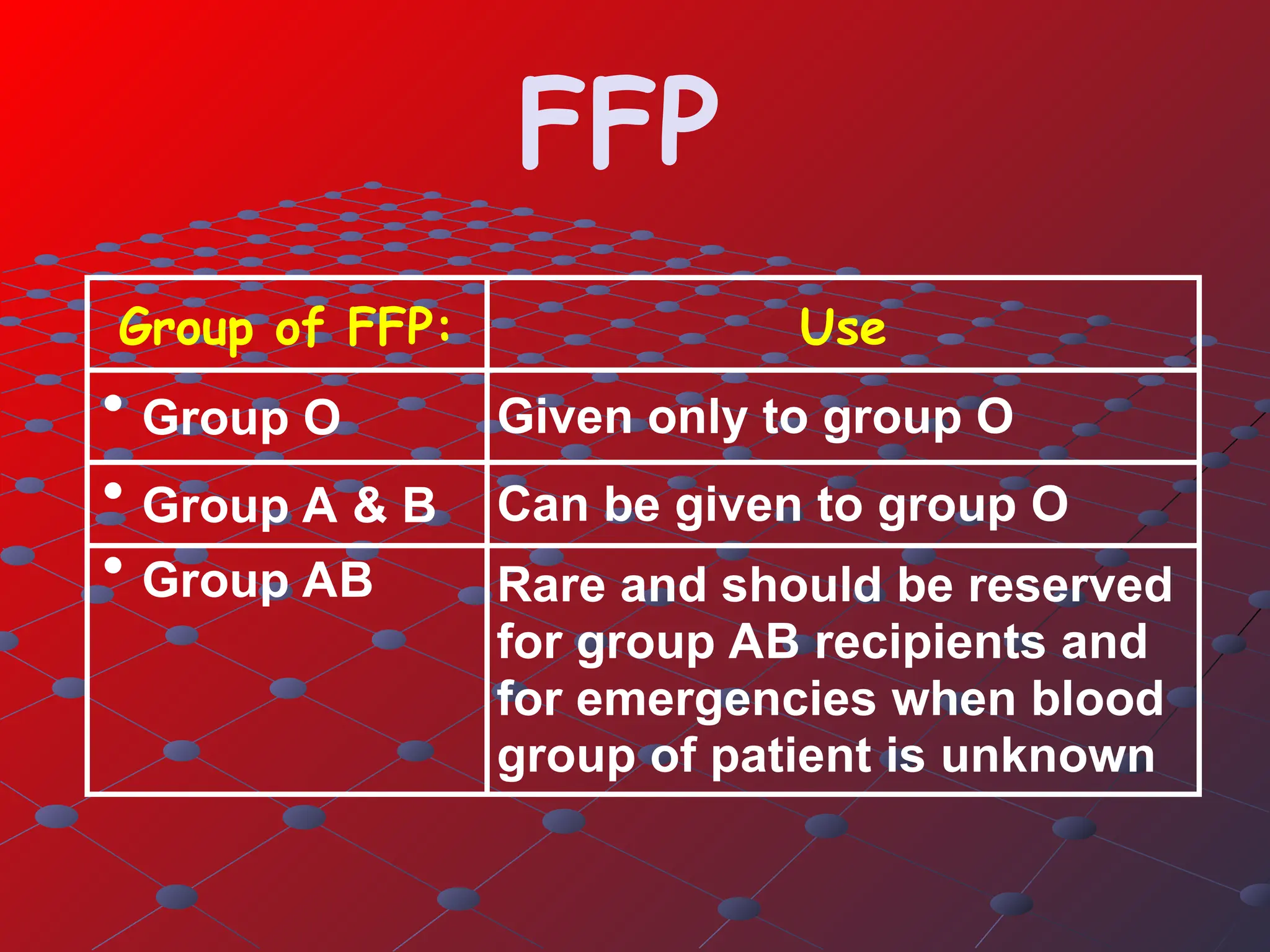
FFP
Group of FFP: Use

Group O Given only to group O

Group A & B Can be given to group O

Group AB Rare and should be reserved
for group AB recipients and
for emergencies when blood
group of patient is unknown
INDICATIONS OF FFP
1- Replacement of single coagulation factor
deficiencies where specific or combined factor
concentrates are unavailable.
2- Immediate reversal of warfarin effect in
patients needing emergency surgery (can not wait
12 hrs for vitamin K to become effective )
3- Acute DIC with haemorrhage or abnormality of
coagulation tests.
4- TTP.
INDICATIONS OF FFP
1- Hypovolaemia.
2- Plasma exchange
3- Nutritional support and
protein-losing states.
Remember !!
Do not use FFP for :
COMPLICATIONS OF FFP
1- Allergic reactions: 1 - 3 % .
2- Anaphylactic reactions 1 : 20000 .
3- Infectious complications like whole blood
but agents transmitted by cellular
components are not transmitted (e.g.
herpes viruses, malaria, CMV).
4- Haemolysis if ABO incompatible plasma is infused.
5- Fluid overload
Guidelines on Gamma
Irradiation Of Blood Components
Aim : prevention of GVHD
Components to be irradiated :
RBCs, platelets, granulocyte transfusions.
Components which do not need irradiation:
FFP, cryoprecipitate, fractionated plasma
products.
Dose if irradiation : 30 Gy.
Guidelines on Gamma
Irradiation Of Blood Components
Indications :
1- Transfusion from relatives.
2- HLA-matched platelets even if the
patient is immnocompetent.
3- BMT.
4- HD.
5- NHL treated with purine analogues.
Decrease in:
Threshold level
of leukocytes
Febrile non-haemolytic
reaction
> 108
Viral infections carried in
leukocytes (e.g. CMV)
> 107
HLA alloimmunization > 5 X 10⁶
LEUKODEPLETION
Advantages:
Leukocyte filters:-
Value :-
leukocytes by 3 - 4 logs.
Types :-
- Pre-storage filtration (preferred)
- Bedside filtration (less effective)
Remember :-
Modern cell separators leukodeplete
platelet concentrates to < 1 x 10⁶
. No filtration
needed.
LEUKODEPLETION
WASHED COMPONENT
( RBCs or PLATELETS )
Aim :-
to remove plasma from
components given to Ig A
deficient recipients (particularly
those with high anti-IgA titers) to
avoid anaphylactic reactions.
AUTOLOGOUS TRANSFUSIONS
Indications:
- Pre-deposit of blood is only considered in
operations in which transfusion are likely to be
needed.
- Pre-deposited blood is given in the same
indications as for allogeneic blood and not just
because it is available.
- Inform patient that in spite of this, allogeneic
transfusion may be necessary.
AUTOLOGOUS TRANSFUSIONS
Requirements:
- Hb >11 gm/dl and never if <10 gm/dl.
- Screen for virological markers and if
infectivity suspected do not accept.
- The patient must be physically fit with
adequate venous access.
- Hypertensive patients on B-blockers or ACE
inhibitors should receive volume replacement
to avoid hypotension.
- No history of epilepsy (withdrawal of blood
may induce fits).
AUTOLOGOUS TRANSFUSIONS
Timing Of Collection:
Two units are taken:
- 1st 10-14 days pre-operative.
- 2nd 3 - 7 days pre-operative.
If more units needed:
devise a careful schedule but remember that
the max storage is 35 days.
The last donation:
not closer than 3 days prior to surgery .
Give Fe supplementation:
in the perioperative period
VIRAL SAFETY OF BLOOD
COMPONENTS
Donors are tested for:
1- HBV Hbs Ag
2- HCV HCV antibodies
HCV PCR
3- HIV HIV I + II antibodies
Leukodepletion is a very effective way to decrease
CMV infection to an incidence of <3%.
Donors are also screened for syphilis
Packed
RBCs
PLT Concentrate FFP
Storage 5o
C PLT shaker at room
temp.
-20o
C to -40o
C
Expiry 35 days 5 days < -40o
C: 2 yr
< -30o
C: 1 yr
< -25o
C: 6 mo
< -18o
C: 3 mo
Leukocyte
depletion
Yes Yes No
Irradiation Yes Yes NO
Indications Symptomatic
anaemia
Thrombocytopenic
bleeding or
 Prophylactic (if PLT
<10 X 109
/L)
Complex
coagulopathies
Compatibility
at transfusion
ABO major Optimal ABO major ABO minor
Cross match Yes No No
Bedside test Yes No Yes
Blood Component Therapy DR MASOUD 2023.ppsx

Blood Component Therapy DR MASOUD 2023.ppsx

  • 1.
  • 2.
    1. Transfusion oferythrocytes The aim for transfusion of packed RBCs (PRBCs) is: - To increase blood volume with saline or colloid solutions. - To increase oxygen carrying capacity for actual or incipient congestive heart failure or to reverse ischemic symptoms
  • 3.
    IMPORTANT RULES Accurate diagnosisof underlying pathology to avoid transfusion of conditions easily treated by medication e.g. Fe, B12, folic acid ….etc. Inspect component prior to use (e.g. in excessive haemolysis significant colour change in the bag compared to tubing segment). All blood components are transfused through a standard filter (170-260 micron). Addition of a leukoreduction filter is preferred if available. If the container is punctured, it expires after 4 hrs at room temp and 24 hrs if refrigerated.
  • 4.
    Infusion: Rate of transfusion10-15 drops/min in the first 15 min. Stop if reaction occurs. If components cannot be infused within 4 hrs, divide and store in the blood bank. Medications and solutions should not be routinely added to, or infused in the same tubing except 0.9% saline:- - Lactated ringer’s or other calcium-containing solutions should never be added to blood (reaction with citrate). - Dextrose may cause agglutination of red cells.
  • 5.
    INDICATIONS OF BLOOD TRANSFUSIONIN ADULTS 1- Acute blood Loss : > 25% of blood volume lost 2- Patients without evidence of blood loss: - With chemotherapy and Hb < 8 gm / dl. - End-stage CRF and Hb < 7 gm / dl. - CVS disease and Hb < 9 gm /dl. 3- Patients requiring long- term transfusion support e.g. RA: - Non-ambulatory……………..Hb < 7 gm / dl. - Ambulatory…………………..Hb < 8 gm / dl.
  • 6.
    4- Pre-operative - Emergencyoperation: Hb < 8 gm / dl give blood. Hb 8-10 gm /dl assess individually. - Elective surgery and cause of anemia known try to correct with haematinics. 5- Post-operative: “ Top up “ transfusion only for symptomatic anaemia otherwise give Fe supplementation. INDICATIONS OF BLOOD TRANSFUSION IN ADULTS
  • 7.
    Whole blood isonly indicated when volume expansion & oxygen-carrying capacity are needed simultaneously. Do not use whole blood to increase oncotic pressure. Do not use packed RBCs as volume expanders. Remember :-
  • 8.
    ABO-groups of allred cell-containing components must be compatible with ABO antibodies in recipient plasma. Whole blood must be ABO-identical with the recipient. Packed red cells need not to be ABO identical but only compatible. Extreme emergency group O Rh -ve followed by ABO Rh specific blood as soon as possible to minimize the volume of group O plasma administered. Remember :-
  • 9.
    DOSAGE OF REDCELL TRANSFUSIONS 1- A rise of 1 gm /dl in Hb expected from 1 unit. 2- In adults transfusion of less than 2 units rarely provides clinical benefit except for patients in ICU where tight Hb limits are needed.
  • 10.
    RATE OF BLOODTRANSFUSION Chronic anemia: * Rate: 3-4 hrs / unit Start by 10- 15 drops / min for 15 min If no reaction as rapid as tolerated by circulatory system. * Measure : Temp Pulse before each unit B.P. then every 10 min for 1/2 hr then once every hour until transfusion completed
  • 11.
    Acute blood loss: 5-10 min / unit until systolic BP = 100 mm Hg - Blood infusion sets are calibrated to deliver 1 ml in 20 drops. - The greatest rate at which blood can be transfused by gravity alone is 60 ml/min. - If a faster rate is required use either multiple cannulae, or manual or mechanical pressure. Remember !! RATE OF BLOOD TRANSFUSION
  • 12.
    COMPATIBILITY OF PACKEDRBCs Recipient group Possible donor group(s) O O A A , O B B , O AB AB , A , B , O
  • 13.
    Median-term Local phlebitis. Delayed haemolytic reactions. Post-transfusion purpura. Hypertension and/or convulsion syndromes. GVHD. Long-term Transmitted infections. Feoverload Alloimmunization COMPLICATIONS OF RED CELL TRANSFUSIONS Immediate Fever Immediate-type hypersensitivity. Haemolylic reactions. Circulatory overload. Citrate toxicity. Hyperkalaemia. Massive transfusion leading to hypothermia and depletion of platelets and coagulation factors.
  • 14.
    Fever Incidence : 1% of blood transfusions Causes: Anti-HLA Ab or Cytokines Clinical picture: Slow fever < 40o C +/- mild shivering. Patient feels well. Management: Slow down the rate of transfusion. Hydrocortisone 100 mg iv stat (if the pt. is shivering or chlorpheniramine 10 mg iv stat. Consider leukodepletion.
  • 15.
    Mild reactions (Allergic) Severe reactions (Anaphylactic) Cause Allergyto donor plasma proteins Usually reported in Ig A-deficient patients who have Ig A antibodies C.P. Urticaria Erythema Maculopapular rash Periorbital oedema Bronchospasm Hypotension Management Antihistaminic Continue transfusion in case of mild urticarial rash only. Stop transfusion Change giving set I.V. colloids to maintain BP & circulatory volume Hydrocortisone 100 mg iv stat Chlorpheniramine 10 mg iv stat Adrenaline 1:1000 1 ml i.m. stat in severe cases Immediate-type Hypersensitivity Reactions May occur 30-90 min. after transfusion of blood component.
  • 16.
    HAEMOLYTIC TRANSFUSION REACTIONS Symptoms: Restlessness /agitation Flushing Anxiety Nausea & vomiting Pain at venepuncture site. Abdominal, flanks or chest pain Diarrhea Signs: Fever Hypotension Oozing from wound or venepuncture site. Haemoglobinuria
  • 17.
    HAEMOLYTIC TRANSFUSION REACTIONS Remember !! Underanaesthesia, there will be no symptoms but only signs e.g. oozing from venepuncture and surgical sites or hypotension inappropriate for fluid balance.
  • 18.
    CAUSES OF HAEMOLYTIC TRANSFUSIONREACTIONS 1- Incompatibility of antigens on transfused cell and antibodies in recipients plasma ( ABO + other major antigens ) . 2- Introduction of hypotonic fluids in the circulation. 3- Drugs co-administered with transfusion. 4- Bacterial toxins. 5- Thermal injury of component (freezing or overheating ).
  • 19.
    MANAGEMENT OF HAEMOLYTIC TRANSFUSIONREACTIONS 1- Stop transfusion . 2- Hydrocortisone 100 mg iv Chlorpheniramine 10 mg iv Adrenaline 1 : 1000 1ml i.m. if reaction is severe . 3- In cases of severe shock give adrenaline 100 g slowly i.v., repeated as necessary and stopped once the patient responds. 4-Continue treatment of shock by: - I.V. colloids - Crystalloids - Inotropes
  • 20.
    5- Broad spectrumantibiotics if bacterial contamination is suspected. 6- CBC , BUN , creatinine, electrolytes. Repeat cross match and Coomb's test, full coagulation screen, blood culture. 7- Fluid balance, urinary catheter, consider CVP. 8- Watch for hyperkalaemia , haemoglubinuria and acute renal shut-down. 9- Test urine for : bilirubin, free Hb, methaemoglobinuria (repeat at 6 & 24 hrs ) 10-Return donor blood to repeat cross-match & perform culture. MANAGEMENT OF HAEMOLYTIC TRANSFUSION REACTIONS
  • 21.
    11- Treatment ofacute renal shut-down :- - 100 ml mannitol (20 %) over 15 min. This should initiate diuresis of 1-3 ml urine / min in a hydrated patient. - Repeat dose if urine < 100 ml / hr for any subsequent 2 hrs. - Stop mannitol if urine > 100 ml / hr without its use. - Urine Na: < 20 mEq /L no acute tubular necrosis give furosemide 80 - 160 mg i.v. > 50 mEq /L or no response to furosemide acute tubular necrosis MANAGEMENT OF HAEMOLYTIC TRANSFUSION REACTIONS
  • 22.
    CIRCULATORY OVERLOAD CAUSES: 1- Toorapid transfusion. 2- Severe anaemia with disturbed cardiac function. MANAGEMENT: 1- Reduce volume of component 2- Transfuse slowly. 3- Diuretics .
  • 23.
    CITRATE TOXICITY CAUSES: 1- Massivetransfusion with whole blood 2- Large volume of FFP in pt . with liver disease MANAGEMENT: 1- Monitor serum Ca. 2- Give 10 ml Ca gluconate (10 %) for every unit transfused
  • 24.
    OTHER COMPLICATIONS OF MASSIVETRANSFUSION 1- Hypothermia Give plasma and platelets as needed 2- Depletion of platelets and coagulation factors Worm the blood
  • 25.
    DELAYED HAEMOLYTIC TRANSFUION REACTION Onset:2 - 14 days post-transfusion Mechanism: Secondary immune response in patients with previous red cell antibodies ( Rh , Kell , Kidd , Duffy) C.P.: Hb , jaundice, bilirubin and fever. Course: Usually mild and needs supportive care only.
  • 26.
    GVHD 10-14 days post-transfusion. Rash, diarrhea, deranged liver functions. Pancytopenia . Mortality > 90 % Prevented by irradiation of blood in severely immmunocompromised patients.
  • 27.
    TRANSMITTED INFECTIONS Blood istested for: HBV HIV CMV HCV Treponema pallidum Toxoplasma Malaria
  • 28.
    Fe OVERLOAD Each unit= 250 mg Fe that the body cannot excrete.
  • 29.
    2. PLATELET TRANSFUSION INDICATIONS (1)BM Failure caused by disease or chemotherapy: Give PLT transfusion if PLT count Therapeutic In manifest bleeding < 80 X 109 /L Stable patients < 10 X 109 /L Prophylactic in patients with mucositis, fever, systemic infections, splenomegaly < 20 X 109 /L
  • 30.
    TYPES OF PLATELETCONCENTRATES 1- Random-donor platelets ( RDPs): Obtained from multiple donors of whole blood, used when platelet are needed immediately in patient with transient thrombocytopenia 2- Single-donor platelets ( SDPs) About 6 to 8 units may be obtained from one donor 2 or 3 times weekly, used when recurrent transfusions are needed as alloimmunization is delayed 3- HLA-matched platelets: in alloimmunized patients
  • 31.
    DOSE OF PLATELET CONCENTRATES PLTtype Dose  RDPs 1 unit / 10 kg  SDPs  HLA-matched One concentrate is considered a therapeutic dose
  • 32.
    PLATELET TRANSFUSION REMEMBER !! 1-Compatibility testing is not required. 2- ABO-Rh compatibility required but in emergency cases any ABO group can be given. 3- Platelet concentrates should be transfused as soon as possible after reaching the word and transfusion completed within 1/2 hr and never > 4 hrs. 4- If any gross aggregates are seen do not transfuse. 5- Standard blood transfusion sets are adequate. 6- Do not use sets already used for blood transfusions.
  • 33.
    EXPECTED OUTCOME OF PLATELETTRANSFUSION Normally: in average sized adult, 1 unit RDPs /10 Kg or one SDP dose should lead to 1 hr post- transfusion increment of at least 10 x 109 /l. If not: “Poor platelet recovery “ due to refractoriness caused by alloimmunization. Solution: consider HLA-matched platelets. Remember!! to exclude: - Hypersplensim - DIC - Platelet damage from drugs e.g. Ampho-B
  • 34.
    EXPECTED OUTCOME OF PLATELETTRANSFUSION If 1 hr increment is adequate but 24 hrs count drops again: “Poor platelet survival” Often seen with : fever, sepsis, mild DIC. No benefit from HLA-matched platelets.
  • 35.
    COMPLICATIONS OF PLATELET CONCENTRATES 1-Bacterial contamination: most likely in platelets among all blood components. 2- Non-haemolytic febrile reactions: incidence 1 : 5 3- Immunization to red cell antigens: some RBCs in the concentrate.
  • 36.
    3. Fresh-frozen plasma(FFP) - Contains all coagulation factors and is useful in replacement of all acquired clotting factor deficiencies ( DIC, massive transfusion, liver disease) - Give ABO compatible FFP but compatibility testing is not required. - Volume of a typical unit is 200 ml - Dose 12-15 ml / kg at a rate of 200 ml / hrs. - should be given within max 2 hrs to avoid loss of potency of coagulation factors.
  • 37.
    FFP Group of FFP:Use  Group O Given only to group O  Group A & B Can be given to group O  Group AB Rare and should be reserved for group AB recipients and for emergencies when blood group of patient is unknown
  • 38.
    INDICATIONS OF FFP 1-Replacement of single coagulation factor deficiencies where specific or combined factor concentrates are unavailable. 2- Immediate reversal of warfarin effect in patients needing emergency surgery (can not wait 12 hrs for vitamin K to become effective ) 3- Acute DIC with haemorrhage or abnormality of coagulation tests. 4- TTP.
  • 39.
    INDICATIONS OF FFP 1-Hypovolaemia. 2- Plasma exchange 3- Nutritional support and protein-losing states. Remember !! Do not use FFP for :
  • 40.
    COMPLICATIONS OF FFP 1-Allergic reactions: 1 - 3 % . 2- Anaphylactic reactions 1 : 20000 . 3- Infectious complications like whole blood but agents transmitted by cellular components are not transmitted (e.g. herpes viruses, malaria, CMV). 4- Haemolysis if ABO incompatible plasma is infused. 5- Fluid overload
  • 41.
    Guidelines on Gamma IrradiationOf Blood Components Aim : prevention of GVHD Components to be irradiated : RBCs, platelets, granulocyte transfusions. Components which do not need irradiation: FFP, cryoprecipitate, fractionated plasma products. Dose if irradiation : 30 Gy.
  • 42.
    Guidelines on Gamma IrradiationOf Blood Components Indications : 1- Transfusion from relatives. 2- HLA-matched platelets even if the patient is immnocompetent. 3- BMT. 4- HD. 5- NHL treated with purine analogues.
  • 43.
    Decrease in: Threshold level ofleukocytes Febrile non-haemolytic reaction > 108 Viral infections carried in leukocytes (e.g. CMV) > 107 HLA alloimmunization > 5 X 10⁶ LEUKODEPLETION Advantages:
  • 44.
    Leukocyte filters:- Value :- leukocytesby 3 - 4 logs. Types :- - Pre-storage filtration (preferred) - Bedside filtration (less effective) Remember :- Modern cell separators leukodeplete platelet concentrates to < 1 x 10⁶ . No filtration needed. LEUKODEPLETION
  • 45.
    WASHED COMPONENT ( RBCsor PLATELETS ) Aim :- to remove plasma from components given to Ig A deficient recipients (particularly those with high anti-IgA titers) to avoid anaphylactic reactions.
  • 46.
    AUTOLOGOUS TRANSFUSIONS Indications: - Pre-depositof blood is only considered in operations in which transfusion are likely to be needed. - Pre-deposited blood is given in the same indications as for allogeneic blood and not just because it is available. - Inform patient that in spite of this, allogeneic transfusion may be necessary.
  • 47.
    AUTOLOGOUS TRANSFUSIONS Requirements: - Hb>11 gm/dl and never if <10 gm/dl. - Screen for virological markers and if infectivity suspected do not accept. - The patient must be physically fit with adequate venous access. - Hypertensive patients on B-blockers or ACE inhibitors should receive volume replacement to avoid hypotension. - No history of epilepsy (withdrawal of blood may induce fits).
  • 48.
    AUTOLOGOUS TRANSFUSIONS Timing OfCollection: Two units are taken: - 1st 10-14 days pre-operative. - 2nd 3 - 7 days pre-operative. If more units needed: devise a careful schedule but remember that the max storage is 35 days. The last donation: not closer than 3 days prior to surgery . Give Fe supplementation: in the perioperative period
  • 49.
    VIRAL SAFETY OFBLOOD COMPONENTS Donors are tested for: 1- HBV Hbs Ag 2- HCV HCV antibodies HCV PCR 3- HIV HIV I + II antibodies Leukodepletion is a very effective way to decrease CMV infection to an incidence of <3%. Donors are also screened for syphilis
  • 50.
    Packed RBCs PLT Concentrate FFP Storage5o C PLT shaker at room temp. -20o C to -40o C Expiry 35 days 5 days < -40o C: 2 yr < -30o C: 1 yr < -25o C: 6 mo < -18o C: 3 mo Leukocyte depletion Yes Yes No Irradiation Yes Yes NO Indications Symptomatic anaemia Thrombocytopenic bleeding or  Prophylactic (if PLT <10 X 109 /L) Complex coagulopathies Compatibility at transfusion ABO major Optimal ABO major ABO minor Cross match Yes No No Bedside test Yes No Yes