Genetic Inheritence
and
Chromosomal disorder
Guide-
Dr.H.P.Singh
Dr.Priyank Patel
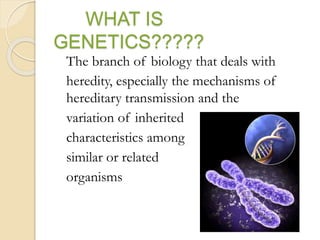
WHAT IS
GENETICS?????
The branch of biology that deals with
heredity, especially the mechanisms of
hereditary transmission and the
variation of inherited
characteristics among
similar or related
organisms
Terminology:
 Gene.
 Alleles- Dominant.
- Recessive.
 Nucleotides.
 Codon.
 Genetic Code.
GENE
 Biological unit of heredity.
 Gene hold the information to build and
maintain their cells and pass genetic traits to
offsprings
 In cells, a gene is portion of
DNA
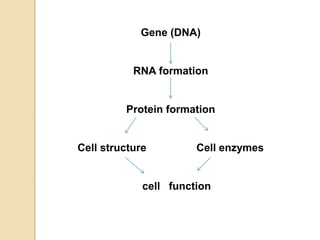
Gene (DNA)
RNA formation
Protein formation
Cell structure Cell enzymes
cell function
ALLELS
 Is one member of a pair or series of
different forms of a gene.
 Homozygous-an organism in which 2
copies of genes are identical i.e. have same
alleles
 Heterozygous-an organism which has
different alleles of the gene
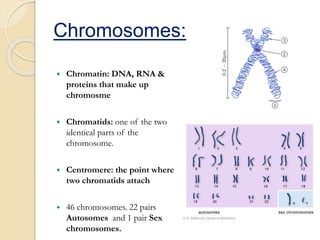
Chromosomes:
 Chromatin: DNA, RNA &
proteins that make up
chromosme
 Chromatids: one of the two
identical parts of the
chromosome.
 Centromere: the point where
two chromatids attach
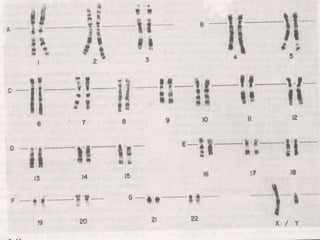
 46 chromosomes. 22 pairs
Autosomes and 1 pair Sex
chromosomes.
NUCLEOTIDE: group of molecules that when linked
together, form the building blocks of DNA and RNA;
composed of phosphate group, the
bases:adenosine,cytosine,guanine and thymine and a pentose
sugar.In case of RNA,thymine base is replaced by uracil.
CODON: series of three adjacent bases in one polynucleotide
chain of a DNA or RNA molecule which codes for a specific
amino acid.
GENETIC CODE: the sequence of nucleotides in a DNA
or RNA molecule that determines the amino acid sequence in
the synthesis of proteins.
Congential Disease.
Diseases which are present at birth.
Hereditary/Familial Disease.
Diseases which are derived from one’s
parents and trasmitted in the gametes through the
generations.
Not all congenital diseases are genetic(
congenital Syphilis) and not all genetic
diseases are congenital (Huntington disease).
Types of
Mutation
Mutation
 it is defined as a permanent changes in the
DNA.
 Mutation that affect germ cell are
transmitted to the progeny and can give rise
to inherited disease.
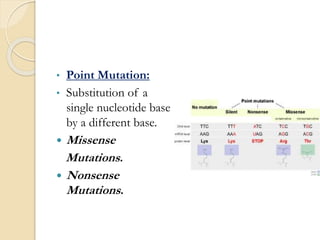
• Point Mutation:
• Substitution of a
single nucleotide base
by a different base.
 Missense
Mutations.
 Nonsense
Mutations.
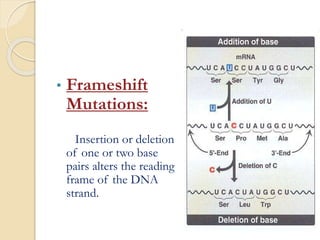
• Frameshift
Mutations:
Insertion or deletion
of one or two base
pairs alters the reading
frame of the DNA
strand.
Classification Of Genetic
Diseases:
 Single Gene Defects/Mendelian Disorders.
 Disorders with Multifactorial or Polygenic
inheritance.
 Cytogenetic Disorders.
 Disorders showing atypical patterns of
inheritance.
Mendelian Disorder
All mendelian disorder are the
result of mutation in single
genes that have large effecs.
Patterns Of Inheritance:
 Autosomal Dominant.
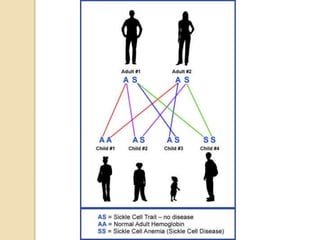
 Autosomal Recessive.
 X-Linked Recessive.
 X-Linked Dominant
Autosomal
Dominant
Disorder.
•Manifested in heterozygous states
•At least one parent of index case is usually
affected
•Both males and females are affected.
•Clinical feature can be modified by variation in
penetrance and expressivity. Some individual
inherit the mutant gene but are phenotpically
normal. This is reffered to as “incomplete
penetrance”.
•In many condition the age of onset is delayed.
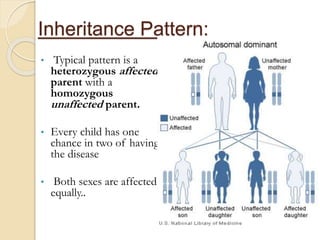
Inheritance Pattern:
• Typical pattern is a
heterozygous affected
parent with a
homozygous
unaffected parent.
• Every child has one
chance in two of having
the disease
• Both sexes are affected
equally..
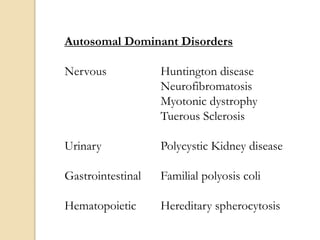
Autosomal Dominant Disorders
Nervous Huntington disease
Neurofibromatosis
Myotonic dystrophy
Tuerous Sclerosis
Urinary Polycystic Kidney disease
Gastrointestinal Familial polyosis coli
Hematopoietic Hereditary spherocytosis
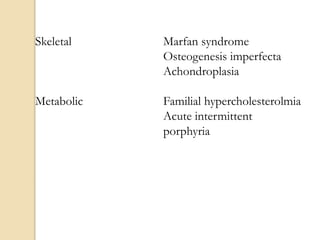
Skeletal Marfan syndrome
Osteogenesis imperfecta
Achondroplasia
Metabolic Familial hypercholesterolmia
Acute intermittent
porphyria
Autosomal
Recessive
Disorder
•Largest category of Mendelian disorder
•Usually does not affect the parent of the affected
individual, but sibling may show the disease.
•Complete penetrance is common.
• Onset is frequently early in life.
•Usually affect enzymatic proteins.
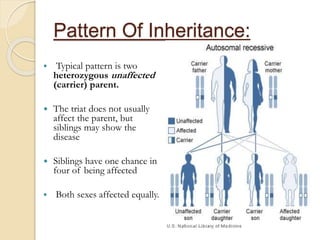
Pattern Of Inheritance:
 Typical pattern is two
heterozygous unaffected
(carrier) parent.
 The triat does not usually
affect the parent, but
siblings may show the
disease
 Siblings have one chance in
four of being affected
 Both sexes affected equally.
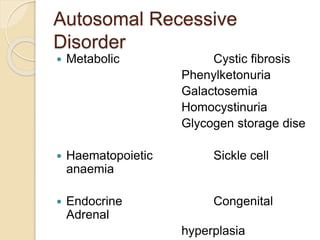
Autosomal Recessive
Disorder
 Metabolic Cystic fibrosis
Phenylketonuria
Galactosemia
Homocystinuria
Glycogen storage dise
 Haematopoietic Sickle cell
anaemia
 Endocrine Congenital
Adrenal
hyperplasia
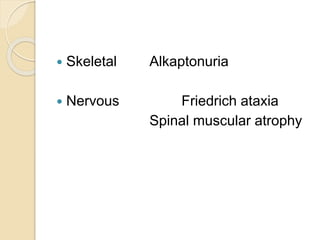
 Skeletal Alkaptonuria
 Nervous Friedrich ataxia
Spinal muscular atrophy
X-Linked
Recessive
Disorders.
•All sex-linked disorders are X-linked,
and almost all are recessive
•Usually expressed only in males
•Rarely, due to random X-inactivation,
a female will express disease,
called manifesting heterozygotes.
Pattern Of Inheritance:
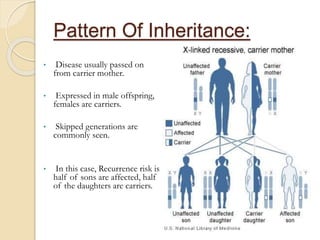
• Disease usually passed on
from carrier mother.
• Expressed in male offspring,
females are carriers.
• Skipped generations are
commonly seen.
• In this case, Recurrence risk is
half of sons are affected, half
of the daughters are carriers.
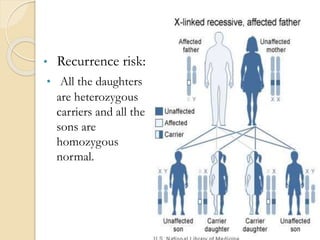
• Recurrence risk:
• All the daughters
are heterozygous
carriers and all the
sons are
homozygous
normal.
X-linked Recessive Disorders
 Musculoskeletal Duchene muscular
dystrophy
 Blood Hemophilia A and B
G6PD def.
 Immune Agammaglobulinemia
Wiskott- aldrich syndrome
 Metabolic Diabetes insipidus
Lesch-nyhan syndrome
DISORDERS WITH MULTIFACTORIAL
(POLYGENIC)INHERITANCE
 Involved in many physiologic characteristics
of humans e.g. height, weight, hair color
 Defined as one governed by additive effect
of two or more genes of small effect but
conditioned by environmental, non genetic
influences
COMMON DISEASES ASSOCIATED:
•Diabetes mellitus
•Hypertension
•Gout
•Cleft lip and palate
•Schizophrenia
•Bipolar disorder
•Congenital heart disease
•Skeletal abnormalities
•Neural tube defects
•Coronary artery disease
Cytogenetic
Disorders.
•Cytogenetic disorders may result from
structural or numeric abnormalities of
chromosomes
•It may affect autosomes or sex
chromosomes
Numeric Abnormalities
 Normal Chromosomal number is 46. (2n=46). This
is called euploid state. (Exact multiple of haploid
number).
 Polyploidy: posession of more than two sets of
homologous chromosomes. Chromosomal numbers
like 3n or 4n. (Incompatible with life); generally
results in spontaneous abortion
 Aneuploidy: Any Chromosomal number that is not
an exact multiple of haploid number . E.g 47 or 45.
Aneuploidy
 Most common cause is nondisjunction of
either a pair of homologous chromosomes
during meiosis I or failure of sister
chromatids to separate during meiosis II.
 The resultant gamete will have either one
less chromosome or one extra
chromosome.
Fertilization of such gamete by normal
gemete will result in zygote being either
trisomic ( 2n+1 ) or monosomic ( 2n-1 ).
Monosomy in autosomes is generally
incompatible with life. Trisomy of certain
autosomes and monosomy of sex
chromosomes is compatible with life.
Mosaicism
 The presence of two or more types of cell
populations in the same individual.
 Postzygotic mitotic nondisjunction will result
in one trisomic and one monosomic daughter
cell.
 The descendants of these cells will produce a
mosaic.
Structural abnormalities
 Usually result from chromosomal breakage,
resulting in loss or rearrangement of genetic
material.
 Patterns of breakage:
• Translocation.
• Isochromosomes.
• Deletion.
• Inversions.
• Ring Chromosomes.
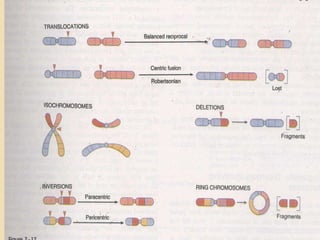
Translocation
 Transfer of a part of one chromosome to
another chromosome
 Translocations are indicated by t
 E.g. 46,XX,t(2;5)(q31;p14)
 Balanced reciprocal translocation is not
harmful to the carrier, however during
gametogenesis, abnormal gametes are
formed, resulting in abnormal zygotes
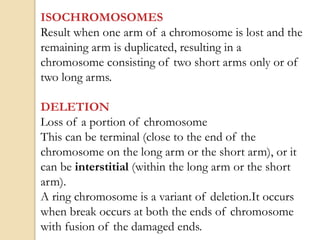
ISOCHROMOSOMES
Result when one arm of a chromosome is lost and the
remaining arm is duplicated, resulting in a
chromosome consisting of two short arms only or of
two long arms.
DELETION
Loss of a portion of chromosome
This can be terminal (close to the end of the
chromosome on the long arm or the short arm), or it
can be interstitial (within the long arm or the short
arm).
A ring chromosome is a variant of deletion.It occurs
when break occurs at both the ends of chromosome
with fusion of the damaged ends.
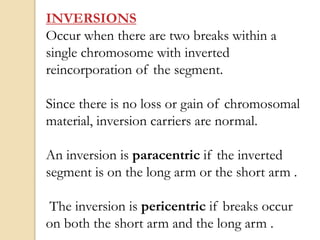
INVERSIONS
Occur when there are two breaks within a
single chromosome with inverted
reincorporation of the segment.
Since there is no loss or gain of chromosomal
material, inversion carriers are normal.
An inversion is paracentric if the inverted
segment is on the long arm or the short arm .
The inversion is pericentric if breaks occur
on both the short arm and the long arm .
General Features of Cytogenetic
Disorders:
 Associated with absence, excess, or
abnormal rearrangements of chromosomes.
 Loss of genetic material produces more
severe defects than does gain.
 Abormalities of sex chromosomes
generally tolerated better than those of
autosomes.
Cytogenetic Disorders
involving Autosomes.
Trisomy 21/Down’s Syndrome:
 Most common chromosomal disorder and a
major cause of mental retardation.
 Down syndrome is a chromosomal
abnormality characterized by the presence of
an extra copy of genetic material on the 21st
chromosome
 Trisomy 21 is mostly caused by a meiotic
nondisjunction event.
•With nondisjunction, a gamete (i.e., a sperm or egg
cell) is produced with an extra copy of chromosome
21; the gamete thus has 24 chromosomes
•When combined with a normal gamete from the
other parent, the embryo now has 47 chromosomes,
with three copies of chromosome 21.
•About 4% of cases are due to Robertsonian
translocations.
•Maternal age has a strong influence on incidence.
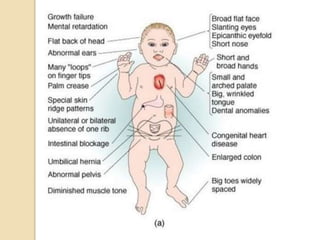
Some feature of Down syndrome
•Mental Retardation
•Epicanthic folds
•Oblique palpebral fissure
•Simian crease
•Hypotonia
•Sandle gap
•Umblical hernia
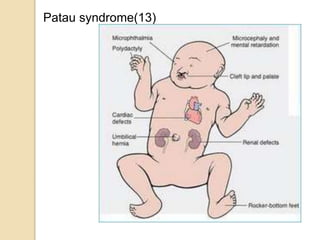
Patau syndrome(13)
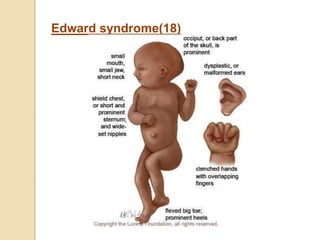
Edward syndrome(18)
Cytogenetic
Disorders
involving
SexChromosomes.
Klinefelter’s Syndrome:
 Defined as Male Hypogonadism, develops
when there are at least two X chromosomes
and one or more Y chromosomes.
 Usual karyotype is 47,XXY. The extra X
may be maternal or paternal.
• One of the most common cause of
hypogonadism in the Males
• The mean IQ is somewhat lower than
normal, but mental retardation is un-
common
Clinical Manifestations:
 Increase in body length between soles and
pubis.
 Reduced facial, body and pubic hair.
Gynecomastia.
 Testicular atrophy.
 Infertility.
 Mild mental retardation.
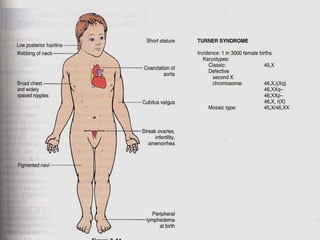
Turner syndrome
 Primary hypogonadism in phenotypic
females.
 Results from partial or complete
monosomy of the X chromosome.
•Most common cause is absence of
one X chromosome.
•Less commonly, mosaicism, or
deletions on the short arm of the X
chromosome.
Thank you

Genetic inheritance and chromosomal disorders

  • 1.
  • 2.
    WHAT IS GENETICS????? The branchof biology that deals with heredity, especially the mechanisms of hereditary transmission and the variation of inherited characteristics among similar or related organisms
  • 3.
    Terminology:  Gene.  Alleles-Dominant. - Recessive.  Nucleotides.  Codon.  Genetic Code.
  • 4.
    GENE  Biological unitof heredity.  Gene hold the information to build and maintain their cells and pass genetic traits to offsprings  In cells, a gene is portion of DNA
  • 5.
    Gene (DNA) RNA formation Proteinformation Cell structure Cell enzymes cell function
  • 6.
    ALLELS  Is onemember of a pair or series of different forms of a gene.  Homozygous-an organism in which 2 copies of genes are identical i.e. have same alleles  Heterozygous-an organism which has different alleles of the gene
  • 8.
    Chromosomes:  Chromatin: DNA,RNA & proteins that make up chromosme  Chromatids: one of the two identical parts of the chromosome.  Centromere: the point where two chromatids attach  46 chromosomes. 22 pairs Autosomes and 1 pair Sex chromosomes.
  • 9.
    NUCLEOTIDE: group ofmolecules that when linked together, form the building blocks of DNA and RNA; composed of phosphate group, the bases:adenosine,cytosine,guanine and thymine and a pentose sugar.In case of RNA,thymine base is replaced by uracil. CODON: series of three adjacent bases in one polynucleotide chain of a DNA or RNA molecule which codes for a specific amino acid. GENETIC CODE: the sequence of nucleotides in a DNA or RNA molecule that determines the amino acid sequence in the synthesis of proteins.
  • 10.
    Congential Disease. Diseases whichare present at birth. Hereditary/Familial Disease. Diseases which are derived from one’s parents and trasmitted in the gametes through the generations. Not all congenital diseases are genetic( congenital Syphilis) and not all genetic diseases are congenital (Huntington disease).
  • 11.
  • 12.
    Mutation  it isdefined as a permanent changes in the DNA.  Mutation that affect germ cell are transmitted to the progeny and can give rise to inherited disease.
  • 13.
    • Point Mutation: •Substitution of a single nucleotide base by a different base.  Missense Mutations.  Nonsense Mutations.
  • 14.
    • Frameshift Mutations: Insertion ordeletion of one or two base pairs alters the reading frame of the DNA strand.
  • 15.
    Classification Of Genetic Diseases: Single Gene Defects/Mendelian Disorders.  Disorders with Multifactorial or Polygenic inheritance.  Cytogenetic Disorders.  Disorders showing atypical patterns of inheritance.
  • 16.
    Mendelian Disorder All mendeliandisorder are the result of mutation in single genes that have large effecs.
  • 17.
    Patterns Of Inheritance: Autosomal Dominant.  Autosomal Recessive.  X-Linked Recessive.  X-Linked Dominant
  • 18.
  • 19.
    •Manifested in heterozygousstates •At least one parent of index case is usually affected •Both males and females are affected. •Clinical feature can be modified by variation in penetrance and expressivity. Some individual inherit the mutant gene but are phenotpically normal. This is reffered to as “incomplete penetrance”. •In many condition the age of onset is delayed.
  • 20.
    Inheritance Pattern: • Typicalpattern is a heterozygous affected parent with a homozygous unaffected parent. • Every child has one chance in two of having the disease • Both sexes are affected equally..
  • 21.
    Autosomal Dominant Disorders NervousHuntington disease Neurofibromatosis Myotonic dystrophy Tuerous Sclerosis Urinary Polycystic Kidney disease Gastrointestinal Familial polyosis coli Hematopoietic Hereditary spherocytosis
  • 22.
    Skeletal Marfan syndrome Osteogenesisimperfecta Achondroplasia Metabolic Familial hypercholesterolmia Acute intermittent porphyria
  • 23.
  • 24.
    •Largest category ofMendelian disorder •Usually does not affect the parent of the affected individual, but sibling may show the disease. •Complete penetrance is common. • Onset is frequently early in life. •Usually affect enzymatic proteins.
  • 25.
    Pattern Of Inheritance: Typical pattern is two heterozygous unaffected (carrier) parent.  The triat does not usually affect the parent, but siblings may show the disease  Siblings have one chance in four of being affected  Both sexes affected equally.
  • 26.
    Autosomal Recessive Disorder  MetabolicCystic fibrosis Phenylketonuria Galactosemia Homocystinuria Glycogen storage dise  Haematopoietic Sickle cell anaemia  Endocrine Congenital Adrenal hyperplasia
  • 27.
     Skeletal Alkaptonuria Nervous Friedrich ataxia Spinal muscular atrophy
  • 28.
  • 29.
    •All sex-linked disordersare X-linked, and almost all are recessive •Usually expressed only in males •Rarely, due to random X-inactivation, a female will express disease, called manifesting heterozygotes.
  • 30.
    Pattern Of Inheritance: •Disease usually passed on from carrier mother. • Expressed in male offspring, females are carriers. • Skipped generations are commonly seen. • In this case, Recurrence risk is half of sons are affected, half of the daughters are carriers.
  • 31.
    • Recurrence risk: •All the daughters are heterozygous carriers and all the sons are homozygous normal.
  • 32.
    X-linked Recessive Disorders Musculoskeletal Duchene muscular dystrophy  Blood Hemophilia A and B G6PD def.  Immune Agammaglobulinemia Wiskott- aldrich syndrome  Metabolic Diabetes insipidus Lesch-nyhan syndrome
  • 33.
    DISORDERS WITH MULTIFACTORIAL (POLYGENIC)INHERITANCE Involved in many physiologic characteristics of humans e.g. height, weight, hair color  Defined as one governed by additive effect of two or more genes of small effect but conditioned by environmental, non genetic influences
  • 34.
    COMMON DISEASES ASSOCIATED: •Diabetesmellitus •Hypertension •Gout •Cleft lip and palate •Schizophrenia •Bipolar disorder •Congenital heart disease •Skeletal abnormalities •Neural tube defects •Coronary artery disease
  • 35.
  • 37.
    •Cytogenetic disorders mayresult from structural or numeric abnormalities of chromosomes •It may affect autosomes or sex chromosomes
  • 38.
    Numeric Abnormalities  NormalChromosomal number is 46. (2n=46). This is called euploid state. (Exact multiple of haploid number).  Polyploidy: posession of more than two sets of homologous chromosomes. Chromosomal numbers like 3n or 4n. (Incompatible with life); generally results in spontaneous abortion  Aneuploidy: Any Chromosomal number that is not an exact multiple of haploid number . E.g 47 or 45.
  • 39.
    Aneuploidy  Most commoncause is nondisjunction of either a pair of homologous chromosomes during meiosis I or failure of sister chromatids to separate during meiosis II.  The resultant gamete will have either one less chromosome or one extra chromosome.
  • 40.
    Fertilization of suchgamete by normal gemete will result in zygote being either trisomic ( 2n+1 ) or monosomic ( 2n-1 ). Monosomy in autosomes is generally incompatible with life. Trisomy of certain autosomes and monosomy of sex chromosomes is compatible with life.
  • 41.
    Mosaicism  The presenceof two or more types of cell populations in the same individual.  Postzygotic mitotic nondisjunction will result in one trisomic and one monosomic daughter cell.  The descendants of these cells will produce a mosaic.
  • 42.
    Structural abnormalities  Usuallyresult from chromosomal breakage, resulting in loss or rearrangement of genetic material.  Patterns of breakage: • Translocation. • Isochromosomes. • Deletion. • Inversions. • Ring Chromosomes.
  • 43.
    Translocation  Transfer ofa part of one chromosome to another chromosome  Translocations are indicated by t  E.g. 46,XX,t(2;5)(q31;p14)  Balanced reciprocal translocation is not harmful to the carrier, however during gametogenesis, abnormal gametes are formed, resulting in abnormal zygotes
  • 44.
    ISOCHROMOSOMES Result when onearm of a chromosome is lost and the remaining arm is duplicated, resulting in a chromosome consisting of two short arms only or of two long arms. DELETION Loss of a portion of chromosome This can be terminal (close to the end of the chromosome on the long arm or the short arm), or it can be interstitial (within the long arm or the short arm). A ring chromosome is a variant of deletion.It occurs when break occurs at both the ends of chromosome with fusion of the damaged ends.
  • 45.
    INVERSIONS Occur when thereare two breaks within a single chromosome with inverted reincorporation of the segment. Since there is no loss or gain of chromosomal material, inversion carriers are normal. An inversion is paracentric if the inverted segment is on the long arm or the short arm . The inversion is pericentric if breaks occur on both the short arm and the long arm .
  • 47.
    General Features ofCytogenetic Disorders:  Associated with absence, excess, or abnormal rearrangements of chromosomes.  Loss of genetic material produces more severe defects than does gain.  Abormalities of sex chromosomes generally tolerated better than those of autosomes.
  • 48.
  • 49.
    Trisomy 21/Down’s Syndrome: Most common chromosomal disorder and a major cause of mental retardation.  Down syndrome is a chromosomal abnormality characterized by the presence of an extra copy of genetic material on the 21st chromosome  Trisomy 21 is mostly caused by a meiotic nondisjunction event.
  • 50.
    •With nondisjunction, agamete (i.e., a sperm or egg cell) is produced with an extra copy of chromosome 21; the gamete thus has 24 chromosomes •When combined with a normal gamete from the other parent, the embryo now has 47 chromosomes, with three copies of chromosome 21. •About 4% of cases are due to Robertsonian translocations. •Maternal age has a strong influence on incidence.
  • 51.
    Some feature ofDown syndrome •Mental Retardation •Epicanthic folds •Oblique palpebral fissure •Simian crease •Hypotonia •Sandle gap •Umblical hernia
  • 53.
  • 54.
  • 55.
  • 56.
    Klinefelter’s Syndrome:  Definedas Male Hypogonadism, develops when there are at least two X chromosomes and one or more Y chromosomes.  Usual karyotype is 47,XXY. The extra X may be maternal or paternal.
  • 57.
    • One ofthe most common cause of hypogonadism in the Males • The mean IQ is somewhat lower than normal, but mental retardation is un- common
  • 58.
    Clinical Manifestations:  Increasein body length between soles and pubis.  Reduced facial, body and pubic hair. Gynecomastia.  Testicular atrophy.  Infertility.  Mild mental retardation.
  • 59.
    Turner syndrome  Primaryhypogonadism in phenotypic females.  Results from partial or complete monosomy of the X chromosome.
  • 60.
    •Most common causeis absence of one X chromosome. •Less commonly, mosaicism, or deletions on the short arm of the X chromosome.
  • 62.