Progress notes
Dr HP Singh
Professor & Head
Outlines
• Definition
• Relevance
• Schematic representation
• Case scenario
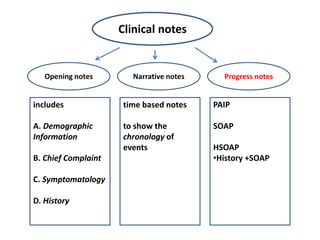
Clinical notes
Opening notes Narrative notes Progress notes
includes
A. Demographic
Information
B. Chief Complaint
C. Symptomatology
D. History
time based notes
to show the
chronology of
events
PAIP
SOAP
HSOAP
•History +SOAP
• Etymology: L, progredi + nota
• part of a medical
record where healthcare professionals record details
to document a patient's clinical status or
achievements during the course of a hospitalization
or over the course of outpatient care
• serve as a record of events during a patient's care,
allow clinicians to compare past status to current
status, serve to communicate findings, opinions and
plans between physicians and other members of the
medical care team, and allow retrospective review of
case details for a variety of interested parties
DEFINITION
• intended to be a concise vehicle of
communication about a patient’s condition to
those who access the health record
• Physicians are generally required to generate at
least one progress note for each patient
encounter
• Nurses are required to generate progress notes
on a more frequent bases, depending on the
level of critical care notes may be required
anywhere from several times an hour to several
times a day.
.
Daily progress note serves as a written
medical legal document to
• Serve as a record of a patient’s hospitalization
• be completed on a Daily basis and includes all
“events” that occur during the hospitalization
• Record “events” in terms of subjective and
objective findings
• include new and active patient health/social
issues (“problems”)
• to evaluate/assess each problem and to
formulate an appropriate
• be legible and well written so to avoid any
misunderstanding by the reader
• have a time and date and be signed on each
page by the author in legible fashion
Purpose of progress notes:
• To inform research
• To act as a working document for day-today
recording of patient care
• To store a chronological account of the patient’s
life, illnesses, its context and who did what and to
what effect
• To enable the clinician to communicate with him-
or herself
• To allow continuity of approach in a continuing
illness
RELEVANCE
• To record any special factors that appear to affect
the patient or the patient’s response to
treatment
• To record any factors that might render the
patient more vulnerable to an adverse reaction to
management or treatment
• To record risk assessments to protect the patient
and others
• To record the advice given to general
practitioners, other clinicians and other agencies
• To record conversations with other clinicians for
collaboration, consultation or to help facilitate
referrals
• To record the information received from others,
including carers
• To store a record to which the patient may have
access
• To inform medico-legal investigations
• To inform clinical audit, governance and
accreditation
• To allow contributions to national data-sets,
morbidity registers
• in a multidisciplinary treatment setting, notes
offer different clinicians a way to stay informed
based on the observations and interventions of
other clinicians
• To record the information received from others,
including carers
• To store a record to which the patient may have
access
• To inform medico-legal investigations
• To inform clinical audit, governance and
accreditation
• To allow contributions to national data-sets,
morbidity registers
• in a multidisciplinary treatment setting, notes
offer different clinicians a way to stay informed
based on the observations and interventions of
other clinicians
Problem oriented record keeping is cornerstone
of problem-oriented medical practice and
consists of
• Establishment and use of data base
• Formulation and maintenance of problem list
• A plan for management of problem
• Education of the patient
• Establishment and maintenance of some form of
audit
Data base
 The result of registration in the medical record of a
defined store of information pertinent to the patient and
his/her problems
 Components
Presenting problems
Patient profile
Present illness(es)
Past history
Previous illness
Systems review
Family history
Physical examination
Growth charts
Developmental flow sheet or screening tests
Defined baseline lab data
 Once the initial data has been recorded, further
data are recorded in relation to specific ,named
and numbered problems
 The number of the problem is entered in left
hand margin and the name of the problem is the
first part of the entry
Problem list
• Derived from information obtained from the data base
• It includes
– Medical
– Social
– Developmental
– Psychologic
– Economic
– Environmental
– Nutritional
• An essential feature of the problem list is that it remains
intellectually honest i.e., each problem should be
expressed only at the level of understanding or confidence
which can be substantiated by objective evidence
• It helps to avoid jumping to potentially erroneous
diagnostic conclusions
PAIP
• To be used at the end of opening notes
• Shorter than opening or narrative notes
P - Problem
A - Assessment
I - Intervention
P - Plan
SOAP
• a method of documentation employed by health care
providers to write out notes in a patient‘s chart, along with
other formats
• Most commonly used progress note
• More focussed than complete history and physical
documentation
• Limited to what is pertinent to current problem(s)
Components
Subjective
Objective
Assessment
Plan
Subjective
 Record of subjective findings that occurred during the
evening , overnight, and in the morning that patient is
being examined
 Essentially how the patient felt during the evening, night
time and morning hours and what happened during
those hours
 Usually recorded in two paragraphs
 First paragraph addresses chief concerns or complaints.
If this is the first time a physician is seeing a patient, the
physician will take a History of Present Illness. Second
paragraph includes pertinent portions of past medical
history
Objective
 Physical Exam: Vital signs, focused physical exam but
almost always should include:
• RESPIRATORY
• CARDIAC
• ABDOMINAL
• CNS
 pertinent normal findings and abnormalities
 Laboratory data
 Diagnostic Imaging
 Microbiology
 a Medication List which includes a listing of all scheduled
and PRN (as needed) medications relevant to active
problems is recommended but is not required.
Assessment
 the most important part of SOAP note
 begin with a one-sentence summary of the problem
 should be organized by problems with the newest or
most acute problem first
 For each problem, include
Statement of the problem
Differentials(acute problem) and present status(chronic
problem)
Clinical reasoning for and against each differential
Plan
 Plan must be formulated to address each problem
 Includes the following components
Diagnostic tests
Treatment plan
Patient education
Planned follow-up
Master X 2 years of age, from Rewa presented with
Subjective
Presented with history of continuous fever of one week duration, loose
stools without blood or mucus at frequency of 6-7/day. was treated with
concentrated ORS and injectable antibiotics. Vomiting started 4 days later
with a frequency of 5-6/day. Urine output was adequate. One episode of
generalized tonic clonic seizures 12 hour ago followed by altered
sensorium for 12 hours.
No history of head injury, ear discharge , cyanotic heart disease or seizures
Objective
Weight 11.5 kg, temperature 39.50 C, pulse rate 100/min, RR 28/min, BP
100/70 mm Hg. Toxic looking semi- conscious. No evidence of dehydration
or meningeal irritation. Liver span of 4.5 cm and spleen just palpable. Brisk
DTR, no sustained clonus with bilateral extensor planters but no focal
neurological signs. Normal fundus examination, no neuro –cutaneous
markers.
CASE SCENARIO
Assessment
 Enteric fever with encephalopathy
Prolonged continuous fever with diarrhea, splenomegaly and altered
sensorium. Presence of seizures in first week unlikely.
 Pyogenic meningitis
No signs of meningeal irritation, long history against this possibility
 Hypernatremic dehydration
Use of Concentrated ORS and presence of seizures support the
possibility. Dehydration may be delayed. Splenomegaly and fever of
39.50 C can not be explained
 Brain abscess
Absence of focal neurological signs and lack of predisposing factors
against this possibility
Plan
Diagnostic tests
– Complete hemogram
– Serum lytes
– Blood glucose
– LFT
– Stool examination
– Widal test
– Blood culture
– CSF examination
– Neuro-imaging
• Treatment plan
– Intravenous fluids
– Injectable appropriate antibiotics
– Antipyretics
– anticonvulsants
Plan con’t….
Education
– Prognosis explained to family members
Planned follow-up
– Review vital signs and lab reports at 9.30 am
Progress notes in NICU
• Essentially the same scheme albeit some minor
modifications
• F-IMNCI recommends the following
T – temperature
A – airway
B – breathing
C – circulation
F – fluids
M – medications
F – feeding
M – monitoring
C – communication
F – follow-up
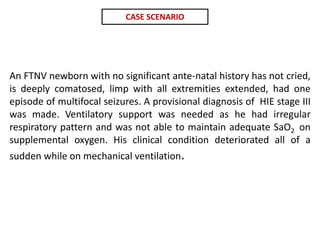
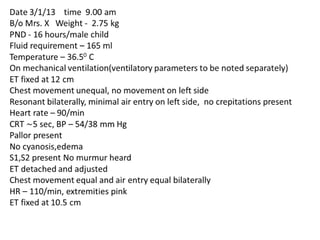
An FTNV newborn with no significant ante-natal history has not cried,
is deeply comatosed, limp with all extremities extended, had one
episode of multifocal seizures. A provisional diagnosis of HIE stage III
was made. Ventilatory support was needed as he had irregular
respiratory pattern and was not able to maintain adequate SaO2 on
supplemental oxygen. His clinical condition deteriorated all of a
sudden while on mechanical ventilation.
CASE SCENARIO
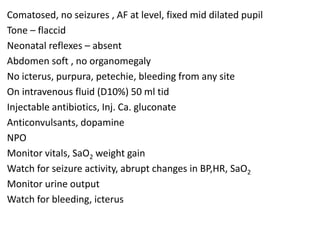
Comatosed, no seizures , AF at level, fixed mid dilated pupil
Tone – flaccid
Neonatal reflexes – absent
Abdomen soft , no organomegaly
No icterus, purpura, petechie, bleeding from any site
On intravenous fluid (D10%) 50 ml tid
Injectable antibiotics, Inj. Ca. gluconate
Anticonvulsants, dopamine
NPO
Monitor vitals, SaO2 weight gain
Watch for seizure activity, abrupt changes in BP,HR, SaO2
Monitor urine output
Watch for bleeding, icterus
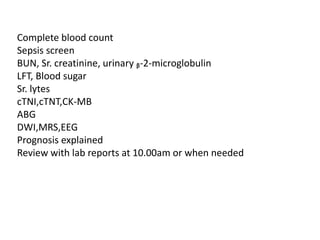
Complete blood count
Sepsis screen
BUN, Sr. creatinine, urinary ᵦ-2-microglobulin
LFT, Blood sugar
Sr. lytes
cTNI,cTNT,CK-MB
ABG
DWI,MRS,EEG
Prognosis explained
Review with lab reports at 10.00am or when needed
THANK YOU

Progress notes

  • 1.
    Progress notes Dr HPSingh Professor & Head
  • 2.
    Outlines • Definition • Relevance •Schematic representation • Case scenario
  • 3.
    Clinical notes Opening notesNarrative notes Progress notes includes A. Demographic Information B. Chief Complaint C. Symptomatology D. History time based notes to show the chronology of events PAIP SOAP HSOAP •History +SOAP
  • 4.
    • Etymology: L,progredi + nota • part of a medical record where healthcare professionals record details to document a patient's clinical status or achievements during the course of a hospitalization or over the course of outpatient care • serve as a record of events during a patient's care, allow clinicians to compare past status to current status, serve to communicate findings, opinions and plans between physicians and other members of the medical care team, and allow retrospective review of case details for a variety of interested parties DEFINITION
  • 5.
    • intended tobe a concise vehicle of communication about a patient’s condition to those who access the health record • Physicians are generally required to generate at least one progress note for each patient encounter • Nurses are required to generate progress notes on a more frequent bases, depending on the level of critical care notes may be required anywhere from several times an hour to several times a day. .
  • 6.
    Daily progress noteserves as a written medical legal document to • Serve as a record of a patient’s hospitalization • be completed on a Daily basis and includes all “events” that occur during the hospitalization • Record “events” in terms of subjective and objective findings
  • 7.
    • include newand active patient health/social issues (“problems”) • to evaluate/assess each problem and to formulate an appropriate • be legible and well written so to avoid any misunderstanding by the reader • have a time and date and be signed on each page by the author in legible fashion
  • 8.
    Purpose of progressnotes: • To inform research • To act as a working document for day-today recording of patient care • To store a chronological account of the patient’s life, illnesses, its context and who did what and to what effect • To enable the clinician to communicate with him- or herself • To allow continuity of approach in a continuing illness RELEVANCE
  • 9.
    • To recordany special factors that appear to affect the patient or the patient’s response to treatment • To record any factors that might render the patient more vulnerable to an adverse reaction to management or treatment • To record risk assessments to protect the patient and others • To record the advice given to general practitioners, other clinicians and other agencies • To record conversations with other clinicians for collaboration, consultation or to help facilitate referrals
  • 10.
    • To recordthe information received from others, including carers • To store a record to which the patient may have access • To inform medico-legal investigations • To inform clinical audit, governance and accreditation • To allow contributions to national data-sets, morbidity registers • in a multidisciplinary treatment setting, notes offer different clinicians a way to stay informed based on the observations and interventions of other clinicians
  • 11.
    • To recordthe information received from others, including carers • To store a record to which the patient may have access • To inform medico-legal investigations • To inform clinical audit, governance and accreditation • To allow contributions to national data-sets, morbidity registers • in a multidisciplinary treatment setting, notes offer different clinicians a way to stay informed based on the observations and interventions of other clinicians
  • 12.
    Problem oriented recordkeeping is cornerstone of problem-oriented medical practice and consists of • Establishment and use of data base • Formulation and maintenance of problem list • A plan for management of problem • Education of the patient • Establishment and maintenance of some form of audit
  • 13.
    Data base  Theresult of registration in the medical record of a defined store of information pertinent to the patient and his/her problems  Components Presenting problems Patient profile Present illness(es) Past history Previous illness Systems review Family history Physical examination Growth charts Developmental flow sheet or screening tests Defined baseline lab data
  • 14.
     Once theinitial data has been recorded, further data are recorded in relation to specific ,named and numbered problems  The number of the problem is entered in left hand margin and the name of the problem is the first part of the entry
  • 15.
    Problem list • Derivedfrom information obtained from the data base • It includes – Medical – Social – Developmental – Psychologic – Economic – Environmental – Nutritional • An essential feature of the problem list is that it remains intellectually honest i.e., each problem should be expressed only at the level of understanding or confidence which can be substantiated by objective evidence • It helps to avoid jumping to potentially erroneous diagnostic conclusions
  • 16.
    PAIP • To beused at the end of opening notes • Shorter than opening or narrative notes P - Problem A - Assessment I - Intervention P - Plan
  • 17.
    SOAP • a methodof documentation employed by health care providers to write out notes in a patient‘s chart, along with other formats • Most commonly used progress note • More focussed than complete history and physical documentation • Limited to what is pertinent to current problem(s) Components Subjective Objective Assessment Plan
  • 18.
    Subjective  Record ofsubjective findings that occurred during the evening , overnight, and in the morning that patient is being examined  Essentially how the patient felt during the evening, night time and morning hours and what happened during those hours  Usually recorded in two paragraphs  First paragraph addresses chief concerns or complaints. If this is the first time a physician is seeing a patient, the physician will take a History of Present Illness. Second paragraph includes pertinent portions of past medical history
  • 19.
    Objective  Physical Exam:Vital signs, focused physical exam but almost always should include: • RESPIRATORY • CARDIAC • ABDOMINAL • CNS  pertinent normal findings and abnormalities  Laboratory data  Diagnostic Imaging  Microbiology  a Medication List which includes a listing of all scheduled and PRN (as needed) medications relevant to active problems is recommended but is not required.
  • 20.
    Assessment  the mostimportant part of SOAP note  begin with a one-sentence summary of the problem  should be organized by problems with the newest or most acute problem first  For each problem, include Statement of the problem Differentials(acute problem) and present status(chronic problem) Clinical reasoning for and against each differential
  • 21.
    Plan  Plan mustbe formulated to address each problem  Includes the following components Diagnostic tests Treatment plan Patient education Planned follow-up
  • 22.
    Master X 2years of age, from Rewa presented with Subjective Presented with history of continuous fever of one week duration, loose stools without blood or mucus at frequency of 6-7/day. was treated with concentrated ORS and injectable antibiotics. Vomiting started 4 days later with a frequency of 5-6/day. Urine output was adequate. One episode of generalized tonic clonic seizures 12 hour ago followed by altered sensorium for 12 hours. No history of head injury, ear discharge , cyanotic heart disease or seizures Objective Weight 11.5 kg, temperature 39.50 C, pulse rate 100/min, RR 28/min, BP 100/70 mm Hg. Toxic looking semi- conscious. No evidence of dehydration or meningeal irritation. Liver span of 4.5 cm and spleen just palpable. Brisk DTR, no sustained clonus with bilateral extensor planters but no focal neurological signs. Normal fundus examination, no neuro –cutaneous markers. CASE SCENARIO
  • 23.
    Assessment  Enteric feverwith encephalopathy Prolonged continuous fever with diarrhea, splenomegaly and altered sensorium. Presence of seizures in first week unlikely.  Pyogenic meningitis No signs of meningeal irritation, long history against this possibility  Hypernatremic dehydration Use of Concentrated ORS and presence of seizures support the possibility. Dehydration may be delayed. Splenomegaly and fever of 39.50 C can not be explained  Brain abscess Absence of focal neurological signs and lack of predisposing factors against this possibility
  • 24.
    Plan Diagnostic tests – Completehemogram – Serum lytes – Blood glucose – LFT – Stool examination – Widal test – Blood culture – CSF examination – Neuro-imaging • Treatment plan – Intravenous fluids – Injectable appropriate antibiotics – Antipyretics – anticonvulsants
  • 25.
    Plan con’t…. Education – Prognosisexplained to family members Planned follow-up – Review vital signs and lab reports at 9.30 am
  • 27.
    Progress notes inNICU • Essentially the same scheme albeit some minor modifications • F-IMNCI recommends the following T – temperature A – airway B – breathing C – circulation F – fluids M – medications F – feeding M – monitoring C – communication F – follow-up
  • 28.
    An FTNV newbornwith no significant ante-natal history has not cried, is deeply comatosed, limp with all extremities extended, had one episode of multifocal seizures. A provisional diagnosis of HIE stage III was made. Ventilatory support was needed as he had irregular respiratory pattern and was not able to maintain adequate SaO2 on supplemental oxygen. His clinical condition deteriorated all of a sudden while on mechanical ventilation. CASE SCENARIO
  • 30.
    Comatosed, no seizures, AF at level, fixed mid dilated pupil Tone – flaccid Neonatal reflexes – absent Abdomen soft , no organomegaly No icterus, purpura, petechie, bleeding from any site On intravenous fluid (D10%) 50 ml tid Injectable antibiotics, Inj. Ca. gluconate Anticonvulsants, dopamine NPO Monitor vitals, SaO2 weight gain Watch for seizure activity, abrupt changes in BP,HR, SaO2 Monitor urine output Watch for bleeding, icterus
  • 31.
    Complete blood count Sepsisscreen BUN, Sr. creatinine, urinary ᵦ-2-microglobulin LFT, Blood sugar Sr. lytes cTNI,cTNT,CK-MB ABG DWI,MRS,EEG Prognosis explained Review with lab reports at 10.00am or when needed
  • 32.