Haematology
Haemostasis
Marah Mubita
University of Zambia,
School of Medicine,
Pathology and Microbiology
Dept.
Haemostasis
• Haemostasis means “arrest of bleeding”
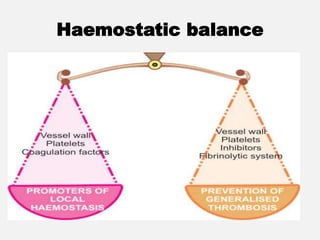
• Represents a delicate balance between procoagulant and
anticoagulant mechanisms
• Process by which blood is maintained in a fluid state and
without any major loss in case of injury
• It’s a process that involves
– Vascular system
– Platelets
– Coagulation system
– Inflammation and would healing process and
– Fibrinolytic system
Maintenance of blood flow
• Laminar flow
– Cellular components of blood are in the centre of
the blood stream
• Endothelial cells (EC)
– The smooth nature of the endothelial cell surface
prevents adhesion
– Heparin sulfate + Antithrombin inhibit serine
proteases for F II, IX and X
– Nitric oxide + Prostacyclin prevent platelet
adhesion
– Thrombomodulin + Thrombin activate protein C
and S which in turn inactivates F V and VIII
Stages of haemostasis
• It can be divided into 5 phases
• Vascular phase
– Immediate vasoconstriction of the injured vessel to
prevent blood loss
• Platelet phase
– Process through which a platelet plug is formed aka
primary haemostasis
• Coagulation phase
– Involves coagulation factors and has intrinsic and
extrinsic pathways aka secondary haemostasis
• Clot retraction and repair
• This causes resizing of clot and restoration of blood flow aka
tertiary haemostasis
• Fibrinolytic phase
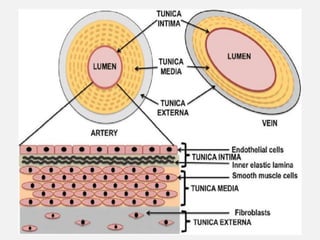
Vascular Phase
• Triggered by damage to blood vessel
• Results in an immediate vascular spasm that
constricts the blood vessel to prevent blood loss
• Mechanism of Vascular spasm
– Endothelin from the EC cause contraction of the
smooth muscles (SM) in the blood vessels
– Myogenic mechanism caused by direct injury to
the SM
– Nociceptor activation – Inflammatory mediators
activation of nociceptors that lead to SM reflexive
contraction
• May last from a few seconds to up to 30 minutes
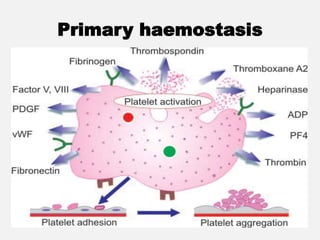
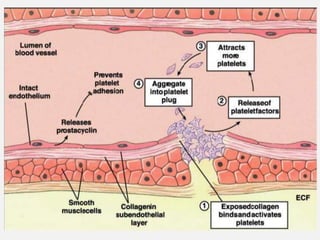
Primary Haemostasis
• This results in platelet plug formation
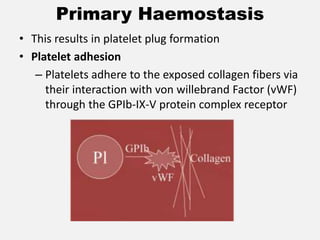
• Platelet adhesion
– Platelets adhere to the exposed collagen fibers via
their interaction with von willebrand Factor (vWF)
through the GPIb-IX-V protein complex receptor
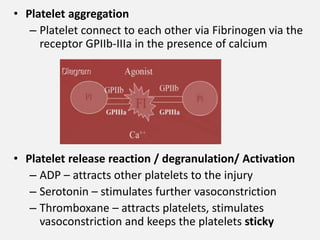
• Platelet aggregation
– Platelet connect to each other via Fibrinogen via the
receptor GPIIb-IIIa in the presence of calcium
• Platelet release reaction / degranulation/ Activation
– ADP – attracts other platelets to the injury
– Serotonin – stimulates further vasoconstriction
– Thromboxane – attracts platelets, stimulates
vasoconstriction and keeps the platelets sticky
Primary haemostasis
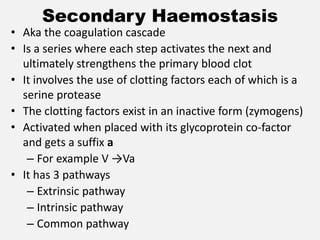
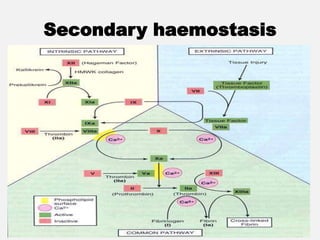
Secondary Haemostasis
• Aka the coagulation cascade
• Is a series where each step activates the next and
ultimately strengthens the primary blood clot
• It involves the use of clotting factors each of which is a
serine protease
• The clotting factors exist in an inactive form (zymogens)
• Activated when placed with its glycoprotein co-factor
and gets a suffix a
– For example V →Va
• It has 3 pathways
– Extrinsic pathway
– Intrinsic pathway
– Common pathway
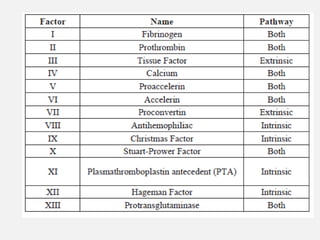
Extrinsic Pathway
• Activated by injury to the endothelial tissue exposing
tissue factor (F-III) to the blood
• F-III in the presence of calcium activates FVII
• The F-III, VIIa and Calcium complex then activate F-X
• This complex is called Extrinsic tenase
• F-VII requires Vitamin K for activation
Intrinsic pathway
• Starts when F-XII is exposed to collagen
• F-XII gets activated to F-XIIa in the presence of Kallikrein,
and high molecular weight kininogen (HMWK)
• F-XIIa activates factor XI into XIa
• In the presence of calcium ion F-XIa activates F-IX
• F-IXa then activates F-VIII
• The F-IXa, VIIIa, calcium and a phospholipid form a
complex that then activates F-X to F-Xa.
• This complex is called Intrinsic tenase
• The phospholipid surface necessary for formation of
coagulation complexes is provided by the platelet plasma
membrane
Common pathway
• This pathway begins at F-X which is activated to F-Xa
• F-Xa with F-V as a cofactor activates F-II
(Prothrombin) into F-IIa( (Thrombin)
• F-IIa in the presence of Calcium activates F-I
(Fibrinogen) to F-Ia (Fibrin)
• F-IIa in the presence of Calcium also activates F-XIII
to F-XIIIa and causes cross linkages in the Fibrin
• F-IIa reinforces the coagulation cascade by giving
positive feedback to factors V, VII, VIII, XI, XII
Secondary haemostasis
Haemostatic balance
Clot retraction and healing
• Aka tertiary haemostasis
• The fibrin mesh interacts with the platelets to
prevent dislodgement
• The platelet intracellular actin or myosin are
connected internally to the GpIIbIIIa and Fib receptor
• The external component of the GpIIbIIIa receptor
interacts with fibrin
• Subsequent contraction of the microtubules leads to
decrease in clot volume (clot retraction).
• For healing Platelet derived growth factor (PDGF)
released from a granules promotes fibroblast
proliferation
Investigations
1.Bleeding time increased in
– Thrombocytopenia.
– Disorders of platelet function.
– von Willebrand’s disease.
– Vascular abnormalities (e.g. in Ehlers-Danlos
syndrome).
– Severe deficiency of factor V and XI.
2. Hess capillary resistance test (tourniquet test)
– Petechiae formation in thrombocytopaenia due to
capillary fragility
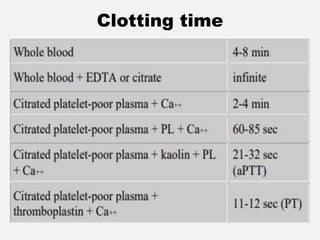
Clotting time
3. Whole blood coagulation time
– Normal range is 4-8 minutes at 37◦C
4. Activated partial thromboplastin time (APTT)
or partial thromboplastin time with kaolin
(PTTK)
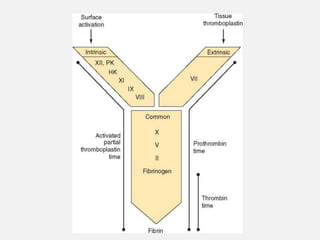
– Used to measure intrinsic and common pathway
factors – Normal range is 30-40 secs
– Common causes of prolonged APTT are
• Parenteral administration of heparin.
• Disseminated intravascular coagulation.
• Liver disease.
• Circulating anticoagulants
5. Prothrombin time
– measures the extrinsic system factor VII as well as
factors in the common pathway
– Normal range is 10-14 secs and is prolonged in
• Administration of oral anticoagulant drugs.
• Liver disease, especially obstructive liver disease.
• Vitamin K deficiency.
• Disseminated intravascular coagulation
6. Thrombin time
– Measures fibrinogen deficiency and normal range is
under 20 secs and it is prolonged in
• Hypofibrinogenaemia (e.g. in DIC)
• Raised concentration of Fibrin degradation products (FDP)
• Presence of heparin
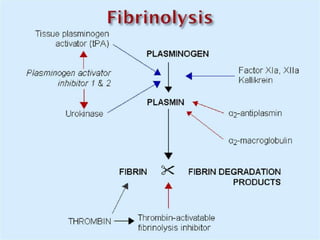
Fibrinolysis
• Fibrinolysis is the process of proteolytic digestion of
fibrin aimed at dissolving a clot
• Plasmin is the enzyme that breaks down fibrin
• It is activated from inactive plasminogen by tissue
plasminogen activator (t-PA) and urokinase.
• Tissue plasminogen activator (t-PA) and urokinase
are inhibited by plasminogen activator inhibitor-1
and plasminogen activator inhibitor-2 (PAI-1 and PAI-
2)
• Fibrinolytic drugs include streptokinase, synthetic t-
PA, aspirin, heparin, warfarin, and citrates.
Causes of coagulation
disorders disorders
• Haemorrhagic diathesis due to vascular
abnormalities.
• Haemorrhagic diathesis related to platelet
abnormalities.
• Disorders of coagulation factors
• Haemorrhagic diathesis due to fibrinolytic
defects
• Combination – DIC
Coagulation disorders
• These are not as common as the other bleeding
disorders
• A deficiency of each of the 13 known plasma
coagulation factors has been reported
• These deficits are either inherited or acquired
• Inherited disorders are usually due to qualitative
or quantitative defect in a single factor
• The acquired disorders on the other hand are
characterised by deficiencies of multiple factors
Clinical features
• The type of bleeding in coagulation disorders is
different from that seen in vascular and platelet
abnormalities
• Instead of spontaneous appearance of petechiae
and purpuras
• plasma coagulation defects manifest more often
in the form of
– Large ecchymoses
– Haematomas
– Bleeding into muscles, joints, body cavities, GIT and
urinary tract
Classic Haemophilia - Haemophilia
A
• Is the second most common in this class (1 per
10,000 male births)
• Its a factor VIII deficiency (either quantitative or
defective)
• Is a sex-(X-) linked recessive trait
• If carriers present factor VIII levels below 50%,
they may become symptomatic
• Most symptomatic haemophiliacs have Factor VIII
< 5%
• True female haemophiliacs may arise of
consanguineous descent
Clinical features
• Bleeding for hours or days after injury
• Bleeding can affect any organ but usually occurs as
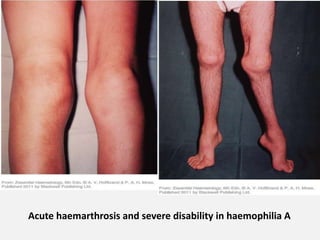
– Recurrent painful haemarthroses
– Muscle haematomas
– Haemophilic pseudo tumours (encapsulated
haematomas)
– Sometimes as haematurias
– Rarely intracranial and oropharyngeal bleeding occur
• If poorly treated may lead to progressive joint
deformity and disability
• Local pressure can cause entrapment neuropathy or
ischaemic necrosis
Acute haemarthrosis and severe disability in haemophilia A
Haematological picture
• Whole blood clotting time is prolonged in severe
cases only
• Prothrombin time is usually normal
• Activated partial thromboplastin time (APTT or PTTK)
is typically prolonged.
• Specific assay for factor VIII shows lowered activity
Management
• Factor VIII replacement therapy (raise the factor level
activity by 30-50%)
• DDAVP (desmopressin) – to raise factor VII levels in
mild haemophiliacs
• Immunosuppressant therapy to those who develop
antibodies to the infused factor
Christmas Disease -Haemophilia B
• Is rarer than haemophilia A
• Estimated incidence is 1 in 100,000 male births
• The inheritance pattern and clinical features of factor
IX deficiency are identical with classic haemophilia
• Laboratory picture is crucial for differential diagnosis
since haemophilia B requires treatment with
different plasma fraction
Haematological picture
• APTT is prolonged
• Factor IX clotting assay shows reduced activity
• As in haemophilia A, the bleeding time and PT
tests are normal.
• Therapy consists of infusion of either fresh
frozen plasma or a plasma enriched with
factor IX.
• Therapy may activate the coagulation system
and cause thrombosis and embolism
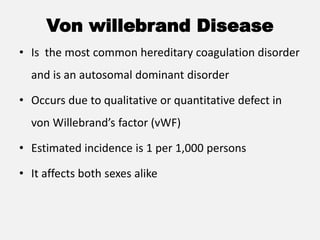
Von willebrand Disease
• Is the most common hereditary coagulation disorder
and is an autosomal dominant disorder
• Occurs due to qualitative or quantitative defect in
von Willebrand’s factor (vWF)
• Estimated incidence is 1 per 1,000 persons
• It affects both sexes alike
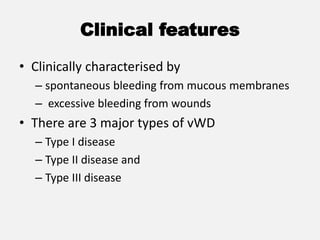
Clinical features
• Clinically characterised by
– spontaneous bleeding from mucous membranes
– excessive bleeding from wounds
• There are 3 major types of vWD
– Type I disease
– Type II disease and
– Type III disease
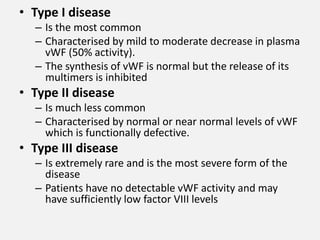
• Type I disease
– Is the most common
– Characterised by mild to moderate decrease in plasma
vWF (50% activity).
– The synthesis of vWF is normal but the release of its
multimers is inhibited
• Type II disease
– Is much less common
– Characterised by normal or near normal levels of vWF
which is functionally defective.
• Type III disease
– Is extremely rare and is the most severe form of the
disease
– Patients have no detectable vWF activity and may
have sufficiently low factor VIII levels
Haematological picture
• Prolonged bleeding time
• Normal platelet count
• Reduced plasma vWF concentration
• Defective platelet aggregation with ristocetin,
an antibiotic.
• Reduced factor VIII activity
• Bleeding episodes in vWD are treated with
cryoprecipitates or factor VIII concentrates
Management
• Intermediate purity factor VIII concentrate
(contains both vWF and factor VIII) for
bleeding.
• Desmopressin is helpful for mild bleeding.
• Fibrinolytic inhibitors (e.g. tranexamic acid)
are helpful.
• Carrier detection and antenatal diagnosis
based on foetal DNA analysis is now available
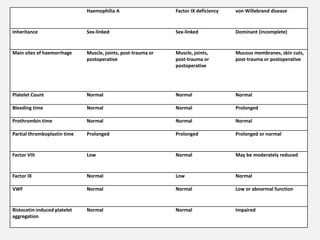
Haemophilia A Factor IX deficiency von Willebrand disease
Inheritance Sex-linked Sex-linked Dominant (incomplete)
Main sites of haemorrhage Muscle, joints, post-trauma or
postoperative
Muscle, joints,
post-trauma or
postoperative
Mucous membranes, skin cuts,
post-trauma or postoperative
Platelet Count Normal Normal Normal
Bleeding time Normal Normal Prolonged
Prothrombin time Normal Normal Normal
Partial thromboplastin time Prolonged Prolonged Prolonged or normal
Factor VIII Low Normal May be moderately reduced
Factor IX Normal Low Normal
VWF Normal Normal Low or abnormal function
Ristocetin-induced platelet
aggregation
Normal Normal Impaired
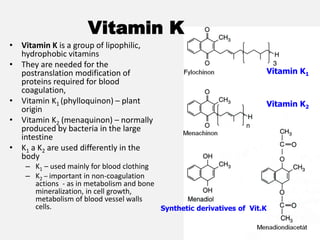
Vitamin K1
Vitamin K2
Vitamin K
• Vitamin K is a group of lipophilic,
hydrophobic vitamins
• They are needed for the
postranslation modification of
proteins required for blood
coagulation,
• Vitamin K1 (phylloquinon) – plant
origin
• Vitamin K2 (menaquinon) – normally
produced by bacteria in the large
intestine
• K1 a K2 are used differently in the
body
– K1 – used mainly for blood clothing
– K2 – important in non-coagulation
actions - as in metabolism and bone
mineralization, in cell growth,
metabolism of blood vessel walls
cells. Synthetic derivatives of Vit.K
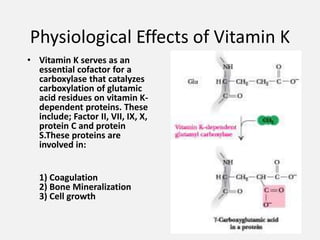
Physiological Effects of Vitamin K
• Vitamin K serves as an
essential cofactor for a
carboxylase that catalyzes
carboxylation of glutamic
acid residues on vitamin K-
dependent proteins. These
include; Factor II, VII, IX, X,
protein C and protein
S.These proteins are
involved in:
1) Coagulation
2) Bone Mineralization
3) Cell growth
Vitamin K Dependent Proteins
• factor II (prothrombin)
• factor VII (proconvertin)
• factor IX (thromboplastin component)
• factor X (Stuart factor)
• protein C & protein S
Neonatal vitamin K deficiency
• Deficiency of vitamin K in the newborn causes
haemorrhagic disease of the newborn
• It is usually caused by
– Liver cell immaturity
– Lack of gut bacterial synthesis of the vitamin
– Low quantities in breast milk
• Routine administration of vitamin K to all
newly born infants caused disappearance of
neonatal vitamin K deficiency.
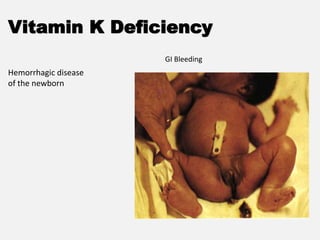
Vitamin K Deficiency
Hemorrhagic disease
of the newborn
GI Bleeding
Vitamin K deficiency in
children and adults
• The 3 major causes are;
– Inadequate dietary intake.
– Intestinal malabsorption.
– Loss of storage site due to hepatocellular disease.
• The onset of vitamin deficiency leads to a fall in
the plasma levels of its dependant factors
• This results in prolonged PT and PTTK
• Parenteral administration of vitamin K rapidly
restores vitamin K levels in the liver.
Coagulation disorders in Liver
Disease
• The liver
– Is the major site for synthesis and metabolism of
coagulation factors
– It also produces coagulation inhibitors such as
antithrombin III and protein C and S
– Also plays a role in the clearance of activated factors and
fibrinolytic enzymes
• Hence liver disease often leads to multiple haemostatic
abnormalities such as
– Hypercoagulability
– DIC
– Systemic fibrinolysis
Major causes of bleeding in
liver diseases
• Morphological lesions
– Portal hypertension, Peptic ulcers, Gastritis
– These affect the synthetic capacity of the liver
• Hepatic dysfunction
– Impaired hepatic synthesis of coagulation factors and
coagulation inhibitors
– Impaired absorption and metabolism of vitamin K.
– Failure to clear activated coagulation factors →DIC
and systemic fibrinolysis
• Complications of therapy
Clinical features
• The haemostatic abnormality in liver disease is
complex but most patients have
• Prolonged PT and PTTK
• Mild thrombocytopenia
• Normal fibrinogen level
• Decreased hepatic stores of vitamin K
• Treatment of the underlying cause usually
resolves the issue
Disseminated Intravascular
Coagulation
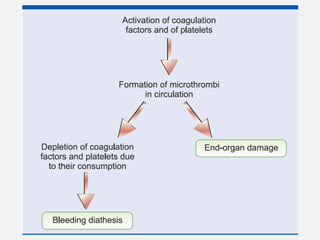
• DIC is evidence for the simultaneous presence
of
– Thrombin (procoagulation)
– Plasmin aka fibrinolysin (fibrinolysis)
• Presentations:
– An acute hemorrhagic disorder
– An indolent, subacute thrombotic disorder
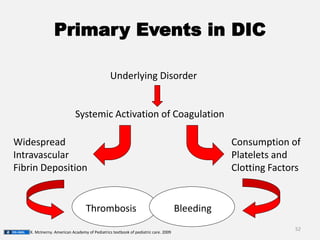
Primary Events in DIC
Underlying Disorder
Systemic Activation of Coagulation
Widespread
Intravascular
Fibrin Deposition
Consumption of
Platelets and
Clotting Factors
Thrombosis Bleeding
52
K. McInerny. American Academy of Pediatrics textbook of pediatric care. 2009
Clinical features
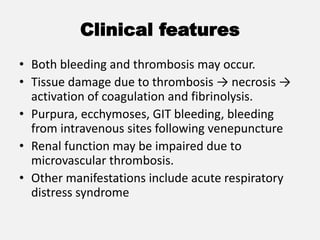
• Both bleeding and thrombosis may occur.
• Tissue damage due to thrombosis → necrosis →
activation of coagulation and fibrinolysis.
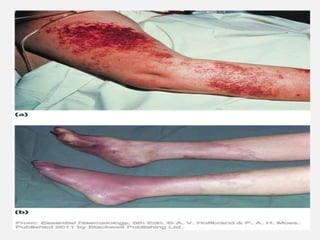
• Purpura, ecchymoses, GIT bleeding, bleeding
from intravenous sites following venepuncture
• Renal function may be impaired due to
microvascular thrombosis.
• Other manifestations include acute respiratory
distress syndrome
Haematological picture
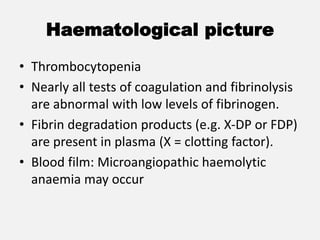
• Thrombocytopenia
• Nearly all tests of coagulation and fibrinolysis
are abnormal with low levels of fibrinogen.
• Fibrin degradation products (e.g. X-DP or FDP)
are present in plasma (X = clotting factor).
• Blood film: Microangiopathic haemolytic
anaemia may occur
Management
• Treat the cause, e.g. antibiotics for
septicaemia,
• Supportive therapy with fresh frozen plasma,
platelet concentrates if bleeding is dominant.
• Anticoagulant therapy (e.g. heparin) if
thrombosis is dominant.
• Protein C and antithrombin in selected
patients
Other acquired disorders of
coagulation
1. Drugs
– Chemotherapy ( l-asparaginase may lead to
thrombosis)
– Anticoagulants – Heparin, Warfarin
2. Massive post-trauma/-surgery
uncontrollable bleeding
3. Renal disease
Vascular disorders
• These disorders are heterogeneous
• characterized by easy bruising and spontaneous
bleeding from the small vessels
• On their own not usually severe
• The bleeding is mainly in the skin causing petechiae,
ecchymoses or both
• In some disorders there is also bleeding from mucous
membranes
• They are either inherited or acquired
Inherited Vascular disorders
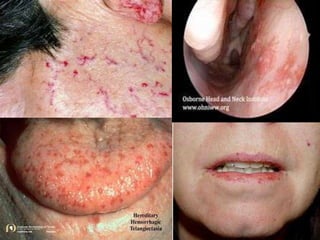
1. Hereditary haemorrhagic telangiectasia (Osler-
Weber- Rendu disease)
• A rare autosomal dominant trait
• The condition begins in childhood and is
characterised by abnormally telangiectatic (dilated)
capillaries
• These capillaries develop in the skin, mucous
membranes and internal organs
• They usually cause frequent epistaxis and GIT
bleeding
2. Inherited disorders of connective tissue matrix.
• Include Marfan’s syndrome, Ehlers-Danlos
syndrome and pseudoxanthoma elasticum
• All of which have inherited defect in the connective
tissue matrix
• Thus have fragile skin vessels and easy bruising
• Mild cases may present with superficial bruising and
purpura following minor trauma
• Purpura is usually present resulting from
• defective platelet aggregation, hyperextensibility of
joints and hyperelastic friable skin
Acquired Vascular Disorders
1. Henoch-Schönlein purpura (Anaphylactoid
purpura)
• is a self-limited type of hypersensitivity Vasculitis
• It is an IgA-mediated vasculitis
• usually seen in children and often follows an acute
upper respiratory tract infection
• Usually produces
– purpuric rash on arms, legs and on the buttocks
– Haematuria
– Colicky abdominal pain due to bleeding into the
GIT
– Polyarthralgia
– Acute nephritis
2. Simple easy bruising (Devil’s pinches).
• Easy bruising of unknown cause is a common
phenomenon in women of child-bearing age
group
3. Infection
• Many infections cause vascular haemorrhages
either by causing toxic damage to the
endothelium or by DIC.
• These are especially prone to occur in
septicaemia and severe measles.
3. Drug related
• Certain drugs form antibodies and produce
hypersensitivity (or leucocytoclastic) vasculitis
responsible for abnormal bleeding
• Others like steroids may be associated with
vascular purpura due to defective vascular
support
4. Scurvy
• Deficiency of vitamin C causes defective collagen
synthesis
• It causes skin bleeding as well as bleeding into
muscle, GIT and GUT
5. Others include Senile purpura, heamolytic
uraemic syndrome,
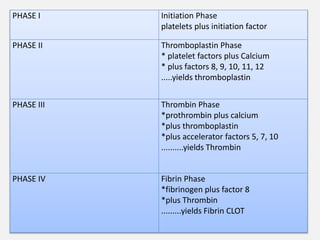
PHASE I Initiation Phase
platelets plus initiation factor
PHASE II Thromboplastin Phase
* platelet factors plus Calcium
* plus factors 8, 9, 10, 11, 12
.....yields thromboplastin
PHASE III Thrombin Phase
*prothrombin plus calcium
*plus thromboplastin
*plus accelerator factors 5, 7, 10
..........yields Thrombin
PHASE IV Fibrin Phase
*fibrinogen plus factor 8
*plus Thrombin
.........yields Fibrin CLOT
References
• Hoffman, R., Benz, E., Silberstein, L., Heslop, H., Weitz,
J. and Anastasi, J., 2017. Hematology. Philadelphia:
Elsevier.
• Hoffbrand, A.V. and Steensma, D.P., 2019. Hoffbrand's
essential haematology. John Wiley & Sons
• Messmore, H. and Wehrmacher, W., 2009. Book
Review: Consultative Hemostasis and Thrombosis.
Clinical and Applied Thrombosis/Hemostasis
• Periayah MH, Halim AS, Mat Saad AZ. Mechanism
Action of Platelets and Crucial Blood Coagulation
Pathways in Hemostasis. Int J Hematol Oncol Stem Cell
Res. 2017 Oct 1;11(4):319-327. PMID: 29340130;
PMCID: PMC5767294

Haemostasis notes for medical students fourth year

  • 1.
    Haematology Haemostasis Marah Mubita University ofZambia, School of Medicine, Pathology and Microbiology Dept.
  • 2.
    Haemostasis • Haemostasis means“arrest of bleeding” • Represents a delicate balance between procoagulant and anticoagulant mechanisms • Process by which blood is maintained in a fluid state and without any major loss in case of injury • It’s a process that involves – Vascular system – Platelets – Coagulation system – Inflammation and would healing process and – Fibrinolytic system
  • 3.
    Maintenance of bloodflow • Laminar flow – Cellular components of blood are in the centre of the blood stream • Endothelial cells (EC) – The smooth nature of the endothelial cell surface prevents adhesion – Heparin sulfate + Antithrombin inhibit serine proteases for F II, IX and X – Nitric oxide + Prostacyclin prevent platelet adhesion – Thrombomodulin + Thrombin activate protein C and S which in turn inactivates F V and VIII
  • 4.
    Stages of haemostasis •It can be divided into 5 phases • Vascular phase – Immediate vasoconstriction of the injured vessel to prevent blood loss • Platelet phase – Process through which a platelet plug is formed aka primary haemostasis • Coagulation phase – Involves coagulation factors and has intrinsic and extrinsic pathways aka secondary haemostasis • Clot retraction and repair • This causes resizing of clot and restoration of blood flow aka tertiary haemostasis • Fibrinolytic phase
  • 5.
    Vascular Phase • Triggeredby damage to blood vessel • Results in an immediate vascular spasm that constricts the blood vessel to prevent blood loss • Mechanism of Vascular spasm – Endothelin from the EC cause contraction of the smooth muscles (SM) in the blood vessels – Myogenic mechanism caused by direct injury to the SM – Nociceptor activation – Inflammatory mediators activation of nociceptors that lead to SM reflexive contraction • May last from a few seconds to up to 30 minutes
  • 7.
    Primary Haemostasis • Thisresults in platelet plug formation • Platelet adhesion – Platelets adhere to the exposed collagen fibers via their interaction with von willebrand Factor (vWF) through the GPIb-IX-V protein complex receptor
  • 8.
    • Platelet aggregation –Platelet connect to each other via Fibrinogen via the receptor GPIIb-IIIa in the presence of calcium • Platelet release reaction / degranulation/ Activation – ADP – attracts other platelets to the injury – Serotonin – stimulates further vasoconstriction – Thromboxane – attracts platelets, stimulates vasoconstriction and keeps the platelets sticky
  • 9.
  • 11.
    Secondary Haemostasis • Akathe coagulation cascade • Is a series where each step activates the next and ultimately strengthens the primary blood clot • It involves the use of clotting factors each of which is a serine protease • The clotting factors exist in an inactive form (zymogens) • Activated when placed with its glycoprotein co-factor and gets a suffix a – For example V →Va • It has 3 pathways – Extrinsic pathway – Intrinsic pathway – Common pathway
  • 13.
    Extrinsic Pathway • Activatedby injury to the endothelial tissue exposing tissue factor (F-III) to the blood • F-III in the presence of calcium activates FVII • The F-III, VIIa and Calcium complex then activate F-X • This complex is called Extrinsic tenase • F-VII requires Vitamin K for activation
  • 14.
    Intrinsic pathway • Startswhen F-XII is exposed to collagen • F-XII gets activated to F-XIIa in the presence of Kallikrein, and high molecular weight kininogen (HMWK) • F-XIIa activates factor XI into XIa • In the presence of calcium ion F-XIa activates F-IX • F-IXa then activates F-VIII • The F-IXa, VIIIa, calcium and a phospholipid form a complex that then activates F-X to F-Xa. • This complex is called Intrinsic tenase • The phospholipid surface necessary for formation of coagulation complexes is provided by the platelet plasma membrane
  • 15.
    Common pathway • Thispathway begins at F-X which is activated to F-Xa • F-Xa with F-V as a cofactor activates F-II (Prothrombin) into F-IIa( (Thrombin) • F-IIa in the presence of Calcium activates F-I (Fibrinogen) to F-Ia (Fibrin) • F-IIa in the presence of Calcium also activates F-XIII to F-XIIIa and causes cross linkages in the Fibrin • F-IIa reinforces the coagulation cascade by giving positive feedback to factors V, VII, VIII, XI, XII
  • 16.
  • 17.
  • 18.
    Clot retraction andhealing • Aka tertiary haemostasis • The fibrin mesh interacts with the platelets to prevent dislodgement • The platelet intracellular actin or myosin are connected internally to the GpIIbIIIa and Fib receptor • The external component of the GpIIbIIIa receptor interacts with fibrin • Subsequent contraction of the microtubules leads to decrease in clot volume (clot retraction). • For healing Platelet derived growth factor (PDGF) released from a granules promotes fibroblast proliferation
  • 19.
    Investigations 1.Bleeding time increasedin – Thrombocytopenia. – Disorders of platelet function. – von Willebrand’s disease. – Vascular abnormalities (e.g. in Ehlers-Danlos syndrome). – Severe deficiency of factor V and XI. 2. Hess capillary resistance test (tourniquet test) – Petechiae formation in thrombocytopaenia due to capillary fragility
  • 20.
  • 21.
    3. Whole bloodcoagulation time – Normal range is 4-8 minutes at 37◦C 4. Activated partial thromboplastin time (APTT) or partial thromboplastin time with kaolin (PTTK) – Used to measure intrinsic and common pathway factors – Normal range is 30-40 secs – Common causes of prolonged APTT are • Parenteral administration of heparin. • Disseminated intravascular coagulation. • Liver disease. • Circulating anticoagulants
  • 22.
    5. Prothrombin time –measures the extrinsic system factor VII as well as factors in the common pathway – Normal range is 10-14 secs and is prolonged in • Administration of oral anticoagulant drugs. • Liver disease, especially obstructive liver disease. • Vitamin K deficiency. • Disseminated intravascular coagulation 6. Thrombin time – Measures fibrinogen deficiency and normal range is under 20 secs and it is prolonged in • Hypofibrinogenaemia (e.g. in DIC) • Raised concentration of Fibrin degradation products (FDP) • Presence of heparin
  • 24.
    Fibrinolysis • Fibrinolysis isthe process of proteolytic digestion of fibrin aimed at dissolving a clot • Plasmin is the enzyme that breaks down fibrin • It is activated from inactive plasminogen by tissue plasminogen activator (t-PA) and urokinase. • Tissue plasminogen activator (t-PA) and urokinase are inhibited by plasminogen activator inhibitor-1 and plasminogen activator inhibitor-2 (PAI-1 and PAI- 2) • Fibrinolytic drugs include streptokinase, synthetic t- PA, aspirin, heparin, warfarin, and citrates.
  • 26.
    Causes of coagulation disordersdisorders • Haemorrhagic diathesis due to vascular abnormalities. • Haemorrhagic diathesis related to platelet abnormalities. • Disorders of coagulation factors • Haemorrhagic diathesis due to fibrinolytic defects • Combination – DIC
  • 27.
    Coagulation disorders • Theseare not as common as the other bleeding disorders • A deficiency of each of the 13 known plasma coagulation factors has been reported • These deficits are either inherited or acquired • Inherited disorders are usually due to qualitative or quantitative defect in a single factor • The acquired disorders on the other hand are characterised by deficiencies of multiple factors
  • 28.
    Clinical features • Thetype of bleeding in coagulation disorders is different from that seen in vascular and platelet abnormalities • Instead of spontaneous appearance of petechiae and purpuras • plasma coagulation defects manifest more often in the form of – Large ecchymoses – Haematomas – Bleeding into muscles, joints, body cavities, GIT and urinary tract
  • 29.
    Classic Haemophilia -Haemophilia A • Is the second most common in this class (1 per 10,000 male births) • Its a factor VIII deficiency (either quantitative or defective) • Is a sex-(X-) linked recessive trait • If carriers present factor VIII levels below 50%, they may become symptomatic • Most symptomatic haemophiliacs have Factor VIII < 5% • True female haemophiliacs may arise of consanguineous descent
  • 30.
    Clinical features • Bleedingfor hours or days after injury • Bleeding can affect any organ but usually occurs as – Recurrent painful haemarthroses – Muscle haematomas – Haemophilic pseudo tumours (encapsulated haematomas) – Sometimes as haematurias – Rarely intracranial and oropharyngeal bleeding occur • If poorly treated may lead to progressive joint deformity and disability • Local pressure can cause entrapment neuropathy or ischaemic necrosis
  • 31.
    Acute haemarthrosis andsevere disability in haemophilia A
  • 32.
    Haematological picture • Wholeblood clotting time is prolonged in severe cases only • Prothrombin time is usually normal • Activated partial thromboplastin time (APTT or PTTK) is typically prolonged. • Specific assay for factor VIII shows lowered activity
  • 33.
    Management • Factor VIIIreplacement therapy (raise the factor level activity by 30-50%) • DDAVP (desmopressin) – to raise factor VII levels in mild haemophiliacs • Immunosuppressant therapy to those who develop antibodies to the infused factor
  • 34.
    Christmas Disease -HaemophiliaB • Is rarer than haemophilia A • Estimated incidence is 1 in 100,000 male births • The inheritance pattern and clinical features of factor IX deficiency are identical with classic haemophilia • Laboratory picture is crucial for differential diagnosis since haemophilia B requires treatment with different plasma fraction
  • 35.
    Haematological picture • APTTis prolonged • Factor IX clotting assay shows reduced activity • As in haemophilia A, the bleeding time and PT tests are normal. • Therapy consists of infusion of either fresh frozen plasma or a plasma enriched with factor IX. • Therapy may activate the coagulation system and cause thrombosis and embolism
  • 36.
    Von willebrand Disease •Is the most common hereditary coagulation disorder and is an autosomal dominant disorder • Occurs due to qualitative or quantitative defect in von Willebrand’s factor (vWF) • Estimated incidence is 1 per 1,000 persons • It affects both sexes alike
  • 37.
    Clinical features • Clinicallycharacterised by – spontaneous bleeding from mucous membranes – excessive bleeding from wounds • There are 3 major types of vWD – Type I disease – Type II disease and – Type III disease
  • 38.
    • Type Idisease – Is the most common – Characterised by mild to moderate decrease in plasma vWF (50% activity). – The synthesis of vWF is normal but the release of its multimers is inhibited • Type II disease – Is much less common – Characterised by normal or near normal levels of vWF which is functionally defective. • Type III disease – Is extremely rare and is the most severe form of the disease – Patients have no detectable vWF activity and may have sufficiently low factor VIII levels
  • 39.
    Haematological picture • Prolongedbleeding time • Normal platelet count • Reduced plasma vWF concentration • Defective platelet aggregation with ristocetin, an antibiotic. • Reduced factor VIII activity • Bleeding episodes in vWD are treated with cryoprecipitates or factor VIII concentrates
  • 40.
    Management • Intermediate purityfactor VIII concentrate (contains both vWF and factor VIII) for bleeding. • Desmopressin is helpful for mild bleeding. • Fibrinolytic inhibitors (e.g. tranexamic acid) are helpful. • Carrier detection and antenatal diagnosis based on foetal DNA analysis is now available
  • 41.
    Haemophilia A FactorIX deficiency von Willebrand disease Inheritance Sex-linked Sex-linked Dominant (incomplete) Main sites of haemorrhage Muscle, joints, post-trauma or postoperative Muscle, joints, post-trauma or postoperative Mucous membranes, skin cuts, post-trauma or postoperative Platelet Count Normal Normal Normal Bleeding time Normal Normal Prolonged Prothrombin time Normal Normal Normal Partial thromboplastin time Prolonged Prolonged Prolonged or normal Factor VIII Low Normal May be moderately reduced Factor IX Normal Low Normal VWF Normal Normal Low or abnormal function Ristocetin-induced platelet aggregation Normal Normal Impaired
  • 42.
    Vitamin K1 Vitamin K2 VitaminK • Vitamin K is a group of lipophilic, hydrophobic vitamins • They are needed for the postranslation modification of proteins required for blood coagulation, • Vitamin K1 (phylloquinon) – plant origin • Vitamin K2 (menaquinon) – normally produced by bacteria in the large intestine • K1 a K2 are used differently in the body – K1 – used mainly for blood clothing – K2 – important in non-coagulation actions - as in metabolism and bone mineralization, in cell growth, metabolism of blood vessel walls cells. Synthetic derivatives of Vit.K
  • 43.
    Physiological Effects ofVitamin K • Vitamin K serves as an essential cofactor for a carboxylase that catalyzes carboxylation of glutamic acid residues on vitamin K- dependent proteins. These include; Factor II, VII, IX, X, protein C and protein S.These proteins are involved in: 1) Coagulation 2) Bone Mineralization 3) Cell growth
  • 44.
    Vitamin K DependentProteins • factor II (prothrombin) • factor VII (proconvertin) • factor IX (thromboplastin component) • factor X (Stuart factor) • protein C & protein S
  • 45.
    Neonatal vitamin Kdeficiency • Deficiency of vitamin K in the newborn causes haemorrhagic disease of the newborn • It is usually caused by – Liver cell immaturity – Lack of gut bacterial synthesis of the vitamin – Low quantities in breast milk • Routine administration of vitamin K to all newly born infants caused disappearance of neonatal vitamin K deficiency.
  • 46.
    Vitamin K Deficiency Hemorrhagicdisease of the newborn GI Bleeding
  • 47.
    Vitamin K deficiencyin children and adults • The 3 major causes are; – Inadequate dietary intake. – Intestinal malabsorption. – Loss of storage site due to hepatocellular disease. • The onset of vitamin deficiency leads to a fall in the plasma levels of its dependant factors • This results in prolonged PT and PTTK • Parenteral administration of vitamin K rapidly restores vitamin K levels in the liver.
  • 48.
    Coagulation disorders inLiver Disease • The liver – Is the major site for synthesis and metabolism of coagulation factors – It also produces coagulation inhibitors such as antithrombin III and protein C and S – Also plays a role in the clearance of activated factors and fibrinolytic enzymes • Hence liver disease often leads to multiple haemostatic abnormalities such as – Hypercoagulability – DIC – Systemic fibrinolysis
  • 49.
    Major causes ofbleeding in liver diseases • Morphological lesions – Portal hypertension, Peptic ulcers, Gastritis – These affect the synthetic capacity of the liver • Hepatic dysfunction – Impaired hepatic synthesis of coagulation factors and coagulation inhibitors – Impaired absorption and metabolism of vitamin K. – Failure to clear activated coagulation factors →DIC and systemic fibrinolysis • Complications of therapy
  • 50.
    Clinical features • Thehaemostatic abnormality in liver disease is complex but most patients have • Prolonged PT and PTTK • Mild thrombocytopenia • Normal fibrinogen level • Decreased hepatic stores of vitamin K • Treatment of the underlying cause usually resolves the issue
  • 51.
    Disseminated Intravascular Coagulation • DICis evidence for the simultaneous presence of – Thrombin (procoagulation) – Plasmin aka fibrinolysin (fibrinolysis) • Presentations: – An acute hemorrhagic disorder – An indolent, subacute thrombotic disorder
  • 52.
    Primary Events inDIC Underlying Disorder Systemic Activation of Coagulation Widespread Intravascular Fibrin Deposition Consumption of Platelets and Clotting Factors Thrombosis Bleeding 52 K. McInerny. American Academy of Pediatrics textbook of pediatric care. 2009
  • 54.
    Clinical features • Bothbleeding and thrombosis may occur. • Tissue damage due to thrombosis → necrosis → activation of coagulation and fibrinolysis. • Purpura, ecchymoses, GIT bleeding, bleeding from intravenous sites following venepuncture • Renal function may be impaired due to microvascular thrombosis. • Other manifestations include acute respiratory distress syndrome
  • 56.
    Haematological picture • Thrombocytopenia •Nearly all tests of coagulation and fibrinolysis are abnormal with low levels of fibrinogen. • Fibrin degradation products (e.g. X-DP or FDP) are present in plasma (X = clotting factor). • Blood film: Microangiopathic haemolytic anaemia may occur
  • 57.
    Management • Treat thecause, e.g. antibiotics for septicaemia, • Supportive therapy with fresh frozen plasma, platelet concentrates if bleeding is dominant. • Anticoagulant therapy (e.g. heparin) if thrombosis is dominant. • Protein C and antithrombin in selected patients
  • 58.
    Other acquired disordersof coagulation 1. Drugs – Chemotherapy ( l-asparaginase may lead to thrombosis) – Anticoagulants – Heparin, Warfarin 2. Massive post-trauma/-surgery uncontrollable bleeding 3. Renal disease
  • 59.
    Vascular disorders • Thesedisorders are heterogeneous • characterized by easy bruising and spontaneous bleeding from the small vessels • On their own not usually severe • The bleeding is mainly in the skin causing petechiae, ecchymoses or both • In some disorders there is also bleeding from mucous membranes • They are either inherited or acquired
  • 60.
    Inherited Vascular disorders 1.Hereditary haemorrhagic telangiectasia (Osler- Weber- Rendu disease) • A rare autosomal dominant trait • The condition begins in childhood and is characterised by abnormally telangiectatic (dilated) capillaries • These capillaries develop in the skin, mucous membranes and internal organs • They usually cause frequent epistaxis and GIT bleeding
  • 62.
    2. Inherited disordersof connective tissue matrix. • Include Marfan’s syndrome, Ehlers-Danlos syndrome and pseudoxanthoma elasticum • All of which have inherited defect in the connective tissue matrix • Thus have fragile skin vessels and easy bruising • Mild cases may present with superficial bruising and purpura following minor trauma • Purpura is usually present resulting from • defective platelet aggregation, hyperextensibility of joints and hyperelastic friable skin
  • 63.
    Acquired Vascular Disorders 1.Henoch-Schönlein purpura (Anaphylactoid purpura) • is a self-limited type of hypersensitivity Vasculitis • It is an IgA-mediated vasculitis • usually seen in children and often follows an acute upper respiratory tract infection • Usually produces – purpuric rash on arms, legs and on the buttocks – Haematuria – Colicky abdominal pain due to bleeding into the GIT – Polyarthralgia – Acute nephritis
  • 64.
    2. Simple easybruising (Devil’s pinches). • Easy bruising of unknown cause is a common phenomenon in women of child-bearing age group 3. Infection • Many infections cause vascular haemorrhages either by causing toxic damage to the endothelium or by DIC. • These are especially prone to occur in septicaemia and severe measles.
  • 65.
    3. Drug related •Certain drugs form antibodies and produce hypersensitivity (or leucocytoclastic) vasculitis responsible for abnormal bleeding • Others like steroids may be associated with vascular purpura due to defective vascular support 4. Scurvy • Deficiency of vitamin C causes defective collagen synthesis • It causes skin bleeding as well as bleeding into muscle, GIT and GUT 5. Others include Senile purpura, heamolytic uraemic syndrome,
  • 66.
    PHASE I InitiationPhase platelets plus initiation factor PHASE II Thromboplastin Phase * platelet factors plus Calcium * plus factors 8, 9, 10, 11, 12 .....yields thromboplastin PHASE III Thrombin Phase *prothrombin plus calcium *plus thromboplastin *plus accelerator factors 5, 7, 10 ..........yields Thrombin PHASE IV Fibrin Phase *fibrinogen plus factor 8 *plus Thrombin .........yields Fibrin CLOT
  • 67.
    References • Hoffman, R.,Benz, E., Silberstein, L., Heslop, H., Weitz, J. and Anastasi, J., 2017. Hematology. Philadelphia: Elsevier. • Hoffbrand, A.V. and Steensma, D.P., 2019. Hoffbrand's essential haematology. John Wiley & Sons • Messmore, H. and Wehrmacher, W., 2009. Book Review: Consultative Hemostasis and Thrombosis. Clinical and Applied Thrombosis/Hemostasis • Periayah MH, Halim AS, Mat Saad AZ. Mechanism Action of Platelets and Crucial Blood Coagulation Pathways in Hemostasis. Int J Hematol Oncol Stem Cell Res. 2017 Oct 1;11(4):319-327. PMID: 29340130; PMCID: PMC5767294