CSF and Blood-BrainBarriers and
Blood-Brain Barriers
- CSF formation and flow
- Main functions of CSF
- Intracranial pressure, Brain edema and Hydrocephalus.
- Composition of CSF
- Blood-Brain Barrier (BBB)
- Main functions of CSF
- Intracranial pressure, Brain edema and Hydrocephalus.
- Composition of CSF
- Blood-Brain Barrier (BBB)
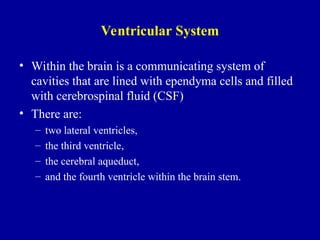
Ventricular System
• Withinthe brain is a communicating system of
cavities that are lined with ependyma cells and filled
with cerebrospinal fluid (CSF)
• There are:
– two lateral ventricles,
– the third ventricle,
– the cerebral aqueduct,
– and the fourth ventricle within the brain stem.
8.
8
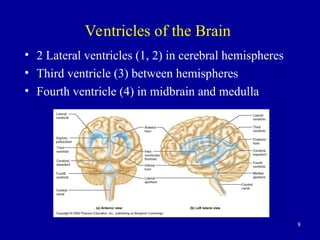
Ventricles of theBrain
• 2 Lateral ventricles (1, 2) in cerebral hemispheres
• Third ventricle (3) between hemispheres
• Fourth ventricle (4) in midbrain and medulla
11
CSF in human
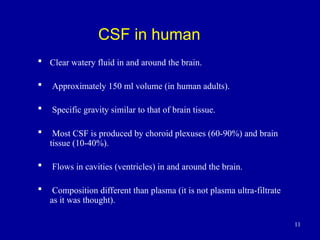
Clear watery fluid in and around the brain.
Approximately 150 ml volume (in human adults).
Specific gravity similar to that of brain tissue.
Most CSF is produced by choroid plexuses (60-90%) and brain
tissue (10-40%).
Flows in cavities (ventricles) in and around the brain.
Composition different than plasma (it is not plasma ultra-filtrate
as it was thought).
12.
Cerebrospinal Fluid
Slide 7.46
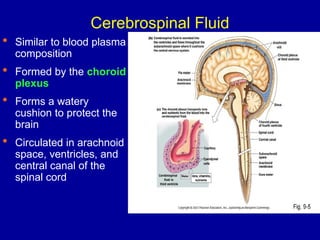
Similar to blood plasma
composition
Formed by the choroid
plexus
Forms a watery
cushion to protect the
brain
Circulated in arachnoid
space, ventricles, and
central canal of the
spinal cord
13.
13
Cerebrospinal fluid (CSF)
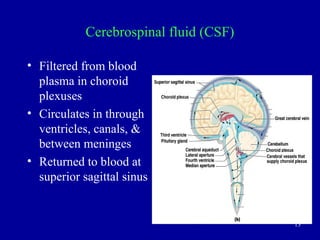
•Filtered from blood
plasma in choroid
plexuses
• Circulates in through
ventricles, canals, &
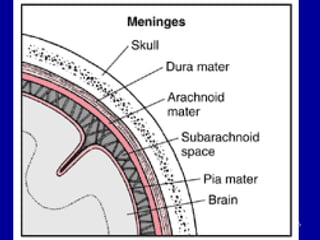
between meninges
• Returned to blood at
superior sagittal sinus
14.
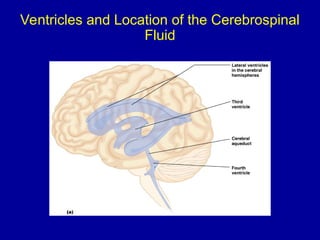
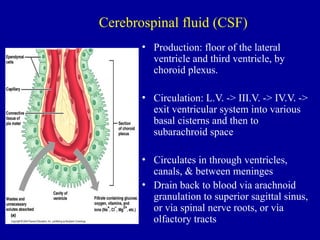
Cerebrospinal fluid (CSF)
•Production: floor of the lateral
ventricle and third ventricle, by
choroid plexus.
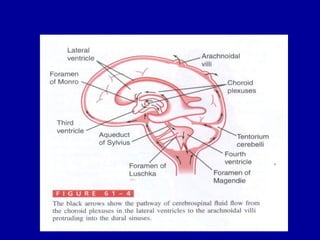
• Circulation: L.V. -> III.V. -> IV.V. ->
exit ventricular system into various
basal cisterns and then to
subarachroid space
• Circulates in through ventricles,
canals, & between meninges
• Drain back to blood via arachnoid
granulation to superior sagittal sinus,
or via spinal nerve roots, or via
olfactory tracts
From Johanson CE
15.
15
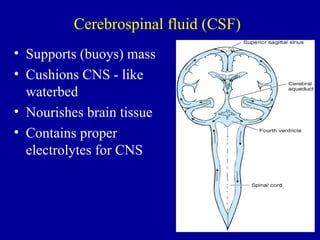
Cerebrospinal fluid (CSF)
•Supports (buoys) mass
• Cushions CNS - like
waterbed
• Nourishes brain tissue
• Contains proper
electrolytes for CNS
16.
Functions of CSF
•Cushioning of the brain in the cranium (Physical Protection):
have similar specific gravity as brain tissue so the brain floats in the CSF.
The weight of the brain is reduced 30 folds.
• Supply Brain tissue with some nutrients:
some substances are delivered into CSF from blood, they gain access into
brain tissue via CSF.
• Sink Action of CSF:
CSF acts as a “sink” for various extracellular material in brain tissue.
• Provide a route for movement of substances from Brain to blood:
some materials gain access to blood from brain via CSF drainage into sinus
blood through the arachnoid villi.
17.
Function of CSF
•Maintenance of a constant external
environment for neurons and glia
• Mechanical cushion to protect the brain
and buoyant to the heavy brain (1400 g)
• Serve as a lymphatic system and a conduit
for neuropeptides
• pH of CSF regulates pulmonary ventilation
and CBF
18.
Choroid Plexus
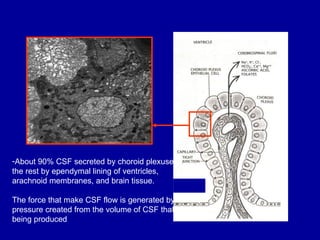
-About 90%CSF secreted by choroid plexuses.
the rest by ependymal lining of ventricles,
arachnoid membranes, and brain tissue.
The force that make CSF flow is generated by the
pressure created from the volume of CSF that is
being produced.
19.
CSF Drainage
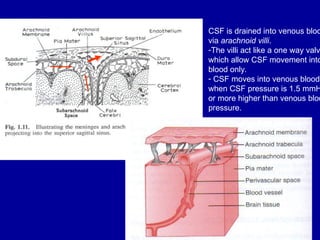
CSF isdrained into venous bloo
via arachnoid villi.
-The villi act like a one way valv
which allow CSF movement into
blood only.
- CSF moves into venous blood
when CSF pressure is 1.5 mmH
or more higher than venous bloo
pressure.
20.
CSF Pressure
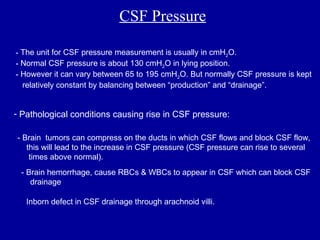
- Theunit for CSF pressure measurement is usually in cmH2O.
- Normal CSF pressure is about 130 cmH2O in lying position.
- However it can vary between 65 to 195 cmH2O. But normally CSF pressure is kept
relatively constant by balancing between “production” and “drainage”.
- Pathological conditions causing rise in CSF pressure:
- Brain tumors can compress on the ducts in which CSF flows and block CSF flow,
this will lead to the increase in CSF pressure (CSF pressure can rise to several
times above normal).
- Brain hemorrhage, cause RBCs & WBCs to appear in CSF which can block CSF
drainage.
- Inborn defect in CSF drainage through arachnoid villi.
21.
Hydrocephalus
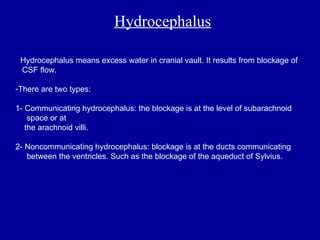
- Hydrocephalus meansexcess water in cranial vault. It results from blockage of
CSF flow.
-There are two types:
1- Communicating hydrocephalus: the blockage is at the level of subarachnoid
space or at
the arachnoid villi.
2- Noncommunicating hydrocephalus: blockage is at the ducts communicating
between the ventricles. Such as the blockage of the aqueduct of Sylvius.
22.
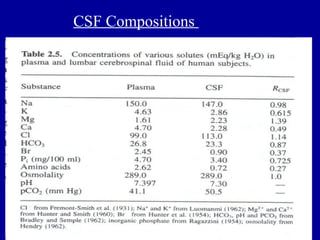
CSF Compositions ofCSF
• Cushioning of the brain in the cranium (Physical Protection):
have similar specific gravity as brain tissue so the brain floats in the CSF. The
weight of the brain is reduced 30 folds.
• Supply Brain tissue with some nutrients:
some substances are delivered into CSF from blood, they gain access into brain
tissue via CSF.
• Sink Action of CSF:
CSF acts as a “sink” for various extracellular material in brain tissue.
• Provide a route for movement of substances from Brain to blood:
some materials gain access to blood from brain via CSF drainage into sinus blood
through the .
23.
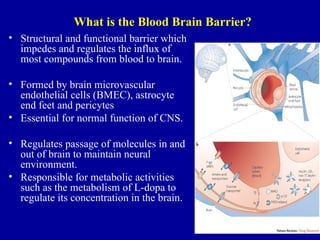
What is theBlood Brain Barrier?
• Structural and functional barrier which
impedes and regulates the influx of
most compounds from blood to brain.
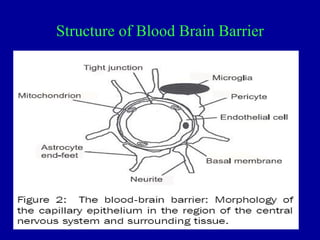
• Formed by brain microvascular
endothelial cells (BMEC), astrocyte
end feet and pericytes
• Essential for normal function of CNS.
• Regulates passage of molecules in and
out of brain to maintain neural
environment.
• Responsible for metabolic activities
such as the metabolism of L-dopa to
regulate its concentration in the brain.
25
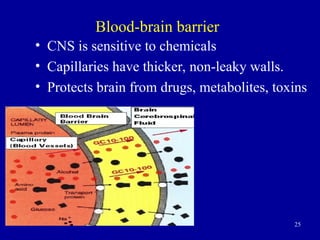
Blood-brain barrier
• CNSis sensitive to chemicals
• Capillaries have thicker, non-leaky walls.
• Protects brain from drugs, metabolites, toxins
26.
Functions and Propertiesof the BBB
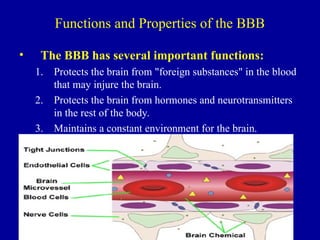
• The BBB has several important functions:
1. Protects the brain from "foreign substances" in the blood
that may injure the brain.
2. Protects the brain from hormones and neurotransmitters
in the rest of the body.
3. Maintains a constant environment for the brain.
27.
Functions and Propertiesof the BBB
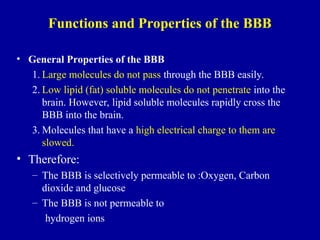
• General Properties of the BBB
1. Large molecules do not pass through the BBB easily.
2. Low lipid (fat) soluble molecules do not penetrate into the
brain. However, lipid soluble molecules rapidly cross the
BBB into the brain.
3. Molecules that have a high electrical charge to them are
slowed.
• Therefore:
– The BBB is selectively permeable to :Oxygen, Carbon
dioxide and glucose
– The BBB is not permeable to
hydrogen ions
28.
Transport of substancesacross the BBB
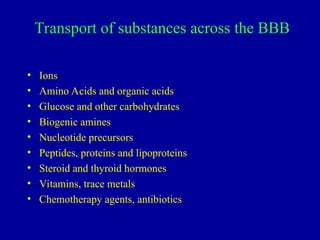
• Ions
• Amino Acids and organic acids
• Glucose and other carbohydrates
• Biogenic amines
• Nucleotide precursors
• Peptides, proteins and lipoproteins
• Steroid and thyroid hormones
• Vitamins, trace metals
• Chemotherapy agents, antibiotics
29.
Transport at theBBB
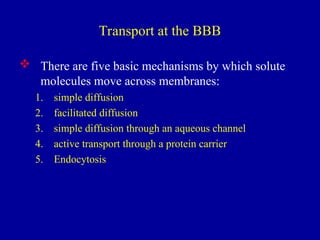
There are five basic mechanisms by which solute
molecules move across membranes:
1. simple diffusion
2. facilitated diffusion
3. simple diffusion through an aqueous channel
4. active transport through a protein carrier
5. Endocytosis
30.
30
Blood supply &Nutrition
• Brain is highly vascular
– blood delivers O2 and glucose supply
• Can't be deprived of O2. No capacity for
anaerobic respiration.
– Brain cells die w/in 5-6 minutes when deprived
• Requires glucose (or ketone bodies) as fuel
– Can't use fats, amino acids.
31.
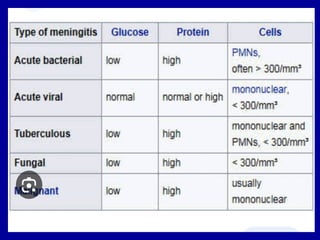
CASE BASE LEARNING
•Patient presence with severe headache, followed by neck
stiffness. On examination classic triad of diagnostic signs
consisting of neck stiffness, high fever and altered mental
status is seen. Provisional diagnosis of meningitis was made
and then lumbar puncture was performed and CSF was sent to
lab for further evaluation.
• Answer the following question
• Q.1 Briefly describe about CSF
• Q.2 Write the normal composition of CSF
• Q.3 Discuss the CSF findings in various viral , fungal,
bacterial and tubecular meningitis.
32.
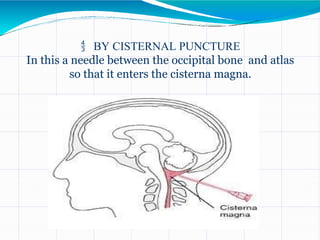
COLLECTION OF CSF
CSF is collected by two methods
BY LUMBAR PUNCTURE
BY CISTERNAL PUNCTURE
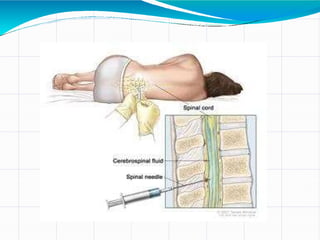
LUMBAR PUNCTURE
In this the needle is introduced into the
subarachnoid space in the lumbar region.
34.
BY CISTERNALPUNCTURE
In this a needle between the occipital bone and atlas
so that it enters the cisterna magna.