ON
AT
“Lions Blood Bank & Research Foundation”
Organized by;
M.SC.MEDICAL LABORATORY TECHNOLOGY(MLT),
DEPARTMENT OF ADVANCED ZOOLOGY,
LOYOLA AUTONOMOUS COLLAGE.
8TH,FEBRUARY,2018.
TOPIC
“AWARNESS ON BLOOD BANKING PROTOCOLS”
Submitted To:- Dr.Sherafin Jancy Vincy (Co-rdinator of M.ScMLT)
Submitted By:- A.Vamsi kumar, Dep No:- 17-PML-014.
INTRODUCTION
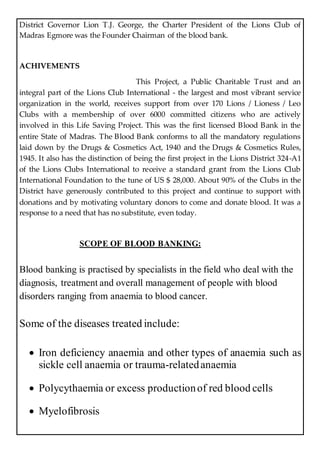
Sharing Life. Saving lives
“Lions Blood Bank & Research Foundation" - a standing
monument of peoples' initiative and sustained efforts to solve a problem. This
Designated Regional Blood Centre has been awarded the status of District Level
Blood Bank by the National AIDS Control Organization who also provides testing
kits and blood bank consumables on a monthly basis considering our good work in
the field of public service activities.
HISTORY
This prestigious project was commissioned on
30th June 1984 during the gubernatorial year of Lion Dr R Rabindranath and
inaugurated by the then Health Minister, Government of Madras, Lion Dr H V
Hande. Nobel Laureate Mother Teresa visited the Blood Bank on March 3, 1985 and
blessed the project while appreciating the move to help "God's People". Past Lions
District Governor Lion T.J. George, the Charter President of the Lions Club of
Madras Egmore was the Founder Chairman of the blood bank.
ACHIVEMENTS
This Project, a Public Charitable Trust and an
integral part of the Lions Club International - the largest and most vibrant service
organization in the world, receives support from over 170 Lions / Lioness / Leo
Clubs with a membership of over 6000 committed citizens who are actively
involved in this Life Saving Project. This was the first licensed Blood Bank in the
entire State of Madras. The Blood Bank conforms to all the mandatory regulations
laid down by the Drugs & Cosmetics Act, 1940 and the Drugs & Cosmetics Rules,
1945. It also has the distinction of being the first project in the Lions District 324-A1
of the Lions Clubs International to receive a standard grant from the Lions Club
International Foundation to the tune of US $ 28,000. About 90% of the Clubs in the
District have generously contributed to this project and continue to support with
donations and by motivating voluntary donors to come and donate blood. It was a
response to a need that has no substitute, even today.
SCOPE OF BLOOD BANKING:
Blood banking is practised by specialists in the field who deal with the
diagnosis, treatment and overall management of people with blood
disorders ranging from anaemia to blood cancer.
Some of the diseases treated include:
 Iron deficiency anaemia and other types of anaemia such as
sickle cell anaemia or trauma-relatedanaemia

 Polycythaemia or excess productionof red blood cells

 Myelofibrosis

 Leukaemia

 Platelet and bleeding disorders such as haemophilia,
idiopathic thrombocytopenic purpura and Von Will brand
disease

 The myelodysplastic syndromes

 Hemoglobinopathies such as thalassemia and sickle cell
disease

 Multiplemyeloma

 Malignant lymphomas

 Blood transfusion

 Bone marrow stem cell transplantation
FRAME WORK OF OUR VISIT
Industrial visit was carried out at the Lions
Blood Bank, 130, Marshalls Road, Egmore, Chennai 600031.
On 08th February, 2018 especially for semester
Two students of 1st yr MLTians. The main objective behind
the visit was to make us aware about how various activities
related to Blood banking, blood collecting, blood storing
and human issuing are carried out in Blood bank to give
us an Idea about how Blood banking was running.
I along with 22 students left for visit at 09:00
a.m. and took about half an hour to cover the distance.
The Blood bank is located in 130, Marshalls Road, Egmore,
Chennai 600031.
. As soon as we reached Bank we were along with
Dr.Stella mam guided by Dr.Magitha CEO of Lions blood bank
to central conferance Hall were orientation of Blood bank
visit was given by CEO of Lions blood bank Dr.Magitha and
Technical assistance about history and how it was
established. It was great to know that it has awarded the
status of District Level Blood Bank by the National AIDS
Control Organization.
She patiently clarified each and every question
asked by us.
I.PLANING AND ORGANIZATION
We were divided into 4 groups, each group
having 6 members to visit various divisions of blood bank
Labs which are:
1.Blood collection room.
2.Components seperation room.
3.Components storage room.
4.Serology lab.
We were instructed to not to
carry mobile phones inside the working laboratories.
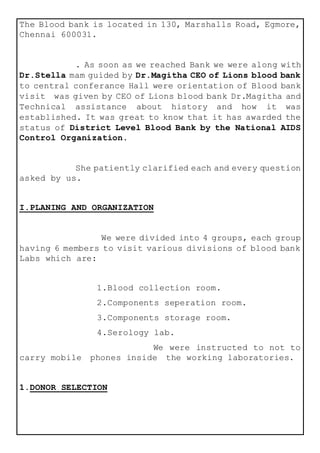
1.DONOR SELECTION
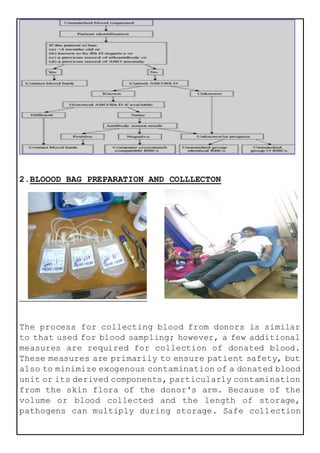
2.BLOOOD BAG PREPARATION AND COLLLECTON
The process for collecting blood from donors is similar
to that used for blood sampling; however, a few additional
measures are required for collection of donated blood.
These measures are primarily to ensure patient safety, but
also to minimize exogenous contamination of a donated blood
unit or its derived components, particularly contamination
from the skin flora of the donor's arm. Because of the
volume or blood collected and the length of storage,
pathogens can multiply during storage. Safe collection
ensures that the blood products are safe for therapeutic
use throughout their shelf life.
After a blood donation
Donor care:ask the donor to remain in the chair and relax
for a few minutes;
1.Inspect The venepuncture site; if it is not bleeding,
apply a bandage to the site; if it is bleeding, apply
further pressure;
2.Ask the donor to sit up slowly and ask how the person
is feeling;
3.Before the donor leaves the donation room, ensure that
the person can stand up without dizziness and without a
drop in blood pressure;
offer the donor some refreshments.
Blood unit and samples
1.Transfer the blood unit to a proper storage container
according to the blood centre requirements and the product
2.Ensure that collected blood samples are stored and
delivered to the laboratory with completed documentation,
at the recommended temperature, and in a leak-proof, closed
container
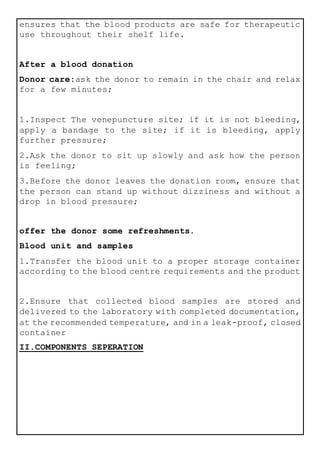
II.COMPONENTS SEPERATION
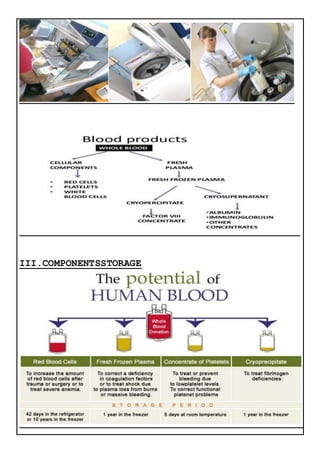
III.COMPONENTSSTORAGE
IV.SEROLOGY LAB
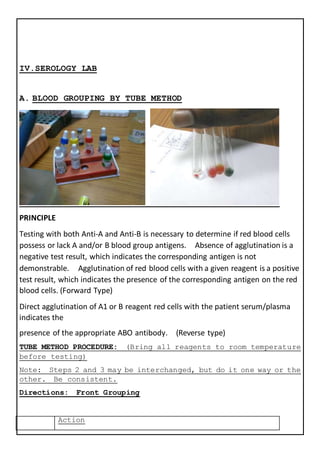
A. BLOOD GROUPING BY TUBE METHOD
PRINCIPLE
Testing with both Anti-A and Anti-B is necessary to determine if red blood cells
possess or lack A and/or B blood group antigens. Absence of agglutination is a
negative test result, which indicates the corresponding antigen is not
demonstrable. Agglutination of red blood cells with a given reagent is a positive
test result, which indicates the presence of the corresponding antigen on the red
blood cells. (Forward Type)
Direct agglutination of A1 or B reagent red cells with the patient serum/plasma
indicates the
presence of the appropriate ABO antibody. (Reverse type)
TUBE METHOD PROCEDURE: (Bring all reagents to room temperature
before testing)
Note: Steps 2 and 3 may be interchanged, but do it one way or the
other. Be consistent.
Directions: Front Grouping
Action
Step
1 Prepare a 3-5% suspension of red blood cells to be
tested in isotonic saline. (Washed or unwashed
cells may be used)
2 Place 1 drop of Anti-A and Anti-B respectively, in
two small, properly labeled test tubes
3 Add one drop of rbc suspension into the tube and mix.
4 Centrifuge the test tube for appropriate centrifuge
time.*
5 Completely resuspend cells and examine
macroscopically for agglutination.
Note: Hemolysis may be a consequence of bacterial
contamination and should not be interpreted as a
positive result.
6 Grade and record results
B.CROSS MATCHING BY GEL CARD METHOD:
PRINCIPLE
The crossmatchtestis used to detect the presenceof blood group antibodies in a recipient's
serum/plasma to antigens on donor red blood cells. In this test, thedonor red blood cells in a
hypotonic buffered salinesolution arecombined with patientserum/plasma to allow
antigen/antibody interaction in theupper chamber of the microtube. This results in
promoting antibody uptake. The detection of this antibody occurs whenthesensitized red
blood cells reactwith the Anti-IgG gelin the microtubeduring centrifugation.
PROCEDURE
Donor Unit Cell Preparation
1. Label test tubes with the appropriate donor unit numbers.
2. In separate labeled
each donor unit.
3. Mix gently. Final cell suspension should be approximately 0.8%.
Compatibility Test Procedure
1. Upon orders for blood, review the blood bank recipient card file and/or computer blood bank history
for previous
testing. Interpretation of previous results should be compared with current interpretations and any
discrepancies
must be resolved.
2. Prior to or in conjunction with the crossmatch, an ABO and Rh type and antibody screen must be
performed on the
patient (recipient) sample to assure that type specific blood is given. If an antibody is detected, the
blood selected
for crossmatch should be negative for the corresponding antigen. (See appropriate procedures in this
manual). Be
sure that the patient name and identification number agree on the tubes of blood and requisition slip.
If there is any
discrepancy, redraw the patient. Autologous units will be processed the same as any other unit.
The unit will be
destroyed if not used.
3. Label the MTS Anti-
4. Remove the foil seal fromthe card.
5. Using an appropriate pipette, add 50 µL of each donor unit red blood cell suspension to the correct
microtube.
6. Using an appropriate pipette, add 25 µL of serum or plasma to the correct micro tube(s).
7. - 30 minutes.
FULLY AUTOMATEDANALYZER
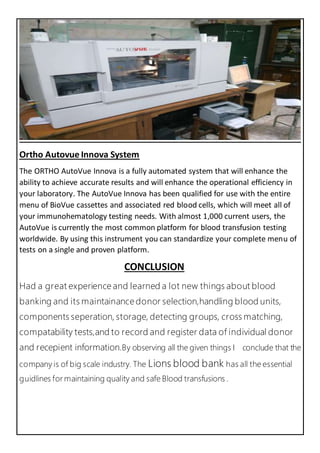
Ortho Autovue Innova System
The ORTHO AutoVue Innova is a fully automated system that will enhance the
ability to achieve accurate results and will enhance the operational efficiency in
your laboratory. The AutoVue Innova has been qualified for use with the entire
menu of BioVue cassettes and associated red blood cells, which will meet all of
your immunohematology testing needs. With almost 1,000 current users, the
AutoVue is currently the most common platform for blood transfusion testing
worldwide. By using this instrument you can standardize your complete menu of
tests on a single and proven platform.
CONCLUSION
Had a great experience and learned a lot new things about blood
banking and its maintainance donor selection,handling blood units,
components seperation, storage, detecting groups, cross matching,
compatability tests,and to record and register data of individual donor
and recepient information.By observing all the given things I conclude that the
company is of big scale industry. The Lions blood bank has all the essential
guidlines for maintaining quality and safe Blood transfusions .
“ My heartful thanks to our beloved Co-ordinator Dr.S.J
VINCY mam and Dear Guide Dr.Stella Mary mam for making
it possible and successful”

Blood bank report

  • 1.
    ON AT “Lions Blood Bank& Research Foundation” Organized by; M.SC.MEDICAL LABORATORY TECHNOLOGY(MLT), DEPARTMENT OF ADVANCED ZOOLOGY, LOYOLA AUTONOMOUS COLLAGE. 8TH,FEBRUARY,2018. TOPIC “AWARNESS ON BLOOD BANKING PROTOCOLS” Submitted To:- Dr.Sherafin Jancy Vincy (Co-rdinator of M.ScMLT) Submitted By:- A.Vamsi kumar, Dep No:- 17-PML-014.
  • 2.
    INTRODUCTION Sharing Life. Savinglives “Lions Blood Bank & Research Foundation" - a standing monument of peoples' initiative and sustained efforts to solve a problem. This Designated Regional Blood Centre has been awarded the status of District Level Blood Bank by the National AIDS Control Organization who also provides testing kits and blood bank consumables on a monthly basis considering our good work in the field of public service activities. HISTORY This prestigious project was commissioned on 30th June 1984 during the gubernatorial year of Lion Dr R Rabindranath and inaugurated by the then Health Minister, Government of Madras, Lion Dr H V Hande. Nobel Laureate Mother Teresa visited the Blood Bank on March 3, 1985 and blessed the project while appreciating the move to help "God's People". Past Lions
  • 3.
    District Governor LionT.J. George, the Charter President of the Lions Club of Madras Egmore was the Founder Chairman of the blood bank. ACHIVEMENTS This Project, a Public Charitable Trust and an integral part of the Lions Club International - the largest and most vibrant service organization in the world, receives support from over 170 Lions / Lioness / Leo Clubs with a membership of over 6000 committed citizens who are actively involved in this Life Saving Project. This was the first licensed Blood Bank in the entire State of Madras. The Blood Bank conforms to all the mandatory regulations laid down by the Drugs & Cosmetics Act, 1940 and the Drugs & Cosmetics Rules, 1945. It also has the distinction of being the first project in the Lions District 324-A1 of the Lions Clubs International to receive a standard grant from the Lions Club International Foundation to the tune of US $ 28,000. About 90% of the Clubs in the District have generously contributed to this project and continue to support with donations and by motivating voluntary donors to come and donate blood. It was a response to a need that has no substitute, even today. SCOPE OF BLOOD BANKING: Blood banking is practised by specialists in the field who deal with the diagnosis, treatment and overall management of people with blood disorders ranging from anaemia to blood cancer. Some of the diseases treated include:  Iron deficiency anaemia and other types of anaemia such as sickle cell anaemia or trauma-relatedanaemia   Polycythaemia or excess productionof red blood cells   Myelofibrosis 
  • 4.
     Leukaemia   Plateletand bleeding disorders such as haemophilia, idiopathic thrombocytopenic purpura and Von Will brand disease   The myelodysplastic syndromes   Hemoglobinopathies such as thalassemia and sickle cell disease   Multiplemyeloma   Malignant lymphomas   Blood transfusion   Bone marrow stem cell transplantation FRAME WORK OF OUR VISIT Industrial visit was carried out at the Lions Blood Bank, 130, Marshalls Road, Egmore, Chennai 600031. On 08th February, 2018 especially for semester Two students of 1st yr MLTians. The main objective behind the visit was to make us aware about how various activities related to Blood banking, blood collecting, blood storing and human issuing are carried out in Blood bank to give us an Idea about how Blood banking was running. I along with 22 students left for visit at 09:00 a.m. and took about half an hour to cover the distance.
  • 5.
    The Blood bankis located in 130, Marshalls Road, Egmore, Chennai 600031. . As soon as we reached Bank we were along with Dr.Stella mam guided by Dr.Magitha CEO of Lions blood bank to central conferance Hall were orientation of Blood bank visit was given by CEO of Lions blood bank Dr.Magitha and Technical assistance about history and how it was established. It was great to know that it has awarded the status of District Level Blood Bank by the National AIDS Control Organization. She patiently clarified each and every question asked by us. I.PLANING AND ORGANIZATION We were divided into 4 groups, each group having 6 members to visit various divisions of blood bank Labs which are: 1.Blood collection room. 2.Components seperation room. 3.Components storage room. 4.Serology lab. We were instructed to not to carry mobile phones inside the working laboratories. 1.DONOR SELECTION
  • 6.
    2.BLOOOD BAG PREPARATIONAND COLLLECTON The process for collecting blood from donors is similar to that used for blood sampling; however, a few additional measures are required for collection of donated blood. These measures are primarily to ensure patient safety, but also to minimize exogenous contamination of a donated blood unit or its derived components, particularly contamination from the skin flora of the donor's arm. Because of the volume or blood collected and the length of storage, pathogens can multiply during storage. Safe collection
  • 7.
    ensures that theblood products are safe for therapeutic use throughout their shelf life. After a blood donation Donor care:ask the donor to remain in the chair and relax for a few minutes; 1.Inspect The venepuncture site; if it is not bleeding, apply a bandage to the site; if it is bleeding, apply further pressure; 2.Ask the donor to sit up slowly and ask how the person is feeling; 3.Before the donor leaves the donation room, ensure that the person can stand up without dizziness and without a drop in blood pressure; offer the donor some refreshments. Blood unit and samples 1.Transfer the blood unit to a proper storage container according to the blood centre requirements and the product 2.Ensure that collected blood samples are stored and delivered to the laboratory with completed documentation, at the recommended temperature, and in a leak-proof, closed container II.COMPONENTS SEPERATION
  • 8.
  • 9.
    IV.SEROLOGY LAB A. BLOODGROUPING BY TUBE METHOD PRINCIPLE Testing with both Anti-A and Anti-B is necessary to determine if red blood cells possess or lack A and/or B blood group antigens. Absence of agglutination is a negative test result, which indicates the corresponding antigen is not demonstrable. Agglutination of red blood cells with a given reagent is a positive test result, which indicates the presence of the corresponding antigen on the red blood cells. (Forward Type) Direct agglutination of A1 or B reagent red cells with the patient serum/plasma indicates the presence of the appropriate ABO antibody. (Reverse type) TUBE METHOD PROCEDURE: (Bring all reagents to room temperature before testing) Note: Steps 2 and 3 may be interchanged, but do it one way or the other. Be consistent. Directions: Front Grouping Action
  • 10.
    Step 1 Prepare a3-5% suspension of red blood cells to be tested in isotonic saline. (Washed or unwashed cells may be used) 2 Place 1 drop of Anti-A and Anti-B respectively, in two small, properly labeled test tubes 3 Add one drop of rbc suspension into the tube and mix. 4 Centrifuge the test tube for appropriate centrifuge time.* 5 Completely resuspend cells and examine macroscopically for agglutination. Note: Hemolysis may be a consequence of bacterial contamination and should not be interpreted as a positive result. 6 Grade and record results B.CROSS MATCHING BY GEL CARD METHOD: PRINCIPLE The crossmatchtestis used to detect the presenceof blood group antibodies in a recipient's serum/plasma to antigens on donor red blood cells. In this test, thedonor red blood cells in a hypotonic buffered salinesolution arecombined with patientserum/plasma to allow antigen/antibody interaction in theupper chamber of the microtube. This results in promoting antibody uptake. The detection of this antibody occurs whenthesensitized red blood cells reactwith the Anti-IgG gelin the microtubeduring centrifugation. PROCEDURE Donor Unit Cell Preparation 1. Label test tubes with the appropriate donor unit numbers. 2. In separate labeled each donor unit.
  • 11.
    3. Mix gently.Final cell suspension should be approximately 0.8%. Compatibility Test Procedure 1. Upon orders for blood, review the blood bank recipient card file and/or computer blood bank history for previous testing. Interpretation of previous results should be compared with current interpretations and any discrepancies must be resolved. 2. Prior to or in conjunction with the crossmatch, an ABO and Rh type and antibody screen must be performed on the patient (recipient) sample to assure that type specific blood is given. If an antibody is detected, the blood selected for crossmatch should be negative for the corresponding antigen. (See appropriate procedures in this manual). Be sure that the patient name and identification number agree on the tubes of blood and requisition slip. If there is any discrepancy, redraw the patient. Autologous units will be processed the same as any other unit. The unit will be destroyed if not used. 3. Label the MTS Anti- 4. Remove the foil seal fromthe card. 5. Using an appropriate pipette, add 50 µL of each donor unit red blood cell suspension to the correct microtube. 6. Using an appropriate pipette, add 25 µL of serum or plasma to the correct micro tube(s). 7. - 30 minutes. FULLY AUTOMATEDANALYZER
  • 12.
    Ortho Autovue InnovaSystem The ORTHO AutoVue Innova is a fully automated system that will enhance the ability to achieve accurate results and will enhance the operational efficiency in your laboratory. The AutoVue Innova has been qualified for use with the entire menu of BioVue cassettes and associated red blood cells, which will meet all of your immunohematology testing needs. With almost 1,000 current users, the AutoVue is currently the most common platform for blood transfusion testing worldwide. By using this instrument you can standardize your complete menu of tests on a single and proven platform. CONCLUSION Had a great experience and learned a lot new things about blood banking and its maintainance donor selection,handling blood units, components seperation, storage, detecting groups, cross matching, compatability tests,and to record and register data of individual donor and recepient information.By observing all the given things I conclude that the company is of big scale industry. The Lions blood bank has all the essential guidlines for maintaining quality and safe Blood transfusions .
  • 13.
    “ My heartfulthanks to our beloved Co-ordinator Dr.S.J VINCY mam and Dear Guide Dr.Stella Mary mam for making it possible and successful”