Blood transfusion-I (Basics)
- Donor - Blood bank - Recipient
Dr. Dibyajyoti Prusty, MD
Haematologist, Haemato-oncologist
SCB Medical College and Hospital, Cuttack
#Blood_Basics
#Blood_Basics
#Blood_Basics
Blood Transfusion Service
Complex organization, requiring careful
designing and management.
Centralized, regionalized, hospital based
or combined
Strategy for the screening of all donated
blood for transfusion-transmitted
infections
Effective legislation governing the
operation of blood transfusion service
Good LABORATORY PRACTICES
in blood bank
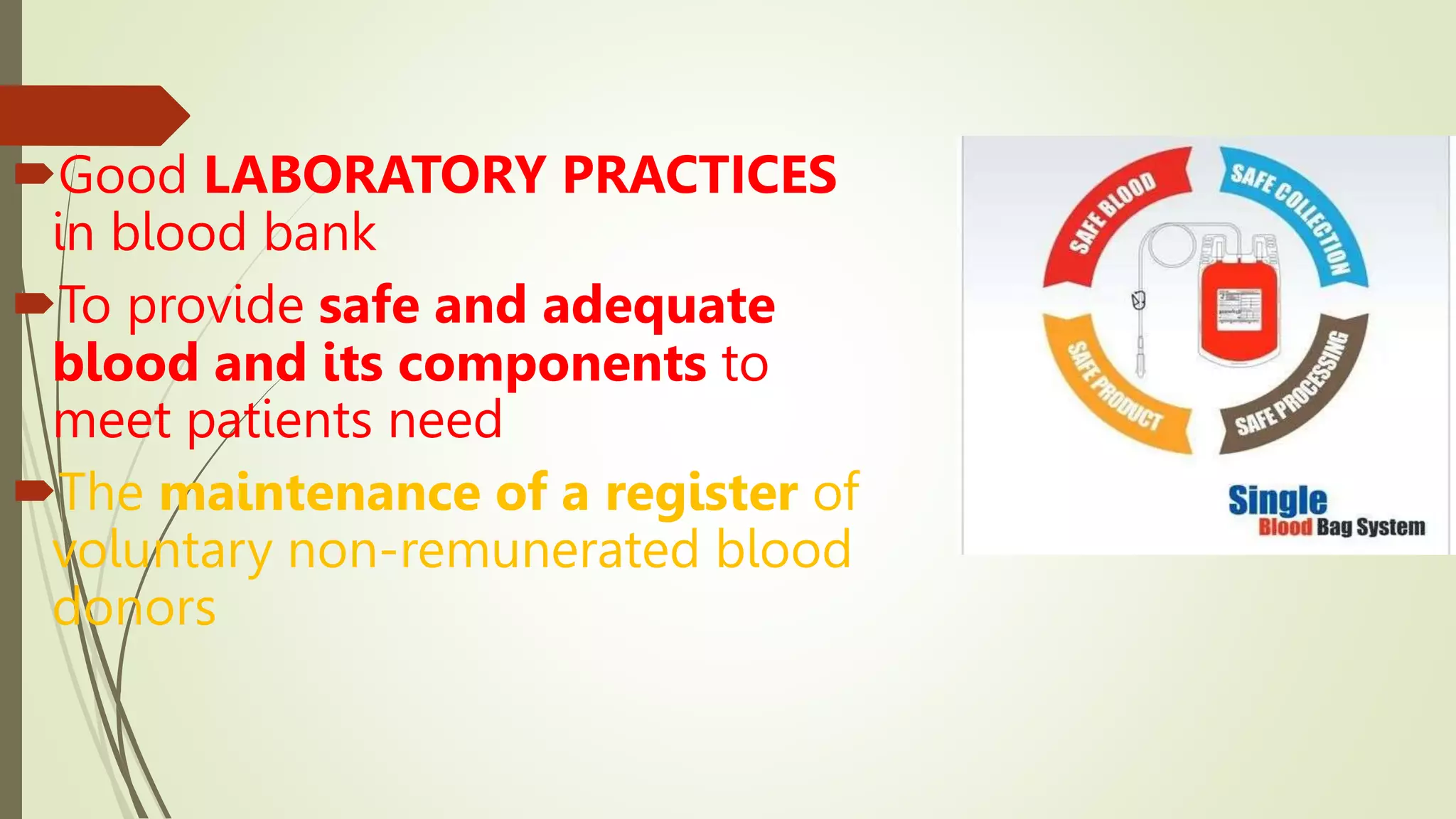
To provide safe and adequate
blood and its components to
meet patients need
The maintenance of a register of
voluntary non-remunerated blood
donors
Officer responsible for the blood donation
programme
Monitoring and evaluation of clinical use of blood.
To promote cooperation between the blood
transfusion services with: (Hospitals, educational institutes,
religious, social and industrial organizations, mass media and the general
public.)
DONORS RECRUITMENT STRATEGIES
Pure Voluntary Recruitment
strategy
Social Persuasion-based
Recruitment Strategy
Remunerated-based
Donations
ORGANIZATION OF OUT-DOOR BLOOD
DONATION CAMPS
 Blood donor organizer
 Informative posters, brochures
 Dealings with donors
 Staff
 Incentives
 light refreshment and donors cards
 Annual award ceremonies
Donors Selection and Blood Collection
 DONOR SCREENING : Consent form
 (1) Registration, consent of the donor, donation.
 (2) Medical history
 (3) Limited physical examination
 (4) Simple laboratory test
 High Risk Group Donors for HIV Transmission:
-Refrain them from blood donation
 BLOOD DONORS QUESTIONNAIRE
History
Occupational hazards
Respiratory Infections
Pregnancy and Abortion
Surgical Procedures
Heart Diseases
Seizures
Fever
Kidney diseases
Vaccination
MEDICATION
 HIV Infection / AIDS
 Viral Hepatitis
 MALARIA
 Syphilis
 Tuberculosis
Donors with Red Cell Abnormalities
 Thalassemia Trait
 (G-6-PD) deficiency
 Polycythemia Vera
EXAMINATION
• General Appearance
• Age
• Weight
• Blood Pressure/pulse
• Donation Interval
• Donor Skin
• Systemic Examination
LABORATORY TESTS:
• Hemoglobin (or Hematocrit):
-should not be less than 12.5 g/dl (or 38% Hct)
Methods: 1. Specific gravity method
2. Sahlis method
3. Cyanmethaemoglobin method
• ABO and Rh (D) Blood Grouping
COLLECTION OF
BLOOD
Equipment and Materials
 Blood Containers: (PVC) plastic bags which are closed system of single, double or triple
bags for collection of 350 ml or 450 ml blood
 Sphygmomanometer, automatic mixing of blood and weighing of blood bag machine
 Sterile cotton swabs and band-aids/bandages
 Methylated spirit, tincture of iodine, providone-iodine solution (1 %) & alcohol
 Emergency drugs
 Blood Volume : Anticoagulant Solution
 Plastic clips, stripper, di-electric tube sealer or aluminium clips, sealer, cutter
METHOD OF PHLEBOTOMY
Concentrate on the Donor always…
 Clean
 Venipuncture
 Constant observation
 One ml of blood weighs 1.05 g. Thus, 350 ml of blood weighs 367 g. and 450 ml weighs
472 g
 Clamp the tubing of the bag
 Remove blood pressure cuff or tourniquet.
 Take the bag to the processing table
 Keep the blood bag at 2-6°C in the refrigerator immediately after collection
 Light refreshment!
ADVERSE DONOR REACTION
 Syncope
 Tetany
 Nausea and vomiting
 Hematoma
 Convulsions
 Cardiac problems
PROCESSING OF DONOR BLOOD
 Number of donation on the blood
bag. Processing pilot tube and donor
record.
 ABO group
 Rh group
 Screening and Identification of
Antibodies (AHG)
Tests for blood transmissible diseases:
front line and residual risk
Hepatitis B surface antigen and anti-HCV by ELISA
Test for anti-HIV 1 and 2 by ELISA
Test for syphilis - Floculation test, Veneral Disease
Research Laboratory (VDRL) assay or Rapid Plasma
Regin (RPR) assay.
Test for malarial parasites: smear, antigen, antibodies
Blood Components
 Whole Blood
 Packed Red Cells
 Red Cells - Leucocytes Reduced
 Red Cells –Washed
 Red Cells –Frozen with glycerol
• Platelets
• Platelets, Apheresis
• Granulocytes
• FFP
• Cryoprecipitated AHF (Cryoprecipetate)
Preservation and Storage Of Blood
 APPROVED PRESERVATIVE SOLUTIONS : ACD, CPD, CP2D, CPDA-1
 RED CELLS PRESERVATION : (Decrease in pH Build up of lactic acid Decrease in
glucose consumption Decrease in ATP level Low 2,3-DPG levels )
 RED CELL FREEZING ( using glycerol) :The frozen red cells can be stored for 10
years
-For rare blood groups, antibodies against high frequency antigens, Storage of blood
for autotransfusion, Prevention of non-haemolytic febrile transfusion reaction,
Prevention of sensitization against HLA antigens
PLATELET PRESERVATION
 Platelets stored in bags made of
polyvinyl chloride (PVC)
 Platelets should be stored at 22-24° C
(controlled temperature)
 continuous gentle agitation in platelet
incubator and agitator.
FRESH FROZEN PLASMA (FFP)
 Shelf life of FFP is 12 months at - 18°C or lower
 Shelf-life of Single donor plasma is 5 years at -18° C or lower
CRYOPRECIPITATE
 stored for 12 months at -18° C or lower
GRANULOCYTES
 The shelf life of granulocytes is 24 hours at 22-24 C
 do not need agitation
SHIPPING OF BLOOD PRODUCTS
The blood during shipment be kept between 2-10°C.
With in the hospital- insulated carrier or in cold insulated
boxes if the ambient temperature is more than 25° C.
Shipping of Platelets- with no ice, to maintain the
temperature between 20-24° C.
Shipping of Frozen Components- Fresh frozen plasma and
cryoprecipitate must be shipped at -18° C or below (Dry
ice)
INE
THANK YOU
Q & A
Qn1. According to Landstainer’s law, if an agglutinogen is
present in the red cells of a blood, then which type of agglutinin
is present in plasma?
 A. Specific agglutinin
 B. Corresponding agglutinin
 C. Indirect agglutinin
 D. Non of these
Qn. 2. In which grouping, the patient’s red cells are mixed with
serum containing anti-D antibodies?
 A. ABO Grouping
 B. Rh grouping
 C. MN grouping
 D. Both A & B
Qn.3. What is the possibility of genotype of blood group ‘O’ ?
 1. AB
 2. AO
 3. OO
 4. AA
Qn.4. During storage of blood in CPD, which is used for
providing energy to RBCs?
 A. Citrate
 B. Glucose
 C. Acid Phosphatase
 D. All of these
Qn. 5. Transfusion of blood previously collected from the same
person is called?
 A. Directed transfusion
 B. Allogenic transfusion
 C. Autologus transfusion
 D. Syngenic transfusion
Qn. 6. Soft spin is used for separation of ?
 A. Platelete from FFP
 B. Platelet Poor plasma from Red cells
 C. Platelet rich plasma from Red cells
 D. Cryoprecipetate from Plasma
Qn. 7. The most rapid method for haemoglobin estimation for
blood donation camps in remote areas ?
 A. Spectrophotometer method
 B. Copper sulphate Specific gravity method
 C. Sahli’s Haemoglobinometer
 D. All can be used
Qn. 8 Front line screening of transfusion transmitted infections
are done by?
 A. ELISA
 B. Rapid Ag Testing kits
 C. NAAT
 D. Chemiluminoscense method
Qn. 9 National voluntary blood donation day celebrated on?
 A. October 14th
 B. June 1st
 C. October 1st
 D. June 14th
Qn. 10. Identify the symbol and the organisation associated with
it.
 A. Red Plus- Indian Red Plus Society
 B. Red Cross- Indian Red Cross Society
 C. Red Square - Indian Red Square Society
 D. Non of these
BLOOD TRANSFUSION-I (Basics) .pptx

BLOOD TRANSFUSION-I (Basics) .pptx

  • 1.
    Blood transfusion-I (Basics) -Donor - Blood bank - Recipient Dr. Dibyajyoti Prusty, MD Haematologist, Haemato-oncologist SCB Medical College and Hospital, Cuttack #Blood_Basics #Blood_Basics #Blood_Basics
  • 2.
  • 3.
    Complex organization, requiringcareful designing and management. Centralized, regionalized, hospital based or combined Strategy for the screening of all donated blood for transfusion-transmitted infections Effective legislation governing the operation of blood transfusion service
  • 4.
    Good LABORATORY PRACTICES inblood bank To provide safe and adequate blood and its components to meet patients need The maintenance of a register of voluntary non-remunerated blood donors
  • 5.
    Officer responsible forthe blood donation programme Monitoring and evaluation of clinical use of blood. To promote cooperation between the blood transfusion services with: (Hospitals, educational institutes, religious, social and industrial organizations, mass media and the general public.)
  • 6.
    DONORS RECRUITMENT STRATEGIES PureVoluntary Recruitment strategy Social Persuasion-based Recruitment Strategy Remunerated-based Donations
  • 7.
    ORGANIZATION OF OUT-DOORBLOOD DONATION CAMPS  Blood donor organizer  Informative posters, brochures  Dealings with donors  Staff  Incentives  light refreshment and donors cards  Annual award ceremonies
  • 8.
    Donors Selection andBlood Collection  DONOR SCREENING : Consent form  (1) Registration, consent of the donor, donation.  (2) Medical history  (3) Limited physical examination  (4) Simple laboratory test  High Risk Group Donors for HIV Transmission: -Refrain them from blood donation  BLOOD DONORS QUESTIONNAIRE
  • 9.
    History Occupational hazards Respiratory Infections Pregnancyand Abortion Surgical Procedures Heart Diseases Seizures Fever Kidney diseases Vaccination MEDICATION  HIV Infection / AIDS  Viral Hepatitis  MALARIA  Syphilis  Tuberculosis
  • 10.
    Donors with RedCell Abnormalities  Thalassemia Trait  (G-6-PD) deficiency  Polycythemia Vera
  • 11.
    EXAMINATION • General Appearance •Age • Weight • Blood Pressure/pulse • Donation Interval • Donor Skin • Systemic Examination LABORATORY TESTS: • Hemoglobin (or Hematocrit): -should not be less than 12.5 g/dl (or 38% Hct) Methods: 1. Specific gravity method 2. Sahlis method 3. Cyanmethaemoglobin method • ABO and Rh (D) Blood Grouping
  • 12.
  • 13.
    Equipment and Materials Blood Containers: (PVC) plastic bags which are closed system of single, double or triple bags for collection of 350 ml or 450 ml blood  Sphygmomanometer, automatic mixing of blood and weighing of blood bag machine  Sterile cotton swabs and band-aids/bandages  Methylated spirit, tincture of iodine, providone-iodine solution (1 %) & alcohol  Emergency drugs  Blood Volume : Anticoagulant Solution  Plastic clips, stripper, di-electric tube sealer or aluminium clips, sealer, cutter
  • 15.
  • 16.
    Concentrate on theDonor always…  Clean  Venipuncture  Constant observation  One ml of blood weighs 1.05 g. Thus, 350 ml of blood weighs 367 g. and 450 ml weighs 472 g  Clamp the tubing of the bag  Remove blood pressure cuff or tourniquet.  Take the bag to the processing table  Keep the blood bag at 2-6°C in the refrigerator immediately after collection  Light refreshment!
  • 17.
    ADVERSE DONOR REACTION Syncope  Tetany  Nausea and vomiting  Hematoma  Convulsions  Cardiac problems
  • 18.
    PROCESSING OF DONORBLOOD  Number of donation on the blood bag. Processing pilot tube and donor record.  ABO group  Rh group  Screening and Identification of Antibodies (AHG)
  • 19.
    Tests for bloodtransmissible diseases: front line and residual risk Hepatitis B surface antigen and anti-HCV by ELISA Test for anti-HIV 1 and 2 by ELISA Test for syphilis - Floculation test, Veneral Disease Research Laboratory (VDRL) assay or Rapid Plasma Regin (RPR) assay. Test for malarial parasites: smear, antigen, antibodies
  • 20.
    Blood Components  WholeBlood  Packed Red Cells  Red Cells - Leucocytes Reduced  Red Cells –Washed  Red Cells –Frozen with glycerol • Platelets • Platelets, Apheresis • Granulocytes • FFP • Cryoprecipitated AHF (Cryoprecipetate)
  • 22.
    Preservation and StorageOf Blood  APPROVED PRESERVATIVE SOLUTIONS : ACD, CPD, CP2D, CPDA-1  RED CELLS PRESERVATION : (Decrease in pH Build up of lactic acid Decrease in glucose consumption Decrease in ATP level Low 2,3-DPG levels )  RED CELL FREEZING ( using glycerol) :The frozen red cells can be stored for 10 years -For rare blood groups, antibodies against high frequency antigens, Storage of blood for autotransfusion, Prevention of non-haemolytic febrile transfusion reaction, Prevention of sensitization against HLA antigens
  • 23.
    PLATELET PRESERVATION  Plateletsstored in bags made of polyvinyl chloride (PVC)  Platelets should be stored at 22-24° C (controlled temperature)  continuous gentle agitation in platelet incubator and agitator.
  • 24.
    FRESH FROZEN PLASMA(FFP)  Shelf life of FFP is 12 months at - 18°C or lower  Shelf-life of Single donor plasma is 5 years at -18° C or lower
  • 25.
    CRYOPRECIPITATE  stored for12 months at -18° C or lower
  • 26.
    GRANULOCYTES  The shelflife of granulocytes is 24 hours at 22-24 C  do not need agitation
  • 27.
    SHIPPING OF BLOODPRODUCTS The blood during shipment be kept between 2-10°C. With in the hospital- insulated carrier or in cold insulated boxes if the ambient temperature is more than 25° C. Shipping of Platelets- with no ice, to maintain the temperature between 20-24° C. Shipping of Frozen Components- Fresh frozen plasma and cryoprecipitate must be shipped at -18° C or below (Dry ice)
  • 28.
  • 29.
  • 30.
    Qn1. According toLandstainer’s law, if an agglutinogen is present in the red cells of a blood, then which type of agglutinin is present in plasma?  A. Specific agglutinin  B. Corresponding agglutinin  C. Indirect agglutinin  D. Non of these
  • 31.
    Qn. 2. Inwhich grouping, the patient’s red cells are mixed with serum containing anti-D antibodies?  A. ABO Grouping  B. Rh grouping  C. MN grouping  D. Both A & B
  • 32.
    Qn.3. What isthe possibility of genotype of blood group ‘O’ ?  1. AB  2. AO  3. OO  4. AA
  • 33.
    Qn.4. During storageof blood in CPD, which is used for providing energy to RBCs?  A. Citrate  B. Glucose  C. Acid Phosphatase  D. All of these
  • 34.
    Qn. 5. Transfusionof blood previously collected from the same person is called?  A. Directed transfusion  B. Allogenic transfusion  C. Autologus transfusion  D. Syngenic transfusion
  • 35.
    Qn. 6. Softspin is used for separation of ?  A. Platelete from FFP  B. Platelet Poor plasma from Red cells  C. Platelet rich plasma from Red cells  D. Cryoprecipetate from Plasma
  • 36.
    Qn. 7. Themost rapid method for haemoglobin estimation for blood donation camps in remote areas ?  A. Spectrophotometer method  B. Copper sulphate Specific gravity method  C. Sahli’s Haemoglobinometer  D. All can be used
  • 37.
    Qn. 8 Frontline screening of transfusion transmitted infections are done by?  A. ELISA  B. Rapid Ag Testing kits  C. NAAT  D. Chemiluminoscense method
  • 38.
    Qn. 9 Nationalvoluntary blood donation day celebrated on?  A. October 14th  B. June 1st  C. October 1st  D. June 14th
  • 39.
    Qn. 10. Identifythe symbol and the organisation associated with it.  A. Red Plus- Indian Red Plus Society  B. Red Cross- Indian Red Cross Society  C. Red Square - Indian Red Square Society  D. Non of these