BY:
Mr. Keyur Vaishnav
Dr. Asma Qureshi
PREVIEW
 Blood is the very life line for every human being, was used as a tonic
by Indian doctors for weak.
 Globally, blood transfusion contributes to saving millions of lives
every year, improves life expectancy and the quality of life of patients
suffering from life-threatening conditions
 WHO developed a global strategy on blood safety to reduce the
burden of diseases due to unsafe blood transfusion
 National Blood Policy came in existence on the directives of
Supreme Court of India - 1996.
 National Blood Transfusion Council (NBTC) as policy formulating
apex body in BT with SBTC,NACO in support of National Blood
programme
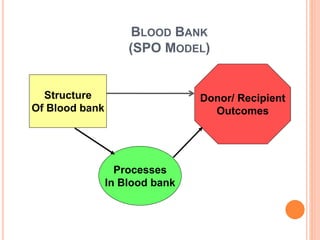
BLOOD BANK
(SPO MODEL)
Structure
Of Blood bank
Processes
In Blood bank
Donor/ Recipient
Outcomes
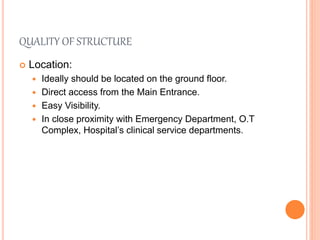
QUALITY OF STRUCTURE
 Location:
 Ideally should be located on the ground floor.
 Direct access from the Main Entrance.
 Easy Visibility.
 In close proximity with Emergency Department, O.T
Complex, Hospital’s clinical service departments.
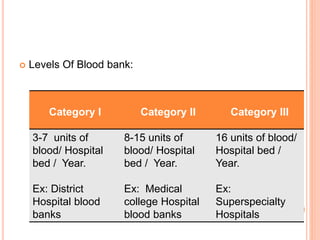
 Levels Of Blood bank:
Category I Category II Category III
3-7 units of
blood/ Hospital
bed / Year.
Ex: District
Hospital blood
banks
8-15 units of
blood/ Hospital
bed / Year.
Ex: Medical
college Hospital
blood banks
16 units of blood/
Hospital bed /
Year.
Ex:
Superspecialty
Hospitals
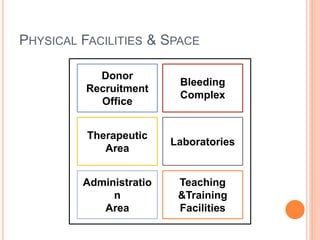
PHYSICAL FACILITIES & SPACE
Donor
Recruitment
Office
Bleeding
Complex
Therapeutic
Area
Laboratories
Administratio
n
Area
Teaching
&Training
Facilities
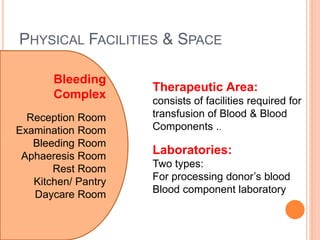
PHYSICAL FACILITIES & SPACE
Bleeding
Complex
Reception Room
Examination Room
Bleeding Room
Aphaeresis Room
Rest Room
Kitchen/ Pantry
Daycare Room
Therapeutic Area:
consists of facilities required for
transfusion of Blood & Blood
Components ..
Laboratories:
Two types:
For processing donor’s blood
Blood component laboratory
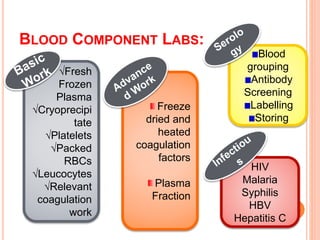
HIV
Malaria
Syphilis
HBV
Hepatitis C
BLOOD COMPONENT LABS:
√Fresh
Frozen
Plasma
√Cryoprecipi
tate
√Platelets
√Packed
RBCs
√Leucocytes
√Relevant
coagulation
work
Freeze
dried and
heated
coagulation
factors
Plasma
Fraction
Blood
grouping
Antibody
Screening
Labelling
Storing
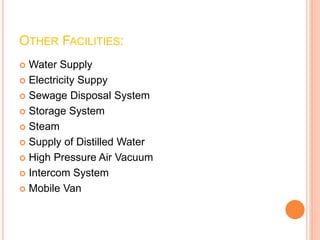
OTHER FACILITIES:
 Water Supply
 Electricity Suppy
 Sewage Disposal System
 Storage System
 Steam
 Supply of Distilled Water
 High Pressure Air Vacuum
 Intercom System
 Mobile Van
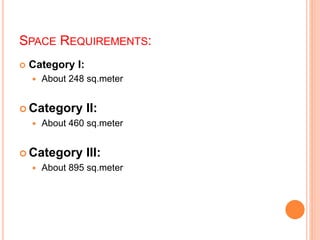
SPACE REQUIREMENTS:
 Category I:
 About 248 sq.meter
 Category II:
 About 460 sq.meter
 Category III:
 About 895 sq.meter
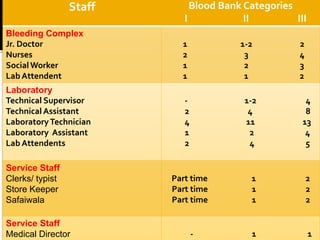
Staff Blood Bank Categories
I II III
Bleeding Complex
Jr. Doctor
Nurses
SocialWorker
Lab Attendent
1 1-2 2
2 3 4
1 2 3
1 1 2
Laboratory
Technical Supervisor
Technical Assistant
LaboratoryTechnician
Laboratory Assistant
Lab Attendents
- 1-2 4
2 4 8
4 11 13
1 2 4
2 4 5
Service Staff
Clerks/ typist
Store Keeper
Safaiwala
Part time 1 2
Part time 1 2
Part time 1 2
Service Staff
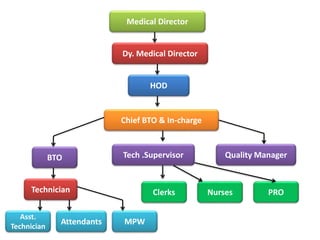
Medical Director - 1 1
Medical Director
Dy. Medical Director
Chief BTO & In-charge
HOD
BTO Tech .Supervisor Quality Manager
Clerks PRONursesTechnician
Asst.
Technician
Attendants MPW
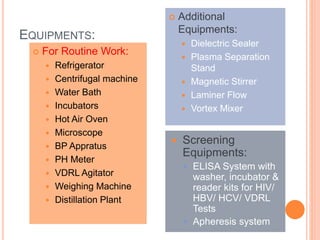
EQUIPMENTS:
 For Routine Work:
 Refrigerator
 Centrifugal machine
 Water Bath
 Incubators
 Hot Air Oven
 Microscope
 BP Appratus
 PH Meter
 VDRL Agitator
 Weighing Machine
 Distillation Plant
 Additional
Equipments:
 Dielectric Sealer
 Plasma Separation
Stand
 Magnetic Stirrer
 Laminer Flow
 Vortex Mixer
 Screening
Equipments:
 ELISA System with
washer, incubator &
reader kits for HIV/
HBV/ HCV/ VDRL
Tests
 Apheresis system
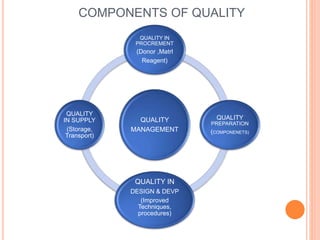
QUALITY
MANAGEMENT
QUALITY IN
PROCREMENT
(Donor ,Matrl
Reagent)
QUALITY
PREPARATION
(COMPONENETS)
QUALITY IN
DESIGN & DEVP
(Improved
Techniques,
procedures)
QUALITY
IN SUPPLY
(Storage,
Transport)
COMPONENTS OF QUALITY
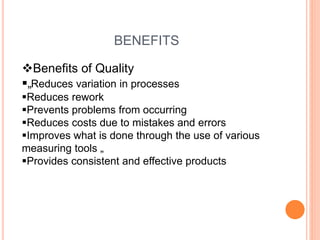
BENEFITS
Benefits of Quality
„Reduces variation in processes
Reduces rework
Prevents problems from occurring
Reduces costs due to mistakes and errors
Improves what is done through the use of various
measuring tools „
Provides consistent and effective products
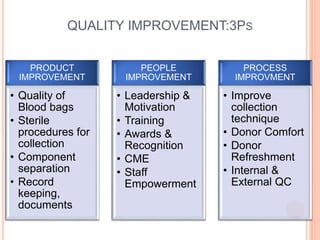
QUALITY IMPROVEMENT:3PS
PRODUCT
IMPROVEMENT
• Quality of
Blood bags
• Sterile
procedures for
collection
• Component
separation
• Record
keeping,
documents
PEOPLE
IMPROVEMENT
• Leadership &
Motivation
• Training
• Awards &
Recognition
• CME
• Staff
Empowerment
PROCESS
IMPROVMENT
• Improve
collection
technique
• Donor Comfort
• Donor
Refreshment
• Internal &
External QC
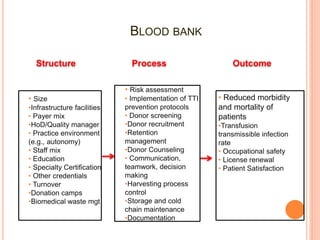
BLOOD BANK
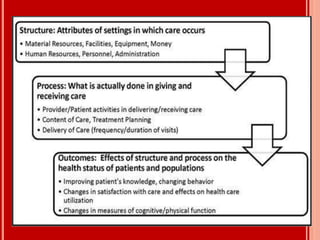
Structure Process Outcome
• Size
•Infrastructure facilities
• Payer mix
•HoD/Quality manager
• Practice environment
(e.g., autonomy)
• Staff mix
• Education
• Specialty Certification
• Other credentials
• Turnover
•Donation camps
•Biomedical waste mgt
• Risk assessment
• Implementation of TTI
prevention protocols
• Donor screening
•Donor recruitment
•Retention
management
•Donor Counseling
• Communication,
teamwork, decision
making
•Harvesting process
control
•Storage and cold
chain maintenance
•Documentation
• Reduced morbidity
and mortality of
patients
•Transfusion
transmissible infection
rate
• Occupational safety
• License renewal
• Patient Satisfaction
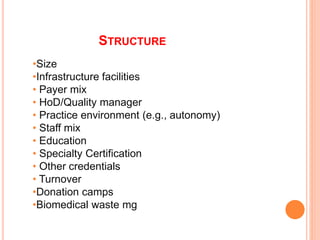
STRUCTURE
•Size
•Infrastructure facilities
• Payer mix
• HoD/Quality manager
• Practice environment (e.g., autonomy)
• Staff mix
• Education
• Specialty Certification
• Other credentials
• Turnover
•Donation camps
•Biomedical waste mg
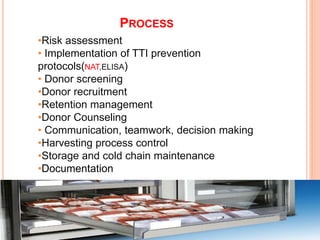
PROCESS
•Risk assessment
• Implementation of TTI prevention
protocols(NAT,ELISA)
• Donor screening
•Donor recruitment
•Retention management
•Donor Counseling
• Communication, teamwork, decision making
•Harvesting process control
•Storage and cold chain maintenance
•Documentation
OUTCOMES
•Reduced morbidity and mortality of
patients
•Transfusion transmissible infection
rate(TTI)
• Occupational safety
• License renewal
• Patient Satisfaction
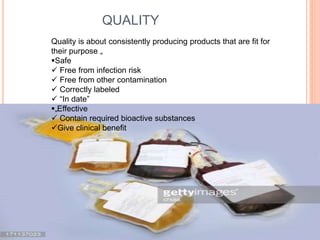
Quality is about consistently producing products that are fit for
their purpose „
Safe
 Free from infection risk
 Free from other contamination
 Correctly labeled
 “In date”
„Effective
 Contain required bioactive substances
Give clinical benefit
QUALITY
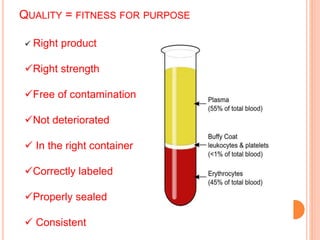
 Right product
Right strength
Free of contamination
Not deteriorated
 In the right container
Correctly labeled
Properly sealed
 Consistent
QUALITY = FITNESS FOR PURPOSE
REFERENCES:
 Hospital Administration by DC Joshi & Mamta
Joshi
 http://nacoonline.org/Quick_links/Publications/B
lood Safety Lab Services/Operational Technical
Guidelines & Policies/ Standards for Blood
bank.
 http://www.who.int/bloodsafety/tranfusion_servi
ces/en.
 http://en.wikipedia.org/wiki/Bloodbank
 Current concept of blood bank organisation and
planning:A Review Int. J. Curr. Res. Biol. Med.
(2016). 1(7): 19-26 ISSN: 2455-944X
Blood Bank: Structure, Process & Outcome

Blood Bank: Structure, Process & Outcome

  • 1.
  • 2.
    PREVIEW  Blood isthe very life line for every human being, was used as a tonic by Indian doctors for weak.  Globally, blood transfusion contributes to saving millions of lives every year, improves life expectancy and the quality of life of patients suffering from life-threatening conditions  WHO developed a global strategy on blood safety to reduce the burden of diseases due to unsafe blood transfusion  National Blood Policy came in existence on the directives of Supreme Court of India - 1996.  National Blood Transfusion Council (NBTC) as policy formulating apex body in BT with SBTC,NACO in support of National Blood programme
  • 3.
    BLOOD BANK (SPO MODEL) Structure OfBlood bank Processes In Blood bank Donor/ Recipient Outcomes
  • 5.
    QUALITY OF STRUCTURE Location:  Ideally should be located on the ground floor.  Direct access from the Main Entrance.  Easy Visibility.  In close proximity with Emergency Department, O.T Complex, Hospital’s clinical service departments.
  • 6.
     Levels OfBlood bank: Category I Category II Category III 3-7 units of blood/ Hospital bed / Year. Ex: District Hospital blood banks 8-15 units of blood/ Hospital bed / Year. Ex: Medical college Hospital blood banks 16 units of blood/ Hospital bed / Year. Ex: Superspecialty Hospitals
  • 7.
    PHYSICAL FACILITIES &SPACE Donor Recruitment Office Bleeding Complex Therapeutic Area Laboratories Administratio n Area Teaching &Training Facilities
  • 8.
    PHYSICAL FACILITIES &SPACE Bleeding Complex Reception Room Examination Room Bleeding Room Aphaeresis Room Rest Room Kitchen/ Pantry Daycare Room Therapeutic Area: consists of facilities required for transfusion of Blood & Blood Components .. Laboratories: Two types: For processing donor’s blood Blood component laboratory
  • 9.
    HIV Malaria Syphilis HBV Hepatitis C BLOOD COMPONENTLABS: √Fresh Frozen Plasma √Cryoprecipi tate √Platelets √Packed RBCs √Leucocytes √Relevant coagulation work Freeze dried and heated coagulation factors Plasma Fraction Blood grouping Antibody Screening Labelling Storing
  • 10.
    OTHER FACILITIES:  WaterSupply  Electricity Suppy  Sewage Disposal System  Storage System  Steam  Supply of Distilled Water  High Pressure Air Vacuum  Intercom System  Mobile Van
  • 11.
    SPACE REQUIREMENTS:  CategoryI:  About 248 sq.meter  Category II:  About 460 sq.meter  Category III:  About 895 sq.meter
  • 12.
    Staff Blood BankCategories I II III Bleeding Complex Jr. Doctor Nurses SocialWorker Lab Attendent 1 1-2 2 2 3 4 1 2 3 1 1 2 Laboratory Technical Supervisor Technical Assistant LaboratoryTechnician Laboratory Assistant Lab Attendents - 1-2 4 2 4 8 4 11 13 1 2 4 2 4 5 Service Staff Clerks/ typist Store Keeper Safaiwala Part time 1 2 Part time 1 2 Part time 1 2 Service Staff Medical Director - 1 1
  • 13.
    Medical Director Dy. MedicalDirector Chief BTO & In-charge HOD BTO Tech .Supervisor Quality Manager Clerks PRONursesTechnician Asst. Technician Attendants MPW
  • 14.
    EQUIPMENTS:  For RoutineWork:  Refrigerator  Centrifugal machine  Water Bath  Incubators  Hot Air Oven  Microscope  BP Appratus  PH Meter  VDRL Agitator  Weighing Machine  Distillation Plant  Additional Equipments:  Dielectric Sealer  Plasma Separation Stand  Magnetic Stirrer  Laminer Flow  Vortex Mixer  Screening Equipments:  ELISA System with washer, incubator & reader kits for HIV/ HBV/ HCV/ VDRL Tests  Apheresis system
  • 15.
    QUALITY MANAGEMENT QUALITY IN PROCREMENT (Donor ,Matrl Reagent) QUALITY PREPARATION (COMPONENETS) QUALITYIN DESIGN & DEVP (Improved Techniques, procedures) QUALITY IN SUPPLY (Storage, Transport) COMPONENTS OF QUALITY
  • 16.
    BENEFITS Benefits of Quality „Reducesvariation in processes Reduces rework Prevents problems from occurring Reduces costs due to mistakes and errors Improves what is done through the use of various measuring tools „ Provides consistent and effective products
  • 17.
    QUALITY IMPROVEMENT:3PS PRODUCT IMPROVEMENT • Qualityof Blood bags • Sterile procedures for collection • Component separation • Record keeping, documents PEOPLE IMPROVEMENT • Leadership & Motivation • Training • Awards & Recognition • CME • Staff Empowerment PROCESS IMPROVMENT • Improve collection technique • Donor Comfort • Donor Refreshment • Internal & External QC
  • 18.
    BLOOD BANK Structure ProcessOutcome • Size •Infrastructure facilities • Payer mix •HoD/Quality manager • Practice environment (e.g., autonomy) • Staff mix • Education • Specialty Certification • Other credentials • Turnover •Donation camps •Biomedical waste mgt • Risk assessment • Implementation of TTI prevention protocols • Donor screening •Donor recruitment •Retention management •Donor Counseling • Communication, teamwork, decision making •Harvesting process control •Storage and cold chain maintenance •Documentation • Reduced morbidity and mortality of patients •Transfusion transmissible infection rate • Occupational safety • License renewal • Patient Satisfaction
  • 19.
    STRUCTURE •Size •Infrastructure facilities • Payermix • HoD/Quality manager • Practice environment (e.g., autonomy) • Staff mix • Education • Specialty Certification • Other credentials • Turnover •Donation camps •Biomedical waste mg
  • 20.
    PROCESS •Risk assessment • Implementationof TTI prevention protocols(NAT,ELISA) • Donor screening •Donor recruitment •Retention management •Donor Counseling • Communication, teamwork, decision making •Harvesting process control •Storage and cold chain maintenance •Documentation
  • 21.
    OUTCOMES •Reduced morbidity andmortality of patients •Transfusion transmissible infection rate(TTI) • Occupational safety • License renewal • Patient Satisfaction
  • 22.
    Quality is aboutconsistently producing products that are fit for their purpose „ Safe  Free from infection risk  Free from other contamination  Correctly labeled  “In date” „Effective  Contain required bioactive substances Give clinical benefit QUALITY
  • 23.
     Right product Rightstrength Free of contamination Not deteriorated  In the right container Correctly labeled Properly sealed  Consistent QUALITY = FITNESS FOR PURPOSE
  • 24.
    REFERENCES:  Hospital Administrationby DC Joshi & Mamta Joshi  http://nacoonline.org/Quick_links/Publications/B lood Safety Lab Services/Operational Technical Guidelines & Policies/ Standards for Blood bank.  http://www.who.int/bloodsafety/tranfusion_servi ces/en.  http://en.wikipedia.org/wiki/Bloodbank  Current concept of blood bank organisation and planning:A Review Int. J. Curr. Res. Biol. Med. (2016). 1(7): 19-26 ISSN: 2455-944X