Dr. Pallawi Bulakh
Contents
 What is Block chain,
 Block chain Technology Mechanisms & Networks,
 Block chain Origins,
 Objective of Block chain,
 Block chain Challenges,
 Transactions And Blocks
What is Block Chain
 Database
 Bit coin
 Ledger
 Record Keeping
Block Chain ??
An Append Only
Transaction Log
 A lot of buzz on Blockchain
 most disruptive technology of the decade.
 The technology is being adapted into many verticals
like Healthcare, Medicines, Insurance, Smart
Properties, Automobiles, and even Governments.
 the most successful implementation of Blockchain is
the Bitcoi
FACT
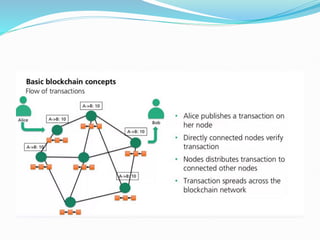
Transaction
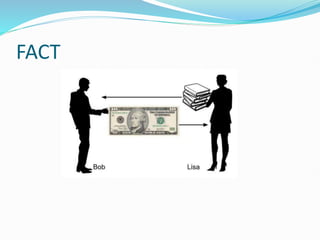
 As clearly seen here, Bob is tendering a $10 bill to Lisa
in exchange of a book.
 Once the Lisa receives this physical $10 bill, there is no
way for Bob to re-use this money for some other
transaction, as the physical currency is now in Lisa’s
possession.
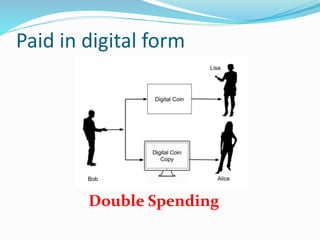
Paid in digital form
Double Spending
Frod??
 As the format for money exchange is in the digital format,
it is essentially a binary physical file stored somewhere on
Bob’s device.
 After Bob gives this file (digital money) to Lisa, he can also
a give a copy of the file to Alice.
 Both now think that they have received the money without
having any means of authenticating the digital coin and
would thus deliver their respective goods to Bob.
 This is called double-spending where the sender spends
the same money at more than one place for obtaining
services or goods from multiple vendors.
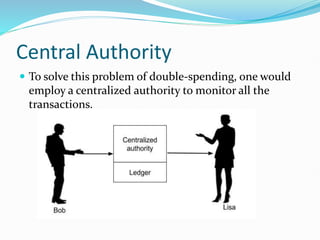
Central Authority
 To solve this problem of double-spending, one would
employ a centralized authority to monitor all the
transactions.
Issues
 The introduction of centralized authority addresses
double-spending but also introduces the cost of
creating and maintaining the authority itself.
 Banks are cutting commissions on currency
transactions to fund operations, which can be costly,
particularly in overseas transfers involving multiple
banks.
 All the above issues are solved by the introduction of
digital currency, called Bitcoin
Solution to Frod
 A bank maintains a ledger book for transactions.
 Bob sends digital money to the bank, which debits his
account, and then credits Lisa's account, ensuring
sufficient balance.
 By routing digital transactions through a centralized
authority, double-spending issues can be solved and
the authenticity of each coin can be verified,
preventing the circulation of fake money like Bob's
copy.
Problems which Internet failed to solve??
Trust
Intermediary
Short comings of current transaction
system:
 Cash is useful only in local transactions and in relatively small
amounts.
 The time between transaction and settlement can be long.
 Duplication of effort and the need for third-party validation
and/or the presence of intermediaries add to the inefficiencies.
 Fraud, cyber attacks, and even simple mistakes add to the cost
and complexity of doing business, and they expose all
participants in the network to risk if a central system, such as a
bank, is compromised.
 Many people in the world don’t have access to a bank account
and have had to develop parallel payment systems to conduct
transactions.
 And transaction volumes will explode with the rise of Internet of
Things
What Exactly Is a Blockchain?
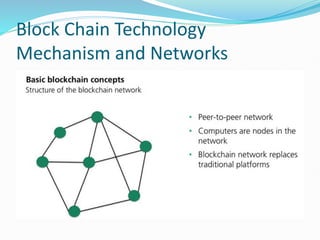
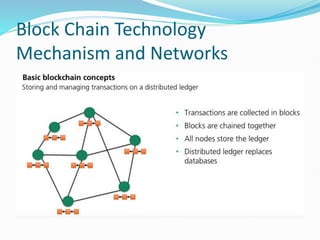
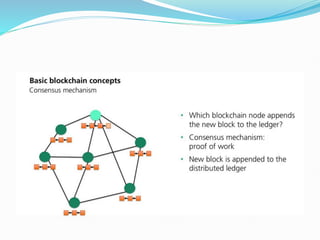
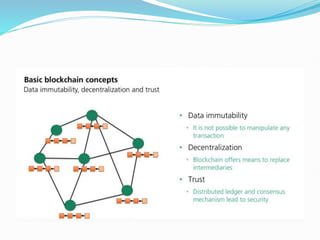
 Simply put, a blockchain is a shared database or ledger.
Pieces of data are stored in data structures known as
blocks, and each network node has a replica of the
entire database. Security is ensured since the majority
will not accept this change if somebody tries to edit or
delete an entry in one copy of the ledger.
And ...the grand Finale!!!!!
Emergence of BitCoin
 BITCOIN- A digital currency to address the
complexities, vulnerabilities, inefficiencies, and costs
of current transaction systems
Block Chain Technology
Mechanism and Networks
Block Chain Technology
Mechanism and Networks
Origin of Blockchain
History of Block chain
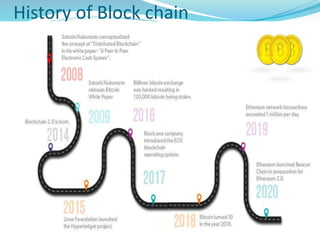
 1991
 A cryptographically secured chain of blocks is
described for the first time by Stuart Haber and W
Scott Stornetta
 1998
 Computer scientist Nick Szabo works on ‘bit gold’, a
decentralised digital currency
 2000
 Stefan Konst publishes his theory of cryptographic
secured chains, plus ideas for implementation
 2008
 Developer(s) working under the pseudonym Satoshi
Nakamoto release a white paper establishing the model for
a blockchain
 2009
 Nakamoto implements the first blockchain as the public
ledger for transactions made using bitcoin
 2014
 Blockchain technology is separated from the currency and
its potential for other financial, interorganisational
transactions is explored. Blockchain 2.0 is born, referring
to applications beyond currency
 The Ethereum blockchain system introduces computer
programs into the blocks, representing financial
instruments such as bonds. These become known as smart
contracts.
 Bitcoin’s role
 Posting their seminal whitepaper in 2008 and
launching the initial code in 2009, Nakamoto created
bitcoin to be a form of cash that could be sent peer-to-
peer without the need for a central bank or other
authority to operate and maintain the ledger, much as
how physical cash can be.
 While it wasn’t the first online currency to be
proposed, the bitcoin proposal solved several problems
in the field and has been by far the most successful
version.
 The engine that runs the bitcoin ledger that Nakamoto
designed is called the blockchain; the original and
largest blockchain is the one that still orchestrates
bitcoin transactions today.
 The second generation
 Other blockchains include those that run the several
hundred “altcoins” – other similar currency projects
with different rules – as well as truly different
applications, such as:
 Ethereum: the second largest blockchain
implementation after bitcoin.
 Ethereum distributes a currency called ether, but also
allows for the storage and operation of computer code,
allowing for smart contracts.
 Ripple: a real-time gross settlement system, currency
exchange and remittance network, based on a public
ledger
Objectives of Block chain
 The objective of block chain technology is to
revolutionize the way data and transactions are
managed, providing a more secure, transparent, and
efficient alternative to traditional centralized systems.
Easy money transfers
 Digitalisation and shifting of the bulk of things to the
online mode have made money transfers available online.
 Various platforms and applications support this and are
easy to use.
 The payments are end-to-end and secure in every way.
OTPs are sent to your registered mobile number.
 That takes a lot of time and costs you more. Blockchain
technology has made it easier, cheaper, and faster.
 Transferring money from one account to the other takes
just a few minutes.
To make lending more accessible
 Lending and borrowing have also become easier with the
help of blockchains.
 The lenders looking for people to borrow from can manage
the collateralised loans through intelligent contracts.
 These contracts will favour both the lender and the
borrower.
 Margin calls, smart management of the accounts, service
payment, complete repayment of the loan, the release of
collateral, etc., are easily taken care of.
 Better deals are available, and the lender might give you the
amount at better rates, making it even more affordable and
convenient.
 The loan processing goes faster, and the entire process
doesn't cost you much.
Safer and smoother financial
exchanges
• Popular and widely embraced due to its popularity.
• Decentralized cryptocurrency exchange platforms
offer greater authority over cryptocurrency and related
aspects.
• Transactions are cheaper and faster than other
methods.
• Provides bulk authority over money, facilitating easy
and comfortable financial exchanges.
• Saves time and improves management of financial
exchanges.
Providing transparency in
insurance
 Block chain Technology in Insurance
• Provides a secure platform for transactions and
interactions.
• Smart contracts enhance organization and
management.
• Records and verifies customer claims.
• Prevents duplicate claims on the same event.
• Enables faster claim processing and faster money
transfers.
Block Chain Challenges
 1. Lack of Trust Between Providers
 Blockchain adoption faces challenges due to lack of
trust among providers, affecting security and trust
among network participants.
Despite decentralized networks lacking a central
authority, blockchain transactions are considered safe,
private, and verified.
Consensus algorithms drive universal agreement, and
private blockchains with no known providers have
higher confidence levels.
2. Scalability Issues
 Blockchain's Scalability Challenges
• Challenges include technical scalability, which may
hinder adoption, especially for public blockchains.
• Legacy transaction networks like Visa can process
thousands of transactions per second.
• Bitcoin and Ethereum, popular blockchain networks,
lag behind in transaction speeds.
• Private blockchain networks, designed for trusted
transactions, have no scalability concerns.
• Private blockchains with no known providers have
higher levels of confidence, ensuring each new block
contributes the sole truth.
3. Regulatory Ambiguity and Poor
Governance
 Lack of legislative certainty hinders widespread use of
blockchain technology.
• Current regulations fail to keep pace with technological
advancements.
• Blockchain system reduces oversight, a major drawback.
• Businesses use blockchain for transactions, but lack clear
regulations.
• Smart contracts require regulatory support, hindering
adoption and investment.
• Private blockchain networks, with trusted parties,
overcome scalability issues.
• Private blockchains with no known providers have higher
levels of confidence.
4. Limited interoperability due to
Lack of Standardizing
 • Lack of compatibility across blockchain networks.
• Projects use various blockchain platforms with
unique protocols, code languages, consensus
processes, and privacy safeguards.
• Blockchain sector in a "state of disorder" due to lack
of common standards.
• Consistency in protocols affects security, hindering
mass adoption.
Transactions and Blocks
Key elements of a
block chain
Block
 Block is a place in a blockchain where data is stored.
 In the case of crypto currency block chains, the data
stored in a block are transactions.
 These blocks are chained together by adding the
previous block's hash to the next block's header.
 It keeps the order of the blocks intact and makes the
data in the blocks immutable.
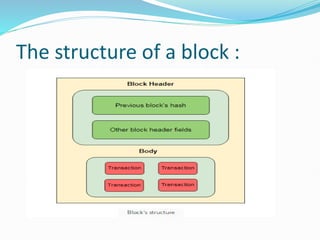
The structure of a block :
 A block consists of the following two main parts:
 Header
 Body
 Header
 A block's header contains information about the block
and the miner. It is further divided into subparts which
are as follows:
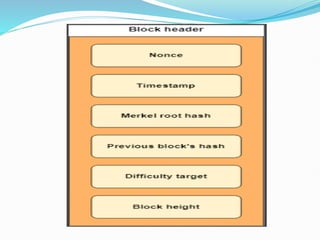
 Previous block's hash
 This is the hash of the previous block. It chains the
blocks together and makes the data in the previous
blocks immutable. If data in the previous blocks is
changed, then the hash of that block will change
causing the unchaining of the blockchain.
 Other block header fields
 These fields can vary depending on the different
requirements of different block chains. Some of the
common fields are as follows:
 Nonce: This is an integer that a miner changes to change the
hash of the block to achieve the network's difficulty.
 Timestamp: This is the time at which the block was mined.
It is usually in the Unix time.
 Miner: Miners are an essential part of the block chain
network. They are responsible for verifying
transactions and adding them to the block chain.
 Difficulty: It is the current difficulty level of the
network. It is stored in different formats in every
blockchain.
 Merkel root hash: Hashes pair off transactions until
only one hash remains, called a root hash or a Merkel
root hash
 Block height: The number of blocks mined between
the genesis block and the current block.
 Body
 It includes all the data stored in the block, such as
transactions. Every blockchain has a different format
for storing transactions. An array of transactions is
stored in the body of the block.
The Birth of Blockchain
 • Bitcoin is actually built on the foundation of
blockchain, which serves as bitcoin’s shared ledger.
 • This shared ledger can be used to record any
transaction and track the movement of any asset
whether tangible, intangible, or digital
Advantages:
 »Cost-effective: Bitcoin eliminates the need for
intermediaries.
 » Efficient: Transaction information is recorded once
and is available to all parties through the distributed
network.
 »Safe and secure: The underlying ledger is tamper
evident. A transaction can’t be changed; it can only be
reversed with another transaction, in which case both
transactions are visible
Point to be noted
 Bitcoin and blockchain are not the same.
 Blockchain provides the means to record and store
bitcoin transactions, but blockchain has many uses
beyond bitcoin.
 Bitcoin is only the first use case for blockchain
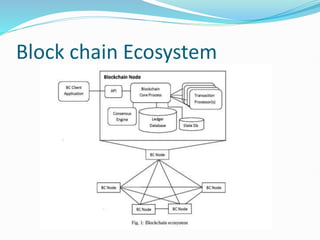
Block chain Ecosystem
Block chain technology Mechanism
Features of block chain
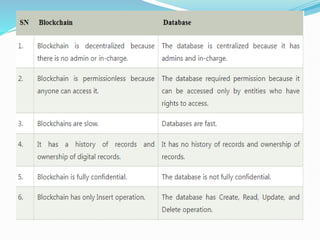
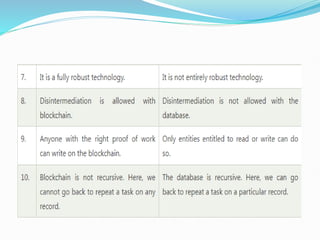
 Blockchain is a type of shared database that differs from a typical
database in the way it stores information; blockchains store data
in blocks linked together via cryptography.
 Different types of information can be stored on a blockchain, but
the most common use for transactions has been as a ledger.
 In Bitcoin’s case, the blockchain is decentralized, so no single
person or group has control—instead, all users collectively retain
control.
 Decentralized blockchains are immutable, which means that the
data entered is irreversible.
 For Bitcoin, transactions are permanently recorded and viewable
to anyone.
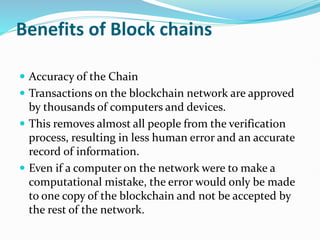
Benefits of Block chains
 Accuracy of the Chain
 Transactions on the blockchain network are approved
by thousands of computers and devices.
 This removes almost all people from the verification
process, resulting in less human error and an accurate
record of information.
 Even if a computer on the network were to make a
computational mistake, the error would only be made
to one copy of the blockchain and not be accepted by
the rest of the network.
Benefits of Block chains
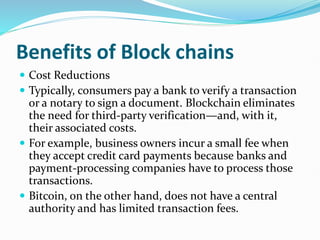
 Cost Reductions
 Typically, consumers pay a bank to verify a transaction
or a notary to sign a document. Blockchain eliminates
the need for third-party verification—and, with it,
their associated costs.
 For example, business owners incur a small fee when
they accept credit card payments because banks and
payment-processing companies have to process those
transactions.
 Bitcoin, on the other hand, does not have a central
authority and has limited transaction fees.
Benefits of Block chains
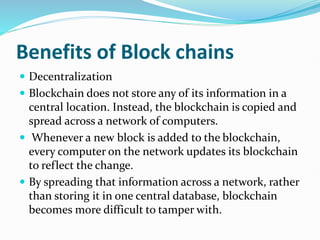
 Decentralization
 Blockchain does not store any of its information in a
central location. Instead, the blockchain is copied and
spread across a network of computers.
 Whenever a new block is added to the blockchain,
every computer on the network updates its blockchain
to reflect the change.
 By spreading that information across a network, rather
than storing it in one central database, blockchain
becomes more difficult to tamper with.
Benefits of Block chains
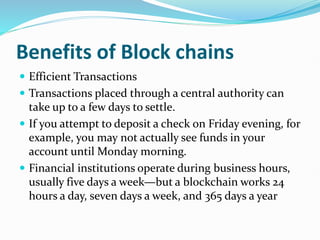
 Efficient Transactions
 Transactions placed through a central authority can
take up to a few days to settle.
 If you attempt to deposit a check on Friday evening, for
example, you may not actually see funds in your
account until Monday morning.
 Financial institutions operate during business hours,
usually five days a week—but a blockchain works 24
hours a day, seven days a week, and 365 days a year
Benefits of Block chains
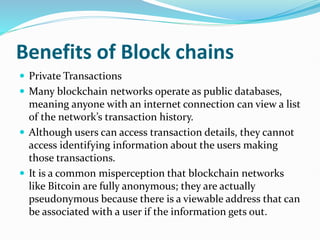
 Private Transactions
 Many blockchain networks operate as public databases,
meaning anyone with an internet connection can view a list
of the network’s transaction history.
 Although users can access transaction details, they cannot
access identifying information about the users making
those transactions.
 It is a common misperception that blockchain networks
like Bitcoin are fully anonymous; they are actually
pseudonymous because there is a viewable address that can
be associated with a user if the information gets out.
Benefits of Block chains
 Secure Transactions
 Once a transaction is recorded, its authenticity must
be verified by the blockchain network.
 After the transaction is validated, it is added to the
blockchain block.
 Each block on the blockchain contains its unique hash
and the unique hash of the block before it.
 Therefore, the blocks cannot be altered once the
network confirms them.
Benefits of Block chains
 Transparency
 Many blockchains are entirely open-source software. This
means that everyone can view its code.
 This gives auditors the ability to review cryptocurrencies
like Bitcoin for security.
 However, it also means there is no real authority on who
controls Bitcoin’s code or how it is edited.
 Because of this, anyone can suggest changes or upgrades to
the system.
 If a majority of the network users agree that the new
version of the code with the upgrade is sound and
worthwhile, then Bitcoin can be updated
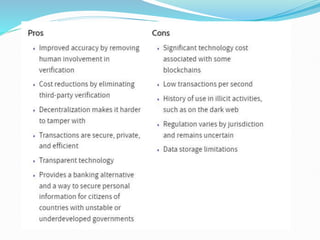
Drawbacks of Block chains
 Technology Cost
 Although blockchain can save users money on
transaction fees, the technology is far from free.
 For example, the Bitcoin network's proof-of-work
system to validate transactions consumes vast amounts
of computational power.
 In the real world, the energy consumed by the millions
of devices on the Bitcoin network is more than
Pakistan consumes annually
Drawbacks of Block chains
 Speed and Data Inefficiency
 Bitcoin is a perfect case study for the possible
inefficiencies of blockchain.
 Bitcoin's PoW system takes about 10 minutes to add a
new block to the blockchain.
 At that rate, it's estimated that the blockchain
network can only manage about three transactions per
second
Drawbacks of Block chains
 Illegal Activity
 While confidentiality on the blockchain network
protects users from hacks and preserves privacy, it also
allows for illegal trading and activity on the blockchain
network.
 The most cited example of blockchain being used for
illicit transactions is probably the Silk Road, an online
dark web illegal-drug and money laundering
marketplace operating from February 2011 until
October 2013, when the FBI shut it down.
Drawbacks of Block chains
 Regulation
 Many in the crypto space have expressed concerns
about government regulation of cryptocurrencies.
 Many jurisdictions are tightening control over certain
types of crypto and other virtual currencies.
 However, no regulations have yet been introduced
that focus on restricting blockchain uses and
development, only certain products created using it.
Drawbacks of Block chains
 Data Storage
 Another significant implication of blockchains is that
they require storage.
 This may not appear to be substantial because we
already store lots of information and data.
 However, as time passes, the number of growing
blockchain uses will require more storage, especially
on blockchains where nodes store the entire chain.
 Thank you
References
 https://www.coursera.org/learn/blockchain-
professionals/exam/oUwtf/blockchain-
characteristics?redirectToCover=true
 https://www.udemy.com/course/blockchain-
complete-reference/learn/lecture/9594648#content
 Chatgpt

Block Chain Technology M.Sc. UNIT 1.pptx

  • 1.
  • 2.
    Contents  What isBlock chain,  Block chain Technology Mechanisms & Networks,  Block chain Origins,  Objective of Block chain,  Block chain Challenges,  Transactions And Blocks
  • 3.
    What is BlockChain  Database  Bit coin  Ledger  Record Keeping
  • 4.
    Block Chain ?? AnAppend Only Transaction Log
  • 6.
     A lotof buzz on Blockchain  most disruptive technology of the decade.  The technology is being adapted into many verticals like Healthcare, Medicines, Insurance, Smart Properties, Automobiles, and even Governments.  the most successful implementation of Blockchain is the Bitcoi
  • 7.
  • 8.
    Transaction  As clearlyseen here, Bob is tendering a $10 bill to Lisa in exchange of a book.  Once the Lisa receives this physical $10 bill, there is no way for Bob to re-use this money for some other transaction, as the physical currency is now in Lisa’s possession.
  • 9.
    Paid in digitalform Double Spending
  • 10.
    Frod??  As theformat for money exchange is in the digital format, it is essentially a binary physical file stored somewhere on Bob’s device.  After Bob gives this file (digital money) to Lisa, he can also a give a copy of the file to Alice.  Both now think that they have received the money without having any means of authenticating the digital coin and would thus deliver their respective goods to Bob.  This is called double-spending where the sender spends the same money at more than one place for obtaining services or goods from multiple vendors.
  • 11.
    Central Authority  Tosolve this problem of double-spending, one would employ a centralized authority to monitor all the transactions.
  • 12.
    Issues  The introductionof centralized authority addresses double-spending but also introduces the cost of creating and maintaining the authority itself.  Banks are cutting commissions on currency transactions to fund operations, which can be costly, particularly in overseas transfers involving multiple banks.  All the above issues are solved by the introduction of digital currency, called Bitcoin
  • 13.
    Solution to Frod A bank maintains a ledger book for transactions.  Bob sends digital money to the bank, which debits his account, and then credits Lisa's account, ensuring sufficient balance.  By routing digital transactions through a centralized authority, double-spending issues can be solved and the authenticity of each coin can be verified, preventing the circulation of fake money like Bob's copy.
  • 14.
    Problems which Internetfailed to solve?? Trust Intermediary
  • 15.
    Short comings ofcurrent transaction system:  Cash is useful only in local transactions and in relatively small amounts.  The time between transaction and settlement can be long.  Duplication of effort and the need for third-party validation and/or the presence of intermediaries add to the inefficiencies.  Fraud, cyber attacks, and even simple mistakes add to the cost and complexity of doing business, and they expose all participants in the network to risk if a central system, such as a bank, is compromised.  Many people in the world don’t have access to a bank account and have had to develop parallel payment systems to conduct transactions.  And transaction volumes will explode with the rise of Internet of Things
  • 16.
    What Exactly Isa Blockchain?  Simply put, a blockchain is a shared database or ledger. Pieces of data are stored in data structures known as blocks, and each network node has a replica of the entire database. Security is ensured since the majority will not accept this change if somebody tries to edit or delete an entry in one copy of the ledger.
  • 17.
    And ...the grandFinale!!!!!
  • 18.
    Emergence of BitCoin BITCOIN- A digital currency to address the complexities, vulnerabilities, inefficiencies, and costs of current transaction systems
  • 19.
  • 20.
  • 24.
  • 25.
  • 26.
     1991  Acryptographically secured chain of blocks is described for the first time by Stuart Haber and W Scott Stornetta  1998  Computer scientist Nick Szabo works on ‘bit gold’, a decentralised digital currency  2000  Stefan Konst publishes his theory of cryptographic secured chains, plus ideas for implementation
  • 27.
     2008  Developer(s)working under the pseudonym Satoshi Nakamoto release a white paper establishing the model for a blockchain  2009  Nakamoto implements the first blockchain as the public ledger for transactions made using bitcoin  2014  Blockchain technology is separated from the currency and its potential for other financial, interorganisational transactions is explored. Blockchain 2.0 is born, referring to applications beyond currency  The Ethereum blockchain system introduces computer programs into the blocks, representing financial instruments such as bonds. These become known as smart contracts.
  • 28.
     Bitcoin’s role Posting their seminal whitepaper in 2008 and launching the initial code in 2009, Nakamoto created bitcoin to be a form of cash that could be sent peer-to- peer without the need for a central bank or other authority to operate and maintain the ledger, much as how physical cash can be.  While it wasn’t the first online currency to be proposed, the bitcoin proposal solved several problems in the field and has been by far the most successful version.  The engine that runs the bitcoin ledger that Nakamoto designed is called the blockchain; the original and largest blockchain is the one that still orchestrates bitcoin transactions today.
  • 29.
     The secondgeneration  Other blockchains include those that run the several hundred “altcoins” – other similar currency projects with different rules – as well as truly different applications, such as:  Ethereum: the second largest blockchain implementation after bitcoin.  Ethereum distributes a currency called ether, but also allows for the storage and operation of computer code, allowing for smart contracts.  Ripple: a real-time gross settlement system, currency exchange and remittance network, based on a public ledger
  • 30.
    Objectives of Blockchain  The objective of block chain technology is to revolutionize the way data and transactions are managed, providing a more secure, transparent, and efficient alternative to traditional centralized systems.
  • 31.
    Easy money transfers Digitalisation and shifting of the bulk of things to the online mode have made money transfers available online.  Various platforms and applications support this and are easy to use.  The payments are end-to-end and secure in every way. OTPs are sent to your registered mobile number.  That takes a lot of time and costs you more. Blockchain technology has made it easier, cheaper, and faster.  Transferring money from one account to the other takes just a few minutes.
  • 32.
    To make lendingmore accessible  Lending and borrowing have also become easier with the help of blockchains.  The lenders looking for people to borrow from can manage the collateralised loans through intelligent contracts.  These contracts will favour both the lender and the borrower.  Margin calls, smart management of the accounts, service payment, complete repayment of the loan, the release of collateral, etc., are easily taken care of.  Better deals are available, and the lender might give you the amount at better rates, making it even more affordable and convenient.  The loan processing goes faster, and the entire process doesn't cost you much.
  • 33.
    Safer and smootherfinancial exchanges • Popular and widely embraced due to its popularity. • Decentralized cryptocurrency exchange platforms offer greater authority over cryptocurrency and related aspects. • Transactions are cheaper and faster than other methods. • Provides bulk authority over money, facilitating easy and comfortable financial exchanges. • Saves time and improves management of financial exchanges.
  • 34.
    Providing transparency in insurance Block chain Technology in Insurance • Provides a secure platform for transactions and interactions. • Smart contracts enhance organization and management. • Records and verifies customer claims. • Prevents duplicate claims on the same event. • Enables faster claim processing and faster money transfers.
  • 35.
    Block Chain Challenges 1. Lack of Trust Between Providers  Blockchain adoption faces challenges due to lack of trust among providers, affecting security and trust among network participants. Despite decentralized networks lacking a central authority, blockchain transactions are considered safe, private, and verified. Consensus algorithms drive universal agreement, and private blockchains with no known providers have higher confidence levels.
  • 36.
    2. Scalability Issues Blockchain's Scalability Challenges • Challenges include technical scalability, which may hinder adoption, especially for public blockchains. • Legacy transaction networks like Visa can process thousands of transactions per second. • Bitcoin and Ethereum, popular blockchain networks, lag behind in transaction speeds. • Private blockchain networks, designed for trusted transactions, have no scalability concerns. • Private blockchains with no known providers have higher levels of confidence, ensuring each new block contributes the sole truth.
  • 37.
    3. Regulatory Ambiguityand Poor Governance  Lack of legislative certainty hinders widespread use of blockchain technology. • Current regulations fail to keep pace with technological advancements. • Blockchain system reduces oversight, a major drawback. • Businesses use blockchain for transactions, but lack clear regulations. • Smart contracts require regulatory support, hindering adoption and investment. • Private blockchain networks, with trusted parties, overcome scalability issues. • Private blockchains with no known providers have higher levels of confidence.
  • 38.
    4. Limited interoperabilitydue to Lack of Standardizing  • Lack of compatibility across blockchain networks. • Projects use various blockchain platforms with unique protocols, code languages, consensus processes, and privacy safeguards. • Blockchain sector in a "state of disorder" due to lack of common standards. • Consistency in protocols affects security, hindering mass adoption.
  • 39.
    Transactions and Blocks Keyelements of a block chain
  • 40.
    Block  Block isa place in a blockchain where data is stored.  In the case of crypto currency block chains, the data stored in a block are transactions.  These blocks are chained together by adding the previous block's hash to the next block's header.  It keeps the order of the blocks intact and makes the data in the blocks immutable.
  • 41.
  • 42.
     A blockconsists of the following two main parts:  Header  Body
  • 43.
     Header  Ablock's header contains information about the block and the miner. It is further divided into subparts which are as follows:  Previous block's hash  This is the hash of the previous block. It chains the blocks together and makes the data in the previous blocks immutable. If data in the previous blocks is changed, then the hash of that block will change causing the unchaining of the blockchain.
  • 44.
     Other blockheader fields  These fields can vary depending on the different requirements of different block chains. Some of the common fields are as follows:  Nonce: This is an integer that a miner changes to change the hash of the block to achieve the network's difficulty.  Timestamp: This is the time at which the block was mined. It is usually in the Unix time.  Miner: Miners are an essential part of the block chain network. They are responsible for verifying transactions and adding them to the block chain.
  • 45.
     Difficulty: Itis the current difficulty level of the network. It is stored in different formats in every blockchain.  Merkel root hash: Hashes pair off transactions until only one hash remains, called a root hash or a Merkel root hash  Block height: The number of blocks mined between the genesis block and the current block.
  • 47.
     Body  Itincludes all the data stored in the block, such as transactions. Every blockchain has a different format for storing transactions. An array of transactions is stored in the body of the block.
  • 48.
    The Birth ofBlockchain  • Bitcoin is actually built on the foundation of blockchain, which serves as bitcoin’s shared ledger.  • This shared ledger can be used to record any transaction and track the movement of any asset whether tangible, intangible, or digital
  • 49.
    Advantages:  »Cost-effective: Bitcoineliminates the need for intermediaries.  » Efficient: Transaction information is recorded once and is available to all parties through the distributed network.  »Safe and secure: The underlying ledger is tamper evident. A transaction can’t be changed; it can only be reversed with another transaction, in which case both transactions are visible
  • 50.
    Point to benoted  Bitcoin and blockchain are not the same.  Blockchain provides the means to record and store bitcoin transactions, but blockchain has many uses beyond bitcoin.  Bitcoin is only the first use case for blockchain
  • 51.
  • 52.
  • 53.
    Features of blockchain  Blockchain is a type of shared database that differs from a typical database in the way it stores information; blockchains store data in blocks linked together via cryptography.  Different types of information can be stored on a blockchain, but the most common use for transactions has been as a ledger.  In Bitcoin’s case, the blockchain is decentralized, so no single person or group has control—instead, all users collectively retain control.  Decentralized blockchains are immutable, which means that the data entered is irreversible.  For Bitcoin, transactions are permanently recorded and viewable to anyone.
  • 57.
    Benefits of Blockchains  Accuracy of the Chain  Transactions on the blockchain network are approved by thousands of computers and devices.  This removes almost all people from the verification process, resulting in less human error and an accurate record of information.  Even if a computer on the network were to make a computational mistake, the error would only be made to one copy of the blockchain and not be accepted by the rest of the network.
  • 58.
    Benefits of Blockchains  Cost Reductions  Typically, consumers pay a bank to verify a transaction or a notary to sign a document. Blockchain eliminates the need for third-party verification—and, with it, their associated costs.  For example, business owners incur a small fee when they accept credit card payments because banks and payment-processing companies have to process those transactions.  Bitcoin, on the other hand, does not have a central authority and has limited transaction fees.
  • 59.
    Benefits of Blockchains  Decentralization  Blockchain does not store any of its information in a central location. Instead, the blockchain is copied and spread across a network of computers.  Whenever a new block is added to the blockchain, every computer on the network updates its blockchain to reflect the change.  By spreading that information across a network, rather than storing it in one central database, blockchain becomes more difficult to tamper with.
  • 60.
    Benefits of Blockchains  Efficient Transactions  Transactions placed through a central authority can take up to a few days to settle.  If you attempt to deposit a check on Friday evening, for example, you may not actually see funds in your account until Monday morning.  Financial institutions operate during business hours, usually five days a week—but a blockchain works 24 hours a day, seven days a week, and 365 days a year
  • 61.
    Benefits of Blockchains  Private Transactions  Many blockchain networks operate as public databases, meaning anyone with an internet connection can view a list of the network’s transaction history.  Although users can access transaction details, they cannot access identifying information about the users making those transactions.  It is a common misperception that blockchain networks like Bitcoin are fully anonymous; they are actually pseudonymous because there is a viewable address that can be associated with a user if the information gets out.
  • 62.
    Benefits of Blockchains  Secure Transactions  Once a transaction is recorded, its authenticity must be verified by the blockchain network.  After the transaction is validated, it is added to the blockchain block.  Each block on the blockchain contains its unique hash and the unique hash of the block before it.  Therefore, the blocks cannot be altered once the network confirms them.
  • 63.
    Benefits of Blockchains  Transparency  Many blockchains are entirely open-source software. This means that everyone can view its code.  This gives auditors the ability to review cryptocurrencies like Bitcoin for security.  However, it also means there is no real authority on who controls Bitcoin’s code or how it is edited.  Because of this, anyone can suggest changes or upgrades to the system.  If a majority of the network users agree that the new version of the code with the upgrade is sound and worthwhile, then Bitcoin can be updated
  • 64.
    Drawbacks of Blockchains  Technology Cost  Although blockchain can save users money on transaction fees, the technology is far from free.  For example, the Bitcoin network's proof-of-work system to validate transactions consumes vast amounts of computational power.  In the real world, the energy consumed by the millions of devices on the Bitcoin network is more than Pakistan consumes annually
  • 65.
    Drawbacks of Blockchains  Speed and Data Inefficiency  Bitcoin is a perfect case study for the possible inefficiencies of blockchain.  Bitcoin's PoW system takes about 10 minutes to add a new block to the blockchain.  At that rate, it's estimated that the blockchain network can only manage about three transactions per second
  • 66.
    Drawbacks of Blockchains  Illegal Activity  While confidentiality on the blockchain network protects users from hacks and preserves privacy, it also allows for illegal trading and activity on the blockchain network.  The most cited example of blockchain being used for illicit transactions is probably the Silk Road, an online dark web illegal-drug and money laundering marketplace operating from February 2011 until October 2013, when the FBI shut it down.
  • 67.
    Drawbacks of Blockchains  Regulation  Many in the crypto space have expressed concerns about government regulation of cryptocurrencies.  Many jurisdictions are tightening control over certain types of crypto and other virtual currencies.  However, no regulations have yet been introduced that focus on restricting blockchain uses and development, only certain products created using it.
  • 68.
    Drawbacks of Blockchains  Data Storage  Another significant implication of blockchains is that they require storage.  This may not appear to be substantial because we already store lots of information and data.  However, as time passes, the number of growing blockchain uses will require more storage, especially on blockchains where nodes store the entire chain.
  • 69.
  • 70.