Blockchain
&
Cybersecurity
Presented by
Jason R. Cope
What Is Blockchain?
A technology that:
• Permits transactions to be gathered into
blocks and recorded
• Cryptographically chains blocks in
chronological order creating a “Trustless
system”
• Allows the resulting ledger to be
accessed by different servers (i.e. a
distributed ledger)
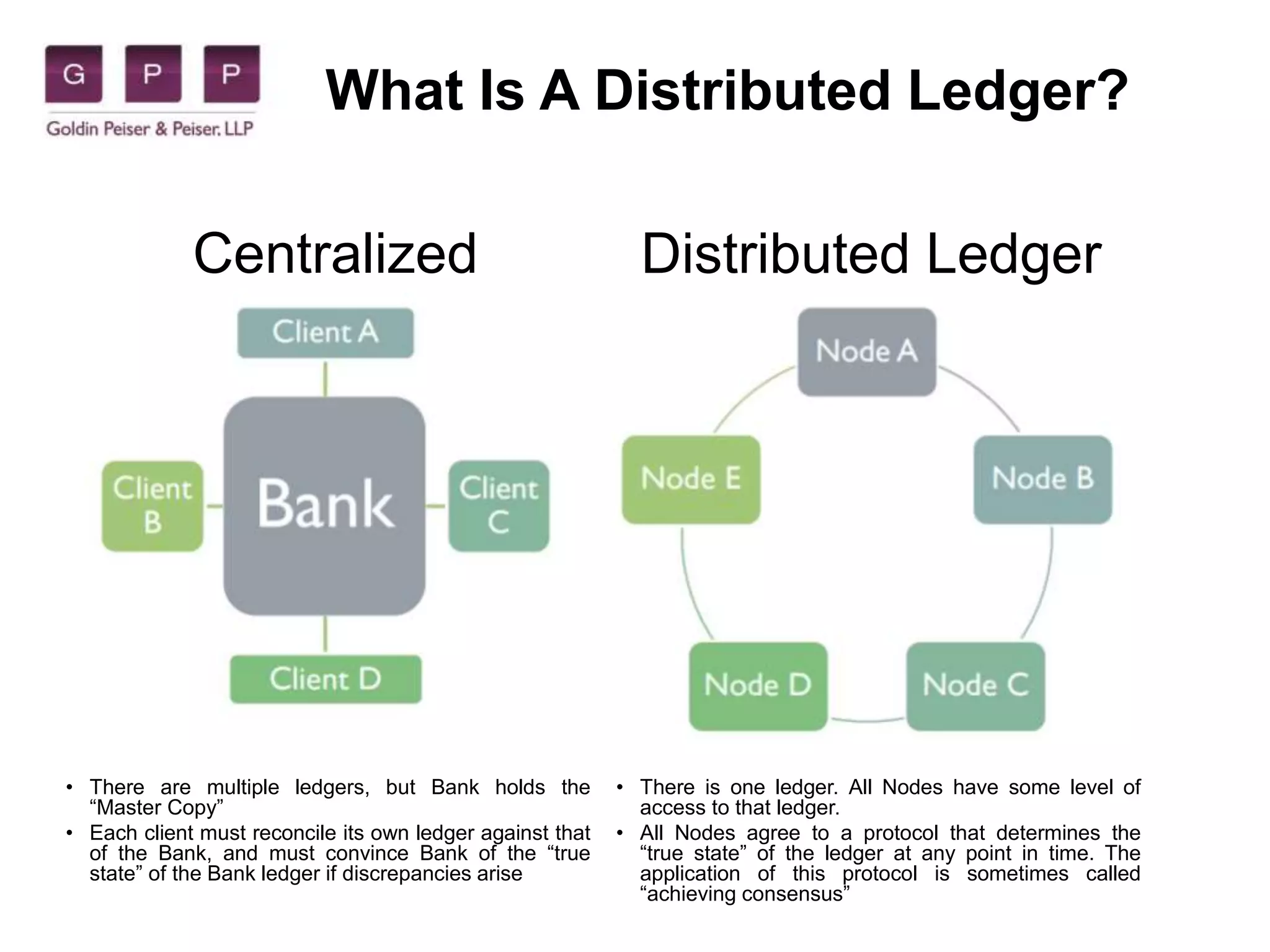
What Is A Distributed Ledger?
Centralized
Ledger
Distributed Ledger
• There are multiple ledgers, but Bank holds the
“Master Copy”
• Each client must reconcile its own ledger against that
of the Bank, and must convince Bank of the “true
state” of the Bank ledger if discrepancies arise
• There is one ledger. All Nodes have some level of
access to that ledger.
• All Nodes agree to a protocol that determines the
“true state” of the ledger at any point in time. The
application of this protocol is sometimes called
“achieving consensus”
Trustless System?
• Doesn’t mean it’s a system you can’t
trust
• No trust is required between participants
in a transaction
• How is this accomplished?
– Data is mined into blocks
– Together these blocks form a chain
– Each block in the chain includes data from
the previous block
– The resulting “blockchain” is a ledger of
transactions that automatically verifies itself
How Does It Work?
Using Blockchains
Smart contracts
• Flexible mechanism that serves as the
middleman for all manner of agreements
and data exchanges
– Identity management
– Voting
– Digital rights management
– Supply chain management
– Point-of-sale applications
– Healthcare
– Currency exchange
– Ride sharing
How Is Blockchain
Related To Bitcoin?
•Blockchain enables the existence of
cryptocurrency
•There are more than 1,600
cryptocurrencies today
•Bitcoin is the name of the best-know
cryptocurrency
•Facebook is actively working on creating a
cryptocurrency
Cryptocurrency
Benefits and Issues
Benefits:
• Offers cheaper and faster peer-to-peer
payment options
• No need to provide personal details
• Gaining acceptance as a payment option
Issues:
• Price volatility
– Less buying and selling of goods and
services
– More speculative trading of the currency
itself
Benefits of Blockchain
• Increased transparency
• Accurate tracking
• Permanent unmodifiable ledger
• Cost reduction
Blockchain Unknowns
• Complex technology
• Regulatory implications
• Implementation challenges
• Competing platforms
• Cybersecurity
CYBERSECURITY
Notable Breaches
• Target (2013)
– 110 million customers credit/debit card
information compromised
– Hackers gained access through a third-party
HVAC vendor to the point-of-sale card readers
– Cost the company $18.5 million, plus
additional compliance requirements
Notable Breaches
• Uber (2016)
– 57 million Uber users and 600 thousand
drivers personal information exposed
– Uber failed to disclose the breach for more
than one year
– Paid the hackers a “bug bounty” fee of $100
thousand to destroy the data with no way to
verify the destruction occurred
– Valuation dropped from $68 billion to $48
billion
Notable Breaches
• Equifax (2017)
– Personal information (including Social Security
Numbers, birthdates, addresses, drivers’ license
numbers) of 143 million consumers compromised
– Caused by a website application vulnerability;
using old outdated systems
– Setup a dedicated website to take care of
consumers
– Provided free credit monitoring for one year for all
consumers affected
– Cost the Company $700 million after reaching a
settlement with the government
Notable Breaches
• Capital One (July 30, 2019)
– Personal information of 100 million
consumers compromised (names, addresses,
phone numbers, email addresses, dates of
birth, annual income disclosures)
– Outside individual gained access to the
network by exploiting a misconfigured web
application firewall
– Will provide free credit monitoring for one year
for all consumers affected
Local Incidents
• Texas Lawbook survey states four out of five
law firms operating in Texas in 2017 and
2018 were victimized by a cyber attack.
• 40% of small and mid-sized companies that
experience data breaches are out of business
within six months.
• Smaller businesses that devote fewer
resources to cybersecurity end up with
information that is more accessible to cyber
attacks
Vulnerability Assessment
• Intended to identify and assign a criticality
rating to potential security weaknesses in
an organization’s technical environment,
but not to exploit the weaknesses
• External
• Internal
Vulnerability Assessment
• External
– Checks for vulnerabilities between the
external network and the internet.
• Internal
– In-depth analysis of the organization’s internal
network.
– Estimated that approximately 80% of security
breaches occur from inside the internal
network.
Vulnerability Assessment
• Deliverables
– Technical vulnerability assessment report
– Recommendations for remediation
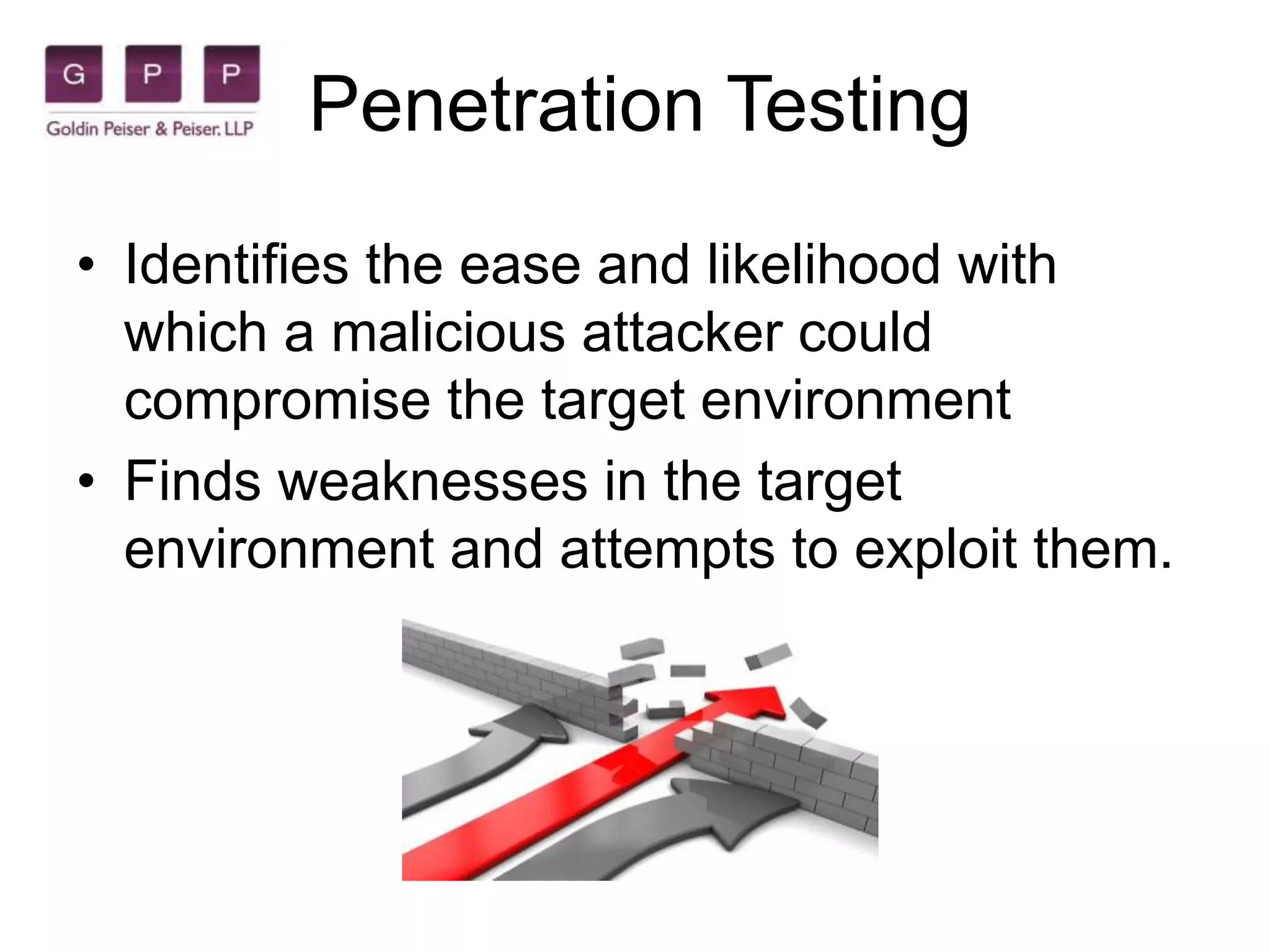
Penetration Testing
• Identifies the ease and likelihood with
which a malicious attacker could
compromise the target environment
• Finds weaknesses in the target
environment and attempts to exploit them.
Social Engineering Assessmen
• Consist of various methods to determine
susceptibility to common people-based
attacks to obtain credentials, convince
users to circumvent security controls,
install unauthorized software, disclose
sensitive information, or enable assess to
unauthorized areas.
• Focus is on humans rather than
weaknesses in the IT infrastructure.
Social Engineering Assessmen
• Common scams:
– Phishing
– Ransomware
– Media drops
– Tailgating
CONTACT US
Jason R. Cope
Goldin Peiser & Peiser, LLP
(214) 635-2508
Jcope@GPPcpa.com

Blockchain and Cybersecurity

  • 1.
  • 3.
    What Is Blockchain? Atechnology that: • Permits transactions to be gathered into blocks and recorded • Cryptographically chains blocks in chronological order creating a “Trustless system” • Allows the resulting ledger to be accessed by different servers (i.e. a distributed ledger)
  • 4.
    What Is ADistributed Ledger? Centralized Ledger Distributed Ledger • There are multiple ledgers, but Bank holds the “Master Copy” • Each client must reconcile its own ledger against that of the Bank, and must convince Bank of the “true state” of the Bank ledger if discrepancies arise • There is one ledger. All Nodes have some level of access to that ledger. • All Nodes agree to a protocol that determines the “true state” of the ledger at any point in time. The application of this protocol is sometimes called “achieving consensus”
  • 5.
    Trustless System? • Doesn’tmean it’s a system you can’t trust • No trust is required between participants in a transaction • How is this accomplished? – Data is mined into blocks – Together these blocks form a chain – Each block in the chain includes data from the previous block – The resulting “blockchain” is a ledger of transactions that automatically verifies itself
  • 6.
  • 7.
    Using Blockchains Smart contracts •Flexible mechanism that serves as the middleman for all manner of agreements and data exchanges – Identity management – Voting – Digital rights management – Supply chain management – Point-of-sale applications – Healthcare – Currency exchange – Ride sharing
  • 8.
    How Is Blockchain RelatedTo Bitcoin? •Blockchain enables the existence of cryptocurrency •There are more than 1,600 cryptocurrencies today •Bitcoin is the name of the best-know cryptocurrency •Facebook is actively working on creating a cryptocurrency
  • 9.
    Cryptocurrency Benefits and Issues Benefits: •Offers cheaper and faster peer-to-peer payment options • No need to provide personal details • Gaining acceptance as a payment option Issues: • Price volatility – Less buying and selling of goods and services – More speculative trading of the currency itself
  • 10.
    Benefits of Blockchain •Increased transparency • Accurate tracking • Permanent unmodifiable ledger • Cost reduction
  • 11.
    Blockchain Unknowns • Complextechnology • Regulatory implications • Implementation challenges • Competing platforms • Cybersecurity
  • 12.
  • 14.
    Notable Breaches • Target(2013) – 110 million customers credit/debit card information compromised – Hackers gained access through a third-party HVAC vendor to the point-of-sale card readers – Cost the company $18.5 million, plus additional compliance requirements
  • 15.
    Notable Breaches • Uber(2016) – 57 million Uber users and 600 thousand drivers personal information exposed – Uber failed to disclose the breach for more than one year – Paid the hackers a “bug bounty” fee of $100 thousand to destroy the data with no way to verify the destruction occurred – Valuation dropped from $68 billion to $48 billion
  • 16.
    Notable Breaches • Equifax(2017) – Personal information (including Social Security Numbers, birthdates, addresses, drivers’ license numbers) of 143 million consumers compromised – Caused by a website application vulnerability; using old outdated systems – Setup a dedicated website to take care of consumers – Provided free credit monitoring for one year for all consumers affected – Cost the Company $700 million after reaching a settlement with the government
  • 17.
    Notable Breaches • CapitalOne (July 30, 2019) – Personal information of 100 million consumers compromised (names, addresses, phone numbers, email addresses, dates of birth, annual income disclosures) – Outside individual gained access to the network by exploiting a misconfigured web application firewall – Will provide free credit monitoring for one year for all consumers affected
  • 18.
    Local Incidents • TexasLawbook survey states four out of five law firms operating in Texas in 2017 and 2018 were victimized by a cyber attack. • 40% of small and mid-sized companies that experience data breaches are out of business within six months. • Smaller businesses that devote fewer resources to cybersecurity end up with information that is more accessible to cyber attacks
  • 19.
    Vulnerability Assessment • Intendedto identify and assign a criticality rating to potential security weaknesses in an organization’s technical environment, but not to exploit the weaknesses • External • Internal
  • 20.
    Vulnerability Assessment • External –Checks for vulnerabilities between the external network and the internet. • Internal – In-depth analysis of the organization’s internal network. – Estimated that approximately 80% of security breaches occur from inside the internal network.
  • 21.
    Vulnerability Assessment • Deliverables –Technical vulnerability assessment report – Recommendations for remediation
  • 22.
    Penetration Testing • Identifiesthe ease and likelihood with which a malicious attacker could compromise the target environment • Finds weaknesses in the target environment and attempts to exploit them.
  • 23.
    Social Engineering Assessmen •Consist of various methods to determine susceptibility to common people-based attacks to obtain credentials, convince users to circumvent security controls, install unauthorized software, disclose sensitive information, or enable assess to unauthorized areas. • Focus is on humans rather than weaknesses in the IT infrastructure.
  • 24.
    Social Engineering Assessmen •Common scams: – Phishing – Ransomware – Media drops – Tailgating
  • 26.
    CONTACT US Jason R.Cope Goldin Peiser & Peiser, LLP (214) 635-2508 Jcope@GPPcpa.com