Blockchain
Technology
1
Zoi Lachana – PhD Candidate, University of the Aegean
Michalis Loutsaris – PhD Candidate, University of the Aegean
Samos Summit 2018
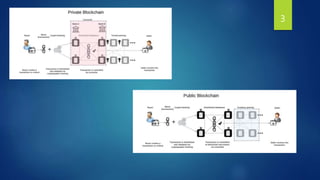
Blockchain
Categories
 Public Blockchain
 Private Blockchain
 Consortium Blockchain
Buterin V. (2015)
2
3
Table 1 Comparisons among public blockchain, consortium blockchain and private blockchain
Property Public blockchain Consortium blockchain Private blockchain
Consensus
determination
All miners
Public
Nearly impossible
tamper
Low
No
Permissionless
to
Selected set of nodes
Could be public or restricted
Couldbe tampered
High
Partial
Permissioned
One organization
Couldbe public
restricted
Could be tampered
High
Yes
Permissioned
orRead permission
Immutability
Efficiency
Centralized
Consensus
process
Blockchain Perspectives
 Consensus determination. In public blockchain, each node could take part in the consensus process.
And only a selected set of nodes are responsible for validating the block in consortium blockchain. As
for private chain, it is fully controlled by one organization who could determine the final consensus.
 Read permission. Transactions in a public blockchain are visible to the public while the read
permission depends on a private blockchain or a consortium blockchain. The consortium or the
organization could decide whether the stored information is public or restricted.
 Immutability. Since transactions are stored in different nodes in the distributed network, so it is
nearly impossible to tamper the public blockchain. However, if the majority of the consortium or the
dominant organization wants to tamper the blockchain, the consortium blockchain or private
blockchain could be reversed or tampered.
 Efficiency. It takes plenty of time to propagate transactions and blocks as there are a large number of
nodes on public blockchain network. Taking network safety into consideration, restrictions on public
blockchain would be much more strict. As a result, transaction throughput is limited and the latency is
high. With fewer validators, consortium blockchain and private blockchain could be more efficient.
 Centralized. The main difference among the three types of blockchains is that public blockchain is
decentralized, consortium blockchain is partially centralized and private blockchain is fully centralized
as it is controlled by a single group.
 Consensus process. Everyone in the world could join the consensus process of the public blockchain.
Different from public blockchain, both consortium blockchain and private blockchain are
permissioned. One node needs to be certificated to join the consensus process in consortium or
private blockchain.
4
Blockchain Technology Key
Characteristics
 Decentralization. In conventional centralized transaction systems, each transaction
needs to be validated through the central trusted agency (e.g., the central bank)
inevitably resulting the cost and the performance bottlenecks at the central servers.
Differently, a transaction in the blockchain network can be conducted between any two
peers (P2P) without the authentication by the central agency.
 Persistency. Since each of the transactions spreading across the network needs to be
confirmed and recorded in blocks distributed in the whole network, it is nearly
impossible to tamper.
 Anonymity. Each user can interact with the blockchain network with a generated
address. Further, a user could generate many addresses to avoid identity exposure.
There is no longer any central party keeping users’ private information.
 Auditability. Since each of the transactions on the blockchain is validated and recorded
with a timestamp, users can easily verify and trace the previous records through
accessing any node in the distributed network.
5
How Blockchain works 6
Blockchain technology explained in
simple words
Imagine you and I bet 50€ on tomorrow’s weather in Samos.
Three options:
 We can trust each other.
 We can turn the bet into a contract.
 We can involve a neutral third party.
Blockchain allows us to write a few lines of code, a program running on the
blockchain, to which both of us send 50€ . This program will keep the 100€ safe
and check tomorrow’s weather automatically on several data sources. Sunny or
rainy it will transfer automatically the whole amount to the winner. Each party can
check the contract logic, and once it’s running on the blockchain it can’t be
changed or stopped. This effort can be quite too high for a 50€ bet, but imagine
when selling a house or a company.
7
8 Steps to build a Blockchain Solution
 Step 1: Identify a Suitable Use-case
 Data Authentication & Verification: this includes immutable storage, digital
signatures and encryption. Data in almost any format can be stored in the
blockchain. Blockchains can create public-private key pairs and also be used for
generating and verifying digital signatures.
 Smart Asset Management: this includes issuance, payment, exchange, escrow
and retirement. A smart / crypto asset is the tokenized version of a real-world
asset e.g. gold, silver, oil, land.
 Smart Contracts: This is a term most often mis-understood, but that’s
something for another day.
8
8 Steps to build a Blockchain Solution
 Step 2: Identify the Most Suitable Consensus Mechanism
 Proof of stake,
 Byzantine fault tolerant,
 Deposit based consensus,
 Federated Byzantine Agreement,
 Proof of Elapsed Time,
 Derived PBFT,
 Redundant Byzantine Fault Tolerance,
 Simplified Byzantine Fault Tolerance,
 Federated consensus,
 Round Robin,
 Delegated Proof of Stake
9
8 Steps to build a Blockchain Solution
 Step 3: Identify the Most Suitable Platform
 Depending upon the consensus mechanism you chose in step 2, you need to
select the most suitable blockchain platform.
 Step 4: Designing the Nodes
 Blockchain solutions can be permissioned (e.g. a Government run land registry)
or permission-less (e.g. Bitcoin, where anyone can become a miner). Blockchain
solutions can be private (e.g. a contract management system implemented in a
pharmaceutical company), public (e.g. an asset backed cryptocurrency) or
hybrid (e.g. a group of banks running a shared KYC platform).
10
8 Steps to build a Blockchain Solution
 Step 5: Design the Blockchain Instance
 Most blockchain platforms need very careful planned configuration for the following elements:
 Permissions
 Asset issuance
 Asset re-issuance
 Atomic exchanges
 Key management
 Multi signatures
 Parameters
 Native assets
 Address formats
 Key formats
 Block signatures
 Hand-shaking
11
8 Steps to build a Blockchain Solution
 Step 6: Building the APIs
 Some blockchain platforms come with pre-made APIs while some don’t. The
major categories of APIs that you would need are for:
 Generating key pairs and addresses
 Performing audit related functions
 Data authentication through digital signatures and hashes
 Data storage and retrieval
 Smart-asset lifecycle management –issuance, payment, exchange, escrw and
retirement
 Smart contracts
12
8 Steps to build a Blockchain Solution
 Step 7: Design the Admin and User Interface
 At this stage you would need to choose the front end and programming
languages (e.g. HTML5, CSS, PHP, C#, Java, Javascript, Python, Ruby, Golang,
Solidity, Angular JS Nodejs). You would also need to choose external databases
(e.g. MySQL, MongoDB) as well as servers (including Web servers, FTP servers,
mail servers).
 Step 8: Adding Future Tech
 You can greatly enhance the power of your Blockchain solution by integrating
Artificial Intelligence, Biometrics, Bots, Cloud, Cognitive services, Containers,
Data Analytics, Internet of Things and Machine Learning.
13
Benefits
 You have complete control of the value you own, there is no third party
that holds your value or that can limit your access to it.
 The cost to perform a value transaction from and to anywhere in the
planet is very low (in the order of a dollar cent fraction). This allows
micropayments.
 Value can be transferred in few minutes and the transaction can be
considered secure in a few hours, not days or weeks.
 Since anyone at any time can verify every transaction made on the
blockchain, full transparency is granted.
 It’s possible to leverage the blockchain technology to build decentralized
applications that would be able to manage information and value transfer
fast and securely.
14
Challenges
 Transactions can be sent and received anonymously. On one side this
preserves the users privacy but on the other allows non legal activity on
the network as institutions cannot track users identity.
 Even if many exchange platforms are emerging, it’s still not that easy to
trade bitcoins for goods and services. However, they are becoming more
and more popular.
 Bitcoin, like many other cryptocurrencies, is very volatile: there aren’t that
many Bitcoins available in the market and the demand is changing rapidly.
Bitcoin price is very effected by large events or announcements in the
cryptocurrencies industry.
 The technology is still in its infancy. New tools are developed every day to
improve the blockchain security stability while offering a broader range of
features, tools and services.
15
Why blockchain technology could
change public administration
 fast
 cheap
 secure public records
 more transparent
 decentralized
So, can be used for many non-financial tasks, such as casting votes in
elections or proving that a document existed at a specific time
16
How blockchain technology could
change public administration
 They could help finally resolve the problem of music and video piracy,
while enabling digital media to be legitimately bought, sold, inherited and
given away second-hand like books, vinyl and video tapes.
 They also present opportunities in all kinds of public services such as
health and welfare payments and, at the frontier of blockchain
development, are self-executing contracts paving the way for companies
that run themselves without human intervention.
17
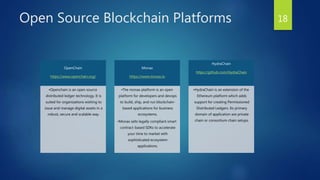
Open Source Blockchain Platforms 18
OpenChain
https://www.openchain.org/
•Openchain is an open source
distributed ledger technology. It is
suited for organizations wishing to
issue and manage digital assets in a
robust, secure and scalable way.
Monax
https://www.monax.io
•The monax platform is an open
platform for developers and devops
to build, ship, and run blockchain-
based applications for business
ecosystems.
•Monax sells legally compliant smart
contract-based SDKs to accelerate
your time to market with
sophisticated ecosystem
applications.
HydraChain
https://github.com/HydraChain
•HydraChain is an extension of the
Ethereum platform which adds
support for creating Permissioned
Distributed Ledgers. Its primary
domain of application are private
chain or consortium chain setups.
Open Source Blockchain Platforms 19
MultiChain
http://www.multichain.com
•MultiChain is an open source platform for
private blockchains, which offers a rich set of
features including extensive configurability,
rapid deployment, permissions management,
native assets and data streams. Although it is
designed to enable private blockchains,
MultiChain provides maximal compatibility
with the bitcoin ecosystem, including the
peer-to-peer protocol, transaction/block
formats and Bitcoin Core APIs/runtime
parameters.
HyperLedger
https://www.hyperledger.org
•Hyperledger is an umbrella project of open
source blockchains and related tools, started
in December 2015 by the Linux Foundation, to
support the collaborative development of
blockchain-based distributed ledgers
Quorum
https://www.jpmorgan.com/global/Quorum
•Quorum is an Ethereum-based distributed
ledger protocol that has been developed to
provide the Financial Services Industry with a
permissioned implementation of Ethereum
that supports transaction and contract privacy.
•Quorum includes a minimalistic fork of the Go
Ethereum client (a.k.a geth), and as such,
leverages the work that the Ethereum
developer community has undertaken.
Blockchain as a Service (Providers)
Microsoft
•Microsoft became one of the first software vendors to offer BaaS when it launched Azure Blockchain Service in 2015.
R3
•There is no greater testimony to the impact blockchain has than the sheer number of companies behind R3, a consortium behind a distributed financial
ledger called Corda that operates like a blockchain while denying it is one.
BitSE
•BitSE runs VeChain, a Chinese cloud product management platform built on a blockchain in collaboration with PricewaterhouseCoopers (PwC) to boost
blockchain adoption in the Asia-Pacific markets.
SAP Cloud Platform Blockchain
•SAP’s blockchain as a service is called "Leonardo," which in turn is based on Hyperledger, and resides in the SAP Cloud service, so it can be accessed
from any device and requires no on-premises hardware or software. SAP Leonardo functions as a blockchain cloud service, machine learning service and
supports the Internet of Things (IoT) in a single ecosystem.
Peer Ledger
•Peer Ledger offers identity management blockchain to externally certify real-world identities, giving blockchain real-to-digital identity mapping,
something the company says the technology has lacked. Peer Ledger uses the public key infrastructure (PKI) system to certify identities outside the
blockchain before connecting them to blockchain accounts. The company is targeting trust-sensitive industries such as healthcare for their solution.
20
More examples?
 e-ID (https://medium.com/uport/zug-id-exploring-the-first-publicly-verified-
blockchain-identity-38bd0ee3702)
 e-Voting (https://www.nvotes.com)
 Health Records (https://e-estonia.com/solutions/healthcare/e-health-record/)
 Land Registry (https://exonum.com/napr)
 Document Validation Check
(https://www.dubailand.gov.ae/English/Pages/Blockchain.aspx)
 Taxes
 Academic Certificates (https://www.coindesk.com/maltas-government-putting-
academic-certificates-blockchain/)
 More…..
21
Thank You!!!
22

Blockchain Technology Developments in Government 3.0

  • 1.
    Blockchain Technology 1 Zoi Lachana –PhD Candidate, University of the Aegean Michalis Loutsaris – PhD Candidate, University of the Aegean Samos Summit 2018
  • 2.
    Blockchain Categories  Public Blockchain Private Blockchain  Consortium Blockchain Buterin V. (2015) 2
  • 3.
  • 4.
    Table 1 Comparisonsamong public blockchain, consortium blockchain and private blockchain Property Public blockchain Consortium blockchain Private blockchain Consensus determination All miners Public Nearly impossible tamper Low No Permissionless to Selected set of nodes Could be public or restricted Couldbe tampered High Partial Permissioned One organization Couldbe public restricted Could be tampered High Yes Permissioned orRead permission Immutability Efficiency Centralized Consensus process Blockchain Perspectives  Consensus determination. In public blockchain, each node could take part in the consensus process. And only a selected set of nodes are responsible for validating the block in consortium blockchain. As for private chain, it is fully controlled by one organization who could determine the final consensus.  Read permission. Transactions in a public blockchain are visible to the public while the read permission depends on a private blockchain or a consortium blockchain. The consortium or the organization could decide whether the stored information is public or restricted.  Immutability. Since transactions are stored in different nodes in the distributed network, so it is nearly impossible to tamper the public blockchain. However, if the majority of the consortium or the dominant organization wants to tamper the blockchain, the consortium blockchain or private blockchain could be reversed or tampered.  Efficiency. It takes plenty of time to propagate transactions and blocks as there are a large number of nodes on public blockchain network. Taking network safety into consideration, restrictions on public blockchain would be much more strict. As a result, transaction throughput is limited and the latency is high. With fewer validators, consortium blockchain and private blockchain could be more efficient.  Centralized. The main difference among the three types of blockchains is that public blockchain is decentralized, consortium blockchain is partially centralized and private blockchain is fully centralized as it is controlled by a single group.  Consensus process. Everyone in the world could join the consensus process of the public blockchain. Different from public blockchain, both consortium blockchain and private blockchain are permissioned. One node needs to be certificated to join the consensus process in consortium or private blockchain. 4
  • 5.
    Blockchain Technology Key Characteristics Decentralization. In conventional centralized transaction systems, each transaction needs to be validated through the central trusted agency (e.g., the central bank) inevitably resulting the cost and the performance bottlenecks at the central servers. Differently, a transaction in the blockchain network can be conducted between any two peers (P2P) without the authentication by the central agency.  Persistency. Since each of the transactions spreading across the network needs to be confirmed and recorded in blocks distributed in the whole network, it is nearly impossible to tamper.  Anonymity. Each user can interact with the blockchain network with a generated address. Further, a user could generate many addresses to avoid identity exposure. There is no longer any central party keeping users’ private information.  Auditability. Since each of the transactions on the blockchain is validated and recorded with a timestamp, users can easily verify and trace the previous records through accessing any node in the distributed network. 5
  • 6.
  • 7.
    Blockchain technology explainedin simple words Imagine you and I bet 50€ on tomorrow’s weather in Samos. Three options:  We can trust each other.  We can turn the bet into a contract.  We can involve a neutral third party. Blockchain allows us to write a few lines of code, a program running on the blockchain, to which both of us send 50€ . This program will keep the 100€ safe and check tomorrow’s weather automatically on several data sources. Sunny or rainy it will transfer automatically the whole amount to the winner. Each party can check the contract logic, and once it’s running on the blockchain it can’t be changed or stopped. This effort can be quite too high for a 50€ bet, but imagine when selling a house or a company. 7
  • 8.
    8 Steps tobuild a Blockchain Solution  Step 1: Identify a Suitable Use-case  Data Authentication & Verification: this includes immutable storage, digital signatures and encryption. Data in almost any format can be stored in the blockchain. Blockchains can create public-private key pairs and also be used for generating and verifying digital signatures.  Smart Asset Management: this includes issuance, payment, exchange, escrow and retirement. A smart / crypto asset is the tokenized version of a real-world asset e.g. gold, silver, oil, land.  Smart Contracts: This is a term most often mis-understood, but that’s something for another day. 8
  • 9.
    8 Steps tobuild a Blockchain Solution  Step 2: Identify the Most Suitable Consensus Mechanism  Proof of stake,  Byzantine fault tolerant,  Deposit based consensus,  Federated Byzantine Agreement,  Proof of Elapsed Time,  Derived PBFT,  Redundant Byzantine Fault Tolerance,  Simplified Byzantine Fault Tolerance,  Federated consensus,  Round Robin,  Delegated Proof of Stake 9
  • 10.
    8 Steps tobuild a Blockchain Solution  Step 3: Identify the Most Suitable Platform  Depending upon the consensus mechanism you chose in step 2, you need to select the most suitable blockchain platform.  Step 4: Designing the Nodes  Blockchain solutions can be permissioned (e.g. a Government run land registry) or permission-less (e.g. Bitcoin, where anyone can become a miner). Blockchain solutions can be private (e.g. a contract management system implemented in a pharmaceutical company), public (e.g. an asset backed cryptocurrency) or hybrid (e.g. a group of banks running a shared KYC platform). 10
  • 11.
    8 Steps tobuild a Blockchain Solution  Step 5: Design the Blockchain Instance  Most blockchain platforms need very careful planned configuration for the following elements:  Permissions  Asset issuance  Asset re-issuance  Atomic exchanges  Key management  Multi signatures  Parameters  Native assets  Address formats  Key formats  Block signatures  Hand-shaking 11
  • 12.
    8 Steps tobuild a Blockchain Solution  Step 6: Building the APIs  Some blockchain platforms come with pre-made APIs while some don’t. The major categories of APIs that you would need are for:  Generating key pairs and addresses  Performing audit related functions  Data authentication through digital signatures and hashes  Data storage and retrieval  Smart-asset lifecycle management –issuance, payment, exchange, escrw and retirement  Smart contracts 12
  • 13.
    8 Steps tobuild a Blockchain Solution  Step 7: Design the Admin and User Interface  At this stage you would need to choose the front end and programming languages (e.g. HTML5, CSS, PHP, C#, Java, Javascript, Python, Ruby, Golang, Solidity, Angular JS Nodejs). You would also need to choose external databases (e.g. MySQL, MongoDB) as well as servers (including Web servers, FTP servers, mail servers).  Step 8: Adding Future Tech  You can greatly enhance the power of your Blockchain solution by integrating Artificial Intelligence, Biometrics, Bots, Cloud, Cognitive services, Containers, Data Analytics, Internet of Things and Machine Learning. 13
  • 14.
    Benefits  You havecomplete control of the value you own, there is no third party that holds your value or that can limit your access to it.  The cost to perform a value transaction from and to anywhere in the planet is very low (in the order of a dollar cent fraction). This allows micropayments.  Value can be transferred in few minutes and the transaction can be considered secure in a few hours, not days or weeks.  Since anyone at any time can verify every transaction made on the blockchain, full transparency is granted.  It’s possible to leverage the blockchain technology to build decentralized applications that would be able to manage information and value transfer fast and securely. 14
  • 15.
    Challenges  Transactions canbe sent and received anonymously. On one side this preserves the users privacy but on the other allows non legal activity on the network as institutions cannot track users identity.  Even if many exchange platforms are emerging, it’s still not that easy to trade bitcoins for goods and services. However, they are becoming more and more popular.  Bitcoin, like many other cryptocurrencies, is very volatile: there aren’t that many Bitcoins available in the market and the demand is changing rapidly. Bitcoin price is very effected by large events or announcements in the cryptocurrencies industry.  The technology is still in its infancy. New tools are developed every day to improve the blockchain security stability while offering a broader range of features, tools and services. 15
  • 16.
    Why blockchain technologycould change public administration  fast  cheap  secure public records  more transparent  decentralized So, can be used for many non-financial tasks, such as casting votes in elections or proving that a document existed at a specific time 16
  • 17.
    How blockchain technologycould change public administration  They could help finally resolve the problem of music and video piracy, while enabling digital media to be legitimately bought, sold, inherited and given away second-hand like books, vinyl and video tapes.  They also present opportunities in all kinds of public services such as health and welfare payments and, at the frontier of blockchain development, are self-executing contracts paving the way for companies that run themselves without human intervention. 17
  • 18.
    Open Source BlockchainPlatforms 18 OpenChain https://www.openchain.org/ •Openchain is an open source distributed ledger technology. It is suited for organizations wishing to issue and manage digital assets in a robust, secure and scalable way. Monax https://www.monax.io •The monax platform is an open platform for developers and devops to build, ship, and run blockchain- based applications for business ecosystems. •Monax sells legally compliant smart contract-based SDKs to accelerate your time to market with sophisticated ecosystem applications. HydraChain https://github.com/HydraChain •HydraChain is an extension of the Ethereum platform which adds support for creating Permissioned Distributed Ledgers. Its primary domain of application are private chain or consortium chain setups.
  • 19.
    Open Source BlockchainPlatforms 19 MultiChain http://www.multichain.com •MultiChain is an open source platform for private blockchains, which offers a rich set of features including extensive configurability, rapid deployment, permissions management, native assets and data streams. Although it is designed to enable private blockchains, MultiChain provides maximal compatibility with the bitcoin ecosystem, including the peer-to-peer protocol, transaction/block formats and Bitcoin Core APIs/runtime parameters. HyperLedger https://www.hyperledger.org •Hyperledger is an umbrella project of open source blockchains and related tools, started in December 2015 by the Linux Foundation, to support the collaborative development of blockchain-based distributed ledgers Quorum https://www.jpmorgan.com/global/Quorum •Quorum is an Ethereum-based distributed ledger protocol that has been developed to provide the Financial Services Industry with a permissioned implementation of Ethereum that supports transaction and contract privacy. •Quorum includes a minimalistic fork of the Go Ethereum client (a.k.a geth), and as such, leverages the work that the Ethereum developer community has undertaken.
  • 20.
    Blockchain as aService (Providers) Microsoft •Microsoft became one of the first software vendors to offer BaaS when it launched Azure Blockchain Service in 2015. R3 •There is no greater testimony to the impact blockchain has than the sheer number of companies behind R3, a consortium behind a distributed financial ledger called Corda that operates like a blockchain while denying it is one. BitSE •BitSE runs VeChain, a Chinese cloud product management platform built on a blockchain in collaboration with PricewaterhouseCoopers (PwC) to boost blockchain adoption in the Asia-Pacific markets. SAP Cloud Platform Blockchain •SAP’s blockchain as a service is called "Leonardo," which in turn is based on Hyperledger, and resides in the SAP Cloud service, so it can be accessed from any device and requires no on-premises hardware or software. SAP Leonardo functions as a blockchain cloud service, machine learning service and supports the Internet of Things (IoT) in a single ecosystem. Peer Ledger •Peer Ledger offers identity management blockchain to externally certify real-world identities, giving blockchain real-to-digital identity mapping, something the company says the technology has lacked. Peer Ledger uses the public key infrastructure (PKI) system to certify identities outside the blockchain before connecting them to blockchain accounts. The company is targeting trust-sensitive industries such as healthcare for their solution. 20
  • 21.
    More examples?  e-ID(https://medium.com/uport/zug-id-exploring-the-first-publicly-verified- blockchain-identity-38bd0ee3702)  e-Voting (https://www.nvotes.com)  Health Records (https://e-estonia.com/solutions/healthcare/e-health-record/)  Land Registry (https://exonum.com/napr)  Document Validation Check (https://www.dubailand.gov.ae/English/Pages/Blockchain.aspx)  Taxes  Academic Certificates (https://www.coindesk.com/maltas-government-putting- academic-certificates-blockchain/)  More….. 21
  • 22.