PRESENTED BY:
NITISH SHARMA
00710100815
M.Tech(IS)
Introduction
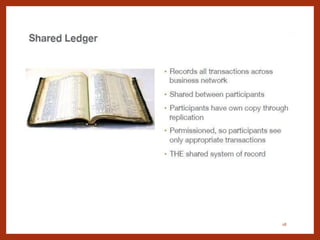
A shared ledger technology allowing any participant in
the business network to see the system of record
(ledger)
2
Ledger: The principal book (or computer file) for recording and totaling financial transactions by account type, with debits and credits in separate columns and a
beginning monetary balance and ending monetary balance for each account.
.
3
4
Think of blockchain technology as a bag of Lego or bricks.
Distributed ledger: A list of transactions that is shared among a
number of computers, rather than being stored on a central
server.
5
A new paradigm for computing
Properties:
1. Decentralized
2. Strong Authentication
3. Tamper Resistance
6
7
Common Themes:
• Usually contains financial transactions.
• Replicated across a number of systems in almost real-time.
• Usually exists over a peer-to-peer network.
• Uses cryptography and digital signatures to prove identity, authenticity and
enforce read/write access rights.
• Can be written by certain participants.
• Can be read by certain participants, a wider audience.
• Has mechanisms to make it hard to change historical records, or at least make
it easy to detect when someone is trying to do so.
Think of “blockchain technology” as a collection of technologies, a bit like a bag of Lego. From the bag, you
can take out different bricks and put them together in different ways to create different results.
8
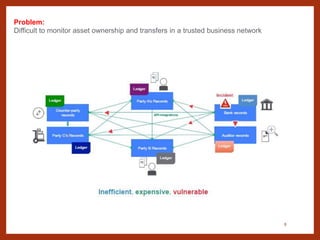
Problem:
Difficult to monitor asset ownership and transfers in a trusted business network
9
Solution:
A permissioned, replicated, shared ledger.
Conflicts in Blockchain are resolved by using:
• Longest Chain Rule
• Proof of Work
10
11
12
PublicVs Private Blockchains
13
14
A blockchain by itself is just a data structure. That is, how data is logically put together and
stored.
Blocks in a chain = pages in a book
For analogy, a book is a chain of pages. Each page in a book contains:
• The text: for example the story.
• Information about itself: at the top of the page there is usually the title.
Similarly in a blockchain block, each block has:
• The contents of the block.
• A ‘header’ which contains the data about the block.
Blocks in a chain refer to previous blocks, like page numbers in a book.
15
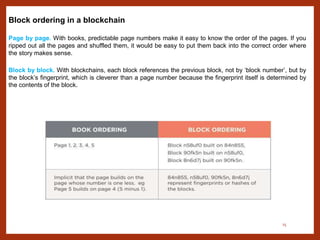
Block ordering in a blockchain
Page by page. With books, predictable page numbers make it easy to know the order of the pages. If you
ripped out all the pages and shuffled them, it would be easy to put them back into the correct order where
the story makes sense.
Block by block. With blockchains, each block references the previous block, not by ‘block number’, but by
the block’s fingerprint, which is cleverer than a page number because the fingerprint itself is determined by
the contents of the block.
16
Internal consistency
By using a fingerprint instead of a timestamp or a numerical sequence, you also get a nice way of
validating the data.
In any blockchain, you can generate the block fingerprints yourself by using certain algorithms. If anyone
wants to meddle with any of the data, they have to regenerate all the fingerprints from that point
forwards and the blockchain will look different.
17
18
19
20
21
22
BENEFITS OF BLOCKCHAIN
23
24
25
26
27
28
29
30
31
32
What are the challenges and opportunities does this technology pose for financial
institutions?
The challenges:
Financial institutions such as banks and brokerages have long held the position of
the trusted third party validating the authenticity and accuracy of a transaction.
Blockchain significantly alters the need for this trusted third-party middleman.
The opportunities:
With the ownership and provenance of a transaction recorded in the blockchain at
the earliest stages of a transaction and verified at every subsequent stage,
agreement among all parties involved in a transaction is guaranteed.
And,
because the blockchain can record and authenticate every stage of a transaction, it
could theoretically be used to secure and verify any type of transaction, from simple
goods-forcash exchanges to complex transaction management, without any third-
party interaction.
.
33
34
Summary
1. Blockchain is a shared, replicated ledger technology.
2. Blockchain can open up business networks by taking out cost, improving efficiencies
and increase accessibility.
3. Blockchain addresses an exciting and topical set of business challenges, which cross
every industry.
References
1. http://scet.berkeley.edu/wp-content/uploads/BlockchainPaper.pdf
2. https://blockchain.info/
3. https://www.pwc.com/us/en/financial-services/publications/viewpoints/assets/qa-what-is-
blockchain.pdf
4. https://www.btcs.com/deck-new.pdf
35

BLOCKCHAIN

  • 1.
  • 2.
    Introduction A shared ledgertechnology allowing any participant in the business network to see the system of record (ledger) 2 Ledger: The principal book (or computer file) for recording and totaling financial transactions by account type, with debits and credits in separate columns and a beginning monetary balance and ending monetary balance for each account.
  • 3.
  • 4.
    4 Think of blockchaintechnology as a bag of Lego or bricks. Distributed ledger: A list of transactions that is shared among a number of computers, rather than being stored on a central server.
  • 5.
    5 A new paradigmfor computing Properties: 1. Decentralized 2. Strong Authentication 3. Tamper Resistance
  • 6.
  • 7.
    7 Common Themes: • Usuallycontains financial transactions. • Replicated across a number of systems in almost real-time. • Usually exists over a peer-to-peer network. • Uses cryptography and digital signatures to prove identity, authenticity and enforce read/write access rights. • Can be written by certain participants. • Can be read by certain participants, a wider audience. • Has mechanisms to make it hard to change historical records, or at least make it easy to detect when someone is trying to do so. Think of “blockchain technology” as a collection of technologies, a bit like a bag of Lego. From the bag, you can take out different bricks and put them together in different ways to create different results.
  • 8.
    8 Problem: Difficult to monitorasset ownership and transfers in a trusted business network
  • 9.
    9 Solution: A permissioned, replicated,shared ledger. Conflicts in Blockchain are resolved by using: • Longest Chain Rule • Proof of Work
  • 10.
  • 11.
  • 12.
  • 13.
  • 14.
    14 A blockchain byitself is just a data structure. That is, how data is logically put together and stored. Blocks in a chain = pages in a book For analogy, a book is a chain of pages. Each page in a book contains: • The text: for example the story. • Information about itself: at the top of the page there is usually the title. Similarly in a blockchain block, each block has: • The contents of the block. • A ‘header’ which contains the data about the block. Blocks in a chain refer to previous blocks, like page numbers in a book.
  • 15.
    15 Block ordering ina blockchain Page by page. With books, predictable page numbers make it easy to know the order of the pages. If you ripped out all the pages and shuffled them, it would be easy to put them back into the correct order where the story makes sense. Block by block. With blockchains, each block references the previous block, not by ‘block number’, but by the block’s fingerprint, which is cleverer than a page number because the fingerprint itself is determined by the contents of the block.
  • 16.
    16 Internal consistency By usinga fingerprint instead of a timestamp or a numerical sequence, you also get a nice way of validating the data. In any blockchain, you can generate the block fingerprints yourself by using certain algorithms. If anyone wants to meddle with any of the data, they have to regenerate all the fingerprints from that point forwards and the blockchain will look different.
  • 17.
  • 18.
  • 19.
  • 20.
  • 21.
  • 22.
  • 23.
  • 24.
  • 25.
  • 26.
  • 27.
  • 28.
  • 29.
  • 30.
  • 31.
  • 32.
    32 What are thechallenges and opportunities does this technology pose for financial institutions? The challenges: Financial institutions such as banks and brokerages have long held the position of the trusted third party validating the authenticity and accuracy of a transaction. Blockchain significantly alters the need for this trusted third-party middleman. The opportunities: With the ownership and provenance of a transaction recorded in the blockchain at the earliest stages of a transaction and verified at every subsequent stage, agreement among all parties involved in a transaction is guaranteed. And, because the blockchain can record and authenticate every stage of a transaction, it could theoretically be used to secure and verify any type of transaction, from simple goods-forcash exchanges to complex transaction management, without any third- party interaction.
  • 33.
  • 34.
    34 Summary 1. Blockchain isa shared, replicated ledger technology. 2. Blockchain can open up business networks by taking out cost, improving efficiencies and increase accessibility. 3. Blockchain addresses an exciting and topical set of business challenges, which cross every industry.
  • 35.
    References 1. http://scet.berkeley.edu/wp-content/uploads/BlockchainPaper.pdf 2. https://blockchain.info/ 3.https://www.pwc.com/us/en/financial-services/publications/viewpoints/assets/qa-what-is- blockchain.pdf 4. https://www.btcs.com/deck-new.pdf 35