BLOCKCHAIN
TECHNOLOGY
Presented by
Ajay Janardhanan
Roll no : 4
WHAT IS BLOCKCHAIN TECHNOLOGY?
Blockchain technology is a decentralized , distributed ledger system
that records transactions across multiple computers in a way that
ensures security, transparency and immutability . Each transactions is
grouped into a block , which is linked to the previous one , forming a
continuous chain . This structure prevents tampering and allows for
trustless , peer-to-peer interactions without the need of central
authority
FUNDAMENTALS OF BLOCKCHAIN
1. Public Distributed Ledgers:
 A block chain is a decentralized public distributed ledger that is used to record transactions
across many computers.
 A distributed ledger is a database that is shared among the users of the blockchain network
 The transactions are accessed and verified by users associated with the bitcoin
network ,thereby making it less prone to cyber attack
2 . Encryption:
 Blockchain eliminates unauthorized access by using the cryptographic algorithm to ensure the
blocks are kept secure
 Each user in block has their key
3. Proof Of Work:
Proof of work (PoW) is a method to validate transactions in a blockchain network by solving a
complex mathematical puzzle called mining
Note: users trying to solve the puzzle is called miners
4. Mining:
In blockchain, miners use their resources (time , money, elelctricity , etc) to validate a new
transaction and record them on the public ledger , they are given a reward
Note: As reward , the miner gets 12.5 BTC(bitcoins)
History Of Blockchain
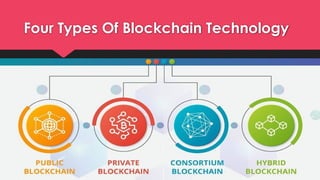
Four Types Of Blockchain Technology
1. Public Blockchain:
These blockchain are completely open to following the idea of decentralization. They are non-
restrictive, anyone having a computer and internet can participate in the network
2. Private Blockchain:
These blockchains are not as decentralized as the public block chains only selected
nodes can participate in the process, making it more secure than others
3. Consortium Blockchain:
It is a creative approach that solves the need of an organization. This blockchain
validates the transactions or receives transactions It is also known as federated blockchain
4. Hybrid Blockchain:
It is the mixed content of private and public blockchain , where some part is controlled
by some organization and other makes are made visible as public blockchain
How Does Blockchain Works?
 Blockchain technology works by recording transactions, creating blocks, and linking them together to
form a chain:
1.Record the transaction: An authorized participant inputs a transaction, which is authenticated by the
technology.
2.Create a block: The transaction is represented in a block, which is sent to every computer node in the
network.
3.Validate the transaction: Authorized nodes validate the transaction and add the block to the
blockchain.
4.Update the network: The update is distributed across the network, finalizing the transaction.
5.Link the blocks: Each block includes a digital summary of all the transactions in that block and all
previous transactions. This digital summary connects the blocks together in a chain.
6.Share the ledger: The ledger is shared among all the nodes.
 Blockchain uses cryptographic hashing to ensure the security of each block. This method converts transaction
data into a unique hexadecimal transaction ID hash, which acts as a digital fingerprint.
 Blockchain is used in many industries, including real estate, where it can revolutionize property transactions
and ownership records.
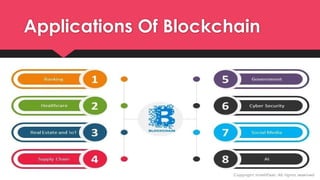
Applications Of Blockchain
1. Money transfers
The original concept behind the invention
of blockchain technology is still a great
application . Money transfers using
blockchain are less expensive and faster
than using existing money transfers
2. Financial Exchanges
Many companies have popped up
over the past few years offering
decentralized cryptocurrency
exchanges using block chains can
allows for faster and less expensive
transactions
3. Lending
Lenders can use blockchain to execute
collateralized loans through smart
contracts . Smart contracts built on
blockchain allow certain events to
automatically trigger things like a service
payment , a margin cell
4. Insurance
Using smart contracts on a blockchain
can provide greater transperancy for
customers and insurance providers.
Recording all claims on a blockchain
would keep customers from making
duplicate claims for the same event
5. Secure Personal Information
Blockchain technology can be used for
secure access to identifying information
while improving access for those who
need it in industries such as travel, health
care , finance, and education
6. Voting
If personal identity information held on a
blockchain, from also being able to vote.
Using blockchain technology can make
sure that nobody votes twice
7. Real Estate
Using blockchain technology to record
real estate transactions can provide a
more secure and accessible means of
verifying and transferring ownership.
That can speed up transactions ,reduce
paper work and save money
8. Health care
Keeping medical records on a blockchain
can allow doctors and medical professional
to obtain accurate and up-to-date
information on their patients . That can
ensure that patients seeing multiple doctors
get the best care possible
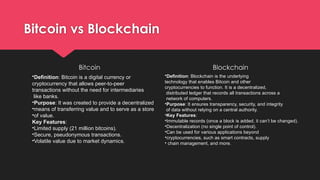
Bitcoin vs Blockchain
Bitcoin Blockchain
•Definition: Bitcoin is a digital currency or
cryptocurrency that allows peer-to-peer
transactions without the need for intermediaries
like banks.
•Purpose: It was created to provide a decentralized
•means of transferring value and to serve as a store
•of value.
Key Features:
•Limited supply (21 million bitcoins).
•Secure, pseudonymous transactions.
•Volatile value due to market dynamics.
•Definition: Blockchain is the underlying
technology that enables Bitcoin and other
cryptocurrencies to function. It is a decentralized,
distributed ledger that records all transactions across a
network of computers.
•Purpose: It ensures transparency, security, and integrity
of data without relying on a central authority.
•Key Features:
•Immutable records (once a block is added, it can’t be changed).
•Decentralization (no single point of control).
•Can be used for various applications beyond
•cryptocurrencies, such as smart contracts, supply
• chain management, and more.
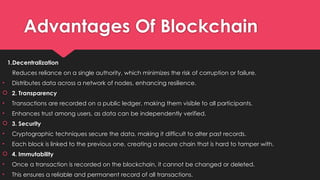
Advantages Of Blockchain
1.Decentralization
Reduces reliance on a single authority, which minimizes the risk of corruption or failure.
• Distributes data across a network of nodes, enhancing resilience.
 2. Transparency
• Transactions are recorded on a public ledger, making them visible to all participants.
• Enhances trust among users, as data can be independently verified.
 3. Security
• Cryptographic techniques secure the data, making it difficult to alter past records.
• Each block is linked to the previous one, creating a secure chain that is hard to tamper with.
 4. Immutability
• Once a transaction is recorded on the blockchain, it cannot be changed or deleted.
• This ensures a reliable and permanent record of all transactions.
o 5. Traceability
o Transactions can be traced back through the blockchain, making it easier to audit
and verify.
o Particularly useful in supply chains to track the origin and journey of products.
o 6. Efficiency
o Reduces the need for intermediaries (like banks), streamlining processes and reducing
costs.
o Automated smart contracts can execute transactions instantly once conditions are
met.
o 7. Cost-Effectiveness
o Reduces costs associated with intermediaries, fraud, and manual processes.
o Lowers transaction fees, especially in cross-border payments.
8. Data Integrity
•Protects data from unauthorized access and ensures that it remains accurate and
reliable.
Disadvantages Of Blockchain
 1. Scalability Issues
• Many blockchains struggle to process large volumes of transactions quickly.
• As the network grows, the time and resources required to validate transactions can increase significantly.
 2. Energy Consumption
• Some consensus mechanisms (like Proof of Work) require significant computational power, leading to high energy consumption.
• This raises environmental concerns, particularly with large-scale mining operations.
 3. Complexity
• Understanding blockchain technology can be challenging for non-technical users.
• Implementing and maintaining blockchain systems may require specialized knowledge and skills.
 4. Regulatory Uncertainty
• Many countries have unclear regulations regarding cryptocurrencies and blockchain technology.
• This uncertainty can hinder adoption and lead to legal complications.
FUTURE OF BLOCKCHAIN
 The future of blockchain technology holds significant promise across various sectors. Here are some key
trends and potential developments:
1.Decentralized Finance (DeFi): DeFi platforms are likely to continue growing, offering users greater access to
financial services without traditional intermediaries.
2.Tokenization of Assets: Real-world assets, like real estate and art, may become tokenized, making
transactions more accessible and liquid.
3. Interoperability: Improved interoperability between different blockchain networks could facilitate more
seamless transactions and data sharing.
4. Supply Chain Transparency: Blockchain can enhance traceability and transparency in supply chains,
helping to combat fraud and improve accountability.
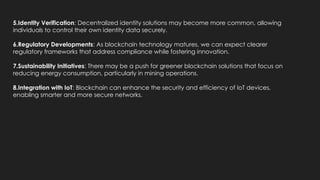
5.Identity Verification: Decentralized identity solutions may become more common, allowing
individuals to control their own identity data securely.
6.Regulatory Developments: As blockchain technology matures, we can expect clearer
regulatory frameworks that address compliance while fostering innovation.
7.Sustainability Initiatives: There may be a push for greener blockchain solutions that focus on
reducing energy consumption, particularly in mining operations.
8.Integration with IoT: Blockchain can enhance the security and efficiency of IoT devices,
enabling smarter and more secure networks.
Conclusion
In conclusion, blockchain technology stands as a transformative force across various sectors, offering
enhanced security, transparency, and efficiency. Its decentralized nature fosters trust and reduces the
need for intermediaries, making it particularly valuable in industries like finance, supply chain, and
healthcare. However, challenges such as scalability, regulatory concerns, and energy consumption
must be addressed to fully realize its potential. As research and development continue, blockchain
could reshape not only business models but also the fundamental way we interact and transact in the
digital age, paving the way for a more secure and equitable future.
BLOCKCHAIN presentaion in computer application.pptx

BLOCKCHAIN presentaion in computer application.pptx

  • 1.
  • 2.
    WHAT IS BLOCKCHAINTECHNOLOGY? Blockchain technology is a decentralized , distributed ledger system that records transactions across multiple computers in a way that ensures security, transparency and immutability . Each transactions is grouped into a block , which is linked to the previous one , forming a continuous chain . This structure prevents tampering and allows for trustless , peer-to-peer interactions without the need of central authority
  • 4.
    FUNDAMENTALS OF BLOCKCHAIN 1.Public Distributed Ledgers:  A block chain is a decentralized public distributed ledger that is used to record transactions across many computers.  A distributed ledger is a database that is shared among the users of the blockchain network  The transactions are accessed and verified by users associated with the bitcoin network ,thereby making it less prone to cyber attack 2 . Encryption:  Blockchain eliminates unauthorized access by using the cryptographic algorithm to ensure the blocks are kept secure  Each user in block has their key
  • 5.
    3. Proof OfWork: Proof of work (PoW) is a method to validate transactions in a blockchain network by solving a complex mathematical puzzle called mining Note: users trying to solve the puzzle is called miners 4. Mining: In blockchain, miners use their resources (time , money, elelctricity , etc) to validate a new transaction and record them on the public ledger , they are given a reward Note: As reward , the miner gets 12.5 BTC(bitcoins)
  • 6.
  • 7.
    Four Types OfBlockchain Technology
  • 8.
    1. Public Blockchain: Theseblockchain are completely open to following the idea of decentralization. They are non- restrictive, anyone having a computer and internet can participate in the network 2. Private Blockchain: These blockchains are not as decentralized as the public block chains only selected nodes can participate in the process, making it more secure than others 3. Consortium Blockchain: It is a creative approach that solves the need of an organization. This blockchain validates the transactions or receives transactions It is also known as federated blockchain 4. Hybrid Blockchain: It is the mixed content of private and public blockchain , where some part is controlled by some organization and other makes are made visible as public blockchain
  • 9.
    How Does BlockchainWorks?  Blockchain technology works by recording transactions, creating blocks, and linking them together to form a chain: 1.Record the transaction: An authorized participant inputs a transaction, which is authenticated by the technology. 2.Create a block: The transaction is represented in a block, which is sent to every computer node in the network. 3.Validate the transaction: Authorized nodes validate the transaction and add the block to the blockchain. 4.Update the network: The update is distributed across the network, finalizing the transaction. 5.Link the blocks: Each block includes a digital summary of all the transactions in that block and all previous transactions. This digital summary connects the blocks together in a chain. 6.Share the ledger: The ledger is shared among all the nodes.  Blockchain uses cryptographic hashing to ensure the security of each block. This method converts transaction data into a unique hexadecimal transaction ID hash, which acts as a digital fingerprint.  Blockchain is used in many industries, including real estate, where it can revolutionize property transactions and ownership records.
  • 10.
  • 11.
    1. Money transfers Theoriginal concept behind the invention of blockchain technology is still a great application . Money transfers using blockchain are less expensive and faster than using existing money transfers 2. Financial Exchanges Many companies have popped up over the past few years offering decentralized cryptocurrency exchanges using block chains can allows for faster and less expensive transactions 3. Lending Lenders can use blockchain to execute collateralized loans through smart contracts . Smart contracts built on blockchain allow certain events to automatically trigger things like a service payment , a margin cell 4. Insurance Using smart contracts on a blockchain can provide greater transperancy for customers and insurance providers. Recording all claims on a blockchain would keep customers from making duplicate claims for the same event
  • 12.
    5. Secure PersonalInformation Blockchain technology can be used for secure access to identifying information while improving access for those who need it in industries such as travel, health care , finance, and education 6. Voting If personal identity information held on a blockchain, from also being able to vote. Using blockchain technology can make sure that nobody votes twice 7. Real Estate Using blockchain technology to record real estate transactions can provide a more secure and accessible means of verifying and transferring ownership. That can speed up transactions ,reduce paper work and save money 8. Health care Keeping medical records on a blockchain can allow doctors and medical professional to obtain accurate and up-to-date information on their patients . That can ensure that patients seeing multiple doctors get the best care possible
  • 13.
    Bitcoin vs Blockchain BitcoinBlockchain •Definition: Bitcoin is a digital currency or cryptocurrency that allows peer-to-peer transactions without the need for intermediaries like banks. •Purpose: It was created to provide a decentralized •means of transferring value and to serve as a store •of value. Key Features: •Limited supply (21 million bitcoins). •Secure, pseudonymous transactions. •Volatile value due to market dynamics. •Definition: Blockchain is the underlying technology that enables Bitcoin and other cryptocurrencies to function. It is a decentralized, distributed ledger that records all transactions across a network of computers. •Purpose: It ensures transparency, security, and integrity of data without relying on a central authority. •Key Features: •Immutable records (once a block is added, it can’t be changed). •Decentralization (no single point of control). •Can be used for various applications beyond •cryptocurrencies, such as smart contracts, supply • chain management, and more.
  • 14.
    Advantages Of Blockchain 1.Decentralization Reducesreliance on a single authority, which minimizes the risk of corruption or failure. • Distributes data across a network of nodes, enhancing resilience.  2. Transparency • Transactions are recorded on a public ledger, making them visible to all participants. • Enhances trust among users, as data can be independently verified.  3. Security • Cryptographic techniques secure the data, making it difficult to alter past records. • Each block is linked to the previous one, creating a secure chain that is hard to tamper with.  4. Immutability • Once a transaction is recorded on the blockchain, it cannot be changed or deleted. • This ensures a reliable and permanent record of all transactions.
  • 15.
    o 5. Traceability oTransactions can be traced back through the blockchain, making it easier to audit and verify. o Particularly useful in supply chains to track the origin and journey of products. o 6. Efficiency o Reduces the need for intermediaries (like banks), streamlining processes and reducing costs. o Automated smart contracts can execute transactions instantly once conditions are met. o 7. Cost-Effectiveness o Reduces costs associated with intermediaries, fraud, and manual processes. o Lowers transaction fees, especially in cross-border payments. 8. Data Integrity •Protects data from unauthorized access and ensures that it remains accurate and reliable.
  • 16.
    Disadvantages Of Blockchain 1. Scalability Issues • Many blockchains struggle to process large volumes of transactions quickly. • As the network grows, the time and resources required to validate transactions can increase significantly.  2. Energy Consumption • Some consensus mechanisms (like Proof of Work) require significant computational power, leading to high energy consumption. • This raises environmental concerns, particularly with large-scale mining operations.  3. Complexity • Understanding blockchain technology can be challenging for non-technical users. • Implementing and maintaining blockchain systems may require specialized knowledge and skills.  4. Regulatory Uncertainty • Many countries have unclear regulations regarding cryptocurrencies and blockchain technology. • This uncertainty can hinder adoption and lead to legal complications.
  • 17.
    FUTURE OF BLOCKCHAIN The future of blockchain technology holds significant promise across various sectors. Here are some key trends and potential developments: 1.Decentralized Finance (DeFi): DeFi platforms are likely to continue growing, offering users greater access to financial services without traditional intermediaries. 2.Tokenization of Assets: Real-world assets, like real estate and art, may become tokenized, making transactions more accessible and liquid. 3. Interoperability: Improved interoperability between different blockchain networks could facilitate more seamless transactions and data sharing. 4. Supply Chain Transparency: Blockchain can enhance traceability and transparency in supply chains, helping to combat fraud and improve accountability.
  • 18.
    5.Identity Verification: Decentralizedidentity solutions may become more common, allowing individuals to control their own identity data securely. 6.Regulatory Developments: As blockchain technology matures, we can expect clearer regulatory frameworks that address compliance while fostering innovation. 7.Sustainability Initiatives: There may be a push for greener blockchain solutions that focus on reducing energy consumption, particularly in mining operations. 8.Integration with IoT: Blockchain can enhance the security and efficiency of IoT devices, enabling smarter and more secure networks.
  • 19.
    Conclusion In conclusion, blockchaintechnology stands as a transformative force across various sectors, offering enhanced security, transparency, and efficiency. Its decentralized nature fosters trust and reduces the need for intermediaries, making it particularly valuable in industries like finance, supply chain, and healthcare. However, challenges such as scalability, regulatory concerns, and energy consumption must be addressed to fully realize its potential. As research and development continue, blockchain could reshape not only business models but also the fundamental way we interact and transact in the digital age, paving the way for a more secure and equitable future.