Ramanan Jagannathan
November 2016
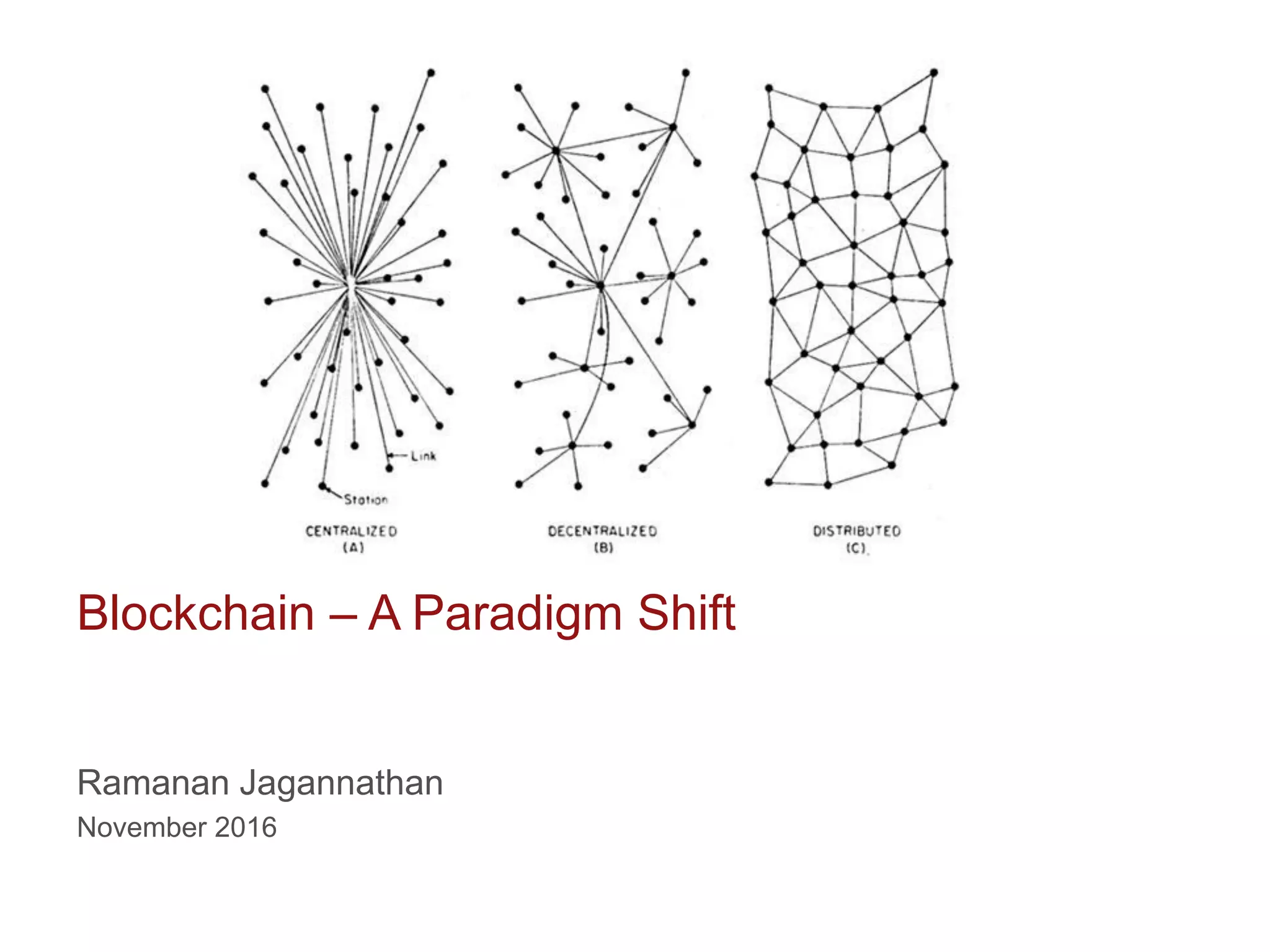
Blockchain – A Paradigm Shift
2
Agenda
• Online Transactions
• Bitcoin and Blockchain
• Global Financial Industry and Blockchain
• Resources to Dig Deeper
3
Agenda
• Online Transactions
• Bitcoin and Blockchain
• Global Financial Industry and Blockchain
• Resources to Dig Deeper
4
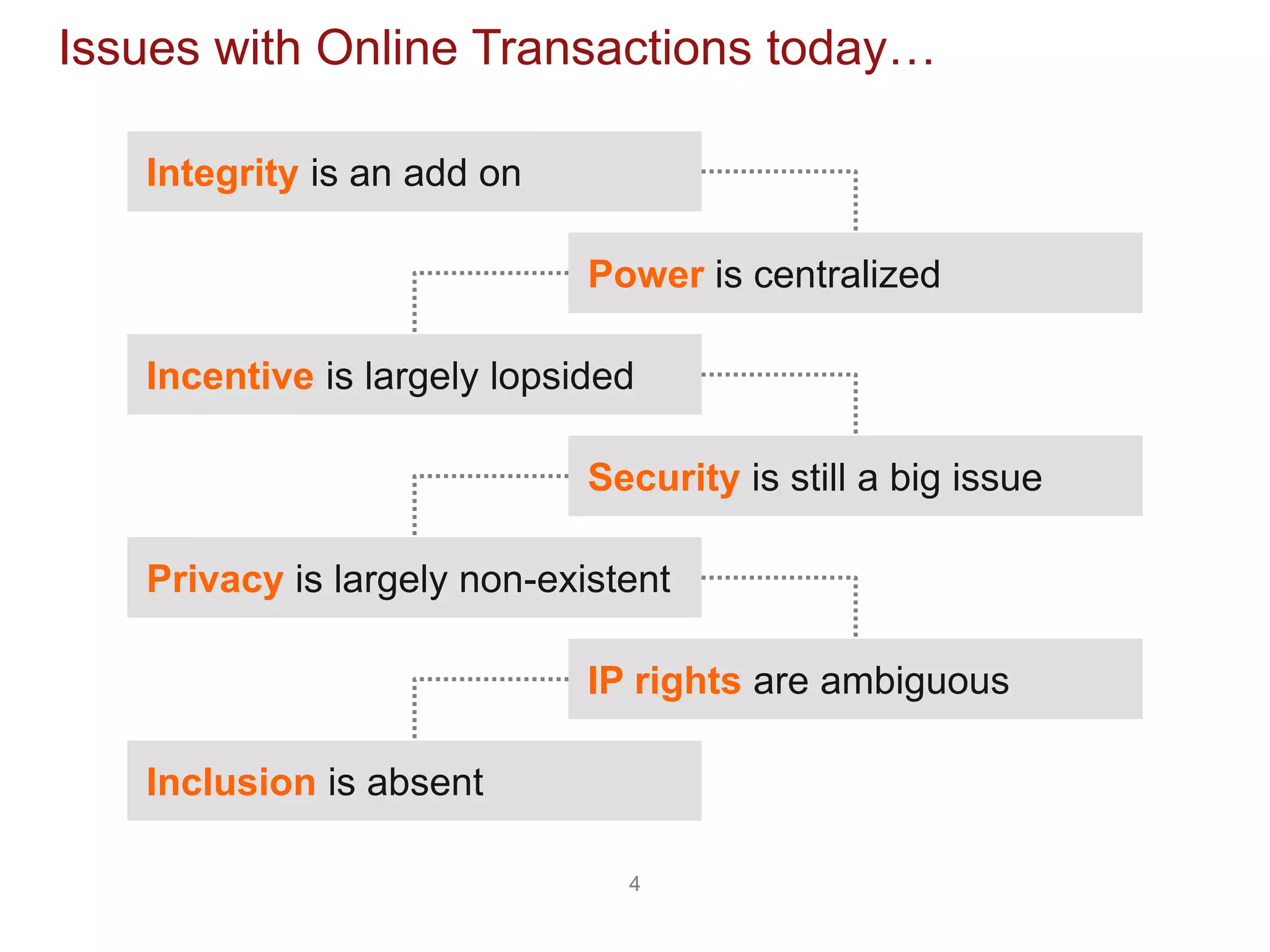
Issues with Online Transactions today…
Power is centralized
Incentive is largely lopsided
Security is still a big issue
Privacy is largely non-existent
IP rights are ambiguous
Inclusion is absent
Integrity is an add on
5
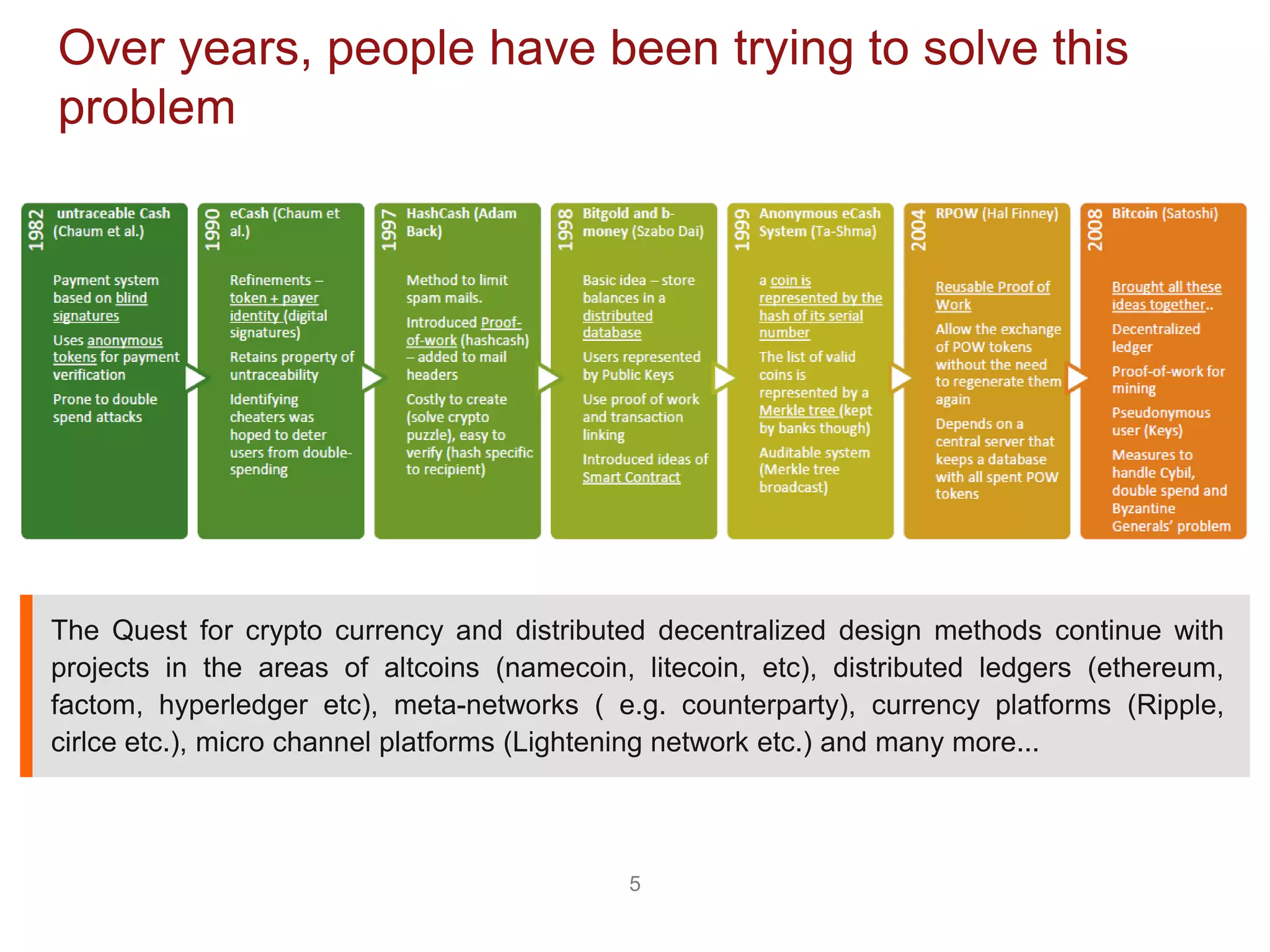
Over years, people have been trying to solve this
problem
The Quest for crypto currency and distributed decentralized design methods continue with
projects in the areas of altcoins (namecoin, litecoin, etc), distributed ledgers (ethereum,
factom, hyperledger etc), meta-networks ( e.g. counterparty), currency platforms (Ripple,
cirlce etc.), micro channel platforms (Lightening network etc.) and many more...
6
Agenda
• Online Transactions
• Bitcoin and Blockchain
• Global Financial Industry and Blockchain
• Resources to Dig Deeper
7
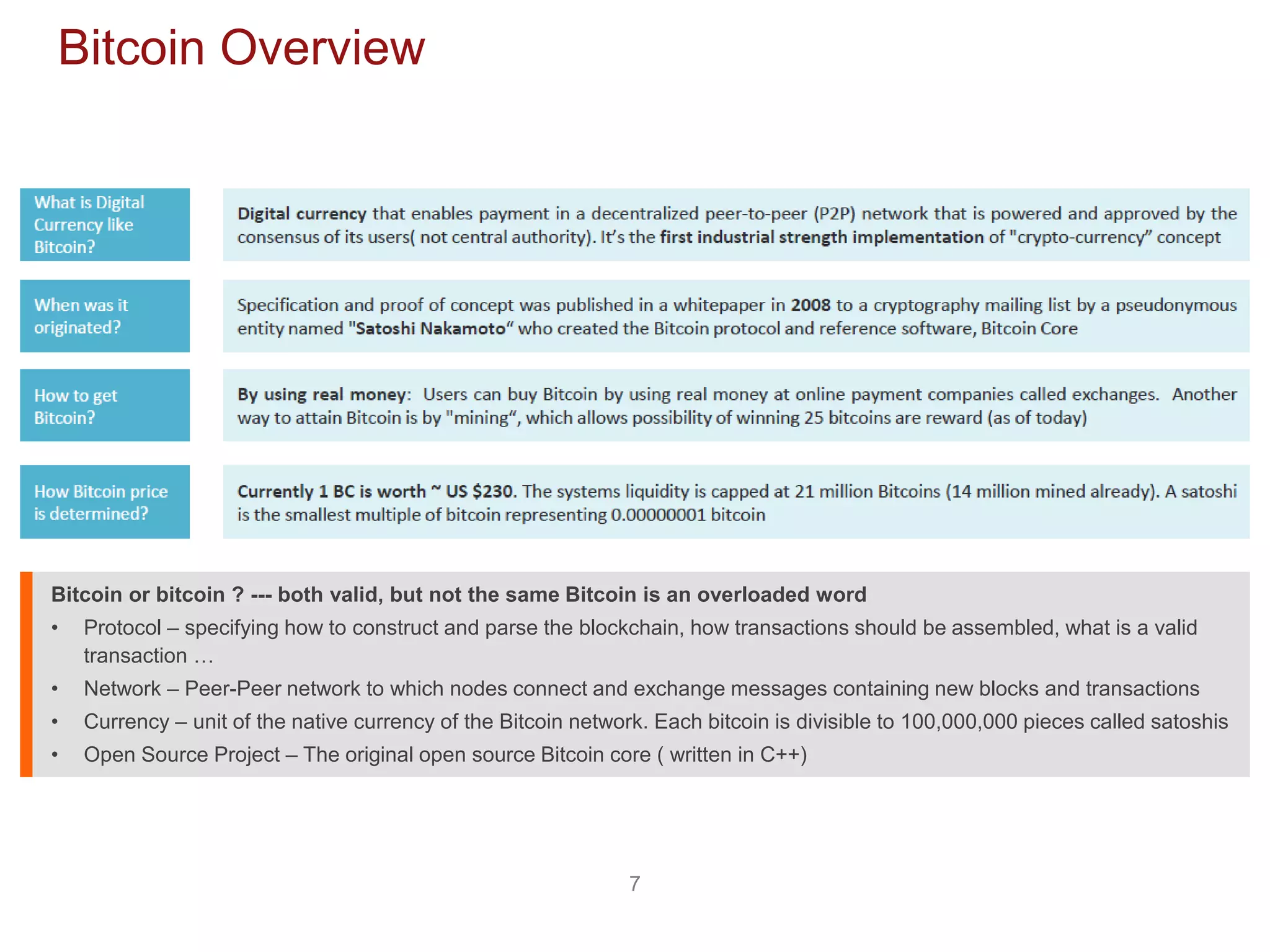
Bitcoin Overview
Bitcoin or bitcoin ? --- both valid, but not the same Bitcoin is an overloaded word
• Protocol – specifying how to construct and parse the blockchain, how transactions should be assembled, what is a valid
transaction …
• Network – Peer-Peer network to which nodes connect and exchange messages containing new blocks and transactions
• Currency – unit of the native currency of the Bitcoin network. Each bitcoin is divisible to 100,000,000 pieces called satoshis
• Open Source Project – The original open source Bitcoin core ( written in C++)
8
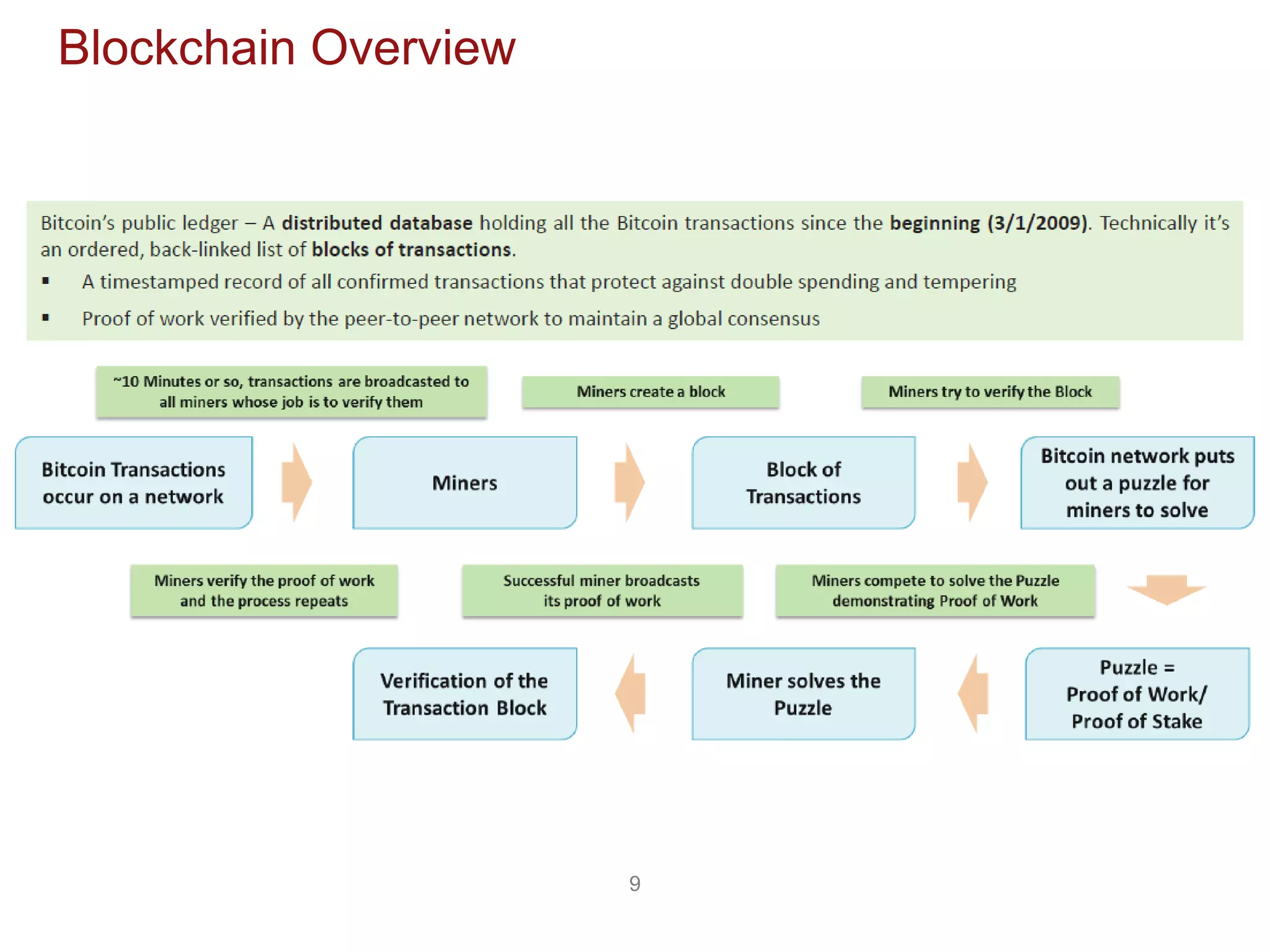
What is a Blockchain ?
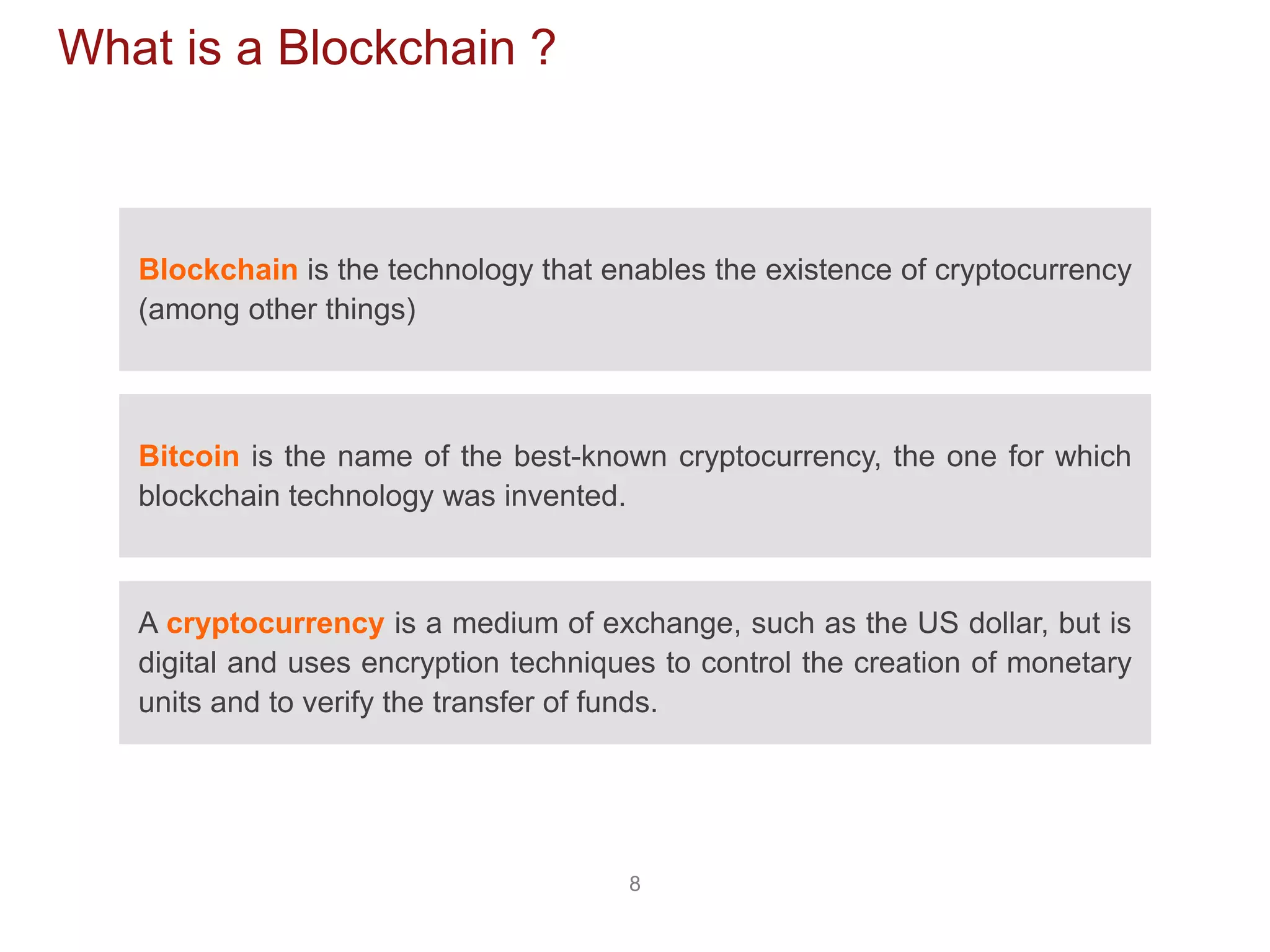
Blockchain is the technology that enables the existence of cryptocurrency
(among other things)
Bitcoin is the name of the best-known cryptocurrency, the one for which
blockchain technology was invented.
A cryptocurrency is a medium of exchange, such as the US dollar, but is
digital and uses encryption techniques to control the creation of monetary
units and to verify the transfer of funds.
9
Blockchain Overview
10
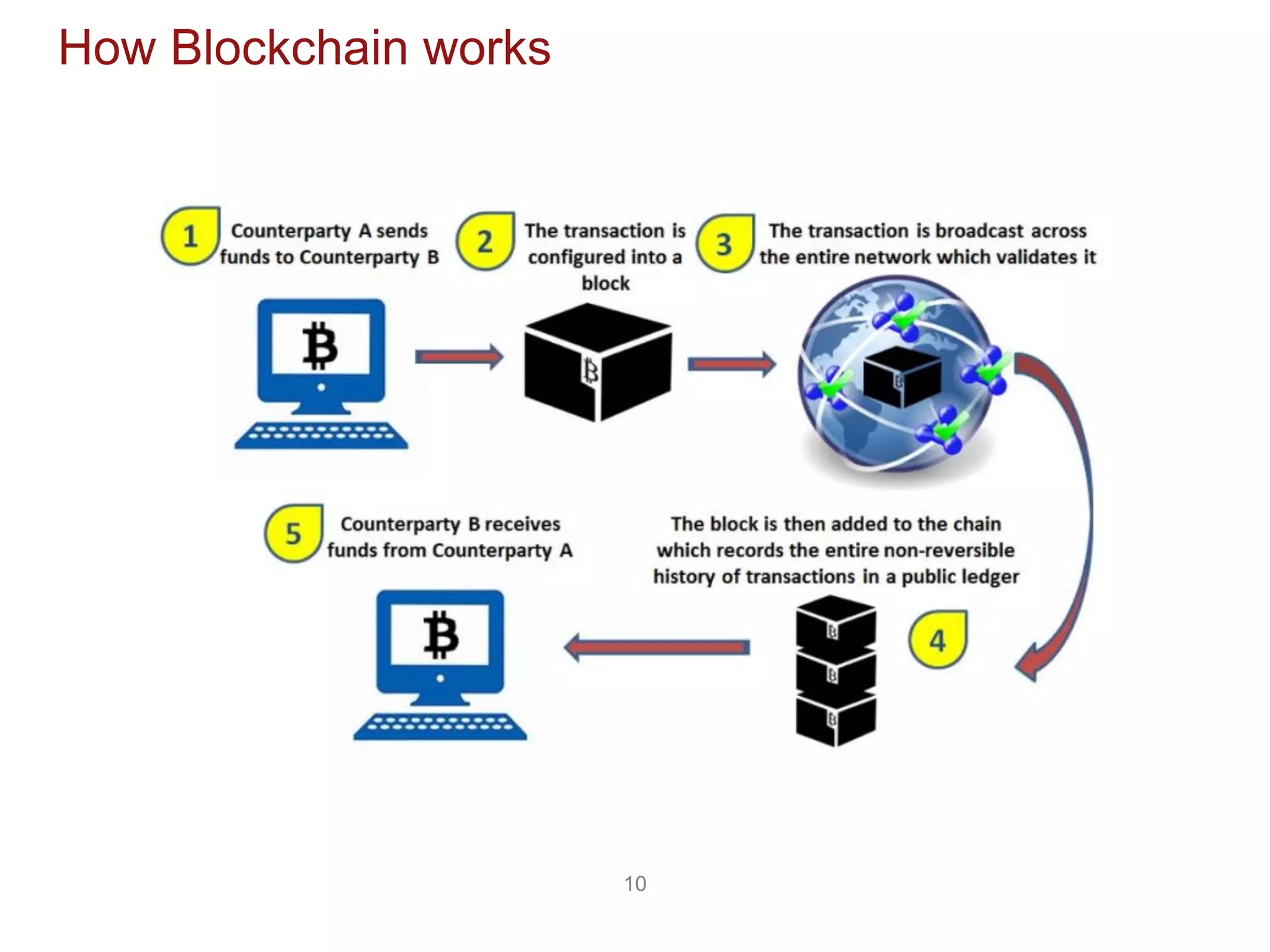
How Blockchain works
11
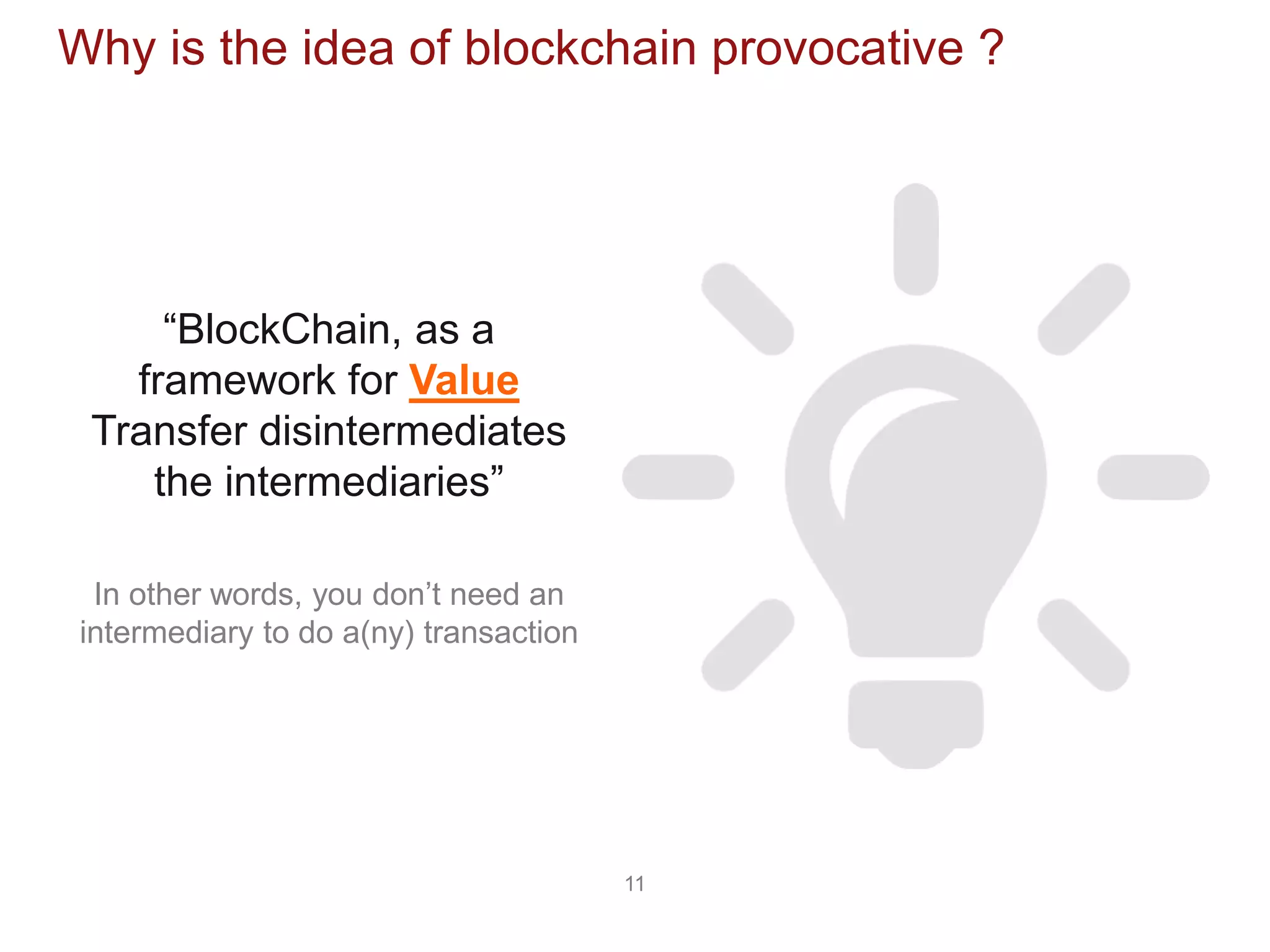
Why is the idea of blockchain provocative ?
“BlockChain, as a
framework for Value
Transfer disintermediates
the intermediaries”
In other words, you don’t need an
intermediary to do a(ny) transaction
12
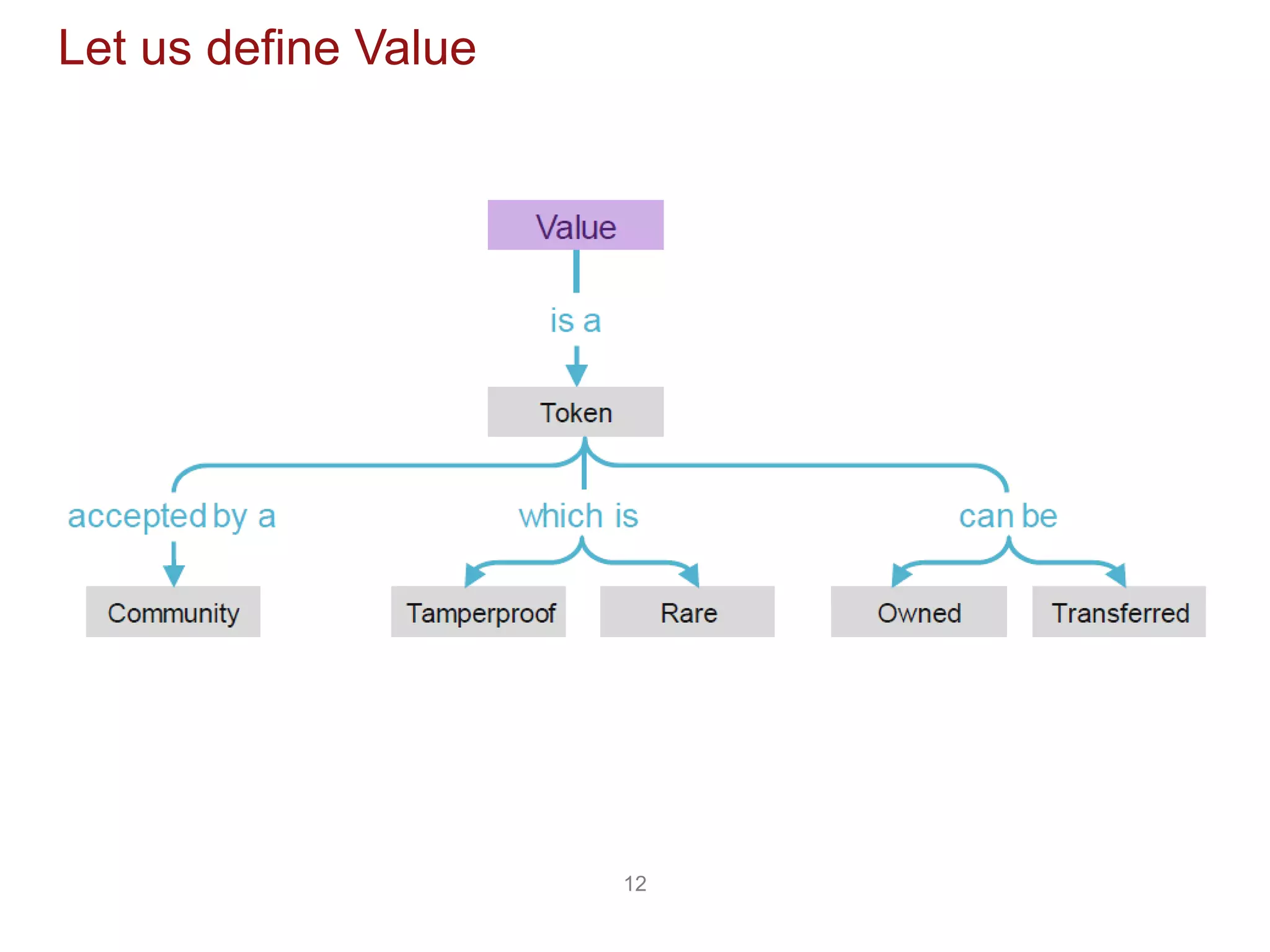
Let us define Value
13
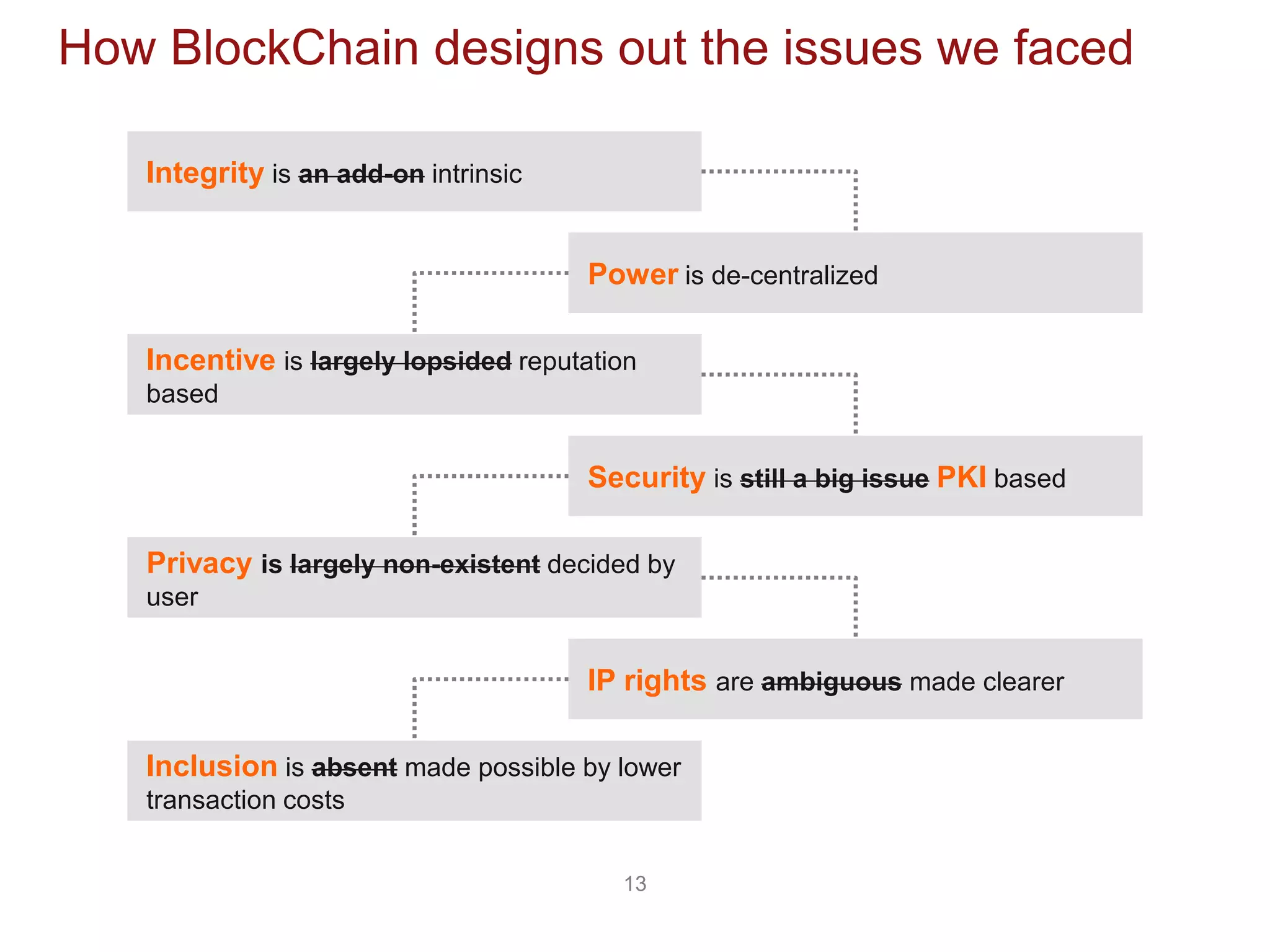
How BlockChain designs out the issues we faced
Power is de-centralized
Incentive is largely lopsided reputation
based
Security is still a big issue PKI based
Privacy is largely non-existent decided by
user
IP rights are ambiguous made clearer
Inclusion is absent made possible by lower
transaction costs
Integrity is an add-on intrinsic
14
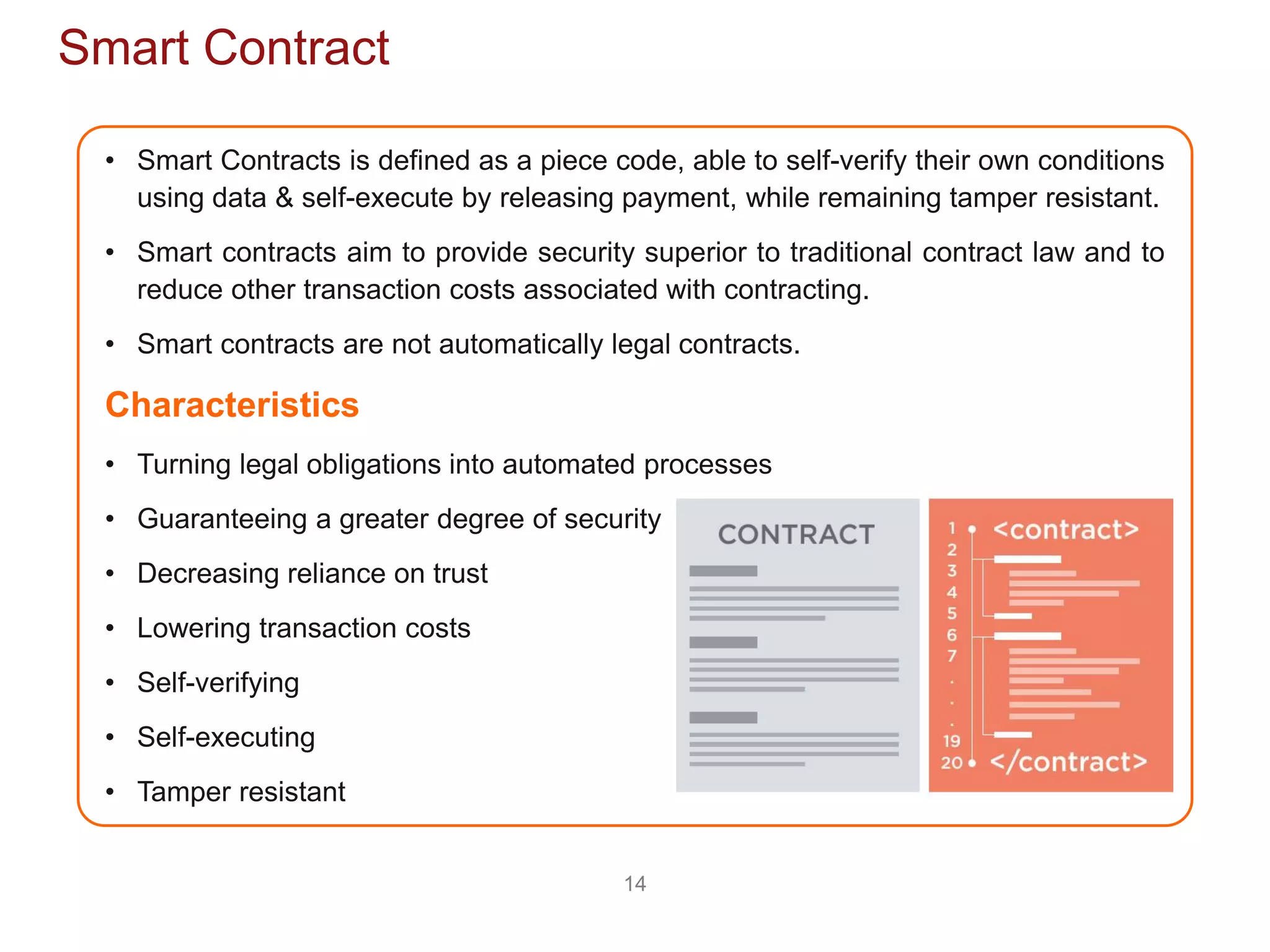
Smart Contract
• Smart Contracts is defined as a piece code, able to self-verify their own conditions
using data & self-execute by releasing payment, while remaining tamper resistant.
• Smart contracts aim to provide security superior to traditional contract law and to
reduce other transaction costs associated with contracting.
• Smart contracts are not automatically legal contracts.
Characteristics
• Turning legal obligations into automated processes
• Guaranteeing a greater degree of security
• Decreasing reliance on trust
• Lowering transaction costs
• Self-verifying
• Self-executing
• Tamper resistant
15
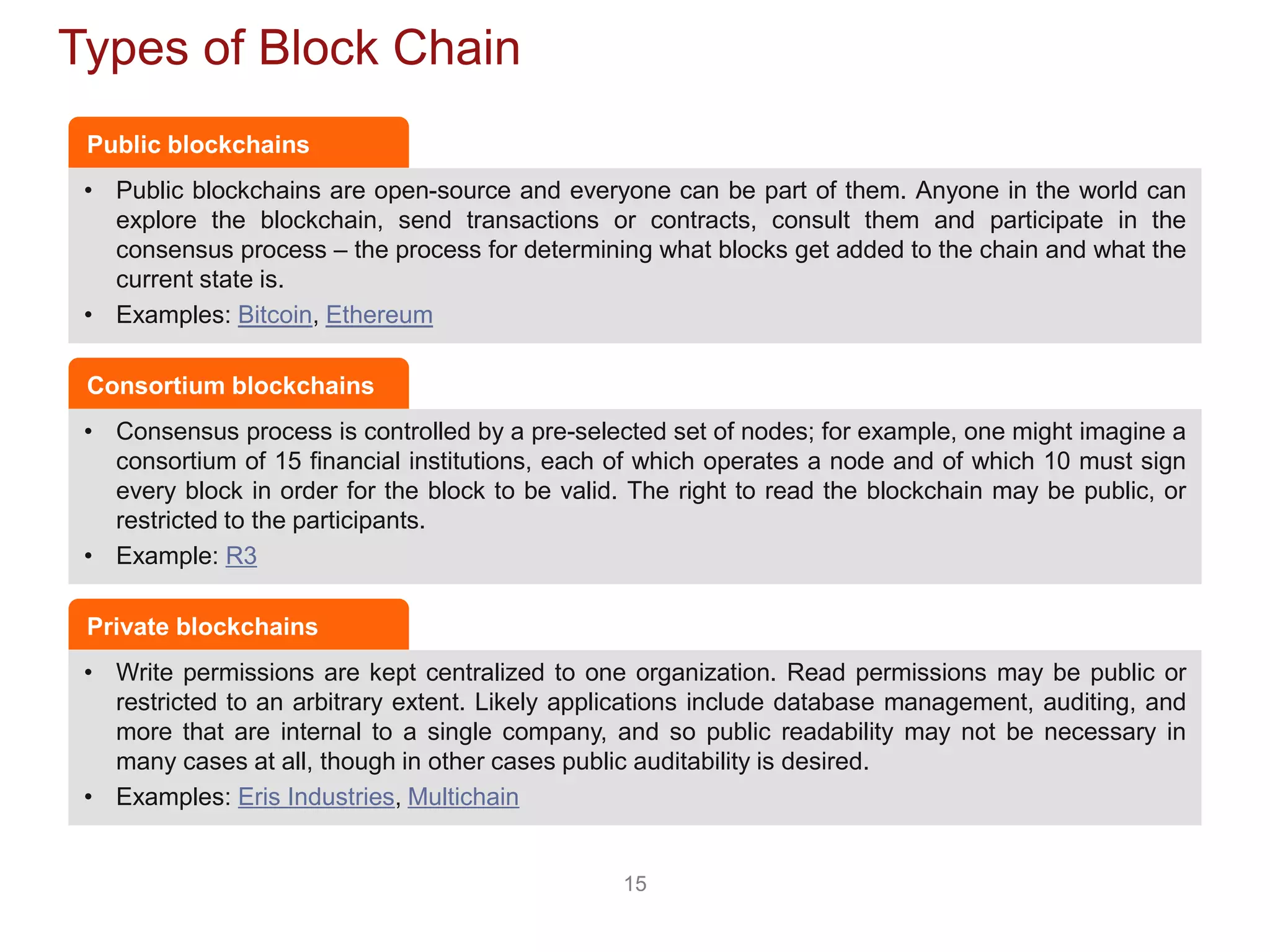
Types of Block Chain
• Public blockchains are open-source and everyone can be part of them. Anyone in the world can
explore the blockchain, send transactions or contracts, consult them and participate in the
consensus process – the process for determining what blocks get added to the chain and what the
current state is.
• Examples: Bitcoin, Ethereum
Public blockchains
• Consensus process is controlled by a pre-selected set of nodes; for example, one might imagine a
consortium of 15 financial institutions, each of which operates a node and of which 10 must sign
every block in order for the block to be valid. The right to read the blockchain may be public, or
restricted to the participants.
• Example: R3
Consortium blockchains
• Write permissions are kept centralized to one organization. Read permissions may be public or
restricted to an arbitrary extent. Likely applications include database management, auditing, and
more that are internal to a single company, and so public readability may not be necessary in
many cases at all, though in other cases public auditability is desired.
• Examples: Eris Industries, Multichain
Private blockchains
16
Agenda
• Online Transactions
• Bitcoin and Blockchain
• Global Financial Industry and Blockchain
• Resources to Dig Deeper
17
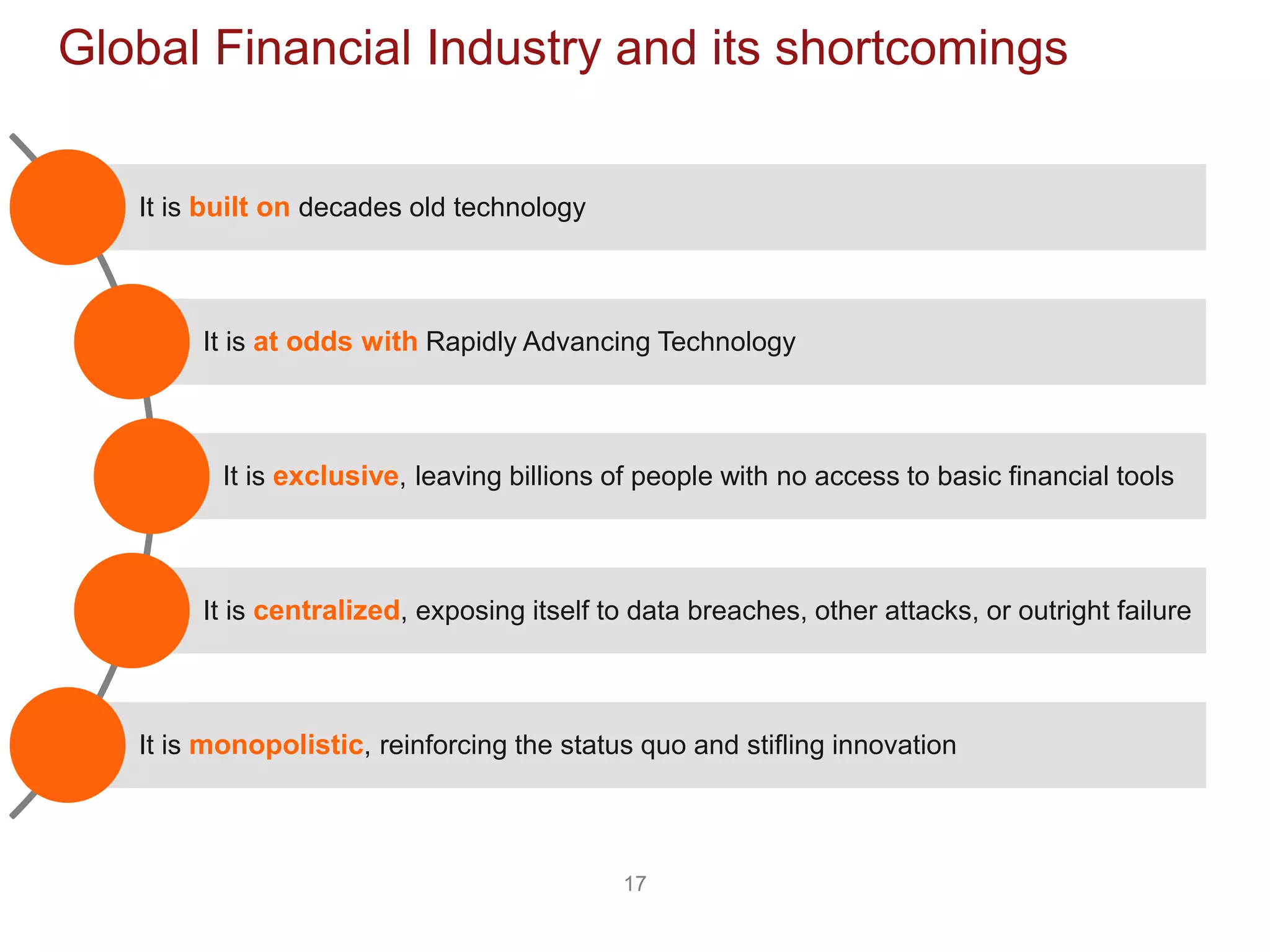
Global Financial Industry and its shortcomings
It is built on decades old technology
It is at odds with Rapidly Advancing Technology
It is exclusive, leaving billions of people with no access to basic financial tools
It is centralized, exposing itself to data breaches, other attacks, or outright failure
It is monopolistic, reinforcing the status quo and stifling innovation
18
Reasons why Blockchain Technology will disrupt
Blockchain enables Two parties who neither know each other or trust each
other to transact and do business
Attestation
On the blockchain, the network both clears and settles peer-to-peer value
transfers, and does it so continually so that the ledger is always up to date
Cost
A bitcoin network in contrast takes an average of ten minutes to clear and
settle all transactions conducted during that period
Speed
The Blockchain Technology mitigates several forms of financial riskRisk
The Blockchain Technology was designed to move bitcoins, and not other
financial assets. The technology is OpenSource and evolves due to
experimentation
Value
Innovation
19
Why are we Talking about Blockchain ?
"If, so many incredibly smart people are working on this and
investing their time and energy, let alone the money that is
flowing into it, 'it's not something that we can all ignore.
However, the community of innovators need to understand
the complexity behind payments"
Ebru Pakcan, Head-Global Payments, citi
“The emerging Technology is fascinating and ING is not in
wait and watch mode but we are in see and do mode”
Mark Buitenhek
Global Head of Payments and Cash Management (PCM)
for ING
" I believe - and this is my personal view - that blockchain
technology will not only change the way we do payments but
it will change the whole trading and settlement topic....When
somebody with a strong brand and security level establishes
it as a reliable service, then the whole industry will follow.
That is my personal prediction."
Oliver Bussman, CIO UBS
“As we build more and more complex infrastructure the
whole maintenance and [impact for] changing regulations is
becoming extremely difficult for most of the banks. What is
being demonstrated here is the quite eye opening and
definitely something to look out for."
Gautam Jain, MD & Global Head-Client Access
• The Bank of England recognized the technology as 'significant innovation' that could have "far-reaching implications".
• New York State has released Bitcoin World's first license - BitLicense!
• Financial Conduct Authority (UK) is investigating ways in which the blockchain can be used in the formal financial
services industry
Source: WSJ, Banktech, American Banker, CoinDesk, BusinessInsider, Financial News, Twitter
20
BFSI Sector foresees disruptive impact*
* Greenwich Associates 2015 study based on 58 respondents in America, Europe and Asia
Reviewing uses of Blockchain for adoption47%
Financial Institutions are implementing some applications for blockchain17%
Believe that blockchain will create disruption in financial Market94%
Familiar with the Blockchain startups and looking keenly into it56%
Want to use blockchain for reducing settlement risk and settlement time84%
Believe that blockchain can be used in OTC derivatives, apart from payments62%
21
Potential to Provide Far-reaching benefits beyond
Payments
22
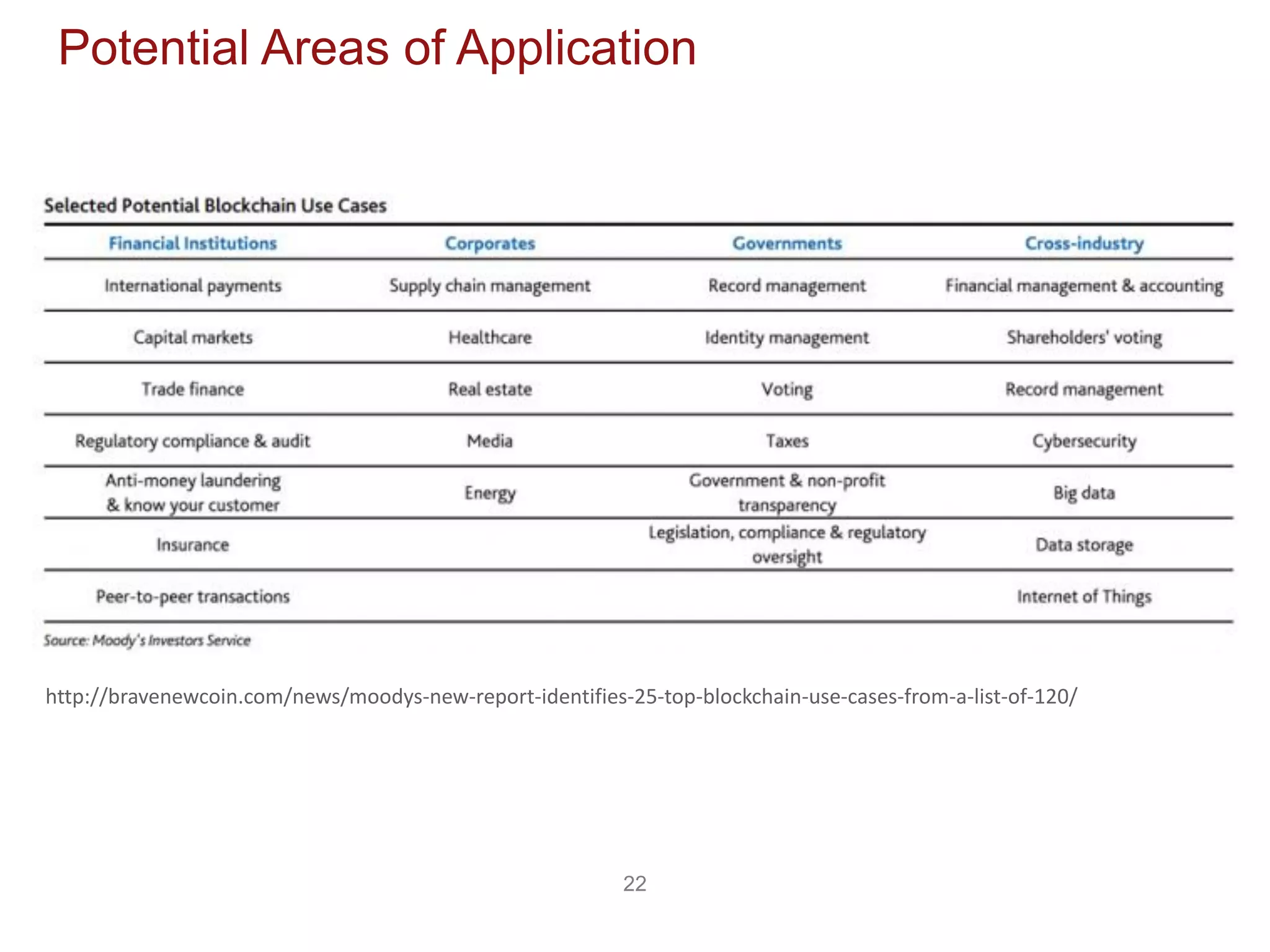
Potential Areas of Application
http://bravenewcoin.com/news/moodys-new-report-identifies-25-top-blockchain-use-cases-from-a-list-of-120/
23
Conclusions of the WEF Report
The World Economic Forum's analysis has yielded six key findings
DLT has great potential to drive simplicity and efficiency though the establishment of
new financial services infrastructure and processes1
DLT is not a panacea; instead it should be viewed as one of the many technologies
that will form the foundation of next generation financial services infrastructure2
Applications of DLT will differ by use case, each leveraging the technology in different
ways for a diverse range of benefits3
Digitial Identity is a critical enabler to broaden applications to new verticals: Digital Fiat
(legal tender), along with other emerging capabilities, has the ability to amplify benefits4
The most important DLT applications will require deep collaboration between incumbents,
innovators and regulators, adding complexity and delaying implementation5
New financial services infrastructure built on DLT will redraw processes and call into
question orthodoxies that are foundational to today's business models6
24
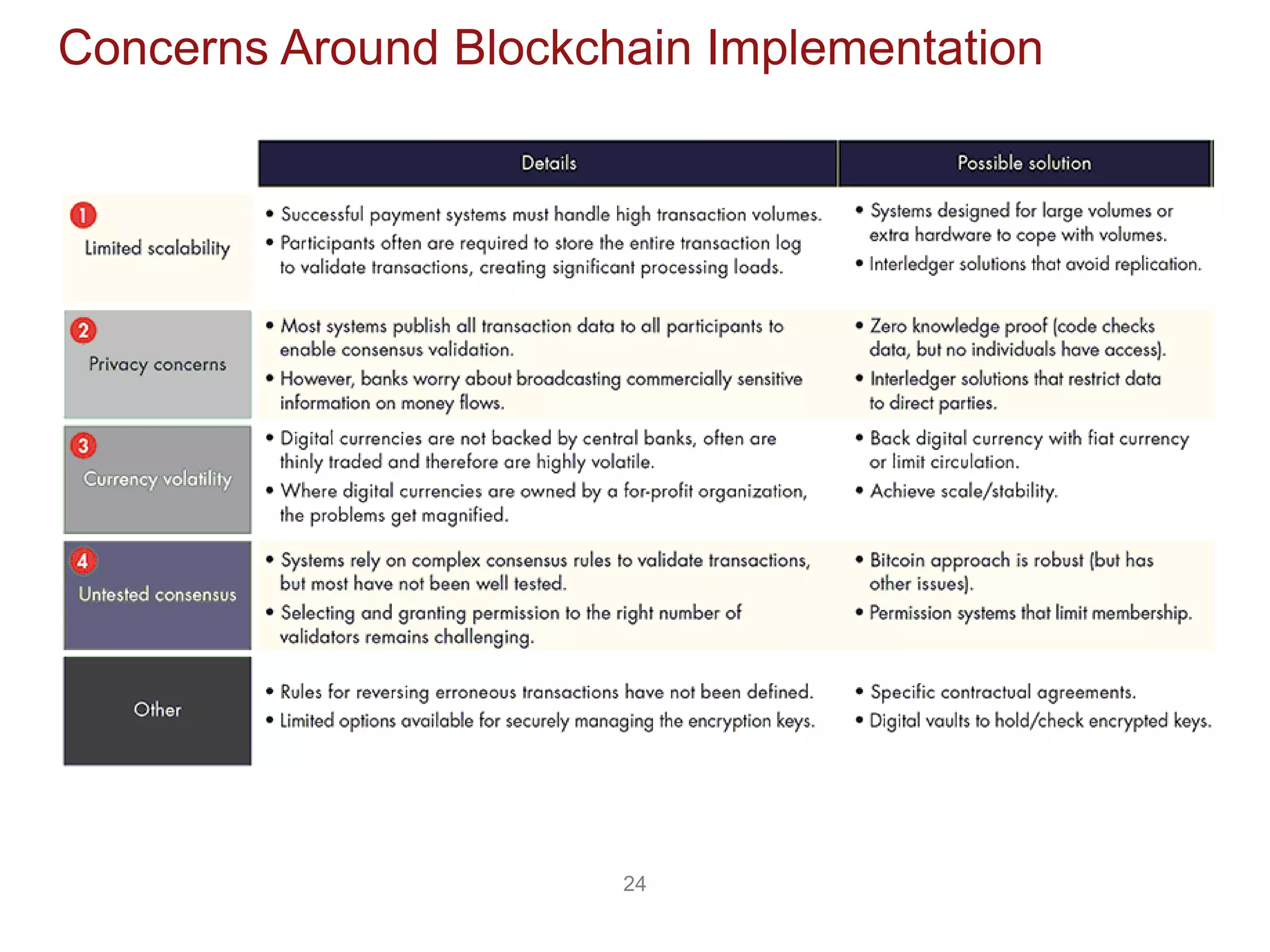
Concerns Around Blockchain Implementation
25
Blockchain Implementation in India
26
Agenda
• Online Transactions
• Bitcoin and Blockchain
• Global Financial Industry and Blockchain
• Resources to Dig Deeper
27
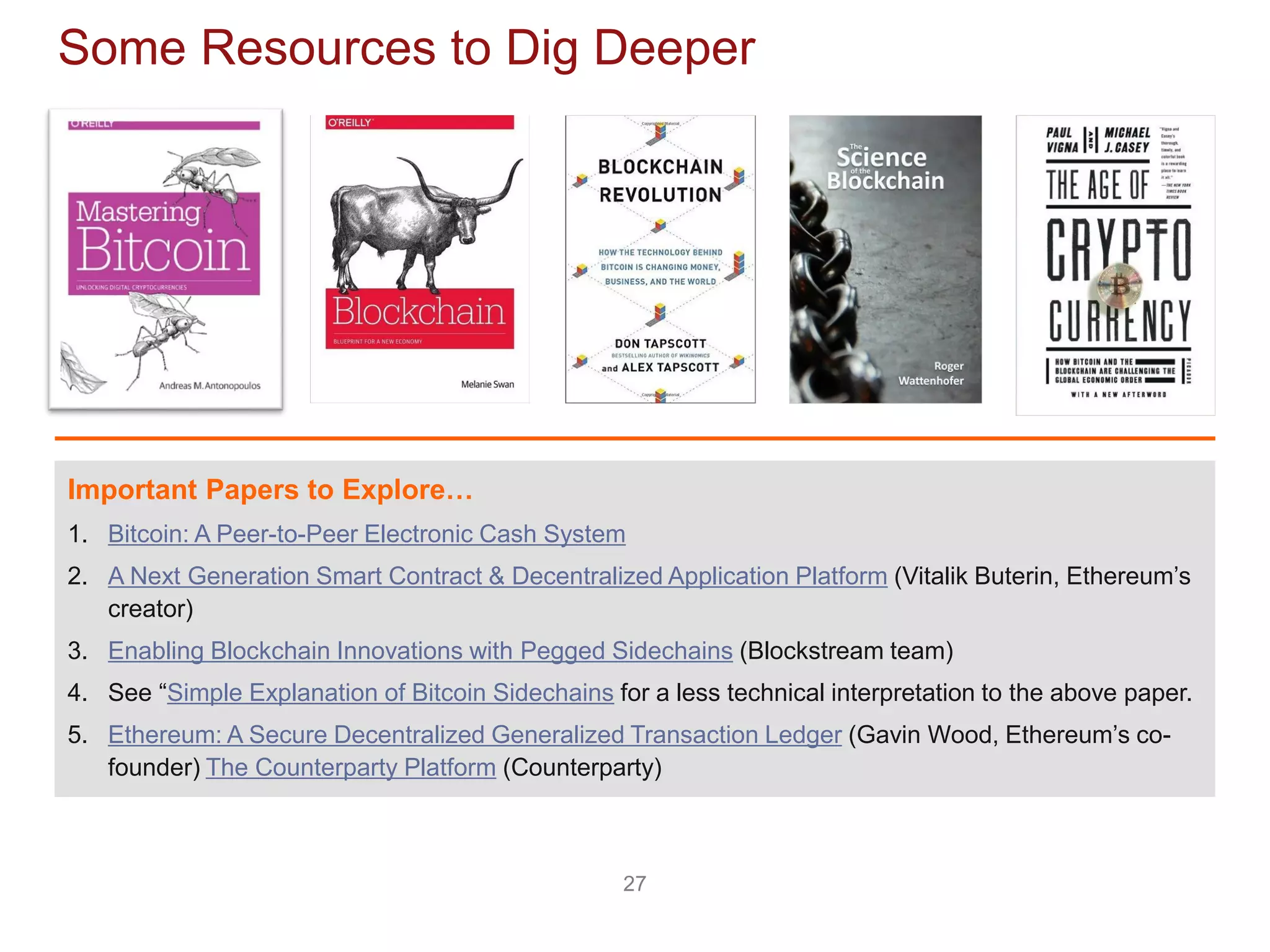
Some Resources to Dig Deeper
Important Papers to Explore…
1. Bitcoin: A Peer-to-Peer Electronic Cash System
2. A Next Generation Smart Contract & Decentralized Application Platform (Vitalik Buterin, Ethereum’s
creator)
3. Enabling Blockchain Innovations with Pegged Sidechains (Blockstream team)
4. See “Simple Explanation of Bitcoin Sidechains for a less technical interpretation to the above paper.
5. Ethereum: A Secure Decentralized Generalized Transaction Ledger (Gavin Wood, Ethereum’s co-
founder) The Counterparty Platform (Counterparty)
28
Questions?

Block chain A Paradigm Shift

  • 1.
  • 2.
    2 Agenda • Online Transactions •Bitcoin and Blockchain • Global Financial Industry and Blockchain • Resources to Dig Deeper
  • 3.
    3 Agenda • Online Transactions •Bitcoin and Blockchain • Global Financial Industry and Blockchain • Resources to Dig Deeper
  • 4.
    4 Issues with OnlineTransactions today… Power is centralized Incentive is largely lopsided Security is still a big issue Privacy is largely non-existent IP rights are ambiguous Inclusion is absent Integrity is an add on
  • 5.
    5 Over years, peoplehave been trying to solve this problem The Quest for crypto currency and distributed decentralized design methods continue with projects in the areas of altcoins (namecoin, litecoin, etc), distributed ledgers (ethereum, factom, hyperledger etc), meta-networks ( e.g. counterparty), currency platforms (Ripple, cirlce etc.), micro channel platforms (Lightening network etc.) and many more...
  • 6.
    6 Agenda • Online Transactions •Bitcoin and Blockchain • Global Financial Industry and Blockchain • Resources to Dig Deeper
  • 7.
    7 Bitcoin Overview Bitcoin orbitcoin ? --- both valid, but not the same Bitcoin is an overloaded word • Protocol – specifying how to construct and parse the blockchain, how transactions should be assembled, what is a valid transaction … • Network – Peer-Peer network to which nodes connect and exchange messages containing new blocks and transactions • Currency – unit of the native currency of the Bitcoin network. Each bitcoin is divisible to 100,000,000 pieces called satoshis • Open Source Project – The original open source Bitcoin core ( written in C++)
  • 8.
    8 What is aBlockchain ? Blockchain is the technology that enables the existence of cryptocurrency (among other things) Bitcoin is the name of the best-known cryptocurrency, the one for which blockchain technology was invented. A cryptocurrency is a medium of exchange, such as the US dollar, but is digital and uses encryption techniques to control the creation of monetary units and to verify the transfer of funds.
  • 9.
  • 10.
  • 11.
    11 Why is theidea of blockchain provocative ? “BlockChain, as a framework for Value Transfer disintermediates the intermediaries” In other words, you don’t need an intermediary to do a(ny) transaction
  • 12.
  • 13.
    13 How BlockChain designsout the issues we faced Power is de-centralized Incentive is largely lopsided reputation based Security is still a big issue PKI based Privacy is largely non-existent decided by user IP rights are ambiguous made clearer Inclusion is absent made possible by lower transaction costs Integrity is an add-on intrinsic
  • 14.
    14 Smart Contract • SmartContracts is defined as a piece code, able to self-verify their own conditions using data & self-execute by releasing payment, while remaining tamper resistant. • Smart contracts aim to provide security superior to traditional contract law and to reduce other transaction costs associated with contracting. • Smart contracts are not automatically legal contracts. Characteristics • Turning legal obligations into automated processes • Guaranteeing a greater degree of security • Decreasing reliance on trust • Lowering transaction costs • Self-verifying • Self-executing • Tamper resistant
  • 15.
    15 Types of BlockChain • Public blockchains are open-source and everyone can be part of them. Anyone in the world can explore the blockchain, send transactions or contracts, consult them and participate in the consensus process – the process for determining what blocks get added to the chain and what the current state is. • Examples: Bitcoin, Ethereum Public blockchains • Consensus process is controlled by a pre-selected set of nodes; for example, one might imagine a consortium of 15 financial institutions, each of which operates a node and of which 10 must sign every block in order for the block to be valid. The right to read the blockchain may be public, or restricted to the participants. • Example: R3 Consortium blockchains • Write permissions are kept centralized to one organization. Read permissions may be public or restricted to an arbitrary extent. Likely applications include database management, auditing, and more that are internal to a single company, and so public readability may not be necessary in many cases at all, though in other cases public auditability is desired. • Examples: Eris Industries, Multichain Private blockchains
  • 16.
    16 Agenda • Online Transactions •Bitcoin and Blockchain • Global Financial Industry and Blockchain • Resources to Dig Deeper
  • 17.
    17 Global Financial Industryand its shortcomings It is built on decades old technology It is at odds with Rapidly Advancing Technology It is exclusive, leaving billions of people with no access to basic financial tools It is centralized, exposing itself to data breaches, other attacks, or outright failure It is monopolistic, reinforcing the status quo and stifling innovation
  • 18.
    18 Reasons why BlockchainTechnology will disrupt Blockchain enables Two parties who neither know each other or trust each other to transact and do business Attestation On the blockchain, the network both clears and settles peer-to-peer value transfers, and does it so continually so that the ledger is always up to date Cost A bitcoin network in contrast takes an average of ten minutes to clear and settle all transactions conducted during that period Speed The Blockchain Technology mitigates several forms of financial riskRisk The Blockchain Technology was designed to move bitcoins, and not other financial assets. The technology is OpenSource and evolves due to experimentation Value Innovation
  • 19.
    19 Why are weTalking about Blockchain ? "If, so many incredibly smart people are working on this and investing their time and energy, let alone the money that is flowing into it, 'it's not something that we can all ignore. However, the community of innovators need to understand the complexity behind payments" Ebru Pakcan, Head-Global Payments, citi “The emerging Technology is fascinating and ING is not in wait and watch mode but we are in see and do mode” Mark Buitenhek Global Head of Payments and Cash Management (PCM) for ING " I believe - and this is my personal view - that blockchain technology will not only change the way we do payments but it will change the whole trading and settlement topic....When somebody with a strong brand and security level establishes it as a reliable service, then the whole industry will follow. That is my personal prediction." Oliver Bussman, CIO UBS “As we build more and more complex infrastructure the whole maintenance and [impact for] changing regulations is becoming extremely difficult for most of the banks. What is being demonstrated here is the quite eye opening and definitely something to look out for." Gautam Jain, MD & Global Head-Client Access • The Bank of England recognized the technology as 'significant innovation' that could have "far-reaching implications". • New York State has released Bitcoin World's first license - BitLicense! • Financial Conduct Authority (UK) is investigating ways in which the blockchain can be used in the formal financial services industry Source: WSJ, Banktech, American Banker, CoinDesk, BusinessInsider, Financial News, Twitter
  • 20.
    20 BFSI Sector foreseesdisruptive impact* * Greenwich Associates 2015 study based on 58 respondents in America, Europe and Asia Reviewing uses of Blockchain for adoption47% Financial Institutions are implementing some applications for blockchain17% Believe that blockchain will create disruption in financial Market94% Familiar with the Blockchain startups and looking keenly into it56% Want to use blockchain for reducing settlement risk and settlement time84% Believe that blockchain can be used in OTC derivatives, apart from payments62%
  • 21.
    21 Potential to ProvideFar-reaching benefits beyond Payments
  • 22.
    22 Potential Areas ofApplication http://bravenewcoin.com/news/moodys-new-report-identifies-25-top-blockchain-use-cases-from-a-list-of-120/
  • 23.
    23 Conclusions of theWEF Report The World Economic Forum's analysis has yielded six key findings DLT has great potential to drive simplicity and efficiency though the establishment of new financial services infrastructure and processes1 DLT is not a panacea; instead it should be viewed as one of the many technologies that will form the foundation of next generation financial services infrastructure2 Applications of DLT will differ by use case, each leveraging the technology in different ways for a diverse range of benefits3 Digitial Identity is a critical enabler to broaden applications to new verticals: Digital Fiat (legal tender), along with other emerging capabilities, has the ability to amplify benefits4 The most important DLT applications will require deep collaboration between incumbents, innovators and regulators, adding complexity and delaying implementation5 New financial services infrastructure built on DLT will redraw processes and call into question orthodoxies that are foundational to today's business models6
  • 24.
  • 25.
  • 26.
    26 Agenda • Online Transactions •Bitcoin and Blockchain • Global Financial Industry and Blockchain • Resources to Dig Deeper
  • 27.
    27 Some Resources toDig Deeper Important Papers to Explore… 1. Bitcoin: A Peer-to-Peer Electronic Cash System 2. A Next Generation Smart Contract & Decentralized Application Platform (Vitalik Buterin, Ethereum’s creator) 3. Enabling Blockchain Innovations with Pegged Sidechains (Blockstream team) 4. See “Simple Explanation of Bitcoin Sidechains for a less technical interpretation to the above paper. 5. Ethereum: A Secure Decentralized Generalized Transaction Ledger (Gavin Wood, Ethereum’s co- founder) The Counterparty Platform (Counterparty)
  • 28.