‫قنبریان‬‫مهدیس‬
Introduction
 Bitcoin is an innovative payment network and a new
kind of money
 Bitcoin, the online, digital currency
 Bitcoin uses peer-to-peer technology to operate with
no central authority or banks
 Bitcoin is open-source; its design is public, nobody
owns or controls
History
 Bitcoin is the first successful implementation of a
distributed crypto-currency, described in part in 1998
by Wei Dai
 2007
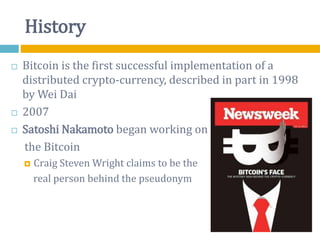
 Satoshi Nakamoto began working on
the Bitcoin
 Craig Steven Wright claims to be the
real person behind the pseudonym
History
 2008
 Nakamoto publishes a design paper
 & Bitcoin.org is registered
 The domain was registered at
anonymousspeech.com
 2009
 Version 0.1 is released
 & The first Bitcoin transaction
 2010
 The first, real-world transaction using Bitcoins takes place
 2013
 The first Bitcoin ATM in the world is debuted in San Diego, California.
 Bitcoin ruled currency by Texas judge
 Bitcoin ruled private money in Germany
Why?
 Bitcoins are sent easily through the Internet, without
needing to trust any third party
 The supply of bitcoins is regulated by software and the
agreement of users of the system and cannot be
manipulated by any government, bank, organization or
individual.
 Transactions:
 Are irreversible by design
 Are fast. Funds received are available for spending within
minutes
 Cost very little, especially compared to other payment networks
Why?
 Anonymity
 Transparency
 solve double spend problem
 Mining by users
 Inflation is Impossible
vocabulary
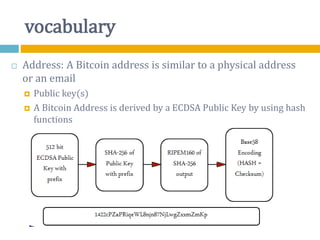
 Address: A Bitcoin address is similar to a physical address
or an email
 Public key(s)
 A Bitcoin Address is derived by a ECDSA Public Key by using hash
functions
vocabulary
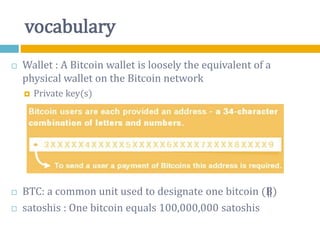
 Wallet : A Bitcoin wallet is loosely the equivalent of a
physical wallet on the Bitcoin network
 Private key(s)
 BTC: a common unit used to designate one bitcoin (B⃦)
 satoshis : One bitcoin equals 100,000,000 satoshis
Proof of Work
 Bitcoin requires that each block prove a significant amount
of work was invested in its creation
 To ensure that untrustworthy peers who want to modify past
blocks have to work harder than honest peers who only want to
add new blocks to the block chain
 The proof of work used in Bitcoin takes advantage of the
apparently random nature of cryptographic hashes
 In Bitcoin the hashing algorithm is SHA256
 only the 80-byte block header is hashed for proof-of-work
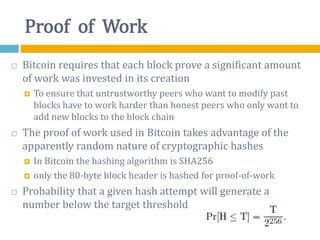
 Probability that a given hash attempt will generate a
number below the target threshold
Proof of Work
 Every 2,016 blocks, the network uses timestamps stored in
each block header
 To calculate the number of seconds elapsed between generation
of the first and last of those last 2,016 blocks
 The ideal value is 1,209,600 seconds (two weeks)
 If it took fewer than two weeks to generate the blocks, the
expected difficulty value is increased proportionally (by as much
as 300%)
 If it took more than two weeks to generate the blocks, the
expected difficulty value is decreased proportionally (by as much
as 75%)
Block Chain
 The block chain provides Bitcoin’s public ledger, an
ordered and timestamped record of transactions
 To protect against double spending and modification
of previous transaction records
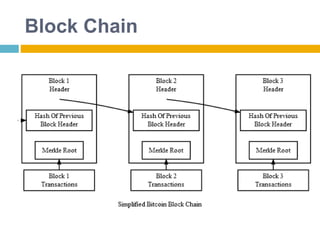
 A block of one or more new transactions is collected
into the transaction data part of a block
 The merkle root is stored in the block header
 Each block also stores the hash of the previous
block’s header
Block Chain
 The block chain provides Bitcoin’s public ledger, an
ordered and timestamped record of transactions
 To protect against double spending and modification
of previous transaction records
 A block of one or more new transactions is collected
into the transaction data part of a block
 The merkle root is stored in the block header
 Each block also stores the hash of the previous
block’s header
A tree constructed by hashing paired data (the leaves), then pairing and
hashing the results until a single hash remains, the merkle root.
 In Bitcoin, the leaves are almost always transactions from a single block.
Block Chain
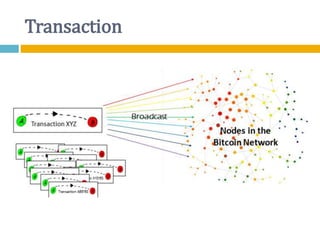
Transaction
 Transactions let users spend satoshis
 There are two types of transactions
 Coinbase transactions
 New Bitcoins are introduced into the system
 In every block as the very first transaction
 reward for solving a proof-of-work problem
 Regular transactions
 Are used to transfer existing Bitcoins amongst different accounts
Transaction
Transaction
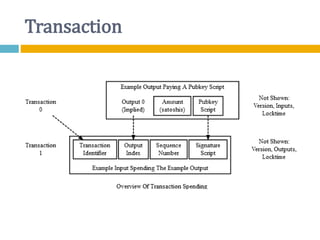
 Each transaction is prefixed by a four-byte transaction
version number
 Bitcoin peers and miners which set of rules to use to validate it
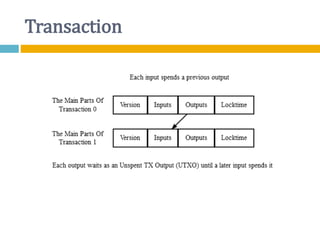
 Each transaction has at least one input and one output
 Each input spends the satoshis paid to a previous output.
 Each output then waits as an Unspent Transaction Output
(UTXO) until a later input spends it
Transaction
Transaction
 An output has an implied index number based on its
location in the transaction
 The output also has an amount in satoshis which it pays to a
conditional pubkey script
 Anyone who can satisfy the conditions of that pubkey script
can spend up to the amount of satoshis paid to it
A script included in outputs which sets the conditions that must be
fulfilled for those satoshis to be spent. Data for fulfilling the conditions
can be provided in a signature script. Called a scriptPubKey in code
Transaction
 An input uses a transaction identifier (txid)
 And an output index number (often called “vout” for output
vector) to identify a particular output to be spent
 It also has a signature script which allows it to provide data
parameters that satisfy the conditionals in the pubkey
script
Data generated by a spender which is almost always used as variables
to satisfy a pubkey script. Called a scriptSig in code
Transaction
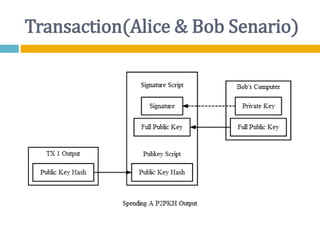
Transaction(Alice & Bob Senario)
 Alice uses to send Bob a transaction and which Bob later
uses to spend that transaction
 Both Alice and Bob will use the most common form of the
standard Pay-To-Public-Key-Hash (P2PKH) transaction
type
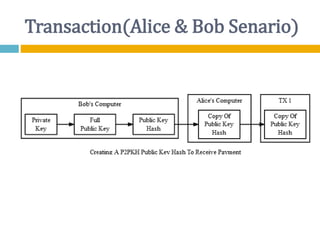
 Bob must first generate a private/public key pair before
Alice can create the first transaction
 Bitcoin uses the Elliptic Curve Digital Signature Algorithm
(ECDSA) with the secp256k1 curve
 secp256k1 private keys are 256 bits of random data
 A copy of that data is deterministically transformed into an
secp256k1 public key
Transaction(Alice & Bob Senario)
 The public key (pubkey) is then cryptographically hashed
 Bob provides the pubkey hash to Alice
 Pubkey hashes are almost always sent encoded as Bitcoin
addresses, which are base58-encoded strings
 containing an address version number, the hash, and an error-
detection checksum
 Once Alice has the address and decodes it back into a
standard hash, she can create the first transaction
 A standard P2PKH transaction output containing
instructions(are called the pubkey script or scriptPubKey)
Transaction(Alice & Bob Senario)
 Alice broadcasts the transaction and it is added to the block
chain.
 The network categorizes it as an Unspent Transaction Output
(UTXO)
 Some time later, Bob decides to spend the UTXO, he must
create an input which references the transaction Alice
created by its hash, called a Transaction Identifier (txid)
 Create a signature script—a collection of data parameters
which satisfy the conditions Alice placed in the previous
output’s pubkey script.
 Signature scripts are also called scriptSigs
Transaction(Alice & Bob Senario)
 Alice broadcasts the transaction and it is added to the block
chain. The network categorizes it as an Unspent
Transaction Output (UTXO), and Bob’s wallet software
displays it as a spendable balance.
 some time later, Bob decides to spend the UTXO, he must
create an input which references the transaction Alice
created by its hash, called a Transaction Identifier (txid)
 create a signature script—a collection of data parameters
which satisfy the conditions Alice placed in the previous
output’s pubkey script. Signature scripts are also called
scriptSigs
Transaction(Alice & Bob Senario)
Wallet
 Wallet programs create public keys to receive satoshis and
use the corresponding private keys to spend those satoshis
 Wallet programs also need to interact with the peer-to-peer
network to get information from the block chain and to
broadcast new transactions
 three necessary, but separable, parts of a wallet system:
 public key distribution program
 signing program
 networked program
Wallet
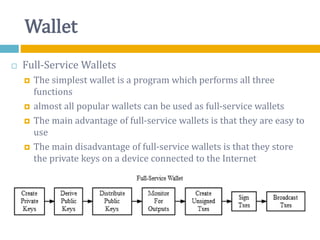
 Full-Service Wallets
 The simplest wallet is a program which performs all three
functions
 almost all popular wallets can be used as full-service wallets
 The main advantage of full-service wallets is that they are easy to
use
 The main disadvantage of full-service wallets is that they store
the private keys on a device connected to the Internet
Wallet
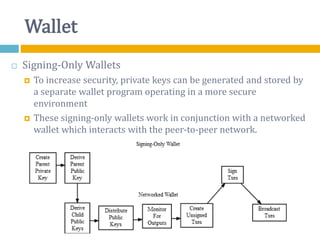
 Signing-Only Wallets
 To increase security, private keys can be generated and stored by
a separate wallet program operating in a more secure
environment
 These signing-only wallets work in conjunction with a networked
wallet which interacts with the peer-to-peer network.
Wallet
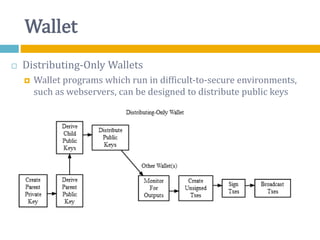
 Distributing-Only Wallets
 Wallet programs which run in difficult-to-secure environments,
such as webservers, can be designed to distribute public keys
Mining
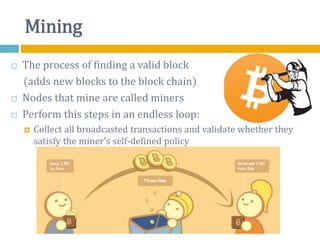
 The process of finding a valid block
(adds new blocks to the block chain)
 Nodes that mine are called miners
 Perform this steps in an endless loop:
 Collect all broadcasted transactions and validate whether they
satisfy the miner's self-defined policy
Mining
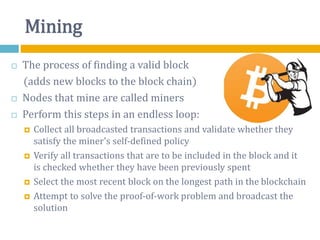
 The process of finding a valid block
(adds new blocks to the block chain)
 Nodes that mine are called miners
 Perform this steps in an endless loop:
 Collect all broadcasted transactions and validate whether they
satisfy the miner's self-defined policy
 Verify all transactions that are to be included in the block and it
is checked whether they have been previously spent
 Select the most recent block on the longest path in the blockchain
 Attempt to solve the proof-of-work problem and broadcast the
solution
Mining
Mining
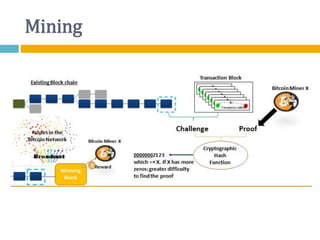
 Miners use software that accesses their processing capacity
to solve transaction-related algorithms . In return, they are
awarded a certain number of Bitcoins per block
 Its mining hardware (an ASIC) along with a target threshold
(difficulty setting).
 The mining hardware iterates through every possible value
for the block header nonce and generates the
corresponding hash
 If a hash is found below the target threshold, the mining
hardware returns the block header with the successful nonce to
the mining software.
 The mining software combines the header with the block and
broadcasts to the network for addition to the block chain
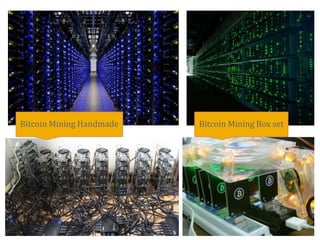
Bitcoin Mining Handmade Bitcoin Mining Box set
Payment
 Payment processing encompasses the steps spenders and
receivers perform to make and accept payments in
exchange for products or services
 The Payment Protocol is described in depth in BIP70,
BIP71, and BIP72
 New payment protocol adds many important features :
 Supports X.509 certificates and SSL encryption to verify
receivers’ identity and help prevent man-in-the-middle attacks
 Allows spenders to submit transactions directly to receivers
without going through the peer-to-peer network
 Bluetooth-based payments
 Instead of a meaningless address
(mjSk1Ny9spzU2fouzYgLqGUD8U41iR35QN), Common Name
(CN) description from the receiver’s X.509
certificate(www.bitcoin.org)
Payment Protocol
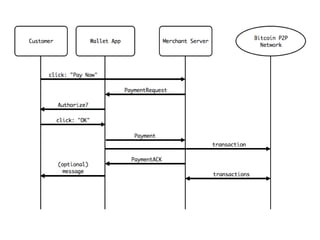
 Charlie, the client, is shopping on a website run by Bob
 Charlie adds a few items to his shopping cart and clicks the
“Checkout With Bitcoin” button.
 Bob’s server automatically adds the following information
to its invoice database:
 The details of Charlie’s order, including items ordered and
shipping address.
 An order total in satoshis
 An expiration time when that total will no longer be acceptable.
 A pubkey script to which Charlie should send payment.
 After adding all that information to the database, Bob’s
server displays a bitcoin: URI for Charlie to click to pay
Payment Protocol
 Charlie clicks on the bitcoin: URI in his browser
 His browser’s URI handler sends the URI to his wallet
program
 Walet sends an HTTP GET to that URL looking for a
PaymentRequest message
 The PaymentRequest message returned may include
private information, such as Charlie’s mailing address
 The unique public key created for the payment request can
be used to create a unique identifier
Payment Protocol
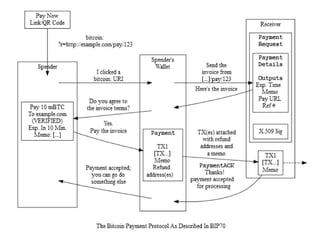
 After receiving the HTTP GET to the URL, Bob’s webserver
takes the unique identifier from the URL and looks up the
corresponding details in the database.
 creates a PaymentDetails message with information:
 The amount of the order in satoshis and the pubkey script to be paid
 A memo containing the list of items ordered
 The time the PaymentDetails message was created plus the time it
expires
 A URL to which Charlie’s wallet should send its completed transaction
 That PaymentDetails message is put inside a
PaymentRequest message.
 Bob’s server sign the entire Request with the server’s X.509
SSL certificate
 Bob’s server sends the payment request to Charlie’s wallet
in the reply to the HTTP GET
Payment Protocol
 Charlie’s wallet receives the PaymentRequest message,
checks its signature, and then displays the details to Charlie
 Charlie agrees to pay, the wallet constructs a payment to the
pubkey script Bob’s server provided
 Constructs a Payment message and sends it to the URL
provided in the PaymentDetails message as an HTTP POST
which contains:
 The signed transaction in which Charlie pays Bob
 An optional memo Charlie can send to Bob
 A refund address (pubkey script) which Bob can pay if he needs
to return some or all of Charlie’s satoshis
Payment Protocol
 Bob’s server receives the Payment message, verifies the
transaction, then broadcasts the transaction to the network.
 Replies to the HTTP POSTed Payment message with a
PaymentACK message
 Charlie’s wallet sees the PaymentACK and tells Charlie that
the payment has been sent
 The PaymentACK doesn’t mean that Bob has verified
Charlie’s payment
 After Bob’s server verifies from the block chain that
Charlie’s transaction has been suitably confirmed, it
authorizes shipping Charlie’s order
Verifying Payment
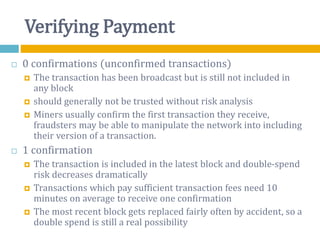
 0 confirmations (unconfirmed transactions)
 The transaction has been broadcast but is still not included in
any block
 should generally not be trusted without risk analysis
 Miners usually confirm the first transaction they receive,
fraudsters may be able to manipulate the network into including
their version of a transaction.
 1 confirmation
 The transaction is included in the latest block and double-spend
risk decreases dramatically
 Transactions which pay sufficient transaction fees need 10
minutes on average to receive one confirmation
 The most recent block gets replaced fairly often by accident, so a
double spend is still a real possibility
Verifying Payment
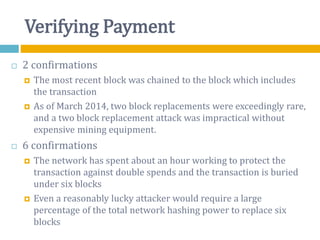
 2 confirmations
 The most recent block was chained to the block which includes
the transaction
 As of March 2014, two block replacements were exceedingly rare,
and a two block replacement attack was impractical without
expensive mining equipment.
 6 confirmations
 The network has spent about an hour working to protect the
transaction against double spends and the transaction is buried
under six blocks
 Even a reasonably lucky attacker would require a large
percentage of the total network hashing power to replace six
blocks
How to can get Bitcoins
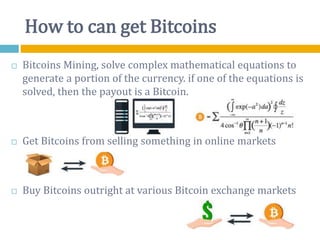
 Bitcoins Mining, solve complex mathematical equations to
generate a portion of the currency. if one of the equations is
solved, then the payout is a Bitcoin.
 Get Bitcoins from selling something in online markets
 Buy Bitcoins outright at various Bitcoin exchange markets

Bitcoin

  • 1.
  • 2.
    Introduction  Bitcoin isan innovative payment network and a new kind of money  Bitcoin, the online, digital currency  Bitcoin uses peer-to-peer technology to operate with no central authority or banks  Bitcoin is open-source; its design is public, nobody owns or controls
  • 3.
    History  Bitcoin isthe first successful implementation of a distributed crypto-currency, described in part in 1998 by Wei Dai  2007  Satoshi Nakamoto began working on the Bitcoin  Craig Steven Wright claims to be the real person behind the pseudonym
  • 4.
    History  2008  Nakamotopublishes a design paper  & Bitcoin.org is registered  The domain was registered at anonymousspeech.com  2009  Version 0.1 is released  & The first Bitcoin transaction  2010  The first, real-world transaction using Bitcoins takes place  2013  The first Bitcoin ATM in the world is debuted in San Diego, California.  Bitcoin ruled currency by Texas judge  Bitcoin ruled private money in Germany
  • 5.
    Why?  Bitcoins aresent easily through the Internet, without needing to trust any third party  The supply of bitcoins is regulated by software and the agreement of users of the system and cannot be manipulated by any government, bank, organization or individual.  Transactions:  Are irreversible by design  Are fast. Funds received are available for spending within minutes  Cost very little, especially compared to other payment networks
  • 6.
    Why?  Anonymity  Transparency solve double spend problem  Mining by users  Inflation is Impossible
  • 7.
    vocabulary  Address: ABitcoin address is similar to a physical address or an email  Public key(s)  A Bitcoin Address is derived by a ECDSA Public Key by using hash functions
  • 8.
    vocabulary  Wallet :A Bitcoin wallet is loosely the equivalent of a physical wallet on the Bitcoin network  Private key(s)  BTC: a common unit used to designate one bitcoin (B⃦)  satoshis : One bitcoin equals 100,000,000 satoshis
  • 9.
    Proof of Work Bitcoin requires that each block prove a significant amount of work was invested in its creation  To ensure that untrustworthy peers who want to modify past blocks have to work harder than honest peers who only want to add new blocks to the block chain  The proof of work used in Bitcoin takes advantage of the apparently random nature of cryptographic hashes  In Bitcoin the hashing algorithm is SHA256  only the 80-byte block header is hashed for proof-of-work  Probability that a given hash attempt will generate a number below the target threshold
  • 10.
    Proof of Work Every 2,016 blocks, the network uses timestamps stored in each block header  To calculate the number of seconds elapsed between generation of the first and last of those last 2,016 blocks  The ideal value is 1,209,600 seconds (two weeks)  If it took fewer than two weeks to generate the blocks, the expected difficulty value is increased proportionally (by as much as 300%)  If it took more than two weeks to generate the blocks, the expected difficulty value is decreased proportionally (by as much as 75%)
  • 11.
    Block Chain  Theblock chain provides Bitcoin’s public ledger, an ordered and timestamped record of transactions  To protect against double spending and modification of previous transaction records  A block of one or more new transactions is collected into the transaction data part of a block  The merkle root is stored in the block header  Each block also stores the hash of the previous block’s header
  • 12.
    Block Chain  Theblock chain provides Bitcoin’s public ledger, an ordered and timestamped record of transactions  To protect against double spending and modification of previous transaction records  A block of one or more new transactions is collected into the transaction data part of a block  The merkle root is stored in the block header  Each block also stores the hash of the previous block’s header A tree constructed by hashing paired data (the leaves), then pairing and hashing the results until a single hash remains, the merkle root.  In Bitcoin, the leaves are almost always transactions from a single block.
  • 13.
  • 14.
    Transaction  Transactions letusers spend satoshis  There are two types of transactions  Coinbase transactions  New Bitcoins are introduced into the system  In every block as the very first transaction  reward for solving a proof-of-work problem  Regular transactions  Are used to transfer existing Bitcoins amongst different accounts
  • 15.
  • 16.
    Transaction  Each transactionis prefixed by a four-byte transaction version number  Bitcoin peers and miners which set of rules to use to validate it  Each transaction has at least one input and one output  Each input spends the satoshis paid to a previous output.  Each output then waits as an Unspent Transaction Output (UTXO) until a later input spends it
  • 17.
  • 18.
    Transaction  An outputhas an implied index number based on its location in the transaction  The output also has an amount in satoshis which it pays to a conditional pubkey script  Anyone who can satisfy the conditions of that pubkey script can spend up to the amount of satoshis paid to it A script included in outputs which sets the conditions that must be fulfilled for those satoshis to be spent. Data for fulfilling the conditions can be provided in a signature script. Called a scriptPubKey in code
  • 19.
    Transaction  An inputuses a transaction identifier (txid)  And an output index number (often called “vout” for output vector) to identify a particular output to be spent  It also has a signature script which allows it to provide data parameters that satisfy the conditionals in the pubkey script Data generated by a spender which is almost always used as variables to satisfy a pubkey script. Called a scriptSig in code
  • 20.
  • 21.
    Transaction(Alice & BobSenario)  Alice uses to send Bob a transaction and which Bob later uses to spend that transaction  Both Alice and Bob will use the most common form of the standard Pay-To-Public-Key-Hash (P2PKH) transaction type  Bob must first generate a private/public key pair before Alice can create the first transaction  Bitcoin uses the Elliptic Curve Digital Signature Algorithm (ECDSA) with the secp256k1 curve  secp256k1 private keys are 256 bits of random data  A copy of that data is deterministically transformed into an secp256k1 public key
  • 22.
    Transaction(Alice & BobSenario)  The public key (pubkey) is then cryptographically hashed  Bob provides the pubkey hash to Alice  Pubkey hashes are almost always sent encoded as Bitcoin addresses, which are base58-encoded strings  containing an address version number, the hash, and an error- detection checksum  Once Alice has the address and decodes it back into a standard hash, she can create the first transaction  A standard P2PKH transaction output containing instructions(are called the pubkey script or scriptPubKey)
  • 23.
    Transaction(Alice & BobSenario)  Alice broadcasts the transaction and it is added to the block chain.  The network categorizes it as an Unspent Transaction Output (UTXO)  Some time later, Bob decides to spend the UTXO, he must create an input which references the transaction Alice created by its hash, called a Transaction Identifier (txid)  Create a signature script—a collection of data parameters which satisfy the conditions Alice placed in the previous output’s pubkey script.  Signature scripts are also called scriptSigs
  • 24.
  • 25.
    Transaction(Alice & BobSenario)  Alice broadcasts the transaction and it is added to the block chain. The network categorizes it as an Unspent Transaction Output (UTXO), and Bob’s wallet software displays it as a spendable balance.  some time later, Bob decides to spend the UTXO, he must create an input which references the transaction Alice created by its hash, called a Transaction Identifier (txid)  create a signature script—a collection of data parameters which satisfy the conditions Alice placed in the previous output’s pubkey script. Signature scripts are also called scriptSigs
  • 26.
  • 27.
    Wallet  Wallet programscreate public keys to receive satoshis and use the corresponding private keys to spend those satoshis  Wallet programs also need to interact with the peer-to-peer network to get information from the block chain and to broadcast new transactions  three necessary, but separable, parts of a wallet system:  public key distribution program  signing program  networked program
  • 28.
    Wallet  Full-Service Wallets The simplest wallet is a program which performs all three functions  almost all popular wallets can be used as full-service wallets  The main advantage of full-service wallets is that they are easy to use  The main disadvantage of full-service wallets is that they store the private keys on a device connected to the Internet
  • 29.
    Wallet  Signing-Only Wallets To increase security, private keys can be generated and stored by a separate wallet program operating in a more secure environment  These signing-only wallets work in conjunction with a networked wallet which interacts with the peer-to-peer network.
  • 30.
    Wallet  Distributing-Only Wallets Wallet programs which run in difficult-to-secure environments, such as webservers, can be designed to distribute public keys
  • 31.
    Mining  The processof finding a valid block (adds new blocks to the block chain)  Nodes that mine are called miners  Perform this steps in an endless loop:  Collect all broadcasted transactions and validate whether they satisfy the miner's self-defined policy
  • 32.
    Mining  The processof finding a valid block (adds new blocks to the block chain)  Nodes that mine are called miners  Perform this steps in an endless loop:  Collect all broadcasted transactions and validate whether they satisfy the miner's self-defined policy  Verify all transactions that are to be included in the block and it is checked whether they have been previously spent  Select the most recent block on the longest path in the blockchain  Attempt to solve the proof-of-work problem and broadcast the solution
  • 33.
  • 34.
    Mining  Miners usesoftware that accesses their processing capacity to solve transaction-related algorithms . In return, they are awarded a certain number of Bitcoins per block  Its mining hardware (an ASIC) along with a target threshold (difficulty setting).  The mining hardware iterates through every possible value for the block header nonce and generates the corresponding hash  If a hash is found below the target threshold, the mining hardware returns the block header with the successful nonce to the mining software.  The mining software combines the header with the block and broadcasts to the network for addition to the block chain
  • 35.
    Bitcoin Mining HandmadeBitcoin Mining Box set
  • 36.
    Payment  Payment processingencompasses the steps spenders and receivers perform to make and accept payments in exchange for products or services  The Payment Protocol is described in depth in BIP70, BIP71, and BIP72  New payment protocol adds many important features :  Supports X.509 certificates and SSL encryption to verify receivers’ identity and help prevent man-in-the-middle attacks  Allows spenders to submit transactions directly to receivers without going through the peer-to-peer network  Bluetooth-based payments  Instead of a meaningless address (mjSk1Ny9spzU2fouzYgLqGUD8U41iR35QN), Common Name (CN) description from the receiver’s X.509 certificate(www.bitcoin.org)
  • 37.
    Payment Protocol  Charlie,the client, is shopping on a website run by Bob  Charlie adds a few items to his shopping cart and clicks the “Checkout With Bitcoin” button.  Bob’s server automatically adds the following information to its invoice database:  The details of Charlie’s order, including items ordered and shipping address.  An order total in satoshis  An expiration time when that total will no longer be acceptable.  A pubkey script to which Charlie should send payment.  After adding all that information to the database, Bob’s server displays a bitcoin: URI for Charlie to click to pay
  • 38.
    Payment Protocol  Charlieclicks on the bitcoin: URI in his browser  His browser’s URI handler sends the URI to his wallet program  Walet sends an HTTP GET to that URL looking for a PaymentRequest message  The PaymentRequest message returned may include private information, such as Charlie’s mailing address  The unique public key created for the payment request can be used to create a unique identifier
  • 39.
    Payment Protocol  Afterreceiving the HTTP GET to the URL, Bob’s webserver takes the unique identifier from the URL and looks up the corresponding details in the database.  creates a PaymentDetails message with information:  The amount of the order in satoshis and the pubkey script to be paid  A memo containing the list of items ordered  The time the PaymentDetails message was created plus the time it expires  A URL to which Charlie’s wallet should send its completed transaction  That PaymentDetails message is put inside a PaymentRequest message.  Bob’s server sign the entire Request with the server’s X.509 SSL certificate  Bob’s server sends the payment request to Charlie’s wallet in the reply to the HTTP GET
  • 40.
    Payment Protocol  Charlie’swallet receives the PaymentRequest message, checks its signature, and then displays the details to Charlie  Charlie agrees to pay, the wallet constructs a payment to the pubkey script Bob’s server provided  Constructs a Payment message and sends it to the URL provided in the PaymentDetails message as an HTTP POST which contains:  The signed transaction in which Charlie pays Bob  An optional memo Charlie can send to Bob  A refund address (pubkey script) which Bob can pay if he needs to return some or all of Charlie’s satoshis
  • 41.
    Payment Protocol  Bob’sserver receives the Payment message, verifies the transaction, then broadcasts the transaction to the network.  Replies to the HTTP POSTed Payment message with a PaymentACK message  Charlie’s wallet sees the PaymentACK and tells Charlie that the payment has been sent  The PaymentACK doesn’t mean that Bob has verified Charlie’s payment  After Bob’s server verifies from the block chain that Charlie’s transaction has been suitably confirmed, it authorizes shipping Charlie’s order
  • 44.
    Verifying Payment  0confirmations (unconfirmed transactions)  The transaction has been broadcast but is still not included in any block  should generally not be trusted without risk analysis  Miners usually confirm the first transaction they receive, fraudsters may be able to manipulate the network into including their version of a transaction.  1 confirmation  The transaction is included in the latest block and double-spend risk decreases dramatically  Transactions which pay sufficient transaction fees need 10 minutes on average to receive one confirmation  The most recent block gets replaced fairly often by accident, so a double spend is still a real possibility
  • 45.
    Verifying Payment  2confirmations  The most recent block was chained to the block which includes the transaction  As of March 2014, two block replacements were exceedingly rare, and a two block replacement attack was impractical without expensive mining equipment.  6 confirmations  The network has spent about an hour working to protect the transaction against double spends and the transaction is buried under six blocks  Even a reasonably lucky attacker would require a large percentage of the total network hashing power to replace six blocks
  • 46.
    How to canget Bitcoins  Bitcoins Mining, solve complex mathematical equations to generate a portion of the currency. if one of the equations is solved, then the payout is a Bitcoin.  Get Bitcoins from selling something in online markets  Buy Bitcoins outright at various Bitcoin exchange markets