
Introduction to
Blockchain
By: Malak Abu Hammad
Supervised by: Dr. Abdullah Alfarrarjeh
Data Communications course
GJU
What is Blockchain?
● Blockchain is a distributed database which maintains a continuously
growing list of records (here list of records could be understood as a
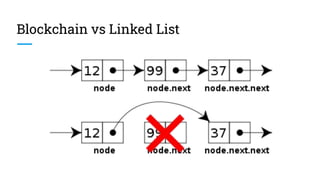
LinkedList), known as 'Blocks'; (a Block is the same as a Node in LinkedList).
Each block has two parts (just as a Node in a LinkedList has two parts - the
data and the address of the next Node); a timestamp with transaction data,
and a link (a hash pointer) to the previous block.
Moreover
Blockchains are not meant for modification and deletion of data. Hence, once
recorded, the data in any given block cannot be modified/erased without the
modification of all subsequent blocks and the collusion of the network. It means
they can be sequentially updated whenever a modification is needed.
Where it can be used?
Blockchain is a great help when historical occurrence of events is critical and
needs to be maintained accurately, like the fields below:
● Money Transactions & Crypto Currencies
● Healthcare
● Medicines
● Insurance
● Smart Properties
● Automobiles
● Governments
● Smart contracts
How nodes are connected?
● A blockchain is connected by a P2P network ( a network of
nodes/computers where each node is an Admin), which enables a protocol
for validating new blocks (below diagram) and relaying transactions.
● A new node gets a copy of the blockchain after joining the network. The
distributed ledger has the capability to be programmed, hence the
transactions can be triggered automatically.
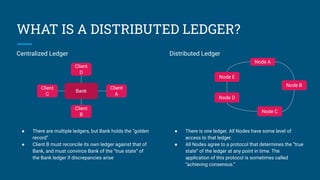
WHAT IS A DISTRIBUTED LEDGER?
Centralized Ledger
● There are multiple ledgers, but Bank holds the “golden
record”
● Client B must reconcile its own ledger against that of
Bank, and must convince Bank of the “true state” of
the Bank ledger if discrepancies arise
Distributed Ledger
● There is one ledger. All Nodes have some level of
access to that ledger.
● All Nodes agree to a protocol that determines the “true
state” of the ledger at any point in time. The
application of this protocol is sometimes called
“achieving consensus.”
Bank
Client
A
Client
B
Client
C
Client
D
Node A
Node B
Node C
Node D
Node E
Distributed Ledger Technology
● Helps transactions to have public witnesses and hence minimize cyber crime and fraud.
● This serves as an open, distributed ledger to record transactions between two parties in a
verifiable and lasting way.
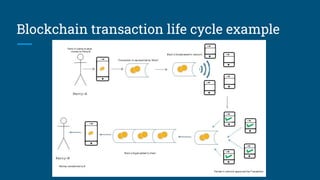
Blockchain transaction life cycle example
Blockchain vs Linked List
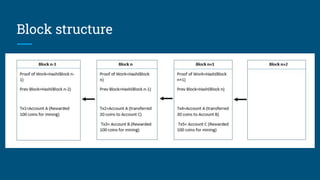
Block structure
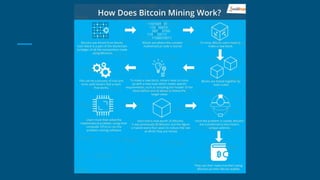
What is mining?
● Mining is NOT about creating new blocks (bitcoins).
● Mining is the mechanism that allows the blockchain to be a decentralized
security.
● It secures the bitcoin system and enable a system without a central
authority. Do not confuse the rewards given to miners ( new bitcoin ) with
the process itself.
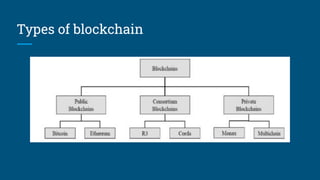
Types of blockchain
Types of blockchain; continued ..
As shown in the previous figure there are three types of blockchain based on access mode, these
types are:
1. Public; public blockchains are available for anyone over the internet to join, like Bitcoin and
Ethereum.
2. Private; private blockchains are available only for members of an organisation to join, like
R3 and Corda.
3. Consortium; consortium blockchains are available only for a group of an organisations (like
hospitals) to join. Monax and Multichain are examples of consortium blockchains.
Advantages of Blockchain
● Security; digital signature and encryption. The system is specially designed to be secure, convenient, and
tamper-proof.
● Fraud control; A system that is based on data stored in a number of places is immune to hackers; it’s not that easy
to get access to it, and if so, any piece of information can be easily recovered
● Transparency; immediate notifications about the completion of transactions, which is both convenient and
trustworthy.
● No hidden fees.
● Access levels; public and private blockchain netwroks.
● Speed; transactions are processed way faster than usual as there is no need to include payment systems, which
reduce the cost and increases the processing speed.
● Account reconciliation; the validity of transactions is checked and confirmed by participants, thus, they also
confirm their own authenticity.
● Trustless system; cutting out intermediaries and third parties.
Disadvantages of Blockchain
● Scalability.
● Hidden identities.
● Network usage.
Thank you

Introduction to Blockchain

  • 1.
    Introduction to Blockchain By: MalakAbu Hammad Supervised by: Dr. Abdullah Alfarrarjeh Data Communications course GJU
  • 2.
    What is Blockchain? ●Blockchain is a distributed database which maintains a continuously growing list of records (here list of records could be understood as a LinkedList), known as 'Blocks'; (a Block is the same as a Node in LinkedList). Each block has two parts (just as a Node in a LinkedList has two parts - the data and the address of the next Node); a timestamp with transaction data, and a link (a hash pointer) to the previous block.
  • 3.
    Moreover Blockchains are notmeant for modification and deletion of data. Hence, once recorded, the data in any given block cannot be modified/erased without the modification of all subsequent blocks and the collusion of the network. It means they can be sequentially updated whenever a modification is needed.
  • 4.
    Where it canbe used? Blockchain is a great help when historical occurrence of events is critical and needs to be maintained accurately, like the fields below: ● Money Transactions & Crypto Currencies ● Healthcare ● Medicines ● Insurance ● Smart Properties ● Automobiles ● Governments ● Smart contracts
  • 5.
    How nodes areconnected? ● A blockchain is connected by a P2P network ( a network of nodes/computers where each node is an Admin), which enables a protocol for validating new blocks (below diagram) and relaying transactions. ● A new node gets a copy of the blockchain after joining the network. The distributed ledger has the capability to be programmed, hence the transactions can be triggered automatically.
  • 6.
    WHAT IS ADISTRIBUTED LEDGER? Centralized Ledger ● There are multiple ledgers, but Bank holds the “golden record” ● Client B must reconcile its own ledger against that of Bank, and must convince Bank of the “true state” of the Bank ledger if discrepancies arise Distributed Ledger ● There is one ledger. All Nodes have some level of access to that ledger. ● All Nodes agree to a protocol that determines the “true state” of the ledger at any point in time. The application of this protocol is sometimes called “achieving consensus.” Bank Client A Client B Client C Client D Node A Node B Node C Node D Node E
  • 7.
    Distributed Ledger Technology ●Helps transactions to have public witnesses and hence minimize cyber crime and fraud. ● This serves as an open, distributed ledger to record transactions between two parties in a verifiable and lasting way.
  • 8.
  • 9.
  • 10.
  • 11.
    What is mining? ●Mining is NOT about creating new blocks (bitcoins). ● Mining is the mechanism that allows the blockchain to be a decentralized security. ● It secures the bitcoin system and enable a system without a central authority. Do not confuse the rewards given to miners ( new bitcoin ) with the process itself.
  • 13.
  • 14.
    Types of blockchain;continued .. As shown in the previous figure there are three types of blockchain based on access mode, these types are: 1. Public; public blockchains are available for anyone over the internet to join, like Bitcoin and Ethereum. 2. Private; private blockchains are available only for members of an organisation to join, like R3 and Corda. 3. Consortium; consortium blockchains are available only for a group of an organisations (like hospitals) to join. Monax and Multichain are examples of consortium blockchains.
  • 15.
    Advantages of Blockchain ●Security; digital signature and encryption. The system is specially designed to be secure, convenient, and tamper-proof. ● Fraud control; A system that is based on data stored in a number of places is immune to hackers; it’s not that easy to get access to it, and if so, any piece of information can be easily recovered ● Transparency; immediate notifications about the completion of transactions, which is both convenient and trustworthy. ● No hidden fees. ● Access levels; public and private blockchain netwroks. ● Speed; transactions are processed way faster than usual as there is no need to include payment systems, which reduce the cost and increases the processing speed. ● Account reconciliation; the validity of transactions is checked and confirmed by participants, thus, they also confirm their own authenticity. ● Trustless system; cutting out intermediaries and third parties.
  • 16.
    Disadvantages of Blockchain ●Scalability. ● Hidden identities. ● Network usage.
  • 17.