MIM THIRD Year (2015 – 18)
JBIMS - MIM
INFORMATION MANAGEMENT
BLOCKCHAIN TECHNOLOGIES
NAME ROLL NO
MUFADDAL NULLWALA 15-I-131
JBIMS - MIM
Index
◦ Introduction to Blockchain
◦ History of Blockchain
◦ How Blockchain works
◦ Blockchain platforms
◦ Blockchain consensus/validation algorithms
◦ Who uses blockchain
◦ Advantages and disadvantages of blockchain
JBIMS - MIM
Introduction to Blockchain
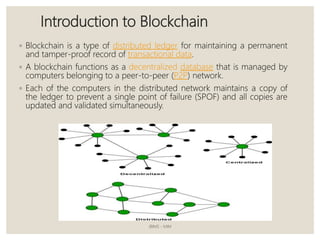
◦ Blockchain is a type of distributed ledger for maintaining a permanent
and tamper-proof record of transactional data.
◦ A blockchain functions as a decentralized database that is managed by
computers belonging to a peer-to-peer (P2P) network.
◦ Each of the computers in the distributed network maintains a copy of
the ledger to prevent a single point of failure (SPOF) and all copies are
updated and validated simultaneously.
JBIMS - MIM
History of Blockchain
◦ In the past, blockchains were commonly associated with digital
currencies, and Bitcoin in particular.
◦ Today, blockchain applications are being explored in many industries as
a secure and cost-effective way to create and manage a distributed
database and maintain records for digital transactions of all types.
◦ Blockchain provided the answer to digital trust because it records
important information in a public space and doesn’t allow anyone to
remove it. It’s transparent, time-stamped and decentralized.
◦ “Blockchain is to Bitcoin, what the internet is to email. A big electronic
system, on top of which you can build applications. Currency is just one,”
.
◦ Even today, there are many who believe Bitcoin and blockchain are one
and the same, even though they are not. Those who started to realize
around 2014 that blockchain could be used for more than
cryptocurrency started to invest in and explore how blockchain could
alter many different kinds of operations.
JBIMS - MIM
How Blockchain works
JBIMS - MIM
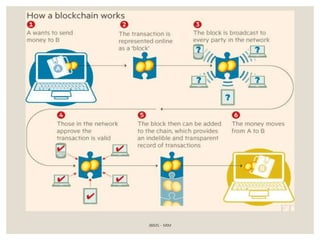
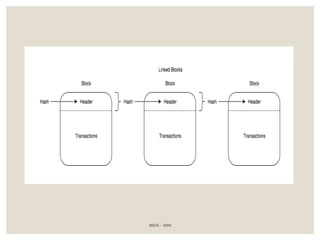
◦ A blockchain ledger consists of two types of records: individual
transactions and blocks.
◦ The first block consists of a header and data that pertains to transactions
taking place within a set time period.
◦ The block’s timestamp is used to help create an alphanumeric string
called a hash.
◦ After the first block has been created, each subsequent block in the
ledger uses the previous block’s hash to calculate its own hash.
◦ Before a new block can be added to the chain, its authenticity must be
verified by a computational process called validation or consensus.
◦ At this point of the blockchain process, a majority of nodes in the
network must agree the new block’s hash has been calculated correctly.
Consensus ensures that all copies of the distributed ledger share the
same state.
JBIMS - MIM
◦ Once a block has been added, it can be referenced in subsequent blocks,
but it cannot be changed.
◦ If someone attempts to swap out a block, the hashes for previous and
subsequent blocks will also change and disrupt the ledger’s shared state.
◦ When consensus is no longer possible, other computers in the network
are aware that a problem has occurred and no new blocks will be added
to the chain until the problem is solved.
◦ Typically, the block causing the error will be discarded and the consensus
process will be repeated.
JBIMS - MIM
Blockchain platforms
◦ Blockchain platforms can be either permission-less or permissioned.
◦ In a public, permissionless blockchain like Bitcoin, every node in the
network can conduct transactions and participate in the consensus
process.
◦ In a private, permissioned chain like Multichain, every node might be
able to conduct transactions, but participation in the consensus
process is restricted to a limited number of approved nodes.
JBIMS - MIM
Blockchain consensus/validation
algorithms
◦ Choosing which consensus algorithm to use is perhaps the most
important aspect of selecting a blockchain platform.
◦ There are four standard methods blockchain and other distributed
database platforms use to arrive at consensus.
◦ Generally, public platforms choose algorithms like Proof of Work
because they require a lot of processing power to compute, but are
easy other network nodes to verify.
◦ The Four Standard algorithms are
1) Proof-of-work algorithm (PoW)
2) Practical byzantine fault tolerance algorithm (PBFT)
3) Proof-of-stake algorithm (PoS)
4) Delegated proof-of-stake algorithm (DPoS)
JBIMS - MIM
Proof-of-work algorithm (PoW)
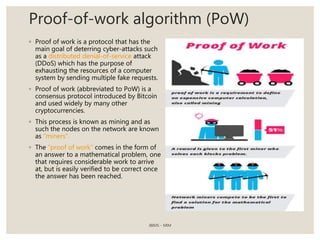
◦ Proof of work is a protocol that has the
main goal of deterring cyber-attacks such
as a distributed denial-of-service attack
(DDoS) which has the purpose of
exhausting the resources of a computer
system by sending multiple fake requests.
◦ Proof of work (abbreviated to PoW) is a
consensus protocol introduced by Bitcoin
and used widely by many other
cryptocurrencies.
◦ This process is known as mining and as
such the nodes on the network are known
as “miners”.
◦ The “proof of work” comes in the form of
an answer to a mathematical problem, one
that requires considerable work to arrive
at, but is easily verified to be correct once
the answer has been reached.
JBIMS - MIM
MINING :
◦ Mining serves as two purposes:
1) To verify the legitimacy of a transaction, or avoiding the so-called
double-spending;
2) To create new digital currencies by rewarding miners for performing
the previous task.
When you want to set a transaction this is what happens behind the
scenes:
a) Transactions are bundled together into what we call a block;
b) Miners verify that transactions within each block are legitimate;
c) To do so, miners should solve a mathematical puzzle known as
of-work problem;
d) A reward is given to the first miner who solves each blocks problem;
e) Verified transactions are stored in the public blockchain
JBIMS - MIM
Practical byzantine fault
tolerance algorithm (PBFT)
◦ pBFT (Practical Byzantine Fault Tolerance) is an
excellent consensus algorithm for enterprise
consortiums where members are partially
trusted
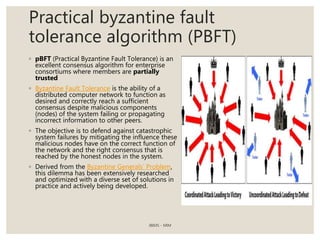
◦ Byzantine Fault Tolerance is the ability of a
distributed computer network to function as
desired and correctly reach a sufficient
consensus despite malicious components
(nodes) of the system failing or propagating
incorrect information to other peers.
◦ The objective is to defend against catastrophic
system failures by mitigating the influence these
malicious nodes have on the correct function of
the network and the right consensus that is
reached by the honest nodes in the system.
◦ Derived from the Byzantine Generals’ Problem,
this dilemma has been extensively researched
and optimized with a diverse set of solutions in
practice and actively being developed.
JBIMS - MIM
Proof-of-stake algorithm (PoS)
◦ Proof of stake is a different way to
validate transactions based and
achieve the distributed consensus.
◦ Unlike the proof-of-Work, where the
algorithm rewards miners who solve
mathematical problems with the goal
of validating transactions and
creating new blocks, with the proof
of stake, the creator of a new block is
chosen in a deterministic way,
depending on its wealth, also
defined as stake.
◦ Also, all the digital currencies are
previously created in the beginning,
and their number never changes.
◦ This means that in the PoS system
there is no block reward, so, the
miners take the transaction fees.
JBIMS - MIM
Why Ethereum wants to use PoS?
◦ The Ethereum community and its creator, Vitalik Buterin, are planning to do a
hard fork to make a transition from proof of work to proof of stake.
◦ But why they want to switch from one to the other?
◦ In a distributed consensus-based on the proof of Work, miners need a lot of
energy. One Bitcoin transaction required the same amount of electricity as
powering 1.57 American households for one day (data from 2015).
◦ And these energy costs are paid with fiat currencies, leading to a constant
downward pressure on the digital currency value.
◦ In a recent research, experts argued that bitcoin transactions may consume as
much electricity as Denmark by 2020.
◦ Developers are pretty worried about this problem, and the Ethereum
community wants to exploit the proof of stake method for a more greener
and cheaper distributed form of consensus.
◦ Also, rewards for the creation of a new block are different: with Proof-of-Work,
the miner may potentially own none of the digital currency he/she is mining.
◦ In Proof-of-Stake, forgers are always those who own the coins minted.
JBIMS - MIM
Delegated proof-of-stake
algorithm (DPoS)
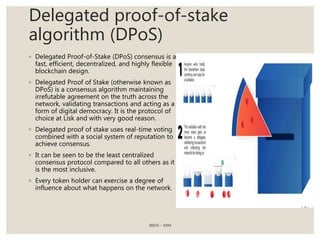
◦ Delegated Proof-of-Stake (DPoS) consensus is a
fast, efficient, decentralized, and highly flexible
blockchain design.
◦ Delegated Proof of Stake (otherwise known as
DPoS) is a consensus algorithm maintaining
irrefutable agreement on the truth across the
network, validating transactions and acting as a
form of digital democracy. It is the protocol of
choice at Lisk and with very good reason.
◦ Delegated proof of stake uses real-time voting
combined with a social system of reputation to
achieve consensus.
◦ It can be seen to be the least centralized
consensus protocol compared to all others as it
is the most inclusive.
◦ Every token holder can exercise a degree of
influence about what happens on the network.
JBIMS - MIM
Who uses blockchain
◦ Although Bitcoin is currently the most visible use of blockchain, it can
be used the same way as any other distributed database.
◦ In 2016, the online retail company Overstock.com used blockchain to
sell and distributed more than 126,000 company shares, marking the
first time a publicly traded company used blockchain to support stock
transactions.
◦ R3, a global consortium of financial institutions, also uses blockchain to
record, manage and synchronize financial information using blockchain
APIs for specific platforms.
◦ Today, banks and financial institutions across the globe are exploring
how they can use blockchain to improve security.
◦ Other industries, including healthcare, government and technology,
are investigating how they can use blockchain to enable secure
exchange of data such as personal health information, digital assets
like downloaded entertainment and real estate deeds.
◦ Manufacturing and other similar businesses also see the potential to
leverage blockchain to manage smart contracts as well as track
materials as they move through their supply chains.
JBIMS - MIM
Advantages and disadvantages of
blockchain
◦ Experts cite several key benefits to using blockchain. Security is
considered one of the major advantages with this technology.
◦ It is almost impossible to corrupt a blockchain because information is
shared and continually reconciled by thousands, even millions of
computers, and blockchain has no single point of failure.
◦ If one node goes down, it’s not a problem because all the other nodes
have a copy of the ledger.
JBIMS - MIM
JBIMS - MIM
JBIMS - MIM

Blockchain Technology

  • 1.
    MIM THIRD Year(2015 – 18) JBIMS - MIM INFORMATION MANAGEMENT BLOCKCHAIN TECHNOLOGIES NAME ROLL NO MUFADDAL NULLWALA 15-I-131
  • 2.
  • 3.
    Index ◦ Introduction toBlockchain ◦ History of Blockchain ◦ How Blockchain works ◦ Blockchain platforms ◦ Blockchain consensus/validation algorithms ◦ Who uses blockchain ◦ Advantages and disadvantages of blockchain JBIMS - MIM
  • 4.
    Introduction to Blockchain ◦Blockchain is a type of distributed ledger for maintaining a permanent and tamper-proof record of transactional data. ◦ A blockchain functions as a decentralized database that is managed by computers belonging to a peer-to-peer (P2P) network. ◦ Each of the computers in the distributed network maintains a copy of the ledger to prevent a single point of failure (SPOF) and all copies are updated and validated simultaneously. JBIMS - MIM
  • 5.
    History of Blockchain ◦In the past, blockchains were commonly associated with digital currencies, and Bitcoin in particular. ◦ Today, blockchain applications are being explored in many industries as a secure and cost-effective way to create and manage a distributed database and maintain records for digital transactions of all types. ◦ Blockchain provided the answer to digital trust because it records important information in a public space and doesn’t allow anyone to remove it. It’s transparent, time-stamped and decentralized. ◦ “Blockchain is to Bitcoin, what the internet is to email. A big electronic system, on top of which you can build applications. Currency is just one,” . ◦ Even today, there are many who believe Bitcoin and blockchain are one and the same, even though they are not. Those who started to realize around 2014 that blockchain could be used for more than cryptocurrency started to invest in and explore how blockchain could alter many different kinds of operations. JBIMS - MIM
  • 6.
    How Blockchain works JBIMS- MIM ◦ A blockchain ledger consists of two types of records: individual transactions and blocks. ◦ The first block consists of a header and data that pertains to transactions taking place within a set time period. ◦ The block’s timestamp is used to help create an alphanumeric string called a hash. ◦ After the first block has been created, each subsequent block in the ledger uses the previous block’s hash to calculate its own hash. ◦ Before a new block can be added to the chain, its authenticity must be verified by a computational process called validation or consensus. ◦ At this point of the blockchain process, a majority of nodes in the network must agree the new block’s hash has been calculated correctly. Consensus ensures that all copies of the distributed ledger share the same state.
  • 7.
    JBIMS - MIM ◦Once a block has been added, it can be referenced in subsequent blocks, but it cannot be changed. ◦ If someone attempts to swap out a block, the hashes for previous and subsequent blocks will also change and disrupt the ledger’s shared state. ◦ When consensus is no longer possible, other computers in the network are aware that a problem has occurred and no new blocks will be added to the chain until the problem is solved. ◦ Typically, the block causing the error will be discarded and the consensus process will be repeated.
  • 8.
  • 9.
    Blockchain platforms ◦ Blockchainplatforms can be either permission-less or permissioned. ◦ In a public, permissionless blockchain like Bitcoin, every node in the network can conduct transactions and participate in the consensus process. ◦ In a private, permissioned chain like Multichain, every node might be able to conduct transactions, but participation in the consensus process is restricted to a limited number of approved nodes. JBIMS - MIM
  • 10.
    Blockchain consensus/validation algorithms ◦ Choosingwhich consensus algorithm to use is perhaps the most important aspect of selecting a blockchain platform. ◦ There are four standard methods blockchain and other distributed database platforms use to arrive at consensus. ◦ Generally, public platforms choose algorithms like Proof of Work because they require a lot of processing power to compute, but are easy other network nodes to verify. ◦ The Four Standard algorithms are 1) Proof-of-work algorithm (PoW) 2) Practical byzantine fault tolerance algorithm (PBFT) 3) Proof-of-stake algorithm (PoS) 4) Delegated proof-of-stake algorithm (DPoS) JBIMS - MIM
  • 11.
    Proof-of-work algorithm (PoW) ◦Proof of work is a protocol that has the main goal of deterring cyber-attacks such as a distributed denial-of-service attack (DDoS) which has the purpose of exhausting the resources of a computer system by sending multiple fake requests. ◦ Proof of work (abbreviated to PoW) is a consensus protocol introduced by Bitcoin and used widely by many other cryptocurrencies. ◦ This process is known as mining and as such the nodes on the network are known as “miners”. ◦ The “proof of work” comes in the form of an answer to a mathematical problem, one that requires considerable work to arrive at, but is easily verified to be correct once the answer has been reached. JBIMS - MIM
  • 12.
    MINING : ◦ Miningserves as two purposes: 1) To verify the legitimacy of a transaction, or avoiding the so-called double-spending; 2) To create new digital currencies by rewarding miners for performing the previous task. When you want to set a transaction this is what happens behind the scenes: a) Transactions are bundled together into what we call a block; b) Miners verify that transactions within each block are legitimate; c) To do so, miners should solve a mathematical puzzle known as of-work problem; d) A reward is given to the first miner who solves each blocks problem; e) Verified transactions are stored in the public blockchain JBIMS - MIM
  • 13.
    Practical byzantine fault tolerancealgorithm (PBFT) ◦ pBFT (Practical Byzantine Fault Tolerance) is an excellent consensus algorithm for enterprise consortiums where members are partially trusted ◦ Byzantine Fault Tolerance is the ability of a distributed computer network to function as desired and correctly reach a sufficient consensus despite malicious components (nodes) of the system failing or propagating incorrect information to other peers. ◦ The objective is to defend against catastrophic system failures by mitigating the influence these malicious nodes have on the correct function of the network and the right consensus that is reached by the honest nodes in the system. ◦ Derived from the Byzantine Generals’ Problem, this dilemma has been extensively researched and optimized with a diverse set of solutions in practice and actively being developed. JBIMS - MIM
  • 14.
    Proof-of-stake algorithm (PoS) ◦Proof of stake is a different way to validate transactions based and achieve the distributed consensus. ◦ Unlike the proof-of-Work, where the algorithm rewards miners who solve mathematical problems with the goal of validating transactions and creating new blocks, with the proof of stake, the creator of a new block is chosen in a deterministic way, depending on its wealth, also defined as stake. ◦ Also, all the digital currencies are previously created in the beginning, and their number never changes. ◦ This means that in the PoS system there is no block reward, so, the miners take the transaction fees. JBIMS - MIM
  • 15.
    Why Ethereum wantsto use PoS? ◦ The Ethereum community and its creator, Vitalik Buterin, are planning to do a hard fork to make a transition from proof of work to proof of stake. ◦ But why they want to switch from one to the other? ◦ In a distributed consensus-based on the proof of Work, miners need a lot of energy. One Bitcoin transaction required the same amount of electricity as powering 1.57 American households for one day (data from 2015). ◦ And these energy costs are paid with fiat currencies, leading to a constant downward pressure on the digital currency value. ◦ In a recent research, experts argued that bitcoin transactions may consume as much electricity as Denmark by 2020. ◦ Developers are pretty worried about this problem, and the Ethereum community wants to exploit the proof of stake method for a more greener and cheaper distributed form of consensus. ◦ Also, rewards for the creation of a new block are different: with Proof-of-Work, the miner may potentially own none of the digital currency he/she is mining. ◦ In Proof-of-Stake, forgers are always those who own the coins minted. JBIMS - MIM
  • 16.
    Delegated proof-of-stake algorithm (DPoS) ◦Delegated Proof-of-Stake (DPoS) consensus is a fast, efficient, decentralized, and highly flexible blockchain design. ◦ Delegated Proof of Stake (otherwise known as DPoS) is a consensus algorithm maintaining irrefutable agreement on the truth across the network, validating transactions and acting as a form of digital democracy. It is the protocol of choice at Lisk and with very good reason. ◦ Delegated proof of stake uses real-time voting combined with a social system of reputation to achieve consensus. ◦ It can be seen to be the least centralized consensus protocol compared to all others as it is the most inclusive. ◦ Every token holder can exercise a degree of influence about what happens on the network. JBIMS - MIM
  • 17.
    Who uses blockchain ◦Although Bitcoin is currently the most visible use of blockchain, it can be used the same way as any other distributed database. ◦ In 2016, the online retail company Overstock.com used blockchain to sell and distributed more than 126,000 company shares, marking the first time a publicly traded company used blockchain to support stock transactions. ◦ R3, a global consortium of financial institutions, also uses blockchain to record, manage and synchronize financial information using blockchain APIs for specific platforms. ◦ Today, banks and financial institutions across the globe are exploring how they can use blockchain to improve security. ◦ Other industries, including healthcare, government and technology, are investigating how they can use blockchain to enable secure exchange of data such as personal health information, digital assets like downloaded entertainment and real estate deeds. ◦ Manufacturing and other similar businesses also see the potential to leverage blockchain to manage smart contracts as well as track materials as they move through their supply chains. JBIMS - MIM
  • 18.
    Advantages and disadvantagesof blockchain ◦ Experts cite several key benefits to using blockchain. Security is considered one of the major advantages with this technology. ◦ It is almost impossible to corrupt a blockchain because information is shared and continually reconciled by thousands, even millions of computers, and blockchain has no single point of failure. ◦ If one node goes down, it’s not a problem because all the other nodes have a copy of the ledger. JBIMS - MIM
  • 19.
  • 20.