Dr. Pallawi Bulakh
Block Chain Basics
 Types of Network
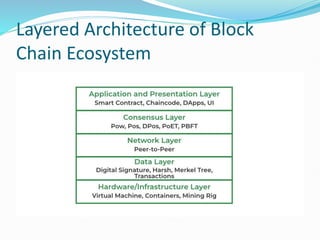
 Layered Architecture of Block Chain Ecosystem
 Components of Clock chain
 Cryptography (Private and Public Keys, Hashing and
Digital signatures)
 Consensus Mechanism
Block chain technology Networks
 Blockchain network is a network of linked nodes used
for read, write transactions into ledger database.
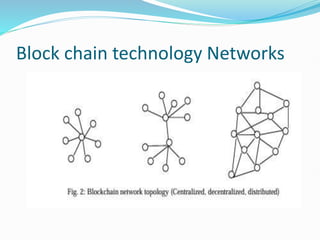
 The topology (as shown in Figure 2) is based on the
nodes participating in consensus process.
 Traditional systems are centralized where all data and
decision-making is concentrated on a single node or
cluster of nodes.
Block chain technology Networks
 In decentralized systems, the data and decision-
making are spread out among a large number of
nodes.
 These nodes maintain copies of the shared database
and decide among themselves which data is to be
committed to the database using consensus
mechanism.
Block chain technology Networks
 Decentralized networks can be an interconnection of
centralized or hub-and-spoke type networks.
 A distributed network is a special case of
decentralized system where every single node in the
network maintains the shared database and
participates in consensus to determine which data is to
be committed to the database.
Public blockchain networks
 A public blockchain is one that anyone can join and
participate in, such as Bitcoin.
 Public blockchain, as the name indicates, is the blockchain
for and of the public.
 There is no one in charge, and anyone can take part in the
process.
 These types of blockchains are open and transparent. Since
there is no one in charge, decisions are made through a
decentralized consensus mechanism.
 Permissioned
 Permissionless
 The most known public blockchains are
the bitcoin blockchain and the Ethereum blockchain.
Characteristics:
 It is an open network where nodes can join and leave without the permission of anyone.
 All nodes in the network can verify a new piece of data added to the network.
 This block chain includes a protocol of incentive mechanism that aims to ensure the
correct operation of the blockchain system.
 This public blockchain is said to be permissionless as anyone can access it without any
kind of permission, and the ledger is shared and transparent.
 There is no need to use your real name, or identity, everything can be hidden.
 In any network, the user has to follow rules that might not even be fair. But not in public
blockchain networks.
 No regulation hence no limit to how one can use the platform for betterment.
 It offers anonymity, no one can track your transaction back to you.
Advantages:
 Transparency: Public blockchains are transparent and open for
everyone to access. This makes the ledger accessible to all,
eliminating chances of corruption and ensuring transparency.
 Security: Public blockchains are designed to operate with
maximum security. The decentralized nature of the network
makes it difficult for hackers to compromise the system.
 Empowerment: Public blockchains empower all participants to
validate transactions without any central authority overlooking
their actions.
 Immutability: Public blockchains are immutable, meaning no
one can tamper with the system, ensuring that transactions are
secure.
Disadvantages:
 Power Consumption: Public blockchains require a lot of
computational power due to their decentralized nature. This
increases energy consumption and can be detrimental to the
environment.
 Scalability: With more users on the blockchain, the network
becomes burdened with more transactions, leading to scalability
issues.
 Conspiracy: The decentralized nature of public blockchains
means that no one knows who validates the transactions,
increasing the risk of potential conspiracy.
 Transactions: Public blockchains can be slow due to the time it
takes to process all transactions on the network.
 Acceptance: Due to the openness and transparency of public
blockchains, it can be difficult for governments to accept them as
they are not controlled by authorities.
Private blockchain networks
 A private blockchain network, similar to a public blockchain
network, is a decentralized peer-to-peer network.
 As the name suggests private blockchain is like a private asset of
the individual or an organization.
 Unlike, a public blockchain, a private blockchain has an in-
charge who monitor important task and give access to read or
block access.
 It is also known as permissioned blockchain as it has restrictions
on who can participate in transactions and validations.
 The entities have been chosen in this network by the respective
authority and the chain developers while building the
blockchain application.
 This blockchain uses are internal to the company so companies
will not want it to be accessible by the public.
Characteristics:
 By its nature, it performs better in database management
and auditing in other fields.
 Not everyone can run a full node and start mining.
 Everyone cannot make transactions on the chain.
 Not everyone can review the blockchain in the blockchain
explorer.
 A user has to be permitted by blockchain authority before
he could access the network thus making it Permissioned
Network.
 Performance becomes faster as fewer nodes participate.
 It is being able to give service on demand making it more
attractive to the user.
Advantages:
 Security: Due to its immutable nature information cannot be altered.
Private blockchain helps in preventing fraud.
 This blockchain uses identity to confirm membership and access
privileges and typically only permit known organization to join.
 Performance: Since the lesser number of nodes are there performance
is increased as it takes less time to validate the block.
 This type of blockchain has higher throughput and lower latency
become more significant as the number of transaction grow.
 Network and distributed system simulators are important tools on
which the performance depends.
 Scalability: A network that doesn’t host millions of users can easily
implement the changes and features and hence can increase scalability.
 It is found to date by some research that at present this type of
blockchain is scalable to a further extent.
 Several parameters are involved in the scalability process and are
dependent on each other
Advantages
 Throughput: Since the number of users is limited this type of
blockchain has higher throughput.
 This throughput gives a more advantage as the business needs faster
transactions which are easily provided by the private blockchain.
 Trust: Users on the private network are not anonymous this increases
the level of trust in the private blockchain.
 Private Blockchain is best suited for applications where it required the
truth that a company can achieve data privacy and control over data
sharing.
 Energy: Since the number of users in a blockchain is less there is less
amount of energy and material used.
 A private blockchain is the most energy-efficient choice that can be
made by businesses as the network are not as much bigger as the public
blockchain.
 Cost-effective: Private blockchains can be cost-effective for businesses
because they don’t require the same level of resources as public
blockchains.
 Private blockchains can be operated on existing infrastructure, which
reduces the costs associated with setting up a new network.
Advantages
 Flexibility: Private blockchains are highly flexible and can be customized to
meet the specific needs of a business.
 They can be designed to include only the necessary features and components,
which makes them more efficient.
 Control: Private blockchains provide businesses with greater control over their
data and the blockchain network.
 Businesses can control who has access to the blockchain and can set rules and
guidelines for how the network is used.
 Privacy: Private blockchains provide greater privacy for businesses, as they can
control who has access to their data and can ensure that sensitive information
is not shared with unauthorized parties.
 Regulatory compliance: Private blockchains can help businesses comply with
regulatory requirements, as they provide a greater level of control and oversight
over the data and network.
 This is particularly important for businesses in industries with strict regulatory
requirements, such as finance and healthcare.
 Collaboration: Private blockchains can facilitate collaboration between
businesses, as they can be designed to allow multiple organizations to
participate in the same network.
 This can lead to greater efficiency and innovation, as businesses can share
information and resources more easily.
Disadvantages:
 Lack of Trust: External players have to trust a private
blockchain network without having control over the
verification.
 These trusted parties would be responsible for
communicating newly verified transactions to the rest of
the network.
 Centralization: With the presence of a few nodes it is
possible that untrustworthy individuals gain control over
the network.
 These blockchains are generally centralized as it is mostly
used by business and enterprises. Although, blockchain is
made to avoid centralization private blockchain inherently
becomes centralized.
Disadvantages
 Integrity: Integrity depends on the standing authorized
user/participants. It is necessary to trust in order to validate the
transaction.
 Confidentiality alone is not sufficient to ensure the participant
trusts the private blockchain.
 It also requires integrity to get confidence in private blockchain
 Control: With fewer participants, it is easier for the hacker to
take control of the network and manipulate the data on it.
 It can happen when two minors are calculating the hash of the
block at the same time and get the same result. As a result, the
blockchain will split and users have two different blockchains.
Hybrid Block Chain
 It is a combination of private and public blockchains.
It is the best of both worlds that can utilize the
advantages of both private-based permissioned
systems and public-based permissionless systems.
 A Hybrid blockchain is a blockchain that combines
elements of both public and private blockchains.
 It is designed to reduce the disadvantages of both
types of blockchains while maximizing their benefits.
 A hybrid database contains both public and private entries.
 Similar to public blockchains, where anyone is invited to join and
participate in the network, public nodes operate similarly to those in
those systems.
 Private nodes, on the other hand, are in charge of validating and
checking transactions and are governed by specific organizations or
individuals.
 Using private nodes, a hybrid blockchain can process transactions
more rapidly and with greater privacy and security.
 Public nodes provide decentralization and transparency at the same
time, making it difficult for one group to maintain control over the
network.
 In a hybrid blockchain, the members can decide who can participate in
the blockchain or which transactions are made public.
Features of Hybrid Blockchain
 1. Data Security
 When compared to private blockchains, hybrid
blockchains offer stricter data security protocols and
slightly more flexibility.
 2. Transactions’ Cost
 Transactions’ cost is assured to be lower because only a few
nodes are needed to validate them.
 3. Closed Ecosystem
 While preserving anonymity, a hybrid blockchain enables
contact with outside parties.
 A hybrid blockchain cannot be the target of a 51 percent
attack from outsiders because it works in a closed
environment.
 4. New Rules
 The advantage of mixed blockchain is that new rules
must be put into place.
 5. Decentralized Access
 Another characteristic of this blockchain is the
increased decentralization of participant access.
Because public and private blockchains approach
decentralization in very different ways, a mixed
blockchain enables it when and where it is required.
Benefits of Hybrid Blockchain
 High-Speed Operations: The hybrid blockchain provides high-speed
operations and is simpler to manage.
 Reduces Transaction Costs: Because verification in a private or public
blockchain can be difficult to complete, strong nodes within the network might
be able to exercise some sort of influence over the decision-makers in charge of
this process, increasing transparency. As a result, transaction costs are
decreased, and expenses may even be as low as $0.01 per transaction.
 Protecting Privacy from the Outside World: The private blockchain is
perfect for privacy-related issues but they have limited means of
communication with the outside world.
 Flexible Infrastructure Settings: Hybrid blockchain offers a flexible strategy
for tailoring the ledger to one’s and the organization’s needs, whereas other
blockchains offer a strict blockchain infrastructure
 Protecting from 51% attack: Hybrid blockchain is immune to 51% attack as
hackers cannot have access to the network to carry out the attack.
Consortium block chains
 A consortium blockchain is like a private blockchain but
differs in the factor of the authority who can control the
access or operations.
 Unlike private blockchain, where there is only one
controlling authority, in a consortium blockchain, the
authority is distributed.
 Instead of one controlling authority, multiple groups have
controlling authorization. Therefore, decentralization is
more prevalent than private blockchain.
 Example: Supply chain where different units such as sales,
logistics, marketing, etc., can have multiple controlling
authorities, etc.
What is Blockchain Ecosystem?
 The blockchain ecosystem is the network of all the
participants in the blockchain network that share the
business process and business objectives. The
ecosystem encompasses the different governing
structures like:
 Individual participation.
 Data ownership.
 Exit and entrance criteria.
 Information and data shared with the system’s
participants.
Block chain ecosystem
 It can provide immutability, decentralization,
flexibility for day-to-day operations, and scalability.
The blockchain ecosystem is a boon for startups and
new technology projects as it creates an
interconnected network.
Types of Blockchain Ecosystem:
 Single-party led blockchain ecosystem: This
ecosystem is led by a single organization where all the
stakeholders have a mutual benefit for participating in
the network.
 For example, Bumble Bee Foods has created a single-
party-led blockchain ecosystem to improve the
traceability of the yellowfin tuna fish.
 This helped to improve the buyer’s confidence in the
fish’s freshness.
Types of Blockchain Ecosystem:
 Joint venture blockchain ecosystem: This is also
known as the Consortium blockchain ecosystem.
 These are slowly becoming popular and they involve
two or more organizations in the ecosystem.
 The participating organizations have an objective of
participating in a common activity or pooling their
resources for achieving a common goal.
 For example, BunkerTrace a marine fuel tracking
solution is a joint venture blockchain ecosystem
between Forecast technology Ltd. and Blockchain
Labs for Open Collaboration (BLOC).
Types of Blockchain Ecosystem:
 Regulatory block chain ecosystem: This ecosystem
comprises various government agencies that share a
project and have to self-report for compliance.
 For example, a shared project between Marine
Transport International and Recycling Association.
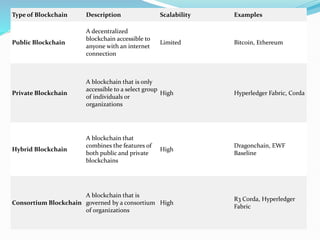
Type of Blockchain Description Scalability Examples
Public Blockchain
A decentralized
blockchain accessible to
anyone with an internet
connection
Limited Bitcoin, Ethereum
Private Blockchain
A blockchain that is only
accessible to a select group
of individuals or
organizations
High Hyperledger Fabric, Corda
Hybrid Blockchain
A blockchain that
combines the features of
both public and private
blockchains
High
Dragonchain, EWF
Baseline
Consortium Blockchain
A blockchain that is
governed by a consortium
of organizations
High
R3 Corda, Hyperledger
Fabric
Layered Architecture of Block
Chain Ecosystem
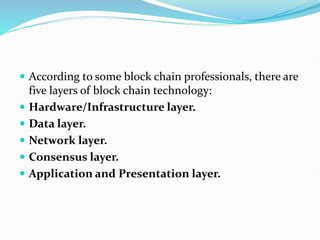
 According to some block chain professionals, there are
five layers of block chain technology:
 Hardware/Infrastructure layer.
 Data layer.
 Network layer.
 Consensus layer.
 Application and Presentation layer.
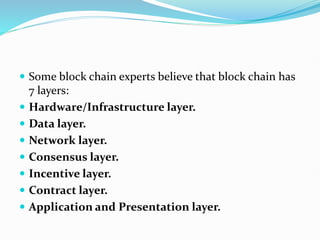
 Some block chain experts believe that block chain has
7 layers:
 Hardware/Infrastructure layer.
 Data layer.
 Network layer.
 Consensus layer.
 Incentive layer.
 Contract layer.
 Application and Presentation layer.
Application layer
 Provides blockchain-based applications for the end user.
The application layer is the end product of the entire
system offering specific products for the users, i.e., wallet,
lending, staking, etc.
 The application layer starts with a smart contract, a
programmable code that governs state transitions.
 It can function as an escrow, payment channel, or vault and
is known by different names in various ecosystems, like
“programs” in Solana and “chaincode” in Hyperledger.
 Smart contracts are a frequent target for hackers, as any
critical error in its code can be exploited for illegal gains.
Protocol (Consensus) Layer
 set rules for node agreement on the state.
The protocol layer sets the rules for block chain
participation, with the consensus mechanism being its key
component.
 Consensus ensures agreement among nodes for block
mining and processing and outlines validator
requirements, varying across proof-of-work, proof-of-stake,
and other consensus mechanisms.
 Propagation protocol broadcasts decisions, while protocol
audits ensure security against threats like 51% attacks.
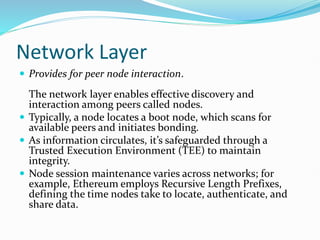
Network Layer
 Provides for peer node interaction.
The network layer enables effective discovery and
interaction among peers called nodes.
 Typically, a node locates a boot node, which scans for
available peers and initiates bonding.
 As information circulates, it’s safeguarded through a
Trusted Execution Environment (TEE) to maintain
integrity.
 Node session maintenance varies across networks; for
example, Ethereum employs Recursive Length Prefixes,
defining the time nodes take to locate, authenticate, and
share data.
Data Layer
 Ensures secure and confident message transmission.
The data layer of blockchain technology is primarily
concerned with data storage and structure.
 It houses the blockchain, a linear succession of blocks
that store transaction information.
 Depending on the specific blockchain, the data
structure can range from a simple transaction list, such
as the one used by Bitcoin, to a more intricate
structure, like Ethereum’s state trie, which stores
contract state information.
Hardware/Infrastructure Layer
 Provides the necessary capacities to host a blockchain.
Blockchain architecture extends to hardware and
infrastructure.
 In this layer—In Proof-of-Work consensus protocols—
miners and validators operate, with miners creating new
blocks using specialized equipment (GPU, ventilator,
stabilizer) and electricity, and validators running nodes for
block mining.
 As for data storage, some blockchains opt for third-party
decentralized data hostings, such as Filecoin, IPFS,
Arweave, or Firebase, due to capacity limitations.
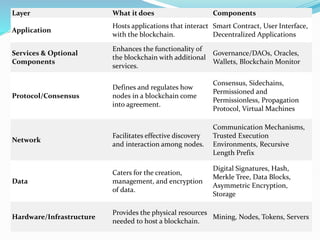
Layer What it does Components
Application
Hosts applications that interact
with the blockchain.
Smart Contract, User Interface,
Decentralized Applications
Services & Optional
Components
Enhances the functionality of
the blockchain with additional
services.
Governance/DAOs, Oracles,
Wallets, Blockchain Monitor
Protocol/Consensus
Defines and regulates how
nodes in a blockchain come
into agreement.
Consensus, Sidechains,
Permissioned and
Permissionless, Propagation
Protocol, Virtual Machines
Network
Facilitates effective discovery
and interaction among nodes.
Communication Mechanisms,
Trusted Execution
Environments, Recursive
Length Prefix
Data
Caters for the creation,
management, and encryption
of data.
Digital Signatures, Hash,
Merkle Tree, Data Blocks,
Asymmetric Encryption,
Storage
Hardware/Infrastructure
Provides the physical resources
needed to host a blockchain.
Mining, Nodes, Tokens, Servers
Components of Block chain
 Node Application: Every internet-connected
computer is allowed to participate if it so chooses,
according to a node application.
 The applications for bitcoin wallets and blockchain are
two examples of node applications.
 In the case of a bank chain as a Blockchain ecosystem,
for instance, only banks are permitted to participate.
 Node applications are not free from restrictions.
Components of Block chain
 Distributed/Shared Ledger (Database): A
particular blockchain system’s participants can access
shared databases and contents through the distributed
ledger.
 The shared ledger contains a list of the regulations that
must be adhered to.
 For instance, if we are operating a bitcoin node
application, we must abide by all regulations listed in
the program code of the bitcoin node application.
Components of Block chain
 Consensus Algorithm: Consensus algorithms are one of the
main parts of a blockchain system and are essential to the
functionality and security of the network.
 Block Chain data Security and Consistency is maintained by
consensus Algorithm.
 It displays the network’s current state and illustrates how the
network’s nodes decide which transactions to accept.
 Additionally, the fact that changing a block only requires
creating a new block from its predecessor and necessitates
regenerating all succeeding blocks and redoing their contents
helps to protect the blockchain from being tampered with.
 For instance, while it only takes ripple a few seconds to ensure
ledger agreement, bitcoin can take several minutes.
Components of Block chain
 Virtual Machine: The term “virtual machine” refers
to a computer program’s depiction of a machine, real
or hypothetical, that may be controlled via
instructions expressed in a language.
 Inside a machine, it is an abstraction of a machine.
 The abstraction of physical objects and entities into
virtual counterparts on a computer is something to
which we have grown somewhat used.
Components of Block chain
 Peer-to-Peer (P2P) Network: A peer-to-peer is a
decentralized model to communicate between many
peer nodes without any central server.
 On block chain networks, each node flexibly
participates in the role of a client and a server to jointly
provide and control data.
 Improving the availability of data helps the system to
avoid information loss.
Consensus Mechanism
 A consensus mechanism is the programming and
process used in block chain systems to achieve
distributed agreement about the ledger's state or the
state of a data set.
 Crypto currencies, block chains, and distributed
ledgers benefit from their use because consensus
mechanisms replace much slower and sometimes
inaccurate or untrustworthy human verifiers and
auditors.
Consensus Mechanism
 A consensus mechanism is a protocol that brings all
nodes of a distributed blockchain network into
agreement on a single data set.
 They act as the verification standards through which
each blockchain transaction gets approved.
Consensus Mechanism
 A consensus mechanism is a self-regulatory stack of
software protocols written into a blockchain’s code
that synchronizes a network into agreement about the
state of a digital ledger.
 This is done by upkeeping a single data set — the
mutually agreed-upon version of a blockchain’s
transaction history — rather than employing
each node, or in-network computer, to individually
maintain their own copy of the database in its entirety
How Does a Consensus
Mechanism Work?
 Nodes input data from a pending transaction, then report back
with an approval or disapproval status once the request is cross-
checked with its records.
 For example, if a user is trying to process a transaction using
previously spent coins that have already been accounted for, this
request would easily be denied against an immutable ledger,
confirmed by majority disapproval.
 Users that fail to adhere to consensus are often banned from a
network.
 In the event a node wanted to challenge the record, they would
have to request a network-wide recall.
 If more than two thirds of their peer nodes approve, then the
transaction is confirmed, distributed and permanently written
into the blockchain.
 ‘Consensus’ simply means an
agreement between a group of
people, and in the world of
blockchain it is an important
concept.
 Common examples of
consensus mechanisms in
blockchain include proof of
work, in which crypto miners
are handsomely rewarded
with newly generated tokens
in exchange for
authenticating transactions
by way of solving arbitrary
computational puzzles, and
proof of stake, where users
put up a certain amount of
tokens for a chance to earn
rewards through transaction
verification in a raffle.
Why Are Consensus Mechanisms
Important in Blockchain?
 consensus mechanisms serve as incentive programs for
good behavior.
 They are not only a decentralized fail-safe that ensures
a system stays up and running; they are what create
trust in a trustless environment.
 Consensus mechanisms prevent double spending
Cryptography
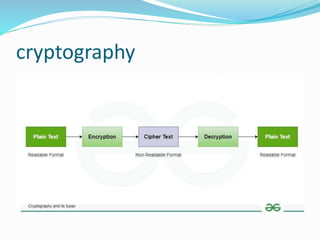
 Cryptography is a technique of securing
communication by converting plain text into
ciphertext.
 Cryptography is a technique of securing information
and communications through the use of codes so that
only those persons for whom the information is
intended can understand and process it.
 Thus preventing unauthorized access to information.
 The prefix “crypt” means “hidden” and the suffix
“graphy” means “writing”.
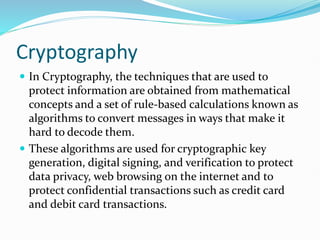
Cryptography
 In Cryptography, the techniques that are used to
protect information are obtained from mathematical
concepts and a set of rule-based calculations known as
algorithms to convert messages in ways that make it
hard to decode them.
 These algorithms are used for cryptographic key
generation, digital signing, and verification to protect
data privacy, web browsing on the internet and to
protect confidential transactions such as credit card
and debit card transactions.
cryptography
Types Of Cryptography
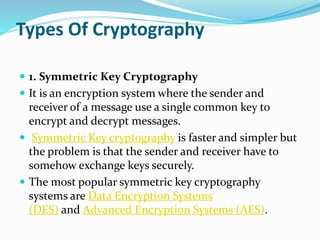
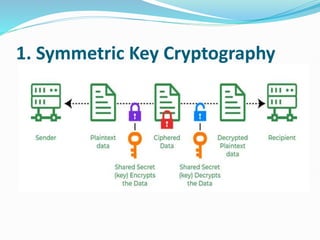
 1. Symmetric Key Cryptography
 It is an encryption system where the sender and
receiver of a message use a single common key to
encrypt and decrypt messages.
 Symmetric Key cryptography is faster and simpler but
the problem is that the sender and receiver have to
somehow exchange keys securely.
 The most popular symmetric key cryptography
systems are Data Encryption Systems
(DES) and Advanced Encryption Systems (AES).
1. Symmetric Key Cryptography
Hash Functions
 There is no usage of any key in this algorithm.
 A hash value with a fixed length is calculated as per
the plain text which makes it impossible for the
contents of plain text to be recovered.
 Many operating systems use hash functions to encrypt
passwords.
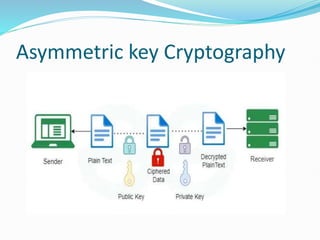
Asymmetric Key Cryptography
 In Asymmetric Key Cryptography, a pair of keys is used
to encrypt and decrypt information.
 A receiver’s public key is used for encryption and a
receiver’s private key is used for decryption.
 Public keys and Private keys are different.
 Even if the public key is known by everyone the
intended receiver can only decode it because he alone
knows his private key.
 The most popular asymmetric key cryptography
algorithm is the RSA algorithm.
Asymmetric key Cryptography
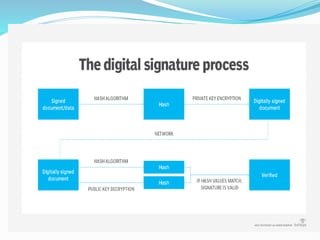
Digital Signature
 A digital signature is a mathematical technique used
to validate the authenticity and integrity of a digital
document, message or software.
 It's the digital equivalent of a handwritten signature or
stamped seal, but it offers far more inherent security.
 A digital signature is intended to solve the problem of
tampering and impersonation in digital
communications.
Digital Signature
 Digital signatures can provide evidence of origin,
identity and status of electronic documents,
transactions and digital messages.
 Signers can also use them to acknowledge informed
consent.
 In many countries, including the U.S., digital
signatures are considered legally binding in the same
way as traditional handwritten document signatures.
References
 https://www.geeksforgeeks.org/private-blockchain/
 https://www.geeksforgeeks.org/hybrid-
blockchain/?ref=lbp
Thank you

Block Chain Technology Chapter No 2.pptx

  • 1.
  • 2.
    Block Chain Basics Types of Network  Layered Architecture of Block Chain Ecosystem  Components of Clock chain  Cryptography (Private and Public Keys, Hashing and Digital signatures)  Consensus Mechanism
  • 3.
    Block chain technologyNetworks  Blockchain network is a network of linked nodes used for read, write transactions into ledger database.  The topology (as shown in Figure 2) is based on the nodes participating in consensus process.  Traditional systems are centralized where all data and decision-making is concentrated on a single node or cluster of nodes.
  • 4.
  • 5.
    Block chain technologyNetworks  In decentralized systems, the data and decision- making are spread out among a large number of nodes.  These nodes maintain copies of the shared database and decide among themselves which data is to be committed to the database using consensus mechanism.
  • 6.
    Block chain technologyNetworks  Decentralized networks can be an interconnection of centralized or hub-and-spoke type networks.  A distributed network is a special case of decentralized system where every single node in the network maintains the shared database and participates in consensus to determine which data is to be committed to the database.
  • 7.
    Public blockchain networks A public blockchain is one that anyone can join and participate in, such as Bitcoin.  Public blockchain, as the name indicates, is the blockchain for and of the public.  There is no one in charge, and anyone can take part in the process.  These types of blockchains are open and transparent. Since there is no one in charge, decisions are made through a decentralized consensus mechanism.  Permissioned  Permissionless  The most known public blockchains are the bitcoin blockchain and the Ethereum blockchain.
  • 8.
    Characteristics:  It isan open network where nodes can join and leave without the permission of anyone.  All nodes in the network can verify a new piece of data added to the network.  This block chain includes a protocol of incentive mechanism that aims to ensure the correct operation of the blockchain system.  This public blockchain is said to be permissionless as anyone can access it without any kind of permission, and the ledger is shared and transparent.  There is no need to use your real name, or identity, everything can be hidden.  In any network, the user has to follow rules that might not even be fair. But not in public blockchain networks.  No regulation hence no limit to how one can use the platform for betterment.  It offers anonymity, no one can track your transaction back to you.
  • 9.
    Advantages:  Transparency: Publicblockchains are transparent and open for everyone to access. This makes the ledger accessible to all, eliminating chances of corruption and ensuring transparency.  Security: Public blockchains are designed to operate with maximum security. The decentralized nature of the network makes it difficult for hackers to compromise the system.  Empowerment: Public blockchains empower all participants to validate transactions without any central authority overlooking their actions.  Immutability: Public blockchains are immutable, meaning no one can tamper with the system, ensuring that transactions are secure.
  • 10.
    Disadvantages:  Power Consumption:Public blockchains require a lot of computational power due to their decentralized nature. This increases energy consumption and can be detrimental to the environment.  Scalability: With more users on the blockchain, the network becomes burdened with more transactions, leading to scalability issues.  Conspiracy: The decentralized nature of public blockchains means that no one knows who validates the transactions, increasing the risk of potential conspiracy.  Transactions: Public blockchains can be slow due to the time it takes to process all transactions on the network.  Acceptance: Due to the openness and transparency of public blockchains, it can be difficult for governments to accept them as they are not controlled by authorities.
  • 11.
    Private blockchain networks A private blockchain network, similar to a public blockchain network, is a decentralized peer-to-peer network.  As the name suggests private blockchain is like a private asset of the individual or an organization.  Unlike, a public blockchain, a private blockchain has an in- charge who monitor important task and give access to read or block access.  It is also known as permissioned blockchain as it has restrictions on who can participate in transactions and validations.  The entities have been chosen in this network by the respective authority and the chain developers while building the blockchain application.  This blockchain uses are internal to the company so companies will not want it to be accessible by the public.
  • 12.
    Characteristics:  By itsnature, it performs better in database management and auditing in other fields.  Not everyone can run a full node and start mining.  Everyone cannot make transactions on the chain.  Not everyone can review the blockchain in the blockchain explorer.  A user has to be permitted by blockchain authority before he could access the network thus making it Permissioned Network.  Performance becomes faster as fewer nodes participate.  It is being able to give service on demand making it more attractive to the user.
  • 13.
    Advantages:  Security: Dueto its immutable nature information cannot be altered. Private blockchain helps in preventing fraud.  This blockchain uses identity to confirm membership and access privileges and typically only permit known organization to join.  Performance: Since the lesser number of nodes are there performance is increased as it takes less time to validate the block.  This type of blockchain has higher throughput and lower latency become more significant as the number of transaction grow.  Network and distributed system simulators are important tools on which the performance depends.  Scalability: A network that doesn’t host millions of users can easily implement the changes and features and hence can increase scalability.  It is found to date by some research that at present this type of blockchain is scalable to a further extent.  Several parameters are involved in the scalability process and are dependent on each other
  • 14.
    Advantages  Throughput: Sincethe number of users is limited this type of blockchain has higher throughput.  This throughput gives a more advantage as the business needs faster transactions which are easily provided by the private blockchain.  Trust: Users on the private network are not anonymous this increases the level of trust in the private blockchain.  Private Blockchain is best suited for applications where it required the truth that a company can achieve data privacy and control over data sharing.  Energy: Since the number of users in a blockchain is less there is less amount of energy and material used.  A private blockchain is the most energy-efficient choice that can be made by businesses as the network are not as much bigger as the public blockchain.  Cost-effective: Private blockchains can be cost-effective for businesses because they don’t require the same level of resources as public blockchains.  Private blockchains can be operated on existing infrastructure, which reduces the costs associated with setting up a new network.
  • 15.
    Advantages  Flexibility: Privateblockchains are highly flexible and can be customized to meet the specific needs of a business.  They can be designed to include only the necessary features and components, which makes them more efficient.  Control: Private blockchains provide businesses with greater control over their data and the blockchain network.  Businesses can control who has access to the blockchain and can set rules and guidelines for how the network is used.  Privacy: Private blockchains provide greater privacy for businesses, as they can control who has access to their data and can ensure that sensitive information is not shared with unauthorized parties.  Regulatory compliance: Private blockchains can help businesses comply with regulatory requirements, as they provide a greater level of control and oversight over the data and network.  This is particularly important for businesses in industries with strict regulatory requirements, such as finance and healthcare.  Collaboration: Private blockchains can facilitate collaboration between businesses, as they can be designed to allow multiple organizations to participate in the same network.  This can lead to greater efficiency and innovation, as businesses can share information and resources more easily.
  • 16.
    Disadvantages:  Lack ofTrust: External players have to trust a private blockchain network without having control over the verification.  These trusted parties would be responsible for communicating newly verified transactions to the rest of the network.  Centralization: With the presence of a few nodes it is possible that untrustworthy individuals gain control over the network.  These blockchains are generally centralized as it is mostly used by business and enterprises. Although, blockchain is made to avoid centralization private blockchain inherently becomes centralized.
  • 17.
    Disadvantages  Integrity: Integritydepends on the standing authorized user/participants. It is necessary to trust in order to validate the transaction.  Confidentiality alone is not sufficient to ensure the participant trusts the private blockchain.  It also requires integrity to get confidence in private blockchain  Control: With fewer participants, it is easier for the hacker to take control of the network and manipulate the data on it.  It can happen when two minors are calculating the hash of the block at the same time and get the same result. As a result, the blockchain will split and users have two different blockchains.
  • 18.
    Hybrid Block Chain It is a combination of private and public blockchains. It is the best of both worlds that can utilize the advantages of both private-based permissioned systems and public-based permissionless systems.  A Hybrid blockchain is a blockchain that combines elements of both public and private blockchains.  It is designed to reduce the disadvantages of both types of blockchains while maximizing their benefits.
  • 19.
     A hybriddatabase contains both public and private entries.  Similar to public blockchains, where anyone is invited to join and participate in the network, public nodes operate similarly to those in those systems.  Private nodes, on the other hand, are in charge of validating and checking transactions and are governed by specific organizations or individuals.  Using private nodes, a hybrid blockchain can process transactions more rapidly and with greater privacy and security.  Public nodes provide decentralization and transparency at the same time, making it difficult for one group to maintain control over the network.  In a hybrid blockchain, the members can decide who can participate in the blockchain or which transactions are made public.
  • 20.
    Features of HybridBlockchain  1. Data Security  When compared to private blockchains, hybrid blockchains offer stricter data security protocols and slightly more flexibility.  2. Transactions’ Cost  Transactions’ cost is assured to be lower because only a few nodes are needed to validate them.  3. Closed Ecosystem  While preserving anonymity, a hybrid blockchain enables contact with outside parties.  A hybrid blockchain cannot be the target of a 51 percent attack from outsiders because it works in a closed environment.
  • 21.
     4. NewRules  The advantage of mixed blockchain is that new rules must be put into place.  5. Decentralized Access  Another characteristic of this blockchain is the increased decentralization of participant access. Because public and private blockchains approach decentralization in very different ways, a mixed blockchain enables it when and where it is required.
  • 22.
    Benefits of HybridBlockchain  High-Speed Operations: The hybrid blockchain provides high-speed operations and is simpler to manage.  Reduces Transaction Costs: Because verification in a private or public blockchain can be difficult to complete, strong nodes within the network might be able to exercise some sort of influence over the decision-makers in charge of this process, increasing transparency. As a result, transaction costs are decreased, and expenses may even be as low as $0.01 per transaction.  Protecting Privacy from the Outside World: The private blockchain is perfect for privacy-related issues but they have limited means of communication with the outside world.  Flexible Infrastructure Settings: Hybrid blockchain offers a flexible strategy for tailoring the ledger to one’s and the organization’s needs, whereas other blockchains offer a strict blockchain infrastructure  Protecting from 51% attack: Hybrid blockchain is immune to 51% attack as hackers cannot have access to the network to carry out the attack.
  • 23.
    Consortium block chains A consortium blockchain is like a private blockchain but differs in the factor of the authority who can control the access or operations.  Unlike private blockchain, where there is only one controlling authority, in a consortium blockchain, the authority is distributed.  Instead of one controlling authority, multiple groups have controlling authorization. Therefore, decentralization is more prevalent than private blockchain.  Example: Supply chain where different units such as sales, logistics, marketing, etc., can have multiple controlling authorities, etc.
  • 24.
    What is BlockchainEcosystem?  The blockchain ecosystem is the network of all the participants in the blockchain network that share the business process and business objectives. The ecosystem encompasses the different governing structures like:  Individual participation.  Data ownership.  Exit and entrance criteria.  Information and data shared with the system’s participants.
  • 25.
    Block chain ecosystem It can provide immutability, decentralization, flexibility for day-to-day operations, and scalability. The blockchain ecosystem is a boon for startups and new technology projects as it creates an interconnected network.
  • 26.
    Types of BlockchainEcosystem:  Single-party led blockchain ecosystem: This ecosystem is led by a single organization where all the stakeholders have a mutual benefit for participating in the network.  For example, Bumble Bee Foods has created a single- party-led blockchain ecosystem to improve the traceability of the yellowfin tuna fish.  This helped to improve the buyer’s confidence in the fish’s freshness.
  • 27.
    Types of BlockchainEcosystem:  Joint venture blockchain ecosystem: This is also known as the Consortium blockchain ecosystem.  These are slowly becoming popular and they involve two or more organizations in the ecosystem.  The participating organizations have an objective of participating in a common activity or pooling their resources for achieving a common goal.  For example, BunkerTrace a marine fuel tracking solution is a joint venture blockchain ecosystem between Forecast technology Ltd. and Blockchain Labs for Open Collaboration (BLOC).
  • 28.
    Types of BlockchainEcosystem:  Regulatory block chain ecosystem: This ecosystem comprises various government agencies that share a project and have to self-report for compliance.  For example, a shared project between Marine Transport International and Recycling Association.
  • 29.
    Type of BlockchainDescription Scalability Examples Public Blockchain A decentralized blockchain accessible to anyone with an internet connection Limited Bitcoin, Ethereum Private Blockchain A blockchain that is only accessible to a select group of individuals or organizations High Hyperledger Fabric, Corda Hybrid Blockchain A blockchain that combines the features of both public and private blockchains High Dragonchain, EWF Baseline Consortium Blockchain A blockchain that is governed by a consortium of organizations High R3 Corda, Hyperledger Fabric
  • 30.
    Layered Architecture ofBlock Chain Ecosystem
  • 31.
     According tosome block chain professionals, there are five layers of block chain technology:  Hardware/Infrastructure layer.  Data layer.  Network layer.  Consensus layer.  Application and Presentation layer.
  • 32.
     Some blockchain experts believe that block chain has 7 layers:  Hardware/Infrastructure layer.  Data layer.  Network layer.  Consensus layer.  Incentive layer.  Contract layer.  Application and Presentation layer.
  • 33.
    Application layer  Providesblockchain-based applications for the end user. The application layer is the end product of the entire system offering specific products for the users, i.e., wallet, lending, staking, etc.  The application layer starts with a smart contract, a programmable code that governs state transitions.  It can function as an escrow, payment channel, or vault and is known by different names in various ecosystems, like “programs” in Solana and “chaincode” in Hyperledger.  Smart contracts are a frequent target for hackers, as any critical error in its code can be exploited for illegal gains.
  • 34.
    Protocol (Consensus) Layer set rules for node agreement on the state. The protocol layer sets the rules for block chain participation, with the consensus mechanism being its key component.  Consensus ensures agreement among nodes for block mining and processing and outlines validator requirements, varying across proof-of-work, proof-of-stake, and other consensus mechanisms.  Propagation protocol broadcasts decisions, while protocol audits ensure security against threats like 51% attacks.
  • 35.
    Network Layer  Providesfor peer node interaction. The network layer enables effective discovery and interaction among peers called nodes.  Typically, a node locates a boot node, which scans for available peers and initiates bonding.  As information circulates, it’s safeguarded through a Trusted Execution Environment (TEE) to maintain integrity.  Node session maintenance varies across networks; for example, Ethereum employs Recursive Length Prefixes, defining the time nodes take to locate, authenticate, and share data.
  • 36.
    Data Layer  Ensuressecure and confident message transmission. The data layer of blockchain technology is primarily concerned with data storage and structure.  It houses the blockchain, a linear succession of blocks that store transaction information.  Depending on the specific blockchain, the data structure can range from a simple transaction list, such as the one used by Bitcoin, to a more intricate structure, like Ethereum’s state trie, which stores contract state information.
  • 37.
    Hardware/Infrastructure Layer  Providesthe necessary capacities to host a blockchain. Blockchain architecture extends to hardware and infrastructure.  In this layer—In Proof-of-Work consensus protocols— miners and validators operate, with miners creating new blocks using specialized equipment (GPU, ventilator, stabilizer) and electricity, and validators running nodes for block mining.  As for data storage, some blockchains opt for third-party decentralized data hostings, such as Filecoin, IPFS, Arweave, or Firebase, due to capacity limitations.
  • 38.
    Layer What itdoes Components Application Hosts applications that interact with the blockchain. Smart Contract, User Interface, Decentralized Applications Services & Optional Components Enhances the functionality of the blockchain with additional services. Governance/DAOs, Oracles, Wallets, Blockchain Monitor Protocol/Consensus Defines and regulates how nodes in a blockchain come into agreement. Consensus, Sidechains, Permissioned and Permissionless, Propagation Protocol, Virtual Machines Network Facilitates effective discovery and interaction among nodes. Communication Mechanisms, Trusted Execution Environments, Recursive Length Prefix Data Caters for the creation, management, and encryption of data. Digital Signatures, Hash, Merkle Tree, Data Blocks, Asymmetric Encryption, Storage Hardware/Infrastructure Provides the physical resources needed to host a blockchain. Mining, Nodes, Tokens, Servers
  • 39.
    Components of Blockchain  Node Application: Every internet-connected computer is allowed to participate if it so chooses, according to a node application.  The applications for bitcoin wallets and blockchain are two examples of node applications.  In the case of a bank chain as a Blockchain ecosystem, for instance, only banks are permitted to participate.  Node applications are not free from restrictions.
  • 40.
    Components of Blockchain  Distributed/Shared Ledger (Database): A particular blockchain system’s participants can access shared databases and contents through the distributed ledger.  The shared ledger contains a list of the regulations that must be adhered to.  For instance, if we are operating a bitcoin node application, we must abide by all regulations listed in the program code of the bitcoin node application.
  • 41.
    Components of Blockchain  Consensus Algorithm: Consensus algorithms are one of the main parts of a blockchain system and are essential to the functionality and security of the network.  Block Chain data Security and Consistency is maintained by consensus Algorithm.  It displays the network’s current state and illustrates how the network’s nodes decide which transactions to accept.  Additionally, the fact that changing a block only requires creating a new block from its predecessor and necessitates regenerating all succeeding blocks and redoing their contents helps to protect the blockchain from being tampered with.  For instance, while it only takes ripple a few seconds to ensure ledger agreement, bitcoin can take several minutes.
  • 42.
    Components of Blockchain  Virtual Machine: The term “virtual machine” refers to a computer program’s depiction of a machine, real or hypothetical, that may be controlled via instructions expressed in a language.  Inside a machine, it is an abstraction of a machine.  The abstraction of physical objects and entities into virtual counterparts on a computer is something to which we have grown somewhat used.
  • 43.
    Components of Blockchain  Peer-to-Peer (P2P) Network: A peer-to-peer is a decentralized model to communicate between many peer nodes without any central server.  On block chain networks, each node flexibly participates in the role of a client and a server to jointly provide and control data.  Improving the availability of data helps the system to avoid information loss.
  • 44.
    Consensus Mechanism  Aconsensus mechanism is the programming and process used in block chain systems to achieve distributed agreement about the ledger's state or the state of a data set.  Crypto currencies, block chains, and distributed ledgers benefit from their use because consensus mechanisms replace much slower and sometimes inaccurate or untrustworthy human verifiers and auditors.
  • 45.
    Consensus Mechanism  Aconsensus mechanism is a protocol that brings all nodes of a distributed blockchain network into agreement on a single data set.  They act as the verification standards through which each blockchain transaction gets approved.
  • 46.
    Consensus Mechanism  Aconsensus mechanism is a self-regulatory stack of software protocols written into a blockchain’s code that synchronizes a network into agreement about the state of a digital ledger.  This is done by upkeeping a single data set — the mutually agreed-upon version of a blockchain’s transaction history — rather than employing each node, or in-network computer, to individually maintain their own copy of the database in its entirety
  • 47.
    How Does aConsensus Mechanism Work?  Nodes input data from a pending transaction, then report back with an approval or disapproval status once the request is cross- checked with its records.  For example, if a user is trying to process a transaction using previously spent coins that have already been accounted for, this request would easily be denied against an immutable ledger, confirmed by majority disapproval.  Users that fail to adhere to consensus are often banned from a network.  In the event a node wanted to challenge the record, they would have to request a network-wide recall.  If more than two thirds of their peer nodes approve, then the transaction is confirmed, distributed and permanently written into the blockchain.
  • 48.
     ‘Consensus’ simplymeans an agreement between a group of people, and in the world of blockchain it is an important concept.  Common examples of consensus mechanisms in blockchain include proof of work, in which crypto miners are handsomely rewarded with newly generated tokens in exchange for authenticating transactions by way of solving arbitrary computational puzzles, and proof of stake, where users put up a certain amount of tokens for a chance to earn rewards through transaction verification in a raffle.
  • 49.
    Why Are ConsensusMechanisms Important in Blockchain?  consensus mechanisms serve as incentive programs for good behavior.  They are not only a decentralized fail-safe that ensures a system stays up and running; they are what create trust in a trustless environment.  Consensus mechanisms prevent double spending
  • 50.
    Cryptography  Cryptography isa technique of securing communication by converting plain text into ciphertext.  Cryptography is a technique of securing information and communications through the use of codes so that only those persons for whom the information is intended can understand and process it.  Thus preventing unauthorized access to information.  The prefix “crypt” means “hidden” and the suffix “graphy” means “writing”.
  • 51.
    Cryptography  In Cryptography,the techniques that are used to protect information are obtained from mathematical concepts and a set of rule-based calculations known as algorithms to convert messages in ways that make it hard to decode them.  These algorithms are used for cryptographic key generation, digital signing, and verification to protect data privacy, web browsing on the internet and to protect confidential transactions such as credit card and debit card transactions.
  • 52.
  • 53.
    Types Of Cryptography 1. Symmetric Key Cryptography  It is an encryption system where the sender and receiver of a message use a single common key to encrypt and decrypt messages.  Symmetric Key cryptography is faster and simpler but the problem is that the sender and receiver have to somehow exchange keys securely.  The most popular symmetric key cryptography systems are Data Encryption Systems (DES) and Advanced Encryption Systems (AES).
  • 54.
    1. Symmetric KeyCryptography
  • 55.
    Hash Functions  Thereis no usage of any key in this algorithm.  A hash value with a fixed length is calculated as per the plain text which makes it impossible for the contents of plain text to be recovered.  Many operating systems use hash functions to encrypt passwords.
  • 56.
    Asymmetric Key Cryptography In Asymmetric Key Cryptography, a pair of keys is used to encrypt and decrypt information.  A receiver’s public key is used for encryption and a receiver’s private key is used for decryption.  Public keys and Private keys are different.  Even if the public key is known by everyone the intended receiver can only decode it because he alone knows his private key.  The most popular asymmetric key cryptography algorithm is the RSA algorithm.
  • 57.
  • 58.
    Digital Signature  Adigital signature is a mathematical technique used to validate the authenticity and integrity of a digital document, message or software.  It's the digital equivalent of a handwritten signature or stamped seal, but it offers far more inherent security.  A digital signature is intended to solve the problem of tampering and impersonation in digital communications.
  • 59.
    Digital Signature  Digitalsignatures can provide evidence of origin, identity and status of electronic documents, transactions and digital messages.  Signers can also use them to acknowledge informed consent.  In many countries, including the U.S., digital signatures are considered legally binding in the same way as traditional handwritten document signatures.
  • 61.
  • 62.