Blister Packing

PRESENTED BY
DR.SAFDER ALI
PRODUCTION EXECUTIVE
Introduction
Blister pack:
“Blister pack or bubble pack is a term for several types
of pre-formed plastic Packaging used for small
consumer goods, foods, and for pharmaceuticals”
Blistering:
“Blistering is the process of making Blisters or
enclosing the tablets & capsules into preformed
plastic packing”
Introduction

“The primary component of a blister pack is a cavity or
pocket made from a formable web, usually a
thermoformed plastic. This usually has a backing of
paper board or a lidding seal of aluminium foil or
plastic.”
The "formed" pocket contains the product and the
"lidding" seals or closes the product in the package.
Blister packaging is the new wave of pharmaceutical
packaging.
Introduction

“Blister packing machines are used by the
pharmaceutical industry for packing a number of
products like Tablets, Capsules, Drugs, Vials,
Ampoules, Syringes or Liquid products”
Uses of Blister Packaging in Pharmaceutical
Industry:
They provide barrier protection for shelf life
requirements.
2. They also provide a degree of tamper resistance.
3. The most important reason for introducing blister
packaging technology was to offer patients a clearly
marked individual dose, enabling them to check
whether they had taken the prescribed drugs on a
given day.
1.
Uses of Blister Packaging in Pharmaceutical
Industry:
4. Moreover, the drugs that were not taken remained

in the original package and were fully protected
against adverse external conditions.
5. The patient could handle the blister package more
easily and could store it more conveniently than
conventional packages.
6. Protection from Moisture, Gas, Light &
Temperature
7. Compliance – Regulatory & Patient
Advantages of blister packaging
1.
2.
3.

4.

5.

Prevention of broken glass bottles
Reduced costs and higher packaging speeds
relative to other packaging materials.
Blister packaging helps retain product integrity
because drugs that are prepackaged in blisters
are shielded from adverse conditions.
Furthermore, opportunities for product
contamination are minimal.
and each dose is identified by product name, lot
number, and expiration date.
Advantages of blister packaging
4.
5.

Blister packaging protects pharmaceuticals in the home
better than bottles do.
Tamper evidence is another strength of blister packaging.
The dosage units are individually sealed in constructions
of plastic, foil, and/or paper. With blister
packaging, however, each tablet or capsule is individually
protected from tampering until use, so any form of
tampering with a blister package is immediately visible.
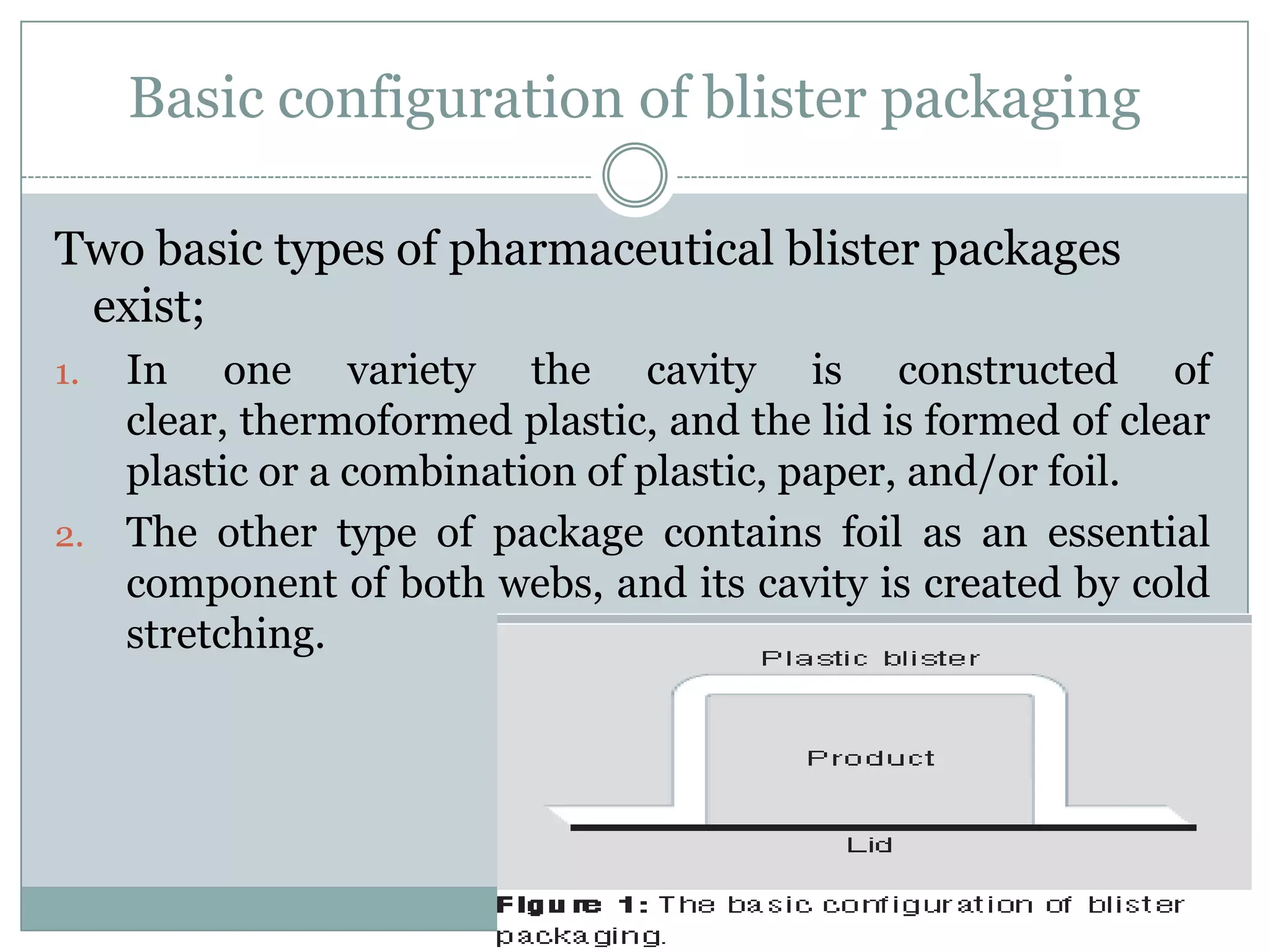
Basic configuration of blister packaging
Two basic types of pharmaceutical blister packages
exist;
In one variety the cavity is constructed of
clear, thermoformed plastic, and the lid is formed of clear
plastic or a combination of plastic, paper, and/or foil.
2. The other type of package contains foil as an essential
component of both webs, and its cavity is created by cold
stretching.
1.
Blister Packing Component
The four basic components of pharmaceutical blister
packages are;
1. The forming film (Forming films account for
approximately 80–85% of the blister package)
2. The lidding material (lidding materials make up
15–20% of the total weight of the package.)
3. Heat seal coating
4. And the printing ink
Blister Packing Component
Forming film:
“The forming film is the packaging component that
receives the product in deep drawn pockets.”
One key to package success is selecting the right plastic
film for the blisters in terms of its;
1. property type,
2. grade,
3. and thickness.
Blister Packing Component
Selection of forming film:

Consideration must be given to the;
1. Height and weight of the product,
2. Sharp or pointed edges of the final package,
3. And the impact resistance,
4. Aging, migration, and cost of the film.
Blister Packing Component
Selection of forming film:



The plastic also must be compatible with the
product.
Factors influencing package production and speed
of assembly must be taken into account, including
heat sealing properties and the ease of cutting and
trimming formed blisters.
Blister Packing Component
Types of forming films are;
1. Thermoforming film
Examples are;
 Rigid PVC
 PVDC (Polyvinylidene chloride)

CTFE (PVC/chlorotrifluoroethylene)
 PS (Polystyrene )
2. Cold forming film
Example (ALUMINIUM foil)
Blister Packing Component
Lidding Material:
“The lidding material provides the base or main
structural component upon which the final blister
package is built”
It must be selected according to;
 The size,
 Shape,
 And weight of the product
 As well as the style of the package to be produced
Blister Packing Component
Important consideration in lidding Lidding
Material selection are:
 The surface of the lidding material must be
compatible with the heat-seal coating process.
 Clay coatings are added to the lidding material to
enhance printing.
 Heat-sealing and printability are both important
considerations in blister packaging, and the lidding
material must offer the best workable compromise.
Blister Packing Component
Heat seal coating:
“Heat-seal coatings provide a bond between the plastic
blister and the printed lidding material.”
“For blister packages, heat-seal coatings are perhaps
the most critical component in the entire system.
The appearance and physical integrity of the package
depends upon the quality of the heat-seal coating.”
Blister Packing Component
Heat seal coating:
 These solvent- or water based coatings can be
applied to rolls or sheets of printed paperboard using
roll coaters, gravure or flexographic methods, knives,
silk-screening, or sprays. Whatever the system, it is
essential that the proper coating weight be applied to
the lidding material for optimum heat-sealing
results.
Blister Packing Component
Heat seal coating:
A successful heat-seal coating for blister packages
must exhibit;
 Good gloss,
 Clarity,
 Abrasion resistance,
 And hot tack
 And must seal to various blister films.
Blister Packing Component
Hot tack:
“Hot tack is particularly important because the
product usually is loaded into the blister and the
lidding material heat sealed in place (face down)
onto the blister. When the package is ejected from
the heat-seal jig, the still-warm bond line must
support its entire weight.”
Blister Packing Component

“The heat-seal coating must precisely match the
lidding material and the plastic material of the
forming films.”
Precisely match means that with pre-determined
sealing parameters, a permanent sealing effect
between the lidding material and the forming film
must be guaranteed under any climatic conditions.
Blister Packing Component
Printing Inks:
“Printing inks provide graphics and aesthetic appeal.”
 They can be applied to the lidding material by letterpress,

gravure, offset, flexographic, or silk-screen printing
processes
 Printing inks must resist heat sealing temperatures as high
as 300 C without showing any discoloration or tackiness.
 They must sufficiently resist abrasion, bending, and fading
and must be safe for use with the intended product.
 Finally, printing inks must comply with FDA
recommendations.
Barrier Packaging foils
 Low barrier film – PVC

 Medium barrier film – PVDC

 High barrier film – ACLAR & ALU/ALU
Blister Packaging machine

Thermoform blistering machine
2. Cold form blistering machine
3. Thermo-cold complex blistering machine
1.
Blister Packaging machine
The essential parts and functions of an intermittently
operating packaging machine include the following;
The unwinding station (The unwinding station
supplies the forming films and the lidding material at a
rate corresponding to the speed of the packaging
machine)
2. The heating station (The heating station raises the
temperature of the plastic forming films to a level suitable
for deep drawing. Forming films containing the polyvinyl
chloride (PVC) support material are heated to 120–140
C. Polypropylene (PP) forming films are heated to 140–
150 C.)
1.
Blister Packaging machine
Note:
Heating station is present only in thermoform &
thermo-cold form blistering machines.
3. The forming station(The forming station forms

the plastic blister cavities via compressed air or die
plates & in case of cold forming machine via
punching pins.
Punch pins material: TEFLON
Blister Packaging machine
4. The cooling station (The cooling station cools

PP films after the forming process. Laminates
containing PVC or aluminum do not need to be
cooled.)
5. The feeding machine (The loading area fills the
blister cavities with product. The feeding machine
can be linked, or the product to be packaged can
simply be swept into the blisters)
Blister Packaging machine
6. The sealing station (The sealing station heat

seals the lidding material to the forming film that
contains the product
7. The printing station ( print or engrave the batch
number & expiry date over the blister)
8. Trimming Station (cuts the blisters into
individual unit)
Blister Packaging machine
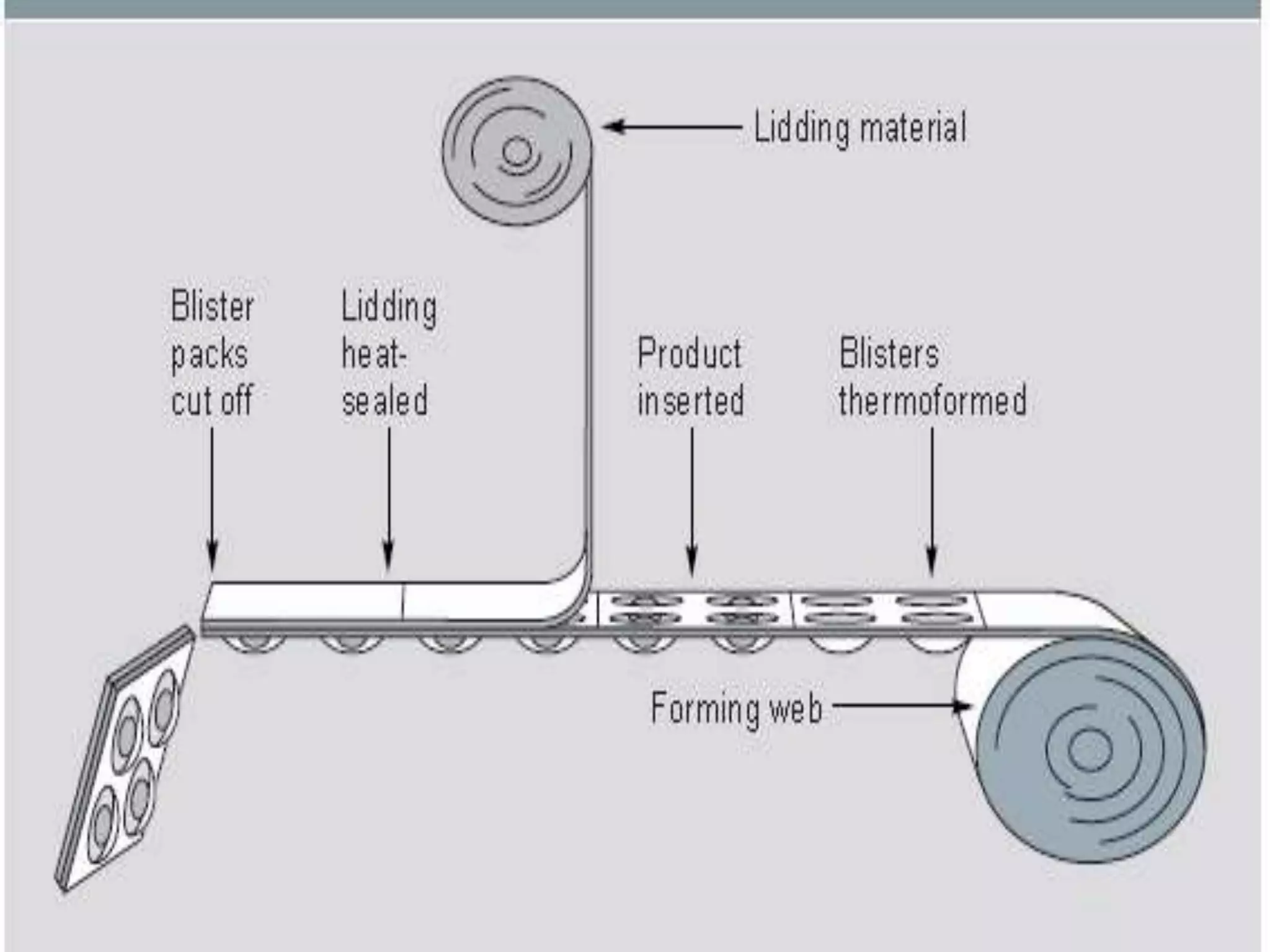
Thermoform Blistering machine:
Example : ALU-PVC machine
Operation:
The sequence involves;
1. Heating the plastic,
2. Thermoforming it into blister cavities,
3. Loading the blister with the product,
4. Placing lidding material over the blister,
5. And heat-sealing the package.
 This can be a simple manual process, or it can be partially
or fully automated.
Blister Packaging machine
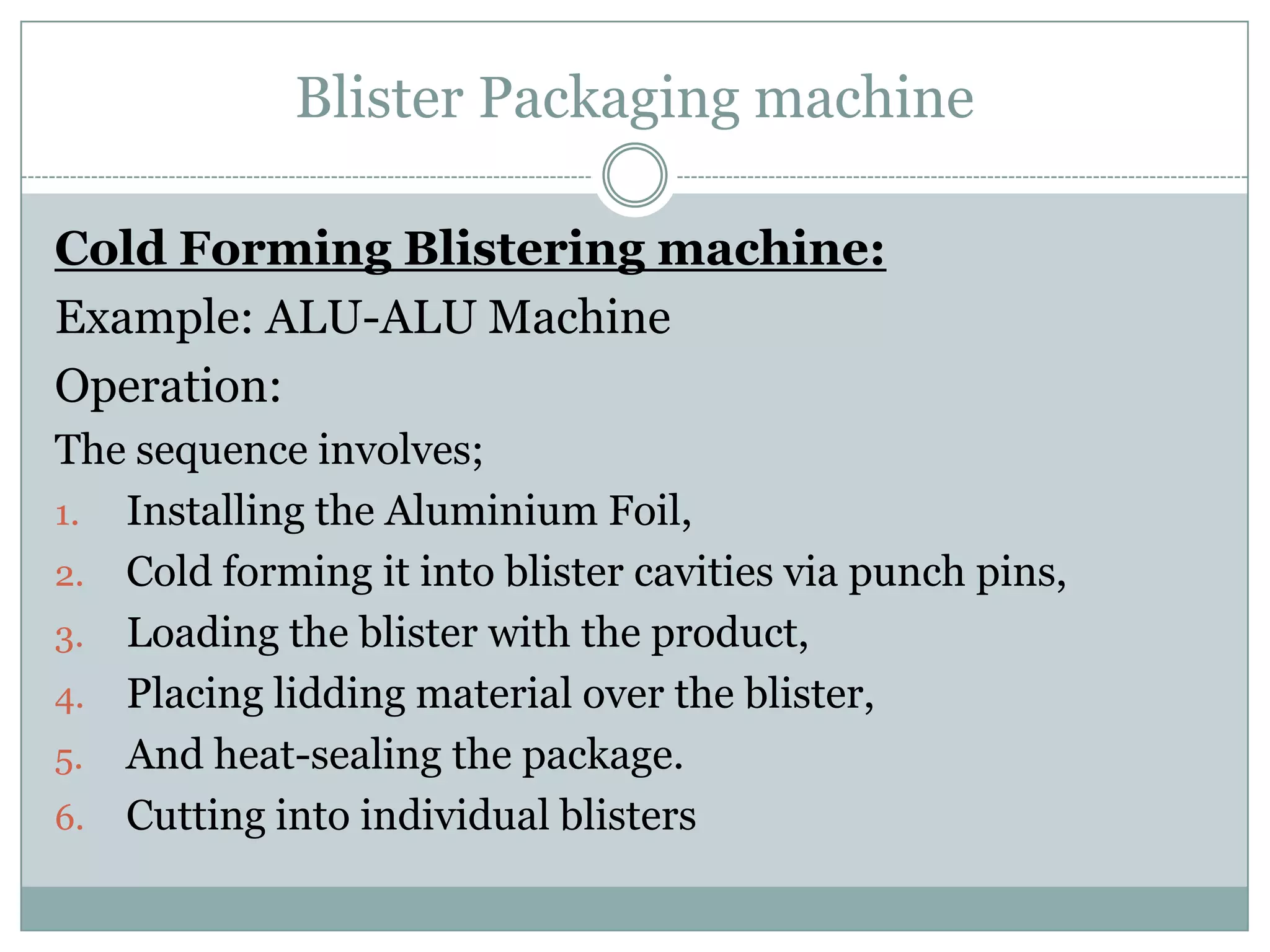
Cold Forming Blistering machine:
Example: ALU-ALU Machine
Operation:
The sequence involves;
1. Installing the Aluminium Foil,
2. Cold forming it into blister cavities via punch pins,
3. Loading the blister with the product,
4. Placing lidding material over the blister,
5. And heat-sealing the package.
6. Cutting into individual blisters
1. Bottom foil uncoiler
2. Cold forming station
3. Feeding device
4. Empty checker
5. Sealing & Embossing

6. Cover foil uncoiler
7. Cooling & slitting
8. Draw Off
9. Punching
10. Waste foil coiler

11. Discharge conveyor
Blister Packaging machine
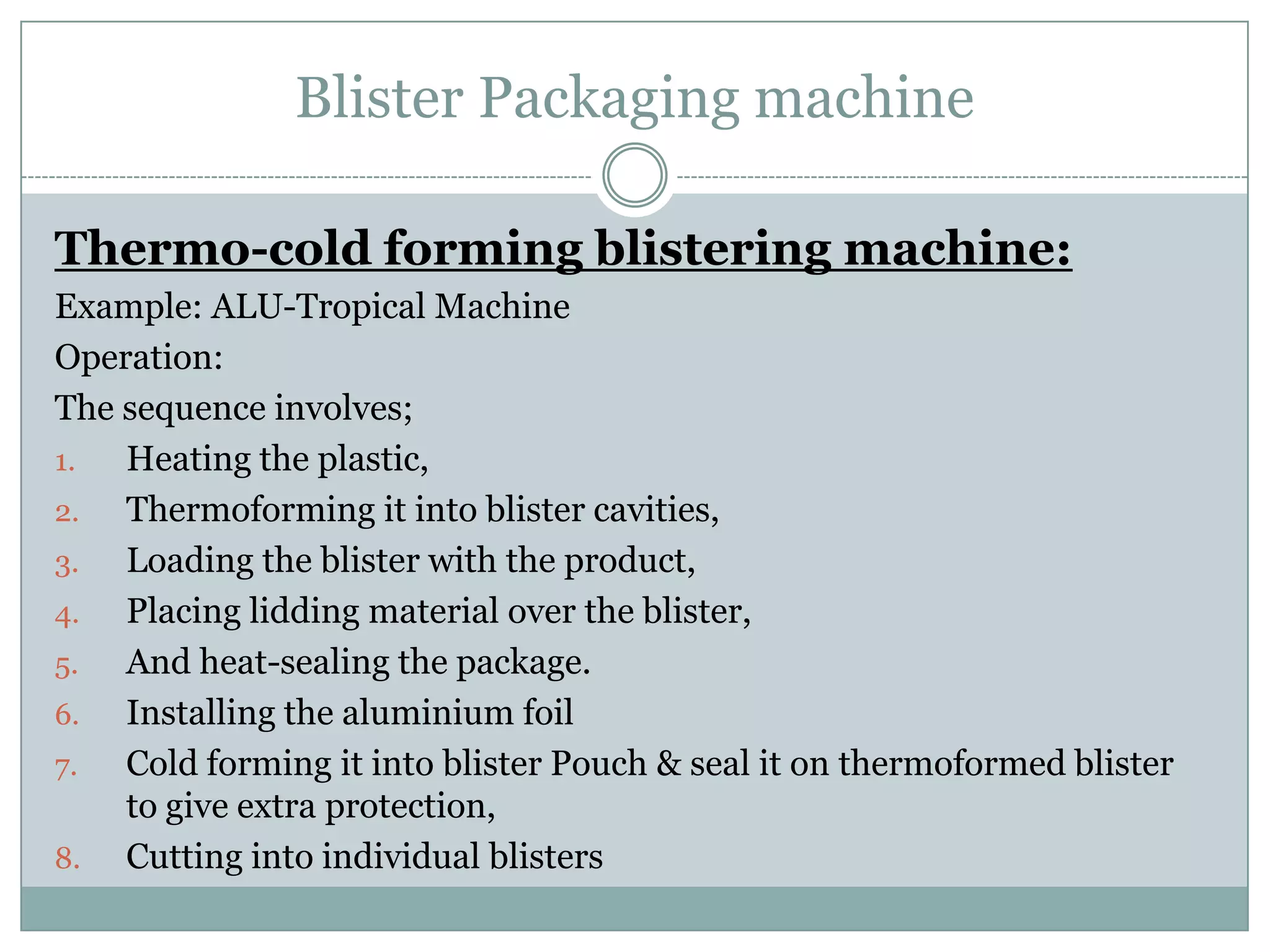
Thermo-cold forming blistering machine:
Example: ALU-Tropical Machine
Operation:
The sequence involves;
1.
Heating the plastic,
2.
Thermoforming it into blister cavities,
3.
Loading the blister with the product,
4.
Placing lidding material over the blister,
5.
And heat-sealing the package.
6.
Installing the aluminium foil
7.
Cold forming it into blister Pouch & seal it on thermoformed blister
to give extra protection,
8.
Cutting into individual blisters
Blister packing
Blister packing

Blister packing

  • 1.
  • 2.
    Introduction Blister pack: “Blister packor bubble pack is a term for several types of pre-formed plastic Packaging used for small consumer goods, foods, and for pharmaceuticals” Blistering: “Blistering is the process of making Blisters or enclosing the tablets & capsules into preformed plastic packing”
  • 3.
    Introduction “The primary componentof a blister pack is a cavity or pocket made from a formable web, usually a thermoformed plastic. This usually has a backing of paper board or a lidding seal of aluminium foil or plastic.” The "formed" pocket contains the product and the "lidding" seals or closes the product in the package. Blister packaging is the new wave of pharmaceutical packaging.
  • 4.
    Introduction “Blister packing machinesare used by the pharmaceutical industry for packing a number of products like Tablets, Capsules, Drugs, Vials, Ampoules, Syringes or Liquid products”
  • 5.
    Uses of BlisterPackaging in Pharmaceutical Industry: They provide barrier protection for shelf life requirements. 2. They also provide a degree of tamper resistance. 3. The most important reason for introducing blister packaging technology was to offer patients a clearly marked individual dose, enabling them to check whether they had taken the prescribed drugs on a given day. 1.
  • 6.
    Uses of BlisterPackaging in Pharmaceutical Industry: 4. Moreover, the drugs that were not taken remained in the original package and were fully protected against adverse external conditions. 5. The patient could handle the blister package more easily and could store it more conveniently than conventional packages. 6. Protection from Moisture, Gas, Light & Temperature 7. Compliance – Regulatory & Patient
  • 7.
    Advantages of blisterpackaging 1. 2. 3. 4. 5. Prevention of broken glass bottles Reduced costs and higher packaging speeds relative to other packaging materials. Blister packaging helps retain product integrity because drugs that are prepackaged in blisters are shielded from adverse conditions. Furthermore, opportunities for product contamination are minimal. and each dose is identified by product name, lot number, and expiration date.
  • 8.
    Advantages of blisterpackaging 4. 5. Blister packaging protects pharmaceuticals in the home better than bottles do. Tamper evidence is another strength of blister packaging. The dosage units are individually sealed in constructions of plastic, foil, and/or paper. With blister packaging, however, each tablet or capsule is individually protected from tampering until use, so any form of tampering with a blister package is immediately visible.
  • 9.
    Basic configuration ofblister packaging Two basic types of pharmaceutical blister packages exist; In one variety the cavity is constructed of clear, thermoformed plastic, and the lid is formed of clear plastic or a combination of plastic, paper, and/or foil. 2. The other type of package contains foil as an essential component of both webs, and its cavity is created by cold stretching. 1.
  • 10.
    Blister Packing Component Thefour basic components of pharmaceutical blister packages are; 1. The forming film (Forming films account for approximately 80–85% of the blister package) 2. The lidding material (lidding materials make up 15–20% of the total weight of the package.) 3. Heat seal coating 4. And the printing ink
  • 11.
    Blister Packing Component Formingfilm: “The forming film is the packaging component that receives the product in deep drawn pockets.” One key to package success is selecting the right plastic film for the blisters in terms of its; 1. property type, 2. grade, 3. and thickness.
  • 12.
    Blister Packing Component Selectionof forming film: Consideration must be given to the; 1. Height and weight of the product, 2. Sharp or pointed edges of the final package, 3. And the impact resistance, 4. Aging, migration, and cost of the film.
  • 13.
    Blister Packing Component Selectionof forming film:   The plastic also must be compatible with the product. Factors influencing package production and speed of assembly must be taken into account, including heat sealing properties and the ease of cutting and trimming formed blisters.
  • 14.
    Blister Packing Component Typesof forming films are; 1. Thermoforming film Examples are;  Rigid PVC  PVDC (Polyvinylidene chloride)  CTFE (PVC/chlorotrifluoroethylene)  PS (Polystyrene ) 2. Cold forming film Example (ALUMINIUM foil)
  • 15.
    Blister Packing Component LiddingMaterial: “The lidding material provides the base or main structural component upon which the final blister package is built” It must be selected according to;  The size,  Shape,  And weight of the product  As well as the style of the package to be produced
  • 16.
    Blister Packing Component Importantconsideration in lidding Lidding Material selection are:  The surface of the lidding material must be compatible with the heat-seal coating process.  Clay coatings are added to the lidding material to enhance printing.  Heat-sealing and printability are both important considerations in blister packaging, and the lidding material must offer the best workable compromise.
  • 17.
    Blister Packing Component Heatseal coating: “Heat-seal coatings provide a bond between the plastic blister and the printed lidding material.” “For blister packages, heat-seal coatings are perhaps the most critical component in the entire system. The appearance and physical integrity of the package depends upon the quality of the heat-seal coating.”
  • 18.
    Blister Packing Component Heatseal coating:  These solvent- or water based coatings can be applied to rolls or sheets of printed paperboard using roll coaters, gravure or flexographic methods, knives, silk-screening, or sprays. Whatever the system, it is essential that the proper coating weight be applied to the lidding material for optimum heat-sealing results.
  • 19.
    Blister Packing Component Heatseal coating: A successful heat-seal coating for blister packages must exhibit;  Good gloss,  Clarity,  Abrasion resistance,  And hot tack  And must seal to various blister films.
  • 20.
    Blister Packing Component Hottack: “Hot tack is particularly important because the product usually is loaded into the blister and the lidding material heat sealed in place (face down) onto the blister. When the package is ejected from the heat-seal jig, the still-warm bond line must support its entire weight.”
  • 21.
    Blister Packing Component “Theheat-seal coating must precisely match the lidding material and the plastic material of the forming films.” Precisely match means that with pre-determined sealing parameters, a permanent sealing effect between the lidding material and the forming film must be guaranteed under any climatic conditions.
  • 22.
    Blister Packing Component PrintingInks: “Printing inks provide graphics and aesthetic appeal.”  They can be applied to the lidding material by letterpress, gravure, offset, flexographic, or silk-screen printing processes  Printing inks must resist heat sealing temperatures as high as 300 C without showing any discoloration or tackiness.  They must sufficiently resist abrasion, bending, and fading and must be safe for use with the intended product.  Finally, printing inks must comply with FDA recommendations.
  • 23.
    Barrier Packaging foils Low barrier film – PVC  Medium barrier film – PVDC  High barrier film – ACLAR & ALU/ALU
  • 24.
    Blister Packaging machine Thermoformblistering machine 2. Cold form blistering machine 3. Thermo-cold complex blistering machine 1.
  • 25.
    Blister Packaging machine Theessential parts and functions of an intermittently operating packaging machine include the following; The unwinding station (The unwinding station supplies the forming films and the lidding material at a rate corresponding to the speed of the packaging machine) 2. The heating station (The heating station raises the temperature of the plastic forming films to a level suitable for deep drawing. Forming films containing the polyvinyl chloride (PVC) support material are heated to 120–140 C. Polypropylene (PP) forming films are heated to 140– 150 C.) 1.
  • 26.
    Blister Packaging machine Note: Heatingstation is present only in thermoform & thermo-cold form blistering machines. 3. The forming station(The forming station forms the plastic blister cavities via compressed air or die plates & in case of cold forming machine via punching pins. Punch pins material: TEFLON
  • 27.
    Blister Packaging machine 4.The cooling station (The cooling station cools PP films after the forming process. Laminates containing PVC or aluminum do not need to be cooled.) 5. The feeding machine (The loading area fills the blister cavities with product. The feeding machine can be linked, or the product to be packaged can simply be swept into the blisters)
  • 28.
    Blister Packaging machine 6.The sealing station (The sealing station heat seals the lidding material to the forming film that contains the product 7. The printing station ( print or engrave the batch number & expiry date over the blister) 8. Trimming Station (cuts the blisters into individual unit)
  • 29.
    Blister Packaging machine ThermoformBlistering machine: Example : ALU-PVC machine Operation: The sequence involves; 1. Heating the plastic, 2. Thermoforming it into blister cavities, 3. Loading the blister with the product, 4. Placing lidding material over the blister, 5. And heat-sealing the package.  This can be a simple manual process, or it can be partially or fully automated.
  • 31.
    Blister Packaging machine ColdForming Blistering machine: Example: ALU-ALU Machine Operation: The sequence involves; 1. Installing the Aluminium Foil, 2. Cold forming it into blister cavities via punch pins, 3. Loading the blister with the product, 4. Placing lidding material over the blister, 5. And heat-sealing the package. 6. Cutting into individual blisters
  • 32.
    1. Bottom foiluncoiler 2. Cold forming station 3. Feeding device 4. Empty checker 5. Sealing & Embossing 6. Cover foil uncoiler 7. Cooling & slitting 8. Draw Off 9. Punching 10. Waste foil coiler 11. Discharge conveyor
  • 33.
    Blister Packaging machine Thermo-coldforming blistering machine: Example: ALU-Tropical Machine Operation: The sequence involves; 1. Heating the plastic, 2. Thermoforming it into blister cavities, 3. Loading the blister with the product, 4. Placing lidding material over the blister, 5. And heat-sealing the package. 6. Installing the aluminium foil 7. Cold forming it into blister Pouch & seal it on thermoformed blister to give extra protection, 8. Cutting into individual blisters