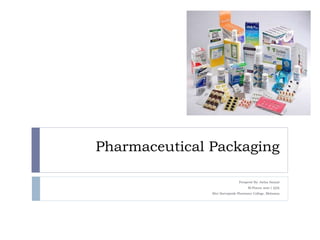
Pharmaceutical Packaging
Preapred By: Astha Sanyal
M.Pharm sem:1 (QA)
Shri Sarvajanik Pharmacy College, Mehsana
Contents
 Definition
 Why packaging development is needed???
 Ideal packaging requirements
 Functions of packaging
 Types of packaging
 Types of packaging material
 Closures
 symbols used on packages and labels
 defects in packaging
Definition
 Packaging: Packing consists of enclosing an
individual item or several items, in a container,
usually for shipment or delivery.
 Pharmaceutical Packaging: P’ceutical packaging
means the combination of components necessary to
contain, preserve, protect and deliver a safe,
efficacious drug products. Such that at any time
point before expiration date of the drug product, a
safe and efficacious dosage form is available.
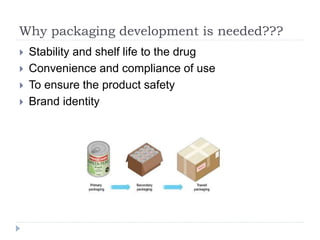
Why packaging development is needed???
 Stability and shelf life to the drug
 Convenience and compliance of use
 To ensure the product safety
 Brand identity
Ideal packaging requirements
 must be protect the preparation from environmental
conditions.
 must not be reactive with the product.
 must not impact to the product tastes or odor.
 must be nontoxic.
 must be FDA approved.
 must meet applicable tamper-resistance
requirements.
 must not be the cause of product degradation.
 must be adaptable to commonly employed high
speed packaging equipment.
Functions of packaging
 Product Identifications
 Product protection
 Facilitating the use of products
 Product promotion
 Marketing
 Convenience
 Barrier protection
 Security
 Information transmission
Types of packaging
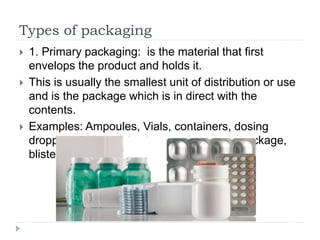
 1. Primary packaging: is the material that first
envelops the product and holds it.
 This is usually the smallest unit of distribution or use
and is the package which is in direct with the
contents.
 Examples: Ampoules, Vials, containers, dosing
dropper, closures(plastic, metal), syringe package,
blister packaging
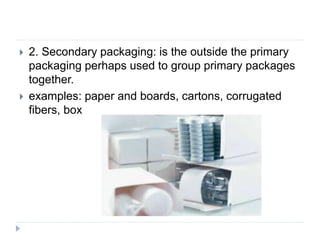
 2. Secondary packaging: is the outside the primary
packaging perhaps used to group primary packages
together.
 examples: paper and boards, cartons, corrugated
fibers, box
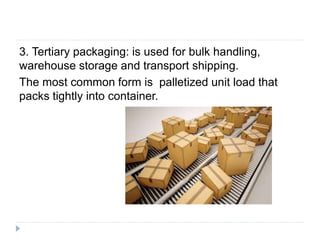
3. Tertiary packaging: is used for bulk handling,
warehouse storage and transport shipping.
The most common form is palletized unit load that
packs tightly into container.
Types of packaging material
 Glass
 Metals
 Rubbers
 Plastics
 Fibrous material
 Films, Foil and laminates
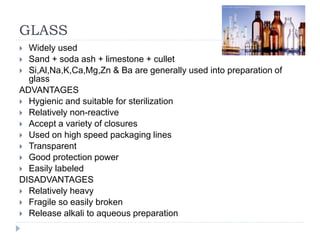
GLASS
 Widely used
 Sand + soda ash + limestone + cullet
 Si,Al,Na,K,Ca,Mg,Zn & Ba are generally used into preparation of
glass
ADVANTAGES
 Hygienic and suitable for sterilization
 Relatively non-reactive
 Accept a variety of closures
 Used on high speed packaging lines
 Transparent
 Good protection power
 Easily labeled
DISADVANTAGES
 Relatively heavy
 Fragile so easily broken
 Release alkali to aqueous preparation
Types of glasses
 Type I (Neutral or Borosilicate glass)
 Type II (Treated soda lime glass)
 Type III (Soda lime glass)
 Type IV (General purpose soda lime glass)
Type I:
 Least reactive
 Higher ingredients and processing cost therefore
used for more senstive p’ceutical products such as
parenteral or blood products
 Mostly ampoules and vials are made up of Type I
glass
Type II:
 Higher chemical resistance but not as much as type I
 Cheaper than Type I
 Acceptable for most products accept blood products
and aqueous pharmaceutical with pH less than 7.
Type III and Type IV Glass
 Have a similar composition and are distinguished
from each other on the basis of Hydraulic
Resistance
 Type III has average or slight better then average
resistance and is suitable for non-aqueous
parenteral products.
Normally dry sterilized before being filled
 Type IV has lowest hydraulic resistance and is
suitable for solid products, some liquids and semi
solids and not for parenteral
METALS
 Used for the medicinal products for non-parenteral
administration
 Metal is strong,opaque,impermiable to
moisture,gases, odors, light, bacteria, and
shetterproof, it is the ideal packaging material for
pressurized containers
 Resistant to high and low temperature
 They include tubes, packs made from foil or
blisters,cans and aerosol and gas cylinders
ALUMINIUM
 Relatively light yet strong
 Barriers to light and chemicals
 Impermeable
 Easy to work into a variety of formats , depending on its
thickness
 Thickest aluminium-rigid containers such as aerosol cans
 Intermediate thickness are when mechanical integrity is
important but the pack should be capable of being reformed
under a reasonable force.
 Thinnest aluminium is used in flexible foil that are usually a
component of laminated packaging material
Disadvantage
 Reactivity in raw state
 Corrosion-To overcome this problem, Aluminium is lined with
epoxide, vinyl or phenolic resins
RUBBERS (Elastomers)
 Excellent material for forming seals, used to form closures such as
bugs for vials
 Categories of rubbers
 NATURAL RUBBER
 Suitable for multiple use closures for injectable products
 Disadvantages it doesn’t well tolerate multiple autoclaving becoming
brittle.
 Risk of product absorbing on or into a rubber.
 It has certain degree of moisture & gas permeation.
 SYNTHETIC RUBBER
 Experience less sorption product ingredients.
 E.g. silicone, butyl, Bromobutyl, Chlorbutyl etc.
 Silicone is least reactive but it dose experience permeability to
moisture and gas
Plastics
 According to the British standards institutes plastics represents:
“ A wide range of solid composite materials which are largely organic, usually
based upon synthetic resins or upon modified polymers of natural origin and
possessing appreciable mechanical strength. At a suitable stage in their
manufacturing, most plastics can be cast, molded or polymerized directly into
shape.”
CLASSES OF PLASTICS
Two classes of plastics, reflecting the behavior with respect to individual or
repeated exposure to heating or cooling
1. THERMOPLASTICS:
Capable of being shaped after initial heating and solidifying by cooling .
Resistance to breakage and cheap to produce
Eg. Polystyrene, polyethylene and PVC
2. THERMOSETS:
They need heat for the processing into a permanent shape.
During heating such a material form permanent crosslinks between the linear
chains, resulting in a solidification and loss of plastic flow
Eg. Phenolic, urea and melamine
 USES:
Used for many types of pack including:
rigid bottles for tablets and capsules, squeezable bottles for eye
drops and nasal spray, jars, flexible tubes and strip and blister
pack
 ADVANTAGES:
 Least expensive than glasses
 Ease of transportation
 No risk of breakage
 Flexible
 Light in weight
DISADVANTAGES:
 Not as chemically inert as Type-I glass
 Not as impermeable to gas and vapor as glass
 May possess an electrostatic charge which will attract particles
TYPES OF PLASTICS
1. POLYETHYLENE
 used as high and low density polyethylene
 LOW DENSITY POLYETHYLENE(LDPE): preferred
plastics for the squeeze bottles.
 Properties: ease of processing, barrier to moisture,
strength/toughness, flexibility, ease of sealing
 HIGH DENSITY POLYETHYLENE(HDPE): less
permeable to gases and more resistance to oils,
chemicals and solvents
 Properties: stiffness, strength/toughness, resistance to
chemicals.
 Widely used for solid dosage form
 Drawback: prone to stress cracking in the presence of
surfactants or vegetable or mineral oils.
 POLYSTYRENE
 Versatile, Insulation, Clarity, Easily foamed(“Styrofoam”)
 Used for the jars for ointment and creams with low water
content
 Drawback: chemicals like isopropyl myristate produce crazing
(a fine network of the surface crack) followed by weakening
and eventually collapsible of the container
 POLYVINYL CHLORIDE
 Versatility, ease of blending strength/toughness, resistance to
grease/oil , resistance to chemicals, clarity
 Used as rigid packaging material and main component of
intravenous bags
 Drawback: poor impact resistance which can be improved by
adding elastomers to the plastics but it will increase its
permeability
 POLYVINYLEDENE CHOLRIDE
 Excellent better properties against: moisture, water
vapor, UV light, aroma, inorganic acids, aqueous salt
solutions, organic water soluble acid, aliphatic
hydrocarbons, eater of long chain fatty acid, detergent
based materials, emulsifying agents and wetting agents
 Good thermoform ability
 PVDC is very cost-effective, as coating weight can be
customized depending on the requirement of the barrier
properties.
 Medical grade and non-toxic
 High levels of transparency which improve the aesthetics
of products
FIBROUS MATERIALS
 Important part of p’ceutical packaging
 Fibrous material includes: papers, labels, cartons,
bags, outers, trays for shrink wraps, layer boards, on
pallets, etc
 Applications and advantages of cartons
 Increases display area
 Provides a better stacking for display of stock items
 Assembles leaflets
 Provides physical protection especially to items like
metal collapsible tubes
 Fiberboard outers either as solid or corrugated board
also fine substantial application for bulk shipments
FILMS, FOILS & LAMINATES
 Regenerated cellulose film based on viscose(chemical used
for manufacturing of rayon) & laminating two or more types of
films, cellulose coating, foil and paper play diff roles such as
supportive, barrier, heat seal and decorative
 Uses of films, foils, laminates:
 Strip packs
 Blister packs
 Sachets
 Diaphargm seal for bottles
 Liners for boxes either attached or loose bag-in-box systems &
bags
 FOIL BLISTERS: when sealed with metal foil-over, the blister
can provide a hermetic pack i.e an isolated system which
excludes any exchange of gases between the product and
surrounding atmosphere
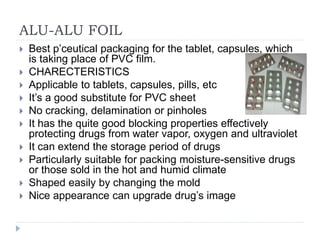
ALU-ALU FOIL
 Best p’ceutical packaging for the tablet, capsules, which
is taking place of PVC film.
 CHARECTERISTICS
 Applicable to tablets, capsules, pills, etc
 It’s a good substitute for PVC sheet
 No cracking, delamination or pinholes
 It has the quite good blocking properties effectively
protecting drugs from water vapor, oxygen and ultraviolet
 It can extend the storage period of drugs
 Particularly suitable for packing moisture-sensitive drugs
or those sold in the hot and humid climate
 Shaped easily by changing the mold
 Nice appearance can upgrade drug’s image
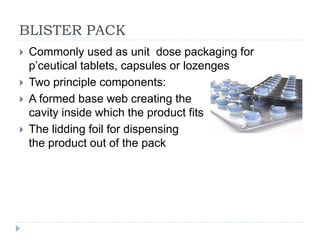
BLISTER PACK
 Commonly used as unit dose packaging for
p’ceutical tablets, capsules or lozenges
 Two principle components:
 A formed base web creating the
cavity inside which the product fits
 The lidding foil for dispensing
the product out of the pack
CAVITY TYPES
1. THERMOFORMING
 A plastic film or sheet is unwound from the reel and
guided through a pre-heating station on the blister
line
 The temperature of the pre-heating plates (upper
and lower) is such a that the plastics will soften and
become moldable
 COLD FORMING
 An aluminum based laminate film is simply pressed
into a mold by means of stamp
 The aluminum will be elongated and maintain the
formed shape
 Advantages: near complete barrier for water and
oxygen, allowing an extended product expiry date
 Disadvantages: slow speed of production compared
to thermoforming an lack of transparency of the
package and larger size of blister card
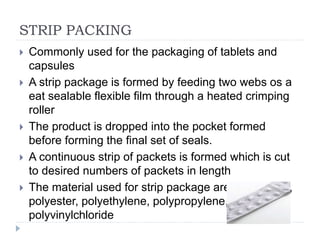
STRIP PACKING
 Commonly used for the packaging of tablets and
capsules
 A strip package is formed by feeding two webs os a
eat sealable flexible film through a heated crimping
roller
 The product is dropped into the pocket formed
before forming the final set of seals.
 A continuous strip of packets is formed which is cut
to desired numbers of packets in length
 The material used for strip package are cellophane,
polyester, polyethylene, polypropylene,
polyvinylchloride
CLOSURES
 Closures are the devices by means of which container can be
opened and closed
 Proper closing of the container is necessary because
1. It prevents loss of material by spilling or volatilization
2. It avoid the contamination of the products from dirt,
microorganisms or insects
3. It prevents deterioration of the product from the effect of the
environment such as moisture, oxygen or carbon dioxide
 Materials used for closures are:
 Cork
 Glass
 Plastics
 Metal
 Rubber
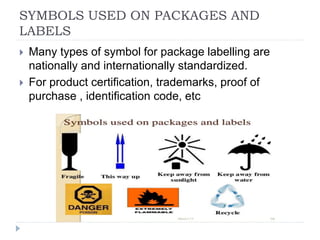
SYMBOLS USED ON PACKAGES AND
LABELS
 Many types of symbol for package labelling are
nationally and internationally standardized.
 For product certification, trademarks, proof of
purchase , identification code, etc
DEFECTS IN PACKAGING
 Inclusion of product or foreign material in seal area
 Misplaced lids/ tops/ closures or crimp seals
 Holes or crack in empty vials/ ampoules
 Invisible defects/leaks
 Color defects in primary packaging

Pharmaceutical packaging

  • 1.
    Pharmaceutical Packaging Preapred By:Astha Sanyal M.Pharm sem:1 (QA) Shri Sarvajanik Pharmacy College, Mehsana
  • 2.
    Contents  Definition  Whypackaging development is needed???  Ideal packaging requirements  Functions of packaging  Types of packaging  Types of packaging material  Closures  symbols used on packages and labels  defects in packaging
  • 3.
    Definition  Packaging: Packingconsists of enclosing an individual item or several items, in a container, usually for shipment or delivery.  Pharmaceutical Packaging: P’ceutical packaging means the combination of components necessary to contain, preserve, protect and deliver a safe, efficacious drug products. Such that at any time point before expiration date of the drug product, a safe and efficacious dosage form is available.
  • 4.
    Why packaging developmentis needed???  Stability and shelf life to the drug  Convenience and compliance of use  To ensure the product safety  Brand identity
  • 5.
    Ideal packaging requirements must be protect the preparation from environmental conditions.  must not be reactive with the product.  must not impact to the product tastes or odor.  must be nontoxic.  must be FDA approved.  must meet applicable tamper-resistance requirements.  must not be the cause of product degradation.  must be adaptable to commonly employed high speed packaging equipment.
  • 6.
    Functions of packaging Product Identifications  Product protection  Facilitating the use of products  Product promotion  Marketing  Convenience  Barrier protection  Security  Information transmission
  • 7.
    Types of packaging 1. Primary packaging: is the material that first envelops the product and holds it.  This is usually the smallest unit of distribution or use and is the package which is in direct with the contents.  Examples: Ampoules, Vials, containers, dosing dropper, closures(plastic, metal), syringe package, blister packaging
  • 8.
     2. Secondarypackaging: is the outside the primary packaging perhaps used to group primary packages together.  examples: paper and boards, cartons, corrugated fibers, box
  • 9.
    3. Tertiary packaging:is used for bulk handling, warehouse storage and transport shipping. The most common form is palletized unit load that packs tightly into container.
  • 10.
    Types of packagingmaterial  Glass  Metals  Rubbers  Plastics  Fibrous material  Films, Foil and laminates
  • 11.
    GLASS  Widely used Sand + soda ash + limestone + cullet  Si,Al,Na,K,Ca,Mg,Zn & Ba are generally used into preparation of glass ADVANTAGES  Hygienic and suitable for sterilization  Relatively non-reactive  Accept a variety of closures  Used on high speed packaging lines  Transparent  Good protection power  Easily labeled DISADVANTAGES  Relatively heavy  Fragile so easily broken  Release alkali to aqueous preparation
  • 12.
    Types of glasses Type I (Neutral or Borosilicate glass)  Type II (Treated soda lime glass)  Type III (Soda lime glass)  Type IV (General purpose soda lime glass)
  • 13.
    Type I:  Leastreactive  Higher ingredients and processing cost therefore used for more senstive p’ceutical products such as parenteral or blood products  Mostly ampoules and vials are made up of Type I glass Type II:  Higher chemical resistance but not as much as type I  Cheaper than Type I  Acceptable for most products accept blood products and aqueous pharmaceutical with pH less than 7.
  • 14.
    Type III andType IV Glass  Have a similar composition and are distinguished from each other on the basis of Hydraulic Resistance  Type III has average or slight better then average resistance and is suitable for non-aqueous parenteral products. Normally dry sterilized before being filled  Type IV has lowest hydraulic resistance and is suitable for solid products, some liquids and semi solids and not for parenteral
  • 15.
    METALS  Used forthe medicinal products for non-parenteral administration  Metal is strong,opaque,impermiable to moisture,gases, odors, light, bacteria, and shetterproof, it is the ideal packaging material for pressurized containers  Resistant to high and low temperature  They include tubes, packs made from foil or blisters,cans and aerosol and gas cylinders
  • 16.
    ALUMINIUM  Relatively lightyet strong  Barriers to light and chemicals  Impermeable  Easy to work into a variety of formats , depending on its thickness  Thickest aluminium-rigid containers such as aerosol cans  Intermediate thickness are when mechanical integrity is important but the pack should be capable of being reformed under a reasonable force.  Thinnest aluminium is used in flexible foil that are usually a component of laminated packaging material Disadvantage  Reactivity in raw state  Corrosion-To overcome this problem, Aluminium is lined with epoxide, vinyl or phenolic resins
  • 17.
    RUBBERS (Elastomers)  Excellentmaterial for forming seals, used to form closures such as bugs for vials  Categories of rubbers  NATURAL RUBBER  Suitable for multiple use closures for injectable products  Disadvantages it doesn’t well tolerate multiple autoclaving becoming brittle.  Risk of product absorbing on or into a rubber.  It has certain degree of moisture & gas permeation.  SYNTHETIC RUBBER  Experience less sorption product ingredients.  E.g. silicone, butyl, Bromobutyl, Chlorbutyl etc.  Silicone is least reactive but it dose experience permeability to moisture and gas
  • 18.
    Plastics  According tothe British standards institutes plastics represents: “ A wide range of solid composite materials which are largely organic, usually based upon synthetic resins or upon modified polymers of natural origin and possessing appreciable mechanical strength. At a suitable stage in their manufacturing, most plastics can be cast, molded or polymerized directly into shape.” CLASSES OF PLASTICS Two classes of plastics, reflecting the behavior with respect to individual or repeated exposure to heating or cooling 1. THERMOPLASTICS: Capable of being shaped after initial heating and solidifying by cooling . Resistance to breakage and cheap to produce Eg. Polystyrene, polyethylene and PVC 2. THERMOSETS: They need heat for the processing into a permanent shape. During heating such a material form permanent crosslinks between the linear chains, resulting in a solidification and loss of plastic flow Eg. Phenolic, urea and melamine
  • 19.
     USES: Used formany types of pack including: rigid bottles for tablets and capsules, squeezable bottles for eye drops and nasal spray, jars, flexible tubes and strip and blister pack  ADVANTAGES:  Least expensive than glasses  Ease of transportation  No risk of breakage  Flexible  Light in weight DISADVANTAGES:  Not as chemically inert as Type-I glass  Not as impermeable to gas and vapor as glass  May possess an electrostatic charge which will attract particles
  • 20.
    TYPES OF PLASTICS 1.POLYETHYLENE  used as high and low density polyethylene  LOW DENSITY POLYETHYLENE(LDPE): preferred plastics for the squeeze bottles.  Properties: ease of processing, barrier to moisture, strength/toughness, flexibility, ease of sealing  HIGH DENSITY POLYETHYLENE(HDPE): less permeable to gases and more resistance to oils, chemicals and solvents  Properties: stiffness, strength/toughness, resistance to chemicals.  Widely used for solid dosage form  Drawback: prone to stress cracking in the presence of surfactants or vegetable or mineral oils.
  • 21.
     POLYSTYRENE  Versatile,Insulation, Clarity, Easily foamed(“Styrofoam”)  Used for the jars for ointment and creams with low water content  Drawback: chemicals like isopropyl myristate produce crazing (a fine network of the surface crack) followed by weakening and eventually collapsible of the container  POLYVINYL CHLORIDE  Versatility, ease of blending strength/toughness, resistance to grease/oil , resistance to chemicals, clarity  Used as rigid packaging material and main component of intravenous bags  Drawback: poor impact resistance which can be improved by adding elastomers to the plastics but it will increase its permeability
  • 22.
     POLYVINYLEDENE CHOLRIDE Excellent better properties against: moisture, water vapor, UV light, aroma, inorganic acids, aqueous salt solutions, organic water soluble acid, aliphatic hydrocarbons, eater of long chain fatty acid, detergent based materials, emulsifying agents and wetting agents  Good thermoform ability  PVDC is very cost-effective, as coating weight can be customized depending on the requirement of the barrier properties.  Medical grade and non-toxic  High levels of transparency which improve the aesthetics of products
  • 23.
    FIBROUS MATERIALS  Importantpart of p’ceutical packaging  Fibrous material includes: papers, labels, cartons, bags, outers, trays for shrink wraps, layer boards, on pallets, etc  Applications and advantages of cartons  Increases display area  Provides a better stacking for display of stock items  Assembles leaflets  Provides physical protection especially to items like metal collapsible tubes  Fiberboard outers either as solid or corrugated board also fine substantial application for bulk shipments
  • 24.
    FILMS, FOILS &LAMINATES  Regenerated cellulose film based on viscose(chemical used for manufacturing of rayon) & laminating two or more types of films, cellulose coating, foil and paper play diff roles such as supportive, barrier, heat seal and decorative  Uses of films, foils, laminates:  Strip packs  Blister packs  Sachets  Diaphargm seal for bottles  Liners for boxes either attached or loose bag-in-box systems & bags  FOIL BLISTERS: when sealed with metal foil-over, the blister can provide a hermetic pack i.e an isolated system which excludes any exchange of gases between the product and surrounding atmosphere
  • 25.
    ALU-ALU FOIL  Bestp’ceutical packaging for the tablet, capsules, which is taking place of PVC film.  CHARECTERISTICS  Applicable to tablets, capsules, pills, etc  It’s a good substitute for PVC sheet  No cracking, delamination or pinholes  It has the quite good blocking properties effectively protecting drugs from water vapor, oxygen and ultraviolet  It can extend the storage period of drugs  Particularly suitable for packing moisture-sensitive drugs or those sold in the hot and humid climate  Shaped easily by changing the mold  Nice appearance can upgrade drug’s image
  • 26.
    BLISTER PACK  Commonlyused as unit dose packaging for p’ceutical tablets, capsules or lozenges  Two principle components:  A formed base web creating the cavity inside which the product fits  The lidding foil for dispensing the product out of the pack
  • 27.
    CAVITY TYPES 1. THERMOFORMING A plastic film or sheet is unwound from the reel and guided through a pre-heating station on the blister line  The temperature of the pre-heating plates (upper and lower) is such a that the plastics will soften and become moldable
  • 28.
     COLD FORMING An aluminum based laminate film is simply pressed into a mold by means of stamp  The aluminum will be elongated and maintain the formed shape  Advantages: near complete barrier for water and oxygen, allowing an extended product expiry date  Disadvantages: slow speed of production compared to thermoforming an lack of transparency of the package and larger size of blister card
  • 29.
    STRIP PACKING  Commonlyused for the packaging of tablets and capsules  A strip package is formed by feeding two webs os a eat sealable flexible film through a heated crimping roller  The product is dropped into the pocket formed before forming the final set of seals.  A continuous strip of packets is formed which is cut to desired numbers of packets in length  The material used for strip package are cellophane, polyester, polyethylene, polypropylene, polyvinylchloride
  • 30.
    CLOSURES  Closures arethe devices by means of which container can be opened and closed  Proper closing of the container is necessary because 1. It prevents loss of material by spilling or volatilization 2. It avoid the contamination of the products from dirt, microorganisms or insects 3. It prevents deterioration of the product from the effect of the environment such as moisture, oxygen or carbon dioxide  Materials used for closures are:  Cork  Glass  Plastics  Metal  Rubber
  • 31.
    SYMBOLS USED ONPACKAGES AND LABELS  Many types of symbol for package labelling are nationally and internationally standardized.  For product certification, trademarks, proof of purchase , identification code, etc
  • 32.
    DEFECTS IN PACKAGING Inclusion of product or foreign material in seal area  Misplaced lids/ tops/ closures or crimp seals  Holes or crack in empty vials/ ampoules  Invisible defects/leaks  Color defects in primary packaging