Closures & Closure Liners
Presented By :-
Jitendra K. Sonawane
M.Pharm (QA)
Guided By:-
Dr. G. B. Patil
Dept. of Pharmaceutics
H. R. Patel Institute of Pharmaceutical
Education and Research, Shirpur
1) Closure
2) Function of a closure
3) Characteristics of closure
4) Types of closures
5) Closure lines
6) Factors in selecting a liner
7) Composition of closure
8) Quality control of container-closures
Contents
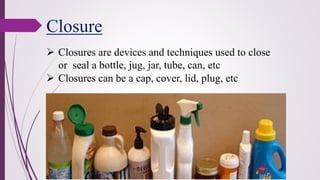
➢ Closures are devices and techniques used to close
or seal a bottle, jug, jar, tube, can, etc
➢ Closures can be a cap, cover, lid, plug, etc
Closure
➢ The closure is normally the most vulnerable and
critical component of a container
➢ An effective closure must prevent the contents from
escaping and allow no substance to enter the
container
1. Provide a totally hermetic seal
2. Provide an effective seal which is acceptable to
the products
3. Provide an effective microbiological seal
Function of a closure
a) It should be resistant and compatible with the
product.
b) If closure is of re-closable type, it should be readily
operable and should be re-sealed effectively.
c) It should be capable of high speed application.
d) It should be decorative and of a shape that blends
with the main containers
Characteristics of Closure
Closures are available in five basic designs:-
1. Screw-on, Threaded, or lug
2. Crimp-on (crowns)
3. Press-on (snap)
4. Roll-on
5. Friction.
Types of Closures
Many variations of these basic types exist,
including
A. Tamperproof.
B. Child resistant.
C. Dispenser applicators
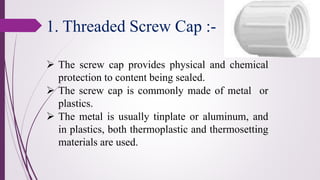
➢ The screw cap provides physical and chemical
protection to content being sealed.
➢ The screw cap is commonly made of metal or
plastics.
➢ The metal is usually tinplate or aluminum, and
in plastics, both thermoplastic and thermosetting
materials are used.
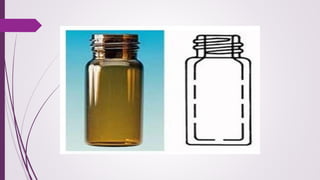
1. Threaded Screw Cap :-
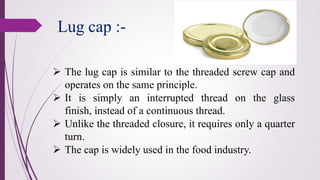
➢ The lug cap is similar to the threaded screw cap and
operates on the same principle.
➢ It is simply an interrupted thread on the glass
finish, instead of a continuous thread.
➢ Unlike the threaded closure, it requires only a quarter
turn.
➢ The cap is widely used in the food industry.
Lug cap :-
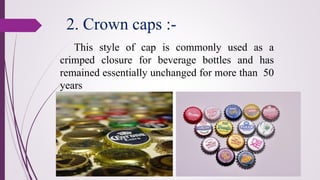
This style of cap is commonly used as a
crimped closure for beverage bottles and has
remained essentially unchanged for more than 50
years
2. Crown caps :-
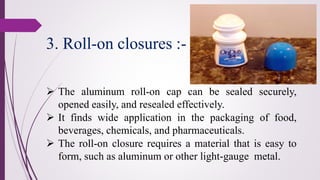
➢ The aluminum roll-on cap can be sealed securely,
opened easily, and resealed effectively.
➢ It finds wide application in the packaging of food,
beverages, chemicals, and pharmaceuticals.
➢ The roll-on closure requires a material that is easy to
form, such as aluminum or other light-gauge metal.
3. Roll-on closures :-
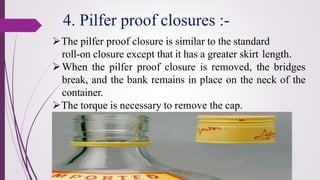
➢The pilfer proof closure is similar to the standard
roll-on closure except that it has a greater skirt length.
➢When the pilfer proof closure is removed, the bridges
break, and the bank remains in place on the neck of the
container.
➢The torque is necessary to remove the cap.
4. Pilfer proof closures :-
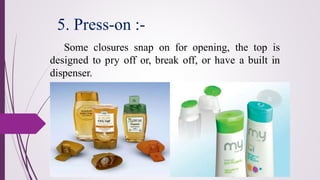
Some closures snap on for opening, the top is
designed to pry off or, break off, or have a built in
dispenser.
5. Press-on :-
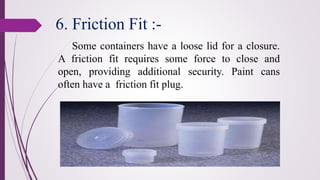
6. Friction Fit :-
Some containers have a loose lid for a closure.
A friction fit requires some force to close and
open, providing additional security. Paint cans
often have a friction fit plug.
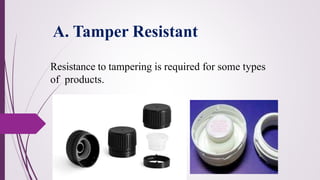
Resistance to tampering is required for some types
of products.
A. Tamper Resistant
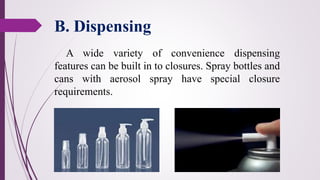
B. Dispensing
A wide variety of convenience dispensing
features can be built in to closures. Spray bottles and
cans with aerosol spray have special closure
requirements.
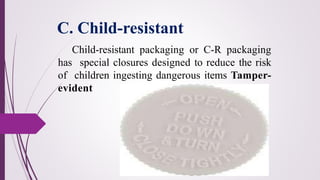
Child-resistant packaging or C-R packaging
has special closures designed to reduce the risk
of children ingesting dangerous items Tamper-
evident
C. Child-resistant
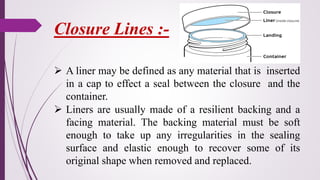
➢ A liner may be defined as any material that is inserted
in a cap to effect a seal between the closure and the
container.
➢ Liners are usually made of a resilient backing and a
facing material. The backing material must be soft
enough to take up any irregularities in the sealing
surface and elastic enough to recover some of its
original shape when removed and replaced.
Closure Lines :-
✓ The most important consideration is that the
liner should be chemically inert with its
product.
✓ Gas and vapour transmission rates are usually
relative and depend chiefly on the shelf life
required for the product.
Factors in Selecting a Liner
1. Homogenous Liner:-
These one piece liners are available as a disk or as a
ring of rubber and plastic.
➢ Expensive
➢ Complicated to apply
➢ Widely used in pharmaceuticals
➢ Uniform properties
➢ Can withstand high-temperature sterilization
2) Heterogenous liner or composite
liner:-
They are composed of layers of different materials.
It consists of two parts
a) Facing
b) backing
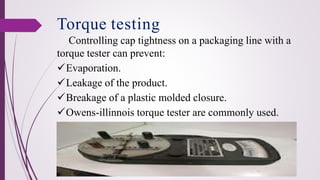
Controlling cap tightness on a packaging line with a
torque tester can prevent:
✓Evaporation.
✓Leakage of the product.
✓Breakage of a plastic molded closure.
✓Owens-illinnois torque tester are commonly used.
Torque testing
Closures are made of :-
✓ Plastic
✓ Rubber
✓ Glass
✓ Metal
✓ Cork
Composition of Closure
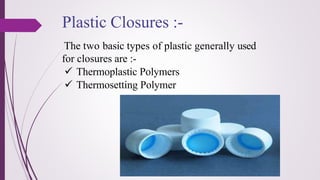
The two basic types of plastic generally used
for closures are :-
✓ Thermoplastic Polymers
✓ Thermosetting Polymer
Plastic Closures :-
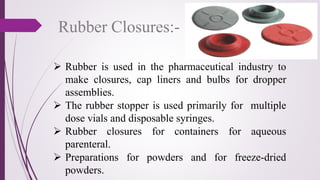
➢ Rubber is used in the pharmaceutical industry to
make closures, cap liners and bulbs for dropper
assemblies.
➢ The rubber stopper is used primarily for multiple
dose vials and disposable syringes.
➢ Rubber closures for containers for aqueous
parenteral.
➢ Preparations for powders and for freeze-dried
powders.
Rubber Closures:-
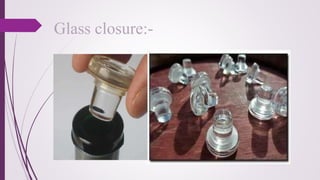
Glass closure:-
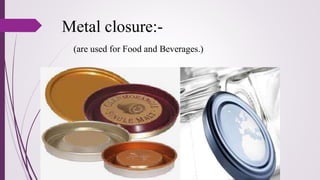
Metal closure:-
(are used for Food and Beverages.)
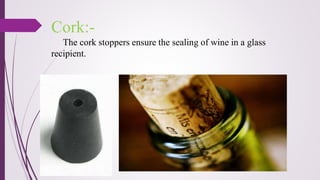
Cork:-
The cork stoppers ensure the sealing of wine in a glass
recipient.
A number of quality control checks are required for the
manufacture and release of container-closures.
These include:
a)After the material has been mixed
b)Post-compression and molding
c)Washing process
d)Post-washing and post-siliconization
e)Packaging After packaging
f)Sterilization
Quality Control of Container-Closures:-
a) After the material has been mixed
➢ Specific gravity
➢ Color
➢ Dispersion in relation to particle size
➢ Hardness
b)Post-compression and molding
➢Here the material is checked for rubber
thickness.
c)Washing process
During the loading of stoppers into a washer, the
quality of the water should be checked for
bioburden and endotoxin (using compendial
methods).
d) Post-washing and post-siliconization
After the stoppers have been washed, a number of quality
control checks should be performed. These include:
❖ Mechanical and Material Tests :-
i. Compression set
ii. Hardness
iii. Fragmentation
iv. Penetrability (what happens when a neddle passes
through the stopper?
v. Assessment of dimension and flexibility
A. Physical Tests
• Resistance to sterilization
• Particle testing
B. Chemical Tests
Tests for extractables and leachables:
➢ Extractables are chemical substances that are
obtained by exposing the packaging to a variety
of solvents under exaggerated incubation
conditions of time and temperature.
➢ Leachables differ from extractables in that they are
chemical substances that migrate under normal
conditions of use from the stopper into a drug
product.
❖Silicone oil determination:
The effect of subvisible silicone particles should be
assessed, for these can cause aggregation with proteins,
and the new complex can potentially trigger an
immunochemical reaction within the body of the patient
receiving the drug,
• Cytological testing
• Bioburden assessment
Some manufacturers undertake an examination for
mesophilic counts whilst others focus on examining for
thermophilic bacteria.
• Bacterial endotoxin testing
The testing of container-closures for endotoxin, using the
Limulus amebocyte lysate (LAL) method.
C. Biological Tests
e)Packaging After packaging
A selection of bags should be examined for tears as
a part of quality control assessment.
f) Sterilization
Container-closures are typically sterilized by one of
two methods: steam sterilization (using autoclaves)
and gamma irradiation.
Closures & closure liners. ppt

Closures & closure liners. ppt

  • 1.
    Closures & ClosureLiners Presented By :- Jitendra K. Sonawane M.Pharm (QA) Guided By:- Dr. G. B. Patil Dept. of Pharmaceutics H. R. Patel Institute of Pharmaceutical Education and Research, Shirpur
  • 2.
    1) Closure 2) Functionof a closure 3) Characteristics of closure 4) Types of closures 5) Closure lines 6) Factors in selecting a liner 7) Composition of closure 8) Quality control of container-closures Contents
  • 3.
    ➢ Closures aredevices and techniques used to close or seal a bottle, jug, jar, tube, can, etc ➢ Closures can be a cap, cover, lid, plug, etc Closure
  • 4.
    ➢ The closureis normally the most vulnerable and critical component of a container ➢ An effective closure must prevent the contents from escaping and allow no substance to enter the container
  • 5.
    1. Provide atotally hermetic seal 2. Provide an effective seal which is acceptable to the products 3. Provide an effective microbiological seal Function of a closure
  • 6.
    a) It shouldbe resistant and compatible with the product. b) If closure is of re-closable type, it should be readily operable and should be re-sealed effectively. c) It should be capable of high speed application. d) It should be decorative and of a shape that blends with the main containers Characteristics of Closure
  • 7.
    Closures are availablein five basic designs:- 1. Screw-on, Threaded, or lug 2. Crimp-on (crowns) 3. Press-on (snap) 4. Roll-on 5. Friction. Types of Closures
  • 8.
    Many variations ofthese basic types exist, including A. Tamperproof. B. Child resistant. C. Dispenser applicators
  • 9.
    ➢ The screwcap provides physical and chemical protection to content being sealed. ➢ The screw cap is commonly made of metal or plastics. ➢ The metal is usually tinplate or aluminum, and in plastics, both thermoplastic and thermosetting materials are used. 1. Threaded Screw Cap :-
  • 11.
    ➢ The lugcap is similar to the threaded screw cap and operates on the same principle. ➢ It is simply an interrupted thread on the glass finish, instead of a continuous thread. ➢ Unlike the threaded closure, it requires only a quarter turn. ➢ The cap is widely used in the food industry. Lug cap :-
  • 12.
    This style ofcap is commonly used as a crimped closure for beverage bottles and has remained essentially unchanged for more than 50 years 2. Crown caps :-
  • 13.
    ➢ The aluminumroll-on cap can be sealed securely, opened easily, and resealed effectively. ➢ It finds wide application in the packaging of food, beverages, chemicals, and pharmaceuticals. ➢ The roll-on closure requires a material that is easy to form, such as aluminum or other light-gauge metal. 3. Roll-on closures :-
  • 14.
    ➢The pilfer proofclosure is similar to the standard roll-on closure except that it has a greater skirt length. ➢When the pilfer proof closure is removed, the bridges break, and the bank remains in place on the neck of the container. ➢The torque is necessary to remove the cap. 4. Pilfer proof closures :-
  • 15.
    Some closures snapon for opening, the top is designed to pry off or, break off, or have a built in dispenser. 5. Press-on :-
  • 16.
    6. Friction Fit:- Some containers have a loose lid for a closure. A friction fit requires some force to close and open, providing additional security. Paint cans often have a friction fit plug.
  • 17.
    Resistance to tamperingis required for some types of products. A. Tamper Resistant
  • 18.
    B. Dispensing A widevariety of convenience dispensing features can be built in to closures. Spray bottles and cans with aerosol spray have special closure requirements.
  • 19.
    Child-resistant packaging orC-R packaging has special closures designed to reduce the risk of children ingesting dangerous items Tamper- evident C. Child-resistant
  • 20.
    ➢ A linermay be defined as any material that is inserted in a cap to effect a seal between the closure and the container. ➢ Liners are usually made of a resilient backing and a facing material. The backing material must be soft enough to take up any irregularities in the sealing surface and elastic enough to recover some of its original shape when removed and replaced. Closure Lines :-
  • 21.
    ✓ The mostimportant consideration is that the liner should be chemically inert with its product. ✓ Gas and vapour transmission rates are usually relative and depend chiefly on the shelf life required for the product. Factors in Selecting a Liner
  • 22.
    1. Homogenous Liner:- Theseone piece liners are available as a disk or as a ring of rubber and plastic. ➢ Expensive ➢ Complicated to apply ➢ Widely used in pharmaceuticals ➢ Uniform properties ➢ Can withstand high-temperature sterilization
  • 23.
    2) Heterogenous lineror composite liner:- They are composed of layers of different materials. It consists of two parts a) Facing b) backing
  • 24.
    Controlling cap tightnesson a packaging line with a torque tester can prevent: ✓Evaporation. ✓Leakage of the product. ✓Breakage of a plastic molded closure. ✓Owens-illinnois torque tester are commonly used. Torque testing
  • 25.
    Closures are madeof :- ✓ Plastic ✓ Rubber ✓ Glass ✓ Metal ✓ Cork Composition of Closure
  • 26.
    The two basictypes of plastic generally used for closures are :- ✓ Thermoplastic Polymers ✓ Thermosetting Polymer Plastic Closures :-
  • 27.
    ➢ Rubber isused in the pharmaceutical industry to make closures, cap liners and bulbs for dropper assemblies. ➢ The rubber stopper is used primarily for multiple dose vials and disposable syringes. ➢ Rubber closures for containers for aqueous parenteral. ➢ Preparations for powders and for freeze-dried powders. Rubber Closures:-
  • 28.
  • 29.
    Metal closure:- (are usedfor Food and Beverages.)
  • 30.
    Cork:- The cork stoppersensure the sealing of wine in a glass recipient.
  • 31.
    A number ofquality control checks are required for the manufacture and release of container-closures. These include: a)After the material has been mixed b)Post-compression and molding c)Washing process d)Post-washing and post-siliconization e)Packaging After packaging f)Sterilization Quality Control of Container-Closures:-
  • 32.
    a) After thematerial has been mixed ➢ Specific gravity ➢ Color ➢ Dispersion in relation to particle size ➢ Hardness b)Post-compression and molding ➢Here the material is checked for rubber thickness.
  • 33.
    c)Washing process During theloading of stoppers into a washer, the quality of the water should be checked for bioburden and endotoxin (using compendial methods).
  • 34.
    d) Post-washing andpost-siliconization After the stoppers have been washed, a number of quality control checks should be performed. These include: ❖ Mechanical and Material Tests :- i. Compression set ii. Hardness iii. Fragmentation iv. Penetrability (what happens when a neddle passes through the stopper? v. Assessment of dimension and flexibility
  • 35.
    A. Physical Tests •Resistance to sterilization • Particle testing B. Chemical Tests Tests for extractables and leachables: ➢ Extractables are chemical substances that are obtained by exposing the packaging to a variety of solvents under exaggerated incubation conditions of time and temperature.
  • 36.
    ➢ Leachables differfrom extractables in that they are chemical substances that migrate under normal conditions of use from the stopper into a drug product. ❖Silicone oil determination: The effect of subvisible silicone particles should be assessed, for these can cause aggregation with proteins, and the new complex can potentially trigger an immunochemical reaction within the body of the patient receiving the drug,
  • 37.
    • Cytological testing •Bioburden assessment Some manufacturers undertake an examination for mesophilic counts whilst others focus on examining for thermophilic bacteria. • Bacterial endotoxin testing The testing of container-closures for endotoxin, using the Limulus amebocyte lysate (LAL) method. C. Biological Tests
  • 38.
    e)Packaging After packaging Aselection of bags should be examined for tears as a part of quality control assessment. f) Sterilization Container-closures are typically sterilized by one of two methods: steam sterilization (using autoclaves) and gamma irradiation.