Pharmaceutical Packaging 
WWW.MYPHARMAGUIDE.COM
Contents 
 Introduction 
 Types of packaging systems 
 Criteria for the selection of package type and package material 
 Packaging evaluation 
 Dosage forms and package forms 
 Containers: Glass, Plastic, Metal 
 Paper and board 
 Films, foils and laminates 
 Rubber components 
 Cotton 
 Adhesives and Inks 
 Closures 
 Special type of delivery devices: Aerosols, Transdermals 
 Packaging of Medical / Surgical Devices 
 Economic Aspects 
 Study Questions 
 References
Introduction 
DEFINITION: 
 Packing: “Packing consists of enclosing an individual 
item, or several items, in a container, usually for shipment 
or delivery. This operation iiss mmoossttllyy ddoonnee bbyy hhaanndd aanndd 
machine.” 
 Pharmaceutical Packaging: “Pharmaceutical packaging 
means the combination of components necessary to 
contain, preserve, protect  deliver a safe, efficacious 
drug product, such that at any time point before 
expiration date of the drug product, a safe  efficacious 
dosage form is available.
Types of Packaging 
Systems 
 Primary package system: Made 
up of those package components 
 subcomponents that come into 
direct contact wwiitthh tthhee pprroodduucctt,, oorr 
those that may have a direct effect 
on the product shelf life. 
 Secondary or tertiary package 
system: Includes cartons, 
corrugated shippers  pallets.
Ideal Requirements of 
Pharmaceutical Packaging 
MMaatteerriiaallss
Possible Interactions BBeettwweeeenn 
PPrriimmaarryy PPaacckkaaggiinngg MMaatteerriiaallss aanndd 
tthhee IInncclluuddeedd PPhhaarrmmaacceeuuttiiccaall 
PPrroodduucctt
PPPPaaaacccckkkkaaaaggggiiiinnnngggg EEEEvvvvaaaalllluuuuaaaattttiiiioooonnnn
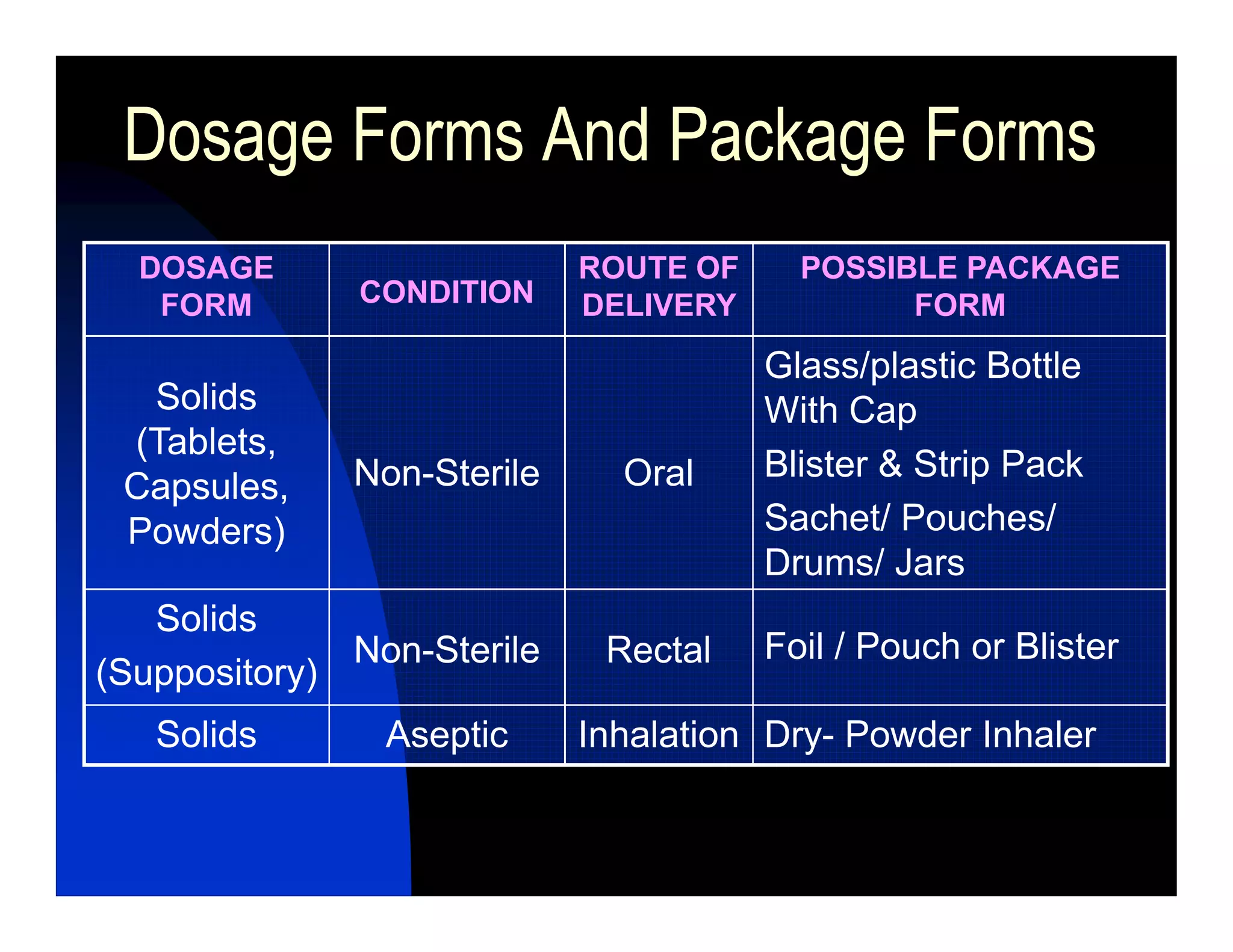
Dosage Forms AAnndd PPaacckkaaggee FFoorrmmss 
DOSAGE 
FORM CONDITION 
ROUTE OF 
DELIVERY 
POSSIBLE PACKAGE 
FORM 
Solids 
(Tablets, 
Capsules, 
Non-Sterile Oral 
Glass/plastic Bottle 
With Cap 
Blister  Strip Pack 
Powders) 
Sachet/ Pouches/ 
Drums/ Jars 
Solids 
(Suppository) 
Non-Sterile Rectal Foil / Pouch or Blister 
Solids Aseptic Inhalation Dry- Powder Inhaler
Liquids Non- 
Sterile 
Oral 
Glass/plastic Bottle With Cap 
Bottle With Spray Pump 
Bottle With Dropper 
Sachet, Pouches 
Drums and Jars 
Liquids Non- 
Sterile 
Topical 
Glass/plastic Bottle With Cap 
Collapsible Tube 
Aerosol Sprays 
Drums and Jars 
Liquids Sterile 
Parenteral 
Ophthalmi-cs 
Glass Ampoules 
Glass / Plastic Vial With Stopper 
Glass / Plastic Vial With Applicator 
Pre-filled Syringe 
Bag 
Form-fill-seal Plastic Container
Ointments/ 
Creams 
Non- 
Sterile 
Topical 
Collapsible Tube 
Pump (High Viscosity 
Dispenser) 
Transdermal Delivery Device 
Glass / Plastic Jar 
Ointments Sterile Ophtha 
lmic 
Collapsible Tube 
Glass / Plastic Bottle With 
Cap 
Form-fill-seal Plastic Bottle 
Glass / Plastic Jar 
Soft Gelatin Capsules
PPaacckkaaggiinngg mmaatteerriiaallss 
 Glass 
 Plastic 
 MMeettaallss:: AAlluummiinnuumm,, SSttaaiinnlleessss SStteeeell 
 Paper and Board 
 Rubber 
 Cotton 
 Closures
Glass containers 
 Advantages 
 DDiissaaddvvaannttaaggeess 
 Types
Plastic containers 
 Commonly used polymers: 
Polyethylene 
Polypropylene 
Poly-vinyl-chloride 
PPoollyyssttyyrreennee 
 Less commonly used polymers: 
Poly-methyl-methacrylate 
Poly-ethylene-terephthalate 
Poly-trifluoro-ethylene 
Amino-formaldehydes 
Polyamides
Plastic containers 
 Advantages 
 Limitations / interactions between 
plastics aanndd ddoossaaggee ffoorrmm 
Permeation 
Leaching 
Sorption 
Chemical reactivity 
Modification
Metal containers 
 Stainless steel 
 Aluminum
Paper and Board 
 Applications / Advantages
Films, Foils and Laminates 
 Materials used for films and foils 
 MMeettaalllliizzaattiioonn 
 Uses of Films, Foils and Laminates
Rubber based components
Examples of Rubber for 
Pharmaceutical product packaging 
 Natural Rubber 
 Neoprene Rubber 
 NNiittrriillee RRuubbbbeerr 
 Butyl Rubber 
 Chloro-butyl Rubber 
 Bromo-butyl Rubber 
 Silicone Rubber
Complex Rubber 
 Vulcanizing agents 
 Accelerators 
 FFiilllleerrss 
 Activators 
 Pigments 
 Anti-oxidants 
 Lubricants 
 Softeners (waxes)
Cotton 
 In solid preparations it is used to 
prevent collision of individual units 
 As desiccant: To prevent 
absorption of moisture ppaarrttiiccuullaarrllyy 
by solid dosage forms like: tablets 
and capsules.
Adhesives and Inks
Closure 
 Ideal characteristics of a closure 
 Functions of a closure
Aerosols
Transdermals
Packaging of Medical / Surgical 
Devices 
 Requirements ooff ppaacckkaaggiinngg 
materials for Medical / Surgical 
Devices
Evaluation Tests carried out for 
medical devices 
 Sterility testing 
 Manual handling 
 VVeehhiiccllee ssttaacckkiinngg 
 Loose-load vibration 
 Drop test 
 Compression 
 Package seal strength testing
Economic Aspects and Outlook 
 Investigator should have a broad 
background in various disciplines 
 New dosage forms, new materials, 
new drug classes
Study questions 
 Define: Packing and Pharmaceutical 
Packaging 
 What are the criteria for the selection of 
materials for pharmaceutical ppaacckkaaggiinngg?? 
 Give details of glass as the packaging 
material 
 What are the specific criteria for the 
packaging of Aerosols, Transdermals 
and Medical Devices?
References 
1. Donald C. Liebe, Packaging of Pharmaceutical Dosage Form, Modern 
Pharmaceutics by G.S.Banker, Marcel Dekker, pp 681-725. 
2. C.P.Croce, A.Fischer  R.L.Thomas, Packaging material Science, The 
theory  Practice of Industrial Pharmacy by Leon Lachman, Third 
eeddiittiioonn,, pppp 771111--773322 
3. Autian. J., J.Pharm.Sci. , 52, 1963, pp 1, 105 
4. D.C.Liebe, Pharmaceutical Packaging, Encyclopedia of 
Pharmaceutical Technology, volume 12, Marcel Dekker, New 
York,1993, pp 1-28 
5. R.P.Abendroth, Glass as a packaging material for pharmaceuticals, 
Encyclopedia of Pharmaceutical Technology, volume 7, Marcel 
Dekker, New York, 1993, pp 79-99
6. S.W.Shalaby  B.L.Williams, Films and sheets for 
packaging, Encyclopedia of Pharmaceutical 
Technology, volume 6, Marcel Dekker, New York,1993, 
pp 29-49 
7. Elastomeric closures for Pharmaceutical packaging 
8. USP 2244,, NNFF 1199,, 22000000.. ppgg 1100.. 
9. Plastic Packaging , Remington: The Science and 
Practice of Pharmacy, 19th edition, Volume II, pp 1487. 
10. M.E.Aulton, Pharmaceutics : The science of dosage 
form design, D.A.Dean- packaging technology, pp. 712- 
725
11. Cooper and Gunn’s Tutorial Pharmacy, sixth edition, pp. 
133-141. 
12. WHO Technical Report Series, no. 902, 2002, Annex 9, 
Guidelines on packaging for Pharmaceutical products, pp 
120-137. 
13. www.ffddaa..ggoovvppaacckkaaggiinngg..hhttmm 
14. http://www.devicelink.com/pmpn/archive/98/08/002.html 
15. Packaging engineering by Louis C. Barail, Reinhold 
Publishing Corporation, U.S.A., 1994. Pages: 1-11, 357- 
364.
16. Medical device packaging handbook, edited by 
Joseph D. O’Brien, 1990, published by Marcel 
Dekker Inc. Pages: 51-220. 
17. Packaging of Pharmaceuticals by C. F. Ross, first 
edition 1975, by Newnes –Butterworths; London.
WWW.MYPHARMAGUIDE.COM

Pharmaceutical packaging

  • 1.
  • 2.
    Contents Introduction Types of packaging systems Criteria for the selection of package type and package material Packaging evaluation Dosage forms and package forms Containers: Glass, Plastic, Metal Paper and board Films, foils and laminates Rubber components Cotton Adhesives and Inks Closures Special type of delivery devices: Aerosols, Transdermals Packaging of Medical / Surgical Devices Economic Aspects Study Questions References
  • 3.
    Introduction DEFINITION: Packing: “Packing consists of enclosing an individual item, or several items, in a container, usually for shipment or delivery. This operation iiss mmoossttllyy ddoonnee bbyy hhaanndd aanndd machine.” Pharmaceutical Packaging: “Pharmaceutical packaging means the combination of components necessary to contain, preserve, protect deliver a safe, efficacious drug product, such that at any time point before expiration date of the drug product, a safe efficacious dosage form is available.
  • 4.
    Types of Packaging Systems Primary package system: Made up of those package components subcomponents that come into direct contact wwiitthh tthhee pprroodduucctt,, oorr those that may have a direct effect on the product shelf life. Secondary or tertiary package system: Includes cartons, corrugated shippers pallets.
  • 5.
    Ideal Requirements of Pharmaceutical Packaging MMaatteerriiaallss
  • 6.
    Possible Interactions BBeettwweeeenn PPrriimmaarryy PPaacckkaaggiinngg MMaatteerriiaallss aanndd tthhee IInncclluuddeedd PPhhaarrmmaacceeuuttiiccaall PPrroodduucctt
  • 7.
  • 8.
    Dosage Forms AAnnddPPaacckkaaggee FFoorrmmss DOSAGE FORM CONDITION ROUTE OF DELIVERY POSSIBLE PACKAGE FORM Solids (Tablets, Capsules, Non-Sterile Oral Glass/plastic Bottle With Cap Blister Strip Pack Powders) Sachet/ Pouches/ Drums/ Jars Solids (Suppository) Non-Sterile Rectal Foil / Pouch or Blister Solids Aseptic Inhalation Dry- Powder Inhaler
  • 9.
    Liquids Non- Sterile Oral Glass/plastic Bottle With Cap Bottle With Spray Pump Bottle With Dropper Sachet, Pouches Drums and Jars Liquids Non- Sterile Topical Glass/plastic Bottle With Cap Collapsible Tube Aerosol Sprays Drums and Jars Liquids Sterile Parenteral Ophthalmi-cs Glass Ampoules Glass / Plastic Vial With Stopper Glass / Plastic Vial With Applicator Pre-filled Syringe Bag Form-fill-seal Plastic Container
  • 10.
    Ointments/ Creams Non- Sterile Topical Collapsible Tube Pump (High Viscosity Dispenser) Transdermal Delivery Device Glass / Plastic Jar Ointments Sterile Ophtha lmic Collapsible Tube Glass / Plastic Bottle With Cap Form-fill-seal Plastic Bottle Glass / Plastic Jar Soft Gelatin Capsules
  • 11.
    PPaacckkaaggiinngg mmaatteerriiaallss Glass Plastic MMeettaallss:: AAlluummiinnuumm,, SSttaaiinnlleessss SStteeeell Paper and Board Rubber Cotton Closures
  • 12.
    Glass containers Advantages DDiissaaddvvaannttaaggeess Types
  • 13.
    Plastic containers Commonly used polymers: Polyethylene Polypropylene Poly-vinyl-chloride PPoollyyssttyyrreennee Less commonly used polymers: Poly-methyl-methacrylate Poly-ethylene-terephthalate Poly-trifluoro-ethylene Amino-formaldehydes Polyamides
  • 14.
    Plastic containers Advantages Limitations / interactions between plastics aanndd ddoossaaggee ffoorrmm Permeation Leaching Sorption Chemical reactivity Modification
  • 15.
    Metal containers Stainless steel Aluminum
  • 16.
    Paper and Board Applications / Advantages
  • 17.
    Films, Foils andLaminates Materials used for films and foils MMeettaalllliizzaattiioonn Uses of Films, Foils and Laminates
  • 18.
  • 19.
    Examples of Rubberfor Pharmaceutical product packaging Natural Rubber Neoprene Rubber NNiittrriillee RRuubbbbeerr Butyl Rubber Chloro-butyl Rubber Bromo-butyl Rubber Silicone Rubber
  • 20.
    Complex Rubber Vulcanizing agents Accelerators FFiilllleerrss Activators Pigments Anti-oxidants Lubricants Softeners (waxes)
  • 21.
    Cotton Insolid preparations it is used to prevent collision of individual units As desiccant: To prevent absorption of moisture ppaarrttiiccuullaarrllyy by solid dosage forms like: tablets and capsules.
  • 22.
  • 23.
    Closure Idealcharacteristics of a closure Functions of a closure
  • 24.
  • 25.
  • 26.
    Packaging of Medical/ Surgical Devices Requirements ooff ppaacckkaaggiinngg materials for Medical / Surgical Devices
  • 27.
    Evaluation Tests carriedout for medical devices Sterility testing Manual handling VVeehhiiccllee ssttaacckkiinngg Loose-load vibration Drop test Compression Package seal strength testing
  • 28.
    Economic Aspects andOutlook Investigator should have a broad background in various disciplines New dosage forms, new materials, new drug classes
  • 29.
    Study questions Define: Packing and Pharmaceutical Packaging What are the criteria for the selection of materials for pharmaceutical ppaacckkaaggiinngg?? Give details of glass as the packaging material What are the specific criteria for the packaging of Aerosols, Transdermals and Medical Devices?
  • 30.
    References 1. DonaldC. Liebe, Packaging of Pharmaceutical Dosage Form, Modern Pharmaceutics by G.S.Banker, Marcel Dekker, pp 681-725. 2. C.P.Croce, A.Fischer R.L.Thomas, Packaging material Science, The theory Practice of Industrial Pharmacy by Leon Lachman, Third eeddiittiioonn,, pppp 771111--773322 3. Autian. J., J.Pharm.Sci. , 52, 1963, pp 1, 105 4. D.C.Liebe, Pharmaceutical Packaging, Encyclopedia of Pharmaceutical Technology, volume 12, Marcel Dekker, New York,1993, pp 1-28 5. R.P.Abendroth, Glass as a packaging material for pharmaceuticals, Encyclopedia of Pharmaceutical Technology, volume 7, Marcel Dekker, New York, 1993, pp 79-99
  • 31.
    6. S.W.Shalaby B.L.Williams, Films and sheets for packaging, Encyclopedia of Pharmaceutical Technology, volume 6, Marcel Dekker, New York,1993, pp 29-49 7. Elastomeric closures for Pharmaceutical packaging 8. USP 2244,, NNFF 1199,, 22000000.. ppgg 1100.. 9. Plastic Packaging , Remington: The Science and Practice of Pharmacy, 19th edition, Volume II, pp 1487. 10. M.E.Aulton, Pharmaceutics : The science of dosage form design, D.A.Dean- packaging technology, pp. 712- 725
  • 32.
    11. Cooper andGunn’s Tutorial Pharmacy, sixth edition, pp. 133-141. 12. WHO Technical Report Series, no. 902, 2002, Annex 9, Guidelines on packaging for Pharmaceutical products, pp 120-137. 13. www.ffddaa..ggoovvppaacckkaaggiinngg..hhttmm 14. http://www.devicelink.com/pmpn/archive/98/08/002.html 15. Packaging engineering by Louis C. Barail, Reinhold Publishing Corporation, U.S.A., 1994. Pages: 1-11, 357- 364.
  • 33.
    16. Medical devicepackaging handbook, edited by Joseph D. O’Brien, 1990, published by Marcel Dekker Inc. Pages: 51-220. 17. Packaging of Pharmaceuticals by C. F. Ross, first edition 1975, by Newnes –Butterworths; London.
  • 34.