PRIMARY AND SECONDARY PACKAGING
PACKAGING Packaging is the science, art and technology of enclosing or protecting products for distribution, storage, sale, and use. It refers to the process of design, evaluation, and production of packages Packaging can be described as a coordinated system of preparing goods for transport, warehousing, logistics, sale, and end use
OBJECTIVES OF PACKAGING Physical protection Barrier protection Containment or agglomeration Security Convenience Portion control
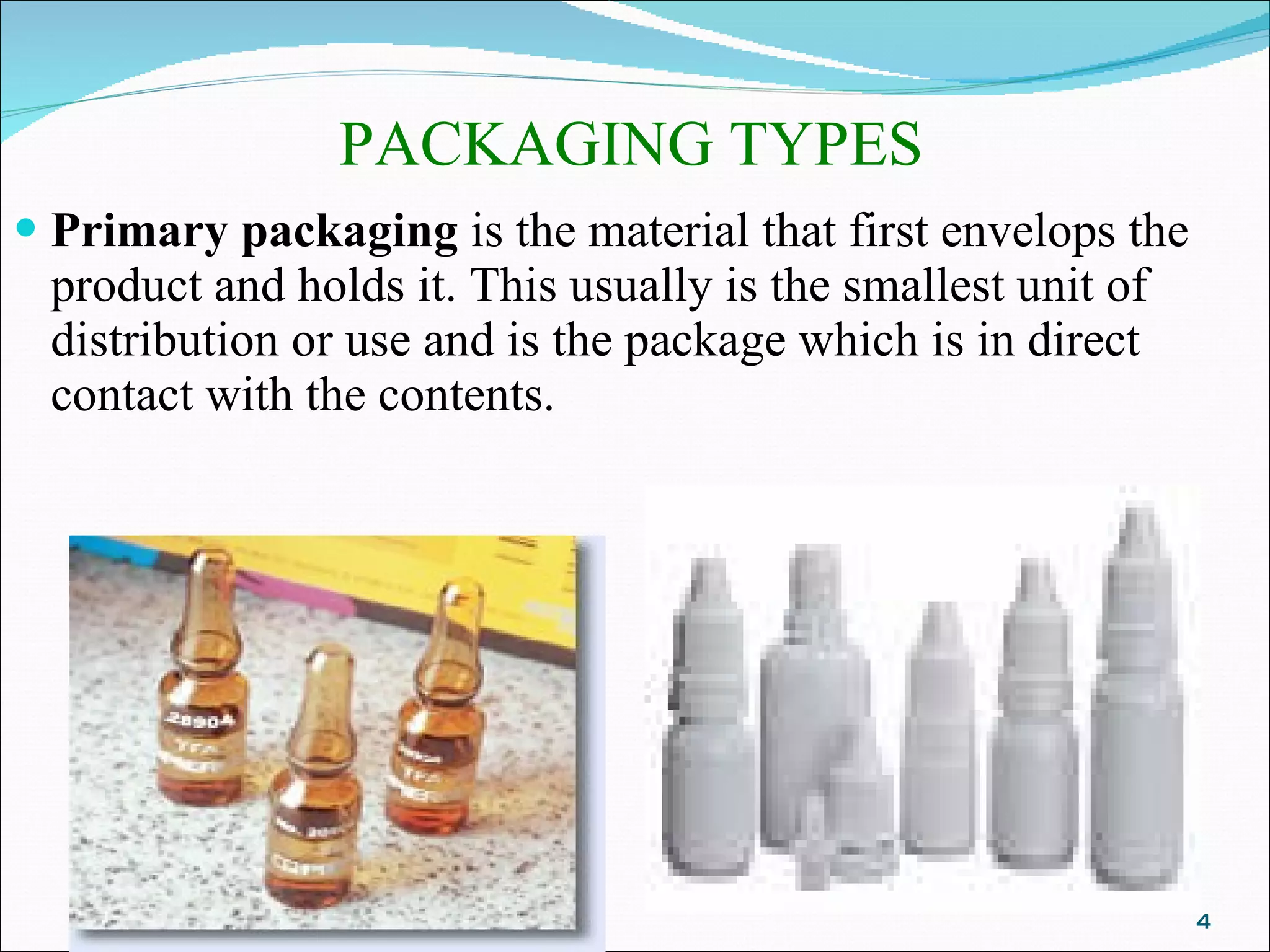
PACKAGING TYPES Primary packaging  is the material that first envelops the product and holds it. This usually is the smallest unit of distribution or use and is the package which is in direct contact with the contents.
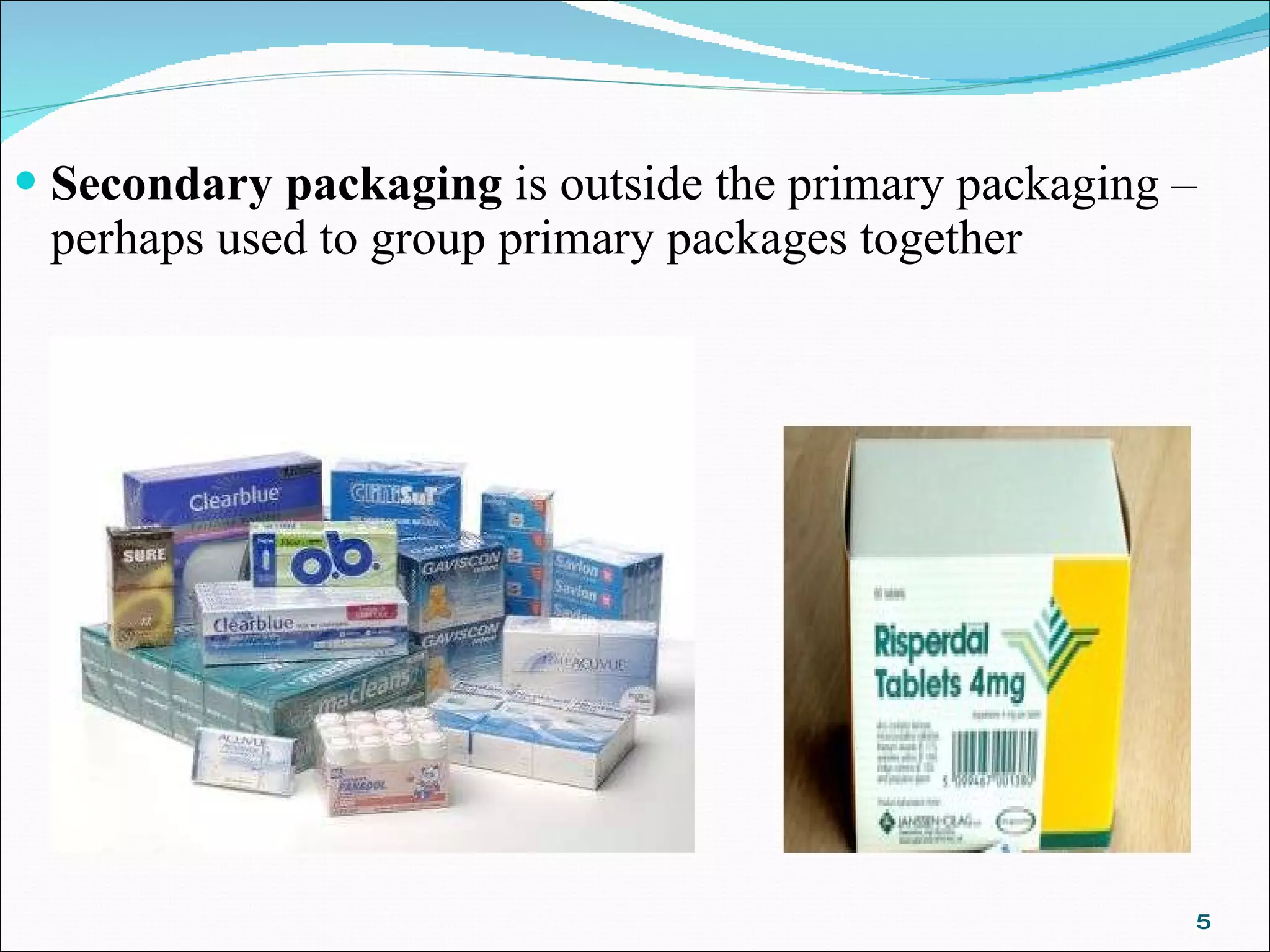
Secondary packaging  is outside the primary packaging – perhaps used to group primary packages together
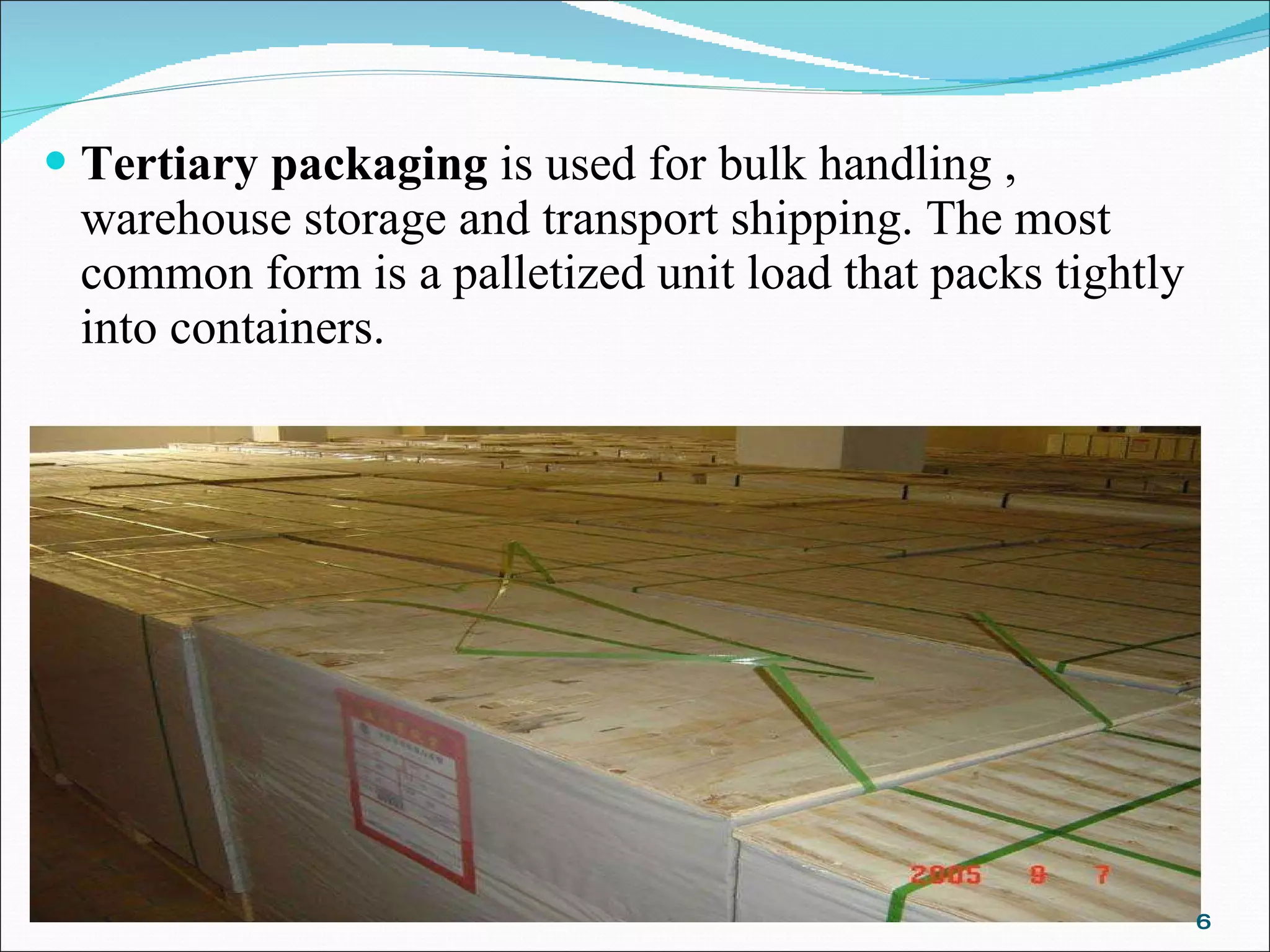
Tertiary packaging  is used for bulk handling , warehouse storage and transport shipping. The most common form is a palletized unit load that packs tightly into containers.
Different types of primary  packaging Ampoules Vials Containers Dosing dropper Closures (plastic, metal) Syringe Strip package Blister packaging
DIFFERENT TYPES OF SECONDARY PACKAGING  Paper and boards Cartons Corrugated fibers Box manufacture    
PRIMARY PACKAGING MATERIALS GLASS  : Glass has been widely used as a drug packaging material.    Advantages of glass : It allows easy inspection of the containers contents.  It is available in variously  shaped containers. Disadvantages of Glass : - It is fragile It is expensive when compared to the price of plastic.  
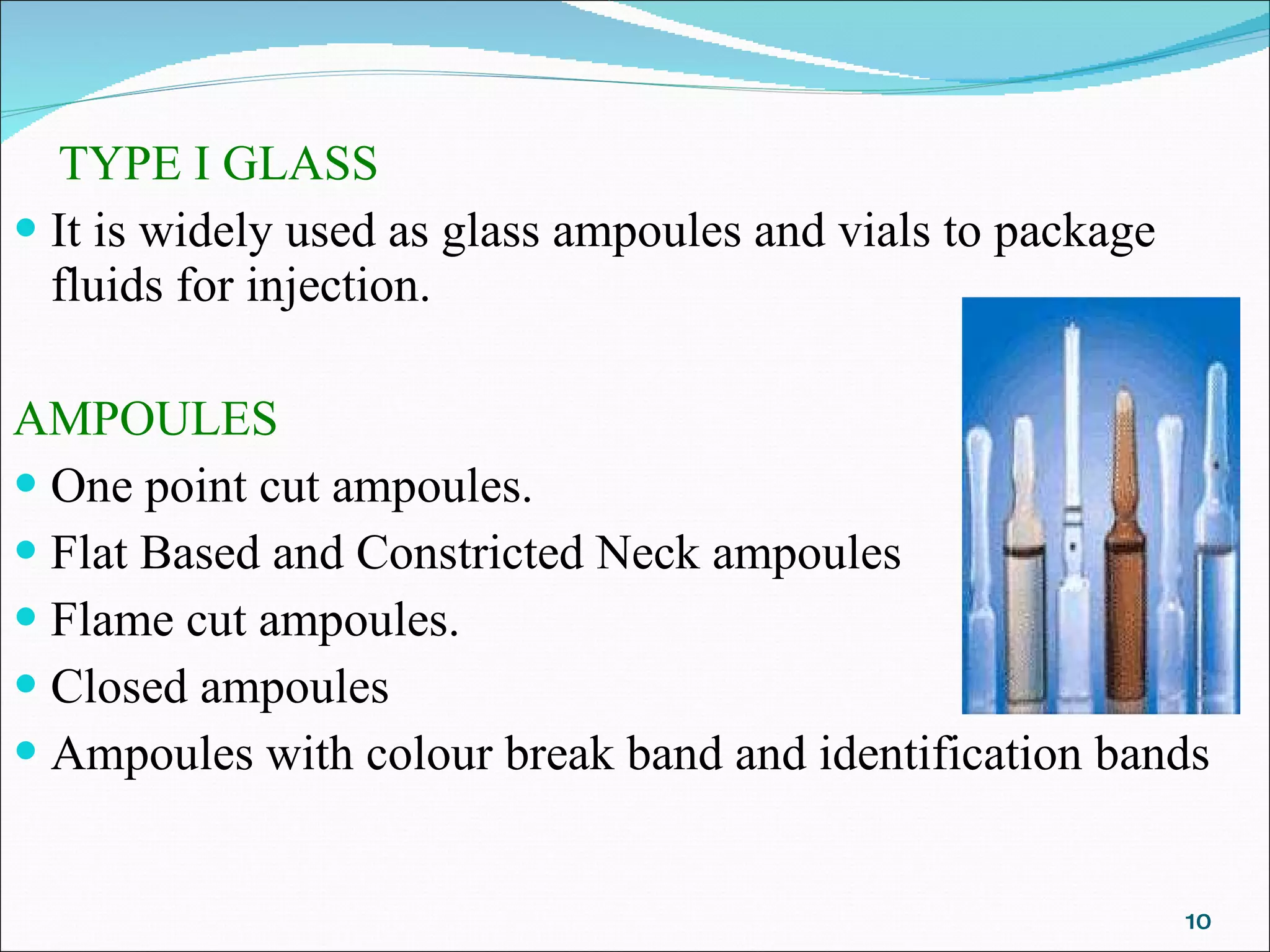
TYPE I GLASS It is widely used as glass ampoules and vials to package fluids for injection.   AMPOULES One point cut ampoules.  Flat Based and Constricted Neck ampoules  Flame cut ampoules.  Closed ampoules  Ampoules with colour break band and identification bands
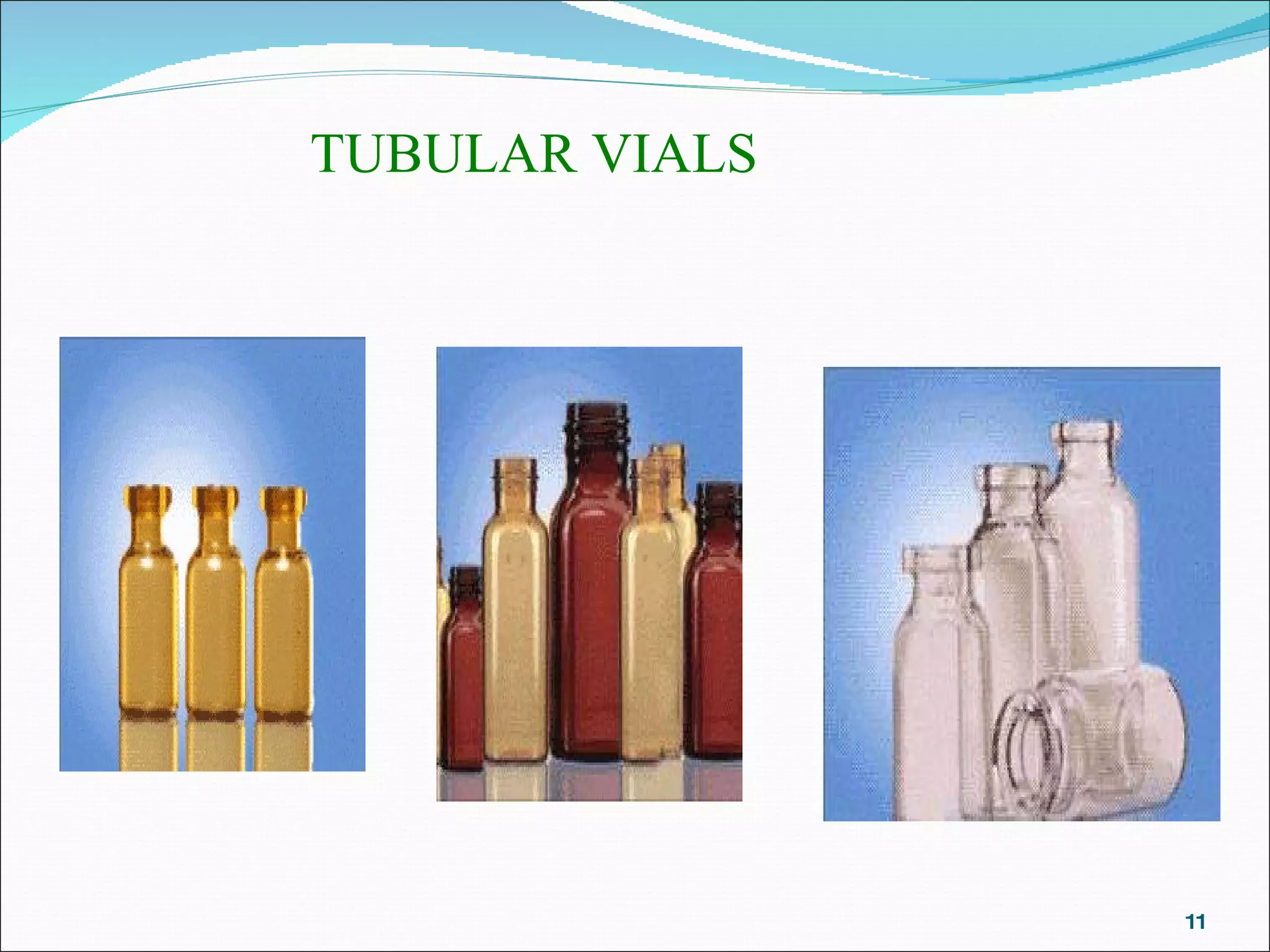
TUBULAR VIALS
TYPES OF GLASS CONTAINERS BOTTLES : -    Used in the dispensary as either amber metric medical bottles or ribbed(fluted )oval bottles. Available in sizes from 50ml to 500ml. Amber metric medical bottles are used for packaging a wide range of oral  medicines. .  Ribbed oval bottles attached are used to package various product that should not be taken orally.  This includes liniments, lotions, inhalations and  antiseptic  solutions.  
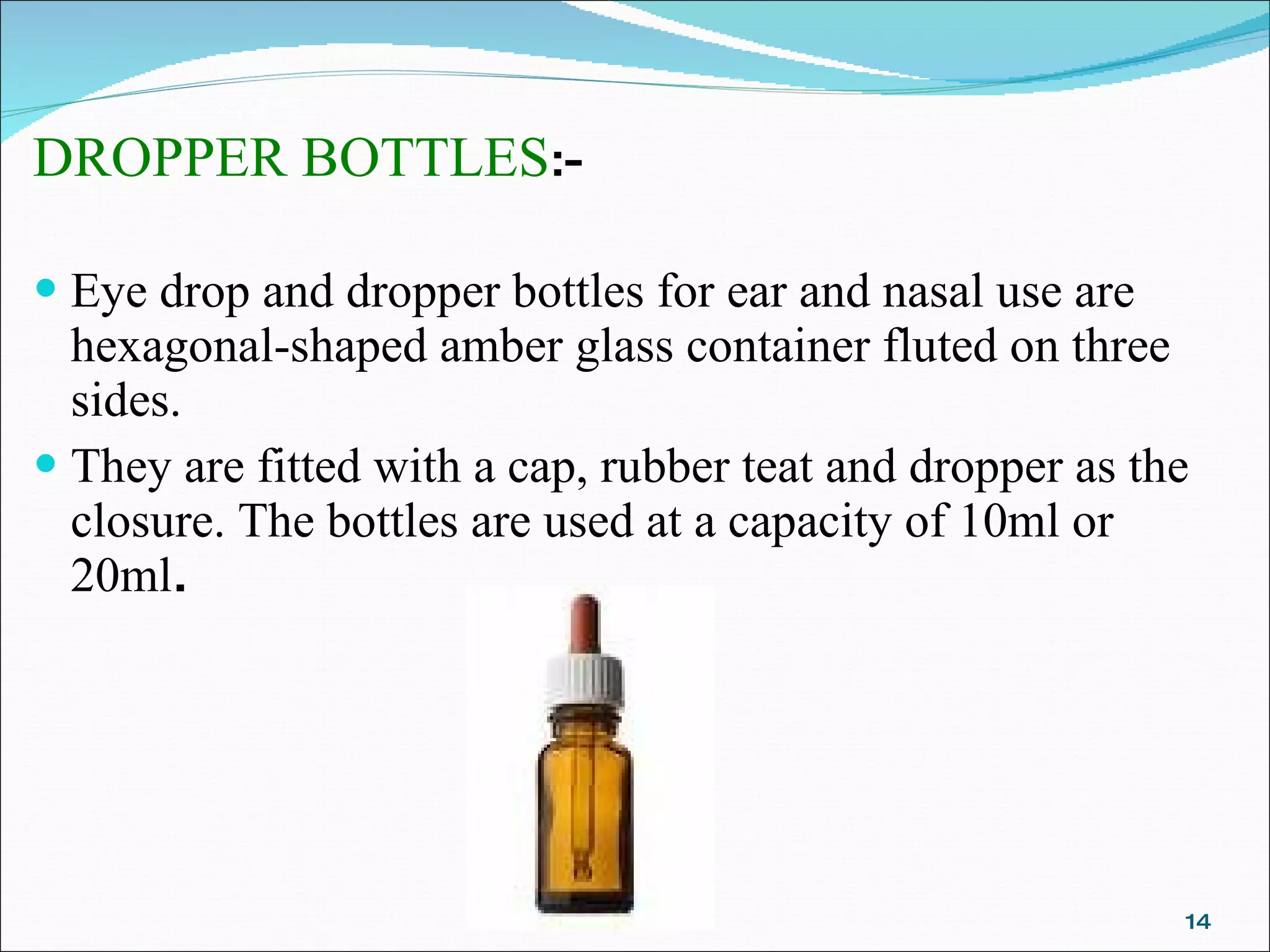
DROPPER BOTTLES :- Eye drop and dropper bottles for ear and nasal use are hexagonal-shaped amber glass container fluted on three sides. They are fitted with a cap, rubber teat and dropper as the closure. The bottles are used at a capacity of 10ml or 20ml .
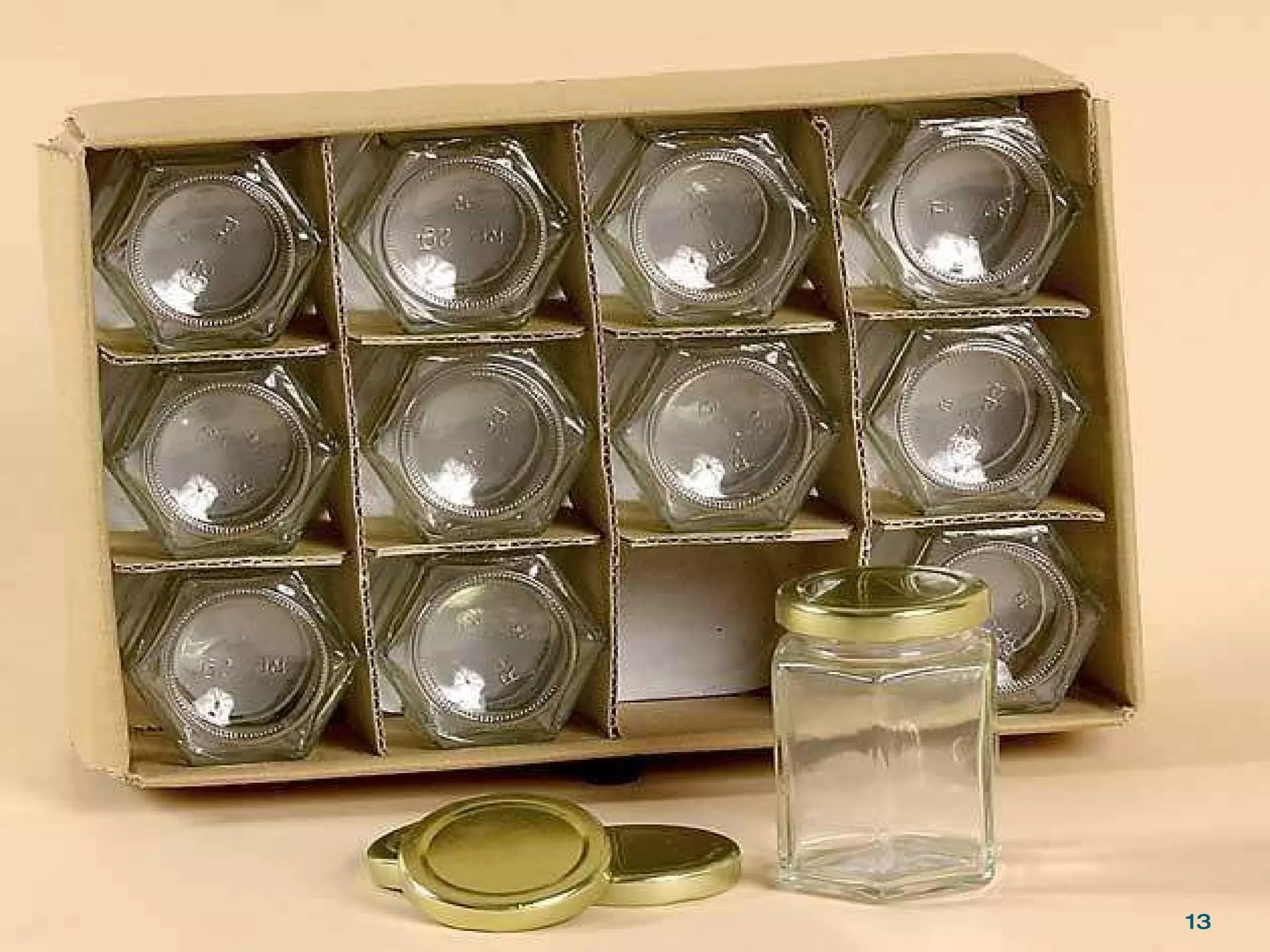
JARS Powders and semi-solid preparations are generally packed in wide-mouthed cylindrical jars made of clear or amber glass. Jars varies from 15ml to 500ml. Jars are used for packing  prepared ointments and  pastes. PLASTICS   Used as container for the product and as secondary packaging  Two classes of plastics are used  and these are known as thermosets and thermoplastics.
  ADVANTAGES OF PLASTICS :- Flexible and not easily broken. Low density and light in weight. Are cheap DISADVANTAGES OF PLASTICS :- They are not as chemically inert as Type -I glass. They are not as impermeable to gas and vapour as glass. They may possess an electrostatic charge which will attract particles.
Used for many types of pack including rigid bottles for tablets and capsules, squeezable bottles for eye drops and nasal sprays, jars, flexible tubes and strip and blister packs.     POLY ETHYLENE :  This is used as high and low density polyethylene Low density polyethylene (LDPE) is  preferred plastic for squeeze bottles. High density poly ethylene (HDPE) is less permeable to gases and more resistant to oils, chemicals and solvents. It is widely used in bottles for solid dosage forms.  
POLYVINYLCHLORIDE (PVC):- Used as rigid packaging material and  main component of intravenous bags. POLY PROPYLENE :-  It has good resistance to cracking when flexed. Suitable for use in closures , tablet containers and intravenous bottles. POLYSTYRENE:- .  It  is also used for jars for ointments and creams with low water content.
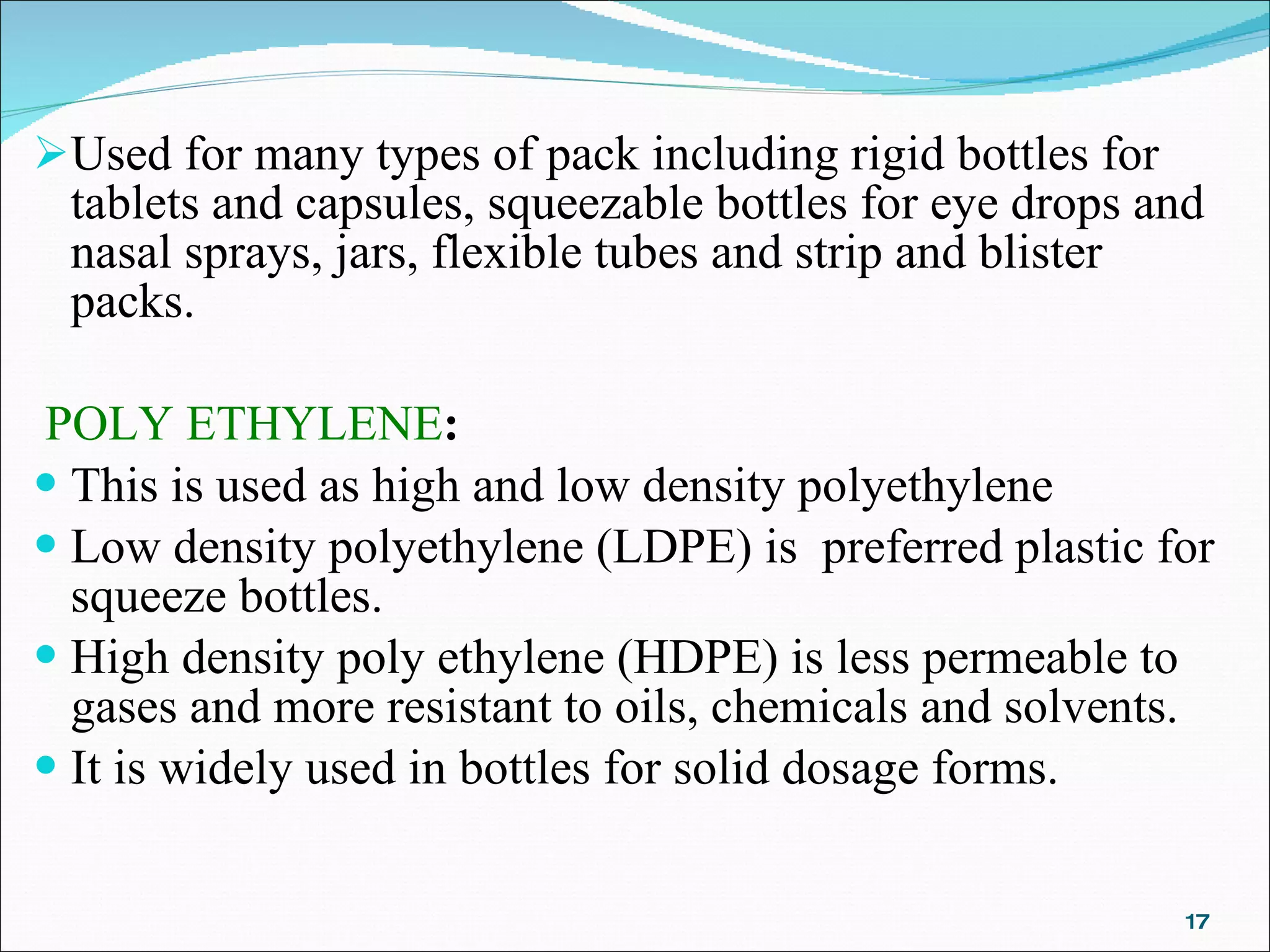
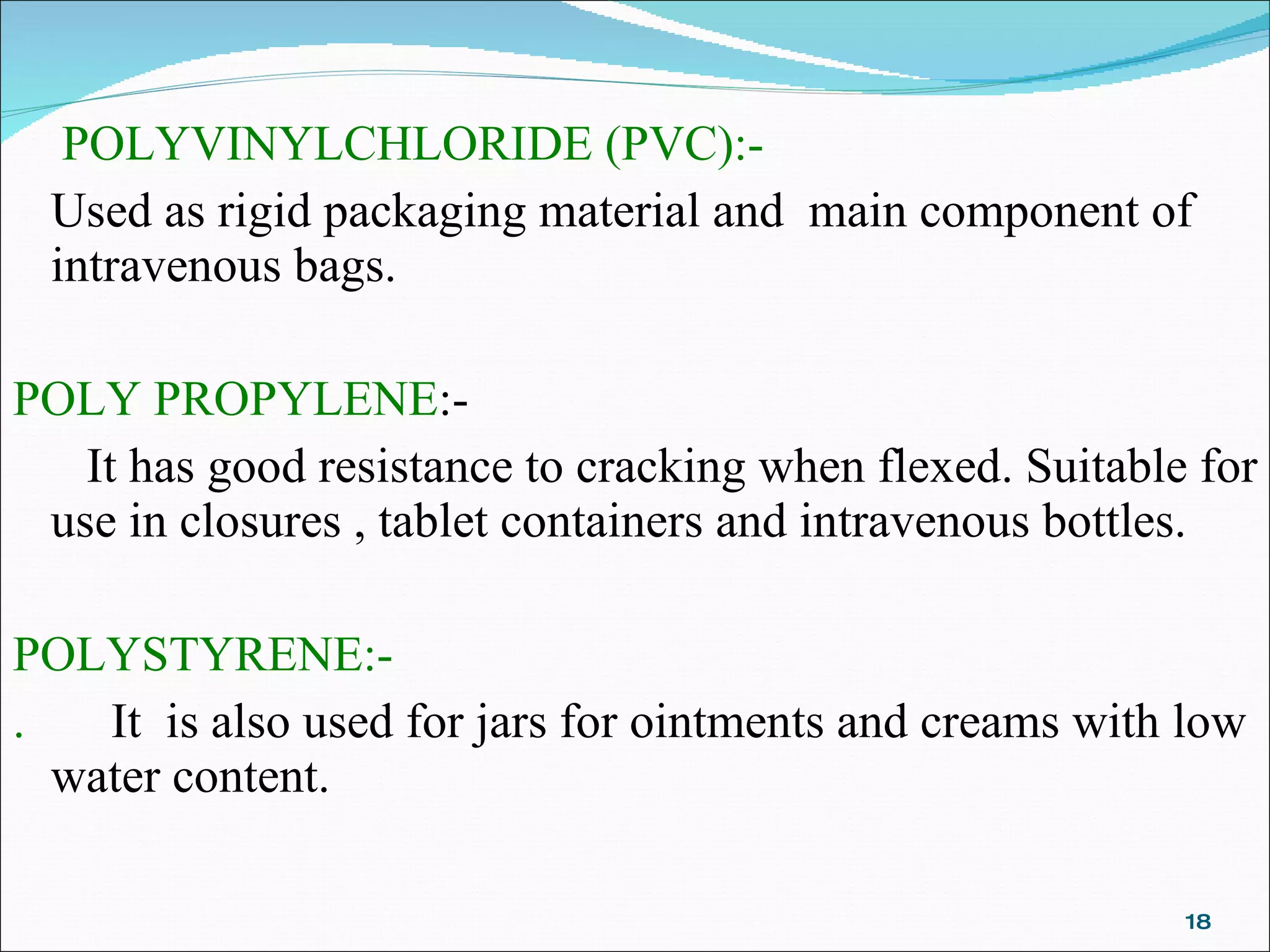
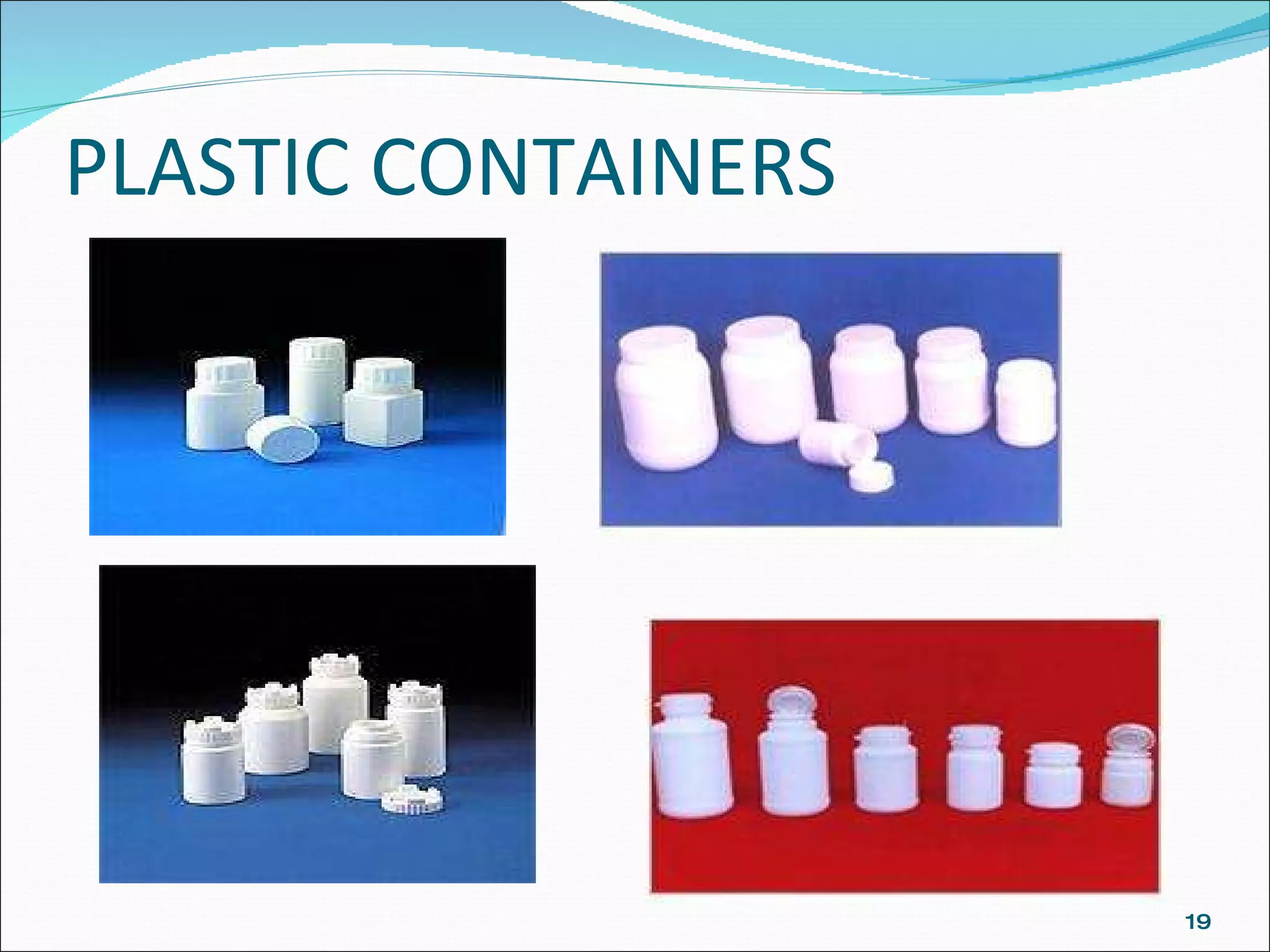
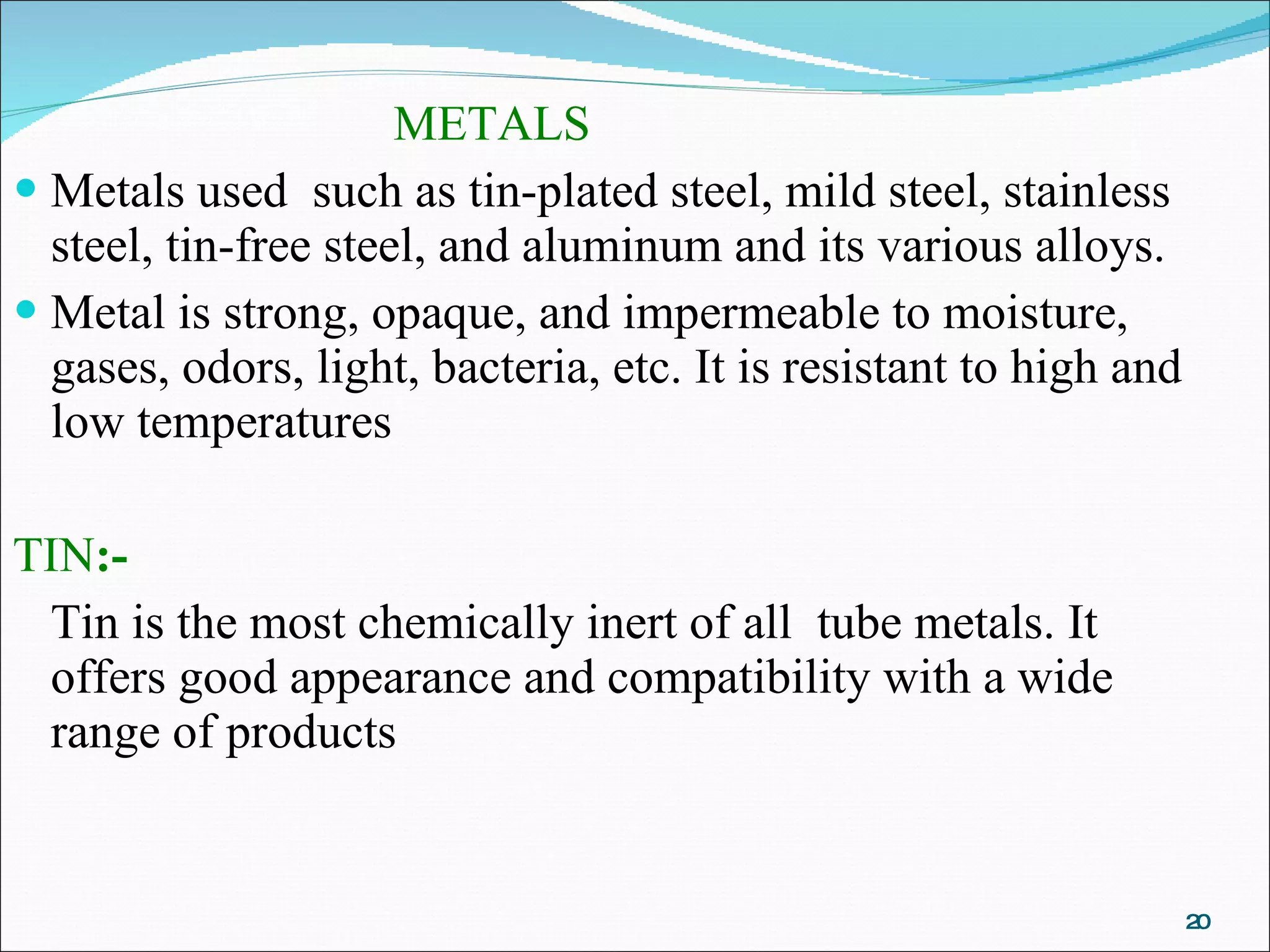
PLASTIC CONTAINERS
METALS   Metals used  such as tin-plated steel, mild steel, stainless steel, tin-free steel, and aluminum and its various alloys. Metal is strong, opaque, and impermeable to moisture, gases, odors, light, bacteria, etc. It is resistant to high and low temperatures  TIN :- Tin is the most chemically inert of all  tube metals. It offers good appearance and compatibility with a wide range of products
TINPLATE:- Tinplate is basically a steel structure with a thin layer of tin deposited on either one side or both sides, gives the steel some protection from corrosion . ALUMINIUM :- Aluminium lighter in weight and can be easier to shape. The thick rigid closures are used mainly for cans or aerosol containers, while the thin flexible material is used primarily for the closure of ,bottles or thermoforms
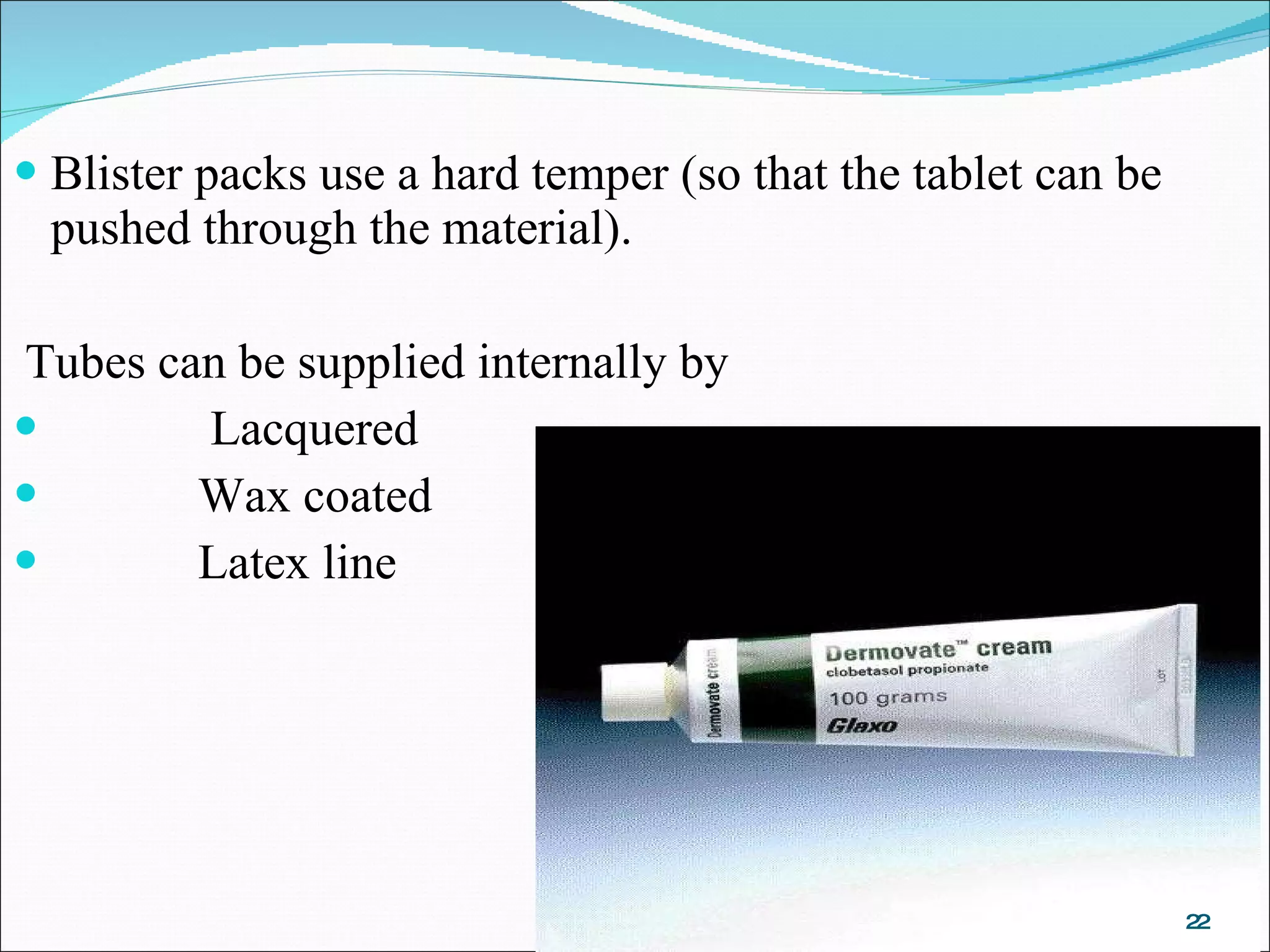
Blister packs use a hard temper (so that the tablet can be pushed through the material).  Tubes can be supplied internally by  Lacquered Wax coated Latex line
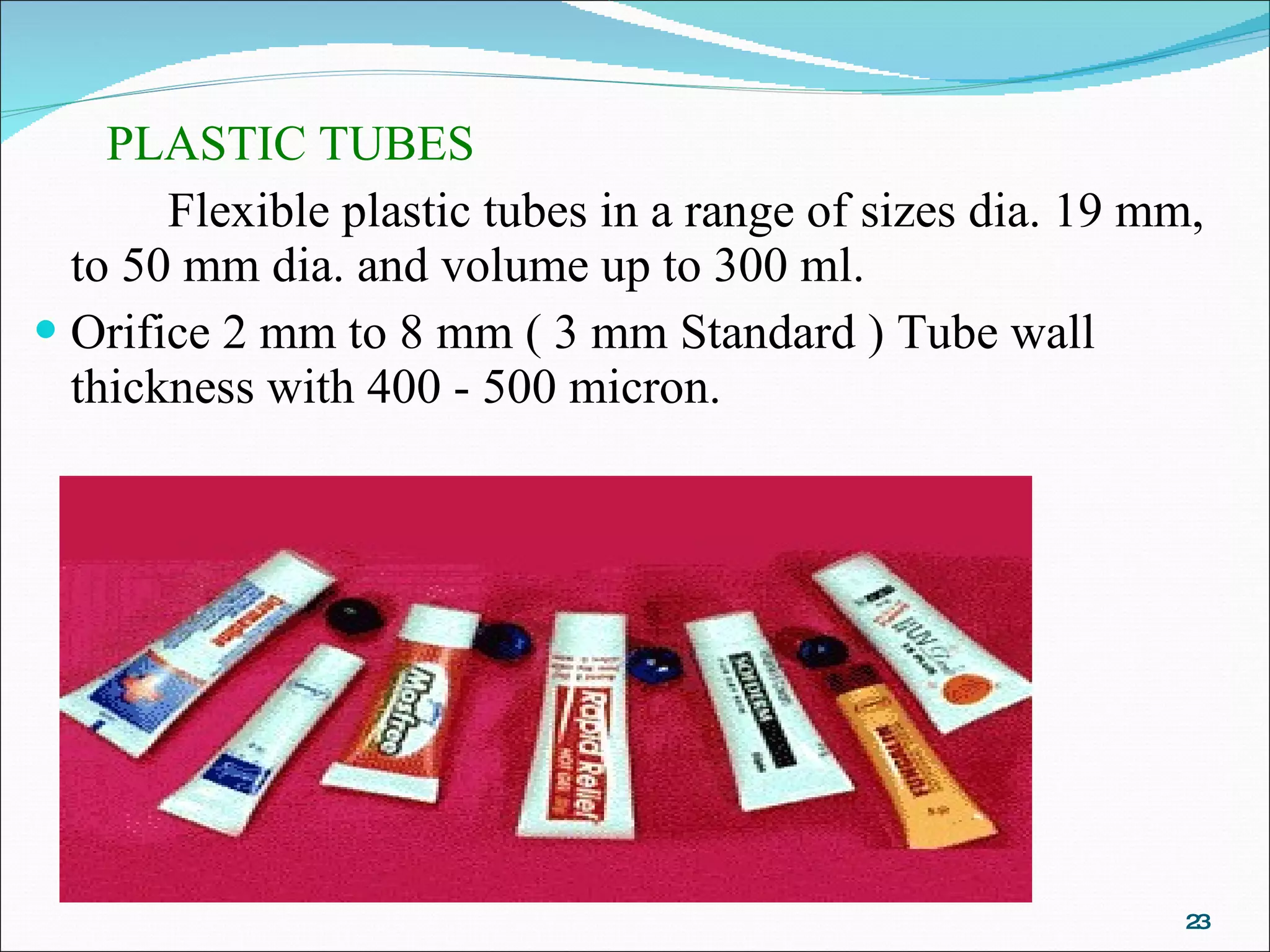
PLASTIC TUBES Flexible plastic tubes in a range of sizes dia. 19 mm, to 50 mm dia. and volume up to 300 ml. Orifice 2 mm to 8 mm ( 3 mm Standard ) Tube wall thickness with 400 - 500 micron.
LAMINATED TUBES  Multilayer tubes with Aluminum foil / nylon / polyester act as barrier against oxygen, moisture, aroma loss and provide a glossy surface enhancing printing quality.   Transparent stretch polypropylene and PET tubes with dispenser caps are designed Different caps such as conical, flip-top,  can be custom designed for an aesthetic look.
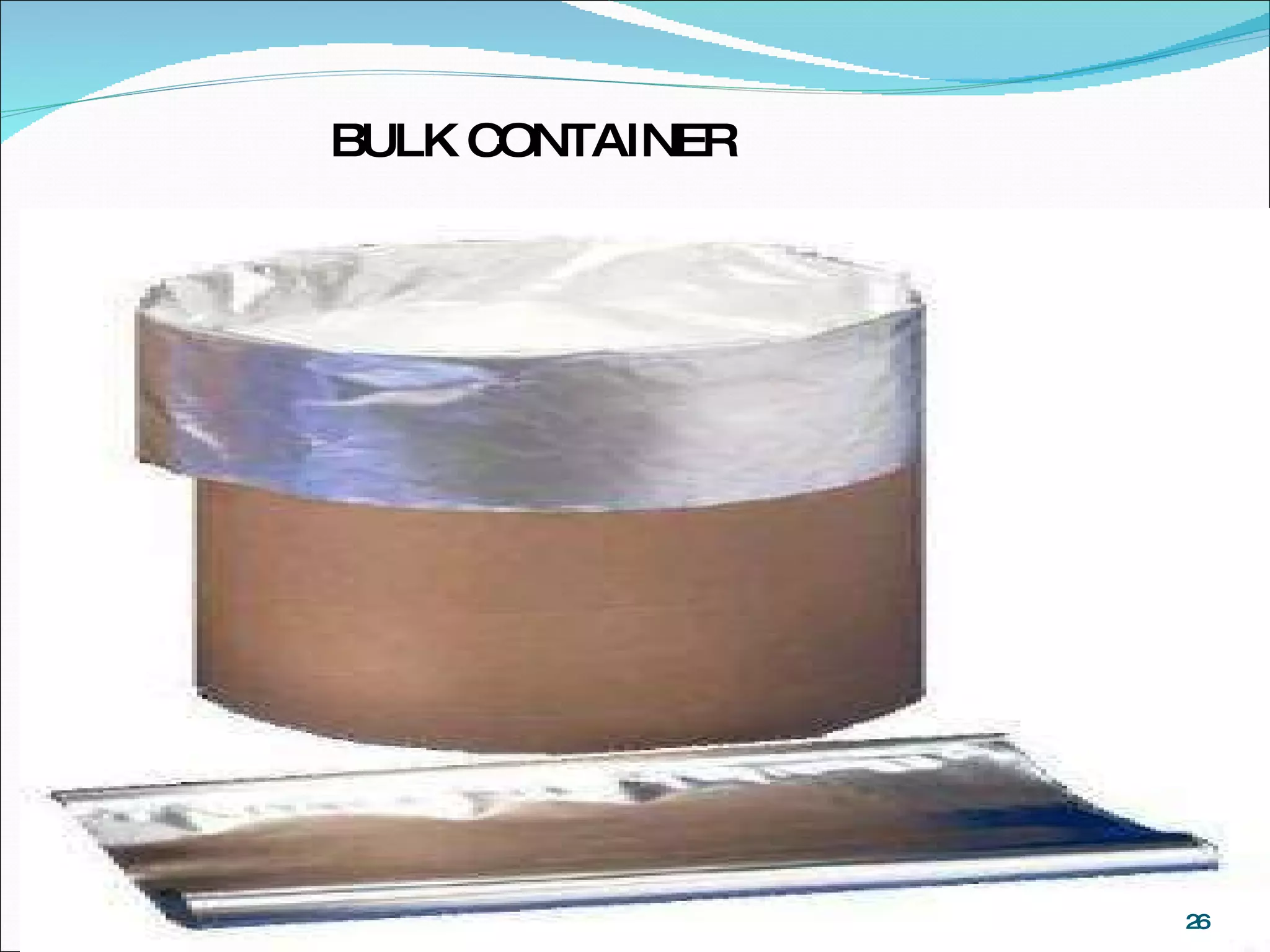
BULK CONTAINERS For bulk drug and active pharmaceutical ingredient packaging, bags and drum liners manufactured in a cGMP-compliant environment. LDPE and foil laminate bags and drum liners are custom-produced in a wide range of sizes and constructions . cGMP-compliant with respect to quality systems, complete traceability, change control, SOPs and pharmaceutical grade housekeeping, and are registered in Drug Master File .   
BULK CONTAINER
BLISTER PACK:- Blister packs are commonly used as unit dose packaging  for pharmaceutical tablets, capsules or lozenges Blister packs consist of two principal components : 1) a formed base web creating the cavity inside which the product fits and 2) the lidding foil for dispensing the product out of the pack. There are two types of forming the cavity into a base web sheet: thermoforming and cold forming
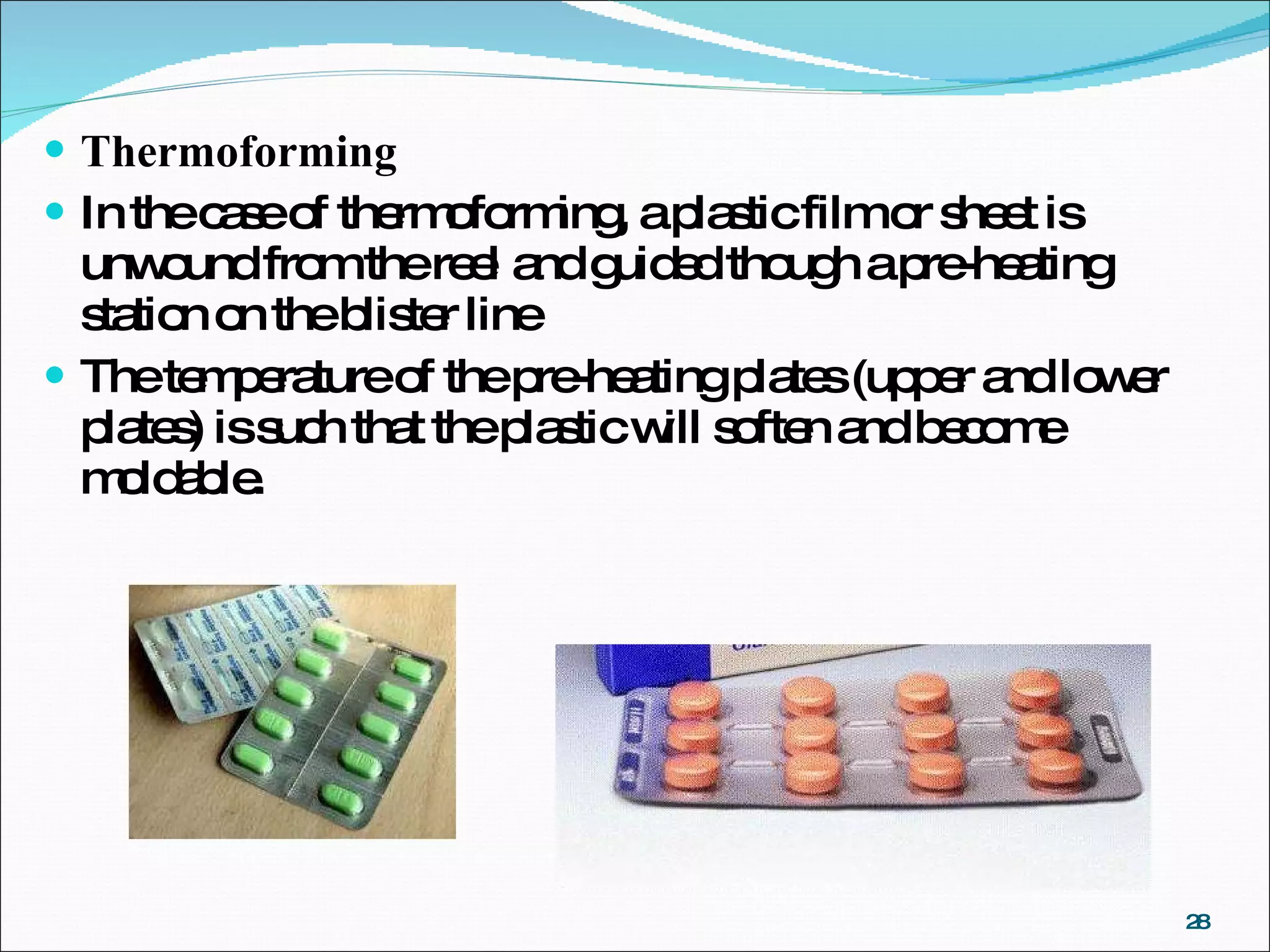
Thermoforming In the case of thermoforming, a plastic film or sheet is unwound from the reel and guided though a pre-heating station on the blister line The temperature of the pre-heating plates (upper and lower plates) is such that the plastic will soften and become moldable.
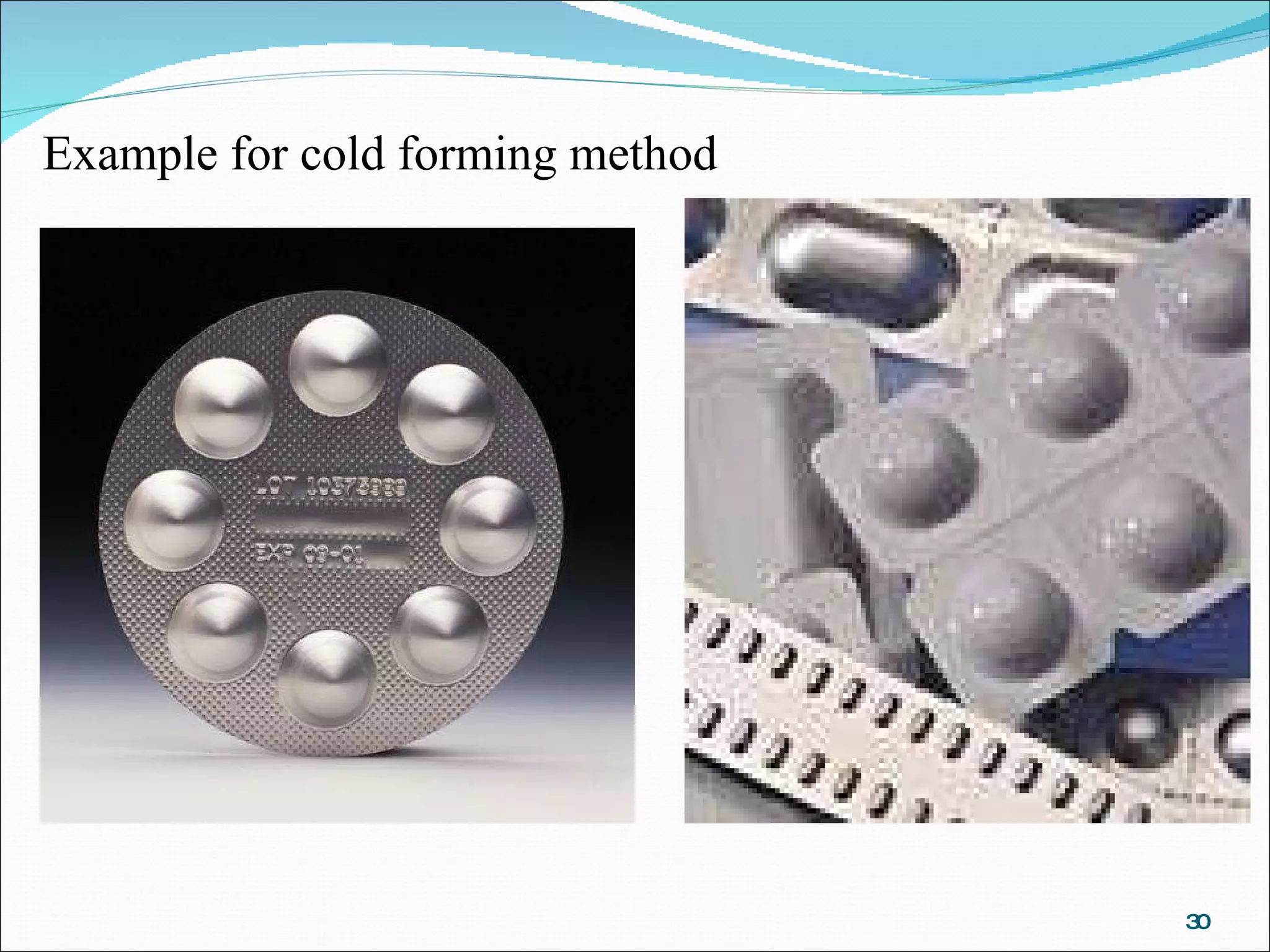
COLD FORMING In the case of cold forming, an aluminum-based laminate film is simply pressed into a mold by means of a stamp. The aluminum will be elongated and maintain the formed shape. Advantage of cold form foil blisters is that the use of aluminum is offering a near complete barrier for water and oxygen, allowing an extended product expiry date. The disadvantages of cold form foil blisters are the slower speed of production compared to thermoforming and the lack of transparency of the package  and the larger size of the blister card
Example for cold forming method
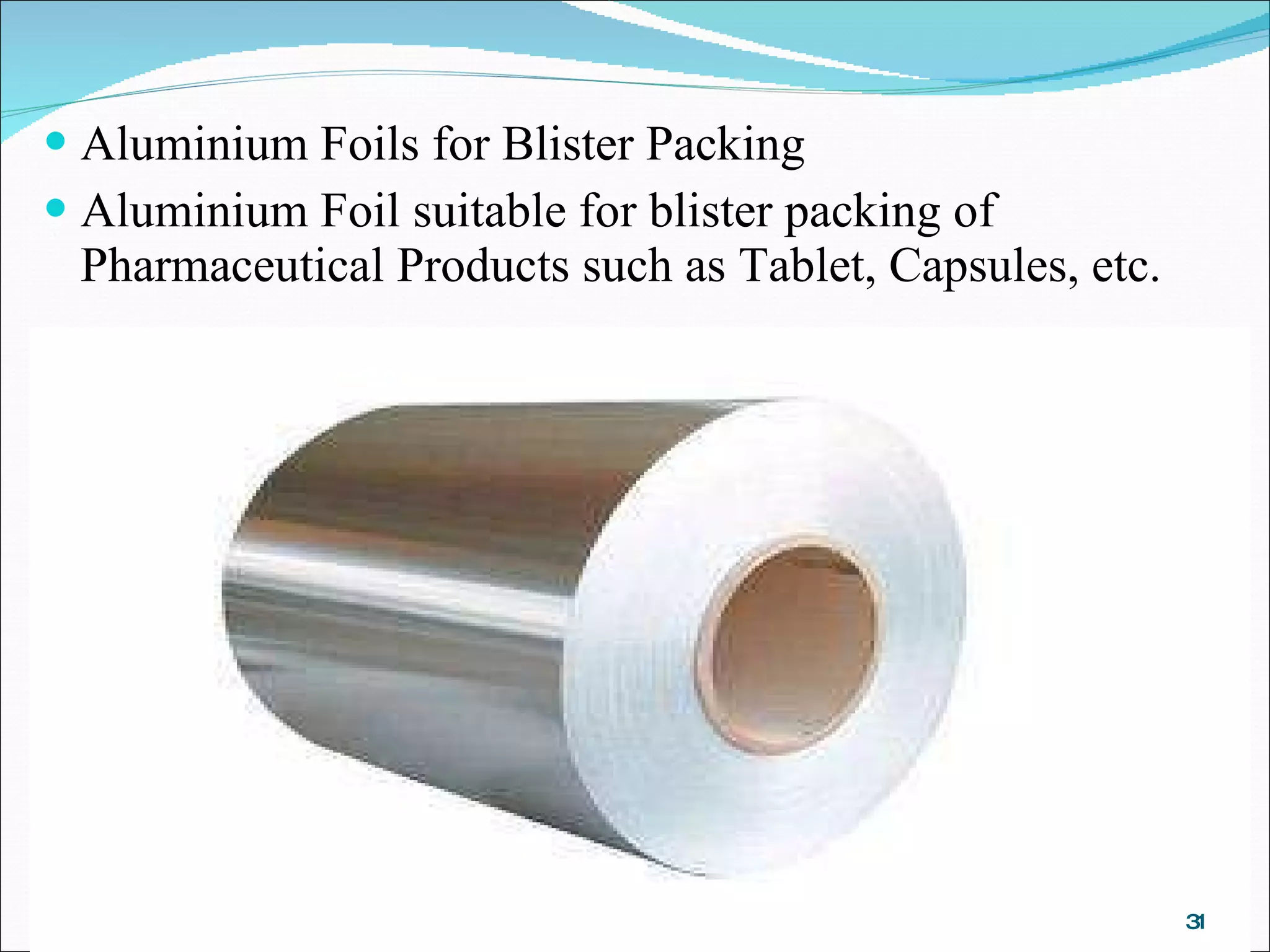
Aluminium Foils for Blister Packing Aluminium Foil suitable for blister packing of Pharmaceutical Products such as Tablet, Capsules, etc.
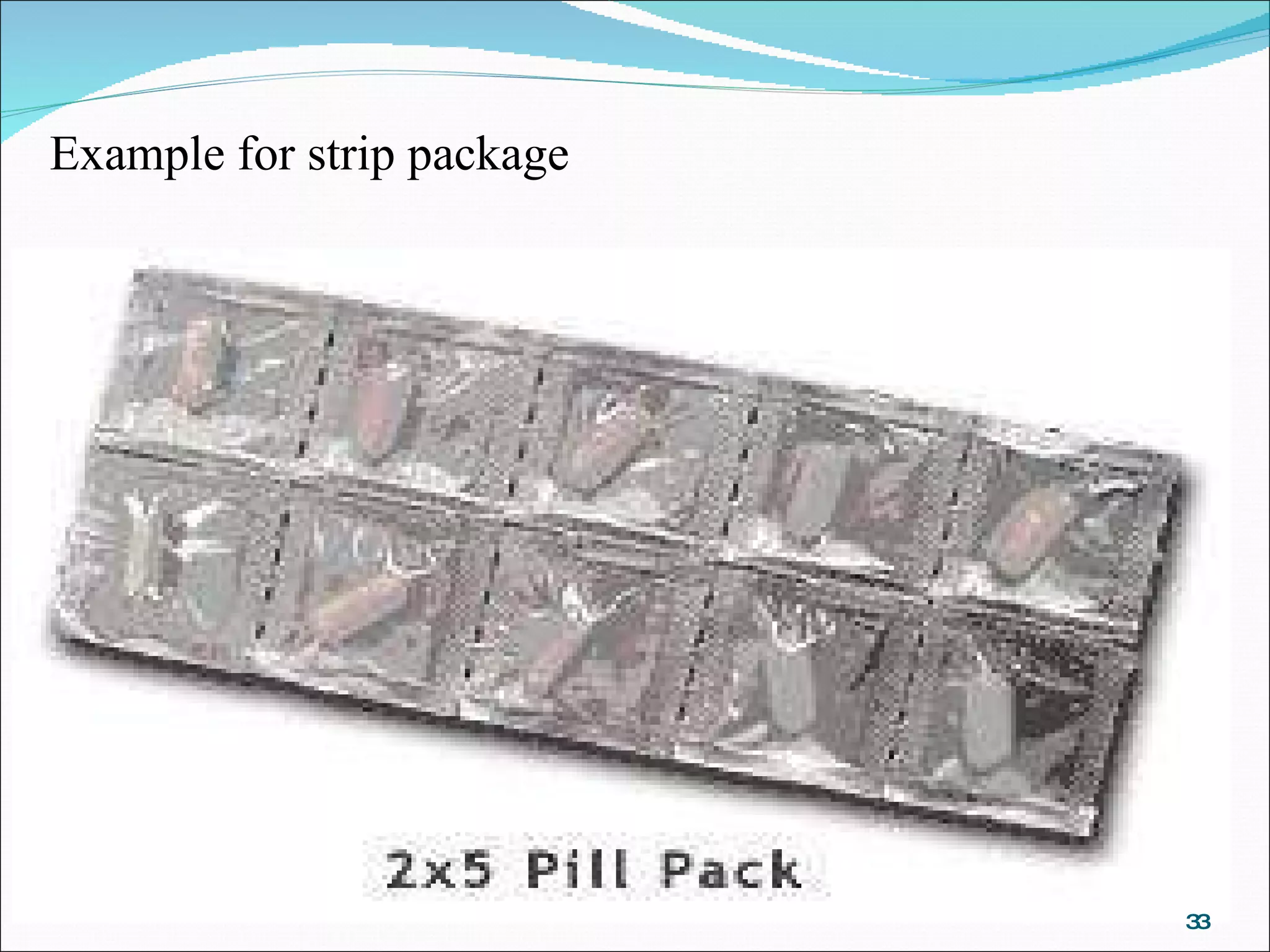
STRIP PACKAGE :- It is commonly used for the packaging of tablets and capsules. A strip package is formed by feeding two webs of a heat sealable flexible film through a heated crimping roller .The product is dropped into the pocket formed before forming the final set of seals. A continuous strip of packets is formed which is cut to the desired number of packets in length. The materials used for strip package are cellophane, polyester, polyethylene, polypropylene,  polyvinylchloride.
Example for strip package
CLOSURES :- Closures are the devices by means of which containers can be opened and closed. Proper closing of the container is necessary because It prevents loss  of material by spilling or volatilization. It avoids contamination of the product from dirt, microorganisms or insects. It prevents deterioration of the product from the effect of the environment such as moisture , oxygen or carbon dioxide.
MATERIALS USED FOR MAKING OF CLOSURES The closures for containers meant for storage  of pharmaceutical products are generally made from the following basic materials. Cork Glass Plastic  Metal  Rubber
SECONDARY PACKAGING MATERIALS PAPER : - This can be used as a flexible wrap for products, or as a closure material for jars. Most paper materials are used with a liner applied either as a laminate or  as a coating.
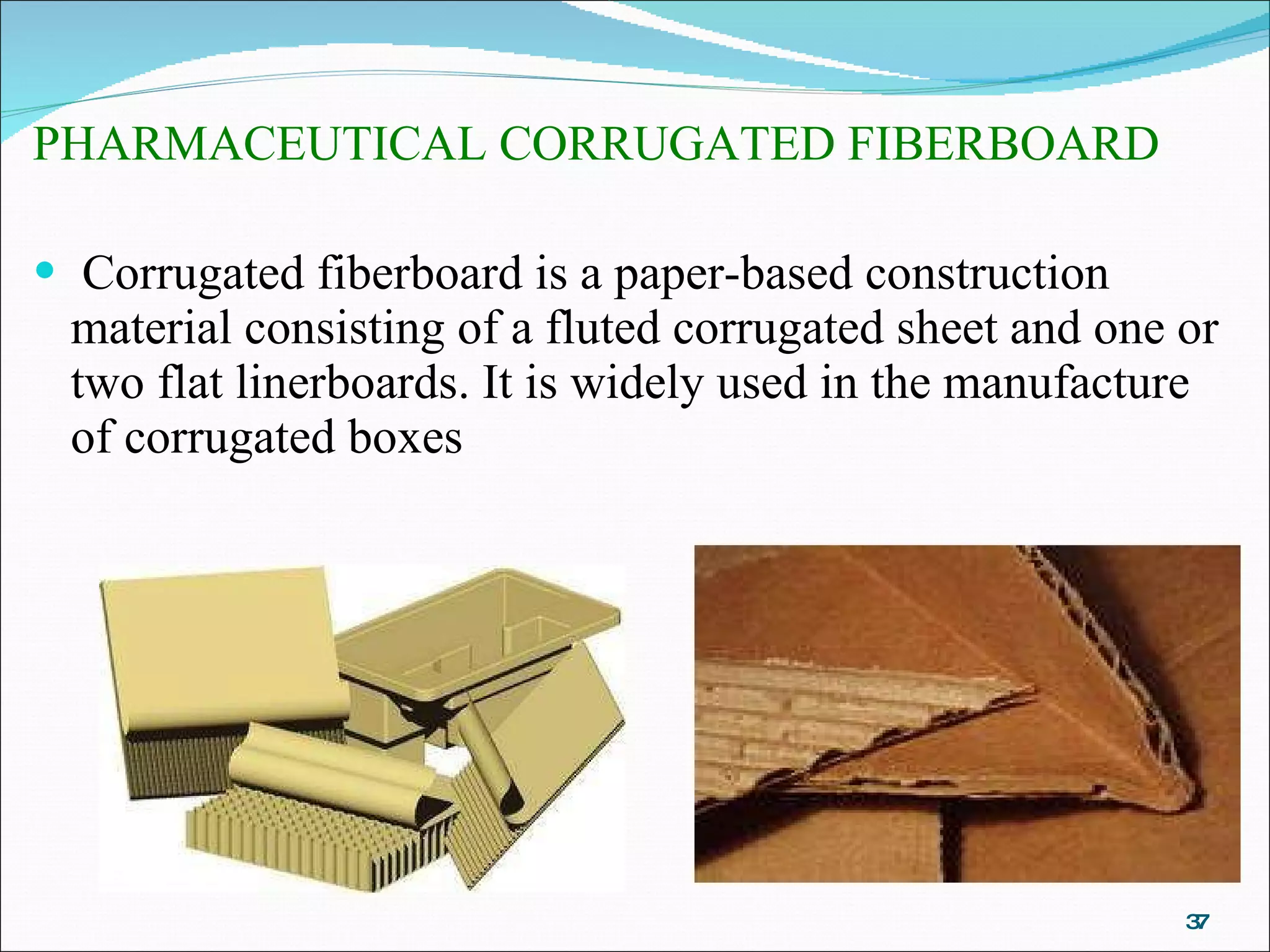
PHARMACEUTICAL CORRUGATED FIBERBOARD Corrugated fiberboard is a paper-based construction material consisting of a fluted corrugated sheet and one or two flat linerboards. It is widely used in the manufacture of corrugated boxes
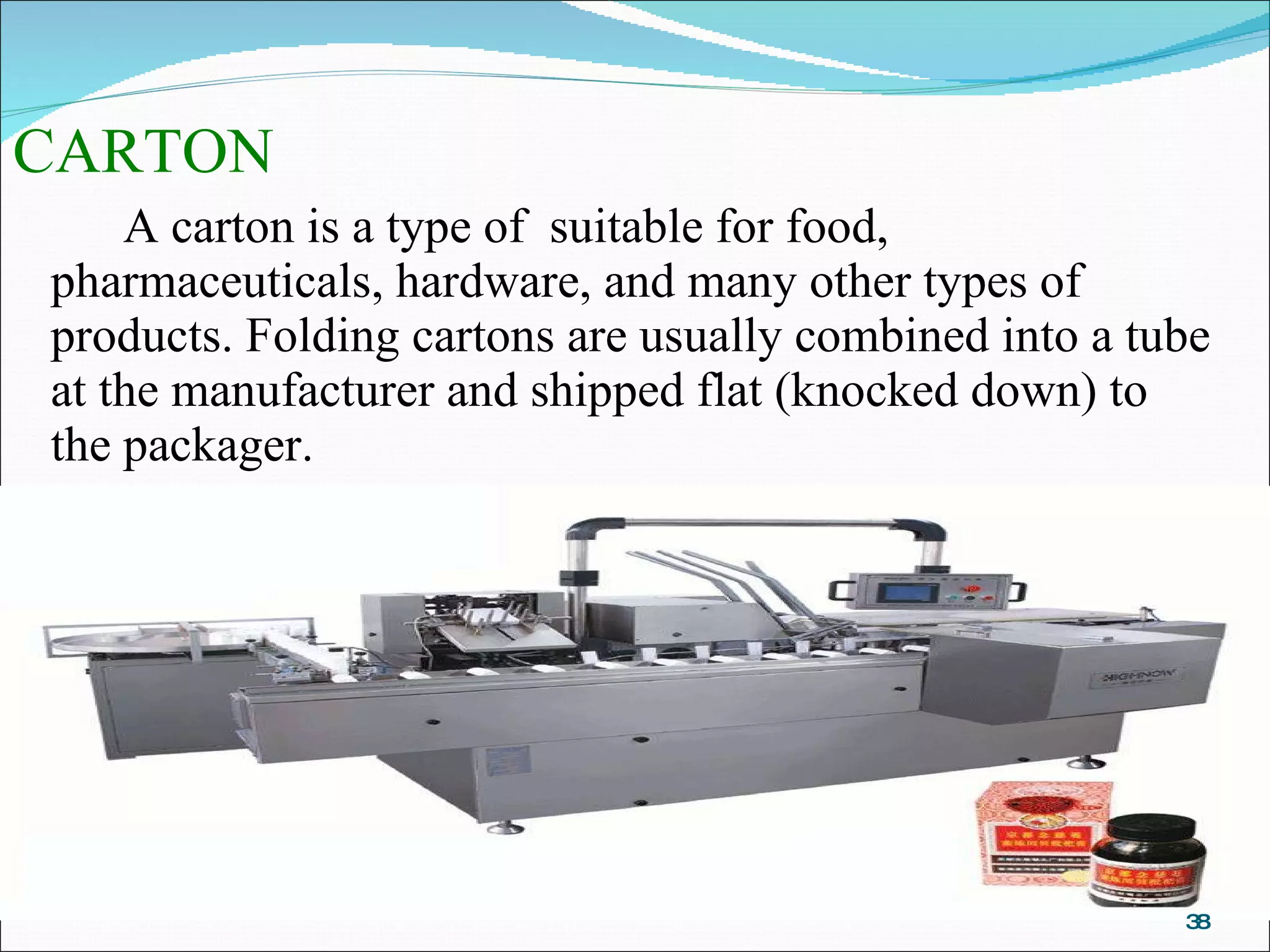
CARTON A carton is a type of  suitable for food, pharmaceuticals, hardware, and many other types of products. Folding cartons are usually combined into a tube at the manufacturer and shipped flat (knocked down) to the packager.
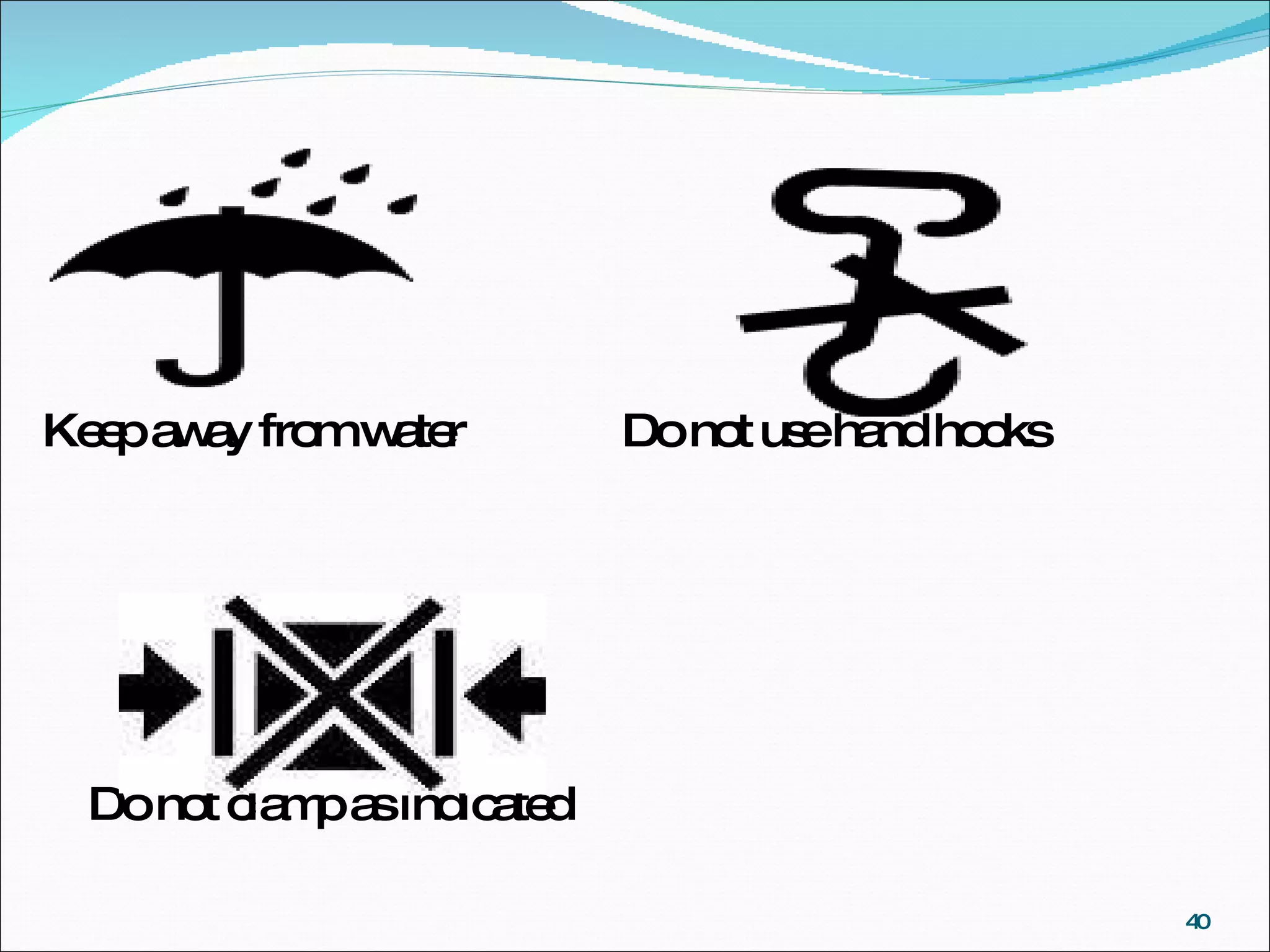
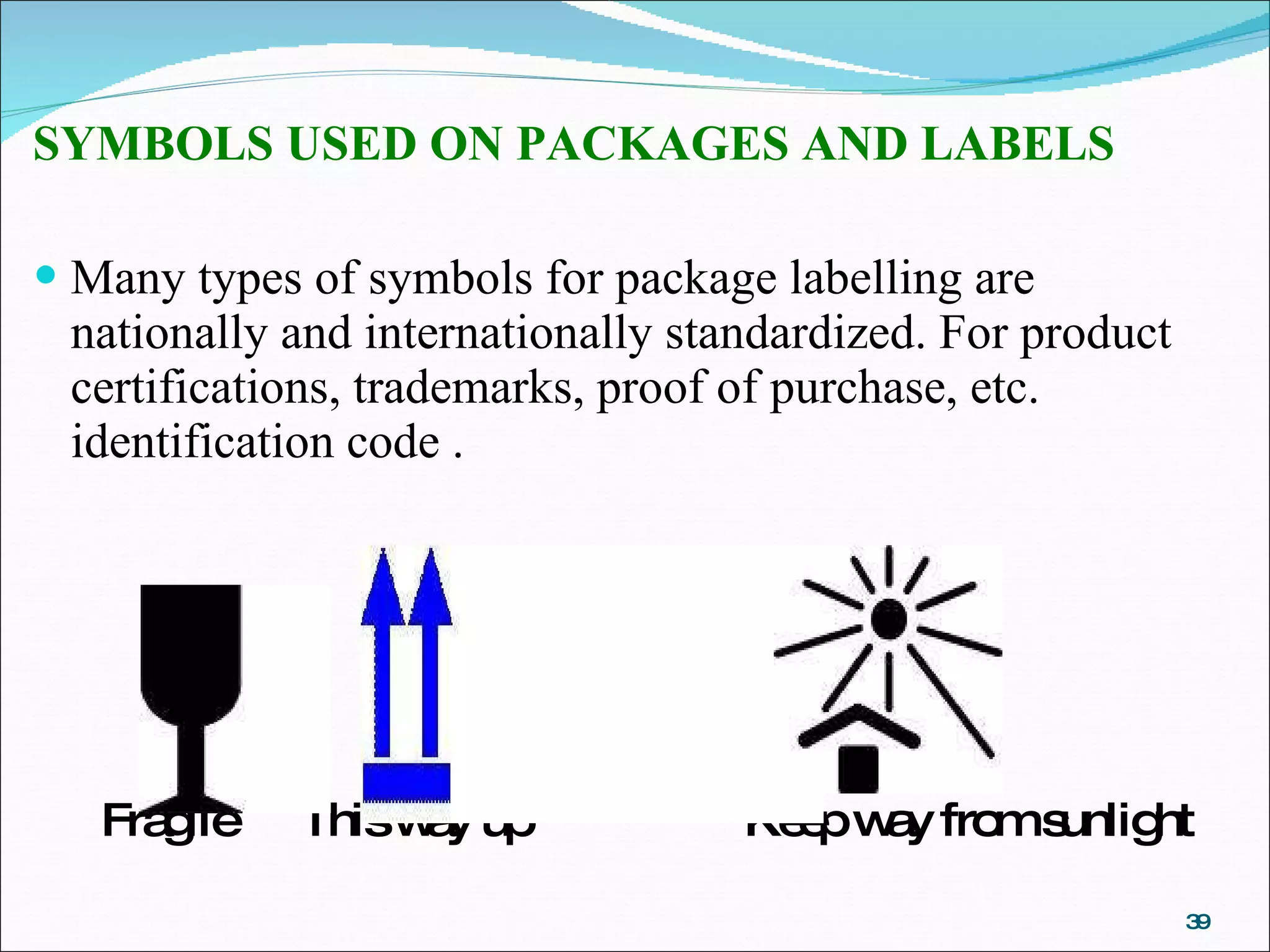
SYMBOLS USED ON PACKAGES AND LABELS Many types of symbols for package labelling are nationally and internationally standardized. For product certifications, trademarks, proof of purchase, etc. identification code . Fragile  This way up  Keep way from sunlight
Keep away from water  Do not use hand hooks Do not clamp as indicated
TRENDS IN PHARMACEUTICAL PACKAGING Packaging of oral medicines generally conforms to requirements for easy dispensing, child resistance but senior-friendliness, but packs must also be identifiable, functional and very often hermetically sealed to cut the number of accidental poisonings Gentle handling is also essential and packs should be hermetically sealed for higher product safety. A solution to achieve hermetically sealed packs for blister, blow-fill-seal pouches, vials and other products is to overwrap them into a horizontal flow wrap.
. New packaging lines will have to offer high flexibility while maintaining production levels.  To meet validation requirements, pharmaceutical companies increasingly demand that machinery is modularized and standardized. This includes a standardized operating interface and control systems for all components. Such systems also have monitoring systems for maximum production safety Sstandardisation that is sufficient to produce high efficiencies. The entire packaging process needs to be harmonised and there is a huge optimisation potential in this area.
EVALUATION OF PRIMARY PACKAGING MATERIAL:- Leakage test Hydrolytic resistance Collapsibility Residue on Ignition Buffering Capacity  Light Transmission Water Vapour Permeation Heavy Metals & Non Volatile Residue
EVALUATION OF SECONDARY PACKAGING MATERIAL Testing of paper and board Air permeability : - Permeability is the mean air flow through unit area under unit pressure difference in unit time, under specific conditions, expressed in Pa -1 s -1 . Tensile strength: -  both wet and dry. The maximum tensile force per unit width that a paper or board will withstand before breaking
COBB TEST: -  This measures the mass of water absorbed by 1cm 2  of the test piece in a specified time under a head of 1 cm of water. It is determined by weighing before and after exposure to the water, and usually quoted in g/m 2
SPECIFIC TESTS FOR CARTONS  Compression: -  Assessment of the strength of the  erected package, thereby estimating the degree of protection that it confers on the contents.  Crease stiffness: -  Also called the crease recovery test. This involves testing a carton board piece and folding it through 90 0 . It will then try to recover its former position when the bending force is removed. The increase and decrease in the inherent board stiffness after folding is measured.  
FUTURE CHALLENGES Moisture sensitive drugs increasing barrier requirements Novel delivery systems Emphasis on speed to market Control of R&D Expenditure/resource - number of stability studies Global  - Regional - Local packs Anti-counterfeiting, illegal cross border trading Multiple studies for different packs vs. Year-on-Year manufacturing costs  
REFERENCES :- Dean DA, Evans ER, Hall H. Pharmaceutical packaging technology ,1 st  ed,Pg:210-65. Remington.The Science and Practice of Pharmacy,  21 st  ed,Vol-1;Pg:1047-10 . Indian Pharmacopiea,2007,Vol-1;Pg:599-25  Leon Lachman, Liberman AH, Kanig JL.The Theory and Practice of Industrial pharmacy,4 th ed,Pg:711-22.  Hanlon J. Handbook of Packaging Engineering.4 th ed;Pg:412-49
THANK YOU

Primary And Second Packaging

  • 1.
  • 2.
    PACKAGING Packaging isthe science, art and technology of enclosing or protecting products for distribution, storage, sale, and use. It refers to the process of design, evaluation, and production of packages Packaging can be described as a coordinated system of preparing goods for transport, warehousing, logistics, sale, and end use
  • 3.
    OBJECTIVES OF PACKAGINGPhysical protection Barrier protection Containment or agglomeration Security Convenience Portion control
  • 4.
    PACKAGING TYPES Primarypackaging is the material that first envelops the product and holds it. This usually is the smallest unit of distribution or use and is the package which is in direct contact with the contents.
  • 5.
    Secondary packaging is outside the primary packaging – perhaps used to group primary packages together
  • 6.
    Tertiary packaging is used for bulk handling , warehouse storage and transport shipping. The most common form is a palletized unit load that packs tightly into containers.
  • 7.
    Different types ofprimary packaging Ampoules Vials Containers Dosing dropper Closures (plastic, metal) Syringe Strip package Blister packaging
  • 8.
    DIFFERENT TYPES OFSECONDARY PACKAGING Paper and boards Cartons Corrugated fibers Box manufacture    
  • 9.
    PRIMARY PACKAGING MATERIALSGLASS : Glass has been widely used as a drug packaging material.   Advantages of glass : It allows easy inspection of the containers contents. It is available in variously shaped containers. Disadvantages of Glass : - It is fragile It is expensive when compared to the price of plastic.  
  • 10.
    TYPE I GLASSIt is widely used as glass ampoules and vials to package fluids for injection.   AMPOULES One point cut ampoules. Flat Based and Constricted Neck ampoules Flame cut ampoules. Closed ampoules Ampoules with colour break band and identification bands
  • 11.
  • 12.
    TYPES OF GLASSCONTAINERS BOTTLES : -   Used in the dispensary as either amber metric medical bottles or ribbed(fluted )oval bottles. Available in sizes from 50ml to 500ml. Amber metric medical bottles are used for packaging a wide range of oral medicines. . Ribbed oval bottles attached are used to package various product that should not be taken orally. This includes liniments, lotions, inhalations and antiseptic solutions.  
  • 14.
    DROPPER BOTTLES :-Eye drop and dropper bottles for ear and nasal use are hexagonal-shaped amber glass container fluted on three sides. They are fitted with a cap, rubber teat and dropper as the closure. The bottles are used at a capacity of 10ml or 20ml .
  • 15.
    JARS Powders andsemi-solid preparations are generally packed in wide-mouthed cylindrical jars made of clear or amber glass. Jars varies from 15ml to 500ml. Jars are used for packing prepared ointments and pastes. PLASTICS Used as container for the product and as secondary packaging Two classes of plastics are used and these are known as thermosets and thermoplastics.
  • 16.
      ADVANTAGES OFPLASTICS :- Flexible and not easily broken. Low density and light in weight. Are cheap DISADVANTAGES OF PLASTICS :- They are not as chemically inert as Type -I glass. They are not as impermeable to gas and vapour as glass. They may possess an electrostatic charge which will attract particles.
  • 17.
    Used for manytypes of pack including rigid bottles for tablets and capsules, squeezable bottles for eye drops and nasal sprays, jars, flexible tubes and strip and blister packs.     POLY ETHYLENE : This is used as high and low density polyethylene Low density polyethylene (LDPE) is preferred plastic for squeeze bottles. High density poly ethylene (HDPE) is less permeable to gases and more resistant to oils, chemicals and solvents. It is widely used in bottles for solid dosage forms.  
  • 18.
    POLYVINYLCHLORIDE (PVC):- Usedas rigid packaging material and main component of intravenous bags. POLY PROPYLENE :- It has good resistance to cracking when flexed. Suitable for use in closures , tablet containers and intravenous bottles. POLYSTYRENE:- . It is also used for jars for ointments and creams with low water content.
  • 19.
  • 20.
    METALS   Metalsused such as tin-plated steel, mild steel, stainless steel, tin-free steel, and aluminum and its various alloys. Metal is strong, opaque, and impermeable to moisture, gases, odors, light, bacteria, etc. It is resistant to high and low temperatures  TIN :- Tin is the most chemically inert of all tube metals. It offers good appearance and compatibility with a wide range of products
  • 21.
    TINPLATE:- Tinplate isbasically a steel structure with a thin layer of tin deposited on either one side or both sides, gives the steel some protection from corrosion . ALUMINIUM :- Aluminium lighter in weight and can be easier to shape. The thick rigid closures are used mainly for cans or aerosol containers, while the thin flexible material is used primarily for the closure of ,bottles or thermoforms
  • 22.
    Blister packs usea hard temper (so that the tablet can be pushed through the material). Tubes can be supplied internally by Lacquered Wax coated Latex line
  • 23.
    PLASTIC TUBES Flexibleplastic tubes in a range of sizes dia. 19 mm, to 50 mm dia. and volume up to 300 ml. Orifice 2 mm to 8 mm ( 3 mm Standard ) Tube wall thickness with 400 - 500 micron.
  • 24.
    LAMINATED TUBES Multilayer tubes with Aluminum foil / nylon / polyester act as barrier against oxygen, moisture, aroma loss and provide a glossy surface enhancing printing quality.   Transparent stretch polypropylene and PET tubes with dispenser caps are designed Different caps such as conical, flip-top, can be custom designed for an aesthetic look.
  • 25.
    BULK CONTAINERS Forbulk drug and active pharmaceutical ingredient packaging, bags and drum liners manufactured in a cGMP-compliant environment. LDPE and foil laminate bags and drum liners are custom-produced in a wide range of sizes and constructions . cGMP-compliant with respect to quality systems, complete traceability, change control, SOPs and pharmaceutical grade housekeeping, and are registered in Drug Master File .  
  • 26.
  • 27.
    BLISTER PACK:- Blisterpacks are commonly used as unit dose packaging for pharmaceutical tablets, capsules or lozenges Blister packs consist of two principal components : 1) a formed base web creating the cavity inside which the product fits and 2) the lidding foil for dispensing the product out of the pack. There are two types of forming the cavity into a base web sheet: thermoforming and cold forming
  • 28.
    Thermoforming In thecase of thermoforming, a plastic film or sheet is unwound from the reel and guided though a pre-heating station on the blister line The temperature of the pre-heating plates (upper and lower plates) is such that the plastic will soften and become moldable.
  • 29.
    COLD FORMING Inthe case of cold forming, an aluminum-based laminate film is simply pressed into a mold by means of a stamp. The aluminum will be elongated and maintain the formed shape. Advantage of cold form foil blisters is that the use of aluminum is offering a near complete barrier for water and oxygen, allowing an extended product expiry date. The disadvantages of cold form foil blisters are the slower speed of production compared to thermoforming and the lack of transparency of the package and the larger size of the blister card
  • 30.
    Example for coldforming method
  • 31.
    Aluminium Foils forBlister Packing Aluminium Foil suitable for blister packing of Pharmaceutical Products such as Tablet, Capsules, etc.
  • 32.
    STRIP PACKAGE :-It is commonly used for the packaging of tablets and capsules. A strip package is formed by feeding two webs of a heat sealable flexible film through a heated crimping roller .The product is dropped into the pocket formed before forming the final set of seals. A continuous strip of packets is formed which is cut to the desired number of packets in length. The materials used for strip package are cellophane, polyester, polyethylene, polypropylene, polyvinylchloride.
  • 33.
  • 34.
    CLOSURES :- Closuresare the devices by means of which containers can be opened and closed. Proper closing of the container is necessary because It prevents loss of material by spilling or volatilization. It avoids contamination of the product from dirt, microorganisms or insects. It prevents deterioration of the product from the effect of the environment such as moisture , oxygen or carbon dioxide.
  • 35.
    MATERIALS USED FORMAKING OF CLOSURES The closures for containers meant for storage of pharmaceutical products are generally made from the following basic materials. Cork Glass Plastic Metal Rubber
  • 36.
    SECONDARY PACKAGING MATERIALSPAPER : - This can be used as a flexible wrap for products, or as a closure material for jars. Most paper materials are used with a liner applied either as a laminate or as a coating.
  • 37.
    PHARMACEUTICAL CORRUGATED FIBERBOARDCorrugated fiberboard is a paper-based construction material consisting of a fluted corrugated sheet and one or two flat linerboards. It is widely used in the manufacture of corrugated boxes
  • 38.
    CARTON A cartonis a type of suitable for food, pharmaceuticals, hardware, and many other types of products. Folding cartons are usually combined into a tube at the manufacturer and shipped flat (knocked down) to the packager.
  • 39.
    SYMBOLS USED ONPACKAGES AND LABELS Many types of symbols for package labelling are nationally and internationally standardized. For product certifications, trademarks, proof of purchase, etc. identification code . Fragile This way up Keep way from sunlight
  • 40.
    Keep away fromwater Do not use hand hooks Do not clamp as indicated
  • 41.
    TRENDS IN PHARMACEUTICALPACKAGING Packaging of oral medicines generally conforms to requirements for easy dispensing, child resistance but senior-friendliness, but packs must also be identifiable, functional and very often hermetically sealed to cut the number of accidental poisonings Gentle handling is also essential and packs should be hermetically sealed for higher product safety. A solution to achieve hermetically sealed packs for blister, blow-fill-seal pouches, vials and other products is to overwrap them into a horizontal flow wrap.
  • 42.
    . New packaginglines will have to offer high flexibility while maintaining production levels. To meet validation requirements, pharmaceutical companies increasingly demand that machinery is modularized and standardized. This includes a standardized operating interface and control systems for all components. Such systems also have monitoring systems for maximum production safety Sstandardisation that is sufficient to produce high efficiencies. The entire packaging process needs to be harmonised and there is a huge optimisation potential in this area.
  • 43.
    EVALUATION OF PRIMARYPACKAGING MATERIAL:- Leakage test Hydrolytic resistance Collapsibility Residue on Ignition Buffering Capacity Light Transmission Water Vapour Permeation Heavy Metals & Non Volatile Residue
  • 44.
    EVALUATION OF SECONDARYPACKAGING MATERIAL Testing of paper and board Air permeability : - Permeability is the mean air flow through unit area under unit pressure difference in unit time, under specific conditions, expressed in Pa -1 s -1 . Tensile strength: - both wet and dry. The maximum tensile force per unit width that a paper or board will withstand before breaking
  • 45.
    COBB TEST: - This measures the mass of water absorbed by 1cm 2 of the test piece in a specified time under a head of 1 cm of water. It is determined by weighing before and after exposure to the water, and usually quoted in g/m 2
  • 46.
    SPECIFIC TESTS FORCARTONS Compression: - Assessment of the strength of the erected package, thereby estimating the degree of protection that it confers on the contents. Crease stiffness: - Also called the crease recovery test. This involves testing a carton board piece and folding it through 90 0 . It will then try to recover its former position when the bending force is removed. The increase and decrease in the inherent board stiffness after folding is measured.  
  • 47.
    FUTURE CHALLENGES Moisturesensitive drugs increasing barrier requirements Novel delivery systems Emphasis on speed to market Control of R&D Expenditure/resource - number of stability studies Global - Regional - Local packs Anti-counterfeiting, illegal cross border trading Multiple studies for different packs vs. Year-on-Year manufacturing costs  
  • 48.
    REFERENCES :- DeanDA, Evans ER, Hall H. Pharmaceutical packaging technology ,1 st ed,Pg:210-65. Remington.The Science and Practice of Pharmacy, 21 st ed,Vol-1;Pg:1047-10 . Indian Pharmacopiea,2007,Vol-1;Pg:599-25 Leon Lachman, Liberman AH, Kanig JL.The Theory and Practice of Industrial pharmacy,4 th ed,Pg:711-22. Hanlon J. Handbook of Packaging Engineering.4 th ed;Pg:412-49
  • 49.