K.K. UNIVERSITY
PRESENTED BY:
Name : Mithilesh Kumar
Branch : B. Pharmacy
Enrollment No : 21080100070
Semester : 7th
Year : 4th
Season : 2021-25
SUBJECT. : PRACTICE SCHOOL
SUBJECT CODE : BP 706PS
SUBMITTED TO :
Muskan mam
Asst. prof. kk University
Nalanda
(school of pharmacy &
paramedical sciences
Nalanda Bihar)
PHARMACEUTICAL INDUSTRIEAL TRAINING
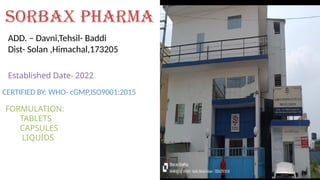
SORBAX PHARMA
ADD. – Davni,Tehsil- Baddi
Dist- Solan ,Himachal,173205
FORMULATION:
TABLETS
CAPSULES
LIQUIDS
CERTIFIED BY: WHO- cGMP,ISO9001:2015
Established Date- 2022
CONTENT
1.Introduction
2.Packginig mission
3.Type of packing material
4. Packing material uses
5.Types of plastics
6. Describe the different type of packing machine
—
PAC GING
ACEUTICAL
• Protection from Environmental
conditions
• Non-reactive with the product
• Not impart taste or Order to the
product
• Non toxic
INTRODUCTION
* Packaging is the science, art and technology
of enclosing or protecting products for
distribution, storage, sale, and use.
* Packaging also refers to the process of
design, evaluation, and production of
packages.
* Pharmaceutical packaging can be defined as the
economical means of providing presentation,
protection, identification , information,
convenience
,compliance , integrity and stability of the product .
FUNCTIONS OF PACKAGING-
• Product Identification:- Packaging greatly helps
in identification of products.
• Product Protection:- Packaging protects the contents
of a product from spoilage, breakage, leakage, etc.
• Facilitating the use of product:- Packaging should
be convenience to open, handle and use for the
consumers.
• Product Promotion:- Packaging is also used for
promotional and attracting the attention of the
people while purchasing.
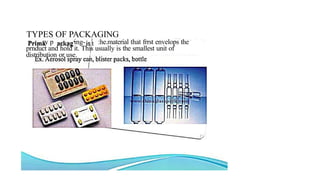
TYPES OF PACKAGING
ry p ing- :he.material that frrst envelops the
prnduct and hold it. This usually is the smallest unit of
distribution or use.
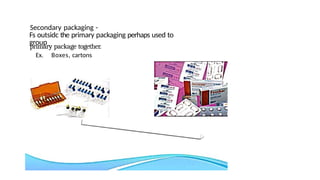
Secondary packaging -
Fs outsidc the primary packaging perhaps used to
group
primary package together.
Ex. Boxes, cartons
PACKAGE TESTING
Drop test
e Vibration test
e Shock test
Inclined impact test
Revolving drum test
TYPES OF PACKAGING MATERIALS USED FOR
PHARMACEUTICAL PACKGING
Glass
• Plastics
• Rubbers
Paper/card boards
Metals
THE CHOICE OF PACKAGING
MATERIAL WILL DEPEND UPON
The degree of protection required
Compatibility with the dosage form
e Customer convenience e.g. size, weight of dosage
form,
* Filling method
e Sterilization method to be employed and cost
Glass has been widely used as a drug packaging material
Advantages
* They are transparent.
They have good protection power. They
can be easily labelled.
Economical
Variety of sizes and shapes
Disadvantages
* Glass is fragile so easily broken.
° Release alkali to aqueous
preparation
PLASTIC
e Plastics may be defined as any group of substances, of natural or
synthetic origins, consisting chiefly of polymers of high molecular
weight that can be moulded into n shape or form by heat and
Advantages
° Less weight than glass,
< fiexib!e
< Variety of sizes and shapes
e Essentially chemically inert, strong, rigid Safety use, high quality,
various designs
Extremely resistant to breakage
Disadvantages
° Absorption permeable to moisture
° Poor printing, thermostaiic charge
TYPEF‘OF PLASTICS
. ...
When heated they may become flexible but they do not become
liquid
e.g. Urea formaldehyde (UF),Pheno[ formaldehyde ,Melamine
formaldehyde (MF), Epoxy resins (epoxides), Polyurethanes (PURs)
Thermoplastice type-
On heating they are soften to viscous fiuid which harden again on
cooling.
e,g. Polyethylene{HDPE — LDPE},
Polyvinylchloride(PVC),Polystyrene Polypropylene, Nylon(PA),
Polyethylene tereplhalate(PET) ,Polyvinylidene chloride(PVdC),
Polycarbonate Acryloniirile butadiene styrene(ABS)
STRIPUACKAGE
> A strip package is a form of unit dose packaging that is
commonly used for the packaging of tablets and capsule .
* A strip package is formed by feeding two webs of a heat
sealable flexible through heated crimping roller.
< The product is dropped into the pocket formed prior to
forming the final set of seals. A continuous strip of packets is
formed in general.
* The strip of packets is cut into desired number of packets.
^ Different packaging materials used are:
paper/polyethylene/foil/PVC.
BLISTER PACKAGE:
* Blister package provides excellent environmental protection, and
efficacious appearance.
lt also provides user functionality in terms of convenience , child
resistance and tamper resistance
The blister package is formed by heat softening a sheet of
thennoplastic resin and vacuum drawing the soften sheet of plastic
into a contoured mold .
After cooling the sheet is released from the mold and proceeds to the
filling station of the machine. It is then lidded with hcat scalable
backing material
Peel able backing material is used to meet thc requirements of
child resistance packaging.
The material such as polyester or paper is used as a component
of backing lamination.
Materials commonly used for the ihermo formable blister are
PVC, polyethylene combinations , polystyrene and
polypropylene.
BOTTLE SEALS
A bottle may be made tampRr resistant by bonding and inner
seal to the rim of the bottle in such a way that the product
can only be attained by destroying the seal .
< Typically glassine liners are two ply laminations use in two
sheet of glassine papRr bounded together with wax or
adhesive
° . For pressure sensitive inner seals pressure sensitive adhesive is
coated on the surface of the inner seal as an encapsulated
adhesive.
TAPE SEALS
* It involves the application of glued or pressure sensitive tape or
label around or over the closure of the package which is to be
destroyed to obtain the product.
The paper used must often is a high density light weight paper
with poor tear strength.
BRUARABLE CAPS
> Breakable closures come in many different designs.
< ThC £Dll-on cap design of aluminium shell used fDr carbonated
beverages.
° The bottom portion of the cap is rolled around the bottle neck
finish.
* The lower portion of the cap blank is usually perforated so that
it breaks awny when the cap is unscrewed. The bottom portion
of the closure has a tear away strip.
For solid particles :
Three types of packing machine
1. Blister packing machine
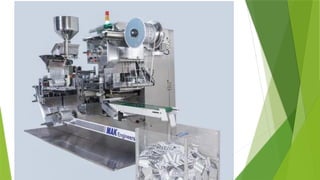
2. ALU - ALU packing machine
3. Automatic Strip packing machine
• Pvc foil+ printed foil
• Hopper
• Plate
• Sealing station of blister
• Farming station
• Making pocket
• Temperature 180-210°c
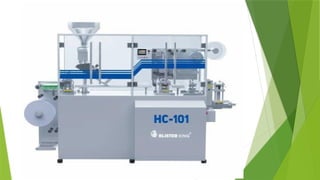
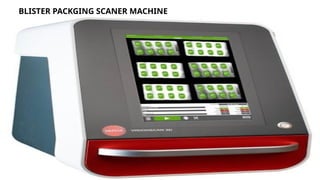
1.Blister packing machine :-
BLISTER PACKGING SCANER MACHINE
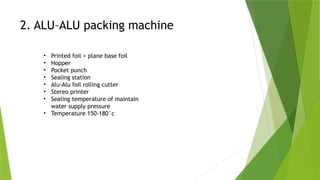
2. ALU–ALU packing machine
• Printed foil + plane base foil
• Hopper
• Pocket punch
• Sealing station
• Alu-Alu foil rolling cutter
• Stereo printer
• Sealing temperature of maintain
water supply pressure
• Temperature 150-180°c
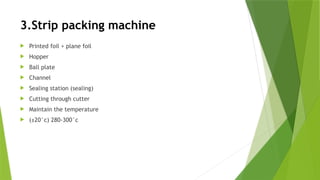
3.Strip packing machine
 Printed foil + plane foil
 Hopper
 Ball plate
 Channel
 Sealing station (sealing)
 Cutting through cutter
 Maintain the temperature
 (±20°c) 280-300°c
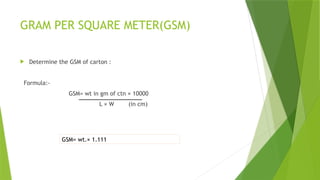
GRAM PER SQUARE METER(GSM)
 Determine the GSM of carton :
Formula:-
GSM= wt in gm of ctn × 10000
L × W (in cm)
GSM= wt.× 1.111
THANK
YOU

B PHARM PHARMACY PRACTICE SCHOOL PPT.pptx

  • 1.
    K.K. UNIVERSITY PRESENTED BY: Name: Mithilesh Kumar Branch : B. Pharmacy Enrollment No : 21080100070 Semester : 7th Year : 4th Season : 2021-25 SUBJECT. : PRACTICE SCHOOL SUBJECT CODE : BP 706PS SUBMITTED TO : Muskan mam Asst. prof. kk University Nalanda (school of pharmacy & paramedical sciences Nalanda Bihar) PHARMACEUTICAL INDUSTRIEAL TRAINING
  • 2.
    SORBAX PHARMA ADD. –Davni,Tehsil- Baddi Dist- Solan ,Himachal,173205 FORMULATION: TABLETS CAPSULES LIQUIDS CERTIFIED BY: WHO- cGMP,ISO9001:2015 Established Date- 2022
  • 3.
    CONTENT 1.Introduction 2.Packginig mission 3.Type ofpacking material 4. Packing material uses 5.Types of plastics 6. Describe the different type of packing machine
  • 4.
    — PAC GING ACEUTICAL • Protectionfrom Environmental conditions • Non-reactive with the product • Not impart taste or Order to the product • Non toxic
  • 5.
    INTRODUCTION * Packaging isthe science, art and technology of enclosing or protecting products for distribution, storage, sale, and use. * Packaging also refers to the process of design, evaluation, and production of packages. * Pharmaceutical packaging can be defined as the economical means of providing presentation, protection, identification , information, convenience ,compliance , integrity and stability of the product .
  • 6.
    FUNCTIONS OF PACKAGING- •Product Identification:- Packaging greatly helps in identification of products. • Product Protection:- Packaging protects the contents of a product from spoilage, breakage, leakage, etc. • Facilitating the use of product:- Packaging should be convenience to open, handle and use for the consumers. • Product Promotion:- Packaging is also used for promotional and attracting the attention of the people while purchasing.
  • 7.
    TYPES OF PACKAGING ryp ing- :he.material that frrst envelops the prnduct and hold it. This usually is the smallest unit of distribution or use.
  • 8.
    Secondary packaging - Fsoutsidc the primary packaging perhaps used to group primary package together. Ex. Boxes, cartons
  • 9.
    PACKAGE TESTING Drop test eVibration test e Shock test Inclined impact test Revolving drum test
  • 10.
    TYPES OF PACKAGINGMATERIALS USED FOR PHARMACEUTICAL PACKGING Glass • Plastics • Rubbers Paper/card boards Metals
  • 11.
    THE CHOICE OFPACKAGING MATERIAL WILL DEPEND UPON The degree of protection required Compatibility with the dosage form e Customer convenience e.g. size, weight of dosage form, * Filling method e Sterilization method to be employed and cost
  • 12.
    Glass has beenwidely used as a drug packaging material Advantages * They are transparent. They have good protection power. They can be easily labelled. Economical Variety of sizes and shapes Disadvantages * Glass is fragile so easily broken. ° Release alkali to aqueous preparation
  • 13.
    PLASTIC e Plastics maybe defined as any group of substances, of natural or synthetic origins, consisting chiefly of polymers of high molecular weight that can be moulded into n shape or form by heat and Advantages ° Less weight than glass, < fiexib!e < Variety of sizes and shapes e Essentially chemically inert, strong, rigid Safety use, high quality, various designs Extremely resistant to breakage Disadvantages ° Absorption permeable to moisture ° Poor printing, thermostaiic charge
  • 14.
    TYPEF‘OF PLASTICS . ... Whenheated they may become flexible but they do not become liquid e.g. Urea formaldehyde (UF),Pheno[ formaldehyde ,Melamine formaldehyde (MF), Epoxy resins (epoxides), Polyurethanes (PURs) Thermoplastice type- On heating they are soften to viscous fiuid which harden again on cooling. e,g. Polyethylene{HDPE — LDPE}, Polyvinylchloride(PVC),Polystyrene Polypropylene, Nylon(PA), Polyethylene tereplhalate(PET) ,Polyvinylidene chloride(PVdC), Polycarbonate Acryloniirile butadiene styrene(ABS)
  • 15.
    STRIPUACKAGE > A strippackage is a form of unit dose packaging that is commonly used for the packaging of tablets and capsule . * A strip package is formed by feeding two webs of a heat sealable flexible through heated crimping roller. < The product is dropped into the pocket formed prior to forming the final set of seals. A continuous strip of packets is formed in general. * The strip of packets is cut into desired number of packets. ^ Different packaging materials used are: paper/polyethylene/foil/PVC.
  • 16.
    BLISTER PACKAGE: * Blisterpackage provides excellent environmental protection, and efficacious appearance. lt also provides user functionality in terms of convenience , child resistance and tamper resistance The blister package is formed by heat softening a sheet of thennoplastic resin and vacuum drawing the soften sheet of plastic into a contoured mold . After cooling the sheet is released from the mold and proceeds to the filling station of the machine. It is then lidded with hcat scalable backing material Peel able backing material is used to meet thc requirements of child resistance packaging. The material such as polyester or paper is used as a component of backing lamination. Materials commonly used for the ihermo formable blister are PVC, polyethylene combinations , polystyrene and polypropylene.
  • 17.
    BOTTLE SEALS A bottlemay be made tampRr resistant by bonding and inner seal to the rim of the bottle in such a way that the product can only be attained by destroying the seal . < Typically glassine liners are two ply laminations use in two sheet of glassine papRr bounded together with wax or adhesive ° . For pressure sensitive inner seals pressure sensitive adhesive is coated on the surface of the inner seal as an encapsulated adhesive. TAPE SEALS * It involves the application of glued or pressure sensitive tape or label around or over the closure of the package which is to be destroyed to obtain the product. The paper used must often is a high density light weight paper with poor tear strength.
  • 18.
    BRUARABLE CAPS > Breakableclosures come in many different designs. < ThC £Dll-on cap design of aluminium shell used fDr carbonated beverages. ° The bottom portion of the cap is rolled around the bottle neck finish. * The lower portion of the cap blank is usually perforated so that it breaks awny when the cap is unscrewed. The bottom portion of the closure has a tear away strip.
  • 19.
    For solid particles: Three types of packing machine 1. Blister packing machine 2. ALU - ALU packing machine 3. Automatic Strip packing machine • Pvc foil+ printed foil • Hopper • Plate • Sealing station of blister • Farming station • Making pocket • Temperature 180-210°c 1.Blister packing machine :-
  • 21.
  • 22.
    2. ALU–ALU packingmachine • Printed foil + plane base foil • Hopper • Pocket punch • Sealing station • Alu-Alu foil rolling cutter • Stereo printer • Sealing temperature of maintain water supply pressure • Temperature 150-180°c
  • 24.
    3.Strip packing machine Printed foil + plane foil  Hopper  Ball plate  Channel  Sealing station (sealing)  Cutting through cutter  Maintain the temperature  (±20°c) 280-300°c
  • 26.
    GRAM PER SQUAREMETER(GSM)  Determine the GSM of carton : Formula:- GSM= wt in gm of ctn × 10000 L × W (in cm) GSM= wt.× 1.111
  • 27.