Methods of Value Capture
4th Session in MT5016
Biz Models for Hi-Tech Products
A/Prof Jeffrey Funk
Division of Engineering and Technology Management
National University of Singapore
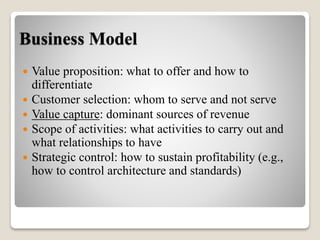
Business Model
 Value proposition: what to offer and how to
differentiate
 Customer selection: whom to serve and not serve
 Value capture: dominant sources of revenue
 Scope of activities: what activities to carry out and
what relationships to have
 Strategic control: how to sustain profitability (e.g.,
how to control architecture and standards)
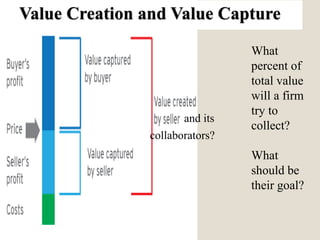
What
percent of
total value
will a firm
try to
collect?
What
should be
their goal?
and its
collaborators?
Value Creation and Value Capture
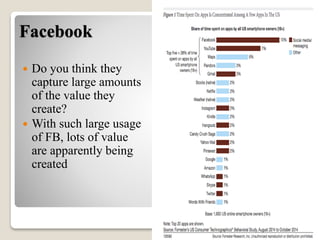
Facebook
 Do you think they
capture large amounts
of the value they
create?
 With such large usage
of FB, lots of value
are apparently being
created
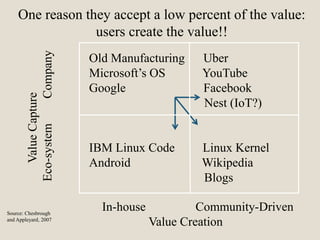
Old Manufacturing Uber
Microsoft’s OS YouTube
Google Facebook
Nest (IoT?)
IBM Linux Code Linux Kernel
Android Wikipedia
Blogs
In-house Community-Driven
Value Creation
ValueCapture
Eco-systemCompany
One reason they accept a low percent of the value:
users create the value!!
Source: Chesbrough
and Appleyard, 2007
Value Creation and Value Capture
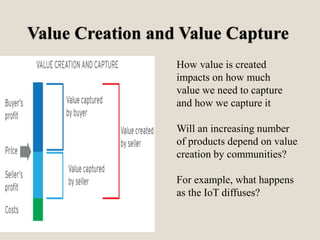
How value is created
impacts on how much
value we need to capture
and how we capture it
Will an increasing number
of products depend on value
creation by communities?
For example, what happens
as the IoT diffuses?
Outline
 Overview of Value Capture
 Examples
◦ Computers
◦ Rolls Royce Jet Engines
◦ Infrastructure: Alstom Transport
◦ Internet of Things
◦ Media
 past, present, future
 can this tell us something about IoT?
 Conclusions
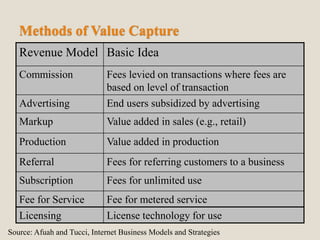
Methods of Value Capture
Revenue Model Basic Idea
Commission Fees levied on transactions where fees are
based on level of transaction
Advertising End users subsidized by advertising
Markup Value added in sales (e.g., retail)
Production Value added in production
Referral Fees for referring customers to a business
Subscription Fees for unlimited use
Fee for Service Fee for metered service
Licensing License technology for use
Source: Afuah and Tucci, Internet Business Models and Strategies
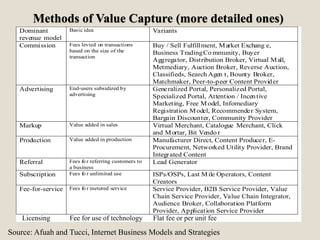
Methods of Value Capture (more detailed ones)
Dominant
revenue model
Basic idea Variants
Commission Fees levied on transactions
based on the size of the
transaction
Buy / Sell Fulfillment, Market Exchang e,
Business TradingCo mmunity, Buyer
Aggregator, Distribution Broker, Virtual Mall,
Metmediary, Auction Broker, Reverse Auction,
Classifieds, Search Agen t, Bounty Broker,
Matchmaker, Peer-to-peer Content Provider
Advertising End-users subsidized by
advertising
Generalized Portal, Personalized Portal,
Specialized Portal, Attention / Incentive
Marketing, Free Model, Infomediary
Registration Model, Recommender System,
Bargain Discounter, Community Provider
Markup Value added in sales Virtual Merchant, Catalogue Merchant, Click
and Mortar, Bit Vendo r
Production Value added in production Manufacturer Direct, Content Producer, E-
Procurement, Networked Utility Provider, Brand
Integrated Content
Referral Fees fo r referring customers to
a business
Lead Generator
Subscription Fees fo r unlimited use ISPs/OSPs, Last Mile Operators, Content
Creators
Fee-for-service Fees fo r metered service Service Provider, B2B Service Provider, Value
Chain Service Provider, Value Chain Integrator,
Audience Broker, Collaboration Platform
Provider, Application Service Provider
Source: Afuah and Tucci, Internet Business Models and Strategies
Licensing Fee for use of technology Flat fee or per unit fee
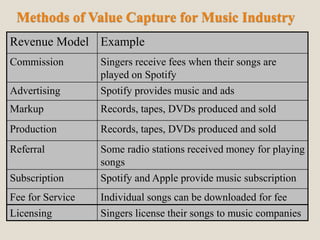
Methods of Value Capture for Music Industry
Revenue Model Example
Commission Singers receive fees when their songs are
played on Spotify
Advertising Spotify provides music and ads
Markup Records, tapes, DVDs produced and sold
Production Records, tapes, DVDs produced and sold
Referral Some radio stations received money for playing
songs
Subscription Spotify and Apple provide music subscription
Fee for Service Individual songs can be downloaded for fee
Licensing Singers license their songs to music companies
At What Price?
 After choosing one of the categories on
the previous slides, an additional issue is:
◦ how much to charge for each element of the
product or service?
 Supply and demand curves help us think
about pricing and value capture
 So does cost structure
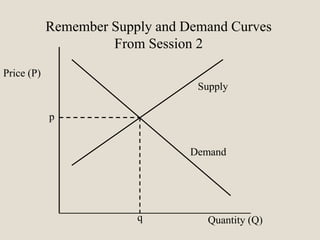
Quantity (Q)
Price (P)
q
p
Remember Supply and Demand Curves
From Session 2
Demand
Supply
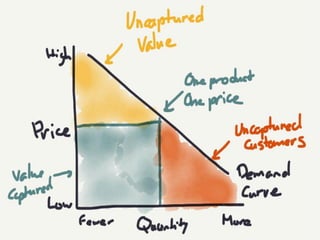
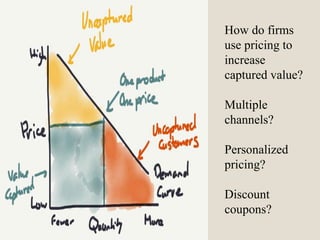
How do firms
use pricing to
increase
captured value?
Multiple
channels?
Personalized
pricing?
Discount
coupons?
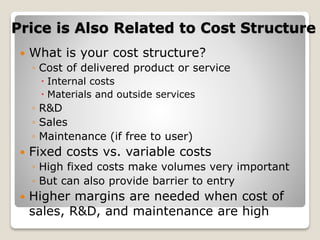
Price is Also Related to Cost Structure
 What is your cost structure?
◦ Cost of delivered product or service
 Internal costs
 Materials and outside services
◦ R&D
◦ Sales
◦ Maintenance (if free to user)
 Fixed costs vs. variable costs
◦ High fixed costs make volumes very important
◦ But can also provide barrier to entry
 Higher margins are needed when cost of
sales, R&D, and maintenance are high
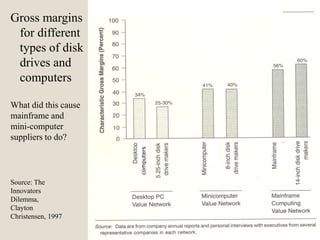
Gross margins
for different
types of disk
drives and
computers
What did this cause
mainframe and
mini-computer
suppliers to do?
computers
Source: The
Innovators
Dilemma,
Clayton
Christensen, 1997
Most Firms Emphasize
Existing Customers
 Easier to make money from existing customers
than to find new customers
 Suppliers of large disk drives, computers did this
◦ slow to find new customers who wanted smaller disk
drives and computers
 Many other firms are doing this now: focusing on
extracting additional value from existing
customers
◦ Cable TV, mobile phones, Google, Amazon
◦ As an aside, lots of jobs for MBAs in these companies
 What is one reason cable TV and mobile phone
companies can focus on extracting value?
May Lead to Disruption
 An emphasis on existing customers and
extracting more value from existing
customers may lead to disruption
 What technologies might disrupt
◦ Cable TV?
◦ Mobile phones?
◦ Google?
◦ Amazon?
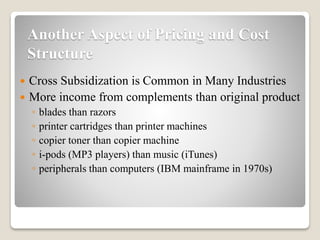
Another Aspect of Pricing and Cost
Structure
 Cross Subsidization is Common in Many Industries
 More income from complements than original product
◦ blades than razors
◦ printer cartridges than printer machines
◦ copier toner than copier machine
◦ i-pods (MP3 players) than music (iTunes)
◦ peripherals than computers (IBM mainframe in 1970s)
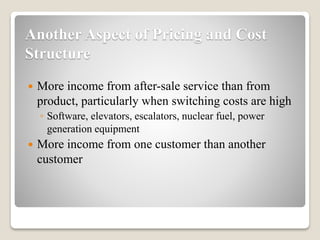
Another Aspect of Pricing and Cost
Structure
 More income from after-sale service than from
product, particularly when switching costs are high
◦ Software, elevators, escalators, nuclear fuel, power
generation equipment
 More income from one customer than another
customer
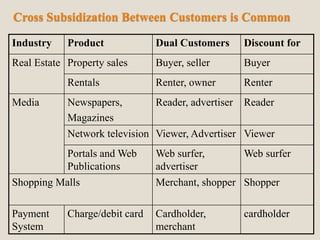
Cross Subsidization Between Customers is Common
Industry Product Dual Customers Discount for
Real Estate Property sales Buyer, seller Buyer
Rentals Renter, owner Renter
Media Newspapers,
Magazines
Reader, advertiser Reader
Network television Viewer, Advertiser Viewer
Portals and Web
Publications
Web surfer,
advertiser
Web surfer
Shopping Malls Merchant, shopper Shopper
Payment
System
Charge/debit card Cardholder,
merchant
cardholder
What if Another Firm Begins Offering
Complements for Your Product?
 Another firm begins offering inexpensive
◦ blades for your razors
◦ printer cartridges for your printers
◦ toner for your copiers
◦ MP3 players for your iTunes music site
 Another firm begins offering inexpensive services for
your hardware
◦ Software, elevators, escalators, nuclear fuel, power generation
equipment
 You might lose your key revenue stream and thus your
profitability
Outline
 Overview of Value Capture
 Other Examples
◦ Computers
◦ Rolls Royce Jet Engines
◦ Infrastructure: Alstom Transport
◦ Internet of Things
◦ Media
 past, present, future
 can this tell us something about IoT?
 Conclusions
Computers (1)
 Most of us buy computers at retail outlets
and retail outlets pay the computer
suppliers
 But there has been a long evolution in
methods of value capture
◦ firms have modified methods of value capture
(and other aspects of biz model) many times
both to survive and find the most profits
 Each “discontinuity” has involved a new
method of value capture
◦ Also differences between firms for the same
discontinuity
Computers (2)
 Mainframe suppliers such as IBM used to
lease computers and software for a
monthly fee
◦ this low monthly fee and IBM’s large software
library created a barrier to entry for other
suppliers
 Mini-computer suppliers found a niche in
mid-1960s by selling computers and
providing documentation for engineers
and scientists who developed their own
software
Computers (3)
 PC suppliers in mid-1970s took mini-computer
method of value capture one step further
◦ More documentation in the form of more “open
system,” which enabled greater choice of software for
users
◦ Purchased microprocessors, other ICs, software from
other firms, sold computers through retail outlets
◦ Low development costs, no sales people, and higher
volumes enabled them to have lower margins
(remember previous slide)
 Software suppliers tried various methods of
value capture
◦ Microsoft received licensing fee for each PC sold
Software
 PC software
◦ IBM offered Microsoft a lump sum payment
for OS
◦ Microsoft wanted a licensing fee per PC
◦ What are the advantages and disadvantages
of each approach?
 Now, service revenues are now greater
than licensing fees for packaged
software and software as service
 Everything is moving to the cloud!
 Even manufactured products are
changing with the Internet of Things
Implications for Electronic Products
 Methods of value capture rapidly change
◦ Using the right method is critical
◦ Charging those with ability to pay is important
 Current trend is for electronic products to generate
content revenues
◦ Apple iPod, iPhone, iPhone
◦ Amazon Kindle, Android Phones
◦ Revenues come from a variety of players in an eco-system
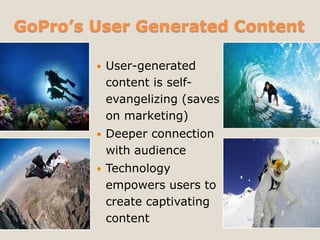
 What about GoPro?
◦ Wearable camera for extreme sports enthusiast
◦ Lots of content is generated by users
◦ Can they promote their product with content?
◦ Can they collect revenues from content?
GoPro’s User Generated Content
 User-generated
content is self-
evangelizing (saves
on marketing)
 Deeper connection
with audience
 Technology
empowers users to
create captivating
content
Outline
 Overview of Value Capture
 Examples
◦ Computers
◦ Rolls Royce Jet Engines
◦ Infrastructure: Alstom Transport
◦ Internet of Things
◦ Media
 past, present, future
 can this tell us something about IoT?
 Conclusions
Rolls Royce Jet Engines
 A leader in providing jet engines for
aircraft manufacturers
 Where do its revenues come from, i.e.,
what is its method of value capture?
 Most of its revenues used to come from
sale of engines
 But over time, things have changed………
Rolls Royce Jet Engines
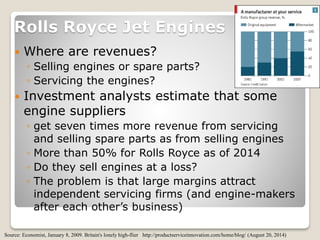
 Where are revenues?
◦ Selling engines or spare parts?
◦ Servicing the engines?
 Investment analysts estimate that some
engine suppliers
◦ get seven times more revenue from servicing
and selling spare parts as from selling engines
◦ More than 50% for Rolls Royce as of 2014
◦ Do they sell engines at a loss?
◦ The problem is that large margins attract
independent servicing firms (and engine-makers
after each other’s business)
Source: Economist, January 8, 2009. Britain's lonely high-flier http://productserviceinnovation.com/home/blog/ (August 20, 2014)
Rolls Royce’s New Method of
Value Capture
 Instead of selling first engines and then parts
and service to airlines, Rolls-Royce
◦ receives a fee for every hour that an engine runs
◦ promises to maintain it and replace it if it breaks
down
 “They aren’t selling engines, they are selling
hot air out the back of an engine,” says an
investment analyst (i.e., new value
proposition) More than half of its engines in
service are covered by such contracts, as are
about 80% of those it is now selling
This New Method of Value Capture
Requires New Capabilities
 Rolls Royce continuously monitors performance of
its 3,500 jet engines around the world,
 This data enables it to predict when engines are
more likely to fail, enabling more effective engine
changes
◦ fewer emergency repairs and fewer unhappy passengers
 The data are equally valuable to Rolls-Royce
◦ Spotting problems early helps it to design and build more
reliable engines or to modify existing ones
◦ Aided improvements in fuel efficiency and extended the
operating life of engines tenfold (to about ten years
between major rebuilds)
Rivals – Barriers to Entry
 How easy is it for rivals to service Rolls Royce
Engines?
 How does Roll Royce do something that makes it
harder for rivals to service their engines
Can this method be applied to
other products?
 Can we apply this idea to other products?
how about stand-up comedians or comedy
movies?
 http://www.bbc.com/news/technology-
29551380
Outline
 Overview of Value Capture
 Examples
◦ Computers
◦ Rolls Royce Jet Engines
◦ Infrastructure: Alstom Transport
◦ Internet of Things
◦ Media
 past, present, future
 can this tell us something about IoT?
 Conclusions
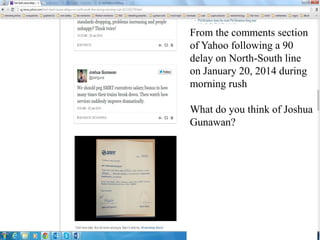
From the comments section
of Yahoo following a 90
delay on North-South line
on January 20, 2014 during
morning rush
What do you think of Joshua
Gunawan?
Alstom Transport (1)
 Alstom is a leading provider of transport
equipment and (e.g., rail) solutions in the world
 Problems with train downtime caused rail
companies to demand and pay for lower
downtimes
 London Underground specified in a contract that
96 trains be available for service each day
 This required Alstom to gradually take over
customer’s operational activities and to redesign
the system for lower downtime
 Should Alstom charge for time and distance that
trains travel?
Alstom Transport (2)
 Another change Alstom made to support
lower downtime of its transport division was
to create two customer-facing divisions:
◦ Alstom Systems provides turnkey solutions for
trains, signaling systems and maintenance services
◦ Alstom Services offers operational services, such as
train maintenance, technical support, product
upgrades and renovation
 This change represents a form of
organizational capability. For example,
feedback from Alstom Services enables
Alstom’s Systems design better turnkey
systems
Similar Examples (1)
 Many providers of
◦ mobile phone infrastructure providers (e.g.,
Ericsson)
◦ Elevators and escalators
◦ Electrical generating equipment
◦ Nuclear fuel
◦ Manufacturing equipment
 are selling services (value proposition)
and getting paid more money (method of
value capture) for doing services than for
manufactured product
Similar Examples (2)
 These providers of equipment and service
know the equipment and service better than
the customer – thus they do the service
 One reason they know the equipment and
service is because they spend a lot on R&D
 They spend a lot on R&D because they sell
systems to many customers
 Related to method of strategic control
◦ Economies of scale in R&D
◦ Mentioned in session 2
Remember
 Changes in business models often cause
the shares of firms to change……..
 Change creates opportunities
Outline
 Overview of Value Capture
 Examples
◦ Computers
◦ Rolls Royce Jet Engines
◦ Infrastructure: Alstom Transport
◦ Internet of Things
◦ Media
 past, present, future
 can this tell us something about IoT?
 Conclusions
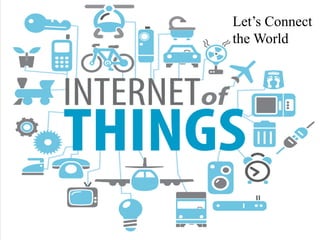
Let’s Connect
the World
Internet of Things
 Enables new value propositions and enables new
sources of revenues from these value propositions
 These value propositions and revenues go beyond
those offered by Rolls Royce
 Value propositions for IoT were discussed in Session
3; for equipment and products, IoT enables
◦ Monitor
◦ Control
◦ Automation
 How can revenues be obtained from this additional
value?
Method of Value Capture for IoT
 Use data to better understand customer needs
◦ Amazon uses data from Kindle to make better
recommendations
◦ Retailers use data on customers in store (through iBeacon)
to make recommendations
 Reduce costs
◦ Farms use data to reduce costs
◦ Owners of equipment can reduce costs by monitoring
equipment location (and recovering stolen or misplaced
items)
◦ Insurance companies can reduce costs by better
understanding and reducing risk
Example of Insurance
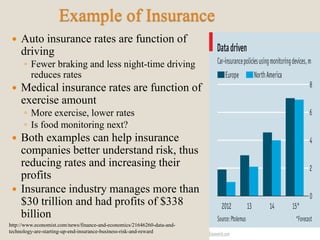
 Auto insurance rates are function of
driving
◦ Fewer braking and less night-time driving
reduces rates
 Medical insurance rates are function of
exercise amount
◦ More exercise, lower rates
◦ Is food monitoring next?
 Both examples can help insurance
companies better understand risk, thus
reducing rates and increasing their
profits
 Insurance industry manages more than
$30 trillion and had profits of $338
billion
http://www.economist.com/news/finance-and-economics/21646260-data-and-
technology-are-starting-up-end-insurance-business-risk-and-reward
Method of Value Capture for IoT (2)
 Provide more value to customers
◦ Transport companies can provide better services if they
have better data on starting and ending points
◦ Equipment sellers can provide more uptime,
troubleshooting, and preventative maintenance for users
◦ This requires close cooperation between sellers and buyers
 Selling data
◦ Who provides Nest (thermostat) with most revenues?
◦ Will similar things emerge with other mechanical
products?
◦ Will third parties (complex value chains) collect and sell
this data?
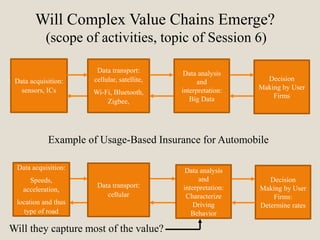
Data acquisition:
sensors, ICs
Data transport:
cellular, satellite,
Wi-Fi, Bluetooth,
Zigbee,
Data analysis
and
interpretation:
Big Data
Will Complex Value Chains Emerge?
(scope of activities, topic of Session 6)
Example of Usage-Based Insurance for Automobile
Decision
Making by User
Firms
Data acquisition:
Speeds,
acceleration,
location and thus
type of road
Data transport:
cellular
Data analysis
and
interpretation:
Characterize
Driving
Behavior
Decision
Making by User
Firms:
Determine rates
Will they capture most of the value?
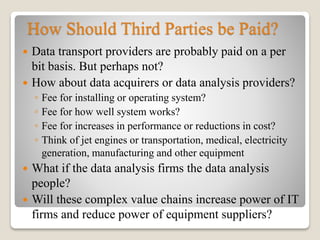
How Should Third Parties be Paid?
 Data transport providers are probably paid on a per
bit basis. But perhaps not?
 How about data acquirers or data analysis providers?
◦ Fee for installing or operating system?
◦ Fee for how well system works?
◦ Fee for increases in performance or reductions in cost?
◦ Think of jet engines or transportation, medical, electricity
generation, manufacturing and other equipment
 What if the data analysis firms the data analysis
people?
 Will these complex value chains increase power of IT
firms and reduce power of equipment suppliers?
What does this tell us About
Internet of Things?
 There will be change
 As data becomes more important part of business
◦ Managing this data will become more important
 Who will manage the data?
 Will it be manufacturers of products, users of products, or
new entrants; new entrants include providers of
◦ Data acquisition, transport, analysis
 Internet companies such as Google, FB, Apple (and
new entrants) have advantages
◦ Experience with managing data
◦ Power on Internet
What does this tell us About
Internet of Things? (2)
 Winners will provide good value propositions and
methods of value capture
 There will be many experiments to find the best value
propositions and methods of value capture
 Market power is also important
 Internet companies such as Google, FB, Apple (and
new entrants) have advantages
◦ Experience with managing data
◦ Power on Internet
 Product manufacturers need to be innovative in their
value propositions, methods of value propositions
(and scopes of activities)
Outline
 Overview of Value Capture
 Examples
◦ Computers
◦ Rolls Royce Jet Engines
◦ Infrastructure: Alstom Transport
◦ Internet of Things
◦ Media
 past, present, future
 can this tell us something about IoT?
 Conclusions
Evolution of Media Sector
 It has become a data intensive industry
 Technological change in how the data is managed
has caused large changes in the major players and in
the value chains
 The music industry was mentioned at the beginning
of these slides
 What about movies and videos?
 Can the evolution of this industry tell us something
about the evolution of Internet of Things?
Income from Videos/Movies
 Theater tickets from about 1900
 Broadcast television ad revenues from late 1940s
 Cable (from 50s) & satellite (from 90s) subscription
fees
 Rental and sales income from VHS from late 1970s,
from DVDs in 1990s
◦ Rental stores pay movie companies fixed fee or percentage
of rental/sales income
◦ Netflix extended this model to mail delivery service and
Redbox extended it to rental kiosks in 2000s
 Internet services
◦ Big changes occurring now
Internet Services
 Growth in Internet has soared in 20th century with
desktops, laptops, smart phones, tablet computers
 Many users are quitting cable and satellite (and
mobile phone) services, only relying on Internet
 Will Internet become main method of delivery?
◦ Users watching streamed videos from Netflix
◦ Viewing YouTube or other videos for free
◦ Purchasing videos from Apple or Amazon
 Let’s look at most successful firms in more detail
◦ Netflix, Google/YouTube
◦ Facebook, new services, and video ads
◦ Apple
◦ Twitter and Periscope
Netflix
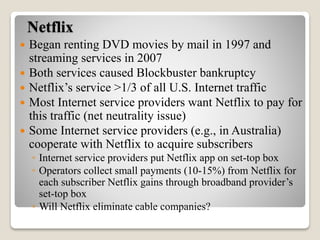
 Began renting DVD movies by mail in 1997 and
streaming services in 2007
 Both services caused Blockbuster bankruptcy
 Netflix’s service >1/3 of all U.S. Internet traffic
 Most Internet service providers want Netflix to pay for
this traffic (net neutrality issue)
 Some Internet service providers (e.g., in Australia)
cooperate with Netflix to acquire subscribers
◦ Internet service providers put Netflix app on set-top box
◦ Operators collect small payments (10-15%) from Netflix for
each subscriber Netflix gains through broadband provider’s
set-top box
◦ Will Netflix eliminate cable companies?
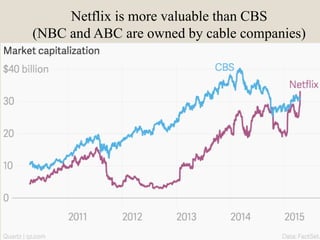
Netflix is more valuable than CBS
(NBC and ABC are owned by cable companies)
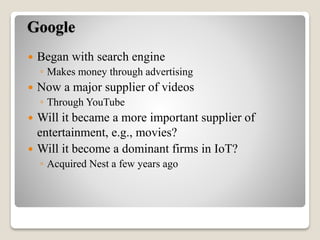
Google
 Began with search engine
◦ Makes money through advertising
 Now a major supplier of videos
◦ Through YouTube
 Will it became a more important supplier of
entertainment, e.g., movies?
 Will it become a dominant firms in IoT?
◦ Acquired Nest a few years ago
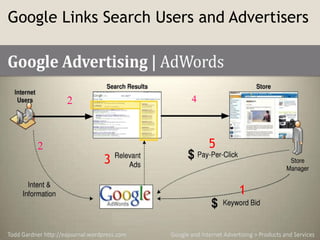
Google Links Search Users and Advertisers
1
3
5
2 4
2
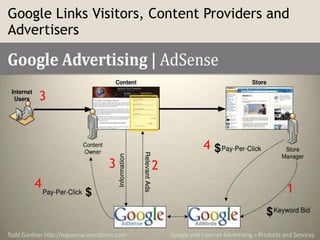
Google Links Visitors, Content Providers and
Advertisers
1
3
3
2
4
4
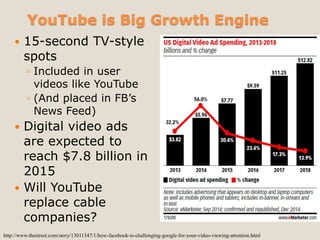
YouTube is Big Growth Engine
 15-second TV-style
spots
◦ Included in user
videos like YouTube
◦ (And placed in FB’s
News Feed)
 Digital video ads
are expected to
reach $7.8 billion in
2015
 Will YouTube
replace cable
companies?
http://www.thestreet.com/story/13011347/1/how-facebook-is-challenging-google-for-your-video-viewing-attention.html
YouTube Created New Eco-System
 YouTube has enabled new singers, comedians, and
other performers to succeed
◦ http://monetizepros.com/features/25-celebrities-who-got-
rich-famous-on-youtube/
◦ Many kids videos
 They receive a portion of the ad revenues
◦ YouTube takes 45%
◦ Some sell downloads of videos, songs, or subscriptions
 Some promote the new performers
◦ Performers endorse products, make public appearances
 Promoting products with infomercials is also a big
business
◦ As is managing these infomercials
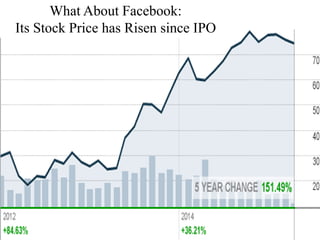
What About Facebook:
Its Stock Price has Risen since IPO
Facebook
 Has experienced rapid growth in number
of users
 One of most popular websites
◦ https://en.wikipedia.org/wiki/List_of_most_po
pular_websites
 Question for FB has always been, how
can it make money from these users
 FB uses data on users to help companies
target users with display ads
◦ gender, age, location, marital status,
languages, education, workplaces, and
interests
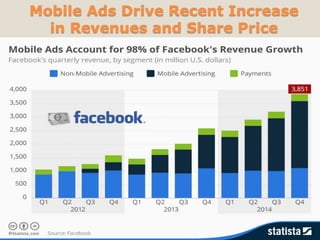
Mobile Ads Drive Recent Increase
in Revenues and Share Price
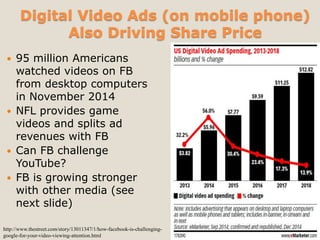
Digital Video Ads (on mobile phone)
Also Driving Share Price
 95 million Americans
watched videos on FB
from desktop computers
in November 2014
 NFL provides game
videos and splits ad
revenues with FB
 Can FB challenge
YouTube?
 FB is growing stronger
with other media (see
next slide)
http://www.thestreet.com/story/13011347/1/how-facebook-is-challenging-
google-for-your-video-viewing-attention.html
Big Source of Future Revenues?
 FB hosts news articles from newspapers
◦ NY Times, National Geographic
◦ FB shares ad revenue with news sites
 Hosting improves user experience
◦ Faster access to news, particularly important on
mobile devices
 Reduces power of news sites
◦ Less time spent on news sites
 Increases power of FB in media
Big Source of Future Revenues? (2)
 Will FB host more types of content
including more video services in future?
 Will these video services include full-
length movies, short comedy routines,
or new performers (like YouTube)?
 Will this enable FB to challenge
YouTube, cable companies, and movie
companies?
 Can FB or Google become a movie
producer?
◦ just like Amazon has become a publisher
Apple
 Highest market capitalization in world
 Most valuable brand name
 Leading supplier of hardware for
accessing the Internet
◦ iPhone, iPad, iPod, MacBook
 Its users are lead users for video and
other services
◦ Large purchasers of music, video, other
content
 Gives Apple much power in any content
negotiations
Apple (2)
 Recently introduced $10 a month music
streaming service (same price as
Spotify)
 Video streaming services are emerging
◦ With HBO (14.99 a month, more expensive
than Netflix’s $7.99 a month service)
◦ With Showtime, expected soon
◦ Probably more will be announced
 These services will continue to weaken
cable companies
 Will Apple (or Google) extend its
domination to television hardware?
Twitter and Periscope
 Another media giant? ($20B market cap)
 Users send 140-character messages
called tweets
 Registered users can read, post tweets
 Unregistered users can only read them
 Users access twitter through website,
SMS, or mobile app
 Twitter makes money through ads, but
future is still unclear
 Twitter recently acquired Periscope
Twitter and Periscope (2)
 Recently introduced Periscope, personal
broadcasting
 Users broadcast from phone by staring at
phone’s camera
 Periscope app notifies others that you are
streaming live video of yourself
 Lots of celebrities want to reveal more about
themselves
 Text responses come almost immediately as the
streaming is started
 How much advertising might this generate?
 How might this change video industry?
Summary of Movie/Video Industry
 Movie companies are still there (Universal, Disney,
Warner Brothers, Paramount) with some changes in
ownership
 But broadcasting companies (CBS, NBC, ABC) are
much weaker and
◦ cable companies (both channels and delivery platforms)
may face same problems as Internet continues to grow in
importance
 Will Netflix, Google, FB, and Apple become
stronger and dominant media industries?
Summary of Movie/Video Industry (2)
 New value propositions, methods of value capture
(and scopes of activities) continue to emerge
◦ From Netflix, Google, FB, and Apple
◦ But also from other incumbents (e.g., Twitter) and
probably from new entrants
 Power also matters
◦ Google, FB, and Apple use their power to enter new
markets
 Will Google, FB, and Apple (and Amazon) become
leaders in media and in Internet of Things?
Conclusions (1)
 New technologies, new markets, and new levels of
value (dis)integration often require new methods of
value capture
 But there are no simple answers to the best methods of
value capture
 Of course you want to maximize revenue, but without
losing customers and collaborators
 One firm’s method of value capture depends on
◦ method of value capture by competition, collaborators
◦ customer needs
Conclusions (2)
 Contrasting industries and analyzing whether
methods of value capture can be borrowed from
other industries is a good place to start
 Also look for consistency among different
elements (customer selection, method of value
capture, value proposition, scope of activities) of
business model
For Your Presentations
 Do not just tell me the sources of revenue for your firm
◦ Identifying these revenue streams is just one step in your
analysis
 Analyze alternative methods of value capture. As stated
on previous slide
◦ Contrasting industries and analyzing whether methods of value
capture can be borrowed from other industries is a good place
to start
◦ Also look for consistency among different elements (customer
selection, method of value capture, value proposition, scope of
activities) of business model

Biz model 4 method of value capture

  • 1.
    Methods of ValueCapture 4th Session in MT5016 Biz Models for Hi-Tech Products A/Prof Jeffrey Funk Division of Engineering and Technology Management National University of Singapore
  • 2.
    Business Model  Valueproposition: what to offer and how to differentiate  Customer selection: whom to serve and not serve  Value capture: dominant sources of revenue  Scope of activities: what activities to carry out and what relationships to have  Strategic control: how to sustain profitability (e.g., how to control architecture and standards)
  • 3.
    What percent of total value willa firm try to collect? What should be their goal? and its collaborators? Value Creation and Value Capture
  • 4.
    Facebook  Do youthink they capture large amounts of the value they create?  With such large usage of FB, lots of value are apparently being created
  • 5.
    Old Manufacturing Uber Microsoft’sOS YouTube Google Facebook Nest (IoT?) IBM Linux Code Linux Kernel Android Wikipedia Blogs In-house Community-Driven Value Creation ValueCapture Eco-systemCompany One reason they accept a low percent of the value: users create the value!! Source: Chesbrough and Appleyard, 2007
  • 6.
    Value Creation andValue Capture How value is created impacts on how much value we need to capture and how we capture it Will an increasing number of products depend on value creation by communities? For example, what happens as the IoT diffuses?
  • 7.
    Outline  Overview ofValue Capture  Examples ◦ Computers ◦ Rolls Royce Jet Engines ◦ Infrastructure: Alstom Transport ◦ Internet of Things ◦ Media  past, present, future  can this tell us something about IoT?  Conclusions
  • 8.
    Methods of ValueCapture Revenue Model Basic Idea Commission Fees levied on transactions where fees are based on level of transaction Advertising End users subsidized by advertising Markup Value added in sales (e.g., retail) Production Value added in production Referral Fees for referring customers to a business Subscription Fees for unlimited use Fee for Service Fee for metered service Licensing License technology for use Source: Afuah and Tucci, Internet Business Models and Strategies
  • 9.
    Methods of ValueCapture (more detailed ones) Dominant revenue model Basic idea Variants Commission Fees levied on transactions based on the size of the transaction Buy / Sell Fulfillment, Market Exchang e, Business TradingCo mmunity, Buyer Aggregator, Distribution Broker, Virtual Mall, Metmediary, Auction Broker, Reverse Auction, Classifieds, Search Agen t, Bounty Broker, Matchmaker, Peer-to-peer Content Provider Advertising End-users subsidized by advertising Generalized Portal, Personalized Portal, Specialized Portal, Attention / Incentive Marketing, Free Model, Infomediary Registration Model, Recommender System, Bargain Discounter, Community Provider Markup Value added in sales Virtual Merchant, Catalogue Merchant, Click and Mortar, Bit Vendo r Production Value added in production Manufacturer Direct, Content Producer, E- Procurement, Networked Utility Provider, Brand Integrated Content Referral Fees fo r referring customers to a business Lead Generator Subscription Fees fo r unlimited use ISPs/OSPs, Last Mile Operators, Content Creators Fee-for-service Fees fo r metered service Service Provider, B2B Service Provider, Value Chain Service Provider, Value Chain Integrator, Audience Broker, Collaboration Platform Provider, Application Service Provider Source: Afuah and Tucci, Internet Business Models and Strategies Licensing Fee for use of technology Flat fee or per unit fee
  • 10.
    Methods of ValueCapture for Music Industry Revenue Model Example Commission Singers receive fees when their songs are played on Spotify Advertising Spotify provides music and ads Markup Records, tapes, DVDs produced and sold Production Records, tapes, DVDs produced and sold Referral Some radio stations received money for playing songs Subscription Spotify and Apple provide music subscription Fee for Service Individual songs can be downloaded for fee Licensing Singers license their songs to music companies
  • 11.
    At What Price? After choosing one of the categories on the previous slides, an additional issue is: ◦ how much to charge for each element of the product or service?  Supply and demand curves help us think about pricing and value capture  So does cost structure
  • 12.
    Quantity (Q) Price (P) q p RememberSupply and Demand Curves From Session 2 Demand Supply
  • 14.
    How do firms usepricing to increase captured value? Multiple channels? Personalized pricing? Discount coupons?
  • 15.
    Price is AlsoRelated to Cost Structure  What is your cost structure? ◦ Cost of delivered product or service  Internal costs  Materials and outside services ◦ R&D ◦ Sales ◦ Maintenance (if free to user)  Fixed costs vs. variable costs ◦ High fixed costs make volumes very important ◦ But can also provide barrier to entry  Higher margins are needed when cost of sales, R&D, and maintenance are high
  • 16.
    Gross margins for different typesof disk drives and computers What did this cause mainframe and mini-computer suppliers to do? computers Source: The Innovators Dilemma, Clayton Christensen, 1997
  • 17.
    Most Firms Emphasize ExistingCustomers  Easier to make money from existing customers than to find new customers  Suppliers of large disk drives, computers did this ◦ slow to find new customers who wanted smaller disk drives and computers  Many other firms are doing this now: focusing on extracting additional value from existing customers ◦ Cable TV, mobile phones, Google, Amazon ◦ As an aside, lots of jobs for MBAs in these companies  What is one reason cable TV and mobile phone companies can focus on extracting value?
  • 18.
    May Lead toDisruption  An emphasis on existing customers and extracting more value from existing customers may lead to disruption  What technologies might disrupt ◦ Cable TV? ◦ Mobile phones? ◦ Google? ◦ Amazon?
  • 19.
    Another Aspect ofPricing and Cost Structure  Cross Subsidization is Common in Many Industries  More income from complements than original product ◦ blades than razors ◦ printer cartridges than printer machines ◦ copier toner than copier machine ◦ i-pods (MP3 players) than music (iTunes) ◦ peripherals than computers (IBM mainframe in 1970s)
  • 20.
    Another Aspect ofPricing and Cost Structure  More income from after-sale service than from product, particularly when switching costs are high ◦ Software, elevators, escalators, nuclear fuel, power generation equipment  More income from one customer than another customer
  • 21.
    Cross Subsidization BetweenCustomers is Common Industry Product Dual Customers Discount for Real Estate Property sales Buyer, seller Buyer Rentals Renter, owner Renter Media Newspapers, Magazines Reader, advertiser Reader Network television Viewer, Advertiser Viewer Portals and Web Publications Web surfer, advertiser Web surfer Shopping Malls Merchant, shopper Shopper Payment System Charge/debit card Cardholder, merchant cardholder
  • 22.
    What if AnotherFirm Begins Offering Complements for Your Product?  Another firm begins offering inexpensive ◦ blades for your razors ◦ printer cartridges for your printers ◦ toner for your copiers ◦ MP3 players for your iTunes music site  Another firm begins offering inexpensive services for your hardware ◦ Software, elevators, escalators, nuclear fuel, power generation equipment  You might lose your key revenue stream and thus your profitability
  • 23.
    Outline  Overview ofValue Capture  Other Examples ◦ Computers ◦ Rolls Royce Jet Engines ◦ Infrastructure: Alstom Transport ◦ Internet of Things ◦ Media  past, present, future  can this tell us something about IoT?  Conclusions
  • 24.
    Computers (1)  Mostof us buy computers at retail outlets and retail outlets pay the computer suppliers  But there has been a long evolution in methods of value capture ◦ firms have modified methods of value capture (and other aspects of biz model) many times both to survive and find the most profits  Each “discontinuity” has involved a new method of value capture ◦ Also differences between firms for the same discontinuity
  • 25.
    Computers (2)  Mainframesuppliers such as IBM used to lease computers and software for a monthly fee ◦ this low monthly fee and IBM’s large software library created a barrier to entry for other suppliers  Mini-computer suppliers found a niche in mid-1960s by selling computers and providing documentation for engineers and scientists who developed their own software
  • 26.
    Computers (3)  PCsuppliers in mid-1970s took mini-computer method of value capture one step further ◦ More documentation in the form of more “open system,” which enabled greater choice of software for users ◦ Purchased microprocessors, other ICs, software from other firms, sold computers through retail outlets ◦ Low development costs, no sales people, and higher volumes enabled them to have lower margins (remember previous slide)  Software suppliers tried various methods of value capture ◦ Microsoft received licensing fee for each PC sold
  • 27.
    Software  PC software ◦IBM offered Microsoft a lump sum payment for OS ◦ Microsoft wanted a licensing fee per PC ◦ What are the advantages and disadvantages of each approach?  Now, service revenues are now greater than licensing fees for packaged software and software as service  Everything is moving to the cloud!  Even manufactured products are changing with the Internet of Things
  • 28.
    Implications for ElectronicProducts  Methods of value capture rapidly change ◦ Using the right method is critical ◦ Charging those with ability to pay is important  Current trend is for electronic products to generate content revenues ◦ Apple iPod, iPhone, iPhone ◦ Amazon Kindle, Android Phones ◦ Revenues come from a variety of players in an eco-system  What about GoPro? ◦ Wearable camera for extreme sports enthusiast ◦ Lots of content is generated by users ◦ Can they promote their product with content? ◦ Can they collect revenues from content?
  • 29.
    GoPro’s User GeneratedContent  User-generated content is self- evangelizing (saves on marketing)  Deeper connection with audience  Technology empowers users to create captivating content
  • 30.
    Outline  Overview ofValue Capture  Examples ◦ Computers ◦ Rolls Royce Jet Engines ◦ Infrastructure: Alstom Transport ◦ Internet of Things ◦ Media  past, present, future  can this tell us something about IoT?  Conclusions
  • 31.
    Rolls Royce JetEngines  A leader in providing jet engines for aircraft manufacturers  Where do its revenues come from, i.e., what is its method of value capture?  Most of its revenues used to come from sale of engines  But over time, things have changed………
  • 32.
    Rolls Royce JetEngines  Where are revenues? ◦ Selling engines or spare parts? ◦ Servicing the engines?  Investment analysts estimate that some engine suppliers ◦ get seven times more revenue from servicing and selling spare parts as from selling engines ◦ More than 50% for Rolls Royce as of 2014 ◦ Do they sell engines at a loss? ◦ The problem is that large margins attract independent servicing firms (and engine-makers after each other’s business) Source: Economist, January 8, 2009. Britain's lonely high-flier http://productserviceinnovation.com/home/blog/ (August 20, 2014)
  • 33.
    Rolls Royce’s NewMethod of Value Capture  Instead of selling first engines and then parts and service to airlines, Rolls-Royce ◦ receives a fee for every hour that an engine runs ◦ promises to maintain it and replace it if it breaks down  “They aren’t selling engines, they are selling hot air out the back of an engine,” says an investment analyst (i.e., new value proposition) More than half of its engines in service are covered by such contracts, as are about 80% of those it is now selling
  • 34.
    This New Methodof Value Capture Requires New Capabilities  Rolls Royce continuously monitors performance of its 3,500 jet engines around the world,  This data enables it to predict when engines are more likely to fail, enabling more effective engine changes ◦ fewer emergency repairs and fewer unhappy passengers  The data are equally valuable to Rolls-Royce ◦ Spotting problems early helps it to design and build more reliable engines or to modify existing ones ◦ Aided improvements in fuel efficiency and extended the operating life of engines tenfold (to about ten years between major rebuilds)
  • 35.
    Rivals – Barriersto Entry  How easy is it for rivals to service Rolls Royce Engines?  How does Roll Royce do something that makes it harder for rivals to service their engines
  • 36.
    Can this methodbe applied to other products?  Can we apply this idea to other products? how about stand-up comedians or comedy movies?  http://www.bbc.com/news/technology- 29551380
  • 37.
    Outline  Overview ofValue Capture  Examples ◦ Computers ◦ Rolls Royce Jet Engines ◦ Infrastructure: Alstom Transport ◦ Internet of Things ◦ Media  past, present, future  can this tell us something about IoT?  Conclusions
  • 38.
    From the commentssection of Yahoo following a 90 delay on North-South line on January 20, 2014 during morning rush What do you think of Joshua Gunawan?
  • 39.
    Alstom Transport (1) Alstom is a leading provider of transport equipment and (e.g., rail) solutions in the world  Problems with train downtime caused rail companies to demand and pay for lower downtimes  London Underground specified in a contract that 96 trains be available for service each day  This required Alstom to gradually take over customer’s operational activities and to redesign the system for lower downtime  Should Alstom charge for time and distance that trains travel?
  • 40.
    Alstom Transport (2) Another change Alstom made to support lower downtime of its transport division was to create two customer-facing divisions: ◦ Alstom Systems provides turnkey solutions for trains, signaling systems and maintenance services ◦ Alstom Services offers operational services, such as train maintenance, technical support, product upgrades and renovation  This change represents a form of organizational capability. For example, feedback from Alstom Services enables Alstom’s Systems design better turnkey systems
  • 41.
    Similar Examples (1) Many providers of ◦ mobile phone infrastructure providers (e.g., Ericsson) ◦ Elevators and escalators ◦ Electrical generating equipment ◦ Nuclear fuel ◦ Manufacturing equipment  are selling services (value proposition) and getting paid more money (method of value capture) for doing services than for manufactured product
  • 42.
    Similar Examples (2) These providers of equipment and service know the equipment and service better than the customer – thus they do the service  One reason they know the equipment and service is because they spend a lot on R&D  They spend a lot on R&D because they sell systems to many customers  Related to method of strategic control ◦ Economies of scale in R&D ◦ Mentioned in session 2
  • 43.
    Remember  Changes inbusiness models often cause the shares of firms to change……..  Change creates opportunities
  • 44.
    Outline  Overview ofValue Capture  Examples ◦ Computers ◦ Rolls Royce Jet Engines ◦ Infrastructure: Alstom Transport ◦ Internet of Things ◦ Media  past, present, future  can this tell us something about IoT?  Conclusions
  • 45.
  • 46.
    Internet of Things Enables new value propositions and enables new sources of revenues from these value propositions  These value propositions and revenues go beyond those offered by Rolls Royce  Value propositions for IoT were discussed in Session 3; for equipment and products, IoT enables ◦ Monitor ◦ Control ◦ Automation  How can revenues be obtained from this additional value?
  • 47.
    Method of ValueCapture for IoT  Use data to better understand customer needs ◦ Amazon uses data from Kindle to make better recommendations ◦ Retailers use data on customers in store (through iBeacon) to make recommendations  Reduce costs ◦ Farms use data to reduce costs ◦ Owners of equipment can reduce costs by monitoring equipment location (and recovering stolen or misplaced items) ◦ Insurance companies can reduce costs by better understanding and reducing risk
  • 48.
    Example of Insurance Auto insurance rates are function of driving ◦ Fewer braking and less night-time driving reduces rates  Medical insurance rates are function of exercise amount ◦ More exercise, lower rates ◦ Is food monitoring next?  Both examples can help insurance companies better understand risk, thus reducing rates and increasing their profits  Insurance industry manages more than $30 trillion and had profits of $338 billion http://www.economist.com/news/finance-and-economics/21646260-data-and- technology-are-starting-up-end-insurance-business-risk-and-reward
  • 49.
    Method of ValueCapture for IoT (2)  Provide more value to customers ◦ Transport companies can provide better services if they have better data on starting and ending points ◦ Equipment sellers can provide more uptime, troubleshooting, and preventative maintenance for users ◦ This requires close cooperation between sellers and buyers  Selling data ◦ Who provides Nest (thermostat) with most revenues? ◦ Will similar things emerge with other mechanical products? ◦ Will third parties (complex value chains) collect and sell this data?
  • 50.
    Data acquisition: sensors, ICs Datatransport: cellular, satellite, Wi-Fi, Bluetooth, Zigbee, Data analysis and interpretation: Big Data Will Complex Value Chains Emerge? (scope of activities, topic of Session 6) Example of Usage-Based Insurance for Automobile Decision Making by User Firms Data acquisition: Speeds, acceleration, location and thus type of road Data transport: cellular Data analysis and interpretation: Characterize Driving Behavior Decision Making by User Firms: Determine rates Will they capture most of the value?
  • 51.
    How Should ThirdParties be Paid?  Data transport providers are probably paid on a per bit basis. But perhaps not?  How about data acquirers or data analysis providers? ◦ Fee for installing or operating system? ◦ Fee for how well system works? ◦ Fee for increases in performance or reductions in cost? ◦ Think of jet engines or transportation, medical, electricity generation, manufacturing and other equipment  What if the data analysis firms the data analysis people?  Will these complex value chains increase power of IT firms and reduce power of equipment suppliers?
  • 52.
    What does thistell us About Internet of Things?  There will be change  As data becomes more important part of business ◦ Managing this data will become more important  Who will manage the data?  Will it be manufacturers of products, users of products, or new entrants; new entrants include providers of ◦ Data acquisition, transport, analysis  Internet companies such as Google, FB, Apple (and new entrants) have advantages ◦ Experience with managing data ◦ Power on Internet
  • 53.
    What does thistell us About Internet of Things? (2)  Winners will provide good value propositions and methods of value capture  There will be many experiments to find the best value propositions and methods of value capture  Market power is also important  Internet companies such as Google, FB, Apple (and new entrants) have advantages ◦ Experience with managing data ◦ Power on Internet  Product manufacturers need to be innovative in their value propositions, methods of value propositions (and scopes of activities)
  • 54.
    Outline  Overview ofValue Capture  Examples ◦ Computers ◦ Rolls Royce Jet Engines ◦ Infrastructure: Alstom Transport ◦ Internet of Things ◦ Media  past, present, future  can this tell us something about IoT?  Conclusions
  • 55.
    Evolution of MediaSector  It has become a data intensive industry  Technological change in how the data is managed has caused large changes in the major players and in the value chains  The music industry was mentioned at the beginning of these slides  What about movies and videos?  Can the evolution of this industry tell us something about the evolution of Internet of Things?
  • 56.
    Income from Videos/Movies Theater tickets from about 1900  Broadcast television ad revenues from late 1940s  Cable (from 50s) & satellite (from 90s) subscription fees  Rental and sales income from VHS from late 1970s, from DVDs in 1990s ◦ Rental stores pay movie companies fixed fee or percentage of rental/sales income ◦ Netflix extended this model to mail delivery service and Redbox extended it to rental kiosks in 2000s  Internet services ◦ Big changes occurring now
  • 57.
    Internet Services  Growthin Internet has soared in 20th century with desktops, laptops, smart phones, tablet computers  Many users are quitting cable and satellite (and mobile phone) services, only relying on Internet  Will Internet become main method of delivery? ◦ Users watching streamed videos from Netflix ◦ Viewing YouTube or other videos for free ◦ Purchasing videos from Apple or Amazon  Let’s look at most successful firms in more detail ◦ Netflix, Google/YouTube ◦ Facebook, new services, and video ads ◦ Apple ◦ Twitter and Periscope
  • 58.
    Netflix  Began rentingDVD movies by mail in 1997 and streaming services in 2007  Both services caused Blockbuster bankruptcy  Netflix’s service >1/3 of all U.S. Internet traffic  Most Internet service providers want Netflix to pay for this traffic (net neutrality issue)  Some Internet service providers (e.g., in Australia) cooperate with Netflix to acquire subscribers ◦ Internet service providers put Netflix app on set-top box ◦ Operators collect small payments (10-15%) from Netflix for each subscriber Netflix gains through broadband provider’s set-top box ◦ Will Netflix eliminate cable companies?
  • 59.
    Netflix is morevaluable than CBS (NBC and ABC are owned by cable companies)
  • 60.
    Google  Began withsearch engine ◦ Makes money through advertising  Now a major supplier of videos ◦ Through YouTube  Will it became a more important supplier of entertainment, e.g., movies?  Will it become a dominant firms in IoT? ◦ Acquired Nest a few years ago
  • 61.
    Google Links SearchUsers and Advertisers 1 3 5 2 4 2
  • 62.
    Google Links Visitors,Content Providers and Advertisers 1 3 3 2 4 4
  • 63.
    YouTube is BigGrowth Engine  15-second TV-style spots ◦ Included in user videos like YouTube ◦ (And placed in FB’s News Feed)  Digital video ads are expected to reach $7.8 billion in 2015  Will YouTube replace cable companies? http://www.thestreet.com/story/13011347/1/how-facebook-is-challenging-google-for-your-video-viewing-attention.html
  • 64.
    YouTube Created NewEco-System  YouTube has enabled new singers, comedians, and other performers to succeed ◦ http://monetizepros.com/features/25-celebrities-who-got- rich-famous-on-youtube/ ◦ Many kids videos  They receive a portion of the ad revenues ◦ YouTube takes 45% ◦ Some sell downloads of videos, songs, or subscriptions  Some promote the new performers ◦ Performers endorse products, make public appearances  Promoting products with infomercials is also a big business ◦ As is managing these infomercials
  • 65.
    What About Facebook: ItsStock Price has Risen since IPO
  • 66.
    Facebook  Has experiencedrapid growth in number of users  One of most popular websites ◦ https://en.wikipedia.org/wiki/List_of_most_po pular_websites  Question for FB has always been, how can it make money from these users  FB uses data on users to help companies target users with display ads ◦ gender, age, location, marital status, languages, education, workplaces, and interests
  • 67.
    Mobile Ads DriveRecent Increase in Revenues and Share Price
  • 68.
    Digital Video Ads(on mobile phone) Also Driving Share Price  95 million Americans watched videos on FB from desktop computers in November 2014  NFL provides game videos and splits ad revenues with FB  Can FB challenge YouTube?  FB is growing stronger with other media (see next slide) http://www.thestreet.com/story/13011347/1/how-facebook-is-challenging- google-for-your-video-viewing-attention.html
  • 69.
    Big Source ofFuture Revenues?  FB hosts news articles from newspapers ◦ NY Times, National Geographic ◦ FB shares ad revenue with news sites  Hosting improves user experience ◦ Faster access to news, particularly important on mobile devices  Reduces power of news sites ◦ Less time spent on news sites  Increases power of FB in media
  • 70.
    Big Source ofFuture Revenues? (2)  Will FB host more types of content including more video services in future?  Will these video services include full- length movies, short comedy routines, or new performers (like YouTube)?  Will this enable FB to challenge YouTube, cable companies, and movie companies?  Can FB or Google become a movie producer? ◦ just like Amazon has become a publisher
  • 71.
    Apple  Highest marketcapitalization in world  Most valuable brand name  Leading supplier of hardware for accessing the Internet ◦ iPhone, iPad, iPod, MacBook  Its users are lead users for video and other services ◦ Large purchasers of music, video, other content  Gives Apple much power in any content negotiations
  • 72.
    Apple (2)  Recentlyintroduced $10 a month music streaming service (same price as Spotify)  Video streaming services are emerging ◦ With HBO (14.99 a month, more expensive than Netflix’s $7.99 a month service) ◦ With Showtime, expected soon ◦ Probably more will be announced  These services will continue to weaken cable companies  Will Apple (or Google) extend its domination to television hardware?
  • 73.
    Twitter and Periscope Another media giant? ($20B market cap)  Users send 140-character messages called tweets  Registered users can read, post tweets  Unregistered users can only read them  Users access twitter through website, SMS, or mobile app  Twitter makes money through ads, but future is still unclear  Twitter recently acquired Periscope
  • 74.
    Twitter and Periscope(2)  Recently introduced Periscope, personal broadcasting  Users broadcast from phone by staring at phone’s camera  Periscope app notifies others that you are streaming live video of yourself  Lots of celebrities want to reveal more about themselves  Text responses come almost immediately as the streaming is started  How much advertising might this generate?  How might this change video industry?
  • 75.
    Summary of Movie/VideoIndustry  Movie companies are still there (Universal, Disney, Warner Brothers, Paramount) with some changes in ownership  But broadcasting companies (CBS, NBC, ABC) are much weaker and ◦ cable companies (both channels and delivery platforms) may face same problems as Internet continues to grow in importance  Will Netflix, Google, FB, and Apple become stronger and dominant media industries?
  • 76.
    Summary of Movie/VideoIndustry (2)  New value propositions, methods of value capture (and scopes of activities) continue to emerge ◦ From Netflix, Google, FB, and Apple ◦ But also from other incumbents (e.g., Twitter) and probably from new entrants  Power also matters ◦ Google, FB, and Apple use their power to enter new markets  Will Google, FB, and Apple (and Amazon) become leaders in media and in Internet of Things?
  • 77.
    Conclusions (1)  Newtechnologies, new markets, and new levels of value (dis)integration often require new methods of value capture  But there are no simple answers to the best methods of value capture  Of course you want to maximize revenue, but without losing customers and collaborators  One firm’s method of value capture depends on ◦ method of value capture by competition, collaborators ◦ customer needs
  • 78.
    Conclusions (2)  Contrastingindustries and analyzing whether methods of value capture can be borrowed from other industries is a good place to start  Also look for consistency among different elements (customer selection, method of value capture, value proposition, scope of activities) of business model
  • 79.
    For Your Presentations Do not just tell me the sources of revenue for your firm ◦ Identifying these revenue streams is just one step in your analysis  Analyze alternative methods of value capture. As stated on previous slide ◦ Contrasting industries and analyzing whether methods of value capture can be borrowed from other industries is a good place to start ◦ Also look for consistency among different elements (customer selection, method of value capture, value proposition, scope of activities) of business model

Editor's Notes

  • #20 As if we paid a movie theater for the amount of time we smiled or laughed while watching a comedy
  • #36 What couldmicrosoft done differently?
  • #38 What are the advantages and disadvantages of selling integrated solutions
  • #43 Why is it difficult for individual’s to receive payments with credit card? How many of you own a credit card?